<?xml version="1.0" encoding="ISO-8859-1"?><article xmlns:mml="http://www.w3.org/1998/Math/MathML" xmlns:xlink="http://www.w3.org/1999/xlink" xmlns:xsi="http://www.w3.org/2001/XMLSchema-instance">
<front>
<journal-meta>
<journal-id>0104-1282</journal-id>
<journal-title><![CDATA[Journal of Human Growth and Development]]></journal-title>
<abbrev-journal-title><![CDATA[Rev. bras. crescimento desenvolv. hum.]]></abbrev-journal-title>
<issn>0104-1282</issn>
<publisher>
<publisher-name><![CDATA[Centro de Estudos de Crescimento e Desenvolvimento do Ser Humano]]></publisher-name>
</publisher>
</journal-meta>
<article-meta>
<article-id>S0104-12822014000200003</article-id>
<title-group>
<article-title xml:lang="en"><![CDATA[A policy pathway to reducing teenage pregnancy in Africa]]></article-title>
</title-group>
<contrib-group>
<contrib contrib-type="author">
<name>
<surname><![CDATA[Odejimi]]></surname>
<given-names><![CDATA[Opeyemi]]></given-names>
</name>
<xref ref-type="aff" rid="A01"/>
</contrib>
<contrib contrib-type="author">
<name>
<surname><![CDATA[Bellingham-Young]]></surname>
<given-names><![CDATA[Denise]]></given-names>
</name>
<xref ref-type="aff" rid="A01"/>
</contrib>
</contrib-group>
<aff id="A01">
<institution><![CDATA[,University of Wolverhampton School of Health and Wellbeing ]]></institution>
<addr-line><![CDATA[ ]]></addr-line>
<country>United Kingdom</country>
</aff>
<pub-date pub-type="pub">
<day>00</day>
<month>00</month>
<year>2014</year>
</pub-date>
<pub-date pub-type="epub">
<day>00</day>
<month>00</month>
<year>2014</year>
</pub-date>
<volume>24</volume>
<numero>2</numero>
<fpage>135</fpage>
<lpage>141</lpage>
<copyright-statement/>
<copyright-year/>
<self-uri xlink:href="http://pepsic.bvsalud.org/scielo.php?script=sci_arttext&amp;pid=S0104-12822014000200003&amp;lng=en&amp;nrm=iso"></self-uri><self-uri xlink:href="http://pepsic.bvsalud.org/scielo.php?script=sci_abstract&amp;pid=S0104-12822014000200003&amp;lng=en&amp;nrm=iso"></self-uri><self-uri xlink:href="http://pepsic.bvsalud.org/scielo.php?script=sci_pdf&amp;pid=S0104-12822014000200003&amp;lng=en&amp;nrm=iso"></self-uri><abstract abstract-type="short" xml:lang="en"><p><![CDATA[BACKGROUND: Teenage pregnancy remains an important and complex issue around the world, with reports indicating that Africa has higher rates than other continents. Studies have indicated that social and economic determinants are associated with these higher rates. Therefore this study aims to identify the social and economic influencers of teenage pregnancy which would help develop a best-practice approach to reduce its incidence in Africa. METHODS: Data sets from the World Bank Organisation between 2008 and 2010 specific to 51 Africa countries were obtained to conduct this study, based on availability. Independent t-test, Spearman's correlation and regression analysis were performed. The eight social and economic variables used in this study are: GDP per capita, GINI index, Female Literacy rate, Health expenditure, Unemployed female rate, Gender equality, Contraceptive prevalence and urban population rate. RESULTS: Independent t-test revealed that in countries where teenage pregnancy rate is high, Literacy rate, contraceptive prevalence rate and Healthcare expenditure rate was low. Spearman correlation indicated that female literacy rate, Healthcare expenditure, GDP per capita and Contraceptive prevalence had a significant inverse relationship with teenage pregnancy rate. Logistic regression indicates that Female Literacy rate is the best predictor of teenage pregnancy in Africa. CONCLUSION: Result suggest that a practical approach to reduce teenage pregnancy rate in Africa is to implement strategies and policies aimed at improving female literacy rate, Health care expenditure and the GDP per capita of a country. Additionally, an increase in female literacy rate would concurrently increase Contraceptive prevalence rate.]]></p></abstract>
<kwd-group>
<kwd lng="en"><![CDATA[Teenage pregnancy]]></kwd>
<kwd lng="en"><![CDATA[social and economic determinants]]></kwd>
<kwd lng="en"><![CDATA[Africa policy]]></kwd>
</kwd-group>
</article-meta>
</front><body><![CDATA[ <p align="right"><font face="Verdana, Arial, Helvetica, sans-serif" size="2">    <b>ORIGINAL RESEARCH</b></font></p>     <p>&nbsp;</p>     <p><font face="Verdana, Arial, Helvetica, sans-serif" size="4"><a name="top"></a><b>A    policy pathway to reducing teenage pregnancy in Africa</b></font></p>     <p>&nbsp;</p>     <p>&nbsp;</p>     <p><font face="Verdana, Arial, Helvetica, sans-serif" size="2"><b>Opeyemi Odejimi<sup>I</sup>;    Denise Bellingham-Young<sup>II</sup></b></font></p>     <p><font face="Verdana, Arial, Helvetica, sans-serif" size="2"><sup>I</sup>Masters    of Public Health, School of Health and Wellbeing. University of Wolverhampton,    United Kingdom    <br>   <sup>II</sup>Senior Lecturer at School of Health and Wellbeing, University of    Wolverhampton, United Kingdom</font></p>     <p>&nbsp;</p>     <p>&nbsp;</p> <hr noshade size="1"/>     ]]></body>
<body><![CDATA[<p><font face="Verdana, Arial, Helvetica, sans-serif" size="2"><b>ABSTRACT</b></font></p>     <p><font face="Verdana, Arial, Helvetica, sans-serif" size="2"><b>BACKGROUND:</b>    Teenage pregnancy remains an important and complex issue around the world, with    reports indicating that Africa has higher rates than other continents. Studies    have indicated that social and economic determinants are associated with these    higher rates. Therefore this study aims to identify the social and economic    influencers of teenage pregnancy which would help develop a best-practice approach    to reduce its incidence in Africa.    <br>   <b>METHODS:</b> Data sets from the World Bank Organisation between 2008 and    2010 specific to 51 Africa countries were obtained to conduct this study, based    on availability. Independent t-test, Spearman's correlation and regression analysis    were performed. The eight social and economic variables used in this study are:    GDP per capita, GINI index, Female Literacy rate, Health expenditure, Unemployed    female rate, Gender equality, Contraceptive prevalence and urban population    rate.    <br>   <b>RESULTS:</b> Independent t-test revealed that in countries where teenage    pregnancy rate is high, Literacy rate, contraceptive prevalence rate and Healthcare    expenditure rate was low. Spearman correlation indicated that female literacy    rate, Healthcare expenditure, GDP per capita and Contraceptive prevalence had    a significant inverse relationship with teenage pregnancy rate. Logistic regression    indicates that Female Literacy rate is the best predictor of teenage pregnancy    in Africa.    <br>   <b>CONCLUSION:</b> Result suggest that a practical approach to reduce teenage    pregnancy rate in Africa is to implement strategies and policies aimed at improving    female literacy rate, Health care expenditure and the GDP per capita of a country.    Additionally, an increase in female literacy rate would concurrently increase    Contraceptive prevalence rate.</font></p>     <p><font face="Verdana, Arial, Helvetica, sans-serif" size="2"><b>Key words:</b>    Teenage pregnancy, social and economic determinants, Africa policy.</font></p> <hr noshade size="1"/>     <p>&nbsp;</p>     <p>&nbsp;</p>     <p><font face="Verdana, Arial, Helvetica, sans-serif" size="3"><b>INTRODUCTION</b></font></p>     <p><font face="Verdana, Arial, Helvetica, sans-serif" size="2">Teenage pregnancy    remains an important and complex issue around the world<sup>1,2</sup>. This    is majorly attributed to the numerous health consequences such as pregnancy    related illness, high infant mortality rate, low birth weight babies, maternal    mortality and exposure to sexually transmitted diseases<sup>3</sup>.</font></p>     ]]></body>
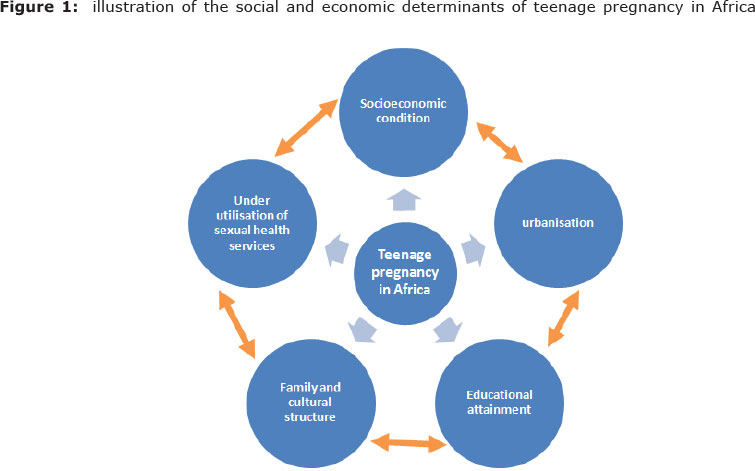
<body><![CDATA[<p><font face="Verdana, Arial, Helvetica, sans-serif" size="2">Asides the medical    consequences, there are several economic and social consequences associated    with high teenage pregnancy rate<sup>4,5</sup>. This is because teenage pregnancy    causes an upsurge in a nation's population which places a burden on other sectors    of the economy, hence, impeding the economic and social progress of such nations<sup>6</sup>;    furthermore, this can lead to extreme poverty especially in lower income countries<sup>7</sup>.</font></p>     <p><font face="Verdana, Arial, Helvetica, sans-serif" size="2">The rate of teenage    pregnancy varies between developed and developing countries. According to World    Health Organisation (WHO) report <sup>8</sup>, the global teenage pregnancy    rate was projected to be 54 births per 1000 women for 2000-2005 periods. Furthermore,    WHO report<sup>9</sup> states that the average teenage birth rate amongst developed    countries was 29 births per 1000 with European countries having the lowest rate;    whereas, in developing countries teenage pregnancy rate was as high as 133 births    per 1000 females.</font></p>     <p><font face="Verdana, Arial, Helvetica, sans-serif" size="2">The World Health    Statistics review<sup>10</sup> indicates that the average teenage pregnancy    rate across Africa is about 118 per 1000 females and this figure is very high    when compared to the rate in other continents. Some researchers have stated    that the high teenage pregnancy rate in Africa can be attributed to Africa being    amongst the poorest continents of the world with most countries underdeveloped<sup>11</sup>.</font></p>     <p><font face="Verdana, Arial, Helvetica, sans-serif" size="2">Dev Raj et al.<sup>14</sup>    in a systematic review on factors associated with teenage pregnancy in South    Asia identified that in developing countries, social and economic determinants    associated with high teenage pregnancy rate are: socioeconomic condition; low    educational attainment; as well as cultural and family structure.</font></p>     <p><font face="Verdana, Arial, Helvetica, sans-serif" size="2">This opinion is    further supported by The World Bank synopsis<sup>15</sup> on the determinants    of increased fertility in low income countries. The Synopsis<sup>15</sup> reported    that poor access to sexual health services and urbanisation were also determinants    of teenage pregnancy amongst developing countries.</font></p>     <p><font face="Verdana, Arial, Helvetica, sans-serif" size="2"><a href="/img/revistas/rbcdh/v24n2/03f01.jpg">Figure    1</a> illustrates the social and economic determinants that influences teenage    pregnancy rate in Africa. The relationship between the social and economic factors    with teenage pregnancy rate is such that each of the underlying social and economic    factors could either increase or decrease teenage pregnancy rate and at the    same time this factors influences one another.</font></p>     <p><font face="Verdana, Arial, Helvetica, sans-serif" size="2">Due to the numerous    impacts of the high teenage pregnancy rate in Africa, there is a need to put    in place a policy that addresses the issue of teenage pregnancies in Africa.    Recent studies carried out in some African countries have identified factors    such as low educational attainment in Kenya<sup>12</sup> and poor use of contraceptive    in Morocco<sup>13</sup> and therefore suggested policies around such factors.</font></p>     <p><font face="Verdana, Arial, Helvetica, sans-serif" size="2">There is however    still a need to investigate other factors associated with high teenage pregnancy    rate in Africa. Therefore, this research paper aims to examine social and economic    factors unique to African nations in an attempt to understand the high prevalence    in Africa; thereby suggesting a policy pathway which can be used in informing    policy makers on the determinants of teenage pregnancy in order to plan targeted    interventions.</font></p>     <p>&nbsp;</p>     <p><font face="Verdana, Arial, Helvetica, sans-serif" size="3"><b>METHODS</b></font></p>     ]]></body>
<body><![CDATA[<p><font face="Verdana, Arial, Helvetica, sans-serif" size="2"><b>Data and methods</b></font></p>     <p><font face="Verdana, Arial, Helvetica, sans-serif" size="2">This study used    data from the World Bank Organisation conducted between 2008 and 2010 in Africa<sup>16</sup>.    Data from 51 African countries were included in this study. Countries were selected    for inclusion based on availability of comparable data sets on teenage pregnancy    rate.</font></p>     <p><font face="Verdana, Arial, Helvetica, sans-serif" size="2"><b>Ethical considerations</b></font></p>     <p><font face="Verdana, Arial, Helvetica, sans-serif" size="2">This study is based    on an analysis of existing survey data and does not involve any form of contact    with human or animal subjects. Data sets utilised in this study have been obtained    from the World Bank Organisation freely within the public domain. In addition,    these data sets do not contain any information that can breech confidentiality    of the participants. Therefore, there are no ethical issues to be considered    for this study as it poses no harm to the participants.</font></p>     <p><font face="Verdana, Arial, Helvetica, sans-serif" size="2"><b>Variables</b></font></p>     <p><font face="Verdana, Arial, Helvetica, sans-serif" size="2">The main dependent    variable is the teenage pregnancy rates in the countries which represent the    number of births per 1000 women aged 15-19. The independent variables aim to    determine the individual characteristics of the countries and generate correlations.    These independent variables are:</font></p> <ul>       <li><font face="Verdana, Arial, Helvetica, sans-serif" size="2"><b>GINI index:</b>      it is a measure of a countries level of income inequality and expresses. This      ranges from 0-100, with zero and 100 signifying perfect equality and inequality      respectively. It is assumed based on Daw Namoro<sup>17, 18</sup> study that      the higher a country's income, the higher the teenage pregnancy rate.</font></li>       <li><font face="Verdana, Arial, Helvetica, sans-serif" size="2"><b>GDP per capita</b>:      This indicates the general standard of living in a country which can be determined      by the level of income of individuals living in a country. This rate is usually      expressed in US Dollars ($). In line with previous study by The World Bank      Synopsis<sup>15</sup> it is expected that the higher the standard of living      (the higher the level of income) the lower the teenage pregnancy rate.</font></li>       <li><font face="Verdana, Arial, Helvetica, sans-serif" size="2"><b>Female Literacy      rate:</b> This is the number of females' ages 15 to 24 years who can both      read and write and understand short simple statements. Following recent research<sup>14,15,      19</sup>. It is expected that the more adolescent females are educated, the      less likely they would be involved in unsafe or underage sexual activity.</font></li>       <li><font face="Verdana, Arial, Helvetica, sans-serif" size="2"><b>Urban population      rate</b>: It refers to the number of people living in urban areas in a country.      in line with previous studies<sup>9, 12, 13, 15</sup> it is presumed that      the more females living in urban areas the lower the teenage pregnancy rate,      as they would engage in more profitable activities in urban regions.</font></li>       ]]></body>
<body><![CDATA[<li><font face="Verdana, Arial, Helvetica, sans-serif" size="2"><b>Contraceptive      prevalence</b>: This is the proportion of women aged 15-49, who are practicing,      or whose sexual partners are practicing, any form of contraception. in line      with previous research<sup>9, 14, 19, 20, 21, 22, 23, 24</sup> it is expected      that the higher the numbers of women practicing any form of contraception,      the lower the teenage pregnancy rate.</font></li>       <li><font face="Verdana, Arial, Helvetica, sans-serif" size="2"><b>Health care      expenditure:</b> It is the sum of public and private health expenditure, and      It covers the provision of both preventive and curative, as well as family      planning activities, nutrition activities, and emergency aid. it is expected      that in line with studies by Dev Raj et al.<sup>14</sup> 2010 and Isaranurug      et al<sup>25</sup> the more a Government spends on health care the lower the      teenage pregnancy rate.</font></li>       <li><font face="Verdana, Arial, Helvetica, sans-serif" size="2"><b>Gender equality</b>:      This measures the extent to which a country has installed institutions and      programmes to enforce laws and policies that promote equal access for men      and women to education, healthcare services, the economy, and protection under      law. It ranges from 1-6 with 1 signifying low and 6 high. It is expected based      on the study by Were<sup>12</sup> that the higher the gender equality of a      country the lower the teenage pregnancy rate.</font></li>     </ul>     <p>&nbsp;</p>     <p><font face="Verdana, Arial, Helvetica, sans-serif" size="3"><b>DATA ANALYSIS</b></font></p>     <p><font face="Verdana, Arial, Helvetica, sans-serif" size="2">Data Analysis in    this study was carried out in various steps. First descriptive analysis was    carried out to derive the median of all variables. Thereafter, all variables    were recoded and categorised into 2 groups using the median, with values below    the median classified as Group 1 and values above the median classified as Group    2 and an Independent t-test was carried out.</font></p>     <p><font face="Verdana, Arial, Helvetica, sans-serif" size="2">Next, Spearman's    correlation analysis was used to derive if there is any association between    the dependent variable and each of the independent variable. IBM SPSS Statistics    19 was the statistical package used in conducted the analysis for this study.    Thereafter, logistic regression was carried out to identify the predictors of    teenage pregnancy in Africa.</font></p>     <p>&nbsp;</p>     <p><font face="Verdana, Arial, Helvetica, sans-serif" size="3"><b>RESULTS</b></font></p>     ]]></body>
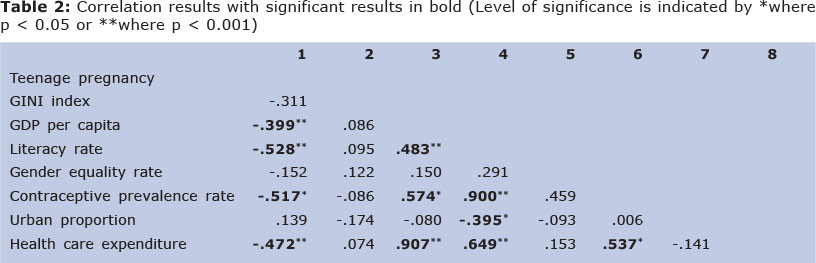
<body><![CDATA[<p><font face="Verdana, Arial, Helvetica, sans-serif" size="2">Using a median    of teenage pregnancy to create two groups, independent t tests were conducted.    Results can be seen in <a href="/img/revistas/rbcdh/v24n2/03t01.jpg">table 1</a>    below which shows the mean for each variable above and below the median teen    age conception rate along with the value of t and probability.</font></p>     <p><font face="Verdana, Arial, Helvetica, sans-serif" size="2">Spearman correlation    was conducted to explore the relationship between variables, results for can    be seen in <a href="/img/revistas/rbcdh/v24n2/03t02.jpg">Table 2</a> below.    Significant correlations can be seen in bold. Level of significance is indicated    by * where p&lt; 0.05 or ** where p &lt;0.001.</font></p>     <p><font face="Verdana, Arial, Helvetica, sans-serif" size="2">Significant strong    negative correlation emerged with literacy and contraceptive prevalence rate    and a significant moderate negative correlation with GDP per capita and healthcare    expenditure indicating that In African countries where literacy rate, contraceptive    prevalence, GDP per capita and health care expenditure are higher, teenage pregnancy    rate is lower.</font></p>     <p><font face="Verdana, Arial, Helvetica, sans-serif" size="2">There was a significant    strong positive correlation between GDP per capita with health care expenditure    and contraceptive prevalence and a significant moderate positive correlation    between GDP per capita and literacy rate, denoting that in African countries    with high GDP per capita, literacy rate, contraceptive prevalence and health    care expenditure will equally be high.</font></p>     <p><font face="Verdana, Arial, Helvetica, sans-serif" size="2">A significant moderate    negative correlation was noted between literacy rate and urban population rate,    implying that in African countries where a greater proportion of the population    are urban dwellers, literacy rate is lower. Also a strong positive relationship    emerged between contra-ceptive prevalence and health care expenditure suggesting    that in countries with high contra-ceptive prevalence, health care expenditure    would also be high.</font></p>     <p><font face="Verdana, Arial, Helvetica, sans-serif" size="2">Furthermore, a    significant strong relation-ship was observed between literacy rate with contraceptive    prevalence rate and healthcare expenditure, illustrating that in African countries    where literacy rate is high, contraceptive prevalence rate and healthcare expenditure    is also high.</font></p>     <p><font face="Verdana, Arial, Helvetica, sans-serif" size="2">To explore key    predictors of teenage pregnancy rate, a logistic regression model with teenage    pregnancy rate as the predicted (dependent) variable and GDP per capita, Health    Care Expenditure and Literacy was significant (<i>f</i> 4.64, p =.000) accounting    for 32% (r<sup>2</sup> = .317) of variance in teenage pregnancy rate in Africa.    Increasing literacy by 1 unit is predicted to reduce teenage pregnancy by 94    per 1000 (<i>b</i> = -.935, p = 0.037). An increase by 1 unit of expenditure    on health care is predicted to reduce teenage pregnancy rate by 37 per 1000    (<i>b</i> = -.369, p = 0.05). Interestingly a unit increase in GDP is predicted    to increase teenage pregnancy rate by 1.7 per 1000 (<i>b</i> = 0.17, p = .042).</font></p>     <p><font face="Verdana, Arial, Helvetica, sans-serif" size="2">As literacy emerged    the key predictor of teenage conception, we explored predictors of literacy    rate. A further logistic regression model with literacy rate as the predicted    (dependent) variable and GDP per capita, urban population, contraceptive prevalence    and health care expenditure as the predictor (independent) variables accounted    for 80% of variance in literacy rate (<i>r</i><sup>2</sup> = .799). Within this    model the significant predictor was contraceptive prevalence indicating that    a unit increase in contraceptive prevalence predicts an increase in literacy    rate of .97 (b = .967).</font></p>     <p>&nbsp;</p>     <p><font face="Verdana, Arial, Helvetica, sans-serif" size="3"><b>DISCUSSION</b></font></p>     ]]></body>
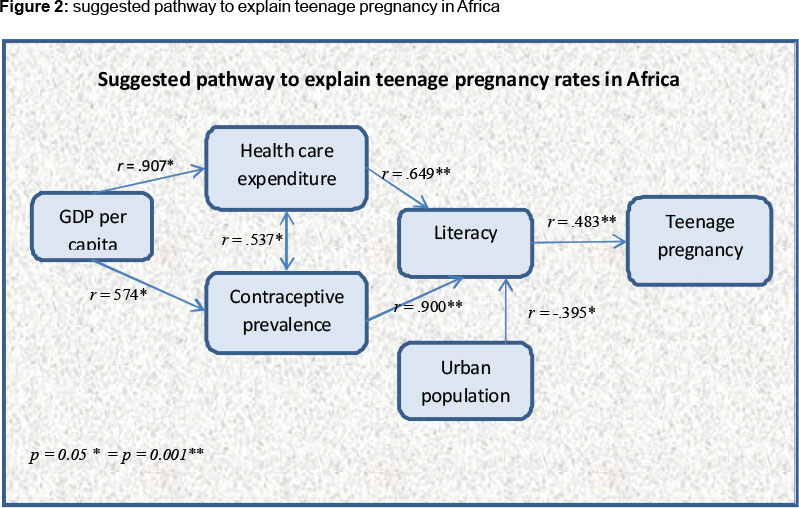
<body><![CDATA[<p><font face="Verdana, Arial, Helvetica, sans-serif" size="2">The purpose of    this research is to suggest a policy pathway that can reduce teenage pregnancy    rate in Africa. Findings from this study have shown that health care expenditure,    female literacy rate and GDP per capita are predictors of teenage pregnancy    with literacy rate being the key predictor. Thus, indicating that the determinants    of teenage pregnancy in Africa are multifaceted.</font></p>     <p><font face="Verdana, Arial, Helvetica, sans-serif" size="2">The evidence that    literacy rate is a major determinant of teenage pregnancy rate is in accordance    with previous studies. A study carried out by Were<sup>12</sup> indicates that    less than 50% of the teenage mothers who took part in the study had completed    primary education, and nearly 62% dropped out when they became pregnant. The    Health Development Agency<sup>26</sup> also expressed a similar opinion stating    that a considerable amount of teenage mothers are more likely to drop out of    school while pregnant.</font></p>     <p><font face="Verdana, Arial, Helvetica, sans-serif" size="2">Furthermore, Lemos<sup>27</sup>    study stated that literacy rate is a key predictor of an individual's socioeconomic    status which is also one of the determinants of teenage pregnancy. The author    further reveals that within poor socioeconomic groups with low educational attainment    teenage pregnancy was twice that observed in similar poor socioeconomic communities    with better educational attainment.</font></p>     <p><font face="Verdana, Arial, Helvetica, sans-serif" size="2">This explains why    Were<sup>12</sup> and Sharma et al<sup>28</sup> stated that literacy rate is    both a cause and a consequence of high teenage pregnancy rate in developing    countries. This is because individuals with low literacy level have a higher    chance of: living in poverty; being in low paid jobs; or unemployed as rightly    pointed out by Hobcraft et al<sup>29</sup>. Thus, teenage parents may end up    becoming deprived families, and the vicious cycle continues<sup>30</sup>.</font></p>     <p><font face="Verdana, Arial, Helvetica, sans-serif" size="2">This study also    demonstrates that as healthcare expenditure and contraceptive prevalence increases,    teenage pregnancy decreases. This is line with previous assumptions made. According    to WHO report<sup>19</sup> there was an 8% increase in the use of contraception    globally between 1990 and 2007; however, the proportion of increment recorded    in Africa appears to be the lowest.</font></p>     <p><font face="Verdana, Arial, Helvetica, sans-serif" size="2">An explanation    given by WHO report<sup>24</sup> and Gogna et al<sup>21</sup> for this decrease    in the use of contraception and healthcare facilities is that in several developing    countries public health measures such as: sex and relationship education; sexual    development; methods of preventing pregnancies; and sexually transmitted diseases    are either inadequate or absolutely lacking.</font></p>     <p><font face="Verdana, Arial, Helvetica, sans-serif" size="2">Furthermore, this    study demonstrates that in countries where GDP per capita is higher, female    literacy rate, contraceptive prevalence and health care expenditure is also    higher. This finding is in accordance with previous research<sup>19, 21, 24</sup>    which clearly indicate that in countries with high GDP per capita more females    would be able to engage in skilled labour and have a good standard of living.</font></p>     <p><font face="Verdana, Arial, Helvetica, sans-serif" size="2">Besides, such countries    with high GDP per capita would have more healthcare facilities which would be    easily accessible and even preventative measures such as: use of contraceptives,    advice and counselling; as well as sex and relationship education can be taught    in such healthcare facilities; Thus, further reducing the teenage pregnancy    rate in such countries.</font></p>     <p><font face="Verdana, Arial, Helvetica, sans-serif" size="2">However, the researchers    also recognises that in countries with high GDP per capita, female literacy    rate, contraceptive prevalence and health care expenditure could remain low    due to issues such as female discrimination and oppression. This is why WHO<sup>31</sup>    has stated that in such countries, health promotion activities that utilises    education, negotiating and training can be used in addressing this issues. Other    interventions suggested are: imposing laws and setting up reproductive rights    tribunals.</font></p>     <p><font face="Verdana, Arial, Helvetica, sans-serif" size="2">This research also    revealed that in countries where literacy rate is high, urban population is    reduced. This finding is in line with previous studies by Abdesslam<sup>13</sup>    and Were<sup>12</sup> which clearly states that many young females in Africa    move from rural regions to urban regions in search for higher educational attainment,    paid employment and better health care facilities. Hence, teenage pregnancy    would be reduced in such countries.</font></p>     ]]></body>
<body><![CDATA[<p><font face="Verdana, Arial, Helvetica, sans-serif" size="2">Nevertheless, the    researchers recognises that the assumption that an increase in urban population    results in a reduction in teenage pregnancy rate is contrary to the study by    Imamura et al<sup>22</sup> which stated that teenage pregnancy is now higher    in urban regions of developing countries. This could possibly be due to high    deprivation faced by urban region migrants. This sometimes bring about such    migrants abandoning their aspirations of higher education or better employment    and subsequently engaging in unsafe sexual practices to survive the harsh conditions    in the urban regions.</font></p>     <p><font face="Verdana, Arial, Helvetica, sans-serif" size="2">A possible explanation    for the non-significant result of GINI index and Gender equality is the format    in which the available data were presented; as both data sets were in index    format. Although the results of GINI index result was not in accordance with    the expected direction. Likewise, urban population showed a non-significant    result but in the expected direction. A possible explanation is that the figures    for urban population rate not specific for females but the entire population    in a country.</font></p>     <p><font face="Verdana, Arial, Helvetica, sans-serif" size="2">These results from    the study has enabled the researchers to develop a conceptual model shown in    <a href="/img/revistas/rbcdh/v24n2/03f02.jpg">figure 2</a> below that shows    a suggested policy pathway that can be used to reduce teenage pregnancy in Africa.</font></p>     <p><font face="Verdana, Arial, Helvetica, sans-serif" size="2">Within the framework    we suggest that increases in GDP per capita will enable the government put in    place policies and strategies that facilitate increase in health care expenditure    and contraceptive prevalence. The bidirectional arrow between health care expenditure    and contraceptive prevalence is indicative of the inter relatedness of these    variables, with one affecting the other.</font></p>     <p><font face="Verdana, Arial, Helvetica, sans-serif" size="2">The position of    literacy rate within the policy pathway is drawn from the regression results    that indicate healthcare expenditure and contraceptive prevalence are key predictors    of literacy rate. Hence, policy that influences these two variables would impact    upon literacy rate. Besides, policies should also pay attention to increasing    literacy rate amongst urban dwellers.</font></p>     <p><font face="Verdana, Arial, Helvetica, sans-serif" size="2">The findings of    this research can be considered in the light of the following limitations: first,    due to the non-availability of recent data sets of some other important social    and economic determinants such as, age at marriage of females, female occupational    status and female income, such social and economic determinants could not be    measured. Second, the format of the available data could underestimate the influence    of the determinants of teenage pregnancy had it been that all the data sets    used the same indicators.</font></p>     <p><font face="Verdana, Arial, Helvetica, sans-serif" size="2">Despite these limitations,    this research study has some significant strength. First of all, it is a large    population-based study with national coverage of all countries in Africa and    the findings from this study are representative of the continent. In addition,    this study is unique in that it adds wealth of knowledge on the determinants    of teenage pregnancy in Africa by exploring the impacts of several social and    economic factors.</font></p>     <p><font face="Verdana, Arial, Helvetica, sans-serif" size="2">Besides, the data    sets used were from the World Bank Organisation which have some important advantages    when compared with other surveys, in that not only are they nationally representative    but also contain data sets of some important variables that made it possible    to carry out the necessary analysis.</font></p>     <p><font face="Verdana, Arial, Helvetica, sans-serif" size="2">Although, thorough    research has been conducted to investigate the impact of several social and    economic factors on teenage pregnancy; however, there are other related areas    that could benefit this work in tackling teenage pregnancy in Africa. For instance,    future research could focus on the barriers to implementing educational services    as well as sex and reproductive education in secondary schools.</font></p>     <p><font face="Verdana, Arial, Helvetica, sans-serif" size="2">In addition, further    research on some variables such as: urban population rate specific for females,    age at marriage of females, female occupational status and female income can    help in identifying other social and economic determinants essential in reducing    the teenage pregnancy rate in Africa.</font></p>     ]]></body>
<body><![CDATA[<p><font face="Verdana, Arial, Helvetica, sans-serif" size="2">Furthermore, future    research can also be conducted to compare the teenage pregnancy rate and other    socioeconomic factors in countries where policies on compulsory education for    teenage females and reproductive rights have been implemented to ascertain the    effectiveness of such policies.</font></p>     <p>&nbsp;</p>     <p><font face="Verdana, Arial, Helvetica, sans-serif" size="3"><b>CONCLUSION</b></font></p>     <p><font face="Verdana, Arial, Helvetica, sans-serif" size="2">This study indicated    that determinants of teenage pregnancy in Africa are multifaceted with social    and economic determinants such as: GDP per capita, literacy rate, contraceptive    prevalence rate and healthcare expenditure rate emerging as great influencers    of teenage pregnancy in Africa.</font></p>     <p><font face="Verdana, Arial, Helvetica, sans-serif" size="2">However, in other    to prioritise due to the limited available resources, particularly in Africa    where a number of the countries are developing countries, a policy pathway based    on the best predictor of teenage pregnancy in Africa has been suggested by the    authors.</font></p>     <p><font face="Verdana, Arial, Helvetica, sans-serif" size="2">A policy pathway    to reduce teenage pregnancy rate in Africa is one that puts in place policies    and strategies to increase female literacy rate. This will increase both the    use of contraception amongst female and the healthcare expenditure. The overall    effect would be an increased GDP per capita of the nation.</font></p>     <p><font face="Verdana, Arial, Helvetica, sans-serif" size="2">Besides an increase    in literacy rate would also reduce rural-urban migration as more educated females    within the rural region would utilise the skills and knowledge gained while    in education to develop their communities. Furthermore, policies that increase    female literacy rate in Africa would help ensure that: schools are located in    the right site; trained individuals are available; free and affordable education    are given to citizenry; as well as ensuring individuals are literate enough    to understand the sex and relationship education given.</font></p>     <p><font face="Verdana, Arial, Helvetica, sans-serif" size="2">Likewise, an increase    in female literacy rate would help disabuse myths and misconception. Thus, allowing    the ease of public health measures that increases access to healthcare facilities    and the use of contraception.</font></p>     <p>&nbsp;</p>     <p><font face="Verdana, Arial, Helvetica, sans-serif" size="3"><b>REFERENCES</b></font></p>     ]]></body>
<body><![CDATA[<!-- ref --><p><font face="Verdana, Arial, Helvetica, sans-serif" size="2">1. Dangal, G. (2005)    An update on teenage pregnancy. <i>The Internet Journal of Gynaecology and Obstetrics</i>    [online]<i>.</i> 5(1) [Accessed 6 December 2011]. Available at: : &lt; <a href="http://ispub.com" target="_blank">http://.ispub.com</a>&gt;    &nbsp;&nbsp;&nbsp;&nbsp;&nbsp;&nbsp;&nbsp;&nbsp;[&#160;<a href="javascript:void(0);" onclick="javascript: window.open('/scielo.php?script=sci_nlinks&ref=2505010&pid=S0104-1282201400020000300001&lng=','','width=640,height=500,resizable=yes,scrollbars=1,menubar=yes,');">Links</a>&#160;]<!-- end-ref --></font></p>     <!-- ref --><p><font face="Verdana, Arial, Helvetica, sans-serif" size="2">2. Gallaghers,    M. (1999) <i>The age of unwed mothers. Is teen pregnancy the problem?</i> New    York: Institute for American Values.    &nbsp;&nbsp;&nbsp;&nbsp;&nbsp;&nbsp;&nbsp;&nbsp;[&#160;<a href="javascript:void(0);" onclick="javascript: window.open('/scielo.php?script=sci_nlinks&ref=2505012&pid=S0104-1282201400020000300002&lng=','','width=640,height=500,resizable=yes,scrollbars=1,menubar=yes,');">Links</a>&#160;]<!-- end-ref --></font></p>     <!-- ref --><p><font face="Verdana, Arial, Helvetica, sans-serif" size="2">3. World Health    Organisation (2006) <i>Pregnant Adolescent: delivering on global promises of    hope</i>. Geneva: World Health Organisation.    &nbsp;&nbsp;&nbsp;&nbsp;&nbsp;&nbsp;&nbsp;&nbsp;[&#160;<a href="javascript:void(0);" onclick="javascript: window.open('/scielo.php?script=sci_nlinks&ref=2505014&pid=S0104-1282201400020000300003&lng=','','width=640,height=500,resizable=yes,scrollbars=1,menubar=yes,');">Links</a>&#160;]<!-- end-ref --></font></p>     <!-- ref --><p><font face="Verdana, Arial, Helvetica, sans-serif" size="2">4. Buvinic, M.,    and Kurz, K. (1998) <i>Prospects for young mothers and their children: a review    of the evidence on consequences of adolescent childbearing in developing countries</i>.    Paper presented at The Committee on Population, National Research Council, National    Academy of Sciences Workshop on Adolescent Reproduction in Developing Countries,    March, 24 - 25: Washington.    &nbsp;&nbsp;&nbsp;&nbsp;&nbsp;&nbsp;&nbsp;&nbsp;[&#160;<a href="javascript:void(0);" onclick="javascript: window.open('/scielo.php?script=sci_nlinks&ref=2505016&pid=S0104-1282201400020000300004&lng=','','width=640,height=500,resizable=yes,scrollbars=1,menubar=yes,');">Links</a>&#160;]<!-- end-ref --></font></p>     <!-- ref --><p><font face="Verdana, Arial, Helvetica, sans-serif" size="2">5. World Health    Organization (1996) <i>Adolescent health</i> - <i>Inter country Consultation    on the promotion of health of adolescent girls through maternal and child health    programmes.</i> Nicosia, Cyprus: World Health Organisation.    &nbsp;&nbsp;&nbsp;&nbsp;&nbsp;&nbsp;&nbsp;&nbsp;[&#160;<a href="javascript:void(0);" onclick="javascript: window.open('/scielo.php?script=sci_nlinks&ref=2505018&pid=S0104-1282201400020000300005&lng=','','width=640,height=500,resizable=yes,scrollbars=1,menubar=yes,');">Links</a>&#160;]<!-- end-ref --></font></p>     ]]></body>
<body><![CDATA[<!-- ref --><p><font face="Verdana, Arial, Helvetica, sans-serif" size="2">6. Aoyama, A. (2001)    <i>Reproductive health in the Middle East and North Africa: well-being for all</i>    [online]. World Bank. [Accessed 18 November 2011]. Available at: <a href="http://site.ebrary.com/lib/wolverhampton/" target="_blank">http://site.ebrary.com/lib/wolverhampton/</a>&gt;    &nbsp;&nbsp;&nbsp;&nbsp;&nbsp;&nbsp;&nbsp;&nbsp;[&#160;<a href="javascript:void(0);" onclick="javascript: window.open('/scielo.php?script=sci_nlinks&ref=2505020&pid=S0104-1282201400020000300006&lng=','','width=640,height=500,resizable=yes,scrollbars=1,menubar=yes,');">Links</a>&#160;]<!-- end-ref --></font></p>     <!-- ref --><p><font face="Verdana, Arial, Helvetica, sans-serif" size="2">7. Agbemenu, K.    (2011) An integrated review of comprehensive sex education for adolescent girls    in Kenya<i>. Journal of nursing scholarship</i>. 43 (1). pp 54-63.    &nbsp;&nbsp;&nbsp;&nbsp;&nbsp;&nbsp;&nbsp;&nbsp;[&#160;<a href="javascript:void(0);" onclick="javascript: window.open('/scielo.php?script=sci_nlinks&ref=2505022&pid=S0104-1282201400020000300007&lng=','','width=640,height=500,resizable=yes,scrollbars=1,menubar=yes,');">Links</a>&#160;]<!-- end-ref --></font></p>     <!-- ref --><p><font face="Verdana, Arial, Helvetica, sans-serif" size="2">8. World Health    Organization (2002) <i>Essential care: practice guide for pregnancy, childbirth    and new born care.</i> Geneva: World Health Organization.    &nbsp;&nbsp;&nbsp;&nbsp;&nbsp;&nbsp;&nbsp;&nbsp;[&#160;<a href="javascript:void(0);" onclick="javascript: window.open('/scielo.php?script=sci_nlinks&ref=2505024&pid=S0104-1282201400020000300008&lng=','','width=640,height=500,resizable=yes,scrollbars=1,menubar=yes,');">Links</a>&#160;]<!-- end-ref --></font></p>     <!-- ref --><p><font face="Verdana, Arial, Helvetica, sans-serif" size="2">9. World Health    Organisation (2007) <i>Adolescent pregnancy - Unmet needs and undone deeds.    A review of the literature and programmes. Issues in Adolescent Health and Development</i>.    Geneva: World Health Organisation</font>&nbsp;&nbsp;&nbsp;&nbsp;&nbsp;&nbsp;&nbsp;&nbsp;[&#160;<a href="javascript:void(0);" onclick="javascript: window.open('/scielo.php?script=sci_nlinks&ref=2505026&pid=S0104-1282201400020000300009&lng=','','width=640,height=500,resizable=yes,scrollbars=1,menubar=yes,');">Links</a>&#160;]<!-- end-ref --><!-- ref --><p><font face="Verdana, Arial, Helvetica, sans-serif" size="2">10. World Health    Statistics (2011) <i>World Health Statistics report, 2011</i>. France: World    Health Organization. 2011.    &nbsp;&nbsp;&nbsp;&nbsp;&nbsp;&nbsp;&nbsp;&nbsp;[&#160;<a href="javascript:void(0);" onclick="javascript: window.open('/scielo.php?script=sci_nlinks&ref=2505027&pid=S0104-1282201400020000300010&lng=','','width=640,height=500,resizable=yes,scrollbars=1,menubar=yes,');">Links</a>&#160;]<!-- end-ref --></font></p>     <!-- ref --><p><font face="Verdana, Arial, Helvetica, sans-serif" size="2">11. United Nation    Development Programme (2003) <i>Millennium development goals: A compact among    nations3333 to end human poverty.</i> New York: United National Development    Programme</font>&nbsp;&nbsp;&nbsp;&nbsp;&nbsp;&nbsp;&nbsp;&nbsp;[&#160;<a href="javascript:void(0);" onclick="javascript: window.open('/scielo.php?script=sci_nlinks&ref=2505029&pid=S0104-1282201400020000300011&lng=','','width=640,height=500,resizable=yes,scrollbars=1,menubar=yes,');">Links</a>&#160;]<!-- end-ref --><!-- ref --><p><font face="Verdana, Arial, Helvetica, sans-serif" size="2">12. Were, M. (2007)    Determinants of teenage pregnancy: The case of Busia district in Kenya. <i>Economics    and human biology</i> 5 pp. 322- 339</font>&nbsp;&nbsp;&nbsp;&nbsp;&nbsp;&nbsp;&nbsp;&nbsp;[&#160;<a href="javascript:void(0);" onclick="javascript: window.open('/scielo.php?script=sci_nlinks&ref=2505030&pid=S0104-1282201400020000300012&lng=','','width=640,height=500,resizable=yes,scrollbars=1,menubar=yes,');">Links</a>&#160;]<!-- end-ref --><!-- ref --><p><font face="Verdana, Arial, Helvetica, sans-serif" size="2">13. Abdsselam,    B. (2011) Social Determinants of Reproductive Health in Morocco. <i>African    Journal of Reproductive Health</i>. 15(<i>2) pp.55-66.    &nbsp;&nbsp;&nbsp;&nbsp;&nbsp;&nbsp;&nbsp;&nbsp;[&#160;<a href="javascript:void(0);" onclick="javascript: window.open('/scielo.php?script=sci_nlinks&ref=2505031&pid=S0104-1282201400020000300013&lng=','','width=640,height=500,resizable=yes,scrollbars=1,menubar=yes,');">Links</a>&#160;]<!-- end-ref --></i></font></p>     <!-- ref --><p><font face="Verdana, Arial, Helvetica, sans-serif" size="2">14. Dev-Raj, A.,    Rabi, B., Amudha<sup>,</sup> P., Edwin, V., and Glyn, C. (2010) Factors associated    with teenage pregnancy in South Asia: a systematic review. <i>Health Science    Journal</i>. 4(1), pp3-14.    &nbsp;&nbsp;&nbsp;&nbsp;&nbsp;&nbsp;&nbsp;&nbsp;[&#160;<a href="javascript:void(0);" onclick="javascript: window.open('/scielo.php?script=sci_nlinks&ref=2505033&pid=S0104-1282201400020000300014&lng=','','width=640,height=500,resizable=yes,scrollbars=1,menubar=yes,');">Links</a>&#160;]<!-- end-ref --></font></p>     <!-- ref --><p><font face="Verdana, Arial, Helvetica, sans-serif" size="2">15. World Bank    (2010) <i>Determinants and Consequences of High Fertility: A Synopsis of the    Evidence</i>. Washington: World Bank Organisation.    &nbsp;&nbsp;&nbsp;&nbsp;&nbsp;&nbsp;&nbsp;&nbsp;[&#160;<a href="javascript:void(0);" onclick="javascript: window.open('/scielo.php?script=sci_nlinks&ref=2505035&pid=S0104-1282201400020000300015&lng=','','width=640,height=500,resizable=yes,scrollbars=1,menubar=yes,');">Links</a>&#160;]<!-- end-ref --></font></p>     <!-- ref --><p><font face="Verdana, Arial, Helvetica, sans-serif" size="2">16. World Bank    Group (2012) The World Bank open data [online]. World Bank: New York. [Accessed    20 May 2012]. Available at: &lt;<a href="http://data.worldbank.org/indicator" target="_blank">http://data.worldbank.org/indicator</a>&gt;    &nbsp;&nbsp;&nbsp;&nbsp;&nbsp;&nbsp;&nbsp;&nbsp;[&#160;<a href="javascript:void(0);" onclick="javascript: window.open('/scielo.php?script=sci_nlinks&ref=2505037&pid=S0104-1282201400020000300016&lng=','','width=640,height=500,resizable=yes,scrollbars=1,menubar=yes,');">Links</a>&#160;]<!-- end-ref -->.</font></p>     <!-- ref --><p><font face="Verdana, Arial, Helvetica, sans-serif" size="2">17. Daw-Namoro,    S. (2009a) The Not-So-Visible Determinants of Youth Reproductive Health in Sub-Saharan    Africa. <i>University of Pittsburgh</i>. pp1-20.    &nbsp;&nbsp;&nbsp;&nbsp;&nbsp;&nbsp;&nbsp;&nbsp;[&#160;<a href="javascript:void(0);" onclick="javascript: window.open('/scielo.php?script=sci_nlinks&ref=2505039&pid=S0104-1282201400020000300017&lng=','','width=640,height=500,resizable=yes,scrollbars=1,menubar=yes,');">Links</a>&#160;]<!-- end-ref --></font></p>     <!-- ref --><p><font face="Verdana, Arial, Helvetica, sans-serif" size="2">18. Daw-Namoro,    S. (2009b) Youth Reproductive Health in Sub-Saharan Africa. Is Governance Part    of the Problem? <i>University of Pittsburgh</i>. pp1-20.    &nbsp;&nbsp;&nbsp;&nbsp;&nbsp;&nbsp;&nbsp;&nbsp;[&#160;<a href="javascript:void(0);" onclick="javascript: window.open('/scielo.php?script=sci_nlinks&ref=2505041&pid=S0104-1282201400020000300018&lng=','','width=640,height=500,resizable=yes,scrollbars=1,menubar=yes,');">Links</a>&#160;]<!-- end-ref --></font></p>     <!-- ref --><p><font face="Verdana, Arial, Helvetica, sans-serif" size="2">19. World Health    Organisation (2012) <i>Early Marriage Adolescent and Young pregnancies</i>.    <i>Report by the secretariat.</i> Geneva: World Health Organisation.    &nbsp;&nbsp;&nbsp;&nbsp;&nbsp;&nbsp;&nbsp;&nbsp;[&#160;<a href="javascript:void(0);" onclick="javascript: window.open('/scielo.php?script=sci_nlinks&ref=2505043&pid=S0104-1282201400020000300019&lng=','','width=640,height=500,resizable=yes,scrollbars=1,menubar=yes,');">Links</a>&#160;]<!-- end-ref --></font></p>     <!-- ref --><p><font face="Verdana, Arial, Helvetica, sans-serif" size="2">20. Ewles, L. (2005)    <i>Key topics in public health: essential briefings on prevention and health    promotion.</i> Edinburgh: Elsevier Churchill Livingstone.    &nbsp;&nbsp;&nbsp;&nbsp;&nbsp;&nbsp;&nbsp;&nbsp;[&#160;<a href="javascript:void(0);" onclick="javascript: window.open('/scielo.php?script=sci_nlinks&ref=2505045&pid=S0104-1282201400020000300020&lng=','','width=640,height=500,resizable=yes,scrollbars=1,menubar=yes,');">Links</a>&#160;]<!-- end-ref --></font></p>     <!-- ref --><p><font face="Verdana, Arial, Helvetica, sans-serif" size="2">21. Gogna, M.,    Binstock, G., Fernandez, S., Ibarluc&yacute;a. I., and Zamberlinc, N. (2008)    Adolescent Pregnancy in Argentina: Evidence-Based Recommendations for Public    Policies. <i>Reproductive Health.</i> 16(31), pp.192 - 201.    &nbsp;&nbsp;&nbsp;&nbsp;&nbsp;&nbsp;&nbsp;&nbsp;[&#160;<a href="javascript:void(0);" onclick="javascript: window.open('/scielo.php?script=sci_nlinks&ref=2505047&pid=S0104-1282201400020000300021&lng=','','width=640,height=500,resizable=yes,scrollbars=1,menubar=yes,');">Links</a>&#160;]<!-- end-ref --></font></p>     <!-- ref --><p><font face="Verdana, Arial, Helvetica, sans-serif" size="2">22. Imamura, M.,    Tucker, J., Hannaford, P., Oliveira da Silva, M., Astin, M., Wyness, L., Bloemenkamp,    K., Jahn, A., Karro, H., Olsen, J., and Temmerman, M. (2007) Factors associated    with teenage pregnancy in the European Union countries: a systematic review.    <i>European Journal of Public Health</i>, 17(6), pp.630 - 636.    &nbsp;&nbsp;&nbsp;&nbsp;&nbsp;&nbsp;&nbsp;&nbsp;[&#160;<a href="javascript:void(0);" onclick="javascript: window.open('/scielo.php?script=sci_nlinks&ref=2505049&pid=S0104-1282201400020000300022&lng=','','width=640,height=500,resizable=yes,scrollbars=1,menubar=yes,');">Links</a>&#160;]<!-- end-ref --></font></p>     <!-- ref --><p><font face="Verdana, Arial, Helvetica, sans-serif" size="2">23. Tripp, J.,    and Viner, R, (2005) ABC of adolescence Sexual health, contraception, and teenage    pregnancy<i>. British Medical Journal</i>. 330, pp.590-593.    &nbsp;&nbsp;&nbsp;&nbsp;&nbsp;&nbsp;&nbsp;&nbsp;[&#160;<a href="javascript:void(0);" onclick="javascript: window.open('/scielo.php?script=sci_nlinks&ref=2505051&pid=S0104-1282201400020000300023&lng=','','width=640,height=500,resizable=yes,scrollbars=1,menubar=yes,');">Links</a>&#160;]<!-- end-ref --></font></p>     <!-- ref --><p><font face="Verdana, Arial, Helvetica, sans-serif" size="2">24. World Health    Organisation (2004) <i>Adolescent Pregnancy: Issues in adolescent health and    development</i>. Geneva: World Health Organisation.    &nbsp;&nbsp;&nbsp;&nbsp;&nbsp;&nbsp;&nbsp;&nbsp;[&#160;<a href="javascript:void(0);" onclick="javascript: window.open('/scielo.php?script=sci_nlinks&ref=2505053&pid=S0104-1282201400020000300024&lng=','','width=640,height=500,resizable=yes,scrollbars=1,menubar=yes,');">Links</a>&#160;]<!-- end-ref --></font></p>     <!-- ref --><p><font face="Verdana, Arial, Helvetica, sans-serif" size="2">25. Isaranurug,    S., Mo-suwan, L., and Choprapawon, C.(2006) Differences in Socio-Economic Status,    Service Utilization, and Pregnancy Outcomes between Teenage and Adult Mothers.    <i>Journal of Medical Association Thailand</i>. 89 (2), pp.145-51.    &nbsp;&nbsp;&nbsp;&nbsp;&nbsp;&nbsp;&nbsp;&nbsp;[&#160;<a href="javascript:void(0);" onclick="javascript: window.open('/scielo.php?script=sci_nlinks&ref=2505055&pid=S0104-1282201400020000300025&lng=','','width=640,height=500,resizable=yes,scrollbars=1,menubar=yes,');">Links</a>&#160;]<!-- end-ref --></font></p>     <!-- ref --><p><font face="Verdana, Arial, Helvetica, sans-serif" size="2">26. Health Development    Agency (2003) <i>Teenage pregnancy and parenthood: a review of reviews. Evidence    briefing</i>. London: Health Development Agency.    &nbsp;&nbsp;&nbsp;&nbsp;&nbsp;&nbsp;&nbsp;&nbsp;[&#160;<a href="javascript:void(0);" onclick="javascript: window.open('/scielo.php?script=sci_nlinks&ref=2505057&pid=S0104-1282201400020000300026&lng=','','width=640,height=500,resizable=yes,scrollbars=1,menubar=yes,');">Links</a>&#160;]<!-- end-ref --></font></p>     <!-- ref --><p><font face="Verdana, Arial, Helvetica, sans-serif" size="2">27. Lemos, G. (2009)    <i>Freedom's consequences: Reducing teenage pregnancy and their negative effects    in the UK</i>. [online]. Report by the Monument trust, Lemos &amp; Crane. [Accessed    5 January 2012]. Available at: <a href="http://www.lemosandcrane.co.uk/home/resources/fq_dl865rte.pdf" target="_blank">http://www.lemosandcrane.co.uk/home/resources/fq_dl865rte.pdf</a></font>&nbsp;&nbsp;&nbsp;&nbsp;&nbsp;&nbsp;&nbsp;&nbsp;[&#160;<a href="javascript:void(0);" onclick="javascript: window.open('/scielo.php?script=sci_nlinks&ref=2505059&pid=S0104-1282201400020000300027&lng=','','width=640,height=500,resizable=yes,scrollbars=1,menubar=yes,');">Links</a>&#160;]<!-- end-ref --><!-- ref --><p><font face="Verdana, Arial, Helvetica, sans-serif" size="2">28. Sharma A.,    Verma K., Khatri S., Kannan A. (2002) Determinants of pregnancy in adolescents    in Nepal. <i>Indian Journal of Paediatrics</i>. 69: pp.19-22.    &nbsp;&nbsp;&nbsp;&nbsp;&nbsp;&nbsp;&nbsp;&nbsp;[&#160;<a href="javascript:void(0);" onclick="javascript: window.open('/scielo.php?script=sci_nlinks&ref=2505060&pid=S0104-1282201400020000300028&lng=','','width=640,height=500,resizable=yes,scrollbars=1,menubar=yes,');">Links</a>&#160;]<!-- end-ref --></font></p>     <!-- ref --><p><font face="Verdana, Arial, Helvetica, sans-serif" size="2">29. Hobcraft, J.    and Kiernan, k (1999) <i>Childhood poverty, early motherhood and adult social    exclusion. CASE paper 28</i>. London: London School of Economics.    &nbsp;&nbsp;&nbsp;&nbsp;&nbsp;&nbsp;&nbsp;&nbsp;[&#160;<a href="javascript:void(0);" onclick="javascript: window.open('/scielo.php?script=sci_nlinks&ref=2505062&pid=S0104-1282201400020000300029&lng=','','width=640,height=500,resizable=yes,scrollbars=1,menubar=yes,');">Links</a>&#160;]<!-- end-ref --></font></p>     <!-- ref --><p><font face="Verdana, Arial, Helvetica, sans-serif" size="2">30. G&ouml;k&ccedil;e,    B., Ozsqahin, A., and Zencir, M. (2007) Determinants of adolescent Pregnancy    in an urban area in Turkey: a population-based Case-control study. <i>Journal    of Biosocial Science</i>. 39, pp.301 - 311.    &nbsp;&nbsp;&nbsp;&nbsp;&nbsp;&nbsp;&nbsp;&nbsp;[&#160;<a href="javascript:void(0);" onclick="javascript: window.open('/scielo.php?script=sci_nlinks&ref=2505064&pid=S0104-1282201400020000300030&lng=','','width=640,height=500,resizable=yes,scrollbars=1,menubar=yes,');">Links</a>&#160;]<!-- end-ref --></font></p>     <!-- ref --><p><font face="Verdana, Arial, Helvetica, sans-serif" size="2">31. World Health    Organisation (2001) <i>Advancing Safe Motherhood through Human Rights</i>. Geneva:    World Health Organization.    &nbsp;&nbsp;&nbsp;&nbsp;&nbsp;&nbsp;&nbsp;&nbsp;[&#160;<a href="javascript:void(0);" onclick="javascript: window.open('/scielo.php?script=sci_nlinks&ref=2505066&pid=S0104-1282201400020000300031&lng=','','width=640,height=500,resizable=yes,scrollbars=1,menubar=yes,');">Links</a>&#160;]<!-- end-ref --></font></p>     <p>&nbsp;</p>     <p>&nbsp;</p>     ]]></body>
<body><![CDATA[<p><font face="Verdana, Arial, Helvetica, sans-serif" size="2">Manuscript submitted    Aug 01 2013    <br>   Accepted for publication Dec 28 2013</font></p>     <p>&nbsp;</p>     <p>&nbsp;</p>     <p><font face="Verdana, Arial, Helvetica, sans-serif" size="2"><b>Corresponding    author:</b> <a href="mailto:opeyemi.odejimi@gmail.com">opeyemi.odejimi@gmail.com</a></font></p>      ]]></body>
<back>
<ref-list>
<ref id="B1">
<label>1</label><nlm-citation citation-type="journal">
<person-group person-group-type="author">
<name>
<surname><![CDATA[Dangal]]></surname>
<given-names><![CDATA[G.]]></given-names>
</name>
</person-group>
<article-title xml:lang="en"><![CDATA[An update on teenage pregnancy]]></article-title>
<source><![CDATA[The Internet Journal of Gynaecology and Obstetrics]]></source>
<year></year>
<volume>5</volume>
<numero>1</numero>
<issue>1</issue>
</nlm-citation>
</ref>
<ref id="B2">
<label>2</label><nlm-citation citation-type="book">
<person-group person-group-type="author">
<name>
<surname><![CDATA[Gallaghers]]></surname>
<given-names><![CDATA[M.]]></given-names>
</name>
</person-group>
<source><![CDATA[The age of unwed mothers: Is teen pregnancy the problem?]]></source>
<year>1999</year>
<publisher-loc><![CDATA[New York ]]></publisher-loc>
<publisher-name><![CDATA[Institute for American Values]]></publisher-name>
</nlm-citation>
</ref>
<ref id="B3">
<label>3</label><nlm-citation citation-type="book">
<collab>World Health Organisation</collab>
<source><![CDATA[]]></source>
<year>2006</year>
<publisher-loc><![CDATA[Geneva ]]></publisher-loc>
<publisher-name><![CDATA[World Health Organisation]]></publisher-name>
</nlm-citation>
</ref>
<ref id="B4">
<label>4</label><nlm-citation citation-type="confpro">
<person-group person-group-type="author">
<name>
<surname><![CDATA[Buvinic]]></surname>
<given-names><![CDATA[M.]]></given-names>
</name>
<name>
<surname><![CDATA[Kurz]]></surname>
<given-names><![CDATA[K.]]></given-names>
</name>
</person-group>
<source><![CDATA[Prospects for young mothers and their children: a review of the evidence on consequences of adolescent childbearing in developing countries]]></source>
<year>1998</year>
<conf-name><![CDATA[ The Committee on Population, National Research Council, National Academy of Sciences Workshop on Adolescent Reproduction in Developing Countries]]></conf-name>
<conf-date>March, 24 - 25</conf-date>
<conf-loc>Washington </conf-loc>
</nlm-citation>
</ref>
<ref id="B5">
<label>5</label><nlm-citation citation-type="book">
<collab>World Health Organization</collab>
<source><![CDATA[Adolescent health - Inter country Consultation on the promotion of health of adolescent girls through maternal and child health programmes]]></source>
<year>1996</year>
<publisher-loc><![CDATA[Nicosia ]]></publisher-loc>
<publisher-name><![CDATA[World Health Organisation]]></publisher-name>
</nlm-citation>
</ref>
<ref id="B6">
<label>6</label><nlm-citation citation-type="book">
<person-group person-group-type="author">
<name>
<surname><![CDATA[Aoyama]]></surname>
<given-names><![CDATA[A.]]></given-names>
</name>
</person-group>
<source><![CDATA[) Reproductive health in the Middle East and North Africa: well-being for all]]></source>
<year>2001</year>
<publisher-name><![CDATA[World Bank]]></publisher-name>
</nlm-citation>
</ref>
<ref id="B7">
<label>7</label><nlm-citation citation-type="journal">
<person-group person-group-type="author">
<name>
<surname><![CDATA[Agbemenu]]></surname>
<given-names><![CDATA[K.]]></given-names>
</name>
</person-group>
<article-title xml:lang="en"><![CDATA[An integrated review of comprehensive sex education for adolescent girls in Kenya]]></article-title>
<source><![CDATA[Journal of nursing scholarship]]></source>
<year></year>
<volume>43</volume>
<numero>1</numero>
<issue>1</issue>
<page-range>54-63</page-range></nlm-citation>
</ref>
<ref id="B8">
<label>8</label><nlm-citation citation-type="book">
<collab>World Health Organization</collab>
<source><![CDATA[Essential care: practice guide for pregnancy, childbirth and new born care]]></source>
<year>2002</year>
<publisher-loc><![CDATA[Geneva ]]></publisher-loc>
<publisher-name><![CDATA[World Health Organization]]></publisher-name>
</nlm-citation>
</ref>
<ref id="B9">
<label>9</label><nlm-citation citation-type="book">
<collab>World Health Organisation</collab>
<source><![CDATA[Adolescent pregnancy - Unmet needs and undone deeds: A review of the literature and programmes. Issues in Adolescent Health and Development]]></source>
<year>2007</year>
<publisher-loc><![CDATA[Geneva ]]></publisher-loc>
<publisher-name><![CDATA[World Health Organisation]]></publisher-name>
</nlm-citation>
</ref>
<ref id="B10">
<label>10</label><nlm-citation citation-type="book">
<collab>World Health Statistics</collab>
<source><![CDATA[World Health Statistics report, 2011]]></source>
<year>2011</year>
<month>20</month>
<day>11</day>
<publisher-name><![CDATA[World Health Organization]]></publisher-name>
</nlm-citation>
</ref>
<ref id="B11">
<label>11</label><nlm-citation citation-type="book">
<collab>United Nation Development Programme</collab>
<source><![CDATA[Millennium development goals: A compact among nations3333 to end human poverty]]></source>
<year>2003</year>
<publisher-loc><![CDATA[New York ]]></publisher-loc>
<publisher-name><![CDATA[United National Development Programme]]></publisher-name>
</nlm-citation>
</ref>
<ref id="B12">
<label>12</label><nlm-citation citation-type="journal">
<person-group person-group-type="author">
<name>
<surname><![CDATA[Were]]></surname>
<given-names><![CDATA[M.]]></given-names>
</name>
</person-group>
<article-title xml:lang="en"><![CDATA[Determinants of teenage pregnancy: The case of Busia district in Kenya]]></article-title>
<source><![CDATA[Economics and human biology]]></source>
<year></year>
<volume>5</volume>
<page-range>322- 339</page-range></nlm-citation>
</ref>
<ref id="B13">
<label>13</label><nlm-citation citation-type="journal">
<person-group person-group-type="author">
<name>
<surname><![CDATA[Abdsselam]]></surname>
<given-names><![CDATA[B.]]></given-names>
</name>
</person-group>
<article-title xml:lang="en"><![CDATA[Social Determinants of Reproductive Health in Morocco]]></article-title>
<source><![CDATA[African Journal of Reproductive Health]]></source>
<year></year>
<volume>15</volume>
<numero>2</numero>
<issue>2</issue>
<page-range>55-66</page-range></nlm-citation>
</ref>
<ref id="B14">
<label>14</label><nlm-citation citation-type="journal">
<person-group person-group-type="author">
<name>
<surname><![CDATA[Dev-Raj]]></surname>
<given-names><![CDATA[A.]]></given-names>
</name>
<name>
<surname><![CDATA[Rabi]]></surname>
<given-names><![CDATA[B.]]></given-names>
</name>
<name>
<surname><![CDATA[Amudha]]></surname>
<given-names><![CDATA[P.]]></given-names>
</name>
<name>
<surname><![CDATA[Edwin]]></surname>
<given-names><![CDATA[V.]]></given-names>
</name>
<name>
<surname><![CDATA[Glyn]]></surname>
<given-names><![CDATA[C.]]></given-names>
</name>
</person-group>
<article-title xml:lang="en"><![CDATA[Factors associated with teenage pregnancy in South Asia: a systematic review]]></article-title>
<source><![CDATA[Health Science Journal]]></source>
<year></year>
<volume>4</volume>
<numero>1</numero>
<issue>1</issue>
<page-range>3-14</page-range></nlm-citation>
</ref>
<ref id="B15">
<label>15</label><nlm-citation citation-type="book">
<collab>World Bank</collab>
<source><![CDATA[Determinants and Consequences of High Fertility: A Synopsis of the Evidence]]></source>
<year>2010</year>
<publisher-loc><![CDATA[Washington ]]></publisher-loc>
<publisher-name><![CDATA[World Bank Organisation]]></publisher-name>
</nlm-citation>
</ref>
<ref id="B16">
<label>16</label><nlm-citation citation-type="book">
<collab>World Bank Group</collab>
<source><![CDATA[The World Bank open data]]></source>
<year>2012</year>
<publisher-loc><![CDATA[New York ]]></publisher-loc>
<publisher-name><![CDATA[World Bank]]></publisher-name>
</nlm-citation>
</ref>
<ref id="B17">
<label>17</label><nlm-citation citation-type="book">
<person-group person-group-type="author">
<name>
<surname><![CDATA[Daw-Namoro]]></surname>
<given-names><![CDATA[S.]]></given-names>
</name>
</person-group>
<source><![CDATA[The Not-So-Visible Determinants of Youth Reproductive Health in Sub-Saharan Africa]]></source>
<year>2009</year>
<page-range>1-20</page-range><publisher-name><![CDATA[University of Pittsburgh]]></publisher-name>
</nlm-citation>
</ref>
<ref id="B18">
<label>18</label><nlm-citation citation-type="book">
<person-group person-group-type="author">
<name>
<surname><![CDATA[Daw-Namoro]]></surname>
<given-names><![CDATA[S.]]></given-names>
</name>
</person-group>
<source><![CDATA[Youth Reproductive Health in Sub-Saharan Africa: Is Governance Part of the Problem?]]></source>
<year>2009</year>
<page-range>1-20</page-range><publisher-name><![CDATA[University of Pittsburgh]]></publisher-name>
</nlm-citation>
</ref>
<ref id="B19">
<label>19</label><nlm-citation citation-type="book">
<collab>World Health Organisation</collab>
<source><![CDATA[Early Marriage Adolescent and Young pregnancies: Report by the secretariat]]></source>
<year>2012</year>
<publisher-loc><![CDATA[Geneva ]]></publisher-loc>
<publisher-name><![CDATA[World Health Organisation]]></publisher-name>
</nlm-citation>
</ref>
<ref id="B20">
<label>20</label><nlm-citation citation-type="book">
<person-group person-group-type="author">
<name>
<surname><![CDATA[Ewles]]></surname>
<given-names><![CDATA[L.]]></given-names>
</name>
</person-group>
<source><![CDATA[Key topics in public health: essential briefings on prevention and health promotion]]></source>
<year>2005</year>
<publisher-loc><![CDATA[Edinburgh ]]></publisher-loc>
<publisher-name><![CDATA[Elsevier Churchill Livingstone]]></publisher-name>
</nlm-citation>
</ref>
<ref id="B21">
<label>21</label><nlm-citation citation-type="journal">
<person-group person-group-type="author">
<name>
<surname><![CDATA[Gogna]]></surname>
<given-names><![CDATA[M.]]></given-names>
</name>
<name>
<surname><![CDATA[Binstock]]></surname>
<given-names><![CDATA[G.]]></given-names>
</name>
<name>
<surname><![CDATA[Fernandez]]></surname>
<given-names><![CDATA[S.]]></given-names>
</name>
<name>
<surname><![CDATA[Ibarlucıa.]]></surname>
<given-names><![CDATA[I.]]></given-names>
</name>
<name>
<surname><![CDATA[Zamberlinc]]></surname>
<given-names><![CDATA[N.]]></given-names>
</name>
</person-group>
<article-title xml:lang="en"><![CDATA[Adolescent Pregnancy in Argentina: Evidence-Based Recommendations for Public Policies]]></article-title>
<source><![CDATA[Reproductive Health]]></source>
<year></year>
<volume>16</volume>
<numero>31</numero>
<issue>31</issue>
<page-range>192 - 201</page-range></nlm-citation>
</ref>
<ref id="B22">
<label>22</label><nlm-citation citation-type="journal">
<person-group person-group-type="author">
<name>
<surname><![CDATA[Imamura]]></surname>
<given-names><![CDATA[M.]]></given-names>
</name>
<name>
<surname><![CDATA[Tucker]]></surname>
<given-names><![CDATA[J.]]></given-names>
</name>
<name>
<surname><![CDATA[Hannaford]]></surname>
<given-names><![CDATA[P.]]></given-names>
</name>
<name>
<surname><![CDATA[Oliveira da Silva]]></surname>
<given-names><![CDATA[M.]]></given-names>
</name>
<name>
<surname><![CDATA[Astin]]></surname>
<given-names><![CDATA[M.]]></given-names>
</name>
<name>
<surname><![CDATA[Wyness]]></surname>
<given-names><![CDATA[L.]]></given-names>
</name>
<name>
<surname><![CDATA[Bloemenkamp]]></surname>
<given-names><![CDATA[K.]]></given-names>
</name>
<name>
<surname><![CDATA[Jahn]]></surname>
<given-names><![CDATA[A.]]></given-names>
</name>
<name>
<surname><![CDATA[Karro]]></surname>
<given-names><![CDATA[H.]]></given-names>
</name>
<name>
<surname><![CDATA[Olsen]]></surname>
<given-names><![CDATA[J.]]></given-names>
</name>
<name>
<surname><![CDATA[Temmerman]]></surname>
<given-names><![CDATA[M.]]></given-names>
</name>
</person-group>
<article-title xml:lang="en"><![CDATA[Factors associated with teenage pregnancy in the European Union countries: a systematic review]]></article-title>
<source><![CDATA[European Journal of Public Health]]></source>
<year></year>
<volume>17</volume>
<numero>6</numero>
<issue>6</issue>
<page-range>630 - 636</page-range></nlm-citation>
</ref>
<ref id="B23">
<label>23</label><nlm-citation citation-type="journal">
<person-group person-group-type="author">
<name>
<surname><![CDATA[Tripp]]></surname>
<given-names><![CDATA[J.]]></given-names>
</name>
<name>
<surname><![CDATA[Viner]]></surname>
<given-names><![CDATA[R]]></given-names>
</name>
</person-group>
<article-title xml:lang="en"><![CDATA[ABC of adolescence Sexual health, contraception, and teenage pregnancy]]></article-title>
<source><![CDATA[British Medical Journal]]></source>
<year></year>
<volume>330</volume>
<page-range>590-593</page-range></nlm-citation>
</ref>
<ref id="B24">
<label>24</label><nlm-citation citation-type="book">
<collab>World Health Organisation</collab>
<source><![CDATA[Adolescent Pregnancy: Issues in adolescent health and development]]></source>
<year>2004</year>
<publisher-loc><![CDATA[Geneva ]]></publisher-loc>
<publisher-name><![CDATA[World Health Organisation]]></publisher-name>
</nlm-citation>
</ref>
<ref id="B25">
<label>25</label><nlm-citation citation-type="journal">
<person-group person-group-type="author">
<name>
<surname><![CDATA[Isaranurug]]></surname>
<given-names><![CDATA[S.]]></given-names>
</name>
<name>
<surname><![CDATA[Mo-suwan]]></surname>
<given-names><![CDATA[L.]]></given-names>
</name>
<name>
<surname><![CDATA[Choprapawon]]></surname>
<given-names><![CDATA[C.]]></given-names>
</name>
</person-group>
<article-title xml:lang="en"><![CDATA[Differences in Socio-Economic Status, Service Utilization, and Pregnancy Outcomes between Teenage and Adult Mothers]]></article-title>
<source><![CDATA[Journal of Medical Association Thailand]]></source>
<year></year>
<volume>89</volume>
<numero>2</numero>
<issue>2</issue>
<page-range>145-51</page-range></nlm-citation>
</ref>
<ref id="B26">
<label>26</label><nlm-citation citation-type="book">
<collab>Health Development Agency</collab>
<source><![CDATA[Teenage pregnancy and parenthood: a review of reviews. Evidence briefing]]></source>
<year>2003</year>
<publisher-loc><![CDATA[London ]]></publisher-loc>
<publisher-name><![CDATA[Health Development Agency]]></publisher-name>
</nlm-citation>
</ref>
<ref id="B27">
<label>27</label><nlm-citation citation-type="journal">
<person-group person-group-type="author">
<name>
<surname><![CDATA[Lemos]]></surname>
<given-names><![CDATA[G.]]></given-names>
</name>
</person-group>
<article-title xml:lang="en"><![CDATA[Freedom's consequences: Reducing teenage pregnancy and their negative effects in the UK]]></article-title>
<source><![CDATA[Monument trust, Lemos & Crane]]></source>
<year></year>
</nlm-citation>
</ref>
<ref id="B28">
<label>28</label><nlm-citation citation-type="journal">
<person-group person-group-type="author">
<name>
<surname><![CDATA[Sharma]]></surname>
<given-names><![CDATA[A.]]></given-names>
</name>
<name>
<surname><![CDATA[Verma]]></surname>
<given-names><![CDATA[K.]]></given-names>
</name>
<name>
<surname><![CDATA[Khatri]]></surname>
<given-names><![CDATA[S.]]></given-names>
</name>
<name>
<surname><![CDATA[Kannan]]></surname>
<given-names><![CDATA[A]]></given-names>
</name>
</person-group>
<article-title xml:lang="en"><![CDATA[(2002) Determinants of pregnancy in adolescents in Nepal]]></article-title>
<source><![CDATA[Indian Journal of Paediatrics]]></source>
<year></year>
<volume>69</volume>
<page-range>19-22</page-range></nlm-citation>
</ref>
<ref id="B29">
<label>29</label><nlm-citation citation-type="book">
<person-group person-group-type="author">
<name>
<surname><![CDATA[Hobcraft]]></surname>
<given-names><![CDATA[J.]]></given-names>
</name>
<name>
<surname><![CDATA[Kiernan]]></surname>
<given-names><![CDATA[k]]></given-names>
</name>
</person-group>
<source><![CDATA[Childhood poverty, early motherhood and adult social exclusion: CASE paper 28]]></source>
<year>1999</year>
<publisher-loc><![CDATA[London ]]></publisher-loc>
<publisher-name><![CDATA[London School of Economics]]></publisher-name>
</nlm-citation>
</ref>
<ref id="B30">
<label>30</label><nlm-citation citation-type="journal">
<person-group person-group-type="author">
<name>
<surname><![CDATA[Gökçe]]></surname>
<given-names><![CDATA[B.]]></given-names>
</name>
<name>
<surname><![CDATA[Ozsqahin]]></surname>
<given-names><![CDATA[A.]]></given-names>
</name>
<name>
<surname><![CDATA[Zencir]]></surname>
<given-names><![CDATA[M.]]></given-names>
</name>
</person-group>
<article-title xml:lang="en"><![CDATA[Determinants of adolescent Pregnancy in an urban area in Turkey: a population-based Case-control study]]></article-title>
<source><![CDATA[Journal of Biosocial Science]]></source>
<year></year>
<volume>39</volume>
<page-range>301 - 311</page-range></nlm-citation>
</ref>
<ref id="B31">
<label>31</label><nlm-citation citation-type="book">
<collab>World Health Organisation</collab>
<source><![CDATA[Advancing Safe Motherhood through Human Rights]]></source>
<year>2001</year>
<publisher-loc><![CDATA[Geneva ]]></publisher-loc>
<publisher-name><![CDATA[World Health Organization]]></publisher-name>
</nlm-citation>
</ref>
</ref-list>
</back>
</article>