<?xml version="1.0" encoding="ISO-8859-1"?><article xmlns:mml="http://www.w3.org/1998/Math/MathML" xmlns:xlink="http://www.w3.org/1999/xlink" xmlns:xsi="http://www.w3.org/2001/XMLSchema-instance">
<front>
<journal-meta>
<journal-id>0104-1282</journal-id>
<journal-title><![CDATA[Journal of Human Growth and Development]]></journal-title>
<abbrev-journal-title><![CDATA[Rev. bras. crescimento desenvolv. hum.]]></abbrev-journal-title>
<issn>0104-1282</issn>
<publisher>
<publisher-name><![CDATA[Centro de Estudos de Crescimento e Desenvolvimento do Ser Humano]]></publisher-name>
</publisher>
</journal-meta>
<article-meta>
<article-id>S0104-12822014000300011</article-id>
<title-group>
<article-title xml:lang="en"><![CDATA[Nutritional status of children and adolescents: factors associated to overweight and fat accumulation]]></article-title>
<article-title xml:lang="pt"><![CDATA[Estado nutricional de crianças e adolescentes: fatores associados ao excesso de peso e acúmulo de gordura]]></article-title>
</title-group>
<contrib-group>
<contrib contrib-type="author">
<name>
<surname><![CDATA[Salvador]]></surname>
<given-names><![CDATA[Cristina Carpentieri Zollner]]></given-names>
</name>
<xref ref-type="aff" rid="A01"/>
</contrib>
<contrib contrib-type="author">
<name>
<surname><![CDATA[Kitoko]]></surname>
<given-names><![CDATA[Pedro Makumbundu]]></given-names>
</name>
<xref ref-type="aff" rid="A02"/>
</contrib>
<contrib contrib-type="author">
<name>
<surname><![CDATA[Gambardella]]></surname>
<given-names><![CDATA[Ana Maria Dianezi]]></given-names>
</name>
<xref ref-type="aff" rid="A03"/>
</contrib>
</contrib-group>
<aff id="A01">
<institution><![CDATA[,Espírito Santo state Department of Health  ]]></institution>
<addr-line><![CDATA[Vitória ES]]></addr-line>
<country>Brazil</country>
</aff>
<aff id="A02">
<institution><![CDATA[,Council of Food and Nutritional Security Espírito Santo state ]]></institution>
<addr-line><![CDATA[Vitória ES]]></addr-line>
<country>Brazil</country>
</aff>
<aff id="A03">
<institution><![CDATA[,University of São Paulo Faculty of Public Health ]]></institution>
<addr-line><![CDATA[São Paulo SP]]></addr-line>
<country>Brazil</country>
</aff>
<pub-date pub-type="pub">
<day>00</day>
<month>00</month>
<year>2014</year>
</pub-date>
<pub-date pub-type="epub">
<day>00</day>
<month>00</month>
<year>2014</year>
</pub-date>
<volume>24</volume>
<numero>3</numero>
<fpage>313</fpage>
<lpage>319</lpage>
<copyright-statement/>
<copyright-year/>
<self-uri xlink:href="http://pepsic.bvsalud.org/scielo.php?script=sci_arttext&amp;pid=S0104-12822014000300011&amp;lng=en&amp;nrm=iso"></self-uri><self-uri xlink:href="http://pepsic.bvsalud.org/scielo.php?script=sci_abstract&amp;pid=S0104-12822014000300011&amp;lng=en&amp;nrm=iso"></self-uri><self-uri xlink:href="http://pepsic.bvsalud.org/scielo.php?script=sci_pdf&amp;pid=S0104-12822014000300011&amp;lng=en&amp;nrm=iso"></self-uri><abstract abstract-type="short" xml:lang="en"><p><![CDATA[OBJECTIVE: To estimate prevalence and identify factors associated with the nutritional status of individuals aged 8 to 17 years old in schools located at 3 administrative regions in the city of Vitória, Brazil. METHODS: The nutritional status of 400 students was assessed based on a cross-sectional study. Association between overweight and fat accumulation around waist was tested considering the variables: sexual maturaten stage, income level, number of siblings, maternal Body Mass Index (BMI) and physical activity. Individuals considered stunting had height-for-age < -2 Z-scores of median value for the reference population; wasting, those with BMI < 5th percentile; overweight, those with BMI e" 85th percentile. Waist circumference was measured under the following parameter: percentile e" 90 of the British population. RESULTS: Prevalence was 4.0% stunting, 4.8% wasting, 21.3% overweight and 27.3% fat accumulation around the waist. In the multiple linear model, variables associated with overweight were the following: initial and intermediate stages of sexual maturaten, maternal BMI &gt; 25kg/m², and high income level. Fat accumulation around the waist was associated to the following variables: maternal BMI &gt;25kg/m², high income level, age < 14, and sedentary &gt; 28 hours/week. CONCLUSIONS: Low prevalence of nutritional deficits and high prevalence of overweight and fat accumulation around the waist were found. Higher prevalence rate occurred among individuals showing the following characteristics: higher income level; overweight mother; within initial and intermediate stages of sexual maturation; bellow 14 years old; sedentary.]]></p></abstract>
<abstract abstract-type="short" xml:lang="pt"><p><![CDATA[OBJETIVO: estimar as prevalências e identificar os fatores associados ao estado nutricional de indivíduos de 8 a 17 anos matriculados em escolas de 3 regiões administrativas do município de Vitória. MÉTODO: avaliou-se o estado nutricional de 400 alunos a partir de um estudo transversal. Testou-se a associação entre o sobrepeso e o acúmulo de gordura na cintura com as variáveis: estágio de maturação sexual, nível socioeconômico, número de irmãos, IMC materno e atividade física. Considerou-se em déficit de estatura os indivíduos com índice estatura/idade < -2 escores z do valor mediano da população de referência, em déficit de peso aqueles com Índice de Massa Corporal (IMC) < percentil 5 e com sobrepeso IMC e" percentil 85. Para o perímetro da cintura, adotou-se como parâmetro o percentil e" 90 da população britânica. RESULTADOS: encontrou-se prevalência de 4,0% de déficit de estatura, 4,8% de déficit de peso, 21,3% de sobrepeso e 27,3% de acúmulo de gordura na cintura. No modelo de regressão linear múltipla as variáveis associadas ao sobrepeso foram maturação sexual em estágio inicial e intermediário, IMC materno e"25kg/m² e maior renda. Para acúmulo de gordura na cintura as variáveis associadas foram IMC materno e"25kg/m², maior renda, menores de 14 anos e sedentarismo e"28 horas/semana. CONCLUSÕES: observou-se baixa prevalência de déficit nutricional e elevada de sobrepeso e acúmulo de gordura na cintura, apresentando maior razão de prevalência entre os indivíduos com maior renda, com mães que apresentaram sobrepeso, nos estágios de maturação sexual inicial ou intermediária, menores de 14 anos e sedentários.]]></p></abstract>
<kwd-group>
<kwd lng="en"><![CDATA[nutritional status]]></kwd>
<kwd lng="en"><![CDATA[sexual maturation]]></kwd>
<kwd lng="en"><![CDATA[stunting]]></kwd>
<kwd lng="en"><![CDATA[overweight]]></kwd>
<kwd lng="en"><![CDATA[abdominal obesity]]></kwd>
<kwd lng="en"><![CDATA[adolescent]]></kwd>
<kwd lng="pt"><![CDATA[estado nutricional]]></kwd>
<kwd lng="pt"><![CDATA[maturação sexual]]></kwd>
<kwd lng="pt"><![CDATA[déficit de estatura]]></kwd>
<kwd lng="pt"><![CDATA[sobrepeso]]></kwd>
<kwd lng="pt"><![CDATA[obesidade abdominal]]></kwd>
<kwd lng="pt"><![CDATA[adolescente]]></kwd>
</kwd-group>
</article-meta>
</front><body><![CDATA[ <p align="right"><font size="2" face="Verdana, Arial, Helvetica, sans-serif"><b>ORIGINAL    RESEARCH</b></font></p>     <p>&nbsp;</p>     <p><font face="Verdana, Arial, Helvetica, sans-serif" size="4"><b>Nutritional    status of children and adolescents: factors associated to overweight and fat    accumulation</b></font></p>     <p>&nbsp;</p>     <p>&nbsp;</p>     <p><font face="Verdana, Arial, Helvetica, sans-serif" size="2"><b>Cristina Carpentieri    Zollner Salvador<sup>I</sup>; Pedro Makumbundu Kitoko<sup>II</sup>; Ana Maria    Dianezi Gambardella<sup>III</sup></b></font></p>     <p><font face="Verdana, Arial, Helvetica, sans-serif" size="2"><sup>I</sup>Nutritionist    at the Esp&iacute;rito Santo state Department of Health - Vit&oacute;ria/ES    - Brazil - CEP 29050-625    <br>   <sup>II</sup>President of the Esp&iacute;rito Santo state Council of Food and    Nutritional Security - Vit&oacute;ria/ES - Brazil    <br>   <sup>III</sup>Professor at the Faculty of Public Health, University of S&atilde;o    Paulo - S&atilde;o Paulo - SP - Brazil</font></p>     <p>&nbsp;</p>     ]]></body>
<body><![CDATA[<p>&nbsp;</p> <hr noshade size="1">     <p><font face="Verdana, Arial, Helvetica, sans-serif" size="2"><b>ABSTRACT</b></font></p>     <p><font face="Verdana, Arial, Helvetica, sans-serif" size="2"><b>OBJECTIVE</b>:    To estimate prevalence and identify factors associated with the nutritional    status of individuals aged 8 to 17 years old in schools located at 3 administrative    regions in the city of Vit&oacute;ria, Brazil.    <br>   <b>METHODS</b>: The nutritional status of 400 students was assessed based on    a cross-sectional study. Association between overweight and fat accumulation    around waist was tested considering the variables: sexual maturaten stage, income    level, number of siblings, maternal Body Mass Index (BMI) and physical activity.    Individuals considered stunting had height-for-age &lt; -2 Z-scores of median    value for the reference population; wasting, those with BMI &lt; 5<sup>th</sup>    percentile; overweight, those with BMI e" 85th percentile. Waist circumference    was measured under the following parameter: percentile e" 90 of the British    population.    <br>   <b>RESULTS</b>: Prevalence was 4.0% stunting, 4.8% wasting, 21.3% overweight    and 27.3% fat accumulation around the waist. In the multiple linear model, variables    associated with overweight were the following: initial and intermediate stages    of<i> sexual maturaten</i>, <i>maternal BMI </i>&gt; 25kg/m<sup>2</sup>, and    high income level. Fat accumulation around the waist was associated to the following    variables: <i>maternal BMI </i>&gt;25kg/m<sup>2</sup>, high income level, <i>age    </i>&lt; 14, and <i>sedentary </i>&gt; 28 hours/week.    <br>   <b>CONCLUSIONS</b>: Low prevalence of nutritional deficits and high prevalence    of overweight and fat accumulation around the waist were found. Higher prevalence    rate occurred among individuals showing the following characteristics: higher    income level; overweight mother; within initial and intermediate stages of sexual    maturation; bellow 14 years old; sedentary.</font></p>     <p><font face="Verdana, Arial, Helvetica, sans-serif" size="2"><b>Key words</b>:    nutritional status, sexual maturation, stunting, overweight, abdominal obesity,    adolescent</font></p> <hr noshade size="1">     <p>&nbsp;</p>     <p>&nbsp;</p>     <p><font face="Verdana, Arial, Helvetica, sans-serif" size="3"><b>INTRODUCTION</b></font></p>     ]]></body>
<body><![CDATA[<p><font face="Verdana, Arial, Helvetica, sans-serif" size="2">Adolescence is    an important period for human growth and development. In this stage of life,    the individual undergoes fast-paced physical and psychosocial changes, setting    patterns for adult life<sup>1</sup>.</font></p>     <p><font face="Verdana, Arial, Helvetica, sans-serif" size="2">During adolescence    nutritional problems coming from earlier life stages can be more easily solved.    Good eating habits and healthy life style may be adopted and kept through adulthood.    Therefore, monitoring adolescents' nutritional status may avoid or postpone    the onset of chronic diseases in later stages<sup>2</sup>.</font></p>     <p><font face="Verdana, Arial, Helvetica, sans-serif" size="2">Population-based    studies in Brazil on the nutritional status of children and adolescents address    critical rises on overweight during last decades, with higher concentration    of cases in individuals pursuing higher incomes. In a few Brazilian cities,    rates are similar or even higher to those in developed countries e.g., Pelotas    and Santos, with 25.9% and 33.7% respectively, compared to average 31.9% in    the USA. In Brazilian adult population, the rate is about 50%<sup>3-6</sup>.</font></p>     <p><font face="Verdana, Arial, Helvetica, sans-serif" size="2">Results are worrisome    considering that obesity is an illness and also a powerful risk factor for other    health problems, e.g. cardiovascular diseases, hypertension, some types of cancer,    diabetes mellitus, and psychosocial disturbs. It is also associated with a rise    on risk of early death<sup>2,7</sup>.</font></p>     <p><font face="Verdana, Arial, Helvetica, sans-serif" size="2">Some authors have    shown the type of obesity with fat accumulation around the waist is associated    with higher risk of metabolic diseases<sup>7</sup>.</font></p>     <p><font face="Verdana, Arial, Helvetica, sans-serif" size="2">Obesity prevention    mechanisms are required, given the difficulty to reverse it in adulthood, when    changes on eating and physical activities habits are already set, besides the    body's trend to maintain the highest achieved weight. Nevertheless, treating    obesity at this stage demands special attention, as a calorie-restricted diet    may affect growth, reinforcing needs for prevention<sup>2,8</sup>.</font></p>     <p><font face="Verdana, Arial, Helvetica, sans-serif" size="2">Whereas obesity    has become a public health issue and require actions for prevention and control,    national survey Pesquisas de Or&ccedil;amentos Familiares 2008-2009 (Survey    on Families' Budgets) conducted by the Brazilian Institute of Geography and    Statistics - IBGE shows a deficit value higher than expected for healthy populations    (in spite of a gradual decrease on nutritional deficiencies in last decades).    This happens particularly among bellow-5-year children, with higher concentration    in individuals with low incomes (8.2%) when compared to wealthier ones (3.1%)<sup>5</sup>,    leaving space for monitoring such deficits.</font></p>     <p><font face="Verdana, Arial, Helvetica, sans-serif" size="2">Thus, the objective    is to describe the factors associated to overweight and fat accumulation in    school children and adolescents.</font></p>     <p>&nbsp;</p>     <p><font face="Verdana, Arial, Helvetica, sans-serif" size="3"><b>METHODS</b></font></p>     ]]></body>
<body><![CDATA[<p><font face="Verdana, Arial, Helvetica, sans-serif" size="2">The study design    is cross-sectional, population-based. Assessed population was composed of 4<sup>th</sup>-to-9<sup>th</sup>    grade students from public and private Elementary Schools within three administrative    regions in the city of Vit&oacute;ria, capital of Esp&iacute;rito Santo state,    Brazil.</font></p>     <p><font face="Verdana, Arial, Helvetica, sans-serif" size="2">A sample of 450    students was randomly chosen from 14.734 students. Size of initial sample was    determined by the formula:</font></p>     <p align="center"><img src="/img/revistas/rbcdh/v24n3/11s01.jpg"></p>     <p><font face="Verdana, Arial, Helvetica, sans-serif" size="2">where: n = sample    size; N = total individuals; n<sub>0</sub> = first approximation to the size    of obtained sample, dividing 1 by the adopted acceptable sampling error: 0.05.</font></p>     <p><font face="Verdana, Arial, Helvetica, sans-serif" size="2">In first stage,    18 schools (12 public and 6 private) were randomly chosen out of 42, considering    the proportion of their distribution. Public and private schools were listed    according to the 3 administrative regions (out of 7) selected by the Education    Department of Vit&oacute;ria (Continental, Maru&iacute;pe e Jucutuquara), in    order to assure the sample's representativeness.</font></p>     <p><font face="Verdana, Arial, Helvetica, sans-serif" size="2">In second stage,    students were chosen by systematic sampling on a 450-student base, 25 students    per each school. 404 students were interviewed and 4 were excluded, summing    400 students in total, with 11.1% loss.</font></p>     <p><font face="Verdana, Arial, Helvetica, sans-serif" size="2">The survey used    for data collection was previously tested in 2 schools, which were excluded    from the sampling process.</font></p>     <p><font face="Verdana, Arial, Helvetica, sans-serif" size="2">Methods described    by LOHMAN et al.<sup>9</sup> were utilized for weight, height and waist perimeter    measurement. Anthropometric measurements were done twice and median value was    adopted. Interviewers were trained for standardization of the anthropometric    measurements, according to the recommendations given by LOHMAN et al. <sup>9    </sup>and HABICHT et al.<sup>9,10</sup>.</font></p>     <p><font face="Verdana, Arial, Helvetica, sans-serif" size="2">In order to analyze    anthropometric data within the studied population, height/age index and Body    Mass Index (BMI) were applied, based on reference values from the <i>National    Center</i> <i>for</i> <i>Health Statistics</i> - NCHS, specific for each age    and sex <sup>2</sup>.</font></p>     <p><font face="Verdana, Arial, Helvetica, sans-serif" size="2">Students showing    stunted-growth had height/age index 2 z-scored below the median value for the    reference population; wasting those with BMI below percentile 5 and overweight    those with BMI<sup>3</sup> percentile 85<sup>1</sup>.</font></p>     ]]></body>
<body><![CDATA[<p><font face="Verdana, Arial, Helvetica, sans-serif" size="2">Classification    of waist perimeter followed parameters proposed by MCARTHY et al.<sup>11</sup>,    who consider cut-points higher or equal to percentile 90 as indicative of fat    accumulation around the waist<sup>11</sup>.</font></p>     <p><font face="Verdana, Arial, Helvetica, sans-serif" size="2">For classification    of maternal nutritional status, BMI values proposed by WHO were chosen: low    weight &lt; 18.5 kg/m<sup>2</sup>; normal weight <sup>3</sup> 18,5 e &lt; 25    kg/m<sup>2</sup>; pre-obese, obese degree I, II e III <sup>3</sup> 25 kg/m<sup>2</sup>.    <sup>12</sup> Owing to the low frequency of low-weight mothers (2.8%), normal-weight    ones were summed.</font></p>     <p><font face="Verdana, Arial, Helvetica, sans-serif" size="2">Data on sexual    maturation was provided through self-assessment by students. They were shown    Tanner stages pictures without the interviewer's interference<sup>13</sup>.    In case of differences between stage of pubic hair (P) and breasts (M) in girls,    as well as pubic hair (P) and genitalia (G) in boys, the medium was used. For    example, when P3 and G2 were mentioned by boys, T 2<sup>1</sup>/<sub>2</sub>    was considered instead. A variable was classified in three stages: initial (T1    and T1<sup>1</sup>/<sub>2</sub>), intermediate (T2 to T3<sup>1</sup>/<sub>2</sub>)    and final (T4 to T5).</font></p>     <p><font face="Verdana, Arial, Helvetica, sans-serif" size="2">Socioeconomic information    was obtained by using the National Economic Indicator (IEN), based on 12 final    goods<sup>14</sup>. Values were divided in four: low income rate, low-intermediate,    upper-intermediate and high.</font></p>     <p><font face="Verdana, Arial, Helvetica, sans-serif" size="2">Data on physical    activity was extracted from the type of sport or other kinds of physical activity    practiced in the last 12 months, along with daily time practicing and week frequency.    Engagement in P.E. classes and in other routine activities was also verified.    Students doing physical activities for at least 5 hours a week were considered    moderate or intense active <sup>15</sup>.</font></p>     <p><font face="Verdana, Arial, Helvetica, sans-serif" size="2">Data on sedentarism    was calculated by summing the total time (in minutes) during which the student    watched TV, played videogame or used the computer over the week. Those spending    at least 28 hours doing such activities were considered sedentary<sup>16</sup>.</font></p>     <p><font face="Verdana, Arial, Helvetica, sans-serif" size="2">Dependent variables    "overweight" and "fat accumulation around the waist" were analyzed, initially,    by comparing frequency distribution to independent variables under study (sexual    maturation, age range, sex, number of siblings, incomes, maternal BMI, physical    activity and sedentarism). Then simple general linear regression was used to    calculate reasons of non-adjusted prevalence for each variable.</font></p>     <p><font face="Verdana, Arial, Helvetica, sans-serif" size="2">Two models for    calculating generalized linear regression (GLM) were built: first, to identify    variables associated with overweight and second, to identify those associated    with the fat accumulation around the waist. Multiple general linear regressions    allowed assessing the effects of different variables addressing the students'    nutritional status, using prevalence rate (PR) to evaluate such effects for    "overweight" and "fat accumulation around the waist".</font></p>     <p><font face="Verdana, Arial, Helvetica, sans-serif" size="2">Simple and multiple    general regressions were not used for dependent variables "stunting" and "wasting"    due to low found prevalence. Software Stata, 9.2 version, was employed to calculate    simple generalized linear regression (SGL) and multiple generalized linear regression    (MGL), binomial family with log link. For the selection of variables under study    to be included in MGL in each model, it was adopted the critical level <i>p    </i><u><i>&lt;</i></u> 0.20 of simple analysis. Variables were added to the    model, once at a time, in p-value crescent order. In MGL, level of significance</font><font size="2">&#945;</font><font face="Verdana, Arial, Helvetica, sans-serif" size="2">    = 0.05 was used.</font></p>     <p><font face="Verdana, Arial, Helvetica, sans-serif" size="2">The analysis of    independent variables' influence on overweight considered as dependent variable:    (y) = BMI/age/sex (Percentile &lt; 85 = 0; Percentile &gt; 85 = 1) . For fat    accumulation around the waist, dependent variable was (y) = waist perimeter/age/sex    (Percentile &lt; 90 = 0; Percentile &gt; 90 = 1).</font></p>     ]]></body>
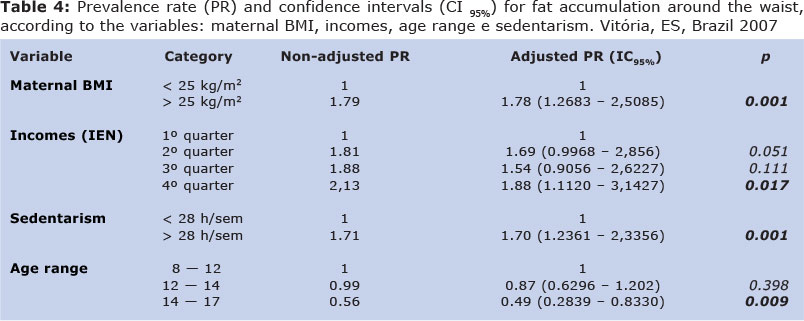
<body><![CDATA[<p><font face="Verdana, Arial, Helvetica, sans-serif" size="2">This study was    approved by the Committee of Ethics for Research from the Faculty of Public    Health, University of S&atilde;o Paulo COEP (157/05), research protocol #1339,    in 29<sup>th</sup> May 2005. All the parents/people in charge of the students    signed a free and clarified Consent Term.</font></p>     <p>&nbsp;</p>     <p><font face="Verdana, Arial, Helvetica, sans-serif" size="3"><b>RESULTS</b></font></p>     <p><font face="Verdana, Arial, Helvetica, sans-serif" size="2">In total, 400 students    were interviewed, 211 boys (52.8%) and 189 girls (47.3%), from 4<sup>th</sup>    to 9<sup>th</sup> grade of Elementary School of 18 schools in the city of Vit&oacute;ria.</font></p>     <p><font face="Verdana, Arial, Helvetica, sans-serif" size="2">Based on the adopted    parameters, 4.0% of students were stunted (16 students), 4.8% had wasting (19    students), 21.3% were overweight (85 students) and 27.3% had fat accumulation    around the waist (109 students).</font></p>     <p><font face="Verdana, Arial, Helvetica, sans-serif" size="2">Simple general    regression analysis reveals higher prevalence of overweight among students in    initial sexual maturation stage (23.3%), younger than 12 years (25.2%), male    (22.7%), with one siblings or none (22.7%), doing physical activities &lt; 5    hours per week (21.7%), sedentary &gt; 28 hours per week (25.8%), pursuing higher    incomes (28.0%<i>)</i> and maternal BMI &gt; 25 kg/m<sup>2</sup> (30.4%). Variables    sexual maturation, age range, sedentarism, family incomes and maternal BMI had    level of significance to become part of multiple general linear regression (<i>p    <u>&lt;</u> 0.20</i>) (<a href="/img/revistas/rbcdh/v24n3/11t01.jpg">Table 1</a>).</font></p>     <p><font face="Verdana, Arial, Helvetica, sans-serif" size="2">In multiple general    linear regression model, prevalence rate was higher among individuals in initial    and intermediate sexual maturation stages, whose mothers had BMI &gt; 25 kg/m<sup>2</sup>    and pursuing higher incomes, for </font><font size="2">&#945;</font><font face="Verdana, Arial, Helvetica, sans-serif" size="2">    = 0.05 (<a href="/img/revistas/rbcdh/v24n3/11t02.jpg">Table 2</a>).</font></p>     <p><font face="Verdana, Arial, Helvetica, sans-serif" size="2">For fat accumulation    around the waist, prevalence was higher among students in initial sexual maturation    stage (28.2%), younger than 12 years (29.7%), female (29.1%), with one sibling    or none (29.2%), doing physical activities &lt; 5 hours per week (28.1%), sedentary    &gt; 28 hours per week (35.4%), pursuing higher incomes (34.0%) and maternal    BMI e" 25 kg/m<sup>2</sup> (37;8%). Same variables in overweight had level of    significance to be part of multiple general linear regression (<i>p </i><u><i>&gt;</i></u><i>    0.20</i>), except for sexual maturation (<a href="/img/revistas/rbcdh/v24n3/11t03.jpg">Table 3</a>).</font></p>     <p><font face="Verdana, Arial, Helvetica, sans-serif" size="2">In multiple general    linear regression, individuals with higher incomes, sedentary and whose mothers    had BMI e" 25 kg/m<sup>2</sup>, had higher prevalence rate of fat accumulation    around the waist and individuals over 14 years, lower prevalence rate for </font><font size="2">&#945;</font><font face="Verdana, Arial, Helvetica, sans-serif" size="2">    = 0.05 (<a href="/img/revistas/rbcdh/v24n3/11t04.jpg">Table 4</a>).</font></p>     <p>&nbsp;</p>     ]]></body>
<body><![CDATA[<p><font face="Verdana, Arial, Helvetica, sans-serif" size="3"><b>DISCUSSION</b></font></p>     <p><font face="Verdana, Arial, Helvetica, sans-serif" size="2">Nutritional deficiencies    are not a major problem within the assessed group. Low prevalence of stunting    (4.0%) and wasting (4.8%) are next to the expected for a healthy population:    2.3% and 5.0% respectively. Such results corroborate population studies in Brazil    showing low prevalence of nutritional deficits among children and adolescents.    This rate has been decreasing over the course of last decades<sup>2,3,5</sup>.</font></p>     <p><font face="Verdana, Arial, Helvetica, sans-serif" size="2">Overweight and    fat accumulation around the waist had high prevalence within the group: 21.3%    and 27.3% respectively. Such values are above the expected for a healthy population,    which are 15% and 10% respectively, according to adopted criteria. Results are    not to be compared with other studies, considering different criteria employed    for nutritional assessment. Nevertheless, it is unquestionable the increase    on prevalence of obesity in Brazilian adolescents, overcoming nutritional deficiencies<sup>2-5,17,18</sup>.</font></p>     <p><font face="Verdana, Arial, Helvetica, sans-serif" size="2">Brazilian studies    confirm higher prevalence of overweight and fat accumulation around the waist    in wealthier individuals (about twice more), unlike findings in developed countries,    where the opposite is verified, even among children and adolescents<sup>5,18-21</sup>.</font></p>     <p><font face="Verdana, Arial, Helvetica, sans-serif" size="2">It is worth mentioning    that almost one third of these individuals showed bad distribution of body fat    (a risk for metabolic diseases), with prevalence of fat accumulation around    the waist almost &frac14; more than overweight (considering BMI percentile &gt;    85&ordm;).</font></p>     <p><font face="Verdana, Arial, Helvetica, sans-serif" size="2">PNDS-2006 describes    more disturbing results, as half of the assessed Brazilian women between 15    and 49 years had fat accumulation around the waist. In 45 to 40 years age range,    frequency reached about 75%<sup>22</sup>.</font></p>     <p><font face="Verdana, Arial, Helvetica, sans-serif" size="2">Such findings reinforce    the need for waist circumference measurement in health units as a trial for    individuals under risk of metabolic diseases.</font></p>     <p><font face="Verdana, Arial, Helvetica, sans-serif" size="2">Maternal BMI was    also associated to problems related to obesity. Individuals with mothers pursuing    BMI e" 25 kg/m<sup>2 </sup>showed prevalence rate of 2.04 times and 1.75 times    for overweight and fat accumulation around the waist, when compared to students    whose mothers had BMI &lt; 25 kg/m<sup>2</sup>.</font></p>     <p><font face="Verdana, Arial, Helvetica, sans-serif" size="2">Some authors confirm    such results; however, there is not clear evidence that obesity is determined    by genetics or environmental factors <sup>23,24,25</sup>. Sharing similar socio-environmental    and culture backgrounds may be associated to close nutritional status between    mothers and their children, although problems may appear in different periods<sup>23,24</sup>.</font></p>     <p><font face="Verdana, Arial, Helvetica, sans-serif" size="2">It is worth remarking    that sedentarism was more strongly associated to fat accumulation around the    waist than overweight. Simple analysis had this variable associated to two factors,    but it did not last in multiple analyses.</font></p>     ]]></body>
<body><![CDATA[<p><font face="Verdana, Arial, Helvetica, sans-serif" size="2">Physical activity    did not have level of significance for this study. This may reflect reverse    causality, owing to cross-sectional approach, as obesity might have motivated    individuals to start physical activities or yet because of limitations on sample    collection.</font></p>     <p><font face="Verdana, Arial, Helvetica, sans-serif" size="2">Variable sedentarism    measured the period in which these individuals were inactive, with reduction    on energy expenditure, and probably higher consumption of food, possibly stimulated    by media <sup>25</sup>. Studies show that less one hour per day (during one    year) of television, video and computer may reduce 2% in prevalence of overweight<sup>26,27</sup>.</font></p>     <p><font face="Verdana, Arial, Helvetica, sans-serif" size="2">Week hours spent    in sedentary activities is averagely 28 hours/week, whereas physical activities    did not reach 4 hours/week, with an average of 1.8 hours/week, i.e. 50% of students    practiced less than 2 hours per week of physical activities.</font></p>     <p><font face="Verdana, Arial, Helvetica, sans-serif" size="2">Considering sexual    maturation, students in initial and intermediate stages had overweight prevalence    rate about twice more than those in final stage. Such result corresponds to    the literature, as adolescents in final development stage are expected to be    thinner and those in stages 1 and 2 of pubertal development occasionally show    an increase on body BMI<sup>28,29</sup>.</font></p>     <p><font face="Verdana, Arial, Helvetica, sans-serif" size="2">Thus, we define    the quality of public health at any given time must be compatible with future    generations enjoying health in an equivalent way. Public health practitioners    must also integrate sustain ability in the definition of public health public    health measures include ensuring a safe and healthy environment, clean water,    safe workplaces; promotion of healthy behaviors such as hand washing and breast    feeding; and, preventing infectious diseases such as delivery of vaccinations    and distribution of condoms to control the spread of sexually transmitted diseases<sup>30</sup>,    including reduction and variable of sedentarism.</font></p>     <p><font face="Verdana, Arial, Helvetica, sans-serif" size="2">In conclusion,    low prevalence of nutritional deficiencies and high prevalence of indicators    associated to obesity were found. Prevalence rate is higher in wealthier students,    those whose mothers had BMI &gt; 25 kg/m<sup>2</sup>, sedentary ones, within    initial or intermediate sexual maturation state, and below 14 years old.</font></p>     <p><font face="Verdana, Arial, Helvetica, sans-serif" size="2">Results follow    trends observed in other Brazilian states over the course of the last decade.    More studies are needed for monitoring nutritional status of adolescents in    the city of Vit&oacute;ria.</font></p>     <p>&nbsp;</p>     <p><font face="Verdana, Arial, Helvetica, sans-serif" size="3"><b>REFERENCES</b></font></p>     <!-- ref --><p><font face="Verdana, Arial, Helvetica, sans-serif" size="2">1. WHO. World Health    Organization. Physical status: the use and interpretation of anthropometry.    Geneva; 1995 (WHO Technical Report Series, 854).    &nbsp;&nbsp;&nbsp;&nbsp;&nbsp;&nbsp;&nbsp;&nbsp;[&#160;<a href="javascript:void(0);" onclick="javascript: window.open('/scielo.php?script=sci_nlinks&ref=2510982&pid=S0104-1282201400030001100001&lng=','','width=640,height=500,resizable=yes,scrollbars=1,menubar=yes,');">Links</a>&#160;]<!-- end-ref --></font></p>     <!-- ref --><p><font face="Verdana, Arial, Helvetica, sans-serif" size="2">2. WHO- World Health    Organization. Nutrition in adolescence: issues and challenges for the health    sector: issues in adolescent health and development [Internet]. Geneva; 2005    [acesso em 30 nov 2006]. Dispon&iacute;vel em: <a href="http://www.who.int/child-adolescent-health/New_Publications/ADH/ISBN_92_4_%20159366_0.pdf" target="_blank">http://www.who.int/child-adolescent-health/New_Publications/ADH/ISBN_92_4_    159366_0.pdf</a>.    &nbsp;&nbsp;&nbsp;&nbsp;&nbsp;&nbsp;&nbsp;&nbsp;[&#160;<a href="javascript:void(0);" onclick="javascript: window.open('/scielo.php?script=sci_nlinks&ref=2510984&pid=S0104-1282201400030001100002&lng=','','width=640,height=500,resizable=yes,scrollbars=1,menubar=yes,');">Links</a>&#160;]<!-- end-ref --></font></p>     <!-- ref --><p><font face="Verdana, Arial, Helvetica, sans-serif" size="2">3. Anjos LA, Castro    IRR, Engstrom EM, Azevedo AMF. Crescimento e estado nutricional em amostra probabil&iacute;stica    de escolares no Munic&iacute;pio do Rio de Janeiro, 1999. Cad Sa&uacute;de P&uacute;blica.    2003; 19 Supl 1:171-9. doi: 10.1590/S0102-311X2003000700018.    &nbsp;&nbsp;&nbsp;&nbsp;&nbsp;&nbsp;&nbsp;&nbsp;[&#160;<a href="javascript:void(0);" onclick="javascript: window.open('/scielo.php?script=sci_nlinks&ref=2510986&pid=S0104-1282201400030001100003&lng=','','width=640,height=500,resizable=yes,scrollbars=1,menubar=yes,');">Links</a>&#160;]<!-- end-ref --></font></p>     <!-- ref --><p><font face="Verdana, Arial, Helvetica, sans-serif" size="2">4. Costa RF, Cintra    IP, Fisberg M. Preval&ecirc;ncia de sobrepeso e obesidade em escolares da cidade    de Santos, SP. Arq Bras Endocrinol Metab. 2006; 50 (1): 60-7. doi: 10.1590/S0004-27302006000100009.    &nbsp;&nbsp;&nbsp;&nbsp;&nbsp;&nbsp;&nbsp;&nbsp;[&#160;<a href="javascript:void(0);" onclick="javascript: window.open('/scielo.php?script=sci_nlinks&ref=2510988&pid=S0104-1282201400030001100004&lng=','','width=640,height=500,resizable=yes,scrollbars=1,menubar=yes,');">Links</a>&#160;]<!-- end-ref --></font></p>     <!-- ref --><p><font face="Verdana, Arial, Helvetica, sans-serif" size="2">5. IBGE- Instituto    Brasileiro de Geografia e Estat&iacute;stica. Pesquisa de Or&ccedil;amentos    Familiares (2008-2009): Antropometria e estado nutricional de crian&ccedil;as,    adolescentes e adultos no Brazil [Internet]. Rio de Janeiro; 2010 [acesso em    13 set 2010]. Dispon&iacute;vel em: <a href="http://www.ibge.gov.br" target="_blank">http://www.ibge.gov.br</a></font>&nbsp;&nbsp;&nbsp;&nbsp;&nbsp;&nbsp;&nbsp;&nbsp;[&#160;<a href="javascript:void(0);" onclick="javascript: window.open('/scielo.php?script=sci_nlinks&ref=2510990&pid=S0104-1282201400030001100005&lng=','','width=640,height=500,resizable=yes,scrollbars=1,menubar=yes,');">Links</a>&#160;]<!-- end-ref --><!-- ref --><p><font face="Verdana, Arial, Helvetica, sans-serif" size="2">6. Ogden CL, Carrol    MD, Flegal KM. High body mass index for age among US children and adolescents,    2003-2006. JAMA. 2008; 299 (20): 2401-5. doi: 10.1001/jama.299.20.2401.    &nbsp;&nbsp;&nbsp;&nbsp;&nbsp;&nbsp;&nbsp;&nbsp;[&#160;<a href="javascript:void(0);" onclick="javascript: window.open('/scielo.php?script=sci_nlinks&ref=2510991&pid=S0104-1282201400030001100006&lng=','','width=640,height=500,resizable=yes,scrollbars=1,menubar=yes,');">Links</a>&#160;]<!-- end-ref --></font></p>     ]]></body>
<body><![CDATA[<!-- ref --><p><font face="Verdana, Arial, Helvetica, sans-serif" size="2">7. Castillo EH,    Borges G, Talavera JO, Orozco R, Vargas-Alem&aacute;n C, Huitr&oacute;n-Bravo    G, <i>et al. </i> Body mass index and the prevalence of metabolic syndrome among    children and adolescents in two Mexican populations. J Adolesc Health. 2007;    40: 521-6. doi:10.1016/j.jadohealth. 2006.12.015.    &nbsp;&nbsp;&nbsp;&nbsp;&nbsp;&nbsp;&nbsp;&nbsp;[&#160;<a href="javascript:void(0);" onclick="javascript: window.open('/scielo.php?script=sci_nlinks&ref=2510993&pid=S0104-1282201400030001100007&lng=','','width=640,height=500,resizable=yes,scrollbars=1,menubar=yes,');">Links</a>&#160;]<!-- end-ref --></font></p>     <!-- ref --><p><font face="Verdana, Arial, Helvetica, sans-serif" size="2">8. Dokken BB, Tsao    T. The physiology of body weight regulation: are we too efficient for our own    good? Diabetes Spectrum. 2007; 20 (3): 166-70. doi: 10.2337/diaspect.20.3.166</font>&nbsp;&nbsp;&nbsp;&nbsp;&nbsp;&nbsp;&nbsp;&nbsp;[&#160;<a href="javascript:void(0);" onclick="javascript: window.open('/scielo.php?script=sci_nlinks&ref=2510995&pid=S0104-1282201400030001100008&lng=','','width=640,height=500,resizable=yes,scrollbars=1,menubar=yes,');">Links</a>&#160;]<!-- end-ref --><!-- ref --><p><font face="Verdana, Arial, Helvetica, sans-serif" size="2">9. Lohman TG, Roche    AF, Martorrel R. Anthropometric Standardization Reference Manual. Illinois:    Human Kinetics Books; 1988.    &nbsp;&nbsp;&nbsp;&nbsp;&nbsp;&nbsp;&nbsp;&nbsp;[&#160;<a href="javascript:void(0);" onclick="javascript: window.open('/scielo.php?script=sci_nlinks&ref=2510996&pid=S0104-1282201400030001100009&lng=','','width=640,height=500,resizable=yes,scrollbars=1,menubar=yes,');">Links</a>&#160;]<!-- end-ref --></font></p>     <!-- ref --><p><font face="Verdana, Arial, Helvetica, sans-serif" size="2">10. Habicth JP,    Martorrel R, Yarbrough C, Malina RM, Klein RE. Height and weight standard for    preschool children: how relevante are ethnic differences in growth potential?    Lancet. 1974; 1:611-5. doi:10.1016/S0140-6736(74)92663-4.    &nbsp;&nbsp;&nbsp;&nbsp;&nbsp;&nbsp;&nbsp;&nbsp;[&#160;<a href="javascript:void(0);" onclick="javascript: window.open('/scielo.php?script=sci_nlinks&ref=2510998&pid=S0104-1282201400030001100010&lng=','','width=640,height=500,resizable=yes,scrollbars=1,menubar=yes,');">Links</a>&#160;]<!-- end-ref --></font></p>     <!-- ref --><p><font face="Verdana, Arial, Helvetica, sans-serif" size="2">11. McCarthy HD,    Jarrett KV, Crawley HF. The development of waist circumference percentiles in    British children aged 5.0-16.9 y. Eur J Clin Nutr. 2001; 55: 902-7.    &nbsp;&nbsp;&nbsp;&nbsp;&nbsp;&nbsp;&nbsp;&nbsp;[&#160;<a href="javascript:void(0);" onclick="javascript: window.open('/scielo.php?script=sci_nlinks&ref=2511000&pid=S0104-1282201400030001100011&lng=','','width=640,height=500,resizable=yes,scrollbars=1,menubar=yes,');">Links</a>&#160;]<!-- end-ref --></font></p>     <!-- ref --><p><font face="Verdana, Arial, Helvetica, sans-serif" size="2">12. WHO- World    Health Organization: Obesity: preventing and managing the global epidemic: report    of a WHO consultation on obesity. Geneva; 1998.    &nbsp;&nbsp;&nbsp;&nbsp;&nbsp;&nbsp;&nbsp;&nbsp;[&#160;<a href="javascript:void(0);" onclick="javascript: window.open('/scielo.php?script=sci_nlinks&ref=2511002&pid=S0104-1282201400030001100012&lng=','','width=640,height=500,resizable=yes,scrollbars=1,menubar=yes,');">Links</a>&#160;]<!-- end-ref --></font></p>     <!-- ref --><p><font face="Verdana, Arial, Helvetica, sans-serif" size="2">13. Colli AS, Coates    V, Guimar&atilde;es BEM. Monitora&ccedil;&atilde;o do crescimento e desenvolvimento    f&iacute;sico. In: Coates V. Medicina do adolescente. S&atilde;o Paulo: Sarvier;    1993. p.51-65.    &nbsp;&nbsp;&nbsp;&nbsp;&nbsp;&nbsp;&nbsp;&nbsp;[&#160;<a href="javascript:void(0);" onclick="javascript: window.open('/scielo.php?script=sci_nlinks&ref=2511004&pid=S0104-1282201400030001100013&lng=','','width=640,height=500,resizable=yes,scrollbars=1,menubar=yes,');">Links</a>&#160;]<!-- end-ref --></font></p>     <!-- ref --><p><font face="Verdana, Arial, Helvetica, sans-serif" size="2">14. Barros AJD,    Victora CG. Indicador econ&ocirc;mico para o Brazil baseado no censo demogr&aacute;fico    de 2000. Rev Sa&uacute;de P&uacute;blica. 2005; 39 (4). doi: 10.1590/S0034-89102005000400002.    &nbsp;&nbsp;&nbsp;&nbsp;&nbsp;&nbsp;&nbsp;&nbsp;[&#160;<a href="javascript:void(0);" onclick="javascript: window.open('/scielo.php?script=sci_nlinks&ref=2511006&pid=S0104-1282201400030001100014&lng=','','width=640,height=500,resizable=yes,scrollbars=1,menubar=yes,');">Links</a>&#160;]<!-- end-ref --></font></p>     <!-- ref --><p><font face="Verdana, Arial, Helvetica, sans-serif" size="2">15. Florindo AA,    Romero A, Peres SV, Silva MV, Slater B. Desenvolvimento e valida&ccedil;&atilde;o    de um question&aacute;rio de avalia&ccedil;&atilde;o de atividade f&iacute;sica    para adolescentes. Rev Sa&uacute;de P&uacute;blica. 2006; 40(5). doi:10.1590/S0034-89102006005000002.    &nbsp;&nbsp;&nbsp;&nbsp;&nbsp;&nbsp;&nbsp;&nbsp;[&#160;<a href="javascript:void(0);" onclick="javascript: window.open('/scielo.php?script=sci_nlinks&ref=2511008&pid=S0104-1282201400030001100015&lng=','','width=640,height=500,resizable=yes,scrollbars=1,menubar=yes,');">Links</a>&#160;]<!-- end-ref --></font></p>     <!-- ref --><p><font face="Verdana, Arial, Helvetica, sans-serif" size="2">16. Eisenman JC,    Bartee RT, Wang MQ. Physical activity, TV viewing, and weight in U.S. youth:    1999 Youth Risk Behavior Survey. Obesity Research. 2002; 10(5): 379-85. doi:    10.1038/oby.2002.52.    &nbsp;&nbsp;&nbsp;&nbsp;&nbsp;&nbsp;&nbsp;&nbsp;[&#160;<a href="javascript:void(0);" onclick="javascript: window.open('/scielo.php?script=sci_nlinks&ref=2511010&pid=S0104-1282201400030001100016&lng=','','width=640,height=500,resizable=yes,scrollbars=1,menubar=yes,');">Links</a>&#160;]<!-- end-ref --></font></p>     <!-- ref --><p><font face="Verdana, Arial, Helvetica, sans-serif" size="2">17. Garcia GCB,    Gambardella AMD, Frutuoso MFP. Estado nutricional e consumo alimentar de adolescentes    de um centro de juventude da cidade de S&atilde;o Paulo. Rev Nutr. 2003; 16(1):    41-50. doi:10.1590/S1415-52732003000100005.    &nbsp;&nbsp;&nbsp;&nbsp;&nbsp;&nbsp;&nbsp;&nbsp;[&#160;<a href="javascript:void(0);" onclick="javascript: window.open('/scielo.php?script=sci_nlinks&ref=2511012&pid=S0104-1282201400030001100017&lng=','','width=640,height=500,resizable=yes,scrollbars=1,menubar=yes,');">Links</a>&#160;]<!-- end-ref --></font></p>     <!-- ref --><p><font face="Verdana, Arial, Helvetica, sans-serif" size="2">18. Oliveira CS,    Veiga GV. Estado nutricional e matura&ccedil;&atilde;o sexual de adolescentes    de uma escola p&uacute;blica e uma escola privada do Munic&iacute;pio do Rio    de janeiro. Rev Nutr. 2005; 18 (2). doi: 10.1590/S1415-52732005000200002.    &nbsp;&nbsp;&nbsp;&nbsp;&nbsp;&nbsp;&nbsp;&nbsp;[&#160;<a href="javascript:void(0);" onclick="javascript: window.open('/scielo.php?script=sci_nlinks&ref=2511014&pid=S0104-1282201400030001100018&lng=','','width=640,height=500,resizable=yes,scrollbars=1,menubar=yes,');">Links</a>&#160;]<!-- end-ref --></font></p>     <!-- ref --><p><font face="Verdana, Arial, Helvetica, sans-serif" size="2">19. Okosun IS,    Boltri JM, Eriksen MP, Hepburn VA. Trends in abdominal obesity in young people:    United States 1988 - 2002. Ethn Dis. 2006; 16 (2): 338-44.    &nbsp;&nbsp;&nbsp;&nbsp;&nbsp;&nbsp;&nbsp;&nbsp;[&#160;<a href="javascript:void(0);" onclick="javascript: window.open('/scielo.php?script=sci_nlinks&ref=2511016&pid=S0104-1282201400030001100019&lng=','','width=640,height=500,resizable=yes,scrollbars=1,menubar=yes,');">Links</a>&#160;]<!-- end-ref --></font></p>     <!-- ref --><p><font face="Verdana, Arial, Helvetica, sans-serif" size="2">20. Wake M, Hardy    P, Canterford L, Sawyer M, Carlin JB. Overweight, obesity and girth of Australian    preschoolers: prevalence and socio-economic correlates. Int J Obes. 2007; 31:    1044-51. doi: 10.1038/sj.ijo.0803503.    &nbsp;&nbsp;&nbsp;&nbsp;&nbsp;&nbsp;&nbsp;&nbsp;[&#160;<a href="javascript:void(0);" onclick="javascript: window.open('/scielo.php?script=sci_nlinks&ref=2511018&pid=S0104-1282201400030001100020&lng=','','width=640,height=500,resizable=yes,scrollbars=1,menubar=yes,');">Links</a>&#160;]<!-- end-ref --></font></p>     <!-- ref --><p><font face="Verdana, Arial, Helvetica, sans-serif" size="2">21. Lioret S, Touvier    M, Lafay L, Volatier J-L, Maire B. Dietary and physical activity patterns in    French children are related to overweight and socio-economic status. J Nutr.    2008; 138: 101-7.    &nbsp;&nbsp;&nbsp;&nbsp;&nbsp;&nbsp;&nbsp;&nbsp;[&#160;<a href="javascript:void(0);" onclick="javascript: window.open('/scielo.php?script=sci_nlinks&ref=2511020&pid=S0104-1282201400030001100021&lng=','','width=640,height=500,resizable=yes,scrollbars=1,menubar=yes,');">Links</a>&#160;]<!-- end-ref --></font></p>     <!-- ref --><p><font face="Verdana, Arial, Helvetica, sans-serif" size="2">22. PNDS - Pesquisa    Nacional de Demografia e Sa&uacute;de da crian&ccedil;a e da mulher. Dimens&atilde;o    do Processo Reprodutivo e da sa&uacute;de da crian&ccedil;a [Internet]. Bras&iacute;lia;    2009 [acesso em 14 set 2010]. Dispon&iacute;vel em: <a href="http://bvsms.saude.gov.br/bvs/publicacoes/pnds_crianca_%20mulher.pdf" target="_blank">http://bvsms.saude.gov.br/bvs/publicacoes/pnds_crianca_    mulher<b>.</b>pdf</a></font>&nbsp;&nbsp;&nbsp;&nbsp;&nbsp;&nbsp;&nbsp;&nbsp;[&#160;<a href="javascript:void(0);" onclick="javascript: window.open('/scielo.php?script=sci_nlinks&ref=2511022&pid=S0104-1282201400030001100022&lng=','','width=640,height=500,resizable=yes,scrollbars=1,menubar=yes,');">Links</a>&#160;]<!-- end-ref --><!-- ref --><p><font face="Verdana, Arial, Helvetica, sans-serif" size="2">23. Ravussin E,    Swinburn BA. Pathophysiology of obesity. Lancet. 1992; 340: 404-8. doi: 10.1016/0140-6736(92)91480-V.    &nbsp;&nbsp;&nbsp;&nbsp;&nbsp;&nbsp;&nbsp;&nbsp;[&#160;<a href="javascript:void(0);" onclick="javascript: window.open('/scielo.php?script=sci_nlinks&ref=2511023&pid=S0104-1282201400030001100023&lng=','','width=640,height=500,resizable=yes,scrollbars=1,menubar=yes,');">Links</a>&#160;]<!-- end-ref --></font></p>     <!-- ref --><p><font face="Verdana, Arial, Helvetica, sans-serif" size="2">24. Bouchard C.    Current understanding of the etiology of obesity: genetic and nongenetic factors.    Am J Clin Nutr. 1991; 53 (Supl) (6): 1561-5.    &nbsp;&nbsp;&nbsp;&nbsp;&nbsp;&nbsp;&nbsp;&nbsp;[&#160;<a href="javascript:void(0);" onclick="javascript: window.open('/scielo.php?script=sci_nlinks&ref=2511025&pid=S0104-1282201400030001100024&lng=','','width=640,height=500,resizable=yes,scrollbars=1,menubar=yes,');">Links</a>&#160;]<!-- end-ref --></font></p>     <!-- ref --><p><font face="Verdana, Arial, Helvetica, sans-serif" size="2">25. Novaes JF,    Franceschini SC, Priore SE. Comparison of the anthropometric and biochemical    variables between children and their parents. Arch Latinoam Nutr. 2007; 57 (2):    137-45.    &nbsp;&nbsp;&nbsp;&nbsp;&nbsp;&nbsp;&nbsp;&nbsp;[&#160;<a href="javascript:void(0);" onclick="javascript: window.open('/scielo.php?script=sci_nlinks&ref=2511027&pid=S0104-1282201400030001100025&lng=','','width=640,height=500,resizable=yes,scrollbars=1,menubar=yes,');">Links</a>&#160;]<!-- end-ref --></font></p>     <!-- ref --><p><font face="Verdana, Arial, Helvetica, sans-serif" size="2">26. Epstein LH,    Roemmich JN, Robinson JL, Paluch PA, Winiewicz DD, Fuerch JH, <i>et al</i>.    A randomized trial of the effects of reducing television viewing and computer    use on body mass index in young children. Arch Pediatr Adolesc Med 2008; 162    (3): 283-4. doi: 10.1001/archpediatrics.2007.45.    &nbsp;&nbsp;&nbsp;&nbsp;&nbsp;&nbsp;&nbsp;&nbsp;[&#160;<a href="javascript:void(0);" onclick="javascript: window.open('/scielo.php?script=sci_nlinks&ref=2511029&pid=S0104-1282201400030001100026&lng=','','width=640,height=500,resizable=yes,scrollbars=1,menubar=yes,');">Links</a>&#160;]<!-- end-ref --></font></p>     <!-- ref --><p><font face="Verdana, Arial, Helvetica, sans-serif" size="2">27. Wijga AH. Scholtens    S, Bemelmans WI, Kerkhof M, Koppelman GH, Brunekreef B, <i>et al</i>. Diet,    screen time, physical activity, and childhood overweight in the general population    and in high risk subgroups: Prospective analysis in the PIAMA birth cohort.    J obesi. 2010; 2010:1-9. doi: 10.1155/2010/423296.    &nbsp;&nbsp;&nbsp;&nbsp;&nbsp;&nbsp;&nbsp;&nbsp;[&#160;<a href="javascript:void(0);" onclick="javascript: window.open('/scielo.php?script=sci_nlinks&ref=2511031&pid=S0104-1282201400030001100027&lng=','','width=640,height=500,resizable=yes,scrollbars=1,menubar=yes,');">Links</a>&#160;]<!-- end-ref --></font></p>     ]]></body>
<body><![CDATA[<!-- ref --><p><font face="Verdana, Arial, Helvetica, sans-serif" size="2">28. Kanbur NO,    Derman O, Kinik E. Prevalence of obesity in adolescents and the impact of sexual    maturation stage on body mass index in obese adolescents. Int J Adolesc. Med    Health, 2002; 14(1): 61-5.    &nbsp;&nbsp;&nbsp;&nbsp;&nbsp;&nbsp;&nbsp;&nbsp;[&#160;<a href="javascript:void(0);" onclick="javascript: window.open('/scielo.php?script=sci_nlinks&ref=2511033&pid=S0104-1282201400030001100028&lng=','','width=640,height=500,resizable=yes,scrollbars=1,menubar=yes,');">Links</a>&#160;]<!-- end-ref --></font></p>     <!-- ref --><p><font face="Verdana, Arial, Helvetica, sans-serif" size="2">29. Kaplowitz PB.    Link between body fat and the timing of puberty. Pediatrics. 2008; 121 Supl    3: 208-17. doi: 10.1542/peds.2007-1813F.    &nbsp;&nbsp;&nbsp;&nbsp;&nbsp;&nbsp;&nbsp;&nbsp;[&#160;<a href="javascript:void(0);" onclick="javascript: window.open('/scielo.php?script=sci_nlinks&ref=2511035&pid=S0104-1282201400030001100029&lng=','','width=640,height=500,resizable=yes,scrollbars=1,menubar=yes,');">Links</a>&#160;]<!-- end-ref --></font></p>     <!-- ref --><p><font face="Verdana, Arial, Helvetica, sans-serif" size="2">30. Atrash HK,    Carpentier R. The evolving role of public health in the delivery of health care.    J. Hum. Growth Dev. 2012; 22(3): 396-399.    &nbsp;&nbsp;&nbsp;&nbsp;&nbsp;&nbsp;&nbsp;&nbsp;[&#160;<a href="javascript:void(0);" onclick="javascript: window.open('/scielo.php?script=sci_nlinks&ref=2511037&pid=S0104-1282201400030001100030&lng=','','width=640,height=500,resizable=yes,scrollbars=1,menubar=yes,');">Links</a>&#160;]<!-- end-ref --></font></p>     <p>&nbsp;</p>     <p>&nbsp;</p>     <p><font face="Verdana, Arial, Helvetica, sans-serif" size="2">Manuscript submitted    Jun 05 2014    <br>   Accepted for publication Sep 18 2014</font></p>     ]]></body>
<body><![CDATA[<p>&nbsp;</p>     <p>&nbsp;</p>     <p><font face="Verdana, Arial, Helvetica, sans-serif" size="2"><b>Aplica&ccedil;&atilde;o    do estudo (novidade): </b>crian&ccedil;as e adolescentes nos est&aacute;gios    de matura&ccedil;&atilde;o sexual inicial ou intermedi&aacute;ria s&atilde;o    mais sedent&aacute;rias e com maior sobrepeso. Nas fam&iacute;lias de maior    renda, h&aacute; maior sobrepeso e obesidade.<b>    <br>   Corresponding author:</b> <a href="mailto:zollner@usp.br">zollner@usp.br</a></font></p>      ]]></body>
<back>
<ref-list>
<ref id="B1">
<label>1</label><nlm-citation citation-type="book">
<collab>World Health Organization</collab>
<source><![CDATA[Physical status: the use and interpretation of anthropometry]]></source>
<year></year>
<publisher-loc><![CDATA[Geneva ]]></publisher-loc>
<publisher-name><![CDATA[1995]]></publisher-name>
</nlm-citation>
</ref>
<ref id="B2">
<label>2</label><nlm-citation citation-type="">
<collab>World Health Organization</collab>
<source><![CDATA[Nutrition in adolescence: issues and challenges for the health sector: issues in adolescent health and development]]></source>
<year>2005</year>
<publisher-loc><![CDATA[Geneva ]]></publisher-loc>
</nlm-citation>
</ref>
<ref id="B3">
<label>3</label><nlm-citation citation-type="journal">
<person-group person-group-type="author">
<name>
<surname><![CDATA[Anjos]]></surname>
<given-names><![CDATA[LA]]></given-names>
</name>
<name>
<surname><![CDATA[Castro]]></surname>
<given-names><![CDATA[IRR]]></given-names>
</name>
<name>
<surname><![CDATA[Engstrom]]></surname>
<given-names><![CDATA[EM]]></given-names>
</name>
<name>
<surname><![CDATA[Azevedo]]></surname>
<given-names><![CDATA[AMF]]></given-names>
</name>
</person-group>
<article-title xml:lang="pt"><![CDATA[Crescimento e estado nutricional em amostra probabilística de escolares no Município do Rio de Janeiro, 1999]]></article-title>
<source><![CDATA[Cad Saúde Pública]]></source>
<year>2003</year>
<volume>19</volume>
<numero>^s1</numero>
<issue>^s1</issue>
<supplement>1</supplement>
<page-range>171-9</page-range></nlm-citation>
</ref>
<ref id="B4">
<label>4</label><nlm-citation citation-type="journal">
<person-group person-group-type="author">
<name>
<surname><![CDATA[Costa]]></surname>
<given-names><![CDATA[RF]]></given-names>
</name>
<name>
<surname><![CDATA[Cintra]]></surname>
<given-names><![CDATA[IP]]></given-names>
</name>
<name>
<surname><![CDATA[Fisberg]]></surname>
<given-names><![CDATA[M]]></given-names>
</name>
</person-group>
<article-title xml:lang="pt"><![CDATA[Prevalência de sobrepeso e obesidade em escolares da cidade de Santos, SP]]></article-title>
<source><![CDATA[Arq Bras Endocrinol Metab]]></source>
<year>2006</year>
<volume>50</volume>
<numero>1</numero>
<issue>1</issue>
<page-range>60-7</page-range></nlm-citation>
</ref>
<ref id="B5">
<label>5</label><nlm-citation citation-type="">
<collab>Instituto Brasileiro de Geografia e Estatística</collab>
<source><![CDATA[Pesquisa de Orçamentos Familiares (2008-2009): Antropometria e estado nutricional de crianças, adolescentes e adultos no Brazil]]></source>
<year>2010</year>
<publisher-loc><![CDATA[Rio de Janeiro ]]></publisher-loc>
</nlm-citation>
</ref>
<ref id="B6">
<label>6</label><nlm-citation citation-type="journal">
<person-group person-group-type="author">
<name>
<surname><![CDATA[Ogden]]></surname>
<given-names><![CDATA[CL]]></given-names>
</name>
<name>
<surname><![CDATA[Carrol]]></surname>
<given-names><![CDATA[MD]]></given-names>
</name>
<name>
<surname><![CDATA[Flegal]]></surname>
<given-names><![CDATA[KM]]></given-names>
</name>
</person-group>
<article-title xml:lang="en"><![CDATA[High body mass index for age among US children and adolescents, 2003-2006]]></article-title>
<source><![CDATA[JAMA]]></source>
<year>2008</year>
<volume>299</volume>
<numero>20</numero>
<issue>20</issue>
<page-range>2401-5</page-range></nlm-citation>
</ref>
<ref id="B7">
<label>7</label><nlm-citation citation-type="journal">
<person-group person-group-type="author">
<name>
<surname><![CDATA[Castillo]]></surname>
<given-names><![CDATA[EH]]></given-names>
</name>
<name>
<surname><![CDATA[Borges]]></surname>
<given-names><![CDATA[G]]></given-names>
</name>
<name>
<surname><![CDATA[Talavera]]></surname>
<given-names><![CDATA[JO]]></given-names>
</name>
<name>
<surname><![CDATA[Orozco]]></surname>
<given-names><![CDATA[R]]></given-names>
</name>
<name>
<surname><![CDATA[Vargas-Alemán]]></surname>
<given-names><![CDATA[C]]></given-names>
</name>
<name>
<surname><![CDATA[Huitrón-Bravo]]></surname>
<given-names><![CDATA[G]]></given-names>
</name>
</person-group>
<article-title xml:lang="en"><![CDATA[Body mass index and the prevalence of metabolic syndrome among children and adolescents in two Mexican populations]]></article-title>
<source><![CDATA[J Adolesc Health]]></source>
<year>2007</year>
<volume>40</volume>
<page-range>521-6</page-range></nlm-citation>
</ref>
<ref id="B8">
<label>8</label><nlm-citation citation-type="journal">
<person-group person-group-type="author">
<name>
<surname><![CDATA[Dokken]]></surname>
<given-names><![CDATA[BB]]></given-names>
</name>
<name>
<surname><![CDATA[Tsao]]></surname>
<given-names><![CDATA[T]]></given-names>
</name>
</person-group>
<article-title xml:lang="en"><![CDATA[The physiology of body weight regulation: are we too efficient for our own good?]]></article-title>
<source><![CDATA[Diabetes Spectrum]]></source>
<year>2007</year>
<volume>20</volume>
<numero>3</numero>
<issue>3</issue>
<page-range>166-70</page-range></nlm-citation>
</ref>
<ref id="B9">
<label>9</label><nlm-citation citation-type="book">
<person-group person-group-type="author">
<name>
<surname><![CDATA[Lohman]]></surname>
<given-names><![CDATA[TG]]></given-names>
</name>
<name>
<surname><![CDATA[Roche]]></surname>
<given-names><![CDATA[AF]]></given-names>
</name>
<name>
<surname><![CDATA[Martorrel]]></surname>
<given-names><![CDATA[R]]></given-names>
</name>
</person-group>
<source><![CDATA[Anthropometric Standardization Reference Manual]]></source>
<year>1988</year>
<publisher-loc><![CDATA[^eIllinois Illinois]]></publisher-loc>
<publisher-name><![CDATA[Human Kinetics Books]]></publisher-name>
</nlm-citation>
</ref>
<ref id="B10">
<label>10</label><nlm-citation citation-type="journal">
<person-group person-group-type="author">
<name>
<surname><![CDATA[Habicth]]></surname>
<given-names><![CDATA[JP]]></given-names>
</name>
<name>
<surname><![CDATA[Martorrel]]></surname>
<given-names><![CDATA[R]]></given-names>
</name>
<name>
<surname><![CDATA[Yarbrough]]></surname>
<given-names><![CDATA[C]]></given-names>
</name>
<name>
<surname><![CDATA[Malina]]></surname>
<given-names><![CDATA[RM]]></given-names>
</name>
<name>
<surname><![CDATA[Klein]]></surname>
<given-names><![CDATA[RE]]></given-names>
</name>
</person-group>
<article-title xml:lang="en"><![CDATA[Height and weight standard for preschool children: how relevante are ethnic differences in growth potential?]]></article-title>
<source><![CDATA[Lancet]]></source>
<year>1974</year>
<volume>1</volume>
<page-range>611-5</page-range></nlm-citation>
</ref>
<ref id="B11">
<label>11</label><nlm-citation citation-type="journal">
<person-group person-group-type="author">
<name>
<surname><![CDATA[McCarthy]]></surname>
<given-names><![CDATA[HD]]></given-names>
</name>
<name>
<surname><![CDATA[Jarrett]]></surname>
<given-names><![CDATA[KV]]></given-names>
</name>
<name>
<surname><![CDATA[Crawley]]></surname>
<given-names><![CDATA[HF]]></given-names>
</name>
</person-group>
<article-title xml:lang="en"><![CDATA[The development of waist circumference percentiles in British children aged 5.0-16.9 y]]></article-title>
<source><![CDATA[Eur J Clin Nutr]]></source>
<year>2001</year>
<volume>55</volume>
<page-range>902-7</page-range></nlm-citation>
</ref>
<ref id="B12">
<label>12</label><nlm-citation citation-type="">
<collab>World Health Organization</collab>
<source><![CDATA[Obesity: preventing and managing the global epidemic: report of a WHO consultation on obesity]]></source>
<year>1998</year>
<publisher-loc><![CDATA[Geneva ]]></publisher-loc>
</nlm-citation>
</ref>
<ref id="B13">
<label>13</label><nlm-citation citation-type="book">
<person-group person-group-type="author">
<name>
<surname><![CDATA[Colli]]></surname>
<given-names><![CDATA[AS]]></given-names>
</name>
<name>
<surname><![CDATA[Coates]]></surname>
<given-names><![CDATA[V]]></given-names>
</name>
<name>
<surname><![CDATA[Guimarães]]></surname>
<given-names><![CDATA[BEM]]></given-names>
</name>
</person-group>
<article-title xml:lang="pt"><![CDATA[Monitoração do crescimento e desenvolvimento físico]]></article-title>
<person-group person-group-type="editor">
<name>
<surname><![CDATA[Coates]]></surname>
<given-names><![CDATA[V]]></given-names>
</name>
</person-group>
<source><![CDATA[Medicina do adolescente]]></source>
<year>1993</year>
<page-range>51-65</page-range><publisher-loc><![CDATA[São Paulo ]]></publisher-loc>
<publisher-name><![CDATA[Sarvier]]></publisher-name>
</nlm-citation>
</ref>
<ref id="B14">
<label>14</label><nlm-citation citation-type="journal">
<person-group person-group-type="author">
<name>
<surname><![CDATA[Barros]]></surname>
<given-names><![CDATA[AJD]]></given-names>
</name>
<name>
<surname><![CDATA[Victora]]></surname>
<given-names><![CDATA[CG]]></given-names>
</name>
</person-group>
<article-title xml:lang="pt"><![CDATA[Indicador econômico para o Brazil baseado no censo demográfico de 2000]]></article-title>
<source><![CDATA[Rev Saúde Pública.]]></source>
<year>2005</year>
<volume>39</volume>
<numero>4</numero>
<issue>4</issue>
</nlm-citation>
</ref>
<ref id="B15">
<label>15</label><nlm-citation citation-type="journal">
<person-group person-group-type="author">
<name>
<surname><![CDATA[Florindo]]></surname>
<given-names><![CDATA[AA]]></given-names>
</name>
<name>
<surname><![CDATA[Romero]]></surname>
<given-names><![CDATA[A]]></given-names>
</name>
<name>
<surname><![CDATA[Peres]]></surname>
<given-names><![CDATA[SV]]></given-names>
</name>
<name>
<surname><![CDATA[Silva]]></surname>
<given-names><![CDATA[MV]]></given-names>
</name>
<name>
<surname><![CDATA[Slater]]></surname>
<given-names><![CDATA[B]]></given-names>
</name>
</person-group>
<article-title xml:lang="pt"><![CDATA[Desenvolvimento e validação de um questionário de avaliação de atividade física para adolescentes]]></article-title>
<source><![CDATA[Rev Saúde Pública.]]></source>
<year>2006</year>
<volume>40</volume>
<numero>5</numero>
<issue>5</issue>
</nlm-citation>
</ref>
<ref id="B16">
<label>16</label><nlm-citation citation-type="journal">
<person-group person-group-type="author">
<name>
<surname><![CDATA[Eisenman]]></surname>
<given-names><![CDATA[JC]]></given-names>
</name>
<name>
<surname><![CDATA[Bartee]]></surname>
<given-names><![CDATA[RT]]></given-names>
</name>
<name>
<surname><![CDATA[Wang]]></surname>
<given-names><![CDATA[MQ]]></given-names>
</name>
</person-group>
<article-title xml:lang="en"><![CDATA[Physical activity, TV viewing, and weight in U: S. youth: 1999 Youth Risk Behavior Survey]]></article-title>
<source><![CDATA[Obesity Research]]></source>
<year>2002</year>
<volume>10</volume>
<numero>5</numero>
<issue>5</issue>
<page-range>379-85</page-range></nlm-citation>
</ref>
<ref id="B17">
<label>17</label><nlm-citation citation-type="journal">
<person-group person-group-type="author">
<name>
<surname><![CDATA[Garcia]]></surname>
<given-names><![CDATA[GCB]]></given-names>
</name>
<name>
<surname><![CDATA[Gambardella]]></surname>
<given-names><![CDATA[AMD]]></given-names>
</name>
<name>
<surname><![CDATA[Frutuoso]]></surname>
<given-names><![CDATA[MFP]]></given-names>
</name>
</person-group>
<article-title xml:lang="pt"><![CDATA[Estado nutricional e consumo alimentar de adolescentes de um centro de juventude da cidade de São Paulo]]></article-title>
<source><![CDATA[Rev Nutr.]]></source>
<year>2003</year>
<volume>16</volume>
<numero>1</numero>
<issue>1</issue>
<page-range>41-50</page-range></nlm-citation>
</ref>
<ref id="B18">
<label>18</label><nlm-citation citation-type="journal">
<person-group person-group-type="author">
<name>
<surname><![CDATA[Oliveira]]></surname>
<given-names><![CDATA[CS]]></given-names>
</name>
<name>
<surname><![CDATA[Veiga]]></surname>
<given-names><![CDATA[GV]]></given-names>
</name>
</person-group>
<article-title xml:lang="pt"><![CDATA[Estado nutricional e maturação sexual de adolescentes de uma escola pública e uma escola privada do Município do Rio de janeiro]]></article-title>
<source><![CDATA[Rev Nutr.]]></source>
<year>2005</year>
<volume>18</volume>
<numero>2</numero>
<issue>2</issue>
</nlm-citation>
</ref>
<ref id="B19">
<label>19</label><nlm-citation citation-type="journal">
<person-group person-group-type="author">
<name>
<surname><![CDATA[Okosun]]></surname>
<given-names><![CDATA[IS]]></given-names>
</name>
<name>
<surname><![CDATA[Boltri]]></surname>
<given-names><![CDATA[JM]]></given-names>
</name>
<name>
<surname><![CDATA[Eriksen]]></surname>
<given-names><![CDATA[MP]]></given-names>
</name>
<name>
<surname><![CDATA[Hepburn]]></surname>
<given-names><![CDATA[VA]]></given-names>
</name>
</person-group>
<article-title xml:lang="en"><![CDATA[Trends in abdominal obesity in young people: United States 1988 - 2002]]></article-title>
<source><![CDATA[Ethn Dis]]></source>
<year>2006</year>
<volume>16</volume>
<numero>2</numero>
<issue>2</issue>
<page-range>338-44</page-range></nlm-citation>
</ref>
<ref id="B20">
<label>20</label><nlm-citation citation-type="journal">
<person-group person-group-type="author">
<name>
<surname><![CDATA[Wake]]></surname>
<given-names><![CDATA[M]]></given-names>
</name>
<name>
<surname><![CDATA[Hardy]]></surname>
<given-names><![CDATA[P]]></given-names>
</name>
<name>
<surname><![CDATA[Canterford]]></surname>
<given-names><![CDATA[L]]></given-names>
</name>
<name>
<surname><![CDATA[Sawyer]]></surname>
<given-names><![CDATA[M]]></given-names>
</name>
<name>
<surname><![CDATA[Carlin]]></surname>
<given-names><![CDATA[JB]]></given-names>
</name>
</person-group>
<article-title xml:lang="en"><![CDATA[Overweight, obesity and girth of Australian preschoolers: prevalence and socio-economic correlates]]></article-title>
<source><![CDATA[Int J Obes]]></source>
<year>2007</year>
<volume>31</volume>
<page-range>1044-51</page-range></nlm-citation>
</ref>
<ref id="B21">
<label>21</label><nlm-citation citation-type="journal">
<person-group person-group-type="author">
<name>
<surname><![CDATA[Lioret]]></surname>
<given-names><![CDATA[S]]></given-names>
</name>
<name>
<surname><![CDATA[Touvier]]></surname>
<given-names><![CDATA[M]]></given-names>
</name>
<name>
<surname><![CDATA[Lafay]]></surname>
<given-names><![CDATA[L]]></given-names>
</name>
<name>
<surname><![CDATA[Volatier]]></surname>
<given-names><![CDATA[J-L]]></given-names>
</name>
<name>
<surname><![CDATA[Maire]]></surname>
<given-names><![CDATA[B]]></given-names>
</name>
</person-group>
<article-title xml:lang="en"><![CDATA[Dietary and physical activity patterns in French children are related to overweight and socio-economic status]]></article-title>
<source><![CDATA[J Nutr]]></source>
<year>2008</year>
<volume>138</volume>
<page-range>101-7</page-range></nlm-citation>
</ref>
<ref id="B22">
<label>22</label><nlm-citation citation-type="">
<collab>Pesquisa Nacional de Demografia e Saúde da criança e da mulher</collab>
<source><![CDATA[Dimensão do Processo Reprodutivo e da saúde da criança]]></source>
<year>2009</year>
<publisher-loc><![CDATA[Brasília ]]></publisher-loc>
</nlm-citation>
</ref>
<ref id="B23">
<label>23</label><nlm-citation citation-type="journal">
<person-group person-group-type="author">
<name>
<surname><![CDATA[Ravussin]]></surname>
<given-names><![CDATA[E]]></given-names>
</name>
<name>
<surname><![CDATA[Swinburn]]></surname>
<given-names><![CDATA[BA]]></given-names>
</name>
</person-group>
<article-title xml:lang="en"><![CDATA[Pathophysiology of obesity]]></article-title>
<source><![CDATA[Lancet]]></source>
<year>1992</year>
<volume>340</volume>
<page-range>404-8</page-range></nlm-citation>
</ref>
<ref id="B24">
<label>24</label><nlm-citation citation-type="journal">
<person-group person-group-type="author">
<name>
<surname><![CDATA[Bouchard]]></surname>
<given-names><![CDATA[C]]></given-names>
</name>
</person-group>
<article-title xml:lang="en"><![CDATA[Current understanding of the etiology of obesity: genetic and nongenetic factors]]></article-title>
<source><![CDATA[Am J Clin Nutr]]></source>
<year>1991</year>
<volume>53</volume>
<numero>^s6</numero>
<issue>^s6</issue>
<supplement>6</supplement>
<page-range>1561-5</page-range></nlm-citation>
</ref>
<ref id="B25">
<label>25</label><nlm-citation citation-type="journal">
<person-group person-group-type="author">
<name>
<surname><![CDATA[Novaes]]></surname>
<given-names><![CDATA[JF]]></given-names>
</name>
<name>
<surname><![CDATA[Franceschini]]></surname>
<given-names><![CDATA[SC]]></given-names>
</name>
<name>
<surname><![CDATA[Priore]]></surname>
<given-names><![CDATA[SE]]></given-names>
</name>
</person-group>
<article-title xml:lang="en"><![CDATA[Comparison of the anthropometric and biochemical variables between children and their parents]]></article-title>
<source><![CDATA[Arch Latinoam Nutr]]></source>
<year>2007</year>
<volume>57</volume>
<numero>2</numero>
<issue>2</issue>
<page-range>137-45</page-range></nlm-citation>
</ref>
<ref id="B26">
<label>26</label><nlm-citation citation-type="journal">
<person-group person-group-type="author">
<name>
<surname><![CDATA[Epstein]]></surname>
<given-names><![CDATA[LH]]></given-names>
</name>
<name>
<surname><![CDATA[Roemmich]]></surname>
<given-names><![CDATA[JN]]></given-names>
</name>
<name>
<surname><![CDATA[Robinson]]></surname>
<given-names><![CDATA[JL]]></given-names>
</name>
<name>
<surname><![CDATA[Paluch]]></surname>
<given-names><![CDATA[PA]]></given-names>
</name>
<name>
<surname><![CDATA[Winiewicz]]></surname>
<given-names><![CDATA[DD]]></given-names>
</name>
<name>
<surname><![CDATA[Fuerch]]></surname>
<given-names><![CDATA[JH]]></given-names>
</name>
</person-group>
<article-title xml:lang="en"><![CDATA[A randomized trial of the effects of reducing television viewing and computer use on body mass index in young children]]></article-title>
<source><![CDATA[Arch Pediatr Adolesc Med]]></source>
<year>2008</year>
<volume>162</volume>
<numero>3</numero>
<issue>3</issue>
<page-range>283-4</page-range></nlm-citation>
</ref>
<ref id="B27">
<label>27</label><nlm-citation citation-type="journal">
<person-group person-group-type="author">
<name>
<surname><![CDATA[Wijga]]></surname>
<given-names><![CDATA[AH]]></given-names>
</name>
</person-group>
<article-title xml:lang="en"><![CDATA[Scholtens S, Bemelmans WI, Kerkhof M, Koppelman GH, Brunekreef B, et al: Diet, screen time, physical activity, and childhood overweight in the general population and in high risk subgroups: Prospective analysis in the PIAMA birth cohort]]></article-title>
<source><![CDATA[J obesi]]></source>
<year>2010</year>
<volume>2010</volume>
<page-range>1-9</page-range></nlm-citation>
</ref>
<ref id="B28">
<label>28</label><nlm-citation citation-type="journal">
<person-group person-group-type="author">
<name>
<surname><![CDATA[Kanbur]]></surname>
<given-names><![CDATA[NO]]></given-names>
</name>
<name>
<surname><![CDATA[Derman]]></surname>
<given-names><![CDATA[O]]></given-names>
</name>
<name>
<surname><![CDATA[Kinik]]></surname>
<given-names><![CDATA[E]]></given-names>
</name>
</person-group>
<article-title xml:lang="en"><![CDATA[Prevalence of obesity in adolescents and the impact of sexual maturation stage on body mass index in obese adolescents]]></article-title>
<source><![CDATA[Int J Adolesc. Med Health,]]></source>
<year>2002</year>
<volume>14</volume>
<numero>1</numero>
<issue>1</issue>
<page-range>61-5</page-range></nlm-citation>
</ref>
<ref id="B29">
<label>29</label><nlm-citation citation-type="journal">
<person-group person-group-type="author">
<name>
<surname><![CDATA[Kaplowitz]]></surname>
<given-names><![CDATA[PB]]></given-names>
</name>
</person-group>
<article-title xml:lang="en"><![CDATA[Link between body fat and the timing of puberty]]></article-title>
<source><![CDATA[Pediatrics]]></source>
<year>2008</year>
<volume>121</volume>
<numero>^s3</numero>
<issue>^s3</issue>
<supplement>3</supplement>
<page-range>208-17</page-range></nlm-citation>
</ref>
<ref id="B30">
<label>30</label><nlm-citation citation-type="journal">
<person-group person-group-type="author">
<name>
<surname><![CDATA[Atrash]]></surname>
<given-names><![CDATA[HK]]></given-names>
</name>
<name>
<surname><![CDATA[Carpentier]]></surname>
<given-names><![CDATA[R]]></given-names>
</name>
</person-group>
<article-title xml:lang="en"><![CDATA[The evolving role of public health in the delivery of health care]]></article-title>
<source><![CDATA[J. Hum. Growth Dev]]></source>
<year>2012</year>
<volume>22</volume>
<numero>3</numero>
<issue>3</issue>
<page-range>396-399</page-range></nlm-citation>
</ref>
</ref-list>
</back>
</article>