<?xml version="1.0" encoding="ISO-8859-1"?><article xmlns:mml="http://www.w3.org/1998/Math/MathML" xmlns:xlink="http://www.w3.org/1999/xlink" xmlns:xsi="http://www.w3.org/2001/XMLSchema-instance">
<front>
<journal-meta>
<journal-id>0104-1282</journal-id>
<journal-title><![CDATA[Journal of Human Growth and Development]]></journal-title>
<abbrev-journal-title><![CDATA[Rev. bras. crescimento desenvolv. hum.]]></abbrev-journal-title>
<issn>0104-1282</issn>
<publisher>
<publisher-name><![CDATA[Centro de Estudos de Crescimento e Desenvolvimento do Ser Humano]]></publisher-name>
</publisher>
</journal-meta>
<article-meta>
<article-id>S0104-12822016000100008</article-id>
<article-id pub-id-type="doi">10.7322/jhgd.113717</article-id>
<title-group>
<article-title xml:lang="en"><![CDATA[Communicative indicators, motor and cognitive development of hearing-impaired children]]></article-title>
<article-title xml:lang="pt"><![CDATA[Indicadores comunicativos, motores e cognitivos do desenvolvimento de crianças deficientes auditivas]]></article-title>
</title-group>
<contrib-group>
<contrib contrib-type="author">
<name>
<surname><![CDATA[Amemiya]]></surname>
<given-names><![CDATA[Érica Endo]]></given-names>
</name>
<xref ref-type="aff" rid="A01"/>
</contrib>
<contrib contrib-type="author">
<name>
<surname><![CDATA[Soares]]></surname>
<given-names><![CDATA[Alexandra Dezani]]></given-names>
</name>
<xref ref-type="aff" rid="A02"/>
</contrib>
<contrib contrib-type="author">
<name>
<surname><![CDATA[Chiari]]></surname>
<given-names><![CDATA[Brasilia Maria]]></given-names>
</name>
<xref ref-type="aff" rid="A03"/>
</contrib>
</contrib-group>
<aff id="A01">
<institution><![CDATA[,Federal University of São Paulo  ]]></institution>
<addr-line><![CDATA[ ]]></addr-line>
</aff>
<aff id="A02">
<institution><![CDATA[,UNIFESP HSP ]]></institution>
<addr-line><![CDATA[ ]]></addr-line>
</aff>
<aff id="A03">
<institution><![CDATA[,UNIFESP Department of Phonoaudiology ]]></institution>
<addr-line><![CDATA[ ]]></addr-line>
</aff>
<pub-date pub-type="pub">
<day>00</day>
<month>00</month>
<year>2016</year>
</pub-date>
<pub-date pub-type="epub">
<day>00</day>
<month>00</month>
<year>2016</year>
</pub-date>
<volume>26</volume>
<numero>1</numero>
<fpage>54</fpage>
<lpage>60</lpage>
<copyright-statement/>
<copyright-year/>
<self-uri xlink:href="http://pepsic.bvsalud.org/scielo.php?script=sci_arttext&amp;pid=S0104-12822016000100008&amp;lng=en&amp;nrm=iso"></self-uri><self-uri xlink:href="http://pepsic.bvsalud.org/scielo.php?script=sci_abstract&amp;pid=S0104-12822016000100008&amp;lng=en&amp;nrm=iso"></self-uri><self-uri xlink:href="http://pepsic.bvsalud.org/scielo.php?script=sci_pdf&amp;pid=S0104-12822016000100008&amp;lng=en&amp;nrm=iso"></self-uri><abstract abstract-type="short" xml:lang="en"><p><![CDATA[INTRODUCTION: For the assessment of child development in the deaf is effective protocols are needed for this population, as in Brazil, standardized tests for these children are still scarce 4.5. Thus, emphasis is placed on studying child development in deaf so that therapeutic and educational approaches are contemplated in accordance with the needs of each child. OBJECTIVE: Analyze the performance of children with hearing deficit in different areas: Communications-Issue, Communication-reception, aspects Motors and Cognitive Aspects of Language. METHODS: We have carried out a comparative study in an institutional clinic with 109 children, divided into 60 hearing individuals with typical development and 49 with hearing loss, severe to profound. The performance index was calculated for each child in these four domains. The index was analysed according to the equation: (number of responses in each area / number of assessed behaviours) x100. RESULTS: In all age groups, hearing-impaired children had a smaller performance when compared to hearing children in the Communication - Emission domain. The Communication-Reception domain showed significant differences (p < 0.05) from the 12-to-23-months to the 60-to-71-months age groups. The Cognitive Aspects domain demonstrated a significant difference (p < 0.01) between hearing-impaired and hearing children aged 24 to 35 months and onwards. Motor Aspects only had a significant difference (p < 0.01) in the last two age groups, 48-59 months and 60-71 months. The significance level was 5%. CONCLUSION: In all age groups, hearing-impaired children's performance was worse when compared to hearing children. The intervention made by health professionals ought to take place as soon as possible in order to develop the cognitive, motor and language skills of the hearing-impaired child.]]></p></abstract>
<abstract abstract-type="short" xml:lang="pt"><p><![CDATA[INTRODUÇÃO: Para que a avaliação do desenvolvimento infantil em deficientes auditivos seja efetiva são necessários protocolos para esta população, já que, no Brasil, testes padronizados para estas crianças ainda são escassos 4,5. Assim, dá-se ênfase em estudar o desenvolvimento infantil em deficientes auditivos, para que abordagens terapêuticas e educacionais sejam contempladas de acordo com a necessidade de cada criança. OBJETIVO: Analisar o desempenho de crianças com déficit de audição nos diferentes domínios: Comunicação-Emissão, Comunicação-Recepção, Aspectos Motores e Aspectos Cognitivos da Linguagem. MÉTODO: Estudo comparativo em uma clínica institucional com 109 crianças, divididas em 60 crianças ouvintes com desenvolvimento típico e 49 crianças com perda auditiva neurossensorial de grau severo a profundo bilateral, para verificação dos desempenhos nos domínios Comunicação - Emissão e Recepção, Aspectos motores e Aspectos Cognitivos da Linguagem. Para cada criança foi calculado o índice de desempenho na Comunicação - Emissão e Recepção, Aspectos Motores e Aspectos Cognitivos da Linguagem. Os índices foram analisados da seguinte forma: (número respostas presentes em cada domínio/número de comportamentos avaliados) x100. RESULTADOS: Em todas as faixas etárias, encontramos desempenho inferior de crianças deficientes auditivas quando comparadas às crianças ouvintes no domínio Comunicação-Emissão. O domínio Comunicação-Recepção apresentou diferenças significantes (p < 0,05) a partir da faixa etária de 12 a 23 meses até a faixa de 60 a 71 meses. O domínio Aspectos Cognitivos da Linguagem apresentou diferença significante (p<0,01) entre crianças deficientes auditivas e ouvintes da faixa etária de 24 a 35 meses em diante. No domínio Aspectos Motores foi observada diferença significante (p<0,01) apenas nas duas últimas faixas etárias de 48 a 59 meses e 60 a 71 meses. O nível de significância adotado foi de 5%. CONCLUSÕES: Em todas as faixas etárias, encontramos desempenho inferior de crianças deficientes auditivas quando comparadas às crianças ouvintes.]]></p></abstract>
<kwd-group>
<kwd lng="en"><![CDATA[hearing loss]]></kwd>
<kwd lng="en"><![CDATA[child development]]></kwd>
<kwd lng="en"><![CDATA[language development disorders]]></kwd>
<kwd lng="pt"><![CDATA[perda auditiva]]></kwd>
<kwd lng="pt"><![CDATA[desenvolvimento infantil]]></kwd>
<kwd lng="pt"><![CDATA[crescimento e desenvolvimento]]></kwd>
</kwd-group>
</article-meta>
</front><body><![CDATA[ <p align="right"><font size="2" face="Verdana, Arial, Helvetica, sans-serif"><b>ORIGINAL    RESEARCH</b></font></p>     <p>&nbsp;</p>     <p><font face="Verdana, Arial, Helvetica, sans-serif" size="4"><b><a name="top"></a>Communicative    indicators, motor and cognitive development of hearing-impaired children</b></font></p>     <p>&nbsp;</p>     <p>&nbsp;</p>     <p><font face="Verdana, Arial, Helvetica, sans-serif" size="2"><b>&Eacute;rica    Endo Amemiya<sup>I</sup><sup>, </sup><a href="#back"><sup>*</sup></a>; Alexandra    Dezani Soares<sup>II</sup>; Brasilia Maria Chiari<sup>III</sup></b></font></p>     <p><font face="Verdana, Arial, Helvetica, sans-serif" size="2"><sup>I</sup>Federal    University of S&atilde;o Paulo (UNIFESP)    <br>   <sup>II</sup>Speech pathologist in the Cochlear Implant Team - HSP- UNIFESP    <br>   <sup>III</sup>Professor at the Department of Phonoaudiology (Speech Pathology)    - UNIFESP</font></p>     <p>&nbsp;</p>     ]]></body>
<body><![CDATA[<p>&nbsp;</p> <hr noshade size="1">     <p><font face="Verdana, Arial, Helvetica, sans-serif" size="2"><b>ABSTRACT</b></font></p>     <p><font face="Verdana, Arial, Helvetica, sans-serif" size="2"><b>INTRODUCTION</b>:    For the assessment of child development in the deaf is effective protocols are    needed for this population, as in Brazil, standardized tests for these children    are still scarce 4.5. Thus, emphasis is placed on studying child development    in deaf so that therapeutic and educational approaches are contemplated in accordance    with the needs of each child.    <br>   <b>OBJECTIVE</b>: Analyze the performance of children with hearing deficit in    different areas: Communications-Issue, Communication-reception, aspects Motors    and Cognitive Aspects of Language.    <br>   <b>METHODS</b>: We have carried out a comparative study in an institutional    clinic with 109 children, divided into 60 hearing individuals with typical development    and 49 with hearing loss, severe to profound. The performance index was calculated    for each child in these four domains. The index was analysed according to the    equation: (number of responses in each area / number of assessed behaviours)    x100.    <br>   <b>RESULTS</b>: In all age groups, hearing-impaired children had a smaller performance    when compared to hearing children in the Communication - Emission domain. The    Communication-Reception domain showed significant differences (p &lt; 0.05)    from the 12-to-23-months to the 60-to-71-months age groups. The Cognitive Aspects    domain demonstrated a significant difference (p &lt; 0.01) between hearing-impaired    and hearing children aged 24 to 35 months and onwards. Motor Aspects only had    a significant difference (p &lt; 0.01) in the last two age groups, 48-59 months    and 60-71 months. The significance level was 5%.    <br>   <b>CONCLUSION</b>: In all age groups, hearing-impaired children's performance    was worse when compared to hearing children. The intervention made by health    professionals ought to take place as soon as possible in order to develop the    cognitive, motor and language skills of the hearing-impaired child.</font></p>     <p><font face="Verdana, Arial, Helvetica, sans-serif" size="2"><b>Keywords</b>:    hearing loss, child development, language development disorders.</font></p> <hr noshade size="1">     <p>&nbsp;</p>     <p>&nbsp;</p>     ]]></body>
<body><![CDATA[<p><font face="Verdana, Arial, Helvetica, sans-serif" size="3"><b>INTRODUCTION</b></font></p>     <p><font face="Verdana, Arial, Helvetica, sans-serif" size="2">During the process    of child development, sensorial ruptures such as hearing loss can worsen language    acquisition to a lesser or greater degree. Language acquisition is crucial because    language, being a strictly human form of communication, transmits complex information    from one person to the other<sup>1</sup> and the linguistic code allows us to    express language<sup>2. </sup></font></p>     <p><font face="Verdana, Arial, Helvetica, sans-serif" size="2">Hearing loss during    a child's development can change the relationship between form and content,    usage and linguistic levels such as syntactic and semantic vocabulary<sup>3,4</sup>.This    proofs that studying child development is a complex task that demands a systematic,    detailed and insightful approach from the researcher.</font></p>     <p><font face="Verdana, Arial, Helvetica, sans-serif" size="2">In order to make    the assessment of child's development in hearing-impaired children effective,    we need to establish protocols for this population, since in Brazil, standardized    tests for these children remain scarce<sup>4,5</sup>. Therefore, we emphasize    studying child development in hearing-impaired children so therapeutic and educational    approaches can be carried out according to the necessity of each child.</font></p>     <p><font face="Verdana, Arial, Helvetica, sans-serif" size="2">Having in mind    how important this subject is, our objective was to investigate the performance    of children with hearing deficit in different domains: Communication-Emission;    Communication-Reception; Motor Aspects and Cognitive Aspects of Language and    compare them with hearing children.</font></p>     <p>&nbsp;</p>     <p><font face="Verdana, Arial, Helvetica, sans-serif" size="3"><b>METHODS</b></font></p>     <p><font face="Verdana, Arial, Helvetica, sans-serif" size="2"><b>This is a comparative    study.</b></font></p>     <p><font face="Verdana, Arial, Helvetica, sans-serif" size="2">The study group    (SG) comprises children with neurosensory hearing loss from a severe degree    to profound bilateral and the control group (CG) comprises hearing children    with no learning or development complaint.</font></p>     <p><font face="Verdana, Arial, Helvetica, sans-serif" size="2">In total, the study    was based on 109 children of both sexes and aged 0 to 71 months. Among them,    60 [55%] were hearing children and 49 [45%] were hearing-impaired children,    58 [53,2%] were female and 61 [46,8%] were male.</font></p>     ]]></body>
<body><![CDATA[<p><font face="Verdana, Arial, Helvetica, sans-serif" size="2">Among the female    children, 32 [53,3%] were hearing and 26 [53,1%] were hearing-impaired children.    When it comes to the figures regarding male children, 28 [46, 7%] were hearing    and 23 [46,9%] were hearing-impaired.</font></p>     <p><font face="Verdana, Arial, Helvetica, sans-serif" size="2">60 hearing children    came from the children's school of the institution, 11, aged 4 to 6 years old,    came from the municipal school and 38 hearing-impaired children, aged 0 to 6    years old, came from ambulatory care.</font></p>     <p><font face="Verdana, Arial, Helvetica, sans-serif" size="2">The sample in this    study had enough statistical power (95%). 102 individuals would be necessary    to carry out this study, according to the statistical program GPower, having    a sample proportion of 1:1 and not having any loss in terms of samples.</font></p>     <p><font face="Verdana, Arial, Helvetica, sans-serif" size="2">Hearing-impaired    children (GE) complied with the following inclusion criteria: having prelingual    hearing loss, in other words, the hearing loss occurred before the age of 3;    aged between 0 and 71 months and neurosensory hearing loss from a severe degree    to deep bilateral<sup>6</sup>. Hearing children, on the other hand, complied    with following criteria: not presenting any hearing complains or complaints    related to communication or learning, and being between the age of 0 and 71    months.</font></p>     <p><font face="Verdana, Arial, Helvetica, sans-serif" size="2">The criteria for    exclusion, both for hearing-impaired children as well as hearing children, were:    children that have cognitive, visual, psychiatric, neurologic and motor impairments    noticed by the assessor, free and clarified consent form and/ or an approval    form not signed by the parent or guardian responsible for the child's participation    in the research.</font></p>     <p><font face="Verdana, Arial, Helvetica, sans-serif" size="2">We took into account    the samples by spontaneous demand of hearing-impaired 0-to71-months children    in the ambulatory care when they attended the service to receive the audiological    diagnosis and the indication of electronic devices.</font></p>     <p><font face="Verdana, Arial, Helvetica, sans-serif" size="2">The instrument    used to gather the data was "Proposal of data systematization of phonoaudiological    assessment through the observation of 0-to-6-year-old children's behaviour"<sup>4</sup>.    It is composed of four domains: Communication-Emission; Communication-Reception;    Motor Aspects and Cognitive Aspects of Language. Each domain addresses expected    behaviour for each age, taking into account the presence or absence of each    one of them. The participants underwent similar procedures in the three places    where samples were collected.</font></p>     <p><font face="Verdana, Arial, Helvetica, sans-serif" size="2">We have carried    out a brief anamnesis and afterwards we started activities that allowed us to    notice or not the presence of expected behaviours according to the age. Playful    materials were used during the entire assessment (paper, black and colour pencils,    scissors, glue, cardboard box, pieces of tissue, mirror, nylon thread, play    dough, plastic throw rings, cardboard or plastic cones, rattle, wooden cubes,    bench, balls, plastic animals, trucks, dolls, family puppets, wooden beads,    miniatures of kitchen utensils, animals, means of transportation, fruits, house,    hairbrush, comic books, children stories, plastic letters and numbers, boards    with geometric shapes, boards with incomplete drawings to fill out, incomplete    human figure, puzzles and different pictures).</font></p>     <p><font face="Verdana, Arial, Helvetica, sans-serif" size="2">The assessment    was recorded with a digital Sony camera, Cyber-shot DSC-W30 model, and the footage    was analysed afterwards. The sessions lasted approximately 40 minutes.</font></p>     <p><font face="Verdana, Arial, Helvetica, sans-serif" size="2">The protocols were    filled out by three speech pathologists at the same time while the video of    the child was presented. The three of them had experience in assessing hearing-impaired    children. The behaviour was only considered present or absent when there was    a consensus of at least two of the assessors. When there was no consensus among    the assessors, a third opinion was consulted.</font></p>     ]]></body>
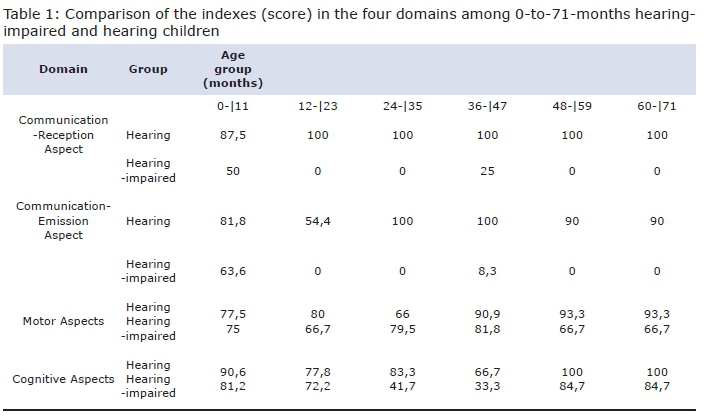
<body><![CDATA[<p><font face="Verdana, Arial, Helvetica, sans-serif" size="2">The data collected    was analysed by the statistic programme SPSS version 19.0.</font></p>     <p><font face="Verdana, Arial, Helvetica, sans-serif" size="2">Furthermore, the    analysis of the answers in the behaviour of hearing and hearing-impaired children    is presented based on the median distribution divided by age.</font></p>     <p><font face="Verdana, Arial, Helvetica, sans-serif" size="2">The performance    in Communication-Emission; Communication-Reception; Motor Aspects and Cognitive    Aspects of Language performance index was calculated to each child.</font></p>     <p><font face="Verdana, Arial, Helvetica, sans-serif" size="2">The indexes were    analysed in regards to the presence of answers in each domain, according to    the calculation: number of present behaviours/ total of analysed items. The    significance level adopted was 5%.</font></p>     <p>&nbsp;</p>     <p><font face="Verdana, Arial, Helvetica, sans-serif" size="3"><b>RESULTS</b></font></p>     <p><font face="Verdana, Arial, Helvetica, sans-serif" size="2">The study group    (SG) was formed by children with neurosensory hearing loss from a severe degree    to profound bilateral and the control group (CG) comprises hearing children    with no learning or development complaints.</font></p>     <p><font face="Verdana, Arial, Helvetica, sans-serif" size="2">"<a href="/img/revistas/rbcdh/v26n1/08t1.jpg">Table    1</a>: Comparison of the indexes in the four domains among 0-to-71-months hearing-impaired    and hearing children" describes the median of indexes in each large domain of    the ages that vary from 0 to 71 months. These indexes indicate hearing and hearing-impaired    children's presence of answers.</font></p>     <p><font face="Verdana, Arial, Helvetica, sans-serif" size="2">On one hand, the    Communication-Emission domain presented significant differences in all age groups.    On the other hand, the Communication-Reception domain presented significant    differences only at the 12- to-23-months age group. The 24-to-47-months age    group had significant differences in the domains: Communication-Reception, Communication-Emission    and Cognitive Aspects of Language. The 48-to-71-months age group had significant    differences in all four domains (p&lt;0, 05).</font></p>     <p>&nbsp;</p>     ]]></body>
<body><![CDATA[<p><font face="Verdana, Arial, Helvetica, sans-serif" size="3"><b>DISCUSSION</b></font></p>     <p><font face="Verdana, Arial, Helvetica, sans-serif" size="2">The first age group    analysed, 0 to 11 months, corresponds to the beginning of development and the    first year of life. We can notice the first communicative resources used by    children, which are already experiencing a large influence of hearing loss.    The Communication - emission domain was the only one that showed a significant    difference (p &lt; 0,05). In this domain, the behaviour "Vocalization with a    variation in intonation after various stimuli" was the most affected one.</font></p>     <p><font face="Verdana, Arial, Helvetica, sans-serif" size="2">Studies in the    literature<sup>7,8</sup> confirm this, because 0-to-11-months children with    hearing loss may present alterations in prosody, which are noticed since the    beginning of vocalizations<sup>9</sup> . The latter are resources used by children    to call the adult's attention. The development of prosody is compromised in    hearing-impaired children due to the hearing difficulty to notice prosodic traces,    which results in alterations of vocalization, absence of consonants and modifications    in the sound of vowels <sup>7. </sup></font></p>     <p><font face="Verdana, Arial, Helvetica, sans-serif" size="2">In the 12-to23-months    age group, we noticed significant differences in the Communication-Reception    and Emission domains<sup>10,11</sup>. Studies affirm that a child aged 12 to    16 months with moderate to profound degree hearing loss are underdeveloped in    terms of receptive and expressive language skills when compared with children    with mild hearing loss. Thus, it emphasizes the importance of hearing feedback    in language development<sup>10,11</sup>.</font></p>     <p><font face="Verdana, Arial, Helvetica, sans-serif" size="2">The 24-to-25-months    age group showed significant differences in three domains: Communication - Reception    and Emission and cognitive aspects of language. Regarding Communication - Reception    and Emission, all the behaviours were absent. When hearing-impaired children    grow up without auricular electronic devices and with no multidisciplinary support,    the deficit becomes more prominent<sup>5</sup>.</font></p>     <p><font face="Verdana, Arial, Helvetica, sans-serif" size="2">In case of medium    otitis between 26 to 28 months, we notice a negative impact in the perception    of speech, which influences both reception and emission, especially for consonants    such as /s/ and /z/, compromising learning<sup>11,12</sup>.</font></p>     <p><font face="Verdana, Arial, Helvetica, sans-serif" size="2">Hearing-impaired    children aged 36 to 47 months who use an Individual Sound Expansion Device (ISED)    have a performance that is compatible to normality when it comes to expressive    vocabulary. This, however, did not occur in the results seen in this study,    because children had a compatible performance only in motor aspects<sup>3. </sup>The    Cognitive Aspects of Language domain presents significant differences. Behaviours    such as "joining part 2 and 3 to form the whole", "combining 1 to 1, 3 or more    objects" and "memorizing pictures (the child is capable of selecting a stimulus    among others)" are altered, which means that the hearing-impaired child's symbolic    thinking is already underdeveloped compared with hearing children<sup>8. </sup></font></p>     <p><font face="Verdana, Arial, Helvetica, sans-serif" size="2">After the initial    development phase, the first years of life, in which motor actions to know and    organize the world prevail, is followed by a phase in which leaning is based    on the senses<sup>13</sup>. Having hearing deficits in this age group makes    it difficult to understand ambiguous messages, jokes, ironies and suspense,    voice control, and causes the production of phonetic and articulating mistakes    throughout the language development<sup>12. </sup> Children with hearing loss    in the 48-to-71-months age group in this study were lagging behind in regards    to language development<sup>14</sup>. In the reality of hearing-impaired children,    the use of syntax similar to that of adults, the expansion of adjectives and    phrasal verbs, negative sentences and yes and no question are hardly reached.    This demonstrates that the child with hearing loss dos not have the opportunity    to socially develop language and speech skills, since these are built through    conversation and personal reports<sup>15-17. </sup></font></p>     <p><font face="Verdana, Arial, Helvetica, sans-serif" size="2">In order to making    it possible for a child with hearing loss to reach good performance in language    acquisition, one needs technological and educational apparatus and a healthy    family environment, as well as cognitive skills<sup>13,18-20. </sup>Cognitive    functions such as attention, categorization, learning and memory can influence    the way the cognitive system processes a sensory entrance coming from electronic    devices, such as cochlear implant<sup>13</sup>.</font></p>     <p><font face="Verdana, Arial, Helvetica, sans-serif" size="2">The deficit in    this functions occurred in all the 4-to-6-months age group children in this    study. We noticed a relationship between hearing and sight<sup>21</sup>, because    both work together in a child's normal development to provide information on    the environment. However, the integration between hearing, visual and motor    development suggests that hearing alteration contributes to motor underdevelopment    in hearing-impaired children associated to the lack of opportunities in experiencing    everyday activities, later insertion in school learning, among others<sup>22</sup>.</font></p>     ]]></body>
<body><![CDATA[<p><font face="Verdana, Arial, Helvetica, sans-serif" size="2">Knowing which are    the most compromised domains in the development process allows us to ensure    professional care in the three most important steps of assessment: diagnosis,    intervention and evaluation of results, allowing information to be shared among    all the professionals in the team <sup>22</sup>.</font></p>     <p>&nbsp;</p>     <p><font face="Verdana, Arial, Helvetica, sans-serif" size="3"><b>CONCLUSION</b></font></p>     <p><font face="Verdana, Arial, Helvetica, sans-serif" size="2">The analysis of    behavioural indicators in the Communication - Reception and Emission, Motor    Aspects and Cognitive aspects of language domains made it possible for us to    build up a profile of hearing-impaired children. In all age groups, we have    found that hearing-impaired children have inferior development when compared    with hearing children in the Communication-Emission domain. The later multidisciplinary    interventions in the hearing-impaired child take place, the more severe will    be his cognitive, motor and linguistic performance.</font></p>     <p>&nbsp;</p>     <p><font face="Verdana, Arial, Helvetica, sans-serif" size="3"><b>ACKNOWLEDGEMENTS</b></font></p>     <p><font face="Verdana, Arial, Helvetica, sans-serif" size="2">Sincere gratitude    is extended to the following:</font></p>     <p><font face="Verdana, Arial, Helvetica, sans-serif" size="2"><b>CAPES</b></font></p>     <p><font face="Verdana, Arial, Helvetica, sans-serif" size="2">Hearing-impaired    person Centre (Centro do Deficiente Auditivo - CDA) - UNIFESP. Paulistinha School    of education (Escola Paulistinha de Educa&ccedil;&atilde;o) - UNIFESP. Helen    Keller Especial Municipal School (Escola Municipal de Educa&ccedil;&atilde;o    Especial Helen Keller)</font></p>     <p>&nbsp;</p>     ]]></body>
<body><![CDATA[<p><font face="Verdana, Arial, Helvetica, sans-serif" size="3"><b>REFERENCES</b></font></p>     <!-- ref --><p><font face="Verdana, Arial, Helvetica, sans-serif" size="2">1. Kandel ER. Uma    vis&atilde;o global. In: Kandel ER, Schwartz JH, Jessel TM. Fundamentos da neuroci&ecirc;ncia    e do comportamento. Rio de Janeiro: Guanabara Koogan; 1997; p.505-6.    &nbsp;&nbsp;&nbsp;&nbsp;&nbsp;&nbsp;&nbsp;&nbsp;[&#160;<a href="javascript:void(0);" onclick="javascript: window.open('/scielo.php?script=sci_nlinks&ref=2521323&pid=S0104-1282201600010000800001&lng=','','width=640,height=500,resizable=yes,scrollbars=1,menubar=yes,');">Links</a>&#160;]<!-- end-ref --></font></p>     <!-- ref --><p><font face="Verdana, Arial, Helvetica, sans-serif" size="2">2. Soares AD, Chiari    BM. Caracteriza&ccedil;&atilde;o da narrativa oral de deficientes auditivos.    Rev Soc Bras Fonoaudiol. 2006;11(4):272-8.    &nbsp;&nbsp;&nbsp;&nbsp;&nbsp;&nbsp;&nbsp;&nbsp;[&#160;<a href="javascript:void(0);" onclick="javascript: window.open('/scielo.php?script=sci_nlinks&ref=2521325&pid=S0104-1282201600010000800002&lng=','','width=640,height=500,resizable=yes,scrollbars=1,menubar=yes,');">Links</a>&#160;]<!-- end-ref --></font></p>     <!-- ref --><p><font face="Verdana, Arial, Helvetica, sans-serif" size="2">3. Costa MCM, Chiari    BM. Verifica&ccedil;&atilde;o do desempenho de crian&ccedil;as deficientes auditivas    oralizadas em teste de vocabul&aacute;rio. Pr&oacute;-Fono R Atual Cient. 2006;18(2):189-96.    DOI: <a href="http://dx.doi.org/10.1590/S0104-56872006000200008" target="_blank">http://dx.doi.org/10.1590/S0104-56872006000200008</a></font>&nbsp;&nbsp;&nbsp;&nbsp;&nbsp;&nbsp;&nbsp;&nbsp;[&#160;<a href="javascript:void(0);" onclick="javascript: window.open('/scielo.php?script=sci_nlinks&ref=2521327&pid=S0104-1282201600010000800003&lng=','','width=640,height=500,resizable=yes,scrollbars=1,menubar=yes,');">Links</a>&#160;]<!-- end-ref --><!-- ref --><p><font face="Verdana, Arial, Helvetica, sans-serif" size="2">4. Chiari BM, Basilio    CS, Nakagawa EA, Cormedi MA, Silva NSM, Cardoso RM, et al. Proposta de sistematiza&ccedil;&atilde;o    de dados da avalia&ccedil;&atilde;o fonoaudiol&oacute;gica atrav&eacute;s da    observa&ccedil;&atilde;o de comportamentos de crian&ccedil;a de 0 a 6 anos.    Pr&oacute;-Fono R Atual Cient. 1991;3(2):29-36.    &nbsp;&nbsp;&nbsp;&nbsp;&nbsp;&nbsp;&nbsp;&nbsp;[&#160;<a href="javascript:void(0);" onclick="javascript: window.open('/scielo.php?script=sci_nlinks&ref=2521328&pid=S0104-1282201600010000800004&lng=','','width=640,height=500,resizable=yes,scrollbars=1,menubar=yes,');">Links</a>&#160;]<!-- end-ref --></font></p>     <!-- ref --><p><font face="Verdana, Arial, Helvetica, sans-serif" size="2">5. Sandri MA, Meneghetti    SL, Gomes E. Perfil comunicativo de crian&ccedil;as entre 1 e 3 anos com desenvolvimento    normal de linguagem. Rev CEFAC. 2009;11(1):34-41. DOI: <a href="http://dx.doi.org/10.1590/S1516-18462009000100006" target="_blank">http://dx.doi.org/10.1590/S1516-18462009000100006</a></font>&nbsp;&nbsp;&nbsp;&nbsp;&nbsp;&nbsp;&nbsp;&nbsp;[&#160;<a href="javascript:void(0);" onclick="javascript: window.open('/scielo.php?script=sci_nlinks&ref=2521330&pid=S0104-1282201600010000800005&lng=','','width=640,height=500,resizable=yes,scrollbars=1,menubar=yes,');">Links</a>&#160;]<!-- end-ref --><!-- ref --><p><font face="Verdana, Arial, Helvetica, sans-serif" size="2">6. World Health    Organization (WHO). Deafnes and Hearing loss. 2015. [Cited 2015 sep 02] Available    from: <a href="http://www.who.int/mediacentre/factsheets/fs300/en/" target="_blank">http://www.who.int/mediacentre/factsheets/fs300/en/</a></font>&nbsp;&nbsp;&nbsp;&nbsp;&nbsp;&nbsp;&nbsp;&nbsp;[&#160;<a href="javascript:void(0);" onclick="javascript: window.open('/scielo.php?script=sci_nlinks&ref=2521331&pid=S0104-1282201600010000800006&lng=','','width=640,height=500,resizable=yes,scrollbars=1,menubar=yes,');">Links</a>&#160;]<!-- end-ref --><!-- ref --><p><font face="Verdana, Arial, Helvetica, sans-serif" size="2">7. Schirmer CR,    Fontoura DR, Nunes ML. Language and learning disorders. J Pediatr (Rio J). 2004;80(2    Suppl.0):S95-103. DOI: <a href="http://dx.doi.org/10.1590/S0021-75572004000300012" target="_blank">http://dx.doi.org/10.1590/S0021-75572004000300012</a></font>&nbsp;&nbsp;&nbsp;&nbsp;&nbsp;&nbsp;&nbsp;&nbsp;[&#160;<a href="javascript:void(0);" onclick="javascript: window.open('/scielo.php?script=sci_nlinks&ref=2521332&pid=S0104-1282201600010000800007&lng=','','width=640,height=500,resizable=yes,scrollbars=1,menubar=yes,');">Links</a>&#160;]<!-- end-ref --><!-- ref --><p><font face="Verdana, Arial, Helvetica, sans-serif" size="2">8. Lyxell B, Wass    M, Sahl&eacute;n B, Samuelsson C, Asker-Arnason L, Ibertsson T, et al. Cognitive    development, reading and prosodic skills in children with cochlear implants.    Scand J Psychol. 2009;50(5):463-74. DOI: <a href="http://dx.doi.org/10.1111/j.1467-9450.2009.00754.x" target="_blank">http://dx.doi.org/10.1111/j.1467-9450.2009.00754.x</a></font>&nbsp;&nbsp;&nbsp;&nbsp;&nbsp;&nbsp;&nbsp;&nbsp;[&#160;<a href="javascript:void(0);" onclick="javascript: window.open('/scielo.php?script=sci_nlinks&ref=2521333&pid=S0104-1282201600010000800008&lng=','','width=640,height=500,resizable=yes,scrollbars=1,menubar=yes,');">Links</a>&#160;]<!-- end-ref --><!-- ref --><p><font face="Verdana, Arial, Helvetica, sans-serif" size="2">9. Nikolopoulos    TP, Vlastarakos PV. Treating options for deaf children. Early Hum Dev. 2010;86(11):669-74.    DOI: <a href="http://dx.doi.org/10.1016/j.earlhumdev.2010.10.001" target="_blank">http://dx.doi.org/10.1016/j.earlhumdev.2010.10.001</a></font>&nbsp;&nbsp;&nbsp;&nbsp;&nbsp;&nbsp;&nbsp;&nbsp;[&#160;<a href="javascript:void(0);" onclick="javascript: window.open('/scielo.php?script=sci_nlinks&ref=2521334&pid=S0104-1282201600010000800009&lng=','','width=640,height=500,resizable=yes,scrollbars=1,menubar=yes,');">Links</a>&#160;]<!-- end-ref --><!-- ref --><p><font face="Verdana, Arial, Helvetica, sans-serif" size="2">10. Vohr B, Jodoin-Krauzyk    J, Tucker R, Johnson MJ, Topol D, Ahlgren M. Early language outcomes of early-identified    infants with permanent hearing loss at 12 to 16 months of age. Pediatrics. 2008;122(3):535-44.    DOI: <a href="http://dx.doi.org/10.1542/peds.2007-2028" target="_blank">http://dx.doi.org/10.1542/peds.2007-2028</a></font>&nbsp;&nbsp;&nbsp;&nbsp;&nbsp;&nbsp;&nbsp;&nbsp;[&#160;<a href="javascript:void(0);" onclick="javascript: window.open('/scielo.php?script=sci_nlinks&ref=2521335&pid=S0104-1282201600010000800010&lng=','','width=640,height=500,resizable=yes,scrollbars=1,menubar=yes,');">Links</a>&#160;]<!-- end-ref --><!-- ref --><p><font face="Verdana, Arial, Helvetica, sans-serif" size="2">11. Moeller MP,    Hoover B, Putman C, Arbataitis K, Bohnenkamp G, Peterson B, et al. Vocalizations    of infants with hearing loss compared with infants with normal hearing: Part    I- phonetic development. Ear Hear. 2007;28(5):605-27. DOI: <a href="http://dx.doi.org/10.1097/AUD.0b013e31812564ab" target="_blank">http://dx.doi.org/10.1097/AUD.0b013e31812564ab</a></font>&nbsp;&nbsp;&nbsp;&nbsp;&nbsp;&nbsp;&nbsp;&nbsp;[&#160;<a href="javascript:void(0);" onclick="javascript: window.open('/scielo.php?script=sci_nlinks&ref=2521336&pid=S0104-1282201600010000800011&lng=','','width=640,height=500,resizable=yes,scrollbars=1,menubar=yes,');">Links</a>&#160;]<!-- end-ref --><!-- ref --><p><font face="Verdana, Arial, Helvetica, sans-serif" size="2">12. Alzahrani M,    Tabet P, Saliba I. Pediatric hearing loss: common causes,diagnosis and therapeutic    approach. Minerva Pediatr. 2015;67(1):75-90.    &nbsp;&nbsp;&nbsp;&nbsp;&nbsp;&nbsp;&nbsp;&nbsp;[&#160;<a href="javascript:void(0);" onclick="javascript: window.open('/scielo.php?script=sci_nlinks&ref=2521337&pid=S0104-1282201600010000800012&lng=','','width=640,height=500,resizable=yes,scrollbars=1,menubar=yes,');">Links</a>&#160;]<!-- end-ref --></font></p>     <!-- ref --><p><font face="Verdana, Arial, Helvetica, sans-serif" size="2">13. Barnard JM,    Fisher LM, Johnson KC, Eisenberg LS, Wang NY, Quittner AL, et al. A Prospective    Longitudinal Study of U.S. Children Unable to Achieve Open-Set Speech Recognition    5 Years After Cochlear Implantation. Otol Neurotol. 2015;36(6):985-92. DOI:    <a href="http://dx.doi.org/10.1097/MAO.0000000000000723" target="_blank">http://dx.doi.org/10.1097/MAO.0000000000000723</a></font>&nbsp;&nbsp;&nbsp;&nbsp;&nbsp;&nbsp;&nbsp;&nbsp;[&#160;<a href="javascript:void(0);" onclick="javascript: window.open('/scielo.php?script=sci_nlinks&ref=2521339&pid=S0104-1282201600010000800013&lng=','','width=640,height=500,resizable=yes,scrollbars=1,menubar=yes,');">Links</a>&#160;]<!-- end-ref --><!-- ref --><p><font face="Verdana, Arial, Helvetica, sans-serif" size="2">14. Fortunato CAU,    Bevilacqua MC, Costa MPR. An&aacute;lise comparativa da linguagem oral de crian&ccedil;as    ouvintes e surdas usu&aacute;rias de implante coclear. Rev CEFAC. 2009;11(4):662-72.    DOI: <a href="http://dx.doi.org/10.1590/S1516-18462009000800015" target="_blank">http://dx.doi.org/10.1590/S1516-18462009000800015</a></font>&nbsp;&nbsp;&nbsp;&nbsp;&nbsp;&nbsp;&nbsp;&nbsp;[&#160;<a href="javascript:void(0);" onclick="javascript: window.open('/scielo.php?script=sci_nlinks&ref=2521340&pid=S0104-1282201600010000800014&lng=','','width=640,height=500,resizable=yes,scrollbars=1,menubar=yes,');">Links</a>&#160;]<!-- end-ref --><!-- ref --><p><font face="Verdana, Arial, Helvetica, sans-serif" size="2">15. Sarant JZ,    Holt CM, Dowell RC, Rickards FW, Blamey PJ. Spoken language development in oral    preschool children with permanent childhood deafness. J Deaf Stud Deaf Educ.    2009;14(2):205-17. DOI: <a href="http://dx.doi.org/10.1093/deafed/enn034" target="_blank">http://dx.doi.org/10.1093/deafed/enn034</a></font>&nbsp;&nbsp;&nbsp;&nbsp;&nbsp;&nbsp;&nbsp;&nbsp;[&#160;<a href="javascript:void(0);" onclick="javascript: window.open('/scielo.php?script=sci_nlinks&ref=2521341&pid=S0104-1282201600010000800015&lng=','','width=640,height=500,resizable=yes,scrollbars=1,menubar=yes,');">Links</a>&#160;]<!-- end-ref --><!-- ref --><p><font face="Verdana, Arial, Helvetica, sans-serif" size="2">16. McCann DC,    Worsfold S, Law CM, Mullee M, Petrou S, Stevenson J, et al. Reading and communication    skills after universal newborn screening for permanent childhood hearing impairment.    Arch Dis Child. 2009;94(4):293-7. DOI: <a href="http://dx.doi.org/10.1136/adc.2008.151217" target="_blank">http://dx.doi.org/10.1136/adc.2008.151217</a></font>&nbsp;&nbsp;&nbsp;&nbsp;&nbsp;&nbsp;&nbsp;&nbsp;[&#160;<a href="javascript:void(0);" onclick="javascript: window.open('/scielo.php?script=sci_nlinks&ref=2521342&pid=S0104-1282201600010000800016&lng=','','width=640,height=500,resizable=yes,scrollbars=1,menubar=yes,');">Links</a>&#160;]<!-- end-ref --><!-- ref --><p><font face="Verdana, Arial, Helvetica, sans-serif" size="2">17. G&acirc;ndara    JP, Befi-Lopes DM. Tend&ecirc;ncias da aquisi&ccedil;&atilde;o lexical em crian&ccedil;as    em desenvolvimento normal e crian&ccedil;as com altera&ccedil;&otilde;es espec&iacute;ficas    no desenvolvimento da linguagem. Rev Soc Bras Fonoaudiol. 2010;15(2):297-304.    DOI: <a href="http://dx.doi.org/10.1590/S1516-80342010000200024" target="_blank">http://dx.doi.org/10.1590/S1516-80342010000200024</a></font>&nbsp;&nbsp;&nbsp;&nbsp;&nbsp;&nbsp;&nbsp;&nbsp;[&#160;<a href="javascript:void(0);" onclick="javascript: window.open('/scielo.php?script=sci_nlinks&ref=2521343&pid=S0104-1282201600010000800017&lng=','','width=640,height=500,resizable=yes,scrollbars=1,menubar=yes,');">Links</a>&#160;]<!-- end-ref --><!-- ref --><p><font face="Verdana, Arial, Helvetica, sans-serif" size="2">18. Kane MO, Schopmeyer    B, Mellon NK, Wang NY, Niparko JK. Prelinguistic communication and subsequent    language acquisition in children with cochlear implants. Arch Otolaryngol Head    Neck Surg. 2004;130(5):619-23. DOI: <a href="http://dx.doi.org/10.1001/archotol.130.5.619" target="_blank">http://dx.doi.org/10.1001/archotol.130.5.619</a></font>&nbsp;&nbsp;&nbsp;&nbsp;&nbsp;&nbsp;&nbsp;&nbsp;[&#160;<a href="javascript:void(0);" onclick="javascript: window.open('/scielo.php?script=sci_nlinks&ref=2521344&pid=S0104-1282201600010000800018&lng=','','width=640,height=500,resizable=yes,scrollbars=1,menubar=yes,');">Links</a>&#160;]<!-- end-ref --><!-- ref --><p><font face="Verdana, Arial, Helvetica, sans-serif" size="2">19. Sharma A, Gilley    PM, Dorman MF, Baldwin R. Deprivation-induced cortical reorganization in children    with cochlear implants. Int J Audiol. 2007;46(9):494-9. DOI: <a href="http://dx.doi.org/10.1080/14992020701524836" target="_blank">http://dx.doi.org/10.1080/14992020701524836</a></font>&nbsp;&nbsp;&nbsp;&nbsp;&nbsp;&nbsp;&nbsp;&nbsp;[&#160;<a href="javascript:void(0);" onclick="javascript: window.open('/scielo.php?script=sci_nlinks&ref=2521345&pid=S0104-1282201600010000800019&lng=','','width=640,height=500,resizable=yes,scrollbars=1,menubar=yes,');">Links</a>&#160;]<!-- end-ref --><!-- ref --><p><font face="Verdana, Arial, Helvetica, sans-serif" size="2">20. Holzinger D,    Fellinger J, Beitel C. Early onset of family centred intervention predicts language    outcomes in children with hearing loss. Int J Pediatr Otorhinolaryngol. 2011;75(2):256-60.    DOI: <a href="http://dx.doi.org/10.1016/j.ijporl.2010.11.011" target="_blank">http://dx.doi.org/10.1016/j.ijporl.2010.11.011</a></font>&nbsp;&nbsp;&nbsp;&nbsp;&nbsp;&nbsp;&nbsp;&nbsp;[&#160;<a href="javascript:void(0);" onclick="javascript: window.open('/scielo.php?script=sci_nlinks&ref=2521346&pid=S0104-1282201600010000800020&lng=','','width=640,height=500,resizable=yes,scrollbars=1,menubar=yes,');">Links</a>&#160;]<!-- end-ref --><!-- ref --><p><font face="Verdana, Arial, Helvetica, sans-serif" size="2">21. Wiegersma PH,    Van der Velde A. Motor development of deaf children. J Child Psychol Psychiatry.    1983; 24(1): 103-11.    &nbsp;&nbsp;&nbsp;&nbsp;&nbsp;&nbsp;&nbsp;&nbsp;[&#160;<a href="javascript:void(0);" onclick="javascript: window.open('/scielo.php?script=sci_nlinks&ref=2521347&pid=S0104-1282201600010000800021&lng=','','width=640,height=500,resizable=yes,scrollbars=1,menubar=yes,');">Links</a>&#160;]<!-- end-ref --></font></p>     <!-- ref --><p><font face="Verdana, Arial, Helvetica, sans-serif" size="2">22. Yoon PJ. Hearing    loss and cochlear implantation in children. Adv Pediatr. 2011;58(1):277-96.    DOI: <a href="http://dx.doi.org/10.1016/j.yapd.2011.03.013" target="_blank">http://dx.doi.org/10.1016/j.yapd.2011.03.013</a></font>&nbsp;&nbsp;&nbsp;&nbsp;&nbsp;&nbsp;&nbsp;&nbsp;[&#160;<a href="javascript:void(0);" onclick="javascript: window.open('/scielo.php?script=sci_nlinks&ref=2521349&pid=S0104-1282201600010000800022&lng=','','width=640,height=500,resizable=yes,scrollbars=1,menubar=yes,');">Links</a>&#160;]<!-- end-ref --><p>&nbsp;</p>     <p>&nbsp;</p>     ]]></body>
<body><![CDATA[<p><font face="Verdana, Arial, Helvetica, sans-serif" size="2">Manuscript submitted:    Oct 22 2015    <br>   Accepted for publication Dec 19 2015.</font></p>     <p>&nbsp;</p>     <p>&nbsp;</p>     <p><font face="Verdana, Arial, Helvetica, sans-serif" size="2"><a name="back"></a>    <b><a href="#top">*</a> Corresponding author: </b> &Eacute;rica Endo Amemiya<b>    - </b>E-mail: <a href="mailto:erica_ea@yahoo.com.br">erica_ea@yahoo.com.br</a></font></p>      ]]></body>
<back>
<ref-list>
<ref id="B1">
<label>1</label><nlm-citation citation-type="book">
<person-group person-group-type="author">
<name>
<surname><![CDATA[Kandel]]></surname>
<given-names><![CDATA[ER]]></given-names>
</name>
</person-group>
<article-title xml:lang="pt"><![CDATA[Uma visão global]]></article-title>
<person-group person-group-type="editor">
<name>
<surname><![CDATA[Kandel]]></surname>
<given-names><![CDATA[ER]]></given-names>
</name>
<name>
<surname><![CDATA[Schwartz]]></surname>
<given-names><![CDATA[JH]]></given-names>
</name>
<name>
<surname><![CDATA[Jessel]]></surname>
<given-names><![CDATA[TM]]></given-names>
</name>
</person-group>
<source><![CDATA[Fundamentos da neurociência e do comportamento]]></source>
<year>1997</year>
<page-range>505-6</page-range><publisher-loc><![CDATA[Rio de Janeiro ]]></publisher-loc>
<publisher-name><![CDATA[Guanabara Koogan]]></publisher-name>
</nlm-citation>
</ref>
<ref id="B2">
<label>2</label><nlm-citation citation-type="journal">
<person-group person-group-type="author">
<name>
<surname><![CDATA[Soares]]></surname>
<given-names><![CDATA[AD]]></given-names>
</name>
<name>
<surname><![CDATA[Chiari]]></surname>
<given-names><![CDATA[BM]]></given-names>
</name>
</person-group>
<article-title xml:lang="pt"><![CDATA[Caracterização da narrativa oral de deficientes auditivos]]></article-title>
<source><![CDATA[Rev Soc Bras Fonoaudiol]]></source>
<year>2006</year>
<volume>11</volume>
<numero>4</numero>
<issue>4</issue>
<page-range>272-8</page-range></nlm-citation>
</ref>
<ref id="B3">
<label>3</label><nlm-citation citation-type="journal">
<person-group person-group-type="author">
<name>
<surname><![CDATA[Costa]]></surname>
<given-names><![CDATA[MCM]]></given-names>
</name>
<name>
<surname><![CDATA[Chiari]]></surname>
<given-names><![CDATA[BM]]></given-names>
</name>
</person-group>
<article-title xml:lang="pt"><![CDATA[Verificação do desempenho de crianças deficientes auditivas oralizadas em teste de vocabulário]]></article-title>
<source><![CDATA[Pró-Fono R Atual Cient]]></source>
<year>2006</year>
<volume>18</volume>
<numero>2</numero>
<issue>2</issue>
<page-range>189-96</page-range></nlm-citation>
</ref>
<ref id="B4">
<label>4</label><nlm-citation citation-type="journal">
<person-group person-group-type="author">
<name>
<surname><![CDATA[Chiari]]></surname>
<given-names><![CDATA[BM]]></given-names>
</name>
<name>
<surname><![CDATA[Basilio]]></surname>
<given-names><![CDATA[CS]]></given-names>
</name>
<name>
<surname><![CDATA[Nakagawa]]></surname>
<given-names><![CDATA[EA]]></given-names>
</name>
<name>
<surname><![CDATA[Cormedi]]></surname>
<given-names><![CDATA[MA]]></given-names>
</name>
<name>
<surname><![CDATA[Silva]]></surname>
<given-names><![CDATA[NSM]]></given-names>
</name>
<name>
<surname><![CDATA[Cardoso]]></surname>
<given-names><![CDATA[RM]]></given-names>
</name>
</person-group>
<article-title xml:lang="pt"><![CDATA[Proposta de sistematização de dados da avaliação fonoaudiológica através da observação de comportamentos de criança de 0 a 6 anos]]></article-title>
<source><![CDATA[Pró-Fono R Atual Cient]]></source>
<year>1991</year>
<volume>3</volume>
<numero>2</numero>
<issue>2</issue>
<page-range>29-36</page-range></nlm-citation>
</ref>
<ref id="B5">
<label>5</label><nlm-citation citation-type="journal">
<person-group person-group-type="author">
<name>
<surname><![CDATA[Sandri]]></surname>
<given-names><![CDATA[MA]]></given-names>
</name>
<name>
<surname><![CDATA[Meneghetti]]></surname>
<given-names><![CDATA[SL]]></given-names>
</name>
<name>
<surname><![CDATA[Gomes]]></surname>
<given-names><![CDATA[E]]></given-names>
</name>
</person-group>
<article-title xml:lang="pt"><![CDATA[Perfil comunicativo de crianças entre 1 e 3 anos com desenvolvimento normal de linguagem]]></article-title>
<source><![CDATA[Rev CEFAC]]></source>
<year>2009</year>
<volume>11</volume>
<numero>1</numero>
<issue>1</issue>
<page-range>34-41</page-range></nlm-citation>
</ref>
<ref id="B6">
<label>6</label><nlm-citation citation-type="">
<collab>World Health Organization</collab>
<source><![CDATA[Deafnes and Hearing loss]]></source>
<year>2015</year>
</nlm-citation>
</ref>
<ref id="B7">
<label>7</label><nlm-citation citation-type="journal">
<person-group person-group-type="author">
<name>
<surname><![CDATA[Schirmer]]></surname>
<given-names><![CDATA[CR]]></given-names>
</name>
<name>
<surname><![CDATA[Fontoura]]></surname>
<given-names><![CDATA[DR]]></given-names>
</name>
<name>
<surname><![CDATA[Nunes]]></surname>
<given-names><![CDATA[ML]]></given-names>
</name>
</person-group>
<article-title xml:lang="en"><![CDATA[Language and learning disorders]]></article-title>
<source><![CDATA[J Pediatr (Rio J)]]></source>
<year>2004</year>
<volume>80</volume>
<numero>^s0</numero>
<issue>^s0</issue>
<supplement>0</supplement>
<page-range>S95-103</page-range></nlm-citation>
</ref>
<ref id="B8">
<label>8</label><nlm-citation citation-type="journal">
<person-group person-group-type="author">
<name>
<surname><![CDATA[Lyxell]]></surname>
<given-names><![CDATA[B]]></given-names>
</name>
<name>
<surname><![CDATA[Wass]]></surname>
<given-names><![CDATA[M]]></given-names>
</name>
<name>
<surname><![CDATA[Sahlén]]></surname>
<given-names><![CDATA[B]]></given-names>
</name>
<name>
<surname><![CDATA[Samuelsson]]></surname>
<given-names><![CDATA[C]]></given-names>
</name>
<name>
<surname><![CDATA[Asker-Arnason]]></surname>
<given-names><![CDATA[L]]></given-names>
</name>
<name>
<surname><![CDATA[Ibertsson]]></surname>
<given-names><![CDATA[T]]></given-names>
</name>
</person-group>
<article-title xml:lang="en"><![CDATA[Cognitive development, reading and prosodic skills in children with cochlear implants]]></article-title>
<source><![CDATA[Scand J Psychol]]></source>
<year>2009</year>
<volume>50</volume>
<numero>5</numero>
<issue>5</issue>
<page-range>463-74</page-range></nlm-citation>
</ref>
<ref id="B9">
<label>9</label><nlm-citation citation-type="journal">
<person-group person-group-type="author">
<name>
<surname><![CDATA[Nikolopoulos]]></surname>
<given-names><![CDATA[TP]]></given-names>
</name>
<name>
<surname><![CDATA[Vlastarakos]]></surname>
<given-names><![CDATA[PV]]></given-names>
</name>
</person-group>
<article-title xml:lang="en"><![CDATA[Treating options for deaf children]]></article-title>
<source><![CDATA[Early Hum Dev]]></source>
<year>2010</year>
<volume>86</volume>
<numero>11</numero>
<issue>11</issue>
<page-range>669-74</page-range></nlm-citation>
</ref>
<ref id="B10">
<label>10</label><nlm-citation citation-type="journal">
<person-group person-group-type="author">
<name>
<surname><![CDATA[Vohr]]></surname>
<given-names><![CDATA[B]]></given-names>
</name>
<name>
<surname><![CDATA[Jodoin-Krauzyk]]></surname>
<given-names><![CDATA[J]]></given-names>
</name>
<name>
<surname><![CDATA[Tucker]]></surname>
<given-names><![CDATA[R]]></given-names>
</name>
<name>
<surname><![CDATA[Johnson]]></surname>
<given-names><![CDATA[MJ]]></given-names>
</name>
<name>
<surname><![CDATA[Topol]]></surname>
<given-names><![CDATA[D]]></given-names>
</name>
<name>
<surname><![CDATA[Ahlgren]]></surname>
<given-names><![CDATA[M]]></given-names>
</name>
</person-group>
<article-title xml:lang="en"><![CDATA[Early language outcomes of early-identified infants with permanent hearing loss at 12 to 16 months of age]]></article-title>
<source><![CDATA[Pediatrics]]></source>
<year>2008</year>
<volume>122</volume>
<numero>3</numero>
<issue>3</issue>
<page-range>535-44</page-range></nlm-citation>
</ref>
<ref id="B11">
<label>11</label><nlm-citation citation-type="journal">
<person-group person-group-type="author">
<name>
<surname><![CDATA[Moeller]]></surname>
<given-names><![CDATA[MP]]></given-names>
</name>
<name>
<surname><![CDATA[Hoover]]></surname>
<given-names><![CDATA[B]]></given-names>
</name>
<name>
<surname><![CDATA[Putman]]></surname>
<given-names><![CDATA[C]]></given-names>
</name>
<name>
<surname><![CDATA[Arbataitis]]></surname>
<given-names><![CDATA[K]]></given-names>
</name>
<name>
<surname><![CDATA[Bohnenkamp]]></surname>
<given-names><![CDATA[G]]></given-names>
</name>
<name>
<surname><![CDATA[Peterson]]></surname>
<given-names><![CDATA[B]]></given-names>
</name>
</person-group>
<article-title xml:lang="en"><![CDATA[Vocalizations of infants with hearing loss compared with infants with normal hearing: Part I- phonetic development]]></article-title>
<source><![CDATA[Ear Hear]]></source>
<year>2007</year>
<volume>28</volume>
<numero>5</numero>
<issue>5</issue>
<page-range>605-27</page-range></nlm-citation>
</ref>
<ref id="B12">
<label>12</label><nlm-citation citation-type="journal">
<person-group person-group-type="author">
<name>
<surname><![CDATA[Alzahrani]]></surname>
<given-names><![CDATA[M]]></given-names>
</name>
<name>
<surname><![CDATA[Tabet]]></surname>
<given-names><![CDATA[P]]></given-names>
</name>
<name>
<surname><![CDATA[Saliba]]></surname>
<given-names><![CDATA[I]]></given-names>
</name>
</person-group>
<article-title xml:lang="en"><![CDATA[Pediatric hearing loss: common causes,diagnosis and therapeutic approach]]></article-title>
<source><![CDATA[Minerva Pediatr]]></source>
<year>2015</year>
<volume>67</volume>
<numero>1</numero>
<issue>1</issue>
<page-range>75-90</page-range></nlm-citation>
</ref>
<ref id="B13">
<label>13</label><nlm-citation citation-type="journal">
<person-group person-group-type="author">
<name>
<surname><![CDATA[Barnard]]></surname>
<given-names><![CDATA[JM]]></given-names>
</name>
<name>
<surname><![CDATA[Fisher]]></surname>
<given-names><![CDATA[LM]]></given-names>
</name>
<name>
<surname><![CDATA[Johnson]]></surname>
<given-names><![CDATA[KC]]></given-names>
</name>
<name>
<surname><![CDATA[Eisenberg]]></surname>
<given-names><![CDATA[LS]]></given-names>
</name>
<name>
<surname><![CDATA[Wang]]></surname>
<given-names><![CDATA[NY]]></given-names>
</name>
<name>
<surname><![CDATA[Quittner]]></surname>
<given-names><![CDATA[AL]]></given-names>
</name>
</person-group>
<article-title xml:lang="en"><![CDATA[A Prospective Longitudinal Study of U: S. Children Unable to Achieve Open-Set Speech Recognition 5 Years After Cochlear Implantation]]></article-title>
<source><![CDATA[Otol Neurotol]]></source>
<year>2015</year>
<volume>36</volume>
<numero>6</numero>
<issue>6</issue>
<page-range>985-92</page-range></nlm-citation>
</ref>
<ref id="B14">
<label>14</label><nlm-citation citation-type="journal">
<person-group person-group-type="author">
<name>
<surname><![CDATA[Fortunato]]></surname>
<given-names><![CDATA[CAU]]></given-names>
</name>
<name>
<surname><![CDATA[Bevilacqua]]></surname>
<given-names><![CDATA[MC]]></given-names>
</name>
<name>
<surname><![CDATA[Costa]]></surname>
<given-names><![CDATA[MPR]]></given-names>
</name>
</person-group>
<article-title xml:lang="pt"><![CDATA[Análise comparativa da linguagem oral de crianças ouvintes e surdas usuárias de implante coclear]]></article-title>
<source><![CDATA[Rev CEFAC]]></source>
<year>2009</year>
<volume>11</volume>
<numero>4</numero>
<issue>4</issue>
<page-range>662-72</page-range></nlm-citation>
</ref>
<ref id="B15">
<label>15</label><nlm-citation citation-type="journal">
<person-group person-group-type="author">
<name>
<surname><![CDATA[Sarant]]></surname>
<given-names><![CDATA[JZ]]></given-names>
</name>
<name>
<surname><![CDATA[Holt]]></surname>
<given-names><![CDATA[CM]]></given-names>
</name>
<name>
<surname><![CDATA[Dowell]]></surname>
<given-names><![CDATA[RC]]></given-names>
</name>
<name>
<surname><![CDATA[Rickards]]></surname>
<given-names><![CDATA[FW]]></given-names>
</name>
<name>
<surname><![CDATA[Blamey]]></surname>
<given-names><![CDATA[PJ]]></given-names>
</name>
</person-group>
<article-title xml:lang="en"><![CDATA[Spoken language development in oral preschool children with permanent childhood deafness]]></article-title>
<source><![CDATA[J Deaf Stud Deaf Educ]]></source>
<year>2009</year>
<volume>14</volume>
<numero>2</numero>
<issue>2</issue>
<page-range>205-17</page-range></nlm-citation>
</ref>
<ref id="B16">
<label>16</label><nlm-citation citation-type="journal">
<person-group person-group-type="author">
<name>
<surname><![CDATA[McCann]]></surname>
<given-names><![CDATA[DC]]></given-names>
</name>
<name>
<surname><![CDATA[Worsfold]]></surname>
<given-names><![CDATA[S]]></given-names>
</name>
<name>
<surname><![CDATA[Law]]></surname>
<given-names><![CDATA[CM]]></given-names>
</name>
<name>
<surname><![CDATA[Mullee]]></surname>
<given-names><![CDATA[M]]></given-names>
</name>
<name>
<surname><![CDATA[Petrou]]></surname>
<given-names><![CDATA[S]]></given-names>
</name>
<name>
<surname><![CDATA[Stevenson]]></surname>
<given-names><![CDATA[J]]></given-names>
</name>
</person-group>
<article-title xml:lang="en"><![CDATA[Reading and communication skills after universal newborn screening for permanent childhood hearing impairment]]></article-title>
<source><![CDATA[Arch Dis Child]]></source>
<year>2009</year>
<volume>94</volume>
<numero>4</numero>
<issue>4</issue>
<page-range>293-7</page-range></nlm-citation>
</ref>
<ref id="B17">
<label>17</label><nlm-citation citation-type="journal">
<person-group person-group-type="author">
<name>
<surname><![CDATA[Gândara]]></surname>
<given-names><![CDATA[JP]]></given-names>
</name>
<name>
<surname><![CDATA[Befi-Lopes]]></surname>
<given-names><![CDATA[DM]]></given-names>
</name>
</person-group>
<article-title xml:lang="pt"><![CDATA[Tendências da aquisição lexical em crianças em desenvolvimento normal e crianças com alterações específicas no desenvolvimento da linguagem]]></article-title>
<source><![CDATA[Rev Soc Bras Fonoaudiol]]></source>
<year>2010</year>
<volume>15</volume>
<numero>2</numero>
<issue>2</issue>
<page-range>297-304</page-range></nlm-citation>
</ref>
<ref id="B18">
<label>18</label><nlm-citation citation-type="journal">
<person-group person-group-type="author">
<name>
<surname><![CDATA[Kane]]></surname>
<given-names><![CDATA[MO]]></given-names>
</name>
<name>
<surname><![CDATA[Schopmeyer]]></surname>
<given-names><![CDATA[B]]></given-names>
</name>
<name>
<surname><![CDATA[Mellon]]></surname>
<given-names><![CDATA[NK]]></given-names>
</name>
<name>
<surname><![CDATA[Wang]]></surname>
<given-names><![CDATA[NY]]></given-names>
</name>
<name>
<surname><![CDATA[Niparko]]></surname>
<given-names><![CDATA[JK]]></given-names>
</name>
</person-group>
<article-title xml:lang="en"><![CDATA[Prelinguistic communication and subsequent language acquisition in children with cochlear implants]]></article-title>
<source><![CDATA[Arch Otolaryngol Head Neck Surg]]></source>
<year>2004</year>
<volume>130</volume>
<numero>5</numero>
<issue>5</issue>
<page-range>619-23</page-range></nlm-citation>
</ref>
<ref id="B19">
<label>19</label><nlm-citation citation-type="journal">
<person-group person-group-type="author">
<name>
<surname><![CDATA[Sharma]]></surname>
<given-names><![CDATA[A]]></given-names>
</name>
<name>
<surname><![CDATA[Gilley]]></surname>
<given-names><![CDATA[PM]]></given-names>
</name>
<name>
<surname><![CDATA[Dorman]]></surname>
<given-names><![CDATA[MF]]></given-names>
</name>
<name>
<surname><![CDATA[Baldwin]]></surname>
<given-names><![CDATA[R]]></given-names>
</name>
</person-group>
<article-title xml:lang="en"><![CDATA[Deprivation-induced cortical reorganization in children with cochlear implants]]></article-title>
<source><![CDATA[Int J Audiol]]></source>
<year>2007</year>
<volume>46</volume>
<numero>9</numero>
<issue>9</issue>
<page-range>494-9</page-range></nlm-citation>
</ref>
<ref id="B20">
<label>20</label><nlm-citation citation-type="journal">
<person-group person-group-type="author">
<name>
<surname><![CDATA[Holzinger]]></surname>
<given-names><![CDATA[D]]></given-names>
</name>
<name>
<surname><![CDATA[Fellinger]]></surname>
<given-names><![CDATA[J]]></given-names>
</name>
<name>
<surname><![CDATA[Beitel]]></surname>
<given-names><![CDATA[C]]></given-names>
</name>
</person-group>
<article-title xml:lang="en"><![CDATA[Early onset of family centred intervention predicts language outcomes in children with hearing loss]]></article-title>
<source><![CDATA[Int J Pediatr Otorhinolaryngol]]></source>
<year>2011</year>
<volume>75</volume>
<numero>2</numero>
<issue>2</issue>
<page-range>256-60</page-range></nlm-citation>
</ref>
<ref id="B21">
<label>21</label><nlm-citation citation-type="journal">
<person-group person-group-type="author">
<name>
<surname><![CDATA[Wiegersma]]></surname>
<given-names><![CDATA[PH]]></given-names>
</name>
<name>
<surname><![CDATA[Van der Velde]]></surname>
<given-names><![CDATA[A]]></given-names>
</name>
</person-group>
<article-title xml:lang="en"><![CDATA[Motor development of deaf children]]></article-title>
<source><![CDATA[J Child Psychol Psychiatry]]></source>
<year>1983</year>
<volume>24</volume>
<numero>1</numero>
<issue>1</issue>
<page-range>103-11</page-range></nlm-citation>
</ref>
<ref id="B22">
<label>22</label><nlm-citation citation-type="journal">
<person-group person-group-type="author">
<name>
<surname><![CDATA[Yoon]]></surname>
<given-names><![CDATA[PJ]]></given-names>
</name>
</person-group>
<article-title xml:lang="en"><![CDATA[Hearing loss and cochlear implantation in children]]></article-title>
<source><![CDATA[Adv Pediatr]]></source>
<year>2011</year>
<volume>58</volume>
<numero>1</numero>
<issue>1</issue>
<page-range>277-96</page-range></nlm-citation>
</ref>
</ref-list>
</back>
</article>