<?xml version="1.0" encoding="ISO-8859-1"?><article xmlns:mml="http://www.w3.org/1998/Math/MathML" xmlns:xlink="http://www.w3.org/1999/xlink" xmlns:xsi="http://www.w3.org/2001/XMLSchema-instance">
<front>
<journal-meta>
<journal-id>1806-6976</journal-id>
<journal-title><![CDATA[SMAD. Revista eletrônica saúde mental álcool e drogas]]></journal-title>
<abbrev-journal-title><![CDATA[SMAD, Rev. Eletrônica Saúde Mental Álcool Drog. (Ed. port.)]]></abbrev-journal-title>
<issn>1806-6976</issn>
<publisher>
<publisher-name><![CDATA[Universidade de São Paulo, Escola de Enfermagem de Ribeirão Preto]]></publisher-name>
</publisher>
</journal-meta>
<article-meta>
<article-id>S1806-69762014000300008</article-id>
<article-id pub-id-type="doi">10.11606/issn.1806-6976.v10i3p159-166</article-id>
<title-group>
<article-title xml:lang="en"><![CDATA[The social network of individuals after attempted suicide: the eco-map as a resource]]></article-title>
<article-title xml:lang="pt"><![CDATA[A rede social de indivíduos pós-tentativa de suicídio: o ecomapa como recurso]]></article-title>
<article-title xml:lang="es"><![CDATA[La red social de individuos pos-tentativa de suicidio: o eco-mapa como recurso]]></article-title>
</title-group>
<contrib-group>
<contrib contrib-type="author">
<name>
<surname><![CDATA[Machado]]></surname>
<given-names><![CDATA[Fernanda Pâmela]]></given-names>
</name>
<xref ref-type="aff" rid="A01"/>
</contrib>
<contrib contrib-type="author">
<name>
<surname><![CDATA[Soares]]></surname>
<given-names><![CDATA[Marcos Hirata]]></given-names>
</name>
<xref ref-type="aff" rid="A02"/>
</contrib>
<contrib contrib-type="author">
<name>
<surname><![CDATA[Mastine]]></surname>
<given-names><![CDATA[Juliana Stuqui]]></given-names>
</name>
<xref ref-type="aff" rid="A01"/>
</contrib>
</contrib-group>
<aff id="A01">
<institution><![CDATA[,Universidade Estadual de Londrina  ]]></institution>
<addr-line><![CDATA[Londrina PR]]></addr-line>
<country>Brazil</country>
</aff>
<aff id="A02">
<institution><![CDATA[,Universidade de São Paulo Escola de Enfermagem de Ribeirão Preto ]]></institution>
<addr-line><![CDATA[Ribeirão Preto SP]]></addr-line>
<country>Brazil</country>
</aff>
<pub-date pub-type="pub">
<day>00</day>
<month>12</month>
<year>2014</year>
</pub-date>
<pub-date pub-type="epub">
<day>00</day>
<month>12</month>
<year>2014</year>
</pub-date>
<volume>10</volume>
<numero>3</numero>
<fpage>159</fpage>
<lpage>166</lpage>
<copyright-statement/>
<copyright-year/>
<self-uri xlink:href="http://pepsic.bvsalud.org/scielo.php?script=sci_arttext&amp;pid=S1806-69762014000300008&amp;lng=en&amp;nrm=iso"></self-uri><self-uri xlink:href="http://pepsic.bvsalud.org/scielo.php?script=sci_abstract&amp;pid=S1806-69762014000300008&amp;lng=en&amp;nrm=iso"></self-uri><self-uri xlink:href="http://pepsic.bvsalud.org/scielo.php?script=sci_pdf&amp;pid=S1806-69762014000300008&amp;lng=en&amp;nrm=iso"></self-uri><abstract abstract-type="short" xml:lang="en"><p><![CDATA[The purpose of this study is to characterize, by means of the eco-map, a social support network of people who have attempted suicide. A qualitative study was conducted; the participant observation method was used between 2011 and 2012, in Londrina, Parana, Brazil, with patients who attempted suicide by toxins. During this period, 6 subjects who attempted suicide were interviewed. Two tables and an eco-map for each subject were created to present the data. Two categories were also created from the data: life history and daily social support of the subjects. It was observed that in patients who have attempted suicide to solve their problems, the eco-map was a useful resource to characterize their social support network, which was weakened, allowing prevention strategies for new attempts.]]></p></abstract>
<abstract abstract-type="short" xml:lang="pt"><p><![CDATA[O objetivo foi caracterizar, por meio do ecomapa, a rede de apoio social de pessoas que tentaram suicídio. Realizou-se uma pesquisa qualitativa, do tipo observação participante entre 2011 e 2012, em Londrina, Paraná, Brasil, com pacientes que tentaram suicídio por produtos químicos. Nesse período, foram entrevistados 6 sujeitos que tentaram suicídio. Para apresentar os dados, criaram-se dois quadros e um ecomapa para cada sujeito. A partir dos dados, criaram-se duas categorias: história de vida e apoio social no cotidiano dos sujeitos. Observou-se que os pacientes tentaram suicídio para solucionar seus problemas e o ecomapa apresentou-se como recurso útil para caracterizar sua rede de apoio social, a qual se apresentou fragilizada, possibilitando estratégias de prevenção de novas tentativas.]]></p></abstract>
<abstract abstract-type="short" xml:lang="es"><p><![CDATA[El objetivo fue caracterizar, por medio del eco-mapa, la red de apoyo social de personas que intentaron suicidarse. Se realizó un estudio cualitativo, del tipo observación participante entre 2011 y 2012, en Londrina, Paraná, Brasil, con pacientes que intentaron suicidarse mediante productos químicos. En ese período, fueron entrevistados 6 sujetos que intentaron suicidarse. Para presentar los datos, se crearon dos cuadros y un eco-mapa para cada sujeto. A partir de los datos, se crearon dos categorías: historial de vida y apoyo social en lo cotidiano de los sujetos. Se observó que los pacientes intentaron suicidarse para solucionar sus problemas y el eco-mapa se presentó como un recurso útil para identificar su red de apoyo social (la cual se presentaba frágil), posibilitando estrategias de prevención de nuevas tentativas.]]></p></abstract>
<kwd-group>
<kwd lng="en"><![CDATA[Social Support]]></kwd>
<kwd lng="en"><![CDATA[Suicide]]></kwd>
<kwd lng="en"><![CDATA[Mental Health]]></kwd>
<kwd lng="en"><![CDATA[Suicide, Attempt]]></kwd>
<kwd lng="pt"><![CDATA[Apoio Social]]></kwd>
<kwd lng="pt"><![CDATA[Suicídio]]></kwd>
<kwd lng="pt"><![CDATA[Saúde Mental]]></kwd>
<kwd lng="pt"><![CDATA[Tentativa de Suicido]]></kwd>
<kwd lng="es"><![CDATA[Apoyo Social]]></kwd>
<kwd lng="es"><![CDATA[Suicidio]]></kwd>
<kwd lng="es"><![CDATA[Salud Mental]]></kwd>
<kwd lng="es"><![CDATA[Intento de Suicidio]]></kwd>
</kwd-group>
</article-meta>
</front><body><![CDATA[ <p align="right"><font face="verdana" size="2"><b>ORIGINAL ARTICLE</b>    <br>   DOI: 10.11606/issn.1806-6976.v10i3p159-166 </font></p>     <p>&nbsp;</p>     <p><font face="verdana" size="4"><b><a name="top"></a>The social   network of individuals after attempted suicide: the eco-map as a resource</b></font></p>     <p>&nbsp;</p>     <p><b><font face="verdana" size="3">La   red social de individuos pos-tentativa de suicidio: o eco-mapa como recurso</font></b></p>     <p>&nbsp;</p>     <p>&nbsp;</p>     <p><b><font face="verdana" size="2">Fernanda P&acirc;mela   Machado<sup>1</sup>; Marcos   Hirata Soares<sup>2</sup>; Juliana Stuqui Mastine<sup>1</sup></font></b><font face="verdana" size="2"></font></p>     <p><font face="verdana" size="2"><sup>I</sup>Undergraduate   student in Nursing, Universidade Estadual de Londrina, Londrina, PR, Brazil    ]]></body>
<body><![CDATA[<br>   <sup>II</sup>Doctoral   student, Escola de Enfermagem de Ribeir&atilde;o Preto, Universidade de S&atilde;o Paulo, WHO   Collaborating Centre for Nursing Research Development, Ribeir&atilde;o Preto, SP,   Brazil. Professor, Universidade Estadual de Londrina, Londrina, PR, Brazil</font></p>     <p><font face="verdana" size="2"><a href="#end">Correspondence</a></font></p>     <p>&nbsp;</p>     <p>&nbsp;</p> <hr size="1" noshade>     <p><b><font face="verdana" size="2">ABSTRACT</font></b></p>     <p><font face="verdana" size="2">The   purpose of this study is to characterize, by means of the eco-map, a social   support network of people who have attempted suicide. A qualitative study was   conducted; the participant observation method was used between 2011 and 2012,   in Londrina, Parana, Brazil, with patients who attempted suicide by toxins.   During this period, 6 subjects who attempted suicide were interviewed. Two   tables and an eco-map for each subject were created to present the data. Two   categories were also created from the data: life history and daily social   support of the subjects. It was observed that in patients who have attempted   suicide to solve their problems, the eco-map was a useful resource to   characterize their social support network, which was weakened, allowing   prevention strategies for new attempts.</font></p>     <p><font face="verdana" size="2"><b>Descriptors:</b> Social Support; Suicide; Mental Health; Suicide, Attempt.</font></p> <hr size="1" noshade>     <p><b><font face="verdana" size="2">RESUMEN</font></b></p>     <p><font face="verdana" size="2">El   objetivo fue caracterizar, por medio del eco-mapa, la red de apoyo social de   personas que intentaron suicidarse. Se realiz&oacute; un estudio cualitativo, del tipo   observaci&oacute;n participante entre 2011 y 2012, en&nbsp; Londrina, Paran&aacute;, Brasil,   con pacientes que intentaron&nbsp; suicidarse mediante productos qu&iacute;micos. En   ese per&iacute;odo, fueron entrevistados 6 sujetos que intentaron suicidarse. Para   presentar los datos, se crearon dos cuadros y un eco-mapa para cada sujeto. A   partir de los datos, se crearon dos categor&iacute;as: historial de vida y apoyo   social en lo cotidiano de los sujetos. Se observ&oacute; que los pacientes intentaron   suicidarse para solucionar sus problemas y el eco-mapa se present&oacute; como un   recurso &uacute;til para identificar su red de apoyo social (la cual se presentaba fr&aacute;gil),   posibilitando estrategias de prevenci&oacute;n de nuevas tentativas.</font></p>     <p><font face="verdana" size="2"><b>Descriptores: </b>Apoyo Social; Suicidio; Salud Mental; Intento de Suicidio.</font></p> <hr size="1" noshade>     ]]></body>
<body><![CDATA[<p>&nbsp;</p>     <p>&nbsp;</p>     <p><b><font face="verdana" size="3">Introduction</font></b></p>     <p><font face="verdana" size="2">Suicide is a phenomenon found in many countries, developed and   developing, being the fourth leading cause of death among the population of 15   to 44 years old. The World Health Organization<sup>(</sup>&sup1;<sup>) </sup>reports that suicidal behavior has been increasingly identified as a   public health problem; in 2003, there were around 900 thousand cases in the   world and for the past 45 years. The mortality rate of people who attempted   suicide varied from younger to older (15 to 45 years).</font></p>     <p><font face="verdana" size="2">Suicidal behavior,   understood as a continuum, ranging from the initial thought to the fait   acompli, has complex causes, which are interrelated. Certain psychiatric   disorders, such as depression, schizophrenia and alcohol dependence play an   important role, but physical diseases, particularly the painful and   debilitating are factors as well. Poverty, loss of loved ones, disagreements   with family or friends, broken relationships are, admittedly, risk factors that   affect those who are predisposed, or especially vulnerable to suicide<sup>(</sup>&sup2;<sup>)</sup>.</font></p>     <p><font face="verdana" size="2">There are several factors   that can lead human beings to commit suicide, for example: hopelessness,   previous attempts, people with chronic pain, educational difficulties,   inability to sort out daily problems, stressful or traumatic events, in   addition to individuals dissatisfied with life, as well as, pessimistic   individuals. Other studies have suggested that there is, however, a relationship   between social support and suicide<sup>(</sup>&sup3;<sup>)</sup>.&nbsp;   In a case-control study, the relationship between social support networks and   suicide was examined, and it was concluded that the social support network can   be both a risk factor and protection for suicidal behavior. In a second study,   also case-control, social support was linked to stressful life events,   depression, and suicide attempts; it was shown that there is a need to   implement public policies for social support, directed at employment and   education, as well as treatment and intervention in mental disorders<sup>(4)</sup>.</font></p>     <p><font face="verdana" size="2">The social support for   mental health is understood as assistance available to individuals and groups,   in which this community can receive a kind of "shock absorber" against adverse   events and stressful life situations, thus, obtaining positive resources to   improve their quality of life. The configuration of the social network   includes: the frequency a person visits religious groups, clubs, places of   leisure, family, friends, spouses, neighbors, service workers, along with   interactions in the workplace and in society in general<sup>(5)</sup>.</font></p>     <p><font face="verdana" size="2">The social support network   seems to have a broad impact on physical and mental health, as it influences   the way in which a person perceives stressful situations. Social support along   with self-esteem, and a sense of control and dominion over one's own life make   up the social resources and individual coping strategies that people use as a   response to stressful situations; these aspects are considered protective   factors and health promoters, helping them cope with specific situations such   as acute or chronic illnesses, stress, crisis development and social or physical   vulnerability<sup>(6)</sup><sub>.</sub></font></p>     <p><font face="verdana" size="2">Therefore, social support   is an adjunct part to the theory of adaptation to stress, the characteristics   of stressors, coping strategies and the subjective evaluation of the situation<sup>(7)</sup>.<sup> </sup>In this sense, this study is important for the characterization of the   social network of people who attempted suicide because it may be able to   identify key points for prevention of new suicide attempts.</font></p>     <p>&nbsp;</p>     ]]></body>
<body><![CDATA[<p><b><font face="verdana" size="3">Objective</font></b></p>     <p><font face="verdana" size="2">Characterization of the   social support network of people who attempted suicide.</font></p>     <p>&nbsp;</p>     <p><b><font face="verdana" size="3">Methodology</font></b></p>     <p><font face="verdana" size="2">It is a qualitative study,   participant observation type, carried out between October 2011 and February   2012, in the city of Londrina, PR, which has 506,701 inhabitants, in an area of   1.653km&sup2; and Human Development Index (HDI) of 0.824.</font></p>     <p><font face="verdana" size="2">The subjects were recruited   from case notification to the researchers, from the Toxicological Information   Center (TIC), linked to the University Hospital of the Northern Region of   Parana (UHNRP), which admits all types of poisoning by toxins and medicines,   where several cases can be considered suicide attempts.</font></p>     <p><font face="verdana" size="2">Indirect interviewing was the technique used for data collection with the   patients with suicide attempts at (UHNRP).&nbsp; The indirect interview is   based on the principles of Interpersonal Relationship Therapy, used in   Psychiatric Nursing, to improve the communication process and, at the same   time, allow the expression of feelings by the patient, in order to also make   the therapeutic period of the patient the subject of study.</font></p>     <p><font face="verdana" size="2">There were 14 patients   referred by TIC, however, only 6 managed to be located while they were   hospitalized due to the rapid hospital discharge process. The inclusion   criteria for this study were: a suicide attempt by toxins, living in the city   of Londrina, and willingness to report their history to interviewers. There was   no refusal to participate in the study. The research was approved by the   Research Ethics Committee (C. A. A. E. 0289.0.268.000 -11).</font></p>     <p><font face="verdana" size="2">The subjects were always   met in pairs: while one interviewer interacted with the patient, the other   documented the information reported. We used this feature, instead of recording   the interview, because of the fact that we believe it improves the interaction   between the interviewer and the subject, considering the delicacy of the issue   addressed in this study.</font></p>     <p>&nbsp;</p>     ]]></body>
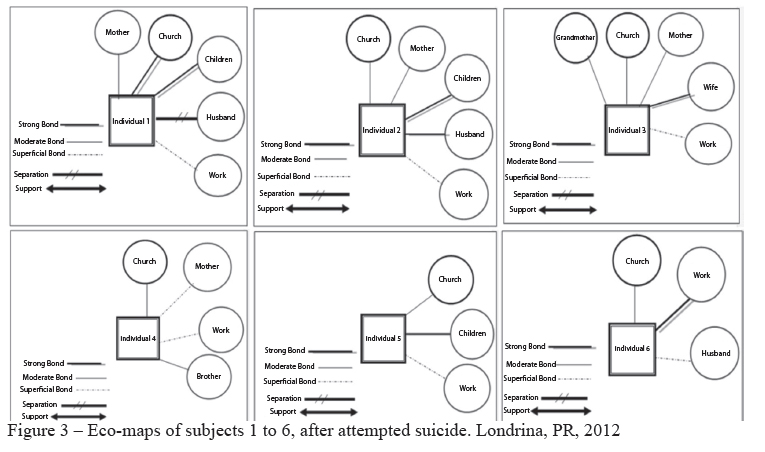
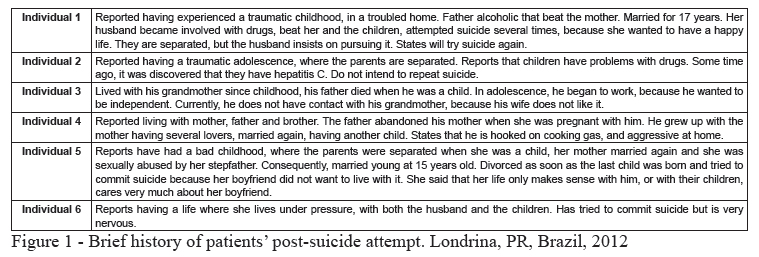
<body><![CDATA[<p><b><font face="verdana" size="3">Results</font></b></p>     <p><font face="verdana" size="2">There were two figures for   subject categorization constructed and a figure representing all the eco-maps   of the subjects in the study, to represent the social network of people   post-suicide attempt. The purpose of the eco-map is to represent the   relationships of individuals and families with the other systems, setting up a   strategy for greater visual impact and a quick view of information.</font></p>     <p><font face="verdana" size="2">The eco-maps (<a href="/img/revistas/smad/v10n3/a08fig03.jpg">Figure 3</a>) and <a href="/img/revistas/smad/v10n3/a08fig01.jpg">figures 1</a> and <a href="/img/revistas/smad/v10n3/a08fig02.jpg">2</a> represent the synthesis of the data obtained in the interviews.   The subjects were four female and two male. The ages ranged from 18 to 46   years. The level of instruction was consistent with an incomplete secondary   education and, as for occupation; the participants included a sales clerk, a   production assistant, a student, a housewife and two that reported not having   jobs.</font></p>     <p>&nbsp;</p>     <p><b><font face="verdana" size="3">Discussion</font></b></p>     <p><b><font face="verdana" size="2">Life   history</font></b></p>     <p><font face="verdana" size="2">Looking at the cases   studied it was found that, with the exception of subject 2, the others showed   traumatic events in their childhood in their family history<sup>(8)</sup>.&nbsp;   All people go through a cycle of life, where they are born, grow, mature, grow   old and die. However, many may or may not face something as serious as violence   in their childhood and adult life. Teens who commit suicide have in their   background, a higher proportion of fights, problems with the police, with the   law, in school, at work, with teenage pregnancy and abortions. Therefore, as   they get older, they cannot help but recall those moments of frustration,   suffering and separation. Unable to bear the burden of distressing feelings,   they opt for suicide; thinking this is the solution to their problems in their   relationships and interactions with family and society<sup> (9)</sup>. Along   with social support, the eco-map, helps assess family relationships with the   social environment for rehabilitation.</font></p>     <p><font face="verdana" size="2">As in the cases studied, <a href="/img/revistas/smad/v10n3/a08fig01.jpg">Figure 3</a> eco-maps showed that individuals 1 through 6 did not have links to   other people except for those living with them. This is believed to be one of   the factors that caused their suicidal behavior <sup>(10)</sup>.</font></p>     <p><font face="verdana" size="2">When examining <a href="/img/revistas/smad/v10n3/html/a08fig01-03.html">Figure 1-3</a>,   individuals 1-5 are seen to have psychosocial problems that accompanied them   since childhood. The first individual reported to have had a troubled   childhood, as well as the other individuals. Individuals 2 and 5 also   experienced times of suffering, in the presence of a dysfunctional family,   without social support and especially without familial support. The presence of   childhood trauma is common in the life history of many patients with psychiatric   disorders. The magnitude of the problem is variable, with some studies pointing   to the occurrence of childhood trauma in approximately 50% of adults with   psychopathology<sup>(11)</sup>.</font></p>     <p><font face="verdana" size="2">In <a href="/img/revistas/smad/v10n3/a08fig01.jpg">Figure 1</a>, individual 6   reports living under pressure with her husband and children and individual 4   reported that his father abandoned his mother when he was a child and he grew   up watching his mother having several boyfriends. In childhood, it is common   for children, that when faced with marital conflicts and other adverse events,   do not feel able and/or self-confident to face the problems of which they   witness or live. This dynamic tends to continue through adulthood, there is no   quick fix without proper treatment. Individuals who have been through traumatic   situations have extremely negative emotions and dysfunctional thoughts, but   psychotherapy can provide excellent resources for overcoming traumas<sup>(12)</sup>.</font></p>     ]]></body>
<body><![CDATA[<p><font face="verdana" size="2">Thus, from these case   studies, it was observed that the use of eco-map can benefit the practice of   nurses as well as other mental health professionals, because it allows for a   diagnosis of social support shown by the individual and thus making timely   interventions in prevention, protection and promotion of mental health of the   subject, enabling suicide prevention.</font></p>     <p><b><font face="verdana" size="2">Social support in the   subjects' everyday lives</font></b></p>     <p><font face="verdana" size="2">In all patients, according   to <a href="/img/revistas/smad/v10n3/a08fig02.jpg">Figure 2</a>, we can see weak social support, indicated by the absence of   friends and leisure activities. Failure to report the bond of friendship and to   trust no one, the only refuge is to be alone, or even to attempt suicide. One   of the factors that can be directly linked to the increase of suicide is   interpersonal difficulty, preventing the individual to make new friends and   share aspects of their life with friends. Therefore, they feel isolated,   without close contacts or confidants<sup>(13)</sup>.</font></p>     <p><font face="verdana" size="2">The human being exists as a being in relation to other people, that is,   needs to be included in a social environment. Everyone needs to have the bonds   of friendship, leisure time, additional close contacts, or significant   relationships from the interaction point of view. Teens who feel excluded from   their social groups feel despised, betrayed, sad, even manifesting   psychosomatic symptoms; all these feelings of pain and loneliness cause acts of   negative thoughts that can lead to isolation and even suicidal behavior<sup>(13)</sup>.</font></p>     <p><font face="verdana" size="2">In relation to work,   according to <a href="/img/revistas/smad/v10n3/a08fig02.jpg">Figure 2</a>, only subjects 3, 4 and 5 were employed, with subjects   only 3 and 5 reporting work as good. All subjects stated that they did not   leave the house, suggesting few recreational options and few physical   activities. We emphasize the importance of leisure activities outside of the   house and working-out. The practice of physical activities, in general, is a   behavioral option that offers a health promotion strategy, as well as improving   self-esteem. Social behavior can be improved with the use of eco-map, because   by using it you can view the information more effectively, enhancing the social   bonds of the individual and search for support<sup>(14)</sup>.</font></p>     <p><font face="verdana" size="2">It is common for people to   seek psychosocial care though these aspects: the therapist, prayer group,   self-esteem group, self-help group and others. The routine of everyday life   hinders the reduction of stress, participating in leisure with family and friends,   for example, alleviates daily excessive stress. For these people it is   important and necessary to reduce the perceived stress by the individual<sup>(15)</sup>.</font></p>     <p><font face="verdana" size="2">The person with stress   overload, discouraged and looking for relief can often look to church and worship.   Through participation in church or in church services there is more contact   with people, increasing their number of friends, improving the social bond of   these people. Philosophers, social scientists and social psychologists have   entered into an agreement in which they consider religion an important aspect   of life, with life's setbacks and suffering. Religion is fundamentally   important during times of crisis for individuals, such as: the loss of close   people, serious illness, disability and death. It is an essential element for   humans to have faith and believe that things can be improved, that life gets   better, with an emphasis on conversations about   health and mental disorders<sup>(16)</sup>.</font></p>     <p><font face="verdana" size="2">According to <a href="/img/revistas/smad/v10n3/a08fig02.jpg">Figure 2</a>, only the individual 6 went to church. Individual   1 participated in church, however infrequently, suggesting their social ties   had an impact on maintaining health, functioning as a protective factor in   stressful situations; this can reduce their impact on psychological well-being.   Thus, having a social support network and receiving help from individuals   belonging to this network can benefit their health and well-being. On the other   hand, poor social relations is mental health risk factor<sup>(17)</sup>.</font></p>     <p><font face="verdana" size="2">Social support is   associated with health problems and stress, and is based on two different   models. One is the direct effect model that considers social resources   beneficial to health, regardless of whether the person experiences stressful   events or not. The indirect effect model proposes that social support is   associated only with well-being. It can be seen in <a href="/img/revistas/smad/v10n3/a08fig02.jpg">Figure 2</a>, that social support   is absent; therefore, becoming a factor that increases the vulnerability of the   subject to stress, psychological distress, depressive feelings and suicidal   behavior<sup>(18)</sup>.</font></p>     <p>&nbsp;</p>     ]]></body>
<body><![CDATA[<p><b><font face="verdana" size="3">Conclusion</font></b></p>     <p><font face="verdana" size="2">The social support network   can be a predictor of suicide, but also serves as a resource for prevention of   suicide, from the perspective of stress coping theory and also for planning   mental health promotion activities. The eco-map proves to be a valuable tool   for nurses. It is an assessment tool that can be used to help the user to work   out social ties, highlighting those that need to be kept, broken or   strengthened as social support. The eco-map serves as a resource to identify   and evaluate the social support network, which showed it as weakened,   suggesting the psychosocial vulnerability of the subject to new suicide   attempts.</font></p>     <p><font face="verdana" size="2">It is believed that this   study is important for professional nursing practice, as it allows the   identification of risk and protective factors for suicide, helping to prevent   this event which is important in the current context.</font></p>     <p><font face="verdana" size="2">The limitation of this study is that it does not research the care   provided to the subject within the health care system, which does not draw   conclusions on the merits of health care, however, instead it provides   opportunities for important reflection on the social contexts from where the patients   are coming, which is important for intervention.</font></p>     <p>&nbsp;</p>     <p><b><font face="verdana" size="3">References</font></b></p>     <!-- ref --><p><font face="verdana" size="2">1.Organiza&ccedil;&atilde;o Mundial   de Sa&uacute;de (OMS). Preven&ccedil;&atilde;o do suic&iacute;dio: um recurso para conselheiros. Genebra:   OMS; 2006.    &nbsp;&nbsp;&nbsp;&nbsp;&nbsp;&nbsp;&nbsp;&nbsp;[&#160;<a href="javascript:void(0);" onclick="javascript: window.open('/scielo.php?script=sci_nlinks&ref=3496904&pid=S1806-6976201400030000800001&lng=','','width=640,height=500,resizable=yes,scrollbars=1,menubar=yes,');">Links</a>&#160;]<!-- end-ref --></font></p>     <!-- ref --><p><font face="verdana" size="2">2. Soares MH, Bueno   SMV. Sa&uacute;de mental: novas perspectivas. S&atilde;o Caetano do Sul: Yendis; 2011.    &nbsp;&nbsp;&nbsp;&nbsp;&nbsp;&nbsp;&nbsp;&nbsp;[&#160;<a href="javascript:void(0);" onclick="javascript: window.open('/scielo.php?script=sci_nlinks&ref=3496906&pid=S1806-6976201400030000800002&lng=','','width=640,height=500,resizable=yes,scrollbars=1,menubar=yes,');">Links</a>&#160;]<!-- end-ref --> </font></p>     ]]></body>
<body><![CDATA[<!-- ref --><p><font face="verdana" size="2">3. Gaspari VPP, Botega   NJ. Rede de apoio social e tentativa de suic&iacute;dio. J Bras Psiquiatria.   2002;51(4):233-40.    &nbsp;&nbsp;&nbsp;&nbsp;&nbsp;&nbsp;&nbsp;&nbsp;[&#160;<a href="javascript:void(0);" onclick="javascript: window.open('/scielo.php?script=sci_nlinks&ref=3496908&pid=S1806-6976201400030000800003&lng=','','width=640,height=500,resizable=yes,scrollbars=1,menubar=yes,');">Links</a>&#160;]<!-- end-ref --></font></p>     <!-- ref --><p><font face="verdana" size="2">4. Fonseca DM, Abelha   L, Lovisi GM, Legay LF. Apoio social, eventos estressantes e depress&atilde;o em casos   de tentativa de suic&iacute;dio: um estudo de caso-controle realizado em um hospital   de emerg&ecirc;ncia do Rio de Janeiro. Cad Sa&uacute;de Coletiva. 2010;18(2):217-28.    &nbsp;&nbsp;&nbsp;&nbsp;&nbsp;&nbsp;&nbsp;&nbsp;[&#160;<a href="javascript:void(0);" onclick="javascript: window.open('/scielo.php?script=sci_nlinks&ref=3496910&pid=S1806-6976201400030000800004&lng=','','width=640,height=500,resizable=yes,scrollbars=1,menubar=yes,');">Links</a>&#160;]<!-- end-ref --></font></p>     <!-- ref --><p><font face="verdana" size="2">5. Nutbeam D. Health   promotion glossary. Health Promot Internation. 1998;13(4):349-64.    &nbsp;&nbsp;&nbsp;&nbsp;&nbsp;&nbsp;&nbsp;&nbsp;[&#160;<a href="javascript:void(0);" onclick="javascript: window.open('/scielo.php?script=sci_nlinks&ref=3496912&pid=S1806-6976201400030000800005&lng=','','width=640,height=500,resizable=yes,scrollbars=1,menubar=yes,');">Links</a>&#160;]<!-- end-ref --> </font></p>     <!-- ref --><p><font face="verdana" size="2">6. Gon&ccedil;alves TR,   Pawlowski J, Bandeira D, Piccinini CA. Avalia&ccedil;&atilde;o de apoio social em estudos   brasileiros: aspectos conceituais e instrumentos. Ci&ecirc;nc Sa&uacute;de Coletiva. 2011;16   (3):1755-69.    &nbsp;&nbsp;&nbsp;&nbsp;&nbsp;&nbsp;&nbsp;&nbsp;[&#160;<a href="javascript:void(0);" onclick="javascript: window.open('/scielo.php?script=sci_nlinks&ref=3496914&pid=S1806-6976201400030000800006&lng=','','width=640,height=500,resizable=yes,scrollbars=1,menubar=yes,');">Links</a>&#160;]<!-- end-ref --></font></p>     <!-- ref --><p><font face="verdana" size="2">7. Lazarus RS, Folkman   S. Stress, appraisal and coping. New York: Springer; 1984.    &nbsp;&nbsp;&nbsp;&nbsp;&nbsp;&nbsp;&nbsp;&nbsp;[&#160;<a href="javascript:void(0);" onclick="javascript: window.open('/scielo.php?script=sci_nlinks&ref=3496916&pid=S1806-6976201400030000800007&lng=','','width=640,height=500,resizable=yes,scrollbars=1,menubar=yes,');">Links</a>&#160;]<!-- end-ref --></font></p>     ]]></body>
<body><![CDATA[<!-- ref --><p><font face="verdana" size="2">8. Mann J. The   neurobiology of suicide. Nat Med. 1998;4:25-30.    &nbsp;&nbsp;&nbsp;&nbsp;&nbsp;&nbsp;&nbsp;&nbsp;[&#160;<a href="javascript:void(0);" onclick="javascript: window.open('/scielo.php?script=sci_nlinks&ref=3496918&pid=S1806-6976201400030000800008&lng=','','width=640,height=500,resizable=yes,scrollbars=1,menubar=yes,');">Links</a>&#160;]<!-- end-ref --></font></p>     <!-- ref --><p><font face="verdana" size="2">9. Avanci RC, Pedr&atilde;o   LJ, Costa J&uacute;nior ML. Perfil do adolescente que tenta suic&iacute;dio em uma unidade de   emerg&ecirc;ncia. Rev Bras Enferm. 2005;58(5):535-9.    &nbsp;&nbsp;&nbsp;&nbsp;&nbsp;&nbsp;&nbsp;&nbsp;[&#160;<a href="javascript:void(0);" onclick="javascript: window.open('/scielo.php?script=sci_nlinks&ref=3496920&pid=S1806-6976201400030000800009&lng=','','width=640,height=500,resizable=yes,scrollbars=1,menubar=yes,');">Links</a>&#160;]<!-- end-ref --></font></p>     <!-- ref --><p><font face="verdana" size="2">10. Nascimento LC,   Rocha SMM, Hayes VE. Contribui&ccedil;&otilde;es do genograma e do ecomapa para o estudo de   fam&iacute;lias em enfermagem pedi&aacute;trica. Texto Contexto Enferm. 2005;14(2):280-6.    &nbsp;&nbsp;&nbsp;&nbsp;&nbsp;&nbsp;&nbsp;&nbsp;[&#160;<a href="javascript:void(0);" onclick="javascript: window.open('/scielo.php?script=sci_nlinks&ref=3496922&pid=S1806-6976201400030000800010&lng=','','width=640,height=500,resizable=yes,scrollbars=1,menubar=yes,');">Links</a>&#160;]<!-- end-ref --></font></p>     <!-- ref --><p><font face="verdana" size="2">11. Zavaschi LMS, Satler F, Poester D, Vargas CF,   Pizenski R, Rohde LAP, et al. Associa&ccedil;&atilde;o entre trauma por perda na inf&acirc;ncia e   depress&atilde;o na vida adulta. Rev Bras Psiquiatr. &#91;Internet&#93; 2002 &#91;acesso 10 jan   2013&#93;; 24(4):189-95. Dispon&iacute;vel em: <a href="http://www.scielo.br/pdf/rbp/v24n4/12728.pdf" target="_blank">http://www.scielo.br/pdf/rbp/v24n4/12728.pdf</a></font>&nbsp;&nbsp;&nbsp;&nbsp;&nbsp;&nbsp;&nbsp;&nbsp;[&#160;<a href="javascript:void(0);" onclick="javascript: window.open('/scielo.php?script=sci_nlinks&ref=3496924&pid=S1806-6976201400030000800011&lng=','','width=640,height=500,resizable=yes,scrollbars=1,menubar=yes,');">Links</a>&#160;]<!-- end-ref --><!-- ref --><p><font face="verdana" size="2">12. Avanci RC, Pedr&atilde;o   LJ, Costa ML J&uacute;nior. Perfil do adolescente que tenta suic&iacute;dio em uma unidade de   emerg&ecirc;ncia. Rev Bras Enferm. 2005;58(5):535-9.    &nbsp;&nbsp;&nbsp;&nbsp;&nbsp;&nbsp;&nbsp;&nbsp;[&#160;<a href="javascript:void(0);" onclick="javascript: window.open('/scielo.php?script=sci_nlinks&ref=3496925&pid=S1806-6976201400030000800012&lng=','','width=640,height=500,resizable=yes,scrollbars=1,menubar=yes,');">Links</a>&#160;]<!-- end-ref --></font></p>     <!-- ref --><p><font face="verdana" size="2">13. Baptista VM.   Planejamento social: intencionalidade e instrumenta&ccedil;&atilde;o. S&atilde;o Paulo: Veras; 2007.    &nbsp;&nbsp;&nbsp;&nbsp;&nbsp;&nbsp;&nbsp;&nbsp;[&#160;<a href="javascript:void(0);" onclick="javascript: window.open('/scielo.php?script=sci_nlinks&ref=3496927&pid=S1806-6976201400030000800013&lng=','','width=640,height=500,resizable=yes,scrollbars=1,menubar=yes,');">Links</a>&#160;]<!-- end-ref --></font></p>     <!-- ref --><p><font face="verdana" size="2">14. Pond&eacute; MP, Cardoso   C. Lazer como fator de prote&ccedil;&atilde;o da sa&uacute;de mental. Rev Cienc Med.   2003;12(2):165-72.    &nbsp;&nbsp;&nbsp;&nbsp;&nbsp;&nbsp;&nbsp;&nbsp;[&#160;<a href="javascript:void(0);" onclick="javascript: window.open('/scielo.php?script=sci_nlinks&ref=3496929&pid=S1806-6976201400030000800014&lng=','','width=640,height=500,resizable=yes,scrollbars=1,menubar=yes,');">Links</a>&#160;]<!-- end-ref --></font></p>     <!-- ref --><p><font face="verdana" size="2">15. Dalgalarrondo P.   Religi&atilde;o, psicopatologia e sa&uacute;de mental. Porto Alegre: Artmed; 2008.    &nbsp;&nbsp;&nbsp;&nbsp;&nbsp;&nbsp;&nbsp;&nbsp;[&#160;<a href="javascript:void(0);" onclick="javascript: window.open('/scielo.php?script=sci_nlinks&ref=3496931&pid=S1806-6976201400030000800015&lng=','','width=640,height=500,resizable=yes,scrollbars=1,menubar=yes,');">Links</a>&#160;]<!-- end-ref --> </font></p>     <!-- ref --><p><font face="verdana" size="2">16. Harold GK, Religi&atilde;o,   espiritualidade e transtornos psic&oacute;ticos. Rev Psiq Cl&iacute;n. 2007;34(Suppl   1):195-204.    &nbsp;&nbsp;&nbsp;&nbsp;&nbsp;&nbsp;&nbsp;&nbsp;[&#160;<a href="javascript:void(0);" onclick="javascript: window.open('/scielo.php?script=sci_nlinks&ref=3496933&pid=S1806-6976201400030000800016&lng=','','width=640,height=500,resizable=yes,scrollbars=1,menubar=yes,');">Links</a>&#160;]<!-- end-ref --></font></p>     <!-- ref --><p><font face="verdana" size="2">17. Schneider A,   Ramires V. V&iacute;nculo parental e rede de apoio social: rela&ccedil;&atilde;o com a sintomatologia   depressiva na adolesc&ecirc;ncia. Aletheia; 2007;26:95-108.    &nbsp;&nbsp;&nbsp;&nbsp;&nbsp;&nbsp;&nbsp;&nbsp;[&#160;<a href="javascript:void(0);" onclick="javascript: window.open('/scielo.php?script=sci_nlinks&ref=3496935&pid=S1806-6976201400030000800017&lng=','','width=640,height=500,resizable=yes,scrollbars=1,menubar=yes,');">Links</a>&#160;]<!-- end-ref --></font></p>     <!-- ref --><p><font face="verdana" size="2">18. Fonseca DM, Abelha   L, Lovisi GM, Legay LF. Apoio social, eventos estressantes e depress&atilde;o em casos   de tentativa de suic&iacute;dio: um estudo de caso-controle realizado em um hospital   de emerg&ecirc;ncia do Rio de Janeiro. Cad Sa&uacute;de Coletiva. 2010;18(2):217-28.    &nbsp;&nbsp;&nbsp;&nbsp;&nbsp;&nbsp;&nbsp;&nbsp;[&#160;<a href="javascript:void(0);" onclick="javascript: window.open('/scielo.php?script=sci_nlinks&ref=3496937&pid=S1806-6976201400030000800018&lng=','','width=640,height=500,resizable=yes,scrollbars=1,menubar=yes,');">Links</a>&#160;]<!-- end-ref --></font></p>     <p>&nbsp;</p>     <p>&nbsp;</p>     <p><font face="verdana" size="2"><b><a name="end"></a><a href="#top"><img src="/img/revistas/smad/v10n3/seta.jpg" width="15" height="17"></a>Correspondence</b>    <br>   Marcos Hirata Soares    <br>   Universidade Estadual de Londrina. Centro de Ci&ecirc;ncias da Sa&uacute;de    <br>   Departamento de Enfermagem    <br>   Av. Robert Koch, 60    <br>   Vila Oper&aacute;ria    <br>   CEP: 86038-350, Londrina, PR, Brasil    ]]></body>
<body><![CDATA[<br>   E-mail: <a href="mailto:mhirata@uel.br">mhirata@uel.br</a></font></p>     <p><font face="verdana" size="2">Received: May. 13<sup>th</sup> 2013    <br>   Accepted: Apr. 22<sup>nd</sup> 2014</font></p>      ]]></body>
<back>
<ref-list>
<ref id="B1">
<label>1</label><nlm-citation citation-type="book">
<collab>Organização Mundial de Saúde</collab>
<source><![CDATA[Prevenção do suicídio: um recurso para conselheiros]]></source>
<year>2006</year>
<publisher-loc><![CDATA[Genebra ]]></publisher-loc>
<publisher-name><![CDATA[OMS]]></publisher-name>
</nlm-citation>
</ref>
<ref id="B2">
<label>2</label><nlm-citation citation-type="book">
<person-group person-group-type="author">
<name>
<surname><![CDATA[Soares]]></surname>
<given-names><![CDATA[MH]]></given-names>
</name>
<name>
<surname><![CDATA[Bueno]]></surname>
<given-names><![CDATA[SMV]]></given-names>
</name>
</person-group>
<source><![CDATA[Saúde mental: novas perspectivas]]></source>
<year>2011</year>
<publisher-loc><![CDATA[São Caetano do Sul ]]></publisher-loc>
<publisher-name><![CDATA[Yendis]]></publisher-name>
</nlm-citation>
</ref>
<ref id="B3">
<label>3</label><nlm-citation citation-type="journal">
<person-group person-group-type="author">
<name>
<surname><![CDATA[Gaspari]]></surname>
<given-names><![CDATA[VPP]]></given-names>
</name>
<name>
<surname><![CDATA[Botega]]></surname>
<given-names><![CDATA[NJ]]></given-names>
</name>
</person-group>
<article-title xml:lang="pt"><![CDATA[Rede de apoio social e tentativa de suicídio]]></article-title>
<source><![CDATA[J Bras Psiquiatria]]></source>
<year>2002</year>
<volume>51</volume>
<numero>4</numero>
<issue>4</issue>
<page-range>233-40</page-range></nlm-citation>
</ref>
<ref id="B4">
<label>4</label><nlm-citation citation-type="journal">
<person-group person-group-type="author">
<name>
<surname><![CDATA[Fonseca]]></surname>
<given-names><![CDATA[DM]]></given-names>
</name>
<name>
<surname><![CDATA[Abelha]]></surname>
<given-names><![CDATA[L]]></given-names>
</name>
<name>
<surname><![CDATA[Lovisi]]></surname>
<given-names><![CDATA[GM]]></given-names>
</name>
<name>
<surname><![CDATA[Legay]]></surname>
<given-names><![CDATA[LF]]></given-names>
</name>
</person-group>
<article-title xml:lang="pt"><![CDATA[Apoio social, eventos estressantes e depressão em casos de tentativa de suicídio: um estudo de caso-controle realizado em um hospital de emergência do Rio de Janeiro]]></article-title>
<source><![CDATA[Cad Saúde Coletiva]]></source>
<year>2010</year>
<volume>18</volume>
<numero>2</numero>
<issue>2</issue>
<page-range>217-28</page-range></nlm-citation>
</ref>
<ref id="B5">
<label>5</label><nlm-citation citation-type="journal">
<person-group person-group-type="author">
<name>
<surname><![CDATA[Nutbeam]]></surname>
<given-names><![CDATA[D]]></given-names>
</name>
</person-group>
<article-title xml:lang="en"><![CDATA[Health promotion glossary]]></article-title>
<source><![CDATA[Health Promot Internation]]></source>
<year>1998</year>
<volume>13</volume>
<numero>4</numero>
<issue>4</issue>
<page-range>349-64</page-range></nlm-citation>
</ref>
<ref id="B6">
<label>6</label><nlm-citation citation-type="journal">
<person-group person-group-type="author">
<name>
<surname><![CDATA[Gonçalves]]></surname>
<given-names><![CDATA[TR]]></given-names>
</name>
<name>
<surname><![CDATA[Pawlowski]]></surname>
<given-names><![CDATA[J]]></given-names>
</name>
<name>
<surname><![CDATA[Bandeira]]></surname>
<given-names><![CDATA[D]]></given-names>
</name>
<name>
<surname><![CDATA[Piccinini]]></surname>
<given-names><![CDATA[CA]]></given-names>
</name>
</person-group>
<article-title xml:lang="pt"><![CDATA[Avaliação de apoio social em estudos brasileiros: aspectos conceituais e instrumentos]]></article-title>
<source><![CDATA[Ciênc Saúde Coletiva]]></source>
<year>2011</year>
<volume>16</volume>
<numero>3</numero>
<issue>3</issue>
<page-range>1755-69</page-range></nlm-citation>
</ref>
<ref id="B7">
<label>7</label><nlm-citation citation-type="book">
<person-group person-group-type="author">
<name>
<surname><![CDATA[Lazarus]]></surname>
<given-names><![CDATA[RS]]></given-names>
</name>
<name>
<surname><![CDATA[Folkman]]></surname>
<given-names><![CDATA[S]]></given-names>
</name>
</person-group>
<source><![CDATA[Stress, appraisal and coping]]></source>
<year>1984</year>
<publisher-loc><![CDATA[New York ]]></publisher-loc>
<publisher-name><![CDATA[Springer]]></publisher-name>
</nlm-citation>
</ref>
<ref id="B8">
<label>8</label><nlm-citation citation-type="journal">
<person-group person-group-type="author">
<name>
<surname><![CDATA[Mann]]></surname>
<given-names><![CDATA[J]]></given-names>
</name>
</person-group>
<article-title xml:lang="en"><![CDATA[The neurobiology of suicide]]></article-title>
<source><![CDATA[Nat Med]]></source>
<year>1998</year>
<volume>4</volume>
<page-range>25-30</page-range></nlm-citation>
</ref>
<ref id="B9">
<label>9</label><nlm-citation citation-type="journal">
<person-group person-group-type="author">
<name>
<surname><![CDATA[Avanci]]></surname>
<given-names><![CDATA[RC]]></given-names>
</name>
<name>
<surname><![CDATA[Pedrão]]></surname>
<given-names><![CDATA[LJ]]></given-names>
</name>
<name>
<surname><![CDATA[Costa Júnior]]></surname>
<given-names><![CDATA[ML]]></given-names>
</name>
</person-group>
<article-title xml:lang="pt"><![CDATA[Perfil do adolescente que tenta suicídio em uma unidade de emergência]]></article-title>
<source><![CDATA[Rev Bras Enferm]]></source>
<year>2005</year>
<volume>58</volume>
<numero>5</numero>
<issue>5</issue>
<page-range>535-9</page-range></nlm-citation>
</ref>
<ref id="B10">
<label>10</label><nlm-citation citation-type="journal">
<person-group person-group-type="author">
<name>
<surname><![CDATA[Nascimento]]></surname>
<given-names><![CDATA[LC]]></given-names>
</name>
<name>
<surname><![CDATA[Rocha]]></surname>
<given-names><![CDATA[SMM]]></given-names>
</name>
<name>
<surname><![CDATA[Hayes]]></surname>
<given-names><![CDATA[VE]]></given-names>
</name>
</person-group>
<article-title xml:lang="pt"><![CDATA[Contribuições do genograma e do ecomapa para o estudo de famílias em enfermagem pediátrica]]></article-title>
<source><![CDATA[Texto Contexto Enferm]]></source>
<year>2005</year>
<volume>14</volume>
<numero>2</numero>
<issue>2</issue>
<page-range>280-6</page-range></nlm-citation>
</ref>
<ref id="B11">
<label>11</label><nlm-citation citation-type="journal">
<person-group person-group-type="author">
<name>
<surname><![CDATA[Zavaschi]]></surname>
<given-names><![CDATA[LMS]]></given-names>
</name>
<name>
<surname><![CDATA[Satler]]></surname>
<given-names><![CDATA[F]]></given-names>
</name>
<name>
<surname><![CDATA[Poester]]></surname>
<given-names><![CDATA[D]]></given-names>
</name>
<name>
<surname><![CDATA[Vargas]]></surname>
<given-names><![CDATA[CF]]></given-names>
</name>
<name>
<surname><![CDATA[Pizenski]]></surname>
<given-names><![CDATA[R]]></given-names>
</name>
<name>
<surname><![CDATA[Rohde]]></surname>
<given-names><![CDATA[LAP]]></given-names>
</name>
</person-group>
<article-title xml:lang="pt"><![CDATA[Associação entre trauma por perda na infância e depressão na vida adulta]]></article-title>
<source><![CDATA[Rev Bras Psiquiatr]]></source>
<year>2002</year>
<volume>24</volume>
<numero>4</numero>
<issue>4</issue>
<page-range>189-95</page-range></nlm-citation>
</ref>
<ref id="B12">
<label>12</label><nlm-citation citation-type="journal">
<person-group person-group-type="author">
<name>
<surname><![CDATA[Avanci]]></surname>
<given-names><![CDATA[RC]]></given-names>
</name>
<name>
<surname><![CDATA[Pedrão]]></surname>
<given-names><![CDATA[LJ]]></given-names>
</name>
<name>
<surname><![CDATA[Costa Júnior]]></surname>
<given-names><![CDATA[ML]]></given-names>
</name>
</person-group>
<article-title xml:lang="pt"><![CDATA[Perfil do adolescente que tenta suicídio em uma unidade de emergência]]></article-title>
<source><![CDATA[Rev Bras Enferm]]></source>
<year>2005</year>
<volume>58</volume>
<numero>5</numero>
<issue>5</issue>
<page-range>535-9</page-range></nlm-citation>
</ref>
<ref id="B13">
<label>13</label><nlm-citation citation-type="book">
<person-group person-group-type="author">
<name>
<surname><![CDATA[Baptista]]></surname>
<given-names><![CDATA[VM]]></given-names>
</name>
</person-group>
<source><![CDATA[Planejamento social: intencionalidade e instrumentação]]></source>
<year>2007</year>
<publisher-loc><![CDATA[São Paulo ]]></publisher-loc>
<publisher-name><![CDATA[Veras]]></publisher-name>
</nlm-citation>
</ref>
<ref id="B14">
<label>14</label><nlm-citation citation-type="journal">
<person-group person-group-type="author">
<name>
<surname><![CDATA[Pondé]]></surname>
<given-names><![CDATA[MP]]></given-names>
</name>
<name>
<surname><![CDATA[Cardoso]]></surname>
<given-names><![CDATA[C]]></given-names>
</name>
</person-group>
<article-title xml:lang="pt"><![CDATA[Lazer como fator de proteção da saúde mental]]></article-title>
<source><![CDATA[Rev Cienc Med]]></source>
<year>2003</year>
<volume>12</volume>
<numero>2</numero>
<issue>2</issue>
<page-range>165-72</page-range></nlm-citation>
</ref>
<ref id="B15">
<label>15</label><nlm-citation citation-type="book">
<person-group person-group-type="author">
<name>
<surname><![CDATA[Dalgalarrondo]]></surname>
<given-names><![CDATA[P]]></given-names>
</name>
</person-group>
<source><![CDATA[Religião, psicopatologia e saúde mental]]></source>
<year>2008</year>
<publisher-loc><![CDATA[Porto Alegre ]]></publisher-loc>
<publisher-name><![CDATA[Artmed]]></publisher-name>
</nlm-citation>
</ref>
<ref id="B16">
<label>16</label><nlm-citation citation-type="journal">
<person-group person-group-type="author">
<name>
<surname><![CDATA[Harold]]></surname>
<given-names><![CDATA[GK]]></given-names>
</name>
</person-group>
<article-title xml:lang="en"><![CDATA[Religião. espiritualidade e transtornos psicóticos]]></article-title>
<source><![CDATA[Rev Psiq Clín]]></source>
<year>2007</year>
<volume>34</volume>
<numero>^s1</numero>
<issue>^s1</issue>
<supplement>1</supplement>
<page-range>195-204</page-range></nlm-citation>
</ref>
<ref id="B17">
<label>17</label><nlm-citation citation-type="journal">
<person-group person-group-type="author">
<name>
<surname><![CDATA[Schneider]]></surname>
<given-names><![CDATA[A]]></given-names>
</name>
<name>
<surname><![CDATA[Ramires]]></surname>
<given-names><![CDATA[V]]></given-names>
</name>
</person-group>
<article-title xml:lang="pt"><![CDATA[Vínculo parental e rede de apoio social: relação com a sintomatologia depressiva na adolescência]]></article-title>
<source><![CDATA[Aletheia;]]></source>
<year>2007</year>
<volume>26</volume>
<page-range>95-108</page-range></nlm-citation>
</ref>
<ref id="B18">
<label>18</label><nlm-citation citation-type="journal">
<person-group person-group-type="author">
<name>
<surname><![CDATA[Fonseca]]></surname>
<given-names><![CDATA[DM]]></given-names>
</name>
<name>
<surname><![CDATA[Abelha]]></surname>
<given-names><![CDATA[L]]></given-names>
</name>
<name>
<surname><![CDATA[Lovisi]]></surname>
<given-names><![CDATA[GM]]></given-names>
</name>
<name>
<surname><![CDATA[Legay]]></surname>
<given-names><![CDATA[LF]]></given-names>
</name>
</person-group>
<article-title xml:lang="pt"><![CDATA[Apoio social, eventos estressantes e depressão em casos de tentativa de suicídio: um estudo de caso-controle realizado em um hospital de emergência do Rio de Janeiro]]></article-title>
<source><![CDATA[Cad Saúde Coletiva]]></source>
<year>2010</year>
<volume>18</volume>
<numero>2</numero>
<issue>2</issue>
<page-range>217-28</page-range></nlm-citation>
</ref>
</ref-list>
</back>
</article>
