<?xml version="1.0" encoding="ISO-8859-1"?><article xmlns:mml="http://www.w3.org/1998/Math/MathML" xmlns:xlink="http://www.w3.org/1999/xlink" xmlns:xsi="http://www.w3.org/2001/XMLSchema-instance">
<front>
<journal-meta>
<journal-id>2594-9985</journal-id>
<journal-title><![CDATA[Current Ethology]]></journal-title>
<abbrev-journal-title><![CDATA[Curr. Ethol.]]></abbrev-journal-title>
<issn>2594-9985</issn>
<publisher>
<publisher-name><![CDATA[Sociedade Brasileira de Etologia]]></publisher-name>
</publisher>
</journal-meta>
<article-meta>
<article-id>S2594-99852016000200001</article-id>
<title-group>
<article-title xml:lang="en"><![CDATA[Social behavior adaptations in agroup of black-and-gold howler monkeys (Alouattta caraya; Primates, Atelidae) inside an urban forest in the southeast of Brazil]]></article-title>
<article-title xml:lang="pt"><![CDATA[Adaptações do comportamento social em um grupo de macacos bugios pretos e dourados (Alouatta caraya; Primatas, Atelidae) dentro de uma floresta urbana no sudeste do Brasil]]></article-title>
</title-group>
<contrib-group>
<contrib contrib-type="author">
<name>
<surname><![CDATA[Sampaio]]></surname>
<given-names><![CDATA[Ricardo]]></given-names>
</name>
<xref ref-type="aff" rid="A01"/>
</contrib>
<contrib contrib-type="author">
<name>
<surname><![CDATA[Gomes]]></surname>
<given-names><![CDATA[Hugo Lopes]]></given-names>
</name>
<xref ref-type="aff" rid="A01"/>
</contrib>
<contrib contrib-type="author">
<name>
<surname><![CDATA[Braga-hirano]]></surname>
<given-names><![CDATA[Zelinda Maria]]></given-names>
</name>
<xref ref-type="aff" rid="A03"/>
</contrib>
<contrib contrib-type="author">
<name>
<surname><![CDATA[Pedrosa]]></surname>
<given-names><![CDATA[Juliana Moutinho]]></given-names>
</name>
<xref ref-type="aff" rid="A01"/>
</contrib>
<contrib contrib-type="author">
<name>
<surname><![CDATA[Santos]]></surname>
<given-names><![CDATA[Wagner Ferreira Dos]]></given-names>
</name>
<xref ref-type="aff" rid="A01"/>
<xref ref-type="aff" rid="A03"/>
</contrib>
</contrib-group>
<aff id="A01">
<institution><![CDATA[,USP FFCLRP ]]></institution>
<addr-line><![CDATA[Ribeirão Preto SP]]></addr-line>
<country>Brazil</country>
</aff>
<aff id="A02">
<institution><![CDATA[,Regional University of Blumenau  ]]></institution>
<addr-line><![CDATA[Blumenau SC]]></addr-line>
<country>Brazil</country>
</aff>
<aff id="A03">
<institution><![CDATA[,Behavioral Neurosciences Institute  ]]></institution>
<addr-line><![CDATA[Ribeirão Preto São Paulo]]></addr-line>
<country>Brazil</country>
</aff>
<pub-date pub-type="pub">
<day>00</day>
<month>00</month>
<year>2016</year>
</pub-date>
<pub-date pub-type="epub">
<day>00</day>
<month>00</month>
<year>2016</year>
</pub-date>
<volume>15</volume>
<numero>2</numero>
<fpage>1</fpage>
<lpage>15</lpage>
<copyright-statement/>
<copyright-year/>
<self-uri xlink:href="http://pepsic.bvsalud.org/scielo.php?script=sci_arttext&amp;pid=S2594-99852016000200001&amp;lng=en&amp;nrm=iso"></self-uri><self-uri xlink:href="http://pepsic.bvsalud.org/scielo.php?script=sci_abstract&amp;pid=S2594-99852016000200001&amp;lng=en&amp;nrm=iso"></self-uri><self-uri xlink:href="http://pepsic.bvsalud.org/scielo.php?script=sci_pdf&amp;pid=S2594-99852016000200001&amp;lng=en&amp;nrm=iso"></self-uri><abstract abstract-type="short" xml:lang="en"><p><![CDATA[Primates of the Alouatta genus arefolivore - frugivore, resulting in a strategy of reduced energy expenditure, and the spatial relationships between these animals may constitutean important indication of how they establish their social organization. This study aimed to evaluatethe social behaviorof a group of black-and-gold howler monkeys (Alouata caraya) in an urban forest (3 ha) located in Ribeirão Preto (21º10'17" S and 47º48'05" W; São Paulo, Brazil). Thisgroup was organized in a harem systemthat faced instability,although during the study an age-graded system seems to have been stablished in the group. Amatrifocal subgroup was located in the center of the group and a male coalition was located in its periphery. However, this setting changed over the year. Few agonistic episodes were observed (2),and the inter-individual competition seemed reduced due to the high availability of fruit. This study providesimportant information about the plasticity in the social behavior of black-and-gold howler monkeys under the influence of anthropic actionand isolation of habitat.]]></p></abstract>
<abstract abstract-type="short" xml:lang="pt"><p><![CDATA[Os primatas do gênero Alouatta são descritos como folívoros - frugívoros, o que pode levar a uma estratégia de redução do gasto energético e o relacionamento espacial entre indivíduos pode constituir uma importante indicação de como um grupo estabelece sua organização social. Nosso estudo avaliouo comportamento social de um grupo de bugios pretos e dourados (Alouata caraya) em uma floresta urbana (3 ha) em Ribeirão Preto (21º10'17 "S e 47º48'05" W; São Paulo, Brasil). Este grupo se organizou em um sistema de harém, enfrentando instabilidade, porém ao longo do estudo um sistema por ordem de idade parece ter sido estabelecido no grupo. Um subgrupo matrifocal estava localizado no centro do grupo e uma coalizão de machos na periferia, mas essa configuração mudou ao longo do ano. Vimos somente poucos episódios agonísticos (2) e a competição interindividual pareceu diminuída devido à alta disponibilidade de frutos. Este estudo fornece importante informações sobre a plasticidade no comportamento social de bugios vivendo sob influência da ação antrópica e isolamento do hábitat.]]></p></abstract>
<kwd-group>
<kwd lng="en"><![CDATA[Black howler monkey]]></kwd>
<kwd lng="en"><![CDATA[urban forest]]></kwd>
<kwd lng="en"><![CDATA[Alouatta caraya]]></kwd>
<kwd lng="en"><![CDATA[social interaction]]></kwd>
<kwd lng="pt"><![CDATA[Bugio preto]]></kwd>
<kwd lng="pt"><![CDATA[floresta urbana]]></kwd>
<kwd lng="pt"><![CDATA[Alouatta caraya]]></kwd>
<kwd lng="pt"><![CDATA[interação social]]></kwd>
</kwd-group>
</article-meta>
</front><body><![CDATA[ <p><font face="Verdana, Arial, Helvetica, sans-serif" size="4"><b>Social    behavior adaptations in agroup of black-and-gold howler monkeys (<i>Alouattta    caraya</i>; Primates, <i>Atelidae</i>) inside an urban forest in the southeast    of Brazil<a name="top"></a></b></font></p>     <p>&nbsp;</p>     <p><font face="Verdana, Arial, Helvetica, sans-serif" size="3"><b>Adapta&ccedil;&otilde;es    do comportamento social em um grupo de macacos bugios pretos e dourados (<i>Alouatta    caraya</i>; Primatas, Atelidae) dentro de uma floresta urbana no sudeste do    Brasil.</b></font></p>     <p>&nbsp;</p>     <p>&nbsp;</p>     <p><font face="Verdana, Arial, Helvetica, sans-serif" size="2"><b>Ricardo Sampaio<sup>I,    </sup><a href="#back_fn_ast1"><sup>*</sup></a>; Hugo Lopes Gomes<sup>II</sup>;    Zelinda Maria Braga-hirano<sup>III</sup>; Juliana Moutinho Pedrosa<sup>IV</sup>;&nbsp;    Wagner Ferreira Dos Santos<sup>II</sup><sup>, </sup><sup>IV</sup><sup>, </sup><sup>V</sup></b></font></p>     <p><font face="Verdana, Arial, Helvetica, sans-serif" size="2"><sup>I</sup>Postgraduate    Program in Comparative Biology (FFCLRP-USP), Ribeir&atilde;o Preto, SP, Brazil    <br>   <sup>II</sup>Postgraduate Program in Psychobiology (FFCLRP-USP), Ribeir&atilde;o    Preto, SP, Brazil    <br>   <sup>III</sup>Regional University of Blumenau (FURB), Blumenau, SC, Brazil    <br>   <sup>IV</sup>Biology Department, Collegeof Philosophy, Sciences and Literature    of Ribeir&atilde;o Preto - University of S&atilde;o Paulo (FFCLRP-USP); Barba-Negra    Project,Ribeir&atilde;o Preto, SP, Brazil    ]]></body>
<body><![CDATA[<br>   <sup>V</sup>Behavioral Neurosciences Institute (INeC), Ribeir&atilde;o Preto,    S&atilde;o Paulo, Brazil</font></p>     <p>&nbsp;</p>     <p>&nbsp;</p> <hr noshade size="1">     <p><font face="Verdana, Arial, Helvetica, sans-serif" size="2"><b>ABSTRACT</b></font></p>     <p><font face="Verdana, Arial, Helvetica, sans-serif" size="2">Primates of the    <i>Alouatta</i> genus are<i>folivore </i>- <i>frugivore</i>, resulting in a    strategy of reduced energy expenditure, and the spatial relationships between    these animals may constitutean important indication of how they establish their    social organization. This study aimed to evaluatethe social behaviorof a group    of black-and-gold howler monkeys (<i>Alouata caraya</i>) in an urban forest    (3 ha) located in Ribeir&atilde;o Preto (21&ordm;10'17" S and 47&ordm;48'05"    W; S&atilde;o Paulo, Brazil). Thisgroup was organized in a harem systemthat    faced instability,although during the study an age-graded system seems to have    been stablished in the group. Amatrifocal subgroup was located in the center    of the group and a male coalition was located in its periphery. However, this    setting changed over the year. Few agonistic episodes were observed (2),and    the inter-individual competition seemed reduced due to the high availability    of fruit. This study providesimportant information about the plasticity in the    social behavior of black-and-gold howler monkeys under the influence of anthropic    actionand isolation of habitat.</font></p>     <p><font face="Verdana, Arial, Helvetica, sans-serif" size="2"><b>Keywords</b>:    Black howler monkey, urban forest, Alouatta caraya, social interaction.</font></p> <hr noshade size="1">     <p><font face="Verdana, Arial, Helvetica, sans-serif" size="2"><b>RESUMO</b></font></p>     <p><font face="Verdana, Arial, Helvetica, sans-serif" size="2">Os primatas do    g&ecirc;nero <i>Alouatta</i> s&atilde;o descritos como fol&iacute;voros - frug&iacute;voros,    o que pode levar a uma estrat&eacute;gia de redu&ccedil;&atilde;o do gasto energ&eacute;tico    e o relacionamento espacial entre indiv&iacute;duos pode constituir uma importante    indica&ccedil;&atilde;o de como um grupo estabelece sua organiza&ccedil;&atilde;o    social. Nosso estudo avaliouo comportamento social de um grupo de bugios pretos    e dourados (<i>Alouata caraya</i>) em uma floresta urbana (3 ha) em Ribeir&atilde;o    Preto (21&ordm;10'17 "S e 47&ordm;48'05" W; S&atilde;o Paulo, Brasil). Este    grupo se organizou em um sistema de har&eacute;m, enfrentando instabilidade,    por&eacute;m ao longo do estudo um sistema por ordem de idade parece ter sido    estabelecido no grupo. Um subgrupo matrifocal estava localizado no centro do    grupo e uma coaliz&atilde;o de machos na periferia, mas essa configura&ccedil;&atilde;o    mudou ao longo do ano. Vimos somente poucos epis&oacute;dios agon&iacute;sticos    (2) e a competi&ccedil;&atilde;o interindividual pareceu diminu&iacute;da devido    &agrave; alta disponibilidade de frutos. Este estudo fornece importante informa&ccedil;&otilde;es    sobre a plasticidade no comportamento social de bugios vivendo sob influ&ecirc;ncia    da a&ccedil;&atilde;o antr&oacute;pica e isolamento do h&aacute;bitat.</font></p>     <p><font face="Verdana, Arial, Helvetica, sans-serif" size="2"><b>Palavras chaves</b>:    Bugio preto, floresta urbana, Alouatta caraya, intera&ccedil;&atilde;o social.</font></p> <hr noshade size="1">     <p>&nbsp;</p>     ]]></body>
<body><![CDATA[<p>&nbsp;</p>     <p><font face="Verdana, Arial, Helvetica, sans-serif" size="3"><b>INTRODUCTION</b></font></p>     <p><font face="Verdana, Arial, Helvetica, sans-serif" size="2">Howler monkeys    (<i>Alouatta</i>) are considered to have a strategy to reduce energy expenditure    (Crokett &amp; Eisenberg, 1987; Milton, 1999, 2000; Strier, 1992).This pattern    behavior is probably related to a more folivorousthan frugivorous diet (Garber    1987, Neville <i>et al</i>., 1988, Pavelka &amp; Knopff, 2004), in which amechanism    of substance detoxificationto extract energy from leavesleads to an inactive    behavior (Glander, 1975).</font></p>     <p><font face="Verdana, Arial, Helvetica, sans-serif" size="2">In the social system    ofhowler monkeys,inter-individual aggression israre (Altmann, 1959; Carpenter,    1934; Southwick, 1963),and theyorganize their communication and social behavior    by means of indirect signals (approaching and retreating), with unusual episodes    of bouts and vocalizations (Jones, 1982; Jones, 1983; Wang&amp; Milton, 2002).    Researchers believe that these signals, as well as grooming, are more related    to the maintenance of a group-hierarchic social structure than to agonistic    behaviors (Jones, 1982). Therefore, the spatial relationship between individuals    in a howler monkey group can be an important indication of how they relate and    organize their hierarchic social structure (Altmann, 1959; Jones, 1980; Wang    &amp; Milton, 2003; Bezanzon <i>et al</i>., 2002 and 2008).</font></p>     <p><font face="Verdana, Arial, Helvetica, sans-serif" size="2">The social groups    of howler monkeys are organized in many patterns, from a typical harem - where    a dominant male restricts the access to females -to large groups with several    males, which shows a hierarchical social structure and differentiated access    to females (Eisenberg <i>et al.,</i> 1972; Neville <i>et al.</i>, 1988), the    latter being described for the species <i>A. palliata,A. pigra</i>, <i>A. seniculus,</i>and    <i>A. caraya</i> (Crockett &amp; Eisenberg, 1987; Rumiz, 1990; Kowalewski, 2000).    However, some individuals can form subgroups as facultative responsesto different    social and ecological conditions (Kinzey &amp; Cunningham, 1994; Kappeler &amp;    van Schaik, 2002).</font></p>     <p><font face="Verdana, Arial, Helvetica, sans-serif" size="2">Based on indirect    signs expressed byinter-individual distance between all individuals, we analyzed,    during the course of a year, the social behavior of a black-and-goldhowler monkey    group (<i>A. caraya</i>) living in an isolated urban fragmented forest of 25    hectares inside of thecity of Ribeir&atilde;o Preto(S&atilde;o Paulo, Brazil).    We expected this groupto befacing high anthropogenic impact living inside this    isolated forest fragment, since the intra-individual competition for resources    can be high, and subordinated individuals could not immigrate to other areas,resulting    in instability in the social structure of the group.</font></p>     <p><font face="Verdana, Arial, Helvetica, sans-serif" size="2">Considering this    information, we have three predictions about their social structure: 1<sup>st</sup>)    The group presentsa multi-male system with social and hierarchic structure;2<sup>nd</sup>)    There are signs of instability and of formation of subgroups; and 3<sup>rd</sup>)    The group shows a weak pacific trend in its social behavior.</font></p>     <p><font face="Verdana, Arial, Helvetica, sans-serif" size="2">In order to corroborate    these predictions, we will answer the following questions: 1) Do the adult males    have different access to the adult females?; 2) Is there a formation of subgroups,    and how arethey built?;and 3) Is there too much aggression in the group, and    which individuals are the most involved?</font></p>     <p>&nbsp;</p>     <p><font face="Verdana, Arial, Helvetica, sans-serif" size="3"><b>METHODS</b></font></p>     ]]></body>
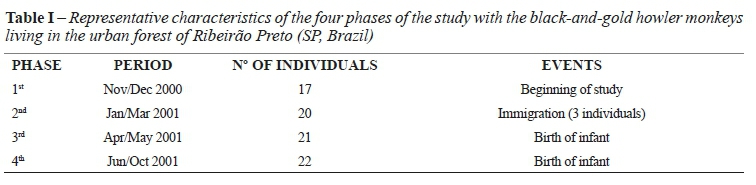
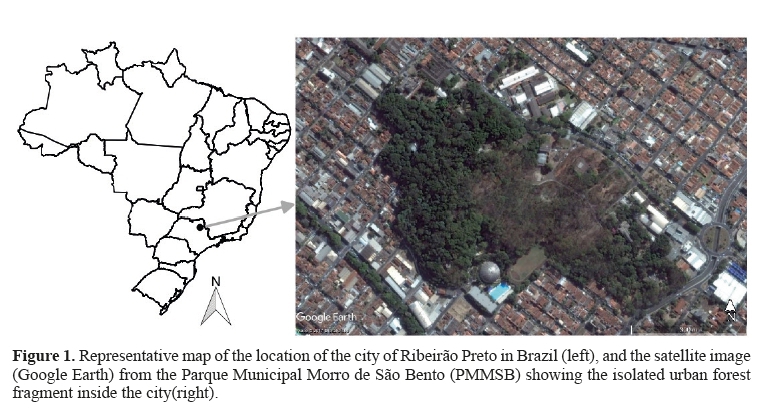
<body><![CDATA[<p><font face="Verdana, Arial, Helvetica, sans-serif" size="2">This study was    performed at Parque Municipal Morro de S&atilde;o Bento (PMMSB) -21&ordm;10&acute;17&acute;&acute;    S, 47&ordm;48&acute;05&acute;&acute; W, which is located in the city of Ribeir&atilde;o    Preto (S&atilde;o Paulo, Brazil). The PMMSB is a park (25 ha, <a href="/img/revistas/ce/v15n2/01f01.jpg">Figure    1</a>) that features the City Zoo, as well as being a semi-deciduous and deciduous    mesophyllous forest fragment of approximately 3 ha (Laguna, 1997). This area    contains native and exotic plant species and wasformally homologatedas an Environmental    Protection Area (&Aacute;rea de Prote&ccedil;&atilde;o Ambiental; APA).</font></p>     <p><font face="Verdana, Arial, Helvetica, sans-serif" size="2">A four-month period    (Jun-Oct, 2000) was necessary for the animals' habituation with the researchers.    During the same period, the group was censured and only one group of 17 individuals    was confirmed. The animals were grouped using age and gender categories, according    to Calegaro-Marques and Bicca-Marques (1993): Adult Males (M); Adult Females    (F); SubadultMales (SAM); Juveniles (J); Infants (I). The subadult female category    was not defined, for it was difficult to distinguish it category from juveniles.</font></p>     <p><font face="Verdana, Arial, Helvetica, sans-serif" size="2">All membership    was separated inthe following classes: M, F, SAM, J, and I;as well as receiving    codes (e.g.: M1-2, SAM1-4, F1-5). It was not possible to distinguish individuals    within the juvenile category, but they were included in the analysis and were    classified in order of appearance in each sampling period (J1, J2, J3...)</font></p>     <p><font face="Verdana, Arial, Helvetica, sans-serif" size="2">The observations    were made during four days in each month,from sunrise to sunset(betweendawn    and dusk), from Nov/2000 to Oct/2001. We used only two categories of inter-individual    distance to interpret the hierarchic social structure and the formation of subgroups:    A, two individuals in body contact; and B, 0 to 3 meters between two individuals.    Inter-individual distances greater than 3 meters were recorded, but were not    used in our analyses.</font></p>     <p><font face="Verdana, Arial, Helvetica, sans-serif" size="2">The <i>ad libitum</i>    method (Altman, 1974), was used to analyze our predictions #1 and 3, in which    any social interactionsbetween the individuals, like conflicts, agonistic behavior    and sexual behavior was sampled during all the study period.The scan sampling    method was employed (Altman, 1974)to analyze our prediction #2, in which the    spatial relationship between all the members of the group was sampled in a 20-minute    intervals.</font></p>     <p><font face="Verdana, Arial, Helvetica, sans-serif" size="2">The study was divided    into four social dynamic phases (<a href="/img/revistas/ce/v15n2/01t1.jpg">Table    1</a>), varying in accordance with the composition of the group, which directly    affected the social dynamics and interactions between the individuals in our    field of vision.</font></p>     <p><font face="Verdana, Arial, Helvetica, sans-serif" size="2">Theinter-individual    distance data were analyzed with multivariate analysis (Cluster Analysis). This    consists in the formation of groups of individuals according to the similarities    of variables displayed bythem. The analyses included two steps: 1) establishment    of similarity index (S.I.) matrix, grade of similarity or association between    counts inter-individual distances; 2) formation of groups by a linking method,    and construction of dendograms based on these indexes (Hair <i>et al.</i>, 1995).</font></p>     <p><font face="Verdana, Arial, Helvetica, sans-serif" size="2">In this study,    the chosen S.I. was the total number of episodes of distances A or B, which    produced similarity matrices for each distance. These were imported to the PRIMER    5 software (Clarke &amp; Warwick, 2001), which grouped the individuals based    on the similarities, expressed by percentages of similarity, of all S.I., building    dendogramsvia a linking method, in which the average of the groups was used.</font></p>     <p><font face="Verdana, Arial, Helvetica, sans-serif" size="2">Using the dendograms,    we built diagrams that represent thelevel of association between all individuals.    The intensity of this association is represented by arrows that are proportional    to the percentage of similarity showed in the dendograms.</font></p>     <p>&nbsp;</p>     ]]></body>
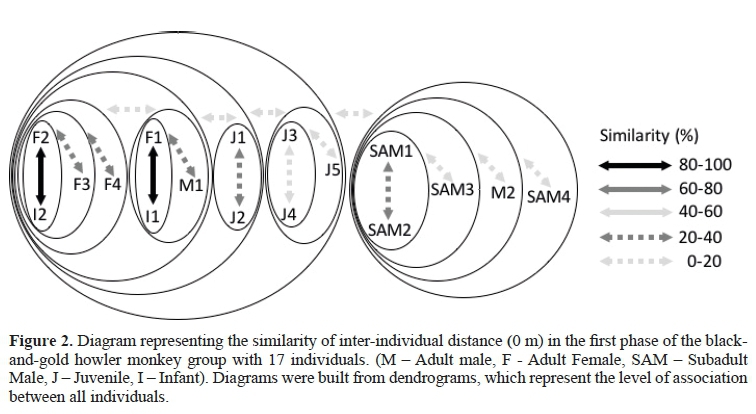
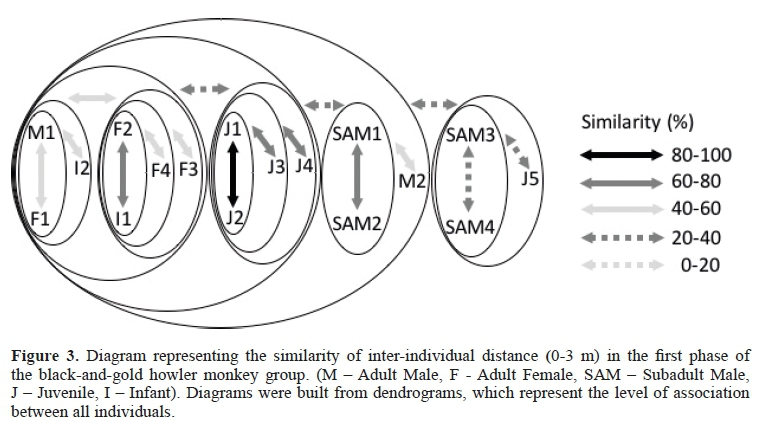
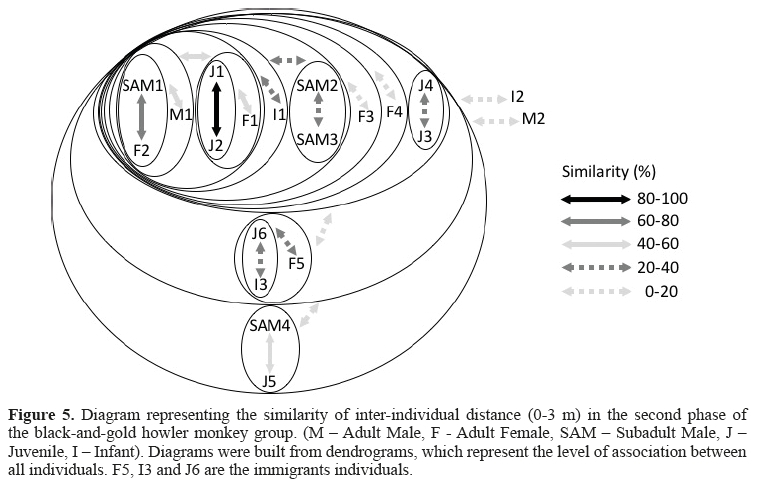
<body><![CDATA[<p><font face="Verdana, Arial, Helvetica, sans-serif" size="3"><b>RESULTS</b></font></p>     <p><font face="Verdana, Arial, Helvetica, sans-serif" size="2">The number of individuals    in the group during the study period is shownin <a href="/img/revistas/ce/v15n2/01t1.jpg">Table    I</a>. The number of individuals varied from seventeen (Nov/2000) to twenty-two    howlers(Oct/2001), andonly two episodes of agonistic behavior throughout the    entire study period were recorded, whereas both were performedonly by adult    females (Sampaio, 2002).</font></p>     <p><font face="Verdana, Arial, Helvetica, sans-serif" size="2">In the first phase,    only one group living in this areawas identified. The second phasewas characterized    by the integration<sup><a name="top_fn1"></a><a href="#back_fn1">1</a></sup>    of three individuals (F5, I3, and J6) - for unknown reasons - in the group,    animals which probably lived in the peripheral area and wentunnoticed during    the first phase. The third phase was characterized by the birth of a howler    (I4). In the fourth phase, another howler (I5) was born.</font></p>     <p><font face="Verdana, Arial, Helvetica, sans-serif" size="2"><i>First Phase</i></font></p>     <p><font face="Verdana, Arial, Helvetica, sans-serif" size="2">As shown in <a href="/img/revistas/ce/v15n2/01f02.jpg">Figure    2</a> (A = 0 m), two subgroups of individuals were observed, whereas the first    one contained all of the adult females that characterized strong affinities    with their infants (matrifocal subgroup). The male adult 1 (M1) was located    close to them. The juveniles of the group established an association (0-40%)    between themselves, as well aswith the adult females (0-20%). The second subgroup    showed associations between subadult males and the M2 (0-40%), with little affinity    towardsthe adult females (0-20%).</font></p>     <p><font face="Verdana, Arial, Helvetica, sans-serif" size="2">When the distance    considered between individuals increased (B= 0 to 3 m), as shown in <a href="/img/revistas/ce/v15n2/01f03.jpg">Figure    3</a>, the adult females still showed high association with their infants (40    - 80%),with the M1 showing proximity to them (40-60%). The juveniles showed    greater association between themselves(40-100%)and with the adult females (20-40%).    The M2, SAM1, and SAM2 were more associated with subgroup 1, appearing in the    periphery of the group. The SAM3 and 4 were associated (20-40%) together with    a 5juvenile, and presented little affinity in relation to the rest of the group    (0-20%).</font></p>     <p><font face="Verdana, Arial, Helvetica, sans-serif" size="2"><i>Second Phase</i></font></p>     <p><font face="Verdana, Arial, Helvetica, sans-serif" size="2">The second phase    was characterized by the integration of three new individuals in the group (F5,    J6, and I3). These immigrants remained associated (20 - 60%) and isolated from    the rest of the group, as shown in <a href="/img/revistas/ce/v15n2/01f04.jpg">Figure    4</a> (A= 0 m).</font></p>     <p><font face="Verdana, Arial, Helvetica, sans-serif" size="2">In general, the    level of closer proximity between the individuals also decreased (<a href="/img/revistas/ce/v15n2/01f04.jpg">Figure    4</a>). The affinity among the adult females (matrifocal subgroup) became less    pronounced than in the first phase, and the F4 distanced itself from the matrifocal    subgroup, as well as being in association with the J4 (40-60%). The M1 was associated    with lower affinitytowards two juveniles (J1 and J2) and with the matrifocal    subgroup (0-20%). The SAM1, 2, and 3 were associated (0-40%) and isolated from    the main group. The M2 was associated with the J5. Meanwhile, the SAM4 was isolated    from the group. The I2, which is presumablyF2's son, showed a smaller proximity    to F2in this phase than in the first one.</font></p>     <p><font face="Verdana, Arial, Helvetica, sans-serif" size="2">When analyzing    <a href="/img/revistas/ce/v15n2/01f05.jpg">Figure 5</a> (B= 0 - 3 m),it is    not possible toobserve the formation of subgroups. The majority of the individuals    interacted with low percentages of affinity (20%). The M1 and SAM1 were in the    center of the group, while the SAM2 and 3 were associated andcloser to this    centerwhen compared to the previous phase, and the SAM4 and M2 were at the edge    of the group. The F1 and 2 were still in the center of the group, and the F3    and 4 were located far from it. The juveniles were still associatedbetween themselves    and with other classes.The immigrants still maintained a tight connection, and    M2, SAM4, J5, and I2 were positioned in the periphery of the group.</font></p>     ]]></body>
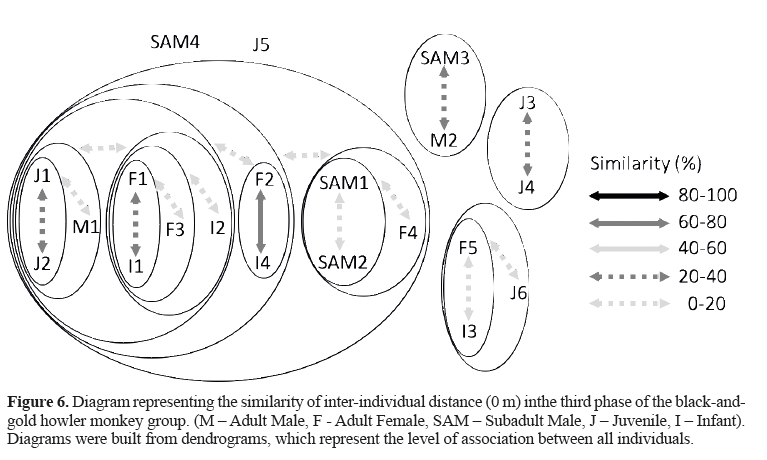
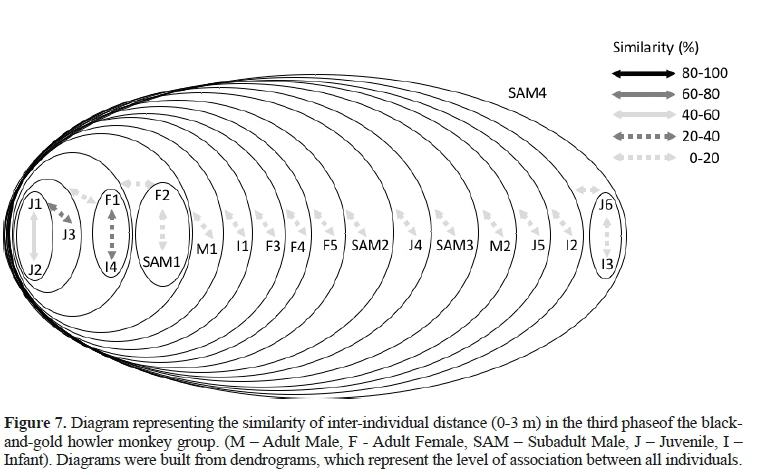
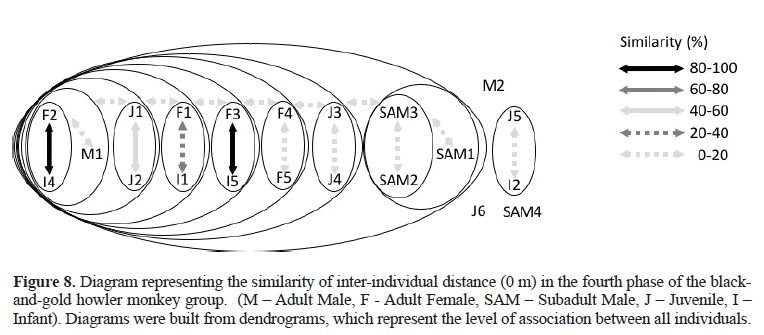
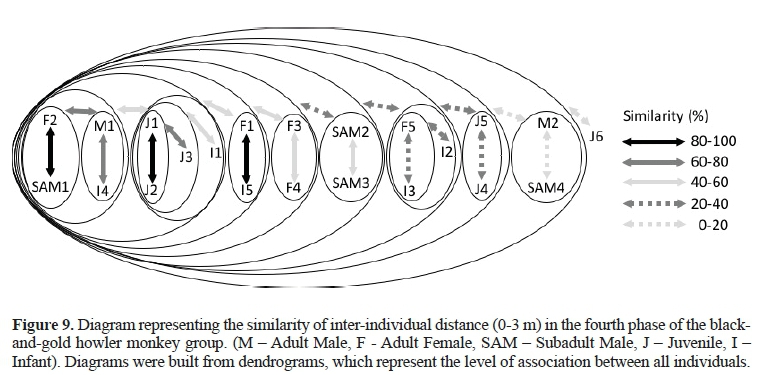
<body><![CDATA[<p><font face="Verdana, Arial, Helvetica, sans-serif" size="2"><i>Third Phase</i></font></p>     <p><font face="Verdana, Arial, Helvetica, sans-serif" size="2">This phase began    when the F2 gave birth to the I4 and its previous infant (I2) started to show    a juvenile behavior, which could be noticedin thefield and is shown in <a href="/img/revistas/ce/v15n2/01f06.jpg">Figure    6</a> and <a href="/img/revistas/ce/v15n2/01f07.jpg">7</a>.However, due to    its smaller size,it could be distinguished from the other juveniles andwe still    decided to recognize it as an infant.</font></p>     <p><font face="Verdana, Arial, Helvetica, sans-serif" size="2">In <a href="/img/revistas/ce/v15n2/01f06.jpg">Figure    6</a> (A = 0 m), it is possible to note that the adult females 1, 2, and 3 were    in the center of the group, and that twojuveniles and I1 and I2 were still there,    too.The M1 was found near them and,with the exception of the interaction between    F2-I4, the similarity between them was lower than 40%. The SAM1 and 2 were weakly    connected between themselves, with the F4,and with the matrifocal subgroup (0-20%).</font></p>     <p><font face="Verdana, Arial, Helvetica, sans-serif" size="2">The SAM3 and the    M2 were associated in the periphery of the group. Two juveniles (J3 and J4)were    associated and isolated from the whole group, while another one was found isolated    from the group. The immigrants (F5, I3, and J6) were still interacting and separated    from the rest of the group.</font></p>     <p><font face="Verdana, Arial, Helvetica, sans-serif" size="2">In <a href="/img/revistas/ce/v15n2/01f07.jpg">Figure    7</a> (B = 0 - 3 m), it is possible to observe the formation of a single group    that displayed a low level of association between the individuals. The adult    females were not in the center of this group, whereas this position was occupied    by three juveniles (J1, J2, and J3) accompanied by theF1, F2, F3, and F5. The    M1 and SAM1 were associated near them. The SAM2 and 3 and the M2 were more peripheral,    but associated with of the group.</font></p>     <p><font face="Verdana, Arial, Helvetica, sans-serif" size="2"><i>Fourth Phase</i></font></p>     <p><font face="Verdana, Arial, Helvetica, sans-serif" size="2">This phase began    when the F3 gave birth to the I5.<a href="/img/revistas/ce/v15n2/01f08.jpg">Figure    8</a> (A = 0 m) shows the matrifocal grouping includingall adult females.The    M1 and two juveniles (J1 e J2) were found very close to them. Subadult males    1, 2, and 3 were in association between themselves and at the edge of the group,    while the SAM4 and M2 were isolated from it. The infant I2 showed affinity with    the J5 in the periphery of the group. The strongest affinities (80-100% of similarity)    were characterized in the association between the F2 and the F3 with their infants    I4 and I5, respectively.</font></p>     <p><font face="Verdana, Arial, Helvetica, sans-serif" size="2">As shownin <a href="/img/revistas/ce/v15n2/01f09.jpg">Figure    9</a> (B = 0 - 3 m),in the center of the group, it is possible to observe that    F2, SAM1, M1, three juveniles,two infants, and the other females (F1, F3, F4,    and F5) were displaced from near the individuals - as mentioned above- to interact    withSAM2, SAM3, I3, and I4. Therefore, the matrifocal subgroup cannot be seen    in <a href="/img/revistas/ce/v15n2/01f09.jpg">Figure 9</a>. The M2, SAM4,    and J6were found in the periphery of the group.</font></p>     <p>&nbsp;</p>     <p><font face="Verdana, Arial, Helvetica, sans-serif" size="3"><b>DISCUSSION</b></font></p>     ]]></body>
<body><![CDATA[<p><font face="Verdana, Arial, Helvetica, sans-serif" size="2">The number of individuals    in the group studied (17-22) was relatively higher than the average for the    <i>Alouatta caraya</i> species(Rumiz, 1990; Bicca-Marques, 1991, Kowalewski    &amp;Zunino,1999; Dvoskin<i>et al.</i>, 2004, Ju&aacute;rez <i>et al.</i>, 2005),    and for the <i>Alouatta</i> genus, since the average number of individuals usually    varies from 3 to 21 animals (Carpenter, 1934; Crockett &amp; Eisenberg, 1987;    Miranda &amp; Passos, 2005;Estrada <i>et al</i>., 2002; Fl&oacute;rez&amp; Delgado,    2011, Azkarate <i>et al</i>., 2017). These 22 individuals were confined in a    3-ha semi-deciduous forest fragment (see Laguna, 1997), which comprisesa highpopulation    density of 100/km<sup>2</sup>, similar only in the number found in forests of    the Argentina (Brown &amp; Zunino, 1994).</font></p>     <p><font face="Verdana, Arial, Helvetica, sans-serif" size="2">Besides the isolation    of this fragmented forest, this large number of individuals living in a small    fragmented area may be explained by the high percentage of fruit ingested by    the howler black-and-gold monkeys when compared to other groups,as described    by Pedrosa (2002) during the same periodstudied. The area contains several exotic    botanical species, including <i>Caryota urens</i> (Laguna, 1997 and 2000), a    palm tree whose fruit supply lasts the entire year (Gomes, 2004). In the period    of the year in which the variety and availability of the fruits are lower, the    howler monkeys use the food offered to the animals of the Zoo (Pedrosa, 2002;    Gomes, 2004).</font></p>     <p><font face="Verdana, Arial, Helvetica, sans-serif" size="2">The confined system    this group faced -in whichthe migration of individuals or subgroups to other    associated forest areas is impossibledue to the isolation of the area (see <a href="/img/revistas/ce/v15n2/01f01.jpg">Figure    1</a>)together with the great availability of food resulted in a high population    density. This context led us to predict that the group could present: (1) a    multi-male system with social and hierarchic structure; (2) signs of instability    and formation of subgroups; and (3) weak pacific trends in their social behavior.</font></p>     <p><font face="Verdana, Arial, Helvetica, sans-serif" size="2">During the entire    sampling period,the group had two adult males, where the M1 was interpreted    as being the first in the hierarchy, since it always located near the adult    females, and M2 was always in the periphery of the group, far from the adult    females, leading us to interpret that this group was socially organized in a    harem system or in an age-graded system, thus not confirming our first hypothesis.</font></p>     <p><font face="Verdana, Arial, Helvetica, sans-serif" size="2">The possible coalition    among the M2 and all SAMs took place in the periphery of the group, with few    interactions with the adult females. The juveniles were frequently associated    between themselves (mainly during playtime), with adult females (looking for    protection and social interactions, probably with their mothers or with other    relatives), and with SAMs. The only two copulations recorded by us (Sampaio,    2002) were performed by the M1, and we did not observe any sexual interaction    between the other males and adult females.</font></p>     <p><font face="Verdana, Arial, Helvetica, sans-serif" size="2">The social organization    in the genus <i>Alouatta</i> seems to be variable. Groups of the<i>A. palliata</i>species    exhibits multi-male organization where the interactions between adult males    are meant to assure their access to the adult females, and the inter-individual    distances between males and females indicate their reproductive success (Jones,    1982).Neville (1972) showed that the<i>A. seniculus</i>species can organize    their groups throughanage-graded or harem system. However, the behavior of the    alpha male was not well characterized.</font></p>     <p><font face="Verdana, Arial, Helvetica, sans-serif" size="2">The social organization    pattern of our study group (harem or age-graded system)is not common for the    <i>Alouattacaraya</i>species (see Rumiz, 1990 and Kowalewski, 2000), and the    harem systems in the <i>Alouatta</i>species was organized through a matrifocal    nucleus and a dominant adult male that had no need for proximity to the females,    but had access to them during the whole time (Neville <i>et al</i>., 1988).    Oliveira and Ades (1998) investigated several groups of<i>A. fusca</i>species    (= <i>A. g. clamitans</i>) and observed that adult males were frequently isolated,    but that they could sometimes be grouped or associated with adult females.</font></p>     <p><font face="Verdana, Arial, Helvetica, sans-serif" size="2">Concerning our    second hypothesis, the formation of subgroups and the occurrence of isolated    animals are often considered signs of instability in groups of howler monkeys.    Neville (1972) was the first author to report the formation of subgroups in    a 16-individual group of <i>A. seniculus</i>.</font></p>     <p><font face="Verdana, Arial, Helvetica, sans-serif" size="2">In our study was    observed signs of instability in all sample periods, thus confirming our second    hypothesis and suggesting the occurrence of the formation of two separate subgroups    - one matrifocal subgroup and a coalition of subordinated males -, and these    dynamics changed throughout the sampling, wherein the first subgroup consisted    in the matrifocal subgroup with an adult female and young animals. With the    exception of the adult male, all the members of another subgroup - formed by    peripheral males and juveniles- showed interaction with the matrifocal group.</font></p>     <p><font face="Verdana, Arial, Helvetica, sans-serif" size="2">Bezanson <i>et    al.</i> (2002)stated that individuals of different sex-age classes ingroups    of Primates may show different patterns of subgroup formation according to the    context they belong to. This concurs with what we observed in the adult and    subadult males, adult females, and infants. Nevertheless, the interactions and    the social organization within this group changed throughout the year.</font></p>     ]]></body>
<body><![CDATA[<p><font face="Verdana, Arial, Helvetica, sans-serif" size="2">In the first phase,    the matrifocal subgroup was characterized by the association between all adult    females and their infants, and the M1associated with them can be understood    as a repelling behavior of the other males in order to avoid infanticide and    allowaccess to copulation. This male behavior was only observed by Jones (1983)    inregarding<i>A. seniculus</i> species.</font></p>     <p><font face="Verdana, Arial, Helvetica, sans-serif" size="2">In the second phase,    the immigrant howler monkeys increased the instability within the group, and    the affinity of the matrifocal subgroup was weaker than in the first phase.    This may have happened because the immigrant adult female (F5) and its infant    (I3) may have had a higher interest on the young females of the group, having    directed their "new" attention towards an infant, causing a lower association    of the F3 and a separation of the F4 from the matrifocal group.The reason behind    this may be the possible attempt to form another subgroup.</font></p>     <p><font face="Verdana, Arial, Helvetica, sans-serif" size="2">The M1 remained    close to the matrifocal subgroup, but the SAM1 exhibited low association with    the other subadult males and with the M2,whereas it showed more association    withthe adult females and with the M1. Subadults males 2 and 3 interacted and    were inserted in the group, while SAM4 and M2 showed more peripheral positioning    within the group.</font></p>     <p><font face="Verdana, Arial, Helvetica, sans-serif" size="2">In the third phase,    we believe that the birth of theI4 may have contributed to the return of F3    and F4to the subgroup of adult females (matrifocal subgroup), even though the    affinity was lower than that observed in the first phase. This finding was similar    to the one observed by Neville <i>et al</i>. (1988), who verified that the birth    of an infant of howler monkeys increases the affinities of adult females among    themselves, as well as with their youth. We noticed that the F4 had greater    interaction with SAM1 and SAM2. However, they were still integrating inthe matrifocal    subgroup.</font></p>     <p><font face="Verdana, Arial, Helvetica, sans-serif" size="2">The group structure    in this phase was similar to that seen in the first phase. However, the coalition    among the subordinated males diminished, and the M2, SAM3, and SAM4 were still    out of the center of the group, remaining associated between themselves, even    though the SAM1 and SAM2 exhibited greater affinity with the adult females F3,    F4, and F5. The immigrants (F5, I3, and J6) seemed to be more integrated in    the group in this phase, which could be explained by the birth of the I4.</font></p>     <p><font face="Verdana, Arial, Helvetica, sans-serif" size="2">The behavior of    the infants and juveniles in this phase was more distant from the main group,    perhaps in search for security, since males had interactions among themselves    in the group's center,leading to higher possibilities of conflict. Another possibility    is that, with maturity, exploratory environmental behavior andpsychomotor-related    activities lead them to be more in the periphery of the group.</font></p>     <p><font face="Verdana, Arial, Helvetica, sans-serif" size="2">In the fourth phase,    the birth of the I5 apparentlyinfluenced adult females, and all of them (including    the immigrant F5) were thenpresent in the matrifocal subgroup. However, more    juveniles and infants were in the center of this association. We could see an    increase in the tendency of SAMs interacting with the adult females. Therefore,    the coalition of the males became weaker and, in the last month of sampling    (Oct/2001), the M2 was no longerpresent in the group. It is not known whether    it was banishedfrom the group, if it emigrated or if it became a satellite male,    but this fact could be related to the poor association of the M2 with the subadult    males and with the M1, or, rather, it could be due to the group's higher instability    related to the increase in the number of its individuals.</font></p>     <p><font face="Verdana, Arial, Helvetica, sans-serif" size="2">Interestingly,    the M2 was still part of the group and did not stop interacting with the subadult    males, even when the SAM1 and SAM2 - apparently the oldest of the subadult males    - started to associate with thematrifocal subgroup and, consequently,with the    M1. We are not sure if the closer proximity between these two SAMs and the M1    is related to a coalition between them or to competition to get access to females.However,no    agonistic behavior betweenthese males was observed during this period, and,    for this reason,we assume that this behavior is more likely to be a coalition    among these males.</font></p>     <p><font face="Verdana, Arial, Helvetica, sans-serif" size="2">This type of male    coalition was also observed by Jones (1980) in a <i>A. palliata</i> group. Most    likely, this binding is related to the M2's departure from the group and its    migration from the park to the city's surrounding areas. A few days after leaving,    it was captured by the Municipal Zoo anddied one week later.</font></p>     <p><font face="Verdana, Arial, Helvetica, sans-serif" size="2">Despite the instability    displayed by this group, we did not observe a more aggressive behavior -as we    expected -, thus refuting our third hypothesis; we only saw two displaysof agonistic    behavior involving two adult females. As mentioned before,the high supply of    fruits during year probably reduced competition among the individuals, and the    indirect signs were enough to establish and communicate the social hierarchy    within this group. However, theaging of subadult males and a consequently increased    competition for access to females may increase the aggressiveness between males.</font></p>     ]]></body>
<body><![CDATA[<p>&nbsp;</p>     <p><font face="Verdana, Arial, Helvetica, sans-serif" size="3"><b>CONCLUSION AND    FINAL CONSIDERATIONS</b></font></p>     <p><font face="Verdana, Arial, Helvetica, sans-serif" size="2">We believe that    our study provides an important interpretation on the social behavior of howler    monkeys (<i>Alouattacaraya</i>). The patterns of social interaction observed    during the samplings were efficiently confirmed by the multivariate methodology    used in this research, which helped us in the identification of the social interaction    patterns, illustrating the plasticity and tendency that the social structure    suffered during the period of study.</font></p>     <p><font face="Verdana, Arial, Helvetica, sans-serif" size="2">This group showed    a strong association among adult females (matrifocal subgroup),whereas the dominant    male (M1) had greater proximity to them. Signs of instability were common throughoutthe    year due to integration of "new" individuals, but the births of infants strengthened    the matrifocal subgroup. The aging of subadult males increased their association    with the matrifocal subgroup and with the M1, resulting in the departure of    the other adult male from the group.</font></p>     <p><font face="Verdana, Arial, Helvetica, sans-serif" size="2">The social organization    of this group could be assumed to be a harem or age-graded system, which experienced    signs of instability, and the few agonistic episodes and inter-individual competition    seemed to be related to the low competition for food, since the availability    of fruits was high.</font></p>     <p><font face="Verdana, Arial, Helvetica, sans-serif" size="2">The <i>A. caraya</i>species    is globally characterized as the "least concern - LC", despite its declining    populations (Fernandez-Duque <i>et al</i>.,2008), butit was classified as a    "near-threatened species" in Brazil (Ludwig <i>et al</i>., 2015); in the state    list ofS&atilde;o Paulo, the species appears as "vulnerable" (Bressan <i>et    al</i>., 2009).</font></p>     <p><font face="Verdana, Arial, Helvetica, sans-serif" size="2">The "near threatened"    and "vulnerable" statusesare very evident in our study area, where the remaining    forests in the region are highly fragmented, coveringonly 4% of Ribeir&atilde;o    Preto's area (Henriques, 2003). Under these conditions, the geographic isolation    leads to high degrees of endogamy, thus resulting in unviable populations in    the long term.</font></p>     <p><font face="Verdana, Arial, Helvetica, sans-serif" size="2">The evaluation    of the black-and-gold howler monkeys'group dynamics is therefore, of great importance    to establish management plans for the conservation of primates that live under    this type of environmental pressure. Hence, in this study, the high population    density of the group and the resulting migration of an individual to the city    area resultedin the relocation of some individuals to other forest fragments    (Rossiand Santos, in press). In addition, the risk of extinction that exists    for the Primates of the tropical area is considerable. Thus, our work can contribute    to the knowledge of a Primate that is under high anthropic action.</font></p>     <p>&nbsp;</p>     <p><font face="Verdana, Arial, Helvetica, sans-serif" size="3"><b>ACKNOWLEDGEMENTS</b></font></p>     ]]></body>
<body><![CDATA[<p><font face="Verdana, Arial, Helvetica, sans-serif" size="2">The authors are    thankful to PIBIC/USP/CNPq and Mr. Vinicio B. Pecci, from the Environmental    Management and Planning Office of Ribeir&atilde;o Preto City Hall, for the financial    support (scholarships); to Mrs. Marisa dos Santos from Ribeir&atilde;o Preto's    City Zoo, who authorized the area of study;as well as to Drs. Gelson Genaro    and Mr. Dilmar Oliveira, who provided suggestions and critical comments to improve    this article. We would like to thank to Dr. Alexandre A. Oliveira for the help    with the statistical analysis, and to Prof. Alexandra Olimpio O. Cunha and Prof.    Abilio Borghi for their assistance regarding the English language.</font></p>     <p>&nbsp;</p>     <p><font face="Verdana, Arial, Helvetica, sans-serif" size="3"><b>BIBLIOGRAPHY</b></font></p>     <!-- ref --><p><font face="Verdana, Arial, Helvetica, sans-serif" size="2">Altmann, S.A. (1959).    Field observations on a howler monkey society. <i>Journal of Mammalogy</i>,    40, 317-330.    &nbsp;&nbsp;&nbsp;&nbsp;&nbsp;&nbsp;&nbsp;&nbsp;[&#160;<a href="javascript:void(0);" onclick="javascript: window.open('/scielo.php?script=sci_nlinks&ref=5521233&pid=S2594-9985201600020000100001&lng=','','width=640,height=500,resizable=yes,scrollbars=1,menubar=yes,');">Links</a>&#160;]<!-- end-ref --></font></p>     <!-- ref --><p><font face="Verdana, Arial, Helvetica, sans-serif" size="2">Altman, J. (1974).    Observational Study of Behavior: Sampling Methods. <i>Behaviour Leiden,</i>    49, 227-267.    &nbsp;&nbsp;&nbsp;&nbsp;&nbsp;&nbsp;&nbsp;&nbsp;[&#160;<a href="javascript:void(0);" onclick="javascript: window.open('/scielo.php?script=sci_nlinks&ref=5521235&pid=S2594-9985201600020000100002&lng=','','width=640,height=500,resizable=yes,scrollbars=1,menubar=yes,');">Links</a>&#160;]<!-- end-ref --></font></p>     <!-- ref --><p><font face="Verdana, Arial, Helvetica, sans-serif" size="2">Azkarate, J.C.,    Dunn, J.C.,Balcells, C.D.,&amp;Bar&oacute;, J.V. (2017).A demographic history    of a population of howler monkeys (<i>Alouatta palliata</i>) living in a fragmented    landscape in Mexico.<i>PeerJ</i>, 5:e3547; DOI 10.7717/peerj.3547.    &nbsp;&nbsp;&nbsp;&nbsp;&nbsp;&nbsp;&nbsp;&nbsp;[&#160;<a href="javascript:void(0);" onclick="javascript: window.open('/scielo.php?script=sci_nlinks&ref=5521237&pid=S2594-9985201600020000100003&lng=','','width=640,height=500,resizable=yes,scrollbars=1,menubar=yes,');">Links</a>&#160;]<!-- end-ref --></font></p>     <!-- ref --><p><font face="Verdana, Arial, Helvetica, sans-serif" size="2">Bezanson, M., Garber    P.A., Rutherford, J.,&amp; Cleveland, A. (2002). Patterns of subgrouping, social    affiliation and social networks in Nicaraguan mantled howler monkeys (<i>Alouatta    palliata</i>). <i>American Journal of Physical Anthropology</i>, 34, 44.    &nbsp;&nbsp;&nbsp;&nbsp;&nbsp;&nbsp;&nbsp;&nbsp;[&#160;<a href="javascript:void(0);" onclick="javascript: window.open('/scielo.php?script=sci_nlinks&ref=5521239&pid=S2594-9985201600020000100004&lng=','','width=640,height=500,resizable=yes,scrollbars=1,menubar=yes,');">Links</a>&#160;]<!-- end-ref --></font></p>     <!-- ref --><p><font face="Verdana, Arial, Helvetica, sans-serif" size="2">Bezanzon, M, Garber,    P.A., Murphy, J.T.,&amp;Premo, L.S. (2008).Patterns of Subgrouping and Spatial    Affiliation in A Community of Mantled Howling Monkeys (<i>Alouatta palliata</i>).<i>American    Journal of Primatology,</i> 70, 282-293.    &nbsp;&nbsp;&nbsp;&nbsp;&nbsp;&nbsp;&nbsp;&nbsp;[&#160;<a href="javascript:void(0);" onclick="javascript: window.open('/scielo.php?script=sci_nlinks&ref=5521241&pid=S2594-9985201600020000100005&lng=','','width=640,height=500,resizable=yes,scrollbars=1,menubar=yes,');">Links</a>&#160;]<!-- end-ref --></font></p>     <!-- ref --><p><font face="Verdana, Arial, Helvetica, sans-serif" size="2">Bicca-Marques,    J.C. (1991). "<i>Ecologia e comportamento de um grupo de bugios pretos Alouatta    caraya (Primates, Cebidae) em Alegrete, RS, Brasil</i>". Master Thesis<i>,</i>    Universidade de Bras&iacute;lia, Bras&iacute;lia-DF, Brasil.    &nbsp;&nbsp;&nbsp;&nbsp;&nbsp;&nbsp;&nbsp;&nbsp;[&#160;<a href="javascript:void(0);" onclick="javascript: window.open('/scielo.php?script=sci_nlinks&ref=5521243&pid=S2594-9985201600020000100006&lng=','','width=640,height=500,resizable=yes,scrollbars=1,menubar=yes,');">Links</a>&#160;]<!-- end-ref --></font></p>     <!-- ref --><p><font face="Verdana, Arial, Helvetica, sans-serif" size="2">Bressan, P.M.,    Kierulff, M.C.M.,&amp; Sugieda, A.M. (2009). Fauna Amea&ccedil;ada de Extin&ccedil;&atilde;o    do Estado de S&atilde;o Paulo: Vertebrados. Funda&ccedil;&atilde;o Parque Zool&oacute;gico    de S&atilde;o Paulo, S&atilde;o Paulo. Secretaria de Meio Ambiente do Estado    de S&atilde;o Paulo. 645p.    &nbsp;&nbsp;&nbsp;&nbsp;&nbsp;&nbsp;&nbsp;&nbsp;[&#160;<a href="javascript:void(0);" onclick="javascript: window.open('/scielo.php?script=sci_nlinks&ref=5521245&pid=S2594-9985201600020000100007&lng=','','width=640,height=500,resizable=yes,scrollbars=1,menubar=yes,');">Links</a>&#160;]<!-- end-ref --></font></p>     <!-- ref --><p><font face="Verdana, Arial, Helvetica, sans-serif" size="2">Brown, A. D.,&amp;Zunino,    G. E. (1994). H&aacute;bitat, densidad y problemas de conservaci&oacute;n de    los primates de Argentina. <i>Vida Silvestre Neotropical</i>, 3, 131-40.    &nbsp;&nbsp;&nbsp;&nbsp;&nbsp;&nbsp;&nbsp;&nbsp;[&#160;<a href="javascript:void(0);" onclick="javascript: window.open('/scielo.php?script=sci_nlinks&ref=5521247&pid=S2594-9985201600020000100008&lng=','','width=640,height=500,resizable=yes,scrollbars=1,menubar=yes,');">Links</a>&#160;]<!-- end-ref --></font></p>     <!-- ref --><p><font face="Verdana, Arial, Helvetica, sans-serif" size="2">Carpenter, C. R.    (1934). A field study of the behavior and social relations of howling monkeys.    <i>Comparative psychology monographs,</i>10, 1-168.    &nbsp;&nbsp;&nbsp;&nbsp;&nbsp;&nbsp;&nbsp;&nbsp;[&#160;<a href="javascript:void(0);" onclick="javascript: window.open('/scielo.php?script=sci_nlinks&ref=5521249&pid=S2594-9985201600020000100009&lng=','','width=640,height=500,resizable=yes,scrollbars=1,menubar=yes,');">Links</a>&#160;]<!-- end-ref --></font></p>     <!-- ref --><p><font face="Verdana, Arial, Helvetica, sans-serif" size="2">Clarke, K.R.,&amp;Warwick,    R.M. (2001). Primer v5: User Manual/Tutorial/Plymouth, U.K.: PRIMER-E Ltd.    &nbsp;&nbsp;&nbsp;&nbsp;&nbsp;&nbsp;&nbsp;&nbsp;[&#160;<a href="javascript:void(0);" onclick="javascript: window.open('/scielo.php?script=sci_nlinks&ref=5521251&pid=S2594-9985201600020000100010&lng=','','width=640,height=500,resizable=yes,scrollbars=1,menubar=yes,');">Links</a>&#160;]<!-- end-ref -->.</font></p>     <!-- ref --><p><font face="Verdana, Arial, Helvetica, sans-serif" size="2">Crockett, C.M.,&amp;    Eisenberg, J.F. (1987). Howlers: Variations in Group Size and Demography. InBB    Smuts, DL Cheney, RM Seyfarth, RW Wrangham, TT Struhsaker (Eds.), <i>Primates    Societies</i>(pp. 54-68). The University of Chicago Press, Chicago.    &nbsp;&nbsp;&nbsp;&nbsp;&nbsp;&nbsp;&nbsp;&nbsp;[&#160;<a href="javascript:void(0);" onclick="javascript: window.open('/scielo.php?script=sci_nlinks&ref=5521253&pid=S2594-9985201600020000100011&lng=','','width=640,height=500,resizable=yes,scrollbars=1,menubar=yes,');">Links</a>&#160;]<!-- end-ref --></font></p>     <!-- ref --><p><font face="Verdana, Arial, Helvetica, sans-serif" size="2">Dvoskin, R., Ju&aacute;rez,    C.P.,&amp; Fernandez-Duque, E. (2004).Population Density of Black Howlers (<i>Alouatta    caraya</i>) in the Gallery Forests of the Argentinean Chaco: A Preliminary Assessment.    <i>Folia Primatol</i>ogica, 75, 93-96.    &nbsp;&nbsp;&nbsp;&nbsp;&nbsp;&nbsp;&nbsp;&nbsp;[&#160;<a href="javascript:void(0);" onclick="javascript: window.open('/scielo.php?script=sci_nlinks&ref=5521255&pid=S2594-9985201600020000100012&lng=','','width=640,height=500,resizable=yes,scrollbars=1,menubar=yes,');">Links</a>&#160;]<!-- end-ref --></font></p>     <!-- ref --><p><font face="Verdana, Arial, Helvetica, sans-serif" size="2">Eisenberg, J.F.,    Muchenhim, N.A.,&amp;Rudran, R. (1972).The relation between ecology and social    structure in primates. <i>Science</i>, 4037, 53-79.    &nbsp;&nbsp;&nbsp;&nbsp;&nbsp;&nbsp;&nbsp;&nbsp;[&#160;<a href="javascript:void(0);" onclick="javascript: window.open('/scielo.php?script=sci_nlinks&ref=5521257&pid=S2594-9985201600020000100013&lng=','','width=640,height=500,resizable=yes,scrollbars=1,menubar=yes,');">Links</a>&#160;]<!-- end-ref --></font></p>     <!-- ref --><p><font face="Verdana, Arial, Helvetica, sans-serif" size="2">Estrada, A., Mendoza,    A., Castellanos, L., Pacheco, R., van Belle, S., Garc&iacute;a,Y.,&amp;Mu&ntilde;oz,D.    (2002). Population of the Black Howler Monkey (<i>Alouatta pigra</i>) in a Fragmented    Landscape in Palenque, Chiapas, Mexico.<i>American Journal of Primatology</i>,    55, 45-55.    &nbsp;&nbsp;&nbsp;&nbsp;&nbsp;&nbsp;&nbsp;&nbsp;[&#160;<a href="javascript:void(0);" onclick="javascript: window.open('/scielo.php?script=sci_nlinks&ref=5521259&pid=S2594-9985201600020000100014&lng=','','width=640,height=500,resizable=yes,scrollbars=1,menubar=yes,');">Links</a>&#160;]<!-- end-ref --></font></p>     <!-- ref --><p><font face="Verdana, Arial, Helvetica, sans-serif" size="2">Fernandez-Duque    E., Wallace. R.B.,&amp;Rylands, A.B. (2008). <i>Alouatta caraya</i>. The IUCN    Red List of Threatened Species, e.T41545A10496784.    &nbsp;&nbsp;&nbsp;&nbsp;&nbsp;&nbsp;&nbsp;&nbsp;[&#160;<a href="javascript:void(0);" onclick="javascript: window.open('/scielo.php?script=sci_nlinks&ref=5521261&pid=S2594-9985201600020000100015&lng=','','width=640,height=500,resizable=yes,scrollbars=1,menubar=yes,');">Links</a>&#160;]<!-- end-ref --></font></p>     <!-- ref --><p><font face="Verdana, Arial, Helvetica, sans-serif" size="2">Fl&oacute;rez,    J.C.M.,&amp; Delgado, J.A.L. (2011). Population Density of the Red Howler Monkey    (<i>Alouatta seniculus</i>) in a Tropical Dry Forest Fragment in Northwestern    Colombia. <i>Neotropical Primates</i>, 18(2), 64-68.    &nbsp;&nbsp;&nbsp;&nbsp;&nbsp;&nbsp;&nbsp;&nbsp;[&#160;<a href="javascript:void(0);" onclick="javascript: window.open('/scielo.php?script=sci_nlinks&ref=5521263&pid=S2594-9985201600020000100016&lng=','','width=640,height=500,resizable=yes,scrollbars=1,menubar=yes,');">Links</a>&#160;]<!-- end-ref --></font></p>     <!-- ref --><p><font face="Verdana, Arial, Helvetica, sans-serif" size="2">Garber, P.A. (1987).    Foraging strategies among living primates. <i>Annual Review of Anthropology</i>,    16, 339-364.    &nbsp;&nbsp;&nbsp;&nbsp;&nbsp;&nbsp;&nbsp;&nbsp;[&#160;<a href="javascript:void(0);" onclick="javascript: window.open('/scielo.php?script=sci_nlinks&ref=5521265&pid=S2594-9985201600020000100017&lng=','','width=640,height=500,resizable=yes,scrollbars=1,menubar=yes,');">Links</a>&#160;]<!-- end-ref --></font></p>     <!-- ref --><p><font face="Verdana, Arial, Helvetica, sans-serif" size="2">Glander, K.E. (1975).    Habitat description and resource utilization: A preliminary report on mantled    howling monkey ecology.In RH Tuttle (ed.),<i>Sociecology and Psychology of Primates</i>(pp.    37-57). The Hague, Mouton.    &nbsp;&nbsp;&nbsp;&nbsp;&nbsp;&nbsp;&nbsp;&nbsp;[&#160;<a href="javascript:void(0);" onclick="javascript: window.open('/scielo.php?script=sci_nlinks&ref=5521267&pid=S2594-9985201600020000100018&lng=','','width=640,height=500,resizable=yes,scrollbars=1,menubar=yes,');">Links</a>&#160;]<!-- end-ref --></font></p>     <!-- ref --><p><font face="Verdana, Arial, Helvetica, sans-serif" size="2">Gomes, H.L. (2004).    "<i>Ecologia alimentar e comportamento geral de Bugios-pretos (</i>Alouatta    caraya<i>, Primates, Atelidae) em mata urbana de Ribeir&atilde;o Preto/SP</i>".    Master Thesis, Universidade de S&atilde;o Paulo, Ribeir&atilde;o Preto, Brasil.    &nbsp;&nbsp;&nbsp;&nbsp;&nbsp;&nbsp;&nbsp;&nbsp;[&#160;<a href="javascript:void(0);" onclick="javascript: window.open('/scielo.php?script=sci_nlinks&ref=5521269&pid=S2594-9985201600020000100019&lng=','','width=640,height=500,resizable=yes,scrollbars=1,menubar=yes,');">Links</a>&#160;]<!-- end-ref --></font></p>     <!-- ref --><p><font face="Verdana, Arial, Helvetica, sans-serif" size="2">Hair, J.F., Anderson,    R.E., Tatham, R.L.,&amp; Black, W.C. (1995). Multivariate Data Analysis with    Readings. Prentice Hall Inc Ed. New Jersey - USA.    &nbsp;&nbsp;&nbsp;&nbsp;&nbsp;&nbsp;&nbsp;&nbsp;[&#160;<a href="javascript:void(0);" onclick="javascript: window.open('/scielo.php?script=sci_nlinks&ref=5521271&pid=S2594-9985201600020000100020&lng=','','width=640,height=500,resizable=yes,scrollbars=1,menubar=yes,');">Links</a>&#160;]<!-- end-ref --></font></p>     <!-- ref --><p><font face="Verdana, Arial, Helvetica, sans-serif" size="2">Henriques, O.K.    (2003). "<i>Caracteriza&ccedil;&atilde;o da vegeta&ccedil;&atilde;o natural    em Ribeir&atilde;o Preto, SP: Bases para conserva&ccedil;&atilde;o</i>". Master    Thesis, Universidade de S&atilde;o Paulo, Ribeir&atilde;o Preto, Brasil.    &nbsp;&nbsp;&nbsp;&nbsp;&nbsp;&nbsp;&nbsp;&nbsp;[&#160;<a href="javascript:void(0);" onclick="javascript: window.open('/scielo.php?script=sci_nlinks&ref=5521273&pid=S2594-9985201600020000100021&lng=','','width=640,height=500,resizable=yes,scrollbars=1,menubar=yes,');">Links</a>&#160;]<!-- end-ref --></font></p>     <!-- ref --><p><font face="Verdana, Arial, Helvetica, sans-serif" size="2">Jones, C.B. (1980).    The functions of status in the mantled howler monkeys, <i>Alouatta palliata</i>    Gray: intraespecific competition for group membership in a folivorous Neotropical    primate. <i>Primates</i>, 21, 389-405.    &nbsp;&nbsp;&nbsp;&nbsp;&nbsp;&nbsp;&nbsp;&nbsp;[&#160;<a href="javascript:void(0);" onclick="javascript: window.open('/scielo.php?script=sci_nlinks&ref=5521275&pid=S2594-9985201600020000100022&lng=','','width=640,height=500,resizable=yes,scrollbars=1,menubar=yes,');">Links</a>&#160;]<!-- end-ref --></font></p>     <!-- ref --><p><font face="Verdana, Arial, Helvetica, sans-serif" size="2">Jones, C.B. (1982).    A field manipulation of spatial relations among male mantled howler monkeys.    <i>Primates</i>, 23 (1), 130-134.    &nbsp;&nbsp;&nbsp;&nbsp;&nbsp;&nbsp;&nbsp;&nbsp;[&#160;<a href="javascript:void(0);" onclick="javascript: window.open('/scielo.php?script=sci_nlinks&ref=5521277&pid=S2594-9985201600020000100023&lng=','','width=640,height=500,resizable=yes,scrollbars=1,menubar=yes,');">Links</a>&#160;]<!-- end-ref --></font></p>     <!-- ref --><p><font face="Verdana, Arial, Helvetica, sans-serif" size="2">Jones C.B. (1983).    Social Organization of captive black howler monkeys (<i>Alouatta caraya</i>):    "Social competition" an use of non-damaging behavior. <i>Primates</i>, 24, 25-39.    &nbsp;&nbsp;&nbsp;&nbsp;&nbsp;&nbsp;&nbsp;&nbsp;[&#160;<a href="javascript:void(0);" onclick="javascript: window.open('/scielo.php?script=sci_nlinks&ref=5521279&pid=S2594-9985201600020000100024&lng=','','width=640,height=500,resizable=yes,scrollbars=1,menubar=yes,');">Links</a>&#160;]<!-- end-ref --></font></p>     <!-- ref --><p><font face="Verdana, Arial, Helvetica, sans-serif" size="2">Ju&aacute;rez,    C.P., Dvoskin, R., &amp; Fern&aacute;ndez-Duque, E. (2005). Structure and Composition    of Wild Black Howler Troops (<i>Alouatta caraya</i>) in Gallery Forests of the    Argentinean Chaco. <i>Neotropical Primates</i>, 13(1), 19-22.    &nbsp;&nbsp;&nbsp;&nbsp;&nbsp;&nbsp;&nbsp;&nbsp;[&#160;<a href="javascript:void(0);" onclick="javascript: window.open('/scielo.php?script=sci_nlinks&ref=5521281&pid=S2594-9985201600020000100025&lng=','','width=640,height=500,resizable=yes,scrollbars=1,menubar=yes,');">Links</a>&#160;]<!-- end-ref --></font></p>     <!-- ref --><p><font face="Verdana, Arial, Helvetica, sans-serif" size="2">Kappeler, P.M.,    &amp;Van Schaik, C.P. (2002). Evolution of Primate Social Systems. <i>International    Journal of Primatology</i>,23(4), 707-740.    &nbsp;&nbsp;&nbsp;&nbsp;&nbsp;&nbsp;&nbsp;&nbsp;[&#160;<a href="javascript:void(0);" onclick="javascript: window.open('/scielo.php?script=sci_nlinks&ref=5521283&pid=S2594-9985201600020000100026&lng=','','width=640,height=500,resizable=yes,scrollbars=1,menubar=yes,');">Links</a>&#160;]<!-- end-ref --></font></p>     <!-- ref --><p><font face="Verdana, Arial, Helvetica, sans-serif" size="2">Kinzey, W.G., &amp;    Cunningham, E.P. (1994). Variability in platyrrhine social organization. <i>American    Journal of Primatology</i>34(2), 185-198.    &nbsp;&nbsp;&nbsp;&nbsp;&nbsp;&nbsp;&nbsp;&nbsp;[&#160;<a href="javascript:void(0);" onclick="javascript: window.open('/scielo.php?script=sci_nlinks&ref=5521285&pid=S2594-9985201600020000100027&lng=','','width=640,height=500,resizable=yes,scrollbars=1,menubar=yes,');">Links</a>&#160;]<!-- end-ref --></font></p>     <!-- ref --><p><font face="Verdana, Arial, Helvetica, sans-serif" size="2">Kowalewski, M.M.,    &amp;Zunino, G.E. (1999). Impact of Deforestation on a Population of <i>Alouatta    caraya</i> in Northern Argentina.<i>Folia Primatologica</i>, 70, 163-166.    &nbsp;&nbsp;&nbsp;&nbsp;&nbsp;&nbsp;&nbsp;&nbsp;[&#160;<a href="javascript:void(0);" onclick="javascript: window.open('/scielo.php?script=sci_nlinks&ref=5521287&pid=S2594-9985201600020000100028&lng=','','width=640,height=500,resizable=yes,scrollbars=1,menubar=yes,');">Links</a>&#160;]<!-- end-ref --></font></p>     <!-- ref --><p><font face="Verdana, Arial, Helvetica, sans-serif" size="2">Kowalewski, M.M.    (2000). <i>"Birth seasonality in black howler monkeys (</i>Alouata caraya<i>)    in an island system in northern Argentina"</i>. Master thesis, State University    of New York at Stony Brook, New York, USA.    &nbsp;&nbsp;&nbsp;&nbsp;&nbsp;&nbsp;&nbsp;&nbsp;[&#160;<a href="javascript:void(0);" onclick="javascript: window.open('/scielo.php?script=sci_nlinks&ref=5521289&pid=S2594-9985201600020000100029&lng=','','width=640,height=500,resizable=yes,scrollbars=1,menubar=yes,');">Links</a>&#160;]<!-- end-ref --></font></p>     <!-- ref --><p><font face="Verdana, Arial, Helvetica, sans-serif" size="2">Laguna, V.G. (1997).    "<i>Levantamento Flor&iacute;stico Fitossociol&oacute;gico em remanescente Floresta    Mes&oacute;fila Semidec&iacute;dua Urbana - Parque Municipal Morro de S&atilde;o    Bento, Ribeir&atilde;o Preto, SP</i>". Monography Thesis, Universidade de S&atilde;o    Paulo, Ribeir&atilde;o Preto, Brasil.    &nbsp;&nbsp;&nbsp;&nbsp;&nbsp;&nbsp;&nbsp;&nbsp;[&#160;<a href="javascript:void(0);" onclick="javascript: window.open('/scielo.php?script=sci_nlinks&ref=5521291&pid=S2594-9985201600020000100030&lng=','','width=640,height=500,resizable=yes,scrollbars=1,menubar=yes,');">Links</a>&#160;]<!-- end-ref --></font></p>     <!-- ref --><p><font face="Verdana, Arial, Helvetica, sans-serif" size="2">Laguna, V.G. (2000).    "<i>Estrutura e Diversidade do Remanescente de Floresta Estacional Semidecidual    do Parque Municipal Morro de S&atilde;o, Ribeir&atilde;o Preto, SP. Ribeir&atilde;o    Preto (SP)". </i>Master Thesis, Universidade de S&atilde;o Paulo, Ribeir&atilde;o    Preto, Brasil.    &nbsp;&nbsp;&nbsp;&nbsp;&nbsp;&nbsp;&nbsp;&nbsp;[&#160;<a href="javascript:void(0);" onclick="javascript: window.open('/scielo.php?script=sci_nlinks&ref=5521293&pid=S2594-9985201600020000100031&lng=','','width=640,height=500,resizable=yes,scrollbars=1,menubar=yes,');">Links</a>&#160;]<!-- end-ref --></font></p>     <!-- ref --><p><font face="Verdana, Arial, Helvetica, sans-serif" size="2">Ludwig, G., Bicca-Marques,    C., R&iacute;mole, J., Cunha, R.G.T., Alves, S.L., Martins, V., Valle, R.R.,    Miranda, J.M.D., &amp; Messias, M.R. (2015). Avalia&ccedil;&atilde;o do Risco    de Extin&ccedil;&atilde;o de <i>Alouatta caraya</i> (Humboldt,1812) no Brasil.    Processo de avalia&ccedil;&atilde;o do risco de extin&ccedil;&atilde;o da fauna    brasileira. ICMBio. <a href="http://www.icmbio.gov.br/portal/biodiversidade/fauna-brasileira/estado-de-conservacao/7176-mamiferos-alouatta-caraya-bugio-preto.html" target="_blank">http://www.icmbio.gov.br/portal/biodiversidade/fauna-brasileira/estado-de-conservacao/7176-mamiferos-alouatta-caraya-bugio-preto.html</a></font>&nbsp;&nbsp;&nbsp;&nbsp;&nbsp;&nbsp;&nbsp;&nbsp;[&#160;<a href="javascript:void(0);" onclick="javascript: window.open('/scielo.php?script=sci_nlinks&ref=5521295&pid=S2594-9985201600020000100032&lng=','','width=640,height=500,resizable=yes,scrollbars=1,menubar=yes,');">Links</a>&#160;]<!-- end-ref --><!-- ref --><p><font face="Verdana, Arial, Helvetica, sans-serif" size="2">Milton, K. (1999).    Nutritional characteristics of wild primate foods: do the diets of our closest    living relatives have lessons for us? <i>Nutrition</i>,15(6), 488-98.    &nbsp;&nbsp;&nbsp;&nbsp;&nbsp;&nbsp;&nbsp;&nbsp;[&#160;<a href="javascript:void(0);" onclick="javascript: window.open('/scielo.php?script=sci_nlinks&ref=5521296&pid=S2594-9985201600020000100033&lng=','','width=640,height=500,resizable=yes,scrollbars=1,menubar=yes,');">Links</a>&#160;]<!-- end-ref --></font></p>     <!-- ref --><p><font face="Verdana, Arial, Helvetica, sans-serif" size="2">Milton, K. (2000).    Back to basics: why foods of wild primates have relevance for modern human health.    <i>Nutrition</i>, (7-8), 480-483.    &nbsp;&nbsp;&nbsp;&nbsp;&nbsp;&nbsp;&nbsp;&nbsp;[&#160;<a href="javascript:void(0);" onclick="javascript: window.open('/scielo.php?script=sci_nlinks&ref=5521298&pid=S2594-9985201600020000100034&lng=','','width=640,height=500,resizable=yes,scrollbars=1,menubar=yes,');">Links</a>&#160;]<!-- end-ref --></font></p>     ]]></body>
<body><![CDATA[<!-- ref --><p><font face="Verdana, Arial, Helvetica, sans-serif" size="2">Miranda, J.M.D.,&amp;    PASSOS, F.C. (2005). Composi&ccedil;&atilde;o e din&acirc;mica de grupos de    <i>Alouatta guaribaclamitans</i> Cabrera, 1940 (Primates, Atelidae) em Floresta    Ombr&oacute;fila Mista no Estado do Paran&aacute;, Brasil. <i>Revista Brasileira    de Zoologia, Curitiba</i>, 22(1), 99-106.    &nbsp;&nbsp;&nbsp;&nbsp;&nbsp;&nbsp;&nbsp;&nbsp;[&#160;<a href="javascript:void(0);" onclick="javascript: window.open('/scielo.php?script=sci_nlinks&ref=5521300&pid=S2594-9985201600020000100035&lng=','','width=640,height=500,resizable=yes,scrollbars=1,menubar=yes,');">Links</a>&#160;]<!-- end-ref --></font></p>     <!-- ref --><p><font face="Verdana, Arial, Helvetica, sans-serif" size="2">Neville M.K. (1972).    Social relations within troops of Red Howler Monkeys (<i>Alouatta seniculus</i>).    <i>Folia Primatologica</i>, 18, 47-77.    &nbsp;&nbsp;&nbsp;&nbsp;&nbsp;&nbsp;&nbsp;&nbsp;[&#160;<a href="javascript:void(0);" onclick="javascript: window.open('/scielo.php?script=sci_nlinks&ref=5521302&pid=S2594-9985201600020000100036&lng=','','width=640,height=500,resizable=yes,scrollbars=1,menubar=yes,');">Links</a>&#160;]<!-- end-ref --></font></p>     <!-- ref --><p><font face="Verdana, Arial, Helvetica, sans-serif" size="2">Neville, M.K.,    Glander, K.E., Braza, F, &amp;Rylands, A.B. (1988). The Howler Monkeys, genus    <i>Alouatta</i>. In: R.A. Mittermeier, A.B., Rylands, A.F., Coimba-Filho, &amp;G.A.B.    da Fonseca. (eds). <i>Ecology and Behavior of Neotropical Primates</i> (pp.    349-453). World Wild Life Fund. Washington, D.C.    &nbsp;&nbsp;&nbsp;&nbsp;&nbsp;&nbsp;&nbsp;&nbsp;[&#160;<a href="javascript:void(0);" onclick="javascript: window.open('/scielo.php?script=sci_nlinks&ref=5521304&pid=S2594-9985201600020000100037&lng=','','width=640,height=500,resizable=yes,scrollbars=1,menubar=yes,');">Links</a>&#160;]<!-- end-ref --></font></p>     <!-- ref --><p><font face="Verdana, Arial, Helvetica, sans-serif" size="2">Oliveira, D.A.G.,&amp;    Ades, C. (1998). Proximity and grooming interactions as indicators of the social    organization of brown howling monkeys (<i>Alouatta fusca clamitans</i>). <i>Neotropical    Primates,</i> 6(4), 115-117.    &nbsp;&nbsp;&nbsp;&nbsp;&nbsp;&nbsp;&nbsp;&nbsp;[&#160;<a href="javascript:void(0);" onclick="javascript: window.open('/scielo.php?script=sci_nlinks&ref=5521306&pid=S2594-9985201600020000100038&lng=','','width=640,height=500,resizable=yes,scrollbars=1,menubar=yes,');">Links</a>&#160;]<!-- end-ref --></font></p>     <!-- ref --><p><font face="Verdana, Arial, Helvetica, sans-serif" size="2">Pavelka, M.S.M.,&amp;Knopff,    K. H. (2004). Diet and activity in black howler monkeys (<i>Alouatta pigra</i>)    in southern Belize: does degree of frugivory influence activity level?<i> Primates</i>,54,    105-111.    &nbsp;&nbsp;&nbsp;&nbsp;&nbsp;&nbsp;&nbsp;&nbsp;[&#160;<a href="javascript:void(0);" onclick="javascript: window.open('/scielo.php?script=sci_nlinks&ref=5521308&pid=S2594-9985201600020000100039&lng=','','width=640,height=500,resizable=yes,scrollbars=1,menubar=yes,');">Links</a>&#160;]<!-- end-ref --></font></p>     ]]></body>
<body><![CDATA[<!-- ref --><p><font face="Verdana, Arial, Helvetica, sans-serif" size="2">Pedrosa J.M. (2002).    "<i>Ecologia Comportamental de um Grupo de Bugios Pretos (</i>Alouatta caraya<i>,    Primates, Cebidae) o fragmento de mata Parque Municipal Morro de S&atilde;o    Bento, Ribeir&atilde;o Preto-SP</i>". Monography Thesis. Universidade de S&atilde;o    Paulo, Ribeir&atilde;o Preto, Brasil.    &nbsp;&nbsp;&nbsp;&nbsp;&nbsp;&nbsp;&nbsp;&nbsp;[&#160;<a href="javascript:void(0);" onclick="javascript: window.open('/scielo.php?script=sci_nlinks&ref=5521310&pid=S2594-9985201600020000100040&lng=','','width=640,height=500,resizable=yes,scrollbars=1,menubar=yes,');">Links</a>&#160;]<!-- end-ref --></font></p>     <!-- ref --><p><font face="Verdana, Arial, Helvetica, sans-serif" size="2">Rossi, M.J.,&amp;    Santos, W.F. (in press). Births during 7 years after the translocation of a    pair of black howler monkeys (<i>Alouatta caraya</i>) to a forest fragment in    southeast Brazil. <i>Primates</i>.    &nbsp;&nbsp;&nbsp;&nbsp;&nbsp;&nbsp;&nbsp;&nbsp;[&#160;<a href="javascript:void(0);" onclick="javascript: window.open('/scielo.php?script=sci_nlinks&ref=5521312&pid=S2594-9985201600020000100041&lng=','','width=640,height=500,resizable=yes,scrollbars=1,menubar=yes,');">Links</a>&#160;]<!-- end-ref --></font></p>     <!-- ref --><p><font face="Verdana, Arial, Helvetica, sans-serif" size="2">Rumiz, D.I. (1990).    <i>Alouata caraya</i>: Population density and demography in Northern Argentina.    <i> of Primatology, </i>21, 279-294.    &nbsp;&nbsp;&nbsp;&nbsp;&nbsp;&nbsp;&nbsp;&nbsp;[&#160;<a href="javascript:void(0);" onclick="javascript: window.open('/scielo.php?script=sci_nlinks&ref=5521314&pid=S2594-9985201600020000100042&lng=','','width=640,height=500,resizable=yes,scrollbars=1,menubar=yes,');">Links</a>&#160;]<!-- end-ref --></font></p>     <!-- ref --><p><font face="Verdana, Arial, Helvetica, sans-serif" size="2">Sampaio,R. (2002).    "<i>Estrutura social e hier&aacute;rquica de um grupo de bugios pretos</i> (<i>Alouatta    carayaHumboldt, 1812, Primates, Atelinae</i>) <i>em um fragmento de mata em    Ribeir&atilde;o Preto/SP</i>". Monography Thesis. Universidade de S&atilde;o    Paulo, Ribeir&atilde;o Preto, Brasil.    &nbsp;&nbsp;&nbsp;&nbsp;&nbsp;&nbsp;&nbsp;&nbsp;[&#160;<a href="javascript:void(0);" onclick="javascript: window.open('/scielo.php?script=sci_nlinks&ref=5521316&pid=S2594-9985201600020000100043&lng=','','width=640,height=500,resizable=yes,scrollbars=1,menubar=yes,');">Links</a>&#160;]<!-- end-ref --></font></p>     <!-- ref --><p><font face="Verdana, Arial, Helvetica, sans-serif" size="2">Southwick, C.H.    (1963). Challenging aspects of the behavioral ecology of howling monkeys. In    Southwick, C.H. (ed.), <i>Primate Social Behavior</i> (pp. 185-191). D. Van    Nostrand, Princeton, NJ.    &nbsp;&nbsp;&nbsp;&nbsp;&nbsp;&nbsp;&nbsp;&nbsp;[&#160;<a href="javascript:void(0);" onclick="javascript: window.open('/scielo.php?script=sci_nlinks&ref=5521318&pid=S2594-9985201600020000100044&lng=','','width=640,height=500,resizable=yes,scrollbars=1,menubar=yes,');">Links</a>&#160;]<!-- end-ref --></font></p>     ]]></body>
<body><![CDATA[<!-- ref --><p><font face="Verdana, Arial, Helvetica, sans-serif" size="2">Strier, K.B. (1992).    Atelinae adaptations: Behavioral strategies and ecological constraints. <i>American    Journal of Physical Anthropolgy</i>,88(4), 515-524.    &nbsp;&nbsp;&nbsp;&nbsp;&nbsp;&nbsp;&nbsp;&nbsp;[&#160;<a href="javascript:void(0);" onclick="javascript: window.open('/scielo.php?script=sci_nlinks&ref=5521320&pid=S2594-9985201600020000100045&lng=','','width=640,height=500,resizable=yes,scrollbars=1,menubar=yes,');">Links</a>&#160;]<!-- end-ref --></font></p>     <!-- ref --><p><font face="Verdana, Arial, Helvetica, sans-serif" size="2">Wang, E.,&amp;    Milton, K. (2003). Intragroup Social Relationships of Male <i>Alouatta palliata</i>    on Barro Colorado Island, Republic of Panama. <i>International Journal of Primatology</i>,    24(6), 1227-1243.    &nbsp;&nbsp;&nbsp;&nbsp;&nbsp;&nbsp;&nbsp;&nbsp;[&#160;<a href="javascript:void(0);" onclick="javascript: window.open('/scielo.php?script=sci_nlinks&ref=5521322&pid=S2594-9985201600020000100046&lng=','','width=640,height=500,resizable=yes,scrollbars=1,menubar=yes,');">Links</a>&#160;]<!-- end-ref --></font></p>     <p>&nbsp;</p>     <p>&nbsp;</p>     <p><font face="Verdana, Arial, Helvetica, sans-serif" size="2"><a name="back_fn_ast1"></a><a href="#top">*</a>    Corresponding author: Wagner Ferreira Dos Santos. Av. Bandeirantes, 3900. Ribeir&atilde;o    Preto,S&atilde;o Paulo, Brazil. CEP: 14040-901    <br>   <a name="back_fn1"></a><a href="#top_fn1">1</a> We are not sure if these individuals    were living isolated from the focal groups or if they had moved away from the    group for a certain period of time.</font></p>      ]]></body>
<back>
<ref-list>
<ref id="B1">
<nlm-citation citation-type="journal">
<person-group person-group-type="author">
<name>
<surname><![CDATA[Altmann]]></surname>
<given-names><![CDATA[S.A.]]></given-names>
</name>
</person-group>
<article-title xml:lang="en"><![CDATA[Field observations on a howler monkey society]]></article-title>
<source><![CDATA[Journal of Mammalogy]]></source>
<year>1959</year>
<volume>40</volume>
<page-range>317-330</page-range></nlm-citation>
</ref>
<ref id="B2">
<nlm-citation citation-type="journal">
<person-group person-group-type="author">
<name>
<surname><![CDATA[Altman]]></surname>
<given-names><![CDATA[J.]]></given-names>
</name>
</person-group>
<article-title xml:lang="en"><![CDATA[Observational Study of Behavior: Sampling Methods]]></article-title>
<source><![CDATA[Behaviour Leiden]]></source>
<year>1974</year>
<volume>49</volume>
<page-range>227-267</page-range></nlm-citation>
</ref>
<ref id="B3">
<nlm-citation citation-type="journal">
<person-group person-group-type="author">
<name>
<surname><![CDATA[Azkarate]]></surname>
<given-names><![CDATA[J.C.]]></given-names>
</name>
<name>
<surname><![CDATA[Dunn]]></surname>
<given-names><![CDATA[J.C.]]></given-names>
</name>
<name>
<surname><![CDATA[Balcells]]></surname>
<given-names><![CDATA[C.D.]]></given-names>
</name>
<name>
<surname><![CDATA[Baró]]></surname>
<given-names><![CDATA[J.V.]]></given-names>
</name>
</person-group>
<article-title xml:lang="en"><![CDATA[A demographic history of a population of howler monkeys (Alouatta palliata) living in a fragmented landscape in Mexico]]></article-title>
<source><![CDATA[PeerJ]]></source>
<year>2017</year>
<volume>5</volume>
<page-range>e3547</page-range></nlm-citation>
</ref>
<ref id="B4">
<nlm-citation citation-type="journal">
<person-group person-group-type="author">
<name>
<surname><![CDATA[Bezanson]]></surname>
<given-names><![CDATA[M.]]></given-names>
</name>
<name>
<surname><![CDATA[Garber]]></surname>
<given-names><![CDATA[P.A.]]></given-names>
</name>
<name>
<surname><![CDATA[Rutherford]]></surname>
<given-names><![CDATA[J.]]></given-names>
</name>
<name>
<surname><![CDATA[Cleveland]]></surname>
<given-names><![CDATA[A.]]></given-names>
</name>
</person-group>
<article-title xml:lang="en"><![CDATA[Patterns of subgrouping, social affiliation and social networks in Nicaraguan mantled howler monkeys (Alouatta palliata)]]></article-title>
<source><![CDATA[American Journal of Physical Anthropology]]></source>
<year>2002</year>
<volume>34</volume>
<page-range>44</page-range></nlm-citation>
</ref>
<ref id="B5">
<nlm-citation citation-type="journal">
<person-group person-group-type="author">
<name>
<surname><![CDATA[Bezanzon]]></surname>
<given-names><![CDATA[M,]]></given-names>
</name>
<name>
<surname><![CDATA[Garber]]></surname>
<given-names><![CDATA[P.A.]]></given-names>
</name>
<name>
<surname><![CDATA[Murphy]]></surname>
<given-names><![CDATA[J.T.]]></given-names>
</name>
<name>
<surname><![CDATA[Premo]]></surname>
<given-names><![CDATA[L.S.]]></given-names>
</name>
</person-group>
<article-title xml:lang="en"><![CDATA[Patterns of Subgrouping and Spatial Affiliation in A Community of Mantled Howling Monkeys (Alouatta palliata)]]></article-title>
<source><![CDATA[American Journal of Primatology]]></source>
<year>2008</year>
<volume>70</volume>
<page-range>282-293</page-range></nlm-citation>
</ref>
<ref id="B6">
<nlm-citation citation-type="">
<person-group person-group-type="author">
<name>
<surname><![CDATA[Bicca-Marques]]></surname>
<given-names><![CDATA[J.C.]]></given-names>
</name>
</person-group>
<source><![CDATA["Ecologia e comportamento de um grupo de bugios pretos Alouatta caraya (Primates, Cebidae) em Alegrete, RS, Brasil"]]></source>
<year>1991</year>
</nlm-citation>
</ref>
<ref id="B7">
<nlm-citation citation-type="book">
<person-group person-group-type="author">
<name>
<surname><![CDATA[Bressan]]></surname>
<given-names><![CDATA[P.M.]]></given-names>
</name>
<name>
<surname><![CDATA[Kierulff]]></surname>
<given-names><![CDATA[M.C.M.]]></given-names>
</name>
<name>
<surname><![CDATA[Sugieda]]></surname>
<given-names><![CDATA[A.M.]]></given-names>
</name>
</person-group>
<source><![CDATA[Fauna Ameaçada de Extinção do Estado de São Paulo: Vertebrados]]></source>
<year>2009</year>
<publisher-loc><![CDATA[São Paulo ]]></publisher-loc>
<publisher-name><![CDATA[Fundação Parque Zoológico de São PauloSecretaria de Meio Ambiente do Estado de São Paulo]]></publisher-name>
</nlm-citation>
</ref>
<ref id="B8">
<nlm-citation citation-type="journal">
<person-group person-group-type="author">
<name>
<surname><![CDATA[Brown]]></surname>
<given-names><![CDATA[A. D.]]></given-names>
</name>
<name>
<surname><![CDATA[Zunino]]></surname>
<given-names><![CDATA[G. E.]]></given-names>
</name>
</person-group>
<article-title xml:lang="es"><![CDATA[Hábitat, densidad y problemas de conservación de los primates de Argentina]]></article-title>
<source><![CDATA[Vida Silvestre Neotropical]]></source>
<year>1994</year>
<volume>3</volume>
<page-range>131-40</page-range></nlm-citation>
</ref>
<ref id="B9">
<nlm-citation citation-type="journal">
<person-group person-group-type="author">
<name>
<surname><![CDATA[Carpenter]]></surname>
<given-names><![CDATA[C. R.]]></given-names>
</name>
</person-group>
<article-title xml:lang="en"><![CDATA[A field study of the behavior and social relations of howling monkeys]]></article-title>
<source><![CDATA[Comparative psychology monographs]]></source>
<year>1934</year>
<volume>10</volume>
<page-range>1-168</page-range></nlm-citation>
</ref>
<ref id="B10">
<nlm-citation citation-type="book">
<person-group person-group-type="author">
<name>
<surname><![CDATA[Clarke]]></surname>
<given-names><![CDATA[K.R]]></given-names>
</name>
<name>
<surname><![CDATA[Warwick]]></surname>
<given-names><![CDATA[R.M.]]></given-names>
</name>
</person-group>
<source><![CDATA[Primer v5: User Manual/Tutorial/Plymouth]]></source>
<year>2001</year>
<publisher-name><![CDATA[PRIMER-E Ltd]]></publisher-name>
</nlm-citation>
</ref>
<ref id="B11">
<nlm-citation citation-type="book">
<person-group person-group-type="author">
<name>
<surname><![CDATA[Crockett]]></surname>
<given-names><![CDATA[C.M.]]></given-names>
</name>
<name>
<surname><![CDATA[Eisenberg]]></surname>
<given-names><![CDATA[J.F.]]></given-names>
</name>
</person-group>
<article-title xml:lang="en"><![CDATA[Howlers: Variations in Group Size and Demography]]></article-title>
<person-group person-group-type="editor">
<name>
<surname><![CDATA[Smuts]]></surname>
<given-names><![CDATA[BB]]></given-names>
</name>
<name>
<surname><![CDATA[Cheney]]></surname>
<given-names><![CDATA[DL]]></given-names>
</name>
<name>
<surname><![CDATA[Seyfarth]]></surname>
<given-names><![CDATA[RM]]></given-names>
</name>
<name>
<surname><![CDATA[Wrangham]]></surname>
<given-names><![CDATA[RW]]></given-names>
</name>
<name>
<surname><![CDATA[Struhsaker]]></surname>
<given-names><![CDATA[TT]]></given-names>
</name>
</person-group>
<source><![CDATA[Primates Societies]]></source>
<year>1987</year>
<page-range>54-68</page-range><publisher-loc><![CDATA[Chicago ]]></publisher-loc>
<publisher-name><![CDATA[The University of Chicago Press]]></publisher-name>
</nlm-citation>
</ref>
<ref id="B12">
<nlm-citation citation-type="journal">
<person-group person-group-type="author">
<name>
<surname><![CDATA[Dvoskin]]></surname>
<given-names><![CDATA[R.]]></given-names>
</name>
<name>
<surname><![CDATA[Juárez]]></surname>
<given-names><![CDATA[C.P.]]></given-names>
</name>
<name>
<surname><![CDATA[Fernandez-Duque]]></surname>
<given-names><![CDATA[E.]]></given-names>
</name>
</person-group>
<article-title xml:lang="en"><![CDATA[Population Density of Black Howlers (Alouatta caraya) in the Gallery Forests of the Argentinean Chaco: A Preliminary Assessment]]></article-title>
<source><![CDATA[Folia Primatologica]]></source>
<year>2004</year>
<volume>75</volume>
<page-range>93-96</page-range></nlm-citation>
</ref>
<ref id="B13">
<nlm-citation citation-type="journal">
<person-group person-group-type="author">
<name>
<surname><![CDATA[Eisenberg]]></surname>
<given-names><![CDATA[J.F.]]></given-names>
</name>
<name>
<surname><![CDATA[Muchenhim]]></surname>
<given-names><![CDATA[N.A.]]></given-names>
</name>
<name>
<surname><![CDATA[Rudran]]></surname>
<given-names><![CDATA[R.]]></given-names>
</name>
</person-group>
<article-title xml:lang="en"><![CDATA[The relation between ecology and social structure in primates]]></article-title>
<source><![CDATA[Science]]></source>
<year>1972</year>
<volume>4037</volume>
<page-range>53-79</page-range></nlm-citation>
</ref>
<ref id="B14">
<nlm-citation citation-type="journal">
<person-group person-group-type="author">
<name>
<surname><![CDATA[Estrada]]></surname>
<given-names><![CDATA[A.]]></given-names>
</name>
<name>
<surname><![CDATA[Mendoza]]></surname>
<given-names><![CDATA[A.]]></given-names>
</name>
<name>
<surname><![CDATA[Castellanos]]></surname>
<given-names><![CDATA[L.]]></given-names>
</name>
<name>
<surname><![CDATA[Pacheco]]></surname>
<given-names><![CDATA[R.]]></given-names>
</name>
<name>
<surname><![CDATA[van Belle]]></surname>
<given-names><![CDATA[S.]]></given-names>
</name>
<name>
<surname><![CDATA[García]]></surname>
<given-names><![CDATA[Y.]]></given-names>
</name>
<name>
<surname><![CDATA[Muñoz]]></surname>
<given-names><![CDATA[D.]]></given-names>
</name>
</person-group>
<article-title xml:lang="en"><![CDATA[Population of the Black Howler Monkey (Alouatta pigra) in a Fragmented Landscape in Palenque, Chiapas, Mexico]]></article-title>
<source><![CDATA[American Journal of Primatology]]></source>
<year>2002</year>
<volume>55</volume>
<page-range>45-55</page-range></nlm-citation>
</ref>
<ref id="B15">
<nlm-citation citation-type="">
<person-group person-group-type="author">
<name>
<surname><![CDATA[Fernandez-Duque]]></surname>
<given-names><![CDATA[E.]]></given-names>
</name>
<name>
<surname><![CDATA[Wallace.]]></surname>
<given-names><![CDATA[R.B.]]></given-names>
</name>
<name>
<surname><![CDATA[Rylands]]></surname>
<given-names><![CDATA[A.B.]]></given-names>
</name>
</person-group>
<source><![CDATA[Alouatta caraya]]></source>
<year>2008</year>
</nlm-citation>
</ref>
<ref id="B16">
<nlm-citation citation-type="journal">
<person-group person-group-type="author">
<name>
<surname><![CDATA[Flórez]]></surname>
<given-names><![CDATA[J.C.M.]]></given-names>
</name>
<name>
<surname><![CDATA[Delgado]]></surname>
<given-names><![CDATA[J.A.L.]]></given-names>
</name>
</person-group>
<article-title xml:lang="en"><![CDATA[Population Density of the Red Howler Monkey (Alouatta seniculus) in a Tropical Dry Forest Fragment in Northwestern Colombia]]></article-title>
<source><![CDATA[Neotropical Primates]]></source>
<year>2011</year>
<volume>18</volume>
<numero>2</numero>
<issue>2</issue>
<page-range>64-68</page-range></nlm-citation>
</ref>
<ref id="B17">
<nlm-citation citation-type="journal">
<person-group person-group-type="author">
<name>
<surname><![CDATA[Garber]]></surname>
<given-names><![CDATA[P.A.]]></given-names>
</name>
</person-group>
<article-title xml:lang="en"><![CDATA[Foraging strategies among living primates]]></article-title>
<source><![CDATA[Annual Review of Anthropology]]></source>
<year>1987</year>
<volume>16</volume>
<page-range>339-364</page-range></nlm-citation>
</ref>
<ref id="B18">
<nlm-citation citation-type="book">
<person-group person-group-type="author">
<name>
<surname><![CDATA[Glander]]></surname>
<given-names><![CDATA[K.E.]]></given-names>
</name>
</person-group>
<article-title xml:lang="en"><![CDATA[Habitat description and resource utilization: A preliminary report on mantled howling monkey ecology]]></article-title>
<person-group person-group-type="editor">
<name>
<surname><![CDATA[Tuttle]]></surname>
<given-names><![CDATA[RH]]></given-names>
</name>
</person-group>
<source><![CDATA[Sociecology and Psychology of Primates]]></source>
<year>1975</year>
<page-range>37-57</page-range><publisher-loc><![CDATA[The Hague ]]></publisher-loc>
<publisher-name><![CDATA[Mouton]]></publisher-name>
</nlm-citation>
</ref>
<ref id="B19">
<nlm-citation citation-type="">
<person-group person-group-type="author">
<name>
<surname><![CDATA[Gomes]]></surname>
<given-names><![CDATA[H.L.]]></given-names>
</name>
</person-group>
<source><![CDATA["Ecologia alimentar e comportamento geral de Bugios-pretos (Alouatta caraya, Primates, Atelidae) em mata urbana de Ribeirão Preto/SP"]]></source>
<year>2004</year>
</nlm-citation>
</ref>
<ref id="B20">
<nlm-citation citation-type="book">
<person-group person-group-type="author">
<name>
<surname><![CDATA[Hair]]></surname>
<given-names><![CDATA[J.F.]]></given-names>
</name>
<name>
<surname><![CDATA[Anderson]]></surname>
<given-names><![CDATA[R.E.]]></given-names>
</name>
<name>
<surname><![CDATA[Tatham]]></surname>
<given-names><![CDATA[R.L.]]></given-names>
</name>
<name>
<surname><![CDATA[Black]]></surname>
<given-names><![CDATA[W.C.]]></given-names>
</name>
</person-group>
<source><![CDATA[Multivariate Data Analysis with Readings]]></source>
<year>1995</year>
<publisher-loc><![CDATA[New Jersey ]]></publisher-loc>
<publisher-name><![CDATA[Prentice Hall Inc Ed]]></publisher-name>
</nlm-citation>
</ref>
<ref id="B21">
<nlm-citation citation-type="">
<person-group person-group-type="author">
<name>
<surname><![CDATA[Henriques]]></surname>
<given-names><![CDATA[O.K.]]></given-names>
</name>
</person-group>
<source><![CDATA["Caracterização da vegetação natural em Ribeirão Preto, SP: Bases para conservação"]]></source>
<year>2003</year>
</nlm-citation>
</ref>
<ref id="B22">
<nlm-citation citation-type="journal">
<person-group person-group-type="author">
<name>
<surname><![CDATA[Jones]]></surname>
<given-names><![CDATA[C.B.]]></given-names>
</name>
</person-group>
<article-title xml:lang="en"><![CDATA[The functions of status in the mantled howler monkeys, Alouatta palliata Gray: intraespecific competition for group membership in a folivorous Neotropical primate]]></article-title>
<source><![CDATA[Primates]]></source>
<year>1980</year>
<volume>21</volume>
<page-range>389-405</page-range></nlm-citation>
</ref>
<ref id="B23">
<nlm-citation citation-type="journal">
<person-group person-group-type="author">
<name>
<surname><![CDATA[Jones]]></surname>
<given-names><![CDATA[C.B.]]></given-names>
</name>
</person-group>
<article-title xml:lang="en"><![CDATA[A field manipulation of spatial relations among male mantled howler monkeys]]></article-title>
<source><![CDATA[Primates]]></source>
<year>1982</year>
<volume>23</volume>
<numero>1</numero>
<issue>1</issue>
<page-range>130-134</page-range></nlm-citation>
</ref>
<ref id="B24">
<nlm-citation citation-type="journal">
<person-group person-group-type="author">
<name>
<surname><![CDATA[Jones]]></surname>
<given-names><![CDATA[C.B.]]></given-names>
</name>
</person-group>
<article-title xml:lang="en"><![CDATA[Social Organization of captive black howler monkeys (Alouatta caraya): "Social competition" an use of non-damaging behavior]]></article-title>
<source><![CDATA[Primates]]></source>
<year>1983</year>
<volume>24</volume>
<page-range>25-39</page-range></nlm-citation>
</ref>
<ref id="B25">
<nlm-citation citation-type="journal">
<person-group person-group-type="author">
<name>
<surname><![CDATA[Juárez]]></surname>
<given-names><![CDATA[C.P.]]></given-names>
</name>
<name>
<surname><![CDATA[Dvoskin]]></surname>
<given-names><![CDATA[R.]]></given-names>
</name>
<name>
<surname><![CDATA[Fernández-Duque]]></surname>
<given-names><![CDATA[E.]]></given-names>
</name>
</person-group>
<article-title xml:lang="en"><![CDATA[Structure and Composition of Wild Black Howler Troops (Alouatta caraya) in Gallery Forests of the Argentinean Chaco]]></article-title>
<source><![CDATA[Neotropical Primates]]></source>
<year>2005</year>
<volume>13</volume>
<numero>1</numero>
<issue>1</issue>
<page-range>19-22</page-range></nlm-citation>
</ref>
<ref id="B26">
<nlm-citation citation-type="journal">
<person-group person-group-type="author">
<name>
<surname><![CDATA[Kappeler]]></surname>
<given-names><![CDATA[P.M.]]></given-names>
</name>
<name>
<surname><![CDATA[Van Schaik]]></surname>
<given-names><![CDATA[C.P.]]></given-names>
</name>
</person-group>
<article-title xml:lang="en"><![CDATA[Evolution of Primate Social Systems]]></article-title>
<source><![CDATA[International Journal of Primatology]]></source>
<year>2002</year>
<volume>23</volume>
<numero>4</numero>
<issue>4</issue>
<page-range>707-740</page-range></nlm-citation>
</ref>
<ref id="B27">
<nlm-citation citation-type="journal">
<person-group person-group-type="author">
<name>
<surname><![CDATA[Kinzey]]></surname>
<given-names><![CDATA[W.G.]]></given-names>
</name>
<name>
<surname><![CDATA[Cunningham]]></surname>
<given-names><![CDATA[E.P.]]></given-names>
</name>
</person-group>
<article-title xml:lang="en"><![CDATA[Variability in platyrrhine social organization]]></article-title>
<source><![CDATA[American Journal of Primatology]]></source>
<year>1994</year>
<volume>34</volume>
<numero>2</numero>
<issue>2</issue>
<page-range>185-198</page-range></nlm-citation>
</ref>
<ref id="B28">
<nlm-citation citation-type="journal">
<person-group person-group-type="author">
<name>
<surname><![CDATA[Kowalewski]]></surname>
<given-names><![CDATA[M.M.]]></given-names>
</name>
<name>
<surname><![CDATA[Zunino]]></surname>
<given-names><![CDATA[G.E.]]></given-names>
</name>
</person-group>
<article-title xml:lang="en"><![CDATA[Impact of Deforestation on a Population of Alouatta caraya in Northern Argentina]]></article-title>
<source><![CDATA[Folia Primatologica]]></source>
<year>1999</year>
<volume>70</volume>
<page-range>163-166</page-range></nlm-citation>
</ref>
<ref id="B29">
<nlm-citation citation-type="">
<person-group person-group-type="author">
<name>
<surname><![CDATA[Kowalewski]]></surname>
<given-names><![CDATA[M.M.]]></given-names>
</name>
</person-group>
<source><![CDATA["Birth seasonality in black howler monkeys (Alouata caraya) in an island system in northern Argentina"]]></source>
<year>2000</year>
</nlm-citation>
</ref>
<ref id="B30">
<nlm-citation citation-type="">
<person-group person-group-type="author">
<name>
<surname><![CDATA[Laguna]]></surname>
<given-names><![CDATA[V.G.]]></given-names>
</name>
</person-group>
<source><![CDATA["Levantamento Florístico Fitossociológico em remanescente Floresta Mesófila Semidecídua Urbana - Parque Municipal Morro de São Bento, Ribeirão Preto, SP"]]></source>
<year>1997</year>
</nlm-citation>
</ref>
<ref id="B31">
<nlm-citation citation-type="">
<person-group person-group-type="author">
<name>
<surname><![CDATA[Laguna]]></surname>
<given-names><![CDATA[V.G.]]></given-names>
</name>
</person-group>
<source><![CDATA["Estrutura e Diversidade do Remanescente de Floresta Estacional Semidecidual do Parque Municipal Morro de São, Ribeirão Preto, SP. Ribeirão Preto (SP)]]></source>
<year>2000</year>
</nlm-citation>
</ref>
<ref id="B32">
<nlm-citation citation-type="book">
<person-group person-group-type="author">
<name>
<surname><![CDATA[Ludwig]]></surname>
<given-names><![CDATA[G.]]></given-names>
</name>
<name>
<surname><![CDATA[Bicca-Marques]]></surname>
<given-names><![CDATA[C.]]></given-names>
</name>
<name>
<surname><![CDATA[Rímole]]></surname>
<given-names><![CDATA[J.]]></given-names>
</name>
<name>
<surname><![CDATA[Cunha]]></surname>
<given-names><![CDATA[R.G.T.]]></given-names>
</name>
<name>
<surname><![CDATA[Alves]]></surname>
<given-names><![CDATA[S.L.]]></given-names>
</name>
<name>
<surname><![CDATA[Martins]]></surname>
<given-names><![CDATA[V.]]></given-names>
</name>
<name>
<surname><![CDATA[Valle]]></surname>
<given-names><![CDATA[R.R.]]></given-names>
</name>
<name>
<surname><![CDATA[Miranda]]></surname>
<given-names><![CDATA[J.M.D.]]></given-names>
</name>
<name>
<surname><![CDATA[Messias]]></surname>
<given-names><![CDATA[M.R.]]></given-names>
</name>
</person-group>
<source><![CDATA[Avaliação do Risco de Extinção de Alouatta caraya (Humboldt,1812) no Brasil: Processo de avaliação do risco de extinção da fauna brasileira]]></source>
<year>2015</year>
<publisher-name><![CDATA[ICMBio]]></publisher-name>
</nlm-citation>
</ref>
<ref id="B33">
<nlm-citation citation-type="journal">
<person-group person-group-type="author">
<name>
<surname><![CDATA[Milton]]></surname>
<given-names><![CDATA[K.]]></given-names>
</name>
</person-group>
<article-title xml:lang="en"><![CDATA[Nutritional characteristics of wild primate foods: do the diets of our closest living relatives have lessons for us?]]></article-title>
<source><![CDATA[Nutrition]]></source>
<year>1999</year>
<volume>15</volume>
<numero>6</numero>
<issue>6</issue>
<page-range>488-98</page-range></nlm-citation>
</ref>
<ref id="B34">
<nlm-citation citation-type="journal">
<person-group person-group-type="author">
<name>
<surname><![CDATA[Milton]]></surname>
<given-names><![CDATA[K.]]></given-names>
</name>
</person-group>
<article-title xml:lang="en"><![CDATA[Back to basics: why foods of wild primates have relevance for modern human health]]></article-title>
<source><![CDATA[Nutrition]]></source>
<year>2000</year>
<numero>7-8</numero>
<issue>7-8</issue>
<page-range>480-483</page-range></nlm-citation>
</ref>
<ref id="B35">
<nlm-citation citation-type="journal">
<person-group person-group-type="author">
<name>
<surname><![CDATA[Miranda]]></surname>
<given-names><![CDATA[J.M.D.]]></given-names>
</name>
<name>
<surname><![CDATA[PASSOS]]></surname>
<given-names><![CDATA[F.C.]]></given-names>
</name>
</person-group>
<article-title xml:lang="pt"><![CDATA[Composição e dinâmica de grupos de Alouatta guaribaclamitans Cabrera, 1940 (Primates, Atelidae) em Floresta Ombrófila Mista no Estado do Paraná, Brasil]]></article-title>
<source><![CDATA[Revista Brasileira de Zoologia, Curitiba]]></source>
<year>2005</year>
<volume>22</volume>
<numero>1</numero>
<issue>1</issue>
<page-range>99-106</page-range></nlm-citation>
</ref>
<ref id="B36">
<nlm-citation citation-type="journal">
<person-group person-group-type="author">
<name>
<surname><![CDATA[Neville]]></surname>
<given-names><![CDATA[M.K.]]></given-names>
</name>
</person-group>
<article-title xml:lang="en"><![CDATA[Social relations within troops of Red Howler Monkeys (Alouatta seniculus)]]></article-title>
<source><![CDATA[Folia Primatologica]]></source>
<year>1972</year>
<volume>18</volume>
<page-range>47-77</page-range></nlm-citation>
</ref>
<ref id="B37">
<nlm-citation citation-type="book">
<person-group person-group-type="author">
<name>
<surname><![CDATA[Neville]]></surname>
<given-names><![CDATA[M.K.]]></given-names>
</name>
<name>
<surname><![CDATA[Glander]]></surname>
<given-names><![CDATA[K.E.]]></given-names>
</name>
<name>
<surname><![CDATA[Braza]]></surname>
<given-names><![CDATA[F,]]></given-names>
</name>
<name>
<surname><![CDATA[Rylands]]></surname>
<given-names><![CDATA[A.B.]]></given-names>
</name>
</person-group>
<article-title xml:lang="en"><![CDATA[The Howler Monkeys, genus Alouatta]]></article-title>
<person-group person-group-type="editor">
<name>
<surname><![CDATA[Mittermeier]]></surname>
<given-names><![CDATA[R.A.]]></given-names>
</name>
<name>
<surname><![CDATA[Rylands]]></surname>
<given-names><![CDATA[A.B.]]></given-names>
</name>
<name>
<surname><![CDATA[Coimba-Filho]]></surname>
<given-names><![CDATA[A.F.]]></given-names>
</name>
<name>
<surname><![CDATA[da Fonseca]]></surname>
<given-names><![CDATA[G.A.B.]]></given-names>
</name>
</person-group>
<source><![CDATA[Ecology and Behavior of Neotropical Primates]]></source>
<year>1988</year>
<page-range>349-453</page-range><publisher-loc><![CDATA[Washington^eD.C D.C]]></publisher-loc>
<publisher-name><![CDATA[World Wild Life Fund]]></publisher-name>
</nlm-citation>
</ref>
<ref id="B38">
<nlm-citation citation-type="journal">
<person-group person-group-type="author">
<name>
<surname><![CDATA[Oliveira]]></surname>
<given-names><![CDATA[D.A.G.]]></given-names>
</name>
<name>
<surname><![CDATA[Ades]]></surname>
<given-names><![CDATA[C.]]></given-names>
</name>
</person-group>
<article-title xml:lang="en"><![CDATA[Proximity and grooming interactions as indicators of the social organization of brown howling monkeys (Alouatta fusca clamitans)]]></article-title>
<source><![CDATA[Neotropical Primates]]></source>
<year>1998</year>
<volume>6</volume>
<numero>4</numero>
<issue>4</issue>
<page-range>115-117</page-range></nlm-citation>
</ref>
<ref id="B39">
<nlm-citation citation-type="journal">
<person-group person-group-type="author">
<name>
<surname><![CDATA[Pavelka]]></surname>
<given-names><![CDATA[M.S.M.]]></given-names>
</name>
<name>
<surname><![CDATA[Knopff]]></surname>
<given-names><![CDATA[K. H.]]></given-names>
</name>
</person-group>
<article-title xml:lang="en"><![CDATA[Diet and activity in black howler monkeys (Alouatta pigra) in southern Belize: does degree of frugivory influence activity level?]]></article-title>
<source><![CDATA[Primates]]></source>
<year>2004</year>
<volume>54</volume>
<page-range>105-111</page-range></nlm-citation>
</ref>
<ref id="B40">
<nlm-citation citation-type="">
<person-group person-group-type="author">
<name>
<surname><![CDATA[Pedrosa]]></surname>
<given-names><![CDATA[J.M.]]></given-names>
</name>
</person-group>
<source><![CDATA["Ecologia Comportamental de um Grupo de Bugios Pretos (Alouatta caraya, Primates, Cebidae) o fragmento de mata Parque Municipal Morro de São Bento, Ribeirão Preto-SP"]]></source>
<year>2002</year>
</nlm-citation>
</ref>
<ref id="B41">
<nlm-citation citation-type="journal">
<person-group person-group-type="author">
<name>
<surname><![CDATA[Rossi]]></surname>
<given-names><![CDATA[M.J.]]></given-names>
</name>
<name>
<surname><![CDATA[Santos]]></surname>
<given-names><![CDATA[W.F.]]></given-names>
</name>
</person-group>
<article-title xml:lang="en"><![CDATA[Births during 7 years after the translocation of a pair of black howler monkeys (Alouatta caraya) to a forest fragment in southeast Brazil]]></article-title>
<source><![CDATA[Primates]]></source>
<year></year>
</nlm-citation>
</ref>
<ref id="B42">
<nlm-citation citation-type="journal">
<person-group person-group-type="author">
<name>
<surname><![CDATA[Rumiz]]></surname>
<given-names><![CDATA[D.I.]]></given-names>
</name>
</person-group>
<article-title xml:lang="en"><![CDATA[Alouata caraya: Population density and demography in Northern Argentina]]></article-title>
<source><![CDATA[of Primatology]]></source>
<year>1990</year>
<volume>21</volume>
<page-range>279-294</page-range></nlm-citation>
</ref>
<ref id="B43">
<nlm-citation citation-type="">
<person-group person-group-type="author">
<name>
<surname><![CDATA[Sampaio]]></surname>
<given-names><![CDATA[R.]]></given-names>
</name>
</person-group>
<source><![CDATA["Estrutura social e hierárquica de um grupo de bugios pretos (Alouatta carayaHumboldt, 1812, Primates, Atelinae) em um fragmento de mata em Ribeirão Preto/SP"]]></source>
<year>2002</year>
</nlm-citation>
</ref>
<ref id="B44">
<nlm-citation citation-type="book">
<person-group person-group-type="author">
<name>
<surname><![CDATA[Southwick]]></surname>
<given-names><![CDATA[C.H.]]></given-names>
</name>
</person-group>
<article-title xml:lang="en"><![CDATA[Challenging aspects of the behavioral ecology of howling monkeys]]></article-title>
<person-group person-group-type="editor">
<name>
<surname><![CDATA[Southwick]]></surname>
<given-names><![CDATA[C.H.]]></given-names>
</name>
</person-group>
<source><![CDATA[Primate Social Behavior]]></source>
<year>1963</year>
<page-range>185-191</page-range><publisher-loc><![CDATA[Princeton^eNJ NJ]]></publisher-loc>
<publisher-name><![CDATA[D. Van Nostrand]]></publisher-name>
</nlm-citation>
</ref>
<ref id="B45">
<nlm-citation citation-type="journal">
<person-group person-group-type="author">
<name>
<surname><![CDATA[Strier]]></surname>
<given-names><![CDATA[K.B.]]></given-names>
</name>
</person-group>
<article-title xml:lang="en"><![CDATA[Atelinae adaptations: Behavioral strategies and ecological constraints]]></article-title>
<source><![CDATA[American Journal of Physical Anthropolgy]]></source>
<year>1992</year>
<volume>88</volume>
<numero>4</numero>
<issue>4</issue>
<page-range>515-524</page-range></nlm-citation>
</ref>
<ref id="B46">
<nlm-citation citation-type="journal">
<person-group person-group-type="author">
<name>
<surname><![CDATA[Wang]]></surname>
<given-names><![CDATA[E.]]></given-names>
</name>
<name>
<surname><![CDATA[Milton]]></surname>
<given-names><![CDATA[K.]]></given-names>
</name>
</person-group>
<article-title xml:lang="en"><![CDATA[Intragroup Social Relationships of Male Alouatta palliata on Barro Colorado Island, Republic of Panama]]></article-title>
<source><![CDATA[International Journal of Primatology]]></source>
<year>2003</year>
<volume>24</volume>
<numero>6</numero>
<issue>6</issue>
<page-range>1227-1243</page-range></nlm-citation>
</ref>
</ref-list>
</back>
</article>