<?xml version="1.0" encoding="ISO-8859-1"?><article xmlns:mml="http://www.w3.org/1998/Math/MathML" xmlns:xlink="http://www.w3.org/1999/xlink" xmlns:xsi="http://www.w3.org/2001/XMLSchema-instance">
<front>
<journal-meta>
<journal-id>0104-1282</journal-id>
<journal-title><![CDATA[Journal of Human Growth and Development]]></journal-title>
<abbrev-journal-title><![CDATA[Rev. bras. crescimento desenvolv. hum.]]></abbrev-journal-title>
<issn>0104-1282</issn>
<publisher>
<publisher-name><![CDATA[Centro de Estudos de Crescimento e Desenvolvimento do Ser Humano]]></publisher-name>
</publisher>
</journal-meta>
<article-meta>
<article-id>S0104-12822012000100014</article-id>
<title-group>
<article-title xml:lang="en"><![CDATA[The difficulties of social adaptation of patients with HIV/AIDS]]></article-title>
<article-title xml:lang="pt"><![CDATA[As dificuldades de adaptação do convívio social de pacientes portadores de HIV/AIDS]]></article-title>
</title-group>
<contrib-group>
<contrib contrib-type="author">
<name>
<surname><![CDATA[Kawagoe]]></surname>
<given-names><![CDATA[Jaqueline]]></given-names>
</name>
</contrib>
<contrib contrib-type="author">
<name>
<surname><![CDATA[Chaves]]></surname>
<given-names><![CDATA[Loide Corina]]></given-names>
</name>
</contrib>
<contrib contrib-type="author">
<name>
<surname><![CDATA[Fonseca]]></surname>
<given-names><![CDATA[Fernando Luiz Affonso]]></given-names>
</name>
<xref ref-type="aff" rid="A01"/>
</contrib>
<contrib contrib-type="author">
<name>
<surname><![CDATA[Filipini]]></surname>
<given-names><![CDATA[Rosangela]]></given-names>
</name>
</contrib>
<contrib contrib-type="author">
<name>
<surname><![CDATA[Blake]]></surname>
<given-names><![CDATA[Márcia de Toledo]]></given-names>
</name>
<xref ref-type="aff" rid="A02"/>
</contrib>
<contrib contrib-type="author">
<name>
<surname><![CDATA[Camillo]]></surname>
<given-names><![CDATA[Simone de Oliveira]]></given-names>
</name>
</contrib>
</contrib-group>
<aff id="A01">
<institution><![CDATA[,Universidade Federal de São Paulo Departamento de Ciências Biológicas ]]></institution>
<addr-line><![CDATA[Diadema SP]]></addr-line>
<country>Brasil</country>
</aff>
<aff id="A02">
<institution><![CDATA[,Faculdade de Medicina do ABC Laboratório de Escrita Científica ]]></institution>
<addr-line><![CDATA[ ]]></addr-line>
</aff>
<pub-date pub-type="pub">
<day>00</day>
<month>00</month>
<year>2012</year>
</pub-date>
<pub-date pub-type="epub">
<day>00</day>
<month>00</month>
<year>2012</year>
</pub-date>
<volume>22</volume>
<numero>1</numero>
<fpage>93</fpage>
<lpage>97</lpage>
<copyright-statement/>
<copyright-year/>
<self-uri xlink:href="http://pepsic.bvsalud.org/scielo.php?script=sci_arttext&amp;pid=S0104-12822012000100014&amp;lng=en&amp;nrm=iso"></self-uri><self-uri xlink:href="http://pepsic.bvsalud.org/scielo.php?script=sci_abstract&amp;pid=S0104-12822012000100014&amp;lng=en&amp;nrm=iso"></self-uri><self-uri xlink:href="http://pepsic.bvsalud.org/scielo.php?script=sci_pdf&amp;pid=S0104-12822012000100014&amp;lng=en&amp;nrm=iso"></self-uri><abstract abstract-type="short" xml:lang="en"><p><![CDATA[Quantitative study of a descriptive nature undertaken at Unidade de Referência em Doenças Infecciosas Preveníveis da Faculdade de Medicina do ABC designed to evaluate the prejudices that still exist in relation to HIV or AIDS patients, as well as their reasons and to investigate the difficulties in social adaptation of those patients. The sample comprised 20 HIV/AIDS patients seen from the Reference Unit and for data collection used a questionnaire. Most (11, 55%) of respondents reported an impact on their lives after the discovery of HIV seropositivity, usually in social life (friends, family and health services). It was found that the lack of knowledge about the disease is a factor of prejudice. In this study we could confirm the existence of prejudice related to HIV-positive patients, even after three decades of the first occurrence of HIV/AIDS.]]></p></abstract>
<abstract abstract-type="short" xml:lang="pt"><p><![CDATA[Estudo quantitativo de caráter descritivo, realizado na Unidade de Referência em Doenças Infecciosas Preveníveis da Faculdade de Medicina do ABC, com objetivos de verificar os preconceitos que ainda existem em relação aos pacientes portadores do HIV ou com AIDS, bem como os motivos pelos quais existem; e de investigar as dificuldades de adaptação no convívio social de pacientes com AIDS. A amostra foi composta por 20 pacientes portadores de HIV/AIDS atendidos na Unidade de Doenças Infecciosas Preveníveis, que participaram da coleta de dados respondendo um questionário. A maior parte (11; 55%) dos entrevistados relatou repercussões em suas vidas após a descoberta da soropositividade, comumente no convívio social (amigos, família e serviços de saúde). Constatou-se que a falta de conhecimento sobre a doença é um fator determinante do preconceito. Neste estudo, pode-se constatar a existência de preconceito relacionado a pacientes soropositivos, mesmo após três décadas da primeira ocorrência de HIV/AIDS.]]></p></abstract>
<kwd-group>
<kwd lng="en"><![CDATA[HIV]]></kwd>
<kwd lng="en"><![CDATA[AIDS]]></kwd>
<kwd lng="en"><![CDATA[social life]]></kwd>
<kwd lng="en"><![CDATA[prejudice]]></kwd>
<kwd lng="en"><![CDATA[adaptation difficulty]]></kwd>
<kwd lng="pt"><![CDATA[HIV]]></kwd>
<kwd lng="pt"><![CDATA[AIDS]]></kwd>
<kwd lng="pt"><![CDATA[convívio social]]></kwd>
<kwd lng="pt"><![CDATA[preconceito]]></kwd>
<kwd lng="pt"><![CDATA[dificuldade de adaptação]]></kwd>
</kwd-group>
</article-meta>
</front><body><![CDATA[ <p align="right"><font size="2" face="Verdana, Arial, Helvetica, sans-serif"><b>ORIGINAL  RESEARCH</b></font></p>    <p>&nbsp;</p>    <p><a name="top"></a><font face="Verdana, Arial, Helvetica, sans-serif" size="4"><b>The  difficulties of social adaptation of patients with HIV/AIDS</b> </font></p>    <p>&nbsp;</p>    <p>&nbsp;</p>    <p><font face="Verdana, Arial, Helvetica, sans-serif" size="2"><b>Jaqueline  Kawagoe<sup>I</sup>; Loide Corina Chaves<sup>I</sup>; Fernando Luiz Affonso Fonseca<sup>II,  III</sup>; Rosangela Filipini<sup>I</sup>; M&aacute;rcia de Toledo Blake<sup>IV</sup>;  Simone de Oliveira Camillo<sup>I</sup></b></font></p>    <p><font face="Verdana, Arial, Helvetica, sans-serif" size="2"><sup>I</sup>Curso  de Enfermagem da Faculdade de Medicina do ABC, Santo Andr&eacute;; SP, Brasil    <br>  <sup>II</sup>Curso de Gest&atilde;o em Sa&uacute;de Ambiental da Faculdade de  Medicina do ABC, Santo Andr&eacute;, SP, Brasil    <br> <sup>III</sup>Departamento  de Ci&ecirc;ncias Biol&oacute;gicas - Universidade Federal de S&atilde;o Paulo-Campus  Diadema, Diadema, SP, Brasil    <br> <sup>IV</sup>Laborat&oacute;rio de Escrita Cient&iacute;fica,  Faculdade de Medicina do ABC</font></p>    ]]></body>
<body><![CDATA[<p><font face="Verdana, Arial, Helvetica, sans-serif" size="2"><a href="#back">Corresponding  author</a></font></p>    <p>&nbsp;</p>    <p>&nbsp;</p><hr size="1" noshade>     <p><font face="Verdana, Arial, Helvetica, sans-serif" size="2"><b>ABSTRACT</b></font></p>    <p><font face="Verdana, Arial, Helvetica, sans-serif" size="2">Quantitative  study of a descriptive nature undertaken at Unidade de Refer&ecirc;ncia em Doen&ccedil;as  Infecciosas Preven&iacute;veis da Faculdade de Medicina do ABC designed to evaluate  the prejudices that still exist in relation to HIV or AIDS patients, as well as  their reasons and to investigate the difficulties in social adaptation of those  patients. The sample comprised 20 HIV/AIDS patients seen from the Reference Unit  and for data collection used a questionnaire. Most (11, 55%) of respondents reported  an impact on their lives after the discovery of HIV seropositivity, usually in  social life (friends, family and health services). It was found that the lack  of knowledge about the disease is a factor of prejudice. In this study we could  confirm the existence of prejudice related to HIV-positive patients, even after  three decades of the first occurrence of HIV/AIDS.</font></p>    <p><font face="Verdana, Arial, Helvetica, sans-serif" size="2"><b>Key  words:</b> HIV; AIDS; social life; prejudice; adaptation difficulty.</font></p><hr size="1" noshade>      <p>&nbsp;</p>    <p>&nbsp;</p>    <p><font face="Verdana, Arial, Helvetica, sans-serif" size="3"><b>INTRODUCTION</b></font></p>    <p><font face="Verdana, Arial, Helvetica, sans-serif" size="2">The  human immunodeficiency virus HIV-1 and HIV-2 are members of the family Retrovidae,  subfamily Lentiviruses. These two types of viruses came from different moments  of contact between primates and humans. HIV-1 originated from the human-Chimp  contact and the HIV-2 contact with the mangabeyfugilento&#185;.</font></p>    ]]></body>
<body><![CDATA[<p><font face="Verdana, Arial, Helvetica, sans-serif" size="2">In  the early 80, the first appearance of the disease, which would be classified as  acquired immunodeficiency syndrome (AIDS), was notified by the Centers for Disease  Control (CDC, USA) and common features were observed among the affected: male,  homosexuals and/or intravenous drug users &#185;.</font></p>    <p><font face="Verdana, Arial, Helvetica, sans-serif" size="2">In  Brazil, in 1982, the first two cases of AIDS were identified by dermatologist  Val&eacute;ria Petri, from Escola Paulista de Medicina<sup>2</sup>.</font></p>    <p><font face="Verdana, Arial, Helvetica, sans-serif" size="2">Since  the first notification of AIDS in Brazil until the year 2008, there were 506,499  cases of the disease. Considering the distribution in Brazil, 18,155 occurrences  were recorded in the Northern region (04%), 58,348 in the Northeast (12%), 305,725  in the Southeast (60%), 95,552 in the South region (19%) and 28,719 in Mid-western  region (6%)<sup>3</sup>.</font></p>    <p><font face="Verdana, Arial, Helvetica, sans-serif" size="2">In  the same period cited previously, 333,485 cases were reported in male and 172,995  in female. Note the proportion of male and female cases being diminished considerably  which in 1986 the reason was 15.1: 1 and in 2006 moved to 1.5: 1 &#179;.</font></p>    <p><font face="Verdana, Arial, Helvetica, sans-serif" size="2">In  research on the treatment for AIDS in the international arena, held by the International  Association of Physicians in AIDS Care (IAPAC), in 18 countries, including Brazil,  with 3,000 individuals with AIDS, it was found that these individuals still concealed  the disease with fear of discrimination, of which more than half of them (54%)  were "somewhat" or "very" concerned that others know their diagnosis and of these,  83% have revealed the reason of social discrimination. It was also cited the concern  about the expulsion of family and friends, inability to establish new relationships,  potential loss of employment and changes to the reputation<sup>4</sup>.</font></p>    <p><font face="Verdana, Arial, Helvetica, sans-serif" size="2">Another  survey conducted by the Ministry of Health exemplifies the prejudices that still  exist in Brazil. From 8,000 people interviewed, 22.5% said they would not buy  vegetables or greens in places where HIV-seropositive individuals work and 13%  said that a teacher with AIDS can't teach classes at any school<sup>3</sup>.</font></p>    <p><font face="Verdana, Arial, Helvetica, sans-serif" size="2">HIV  transmission occurs through sexual intercourse and exposure to secretions containing  infected cells. Other means of transmission are: parenteral exposure to blood  and blood products, perinatal or vertical transmission<sup>5</sup>.</font></p>    <p><font face="Verdana, Arial, Helvetica, sans-serif" size="2">The  contagion of HIV does not occur through sex, provided that they use condoms correctly;  shared masturbation; kiss on the cheek or mouth; sweat and tear; insect bite;  handshake or hug; common use of cutlery or glasses and using the same bus seat<sup>6</sup>.</font></p>    <p><font face="Verdana, Arial, Helvetica, sans-serif" size="2">The  increased HIV patients&acute; survival is disclosed in campaigns as a way to demystify  the disease. According to the Ministry of Health, between 1995 and 2007, the survival  rates doubled from 58 months to 108 months in the regions southeast and south  of the country, due to the early diagnosis, availability of antiretroviral drugs  and the continuous clinical monitoring<sup>3</sup>.</font></p>    <p><font face="Verdana, Arial, Helvetica, sans-serif" size="2">The  interest in developing this study originated by an experience within the community  and extra-hospitalar contact with a patient. He was found before the provision  of nursing assistance in the semio-technical stage, at a trade show he attended  every weekend. After the intra-hospital meeting, in which his HIV diagnosis was  found, the patient became apprehensive with regard to disclosure to others, including  his family, who was not aware of his illness, as noted in his book, and he quit  attendance to the fair.</font></p>    ]]></body>
<body><![CDATA[<p><font face="Verdana, Arial, Helvetica, sans-serif" size="2">Therefore,  this experience raised a great motivation to carry out this survey, questioning&nbsp;still  existing concepts&nbsp;and prejudices, as&nbsp;currently the general population&nbsp;appropriates  instructive information&nbsp;about AIDS. However, why is there still an intolerance  of&nbsp; social interaction&nbsp;among population and the&nbsp;HIV-seropositive  individuals?</font></p>    <p><font face="Verdana, Arial, Helvetica, sans-serif" size="2">Is  it pure prejudice&nbsp; or&nbsp; fear&nbsp; of living with&nbsp;others' problems?</font></p>    <p><font face="Verdana, Arial, Helvetica, sans-serif" size="2">Thus,  the objectives are: check the prejudices that&nbsp;still exist in relation to&nbsp;patients  with HIV&nbsp;/ AIDS, as well as&nbsp;the reasons for which&nbsp;there are, and&nbsp;investigate  the difficulties of social adaptation&nbsp;among patients with&nbsp;AIDS.</font></p>    <p>&nbsp;</p>    <p><font face="Verdana, Arial, Helvetica, sans-serif" size="3"><b>METHODS</b></font></p>    <p><font face="Verdana, Arial, Helvetica, sans-serif" size="2">This  is&nbsp;a&nbsp;quantitative descriptive study,&nbsp;with the exploratory technique&nbsp;used  to obtain data through&nbsp;field research&nbsp;and unstructured literature review.</font></p>    <p><font face="Verdana, Arial, Helvetica, sans-serif" size="2">The&nbsp;study  was conducted in&nbsp;Unidade de Refer&ecirc;ncia em Doen&ccedil;as Infecciosas  Preven&iacute;veis da Faculdade de Medicina do ABC,&nbsp;after approval&nbsp;by  the Ethics Committee on&nbsp;Human Research&nbsp;of the faculty&nbsp;(protocol  No.&nbsp;283/2009), according&nbsp;to Resolution 196/96&nbsp;of Conselho Nacional  de Sa&uacute;de (CNS).</font></p>    <p><font face="Verdana, Arial, Helvetica, sans-serif" size="2">The&nbsp;sample  consisted of&nbsp;20 HIV or&nbsp;AIDS patients, attended&nbsp; at the clinic&nbsp;after&nbsp;consenting  to participate in this&nbsp;study and&nbsp;signing the Term of&nbsp;Free and InformedConsent.  Initially&nbsp;a letter was sent,&nbsp;along with the&nbsp;research project,&nbsp;to  the&nbsp;nursing manager&nbsp;and to the clinical director&nbsp;of the clinic&nbsp;to  be researched,&nbsp;requesting&nbsp;authorization to carry out this study&nbsp;and&nbsp;indications  of patients&nbsp;who fit the&nbsp;desired population.</font></p>    <p><font face="Verdana, Arial, Helvetica, sans-serif" size="2">A  structured and semi-structured questionnaire, composed &nbsp;of nine&nbsp;(09)  open-ended questions, was used for&nbsp;data collection.</font></p>    <p><font face="Verdana, Arial, Helvetica, sans-serif" size="2">The&nbsp;open  and semi-structured&nbsp;questions were designed to allow &nbsp;more spontaneity&nbsp;in  the informant&acute;s responses and&nbsp;meet the objectives proposed in this  study.&nbsp;The open questions corresponded to&nbsp;numbers&nbsp;04 and 08, the&nbsp;semi-structured  corresponded to numbers 01,&nbsp;03, 06 and&nbsp;09 and&nbsp;the&nbsp;structured  corresponded to numbers 02, 05 and&nbsp;07. Question number&nbsp;01&nbsp;featured  the&nbsp;informant&acute;s identification. The questions numbers&nbsp;02 to 06&nbsp;were&nbsp;referring  to the type&nbsp;of discrimination incurred by the&nbsp;customer&nbsp;due to his  HIV/AIDS diagnosis. The&nbsp;questions numbers 07 and 08 were&nbsp;referring to  the client&acute;s possible&nbsp;isolation from social life,&nbsp;after being  aware of&nbsp;his diagnosis. Question number&nbsp;09&nbsp;referred to the reasons&nbsp;that  lead people&nbsp;to present any type of&nbsp;discrimination to those with&nbsp;HIV/AIDS,  according to the opinion of the&nbsp;study subjects. The results were presented  in tables, in absolute and relative frequencies, or&nbsp;in the form of text for&nbsp;the  numerically small results&nbsp;.</font></p>    ]]></body>
<body><![CDATA[<p>&nbsp;</p>    <p><font face="Verdana, Arial, Helvetica, sans-serif" size="3"><b>RESULTS</b></font></p>    <p><font face="Verdana, Arial, Helvetica, sans-serif" size="2">The  results regarding the&nbsp;issues of the&nbsp;questionnaire administered to&nbsp;the  20 HIV&nbsp;or&nbsp;AIDS patients, attended at the clinic of&nbsp;Unidade de Refer&ecirc;ncia  em Doen&ccedil;as Infecciosas Preven&iacute;veis da Faculdade de Medicina do ABC&nbsp;are  presented in&nbsp;tables, in absolute and relative frequencies.</font></p>    <p>&nbsp;</p>    <p><font face="Verdana, Arial, Helvetica, sans-serif" size="3"><b>DISCUSSION</b></font></p>    <p><font face="Verdana, Arial, Helvetica, sans-serif" size="2">The  age range&nbsp;of people who participated in this study&nbsp;varied from&nbsp;20-60  years, eight females and twelve male.&nbsp;Most subjects&nbsp;(09; 45.0%) were&nbsp;aged  40-50 years, while 40% (08) were aged 30-40&nbsp;years, 10%&nbsp;(02)&nbsp;50-60  years&nbsp;and 5%&nbsp;(01) 20-30 years.</font></p>    <p><font face="Verdana, Arial, Helvetica, sans-serif" size="2">Note  that&nbsp;the proportion&nbsp;man woman is consistent&nbsp;with data obtained  by Ministry of Health,&nbsp;in which the ratio obtained&nbsp; was 1.5: 1,&nbsp;respectively.  Twelve&nbsp;men and eight&nbsp;&nbsp;women participated&nbsp;in this study, resulting  in the ratio of&nbsp;1.5:1&nbsp;&#179;.</font></p>    <p><font face="Verdana, Arial, Helvetica, sans-serif" size="2">The&nbsp;subjects&acute;  marital status in this study varied,&nbsp;with the majority&nbsp;(08; 40%)&nbsp;being  single, whereas&nbsp;30% (06)&nbsp;with a partner,&nbsp;20%&nbsp;(04)&nbsp;were  married,&nbsp; 5%&nbsp;(01)&nbsp;was&nbsp;separated&nbsp;and 5% (01)&nbsp;divorced.</font></p>    <p><font face="Verdana, Arial, Helvetica, sans-serif" size="2"><a href="#t1">Table&nbsp;1</a>  shows&nbsp;that the majority (11; 55%) of the subjects&nbsp;responded that did  not suffer&nbsp;discrimination because of their&nbsp;diagnosis. However, it is  noteworthy that of those,&nbsp; many reported verbally that did not&nbsp;&nbsp;  disclose&nbsp;their diagnosis&nbsp;to anyone.</font></p>    <p><a name="t1"></a></p>    ]]></body>
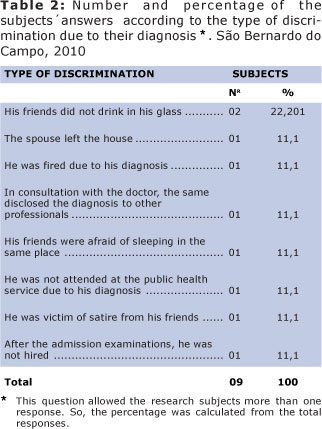
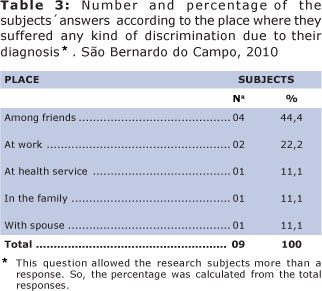
<body><![CDATA[<p>&nbsp;</p>    <p align="center"><img src="/img/revistas/rbcdh/v22n1/en_14t01.jpg"></p>    <p>&nbsp;</p>    <p>&nbsp;</p>    <p align="center"><img src="/img/revistas/rbcdh/v22n1/en_14t02.jpg"></p>    <p>&nbsp;</p>    <p><font face="Verdana, Arial, Helvetica, sans-serif" size="2">The  highest occurrence&nbsp;(02; 22.2%) of discrimination&nbsp; reported&nbsp;by the  research participants was related to&nbsp;non-use of the same&nbsp; household  appliance by&nbsp;friends. This&nbsp; discrimination shows how the lack of&nbsp;knowledge  about the forms of&nbsp;disease transmission&nbsp; can cause&nbsp;constraints  to seropositive&nbsp;individuals.</font></p>    <p><font face="Verdana, Arial, Helvetica, sans-serif" size="2">It  was also cited&nbsp;in the same proportion&nbsp;(01; 11.1%)&nbsp;the spouse&acute;s  moving out the home, dismissal, disclosure of diagnosis&nbsp;to others,&nbsp;fear  of sleeping along with&nbsp;the person, care refusal&nbsp;at health services,&nbsp;  friends&acute; satires and&nbsp;not being hired&nbsp;due to their diagnosis.</font></p>    <p><font face="Verdana, Arial, Helvetica, sans-serif" size="2">It  can be observed&nbsp;that most (04;&nbsp;44.4%) subjects&nbsp;reported having&nbsp;suffered  prejudice among&nbsp;friends, as&nbsp;is shown in <a href="#t3">Table 3</a>.</font></p>    <p><a name="t3"></a></p>    ]]></body>
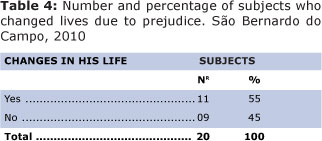
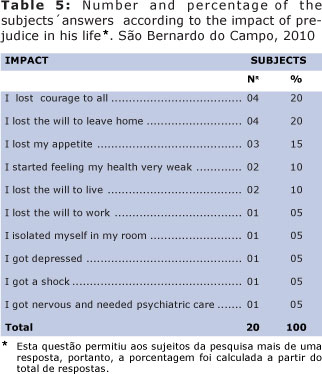
<body><![CDATA[<p>&nbsp;</p>    <p align="center"><img src="/img/revistas/rbcdh/v22n1/en_14t03.jpg"></p>    <p>&nbsp;</p>    <p><font face="Verdana, Arial, Helvetica, sans-serif" size="2">The  second&nbsp;greatest occurrence&nbsp;(2; 22.2%)&nbsp;of prejudice&nbsp; was&nbsp;at  work,&nbsp;which may&nbsp;be a consequence&nbsp;of the number&nbsp; of&nbsp;absences  or delays&nbsp; arising from the use&nbsp;of antiretroviral medications that require&nbsp;medical  supervision and,&nbsp;most commonly, early in treatment&nbsp;for&nbsp;causing  side effects.&nbsp;These conditions&nbsp;lead to a&nbsp;forced diagnosis disclosure  and, often, the&nbsp;person&nbsp; resigns&nbsp;or is&nbsp;fired from his job for  not withstanding the "pressure".&nbsp;</font></p>    <p><font face="Verdana, Arial, Helvetica, sans-serif" size="2">Most  subjects (11; 55%),&nbsp;according to data presented in <a href="#t4">Table&nbsp;4</a>,&nbsp;showed  changes&nbsp;in their lives&nbsp;by the prejudice&nbsp;suffered&nbsp;after discovering  the diagnosis.&nbsp;These changes in&nbsp;the patient's life&nbsp;reflect negatively,&nbsp;  as can be&nbsp;seen in <a href="#t5">Table 5</a>.</font></p>    <p><a name="t4"></a></p>    <p>&nbsp;</p>    <p align="center"><img src="/img/revistas/rbcdh/v22n1/en_14t04.jpg"></p>    <p>&nbsp;</p>    <p><a name="t5"></a></p>    ]]></body>
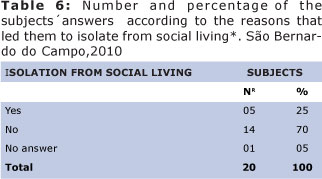
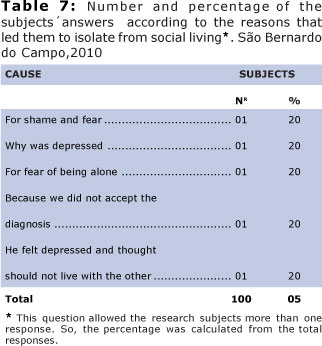
<body><![CDATA[<p>&nbsp;</p>    <p align="center"><img src="/img/revistas/rbcdh/v22n1/en_14t05.jpg"></p>    <p>&nbsp;</p>    <p><font face="Verdana, Arial, Helvetica, sans-serif" size="2">The  answers&nbsp;that prevailed&nbsp;in <a href="#t5">Table 5</a> are&nbsp;related  to&nbsp;loss of&nbsp;mood (04; 20%)&nbsp;and the desire to&nbsp;leave home&nbsp;(04;  20%),&nbsp;followed&nbsp;by loss of appetite&nbsp;(03; 15%),&nbsp;the feeling&nbsp;of  having weak&nbsp;health&nbsp;(02; 10%)&nbsp;and loss of will to live&nbsp;(02;  10%).&nbsp;It was also&nbsp;mentioned&nbsp;the loss&nbsp;of will to work,&nbsp;  isolation, depression, shock,&nbsp;nervousness and&nbsp;need for&nbsp;psychiatric  treatment&nbsp;in equal proportions&nbsp;(01; 05%).</font></p>    <p><font face="Verdana, Arial, Helvetica, sans-serif" size="2"><a href="#t6">Table  6</a> shows that the majority of the subjects (14; 70%) did not isolate from social  life after discovering the HIV/AIDS diagnosis. However, many reported verbally  that they had not disclosed their health status to anyone.</font></p>    <p><a name="t6"></a></p>    <p>&nbsp;</p>    <p align="center"><img src="/img/revistas/rbcdh/v22n1/en_14t06.jpg"></p>    <p>&nbsp;</p>    <p><font face="Verdana, Arial, Helvetica, sans-serif" size="2">It  can be seen in <a href="#t7">Table 7</a> that the responses became similar in  proportion and they are all related to the stigma acquired after the disease,  that is the same to say that HIV-infected patients feel inferior to other people  due to the diagnosis and, thus, isolate themselves from social life.&nbsp;</font></p>    ]]></body>
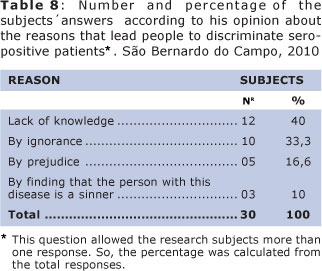
<body><![CDATA[<p><a name="t7"></a></p>    <p>&nbsp;</p>    <p align="center"><img src="/img/revistas/rbcdh/v22n1/en_14t07.jpg"></p>    <p>&nbsp;</p>    <p><font face="Verdana, Arial, Helvetica, sans-serif" size="2">As  the data presented in <a href="#t8">Table 8</a>, the main causes of prejudice  related to HIV-positive patients in their perception are the lack of knowledge  about the disease and its modes of transmission.&nbsp;The factor most often reported  was lack of knowledge (12; 40%), followed by ignorance (10; 33.3%), for pure prejudice  (05; 16.6%) and factors relevant to the history of the disease, such as homosexuality  and promiscuity (03; 10%). The population is generally well informed about the  modes of HIV transmission but is unaware of the everyday situations that provide  risk of infection<sup>8</sup>.</font></p>    <p><a name="t8"></a></p>    <p>&nbsp;</p>    <p align="center"><img src="/img/revistas/rbcdh/v22n1/en_14t08.jpg"></p>    <p>&nbsp;</p>    <p><font face="Verdana, Arial, Helvetica, sans-serif" size="2">It  is important that, in addition to treatment by health services, measures are implanted  to answer the questions of the seropositive patients social network, so that bias  does not exist in the community and, therefore, &nbsp;to improve the&nbsp;quality&nbsp;of  life&nbsp;for&nbsp;those&nbsp;with the disease<sup>9</sup>.&nbsp;</font></p>    ]]></body>
<body><![CDATA[<p><font face="Verdana, Arial, Helvetica, sans-serif" size="2">The  bias perceived by the respondents only makes the experience with seropositivity  even worse, since the stigma imposed by society becomes a pre-determinant of prejudice.&nbsp;The  fact that people close to the patient are prejudiced already affects social interactions.&nbsp;</font></p>    <p><font face="Verdana, Arial, Helvetica, sans-serif" size="2">It  is noteworthy that, according to the Ministry of Health, the secrecy is guaranteed  to people with HIV, but many companies disregard this law in admission examinations<sup>10</sup>.&nbsp;</font></p>    <p><font face="Verdana, Arial, Helvetica, sans-serif" size="2">The  impact of prejudice on the participants' lives showed in this study the great  stigma that HIV/AIDS holds today, using the fact that the transmission of information  about HIV is abundant today.</font></p>    <p><font face="Verdana, Arial, Helvetica, sans-serif" size="2">According  to WHO,&nbsp;discrimination and stigma&nbsp;related to&nbsp;HIV-positive patients  significantly &nbsp;increase&nbsp;feelings of social isolation&nbsp;on them<sup>11</sup>.</font></p>    <p><font face="Verdana, Arial, Helvetica, sans-serif" size="2">The  discovery of&nbsp;seropositivity may influence&nbsp;social interactions,&nbsp;as  evidenced&nbsp;by the omission&nbsp;of diagnosis&nbsp;and subsequent&nbsp; isolation  and depression&nbsp;in many&nbsp;cases<sup>10</sup>.&nbsp;</font></p>    <p><font face="Verdana, Arial, Helvetica, sans-serif" size="2">Considering  the stated facts, it can&nbsp;be inferred that&nbsp;there are many&nbsp;losses  and difficulties faced by&nbsp;HIV-positive patients, which may&nbsp;reflect on&nbsp;various  aspects such as&nbsp;financial, social, and especially&nbsp;the personal.&nbsp;</font></p>    <p><font face="Verdana, Arial, Helvetica, sans-serif" size="2">The  lie&nbsp; and omission&nbsp;of the diagnosis&nbsp;to others&nbsp; serve&nbsp;  often&nbsp;as a strategy&nbsp;for the patient's&nbsp;coping with the disease,  especially&nbsp; in the initial phase,&nbsp;when occurs&nbsp;&nbsp;the discovery  and&nbsp;initiation of&nbsp;treatment<sup>10</sup>.&nbsp;As is the case&nbsp;of  the patient who&nbsp;raised this study, who&nbsp;reported&nbsp;to relatives&nbsp;that  his&nbsp; hospitalization&nbsp;was due to&nbsp;Psoriasis crisis, information&nbsp;given  by&nbsp;him and&nbsp;confirmed&nbsp;in his files.&nbsp;</font></p>    <p><font face="Verdana, Arial, Helvetica, sans-serif" size="2">The  fact of having a disease considered deadly&nbsp;for years and historically associated  with homosexuality&nbsp;and promiscuity,&nbsp;leads the patient to&nbsp;a&nbsp;disparity  of&nbsp;emotions&nbsp;and desires&nbsp;which are reproduced in&nbsp;the form of&nbsp;fear,  shame,&nbsp;anxiety and&nbsp;depress&atilde;o<sup>12</sup>.&nbsp;</font></p>    <p><font face="Verdana, Arial, Helvetica, sans-serif" size="2">According  to literature,&nbsp;the data observed&nbsp;for several&nbsp;years,&nbsp;showed&nbsp;a  reduction&nbsp;in the proportion of&nbsp;individuals in the population&nbsp;who  certainly know&nbsp;the disease forms of transmission, 50%&nbsp;in 1998 to&nbsp;40%&nbsp;in  2005,&nbsp;and the belief&nbsp;of virus transmission&nbsp;by social contact&nbsp;with  infected people&nbsp;without&nbsp;&nbsp;fluid exchange remains&nbsp;high<sup>13</sup>.&nbsp;</font></p>    <p><font face="Verdana, Arial, Helvetica, sans-serif" size="2">These&nbsp;data  draw attention&nbsp;because &nbsp;the HIV/AIDS&nbsp; information transmission  suffer certain limitations to&nbsp;reach the population&nbsp;and this reality&nbsp;creates&nbsp;suffering  and distress&nbsp;in&nbsp;living with&nbsp;HIV/AIDS,&nbsp;what is known and reported&nbsp;by  this research participants.</font></p>    ]]></body>
<body><![CDATA[<p><font face="Verdana, Arial, Helvetica, sans-serif" size="2">Thus,&nbsp;it  was found that&nbsp;after three decades of the &nbsp;HIV detection, responsible  for AIDS development, there is still&nbsp;prejudice related&nbsp;to&nbsp;HIV-positive  patients and that&nbsp;this discrimination&nbsp; perceived by them&nbsp;interfere  negatively on&nbsp;their living with&nbsp;the disease.&nbsp;</font></p>    <p><font face="Verdana, Arial, Helvetica, sans-serif" size="2">We  can infer&nbsp;that the population knowledge&nbsp; about the disease&nbsp;is still  insufficient, leading to&nbsp;situations often&nbsp;embarrassing&nbsp;and inhumane&nbsp;to  patients.&nbsp;Such circumstances lead the person&nbsp;to withhold&nbsp;the diagnosis&nbsp;for  fear&nbsp;of prejudice, making treatment&nbsp;difficult and taking him&nbsp;to  a life&nbsp;with difficulties in&nbsp;social&nbsp;interaction to be&nbsp;transposed.&nbsp;</font></p>    <p><font face="Verdana, Arial, Helvetica, sans-serif" size="2">Therefore,  we emphasize&nbsp;the importance of&nbsp;awareness campaigns&nbsp;about the disease,  mainly&nbsp;about the ways of &nbsp;transmission,&nbsp; associated to the actions&nbsp;of&nbsp;demystification,&nbsp;so  that the HIV positive&nbsp; patient does not face&nbsp;prejudice,&nbsp;beyond  the difficulties&nbsp;of the disease itself&nbsp;and all the history&nbsp;that  accompanies it.&nbsp;</font></p>    <p><font face="Verdana, Arial, Helvetica, sans-serif" size="2">For&nbsp;this  is&nbsp;essential&nbsp;an effort by the&nbsp; media&nbsp; together&nbsp;with the  department &nbsp;of justice, department of work&nbsp;and entities that protect  the rights&nbsp;of workers&nbsp;and/or&nbsp;people living with&nbsp; HIV/AIDS,&nbsp;to  highlight the limitations&nbsp;arising from the stigma&nbsp;associated with the  disease&nbsp;and not only the&nbsp;infection itself.</font></p>    <p>&nbsp;</p>    <p><font face="Verdana, Arial, Helvetica, sans-serif" size="3"><b>REFERENCES</b></font></p>    <!-- ref --><p><font face="Verdana, Arial, Helvetica, sans-serif" size="2">1.  Daspett C. Um estranho entre n&oacute;s: a repercuss&atilde;o do diagn&oacute;stico  de HIV/AIDS na trajet&oacute;ria de casais heterossexuais soroconcor-dantes. S&atilde;o  Paulo, 2005. Disserta&ccedil;&atilde;o (Mestrado em Psicologia Cl&iacute;nica).  Pontificia Universidade Cat&oacute;lica de S&atilde;o Paulo, 2005.    &nbsp;&nbsp;&nbsp;&nbsp;&nbsp;&nbsp;&nbsp;&nbsp;[&#160;<a href="javascript:void(0);" onclick="javascript: window.open('/scielo.php?script=sci_nlinks&ref=2486208&pid=S0104-1282201200010001400001&lng=','','width=640,height=500,resizable=yes,scrollbars=1,menubar=yes,');">Links</a>&#160;]<!-- end-ref --></font></p>    <!-- ref --><p><font face="Verdana, Arial, Helvetica, sans-serif" size="2">2.  Moreira MS. Psiconeuroimunologia. Rio de Janeiro: Editora Medsi, 2003. 256 p&aacute;gs.    &nbsp;&nbsp;&nbsp;&nbsp;&nbsp;&nbsp;&nbsp;&nbsp;[&#160;<a href="javascript:void(0);" onclick="javascript: window.open('/scielo.php?script=sci_nlinks&ref=2486210&pid=S0104-1282201200010001400002&lng=','','width=640,height=500,resizable=yes,scrollbars=1,menubar=yes,');">Links</a>&#160;]<!-- end-ref --></font></p>    ]]></body>
<body><![CDATA[<!-- ref --><p><font face="Verdana, Arial, Helvetica, sans-serif" size="2">3.  Minist&eacute;rio da Sa&uacute;de. Boletim epidemiol&oacute;gico 2008. Dispon&iacute;vel  em: <a href="http://www.aids.gov.br" target="_blank">http://www.aids.gov.br</a>/Acesso  em: 19 de jun. 2009.    &nbsp;&nbsp;&nbsp;&nbsp;&nbsp;&nbsp;&nbsp;&nbsp;[&#160;<a href="javascript:void(0);" onclick="javascript: window.open('/scielo.php?script=sci_nlinks&ref=2486212&pid=S0104-1282201200010001400003&lng=','','width=640,height=500,resizable=yes,scrollbars=1,menubar=yes,');">Links</a>&#160;]<!-- end-ref --></font></p>    <!-- ref --><p><font face="Verdana, Arial, Helvetica, sans-serif" size="2">4.  Scaldaferri A; Ara&uacute;jo FE.Pesquisa sobre o preconceito e o estigma de pacientes  soropositivos. S&atilde;o Paulo, 2008.    &nbsp;&nbsp;&nbsp;&nbsp;&nbsp;&nbsp;&nbsp;&nbsp;[&#160;<a href="javascript:void(0);" onclick="javascript: window.open('/scielo.php?script=sci_nlinks&ref=2486214&pid=S0104-1282201200010001400004&lng=','','width=640,height=500,resizable=yes,scrollbars=1,menubar=yes,');">Links</a>&#160;]<!-- end-ref --></font></p>    <!-- ref --><p><font face="Verdana, Arial, Helvetica, sans-serif" size="2">5.  Rachid M; Schechter M. Manual de HIV/AIDS. 5ª edi&ccedil;&atilde;o. Rio de Janeiro:  Editora Revinter, 2000. 222 p&aacute;gs</font>&nbsp;&nbsp;&nbsp;&nbsp;&nbsp;&nbsp;&nbsp;&nbsp;[&#160;<a href="javascript:void(0);" onclick="javascript: window.open('/scielo.php?script=sci_nlinks&ref=2486216&pid=S0104-1282201200010001400005&lng=','','width=640,height=500,resizable=yes,scrollbars=1,menubar=yes,');">Links</a>&#160;]<!-- end-ref --><!-- ref --><p><font face="Verdana, Arial, Helvetica, sans-serif" size="2">6.  Minist&eacute;rio da Sa&uacute;de. Formas de cont&aacute;gio. Dispon&iacute;vel  em: &lt;<a href="http://www.aids.gov.br/data/Pages/LUMIS81B68422PTBRIE.htm" target="_blank">http://www.aids.gov.br/data/Pages/LUMIS81B68422PTBRIE.htm</a>&gt;.  Acesso em: 19 de jun. 2009.    &nbsp;&nbsp;&nbsp;&nbsp;&nbsp;&nbsp;&nbsp;&nbsp;[&#160;<a href="javascript:void(0);" onclick="javascript: window.open('/scielo.php?script=sci_nlinks&ref=2486217&pid=S0104-1282201200010001400006&lng=','','width=640,height=500,resizable=yes,scrollbars=1,menubar=yes,');">Links</a>&#160;]<!-- end-ref --></font></p>    <!-- ref --><p><font face="Verdana, Arial, Helvetica, sans-serif" size="2">7.  Lakatos EM; Marconi MA. Metodologia Cient&iacute;fica. 2ª edi&ccedil;&atilde;o.  S&atilde;o Paulo: Editora Atlas S.A., 1995. 140 p&aacute;gs.    &nbsp;&nbsp;&nbsp;&nbsp;&nbsp;&nbsp;&nbsp;&nbsp;[&#160;<a href="javascript:void(0);" onclick="javascript: window.open('/scielo.php?script=sci_nlinks&ref=2486219&pid=S0104-1282201200010001400007&lng=','','width=640,height=500,resizable=yes,scrollbars=1,menubar=yes,');">Links</a>&#160;]<!-- end-ref --></font></p>    <!-- ref --><p><font face="Verdana, Arial, Helvetica, sans-serif" size="2">8.  Lima MM. <i>et.al.</i>Conhecimento da popula&ccedil;&atilde;o de Vi&ccedil;osa,  MG, sobre as formas de transmiss&atilde;o da AIDS. Departamento de Biologia Geral,  Universidade Federal de Vi&ccedil;osa. Minas Gerais, 2007.    &nbsp;&nbsp;&nbsp;&nbsp;&nbsp;&nbsp;&nbsp;&nbsp;[&#160;<a href="javascript:void(0);" onclick="javascript: window.open('/scielo.php?script=sci_nlinks&ref=2486221&pid=S0104-1282201200010001400008&lng=','','width=640,height=500,resizable=yes,scrollbars=1,menubar=yes,');">Links</a>&#160;]<!-- end-ref --></font></p>    <!-- ref --><p><font face="Verdana, Arial, Helvetica, sans-serif" size="2">9.  Tunala LG. Fontes cotidianas de estresse entre mulheres portadoras de HIV. <i>RevSaude  Publica.</i> 2002; 36(4supl): 24-31.    &nbsp;&nbsp;&nbsp;&nbsp;&nbsp;&nbsp;&nbsp;&nbsp;[&#160;<a href="javascript:void(0);" onclick="javascript: window.open('/scielo.php?script=sci_nlinks&ref=2486223&pid=S0104-1282201200010001400009&lng=','','width=640,height=500,resizable=yes,scrollbars=1,menubar=yes,');">Links</a>&#160;]<!-- end-ref --></font></p>    <!-- ref --><p><font face="Verdana, Arial, Helvetica, sans-serif" size="2">10.  Garrido PB; Paiva V. Aids, estigma e desemprego: implica&ccedil;&otilde;es para  os servi&ccedil;os de sa&uacute;de.S&atilde;o Paulo, 2007. Rev Sa&uacute;de P&uacute;blica  2007;41(Supl. 2):72-9</font>&nbsp;&nbsp;&nbsp;&nbsp;&nbsp;&nbsp;&nbsp;&nbsp;[&#160;<a href="javascript:void(0);" onclick="javascript: window.open('/scielo.php?script=sci_nlinks&ref=2486225&pid=S0104-1282201200010001400010&lng=','','width=640,height=500,resizable=yes,scrollbars=1,menubar=yes,');">Links</a>&#160;]<!-- end-ref --><!-- ref --><p><font face="Verdana, Arial, Helvetica, sans-serif" size="2">11.  Organiza&ccedil;&atilde;o das Na&ccedil;&otilde;es Unidas. Programa Conjunto das  Na&ccedil;&otilde;es Unidas sobre HIV/Aids. El SIDA: cuidados paliativos.Ginebra;  2001.    &nbsp;&nbsp;&nbsp;&nbsp;&nbsp;&nbsp;&nbsp;&nbsp;[&#160;<a href="javascript:void(0);" onclick="javascript: window.open('/scielo.php?script=sci_nlinks&ref=2486226&pid=S0104-1282201200010001400011&lng=','','width=640,height=500,resizable=yes,scrollbars=1,menubar=yes,');">Links</a>&#160;]<!-- end-ref --></font></p>    <!-- ref --><p><font face="Verdana, Arial, Helvetica, sans-serif" size="2">12.  Carvalho CML; Galv&atilde;o MTG. Enfrentamento da AIDS entre mulheres infectadas  em Fortaleza - CE.S&atilde;o Paulo, 2008. Revista da Escola de Enfermagem USP  2008; 42(1):90-7.    &nbsp;&nbsp;&nbsp;&nbsp;&nbsp;&nbsp;&nbsp;&nbsp;[&#160;<a href="javascript:void(0);" onclick="javascript: window.open('/scielo.php?script=sci_nlinks&ref=2486228&pid=S0104-1282201200010001400012&lng=','','width=640,height=500,resizable=yes,scrollbars=1,menubar=yes,');">Links</a>&#160;]<!-- end-ref --></font></p>    <!-- ref --><p><font face="Verdana, Arial, Helvetica, sans-serif" size="2">13.  Ferreira MP; Grupo de Estudos em Popula&ccedil;&atilde;o, Sexualidade e Aids.  N&iacute;vel de conhecimento e percep&ccedil;&atilde;o de risco da popula&ccedil;&atilde;o  brasileira sobre o HIV/Aids, 1998 e 2005.<i>RevSaude Publica.</i> 2008; 42(Supl1):  65-71.    &nbsp;&nbsp;&nbsp;&nbsp;&nbsp;&nbsp;&nbsp;&nbsp;[&#160;<a href="javascript:void(0);" onclick="javascript: window.open('/scielo.php?script=sci_nlinks&ref=2486230&pid=S0104-1282201200010001400013&lng=','','width=640,height=500,resizable=yes,scrollbars=1,menubar=yes,');">Links</a>&#160;]<!-- end-ref --></font></p>    ]]></body>
<body><![CDATA[<p>&nbsp;</p>    <p>&nbsp;</p>    <p><font face="Verdana, Arial, Helvetica, sans-serif" size="2"><b><a name="back"></a><a href="#top"><img src="/img/revistas/rbcdh/v22n1/seta.jpg" border="0"></a>  Corresponding author:    <br> </b> <a href="mailto:fon_fonseca@yahoo.com.br">fon_fonseca@yahoo.com.br</a></font></p>    <p><font face="Verdana, Arial, Helvetica, sans-serif" size="2">Manuscript  submitted Apr 06 2011    <br> Accepted for publication Dec 20 2011.</font></p>      ]]></body>
<back>
<ref-list>
<ref id="B1">
<label>1</label><nlm-citation citation-type="">
<person-group person-group-type="author">
<name>
<surname><![CDATA[Daspett]]></surname>
<given-names><![CDATA[C]]></given-names>
</name>
</person-group>
<source><![CDATA[Um estranho entre nós: a repercussão do diagnóstico de HIV/AIDS na trajetória de casais heterossexuais soroconcor-dantes]]></source>
<year>2005</year>
<publisher-loc><![CDATA[São Paulo ]]></publisher-loc>
</nlm-citation>
</ref>
<ref id="B2">
<label>2</label><nlm-citation citation-type="book">
<person-group person-group-type="author">
<name>
<surname><![CDATA[Moreira]]></surname>
<given-names><![CDATA[MS]]></given-names>
</name>
</person-group>
<source><![CDATA[Psiconeuroimunologia]]></source>
<year>2003</year>
<publisher-loc><![CDATA[Rio de Janeiro ]]></publisher-loc>
<publisher-name><![CDATA[Editora Medsi]]></publisher-name>
</nlm-citation>
</ref>
<ref id="B3">
<label>3</label><nlm-citation citation-type="">
<collab>Ministério da Saúde</collab>
<source><![CDATA[Boletim epidemiológico 2008]]></source>
<year></year>
</nlm-citation>
</ref>
<ref id="B4">
<label>4</label><nlm-citation citation-type="">
<person-group person-group-type="author">
<name>
<surname><![CDATA[Scaldaferri A; Araújo]]></surname>
<given-names><![CDATA[FE]]></given-names>
</name>
</person-group>
<source><![CDATA[Pesquisa sobre o preconceito e o estigma de pacientes soropositivos]]></source>
<year>2008</year>
<publisher-loc><![CDATA[São Paulo ]]></publisher-loc>
</nlm-citation>
</ref>
<ref id="B5">
<label>5</label><nlm-citation citation-type="book">
<person-group person-group-type="author">
<name>
<surname><![CDATA[Rachid M; Schechter]]></surname>
<given-names><![CDATA[M]]></given-names>
</name>
</person-group>
<source><![CDATA[Manual de HIV/AIDS]]></source>
<year>2000</year>
<edition>5</edition>
<publisher-loc><![CDATA[Rio de Janeiro ]]></publisher-loc>
<publisher-name><![CDATA[Editora Revinter]]></publisher-name>
</nlm-citation>
</ref>
<ref id="B6">
<label>6</label><nlm-citation citation-type="">
<collab>Ministério da Saúde</collab>
<source><![CDATA[Formas de contágio]]></source>
<year></year>
</nlm-citation>
</ref>
<ref id="B7">
<label>7</label><nlm-citation citation-type="book">
<person-group person-group-type="author">
<name>
<surname><![CDATA[Lakatos EM; Marconi]]></surname>
<given-names><![CDATA[MA]]></given-names>
</name>
</person-group>
<source><![CDATA[Metodologia Científica]]></source>
<year>1995</year>
<edition>2</edition>
<publisher-loc><![CDATA[São Paulo ]]></publisher-loc>
<publisher-name><![CDATA[Editora Atlas S.A.]]></publisher-name>
</nlm-citation>
</ref>
<ref id="B8">
<label>8</label><nlm-citation citation-type="book">
<person-group person-group-type="author">
<name>
<surname><![CDATA[Lima]]></surname>
<given-names><![CDATA[MM]]></given-names>
</name>
</person-group>
<source><![CDATA[Conhecimento da população de Viçosa, MG, sobre as formas de transmissão da AIDS]]></source>
<year>2007</year>
<publisher-loc><![CDATA[Minas Gerais ]]></publisher-loc>
<publisher-name><![CDATA[Departamento de Biologia Geral, Universidade Federal de Viçosa]]></publisher-name>
</nlm-citation>
</ref>
<ref id="B9">
<label>9</label><nlm-citation citation-type="journal">
<person-group person-group-type="author">
<name>
<surname><![CDATA[Tunala]]></surname>
<given-names><![CDATA[LG]]></given-names>
</name>
</person-group>
<article-title xml:lang="pt"><![CDATA[Fontes cotidianas de estresse entre mulheres portadoras de HIV]]></article-title>
<source><![CDATA[RevSaude Publica.]]></source>
<year>2002</year>
<volume>36</volume>
<numero>^s4</numero>
<issue>^s4</issue>
<supplement>4</supplement>
<page-range>24-31</page-range></nlm-citation>
</ref>
<ref id="B10">
<label>10</label><nlm-citation citation-type="journal">
<person-group person-group-type="author">
<name>
<surname><![CDATA[Garrido PB; Paiva]]></surname>
<given-names><![CDATA[V]]></given-names>
</name>
</person-group>
<article-title xml:lang="pt"><![CDATA[Aids, estigma e desemprego: implicações para os serviços de saúde.São Paulo, 2007]]></article-title>
<source><![CDATA[Rev Saúde Pública]]></source>
<year>2007</year>
<volume>41</volume>
<numero>^s2</numero>
<issue>^s2</issue>
<supplement>2</supplement>
<page-range>72-9</page-range></nlm-citation>
</ref>
<ref id="B11">
<label>11</label><nlm-citation citation-type="">
<collab>Organização das Nações Unidas</collab>
<source><![CDATA[Programa Conjunto das Nações Unidas sobre HIV/Aids: El SIDA: cuidados paliativos]]></source>
<year>2001</year>
<publisher-loc><![CDATA[Ginebra ]]></publisher-loc>
</nlm-citation>
</ref>
<ref id="B12">
<label>12</label><nlm-citation citation-type="journal">
<person-group person-group-type="author">
<name>
<surname><![CDATA[Carvalho CML; Galvão]]></surname>
<given-names><![CDATA[MTG]]></given-names>
</name>
</person-group>
<article-title xml:lang="pt"><![CDATA[Enfrentamento da AIDS entre mulheres infectadas em Fortaleza - CE: São Paulo, 2008]]></article-title>
<source><![CDATA[Revista da Escola de Enfermagem USP]]></source>
<year>2008</year>
<volume>42</volume>
<numero>1</numero>
<issue>1</issue>
<page-range>90-7</page-range></nlm-citation>
</ref>
<ref id="B13">
<label>13</label><nlm-citation citation-type="journal">
<person-group person-group-type="author">
<name>
<surname><![CDATA[Ferreira]]></surname>
<given-names><![CDATA[MP]]></given-names>
</name>
</person-group>
<collab>Grupo de Estudos em População, Sexualidade e Aids</collab>
<article-title xml:lang="pt"><![CDATA[Nível de conhecimento e percepção de risco da população brasileira sobre o HIV/Aids, 1998 e 2005]]></article-title>
<source><![CDATA[RevSaude Publica.]]></source>
<year>2008</year>
<volume>42</volume>
<numero>^s1</numero>
<issue>^s1</issue>
<supplement>1</supplement>
<page-range>65-71</page-range></nlm-citation>
</ref>
</ref-list>
</back>
</article>