<?xml version="1.0" encoding="ISO-8859-1"?><article xmlns:mml="http://www.w3.org/1998/Math/MathML" xmlns:xlink="http://www.w3.org/1999/xlink" xmlns:xsi="http://www.w3.org/2001/XMLSchema-instance">
<front>
<journal-meta>
<journal-id>0104-1282</journal-id>
<journal-title><![CDATA[Journal of Human Growth and Development]]></journal-title>
<abbrev-journal-title><![CDATA[Rev. bras. crescimento desenvolv. hum.]]></abbrev-journal-title>
<issn>0104-1282</issn>
<publisher>
<publisher-name><![CDATA[Centro de Estudos de Crescimento e Desenvolvimento do Ser Humano]]></publisher-name>
</publisher>
</journal-meta>
<article-meta>
<article-id>S0104-12822016000100010</article-id>
<article-id pub-id-type="doi">10.7322/jhgd.106080</article-id>
<title-group>
<article-title xml:lang="en"><![CDATA[Overweight and low height in children of urban, rural and indigenous communities]]></article-title>
<article-title xml:lang="pt"><![CDATA[Excesso de peso e baixa estatura em crianças de comunidades urbana, rural e indígena]]></article-title>
</title-group>
<contrib-group>
<contrib contrib-type="author">
<name>
<surname><![CDATA[Tagliari]]></surname>
<given-names><![CDATA[Itamar Adriano]]></given-names>
</name>
<xref ref-type="aff" rid="A01"/>
</contrib>
<contrib contrib-type="author">
<name>
<surname><![CDATA[Ferreira]]></surname>
<given-names><![CDATA[Maria Beatriz Rocha]]></given-names>
</name>
<xref ref-type="aff" rid="A02"/>
</contrib>
<contrib contrib-type="author">
<name>
<surname><![CDATA[Silva]]></surname>
<given-names><![CDATA[Larissa Rosa da]]></given-names>
</name>
<xref ref-type="aff" rid="A03"/>
</contrib>
<contrib contrib-type="author">
<name>
<surname><![CDATA[Pizzi]]></surname>
<given-names><![CDATA[Juliana]]></given-names>
</name>
<xref ref-type="aff" rid="A04"/>
</contrib>
<contrib contrib-type="author">
<name>
<surname><![CDATA[Leite]]></surname>
<given-names><![CDATA[Neiva]]></given-names>
</name>
<xref ref-type="aff" rid="A03"/>
</contrib>
</contrib-group>
<aff id="A01">
<institution><![CDATA[,Universidade Estadual de Ponta Grossa Departamento de Educação Física ]]></institution>
<addr-line><![CDATA[Ponta Grossa PR]]></addr-line>
<country>Brasil</country>
</aff>
<aff id="A02">
<institution><![CDATA[,Universidade Federal da Grande Dourados Faculdade de Educação ]]></institution>
<addr-line><![CDATA[ MS]]></addr-line>
<country>Brasil</country>
</aff>
<aff id="A03">
<institution><![CDATA[,Universidade Federal do Paraná Departamento de Educação Física ]]></institution>
<addr-line><![CDATA[Curitiba PR]]></addr-line>
<country>Brasil</country>
</aff>
<aff id="A04">
<institution><![CDATA[,Universidade Paranaense  ]]></institution>
<addr-line><![CDATA[Francisco Beltrão PR]]></addr-line>
<country>Brasil</country>
</aff>
<pub-date pub-type="pub">
<day>00</day>
<month>00</month>
<year>2016</year>
</pub-date>
<pub-date pub-type="epub">
<day>00</day>
<month>00</month>
<year>2016</year>
</pub-date>
<volume>26</volume>
<numero>1</numero>
<fpage>67</fpage>
<lpage>73</lpage>
<copyright-statement/>
<copyright-year/>
<self-uri xlink:href="http://pepsic.bvsalud.org/scielo.php?script=sci_arttext&amp;pid=S0104-12822016000100010&amp;lng=en&amp;nrm=iso"></self-uri><self-uri xlink:href="http://pepsic.bvsalud.org/scielo.php?script=sci_abstract&amp;pid=S0104-12822016000100010&amp;lng=en&amp;nrm=iso"></self-uri><self-uri xlink:href="http://pepsic.bvsalud.org/scielo.php?script=sci_pdf&amp;pid=S0104-12822016000100010&amp;lng=en&amp;nrm=iso"></self-uri><abstract abstract-type="short" xml:lang="en"><p><![CDATA[Changes in lifestyle have led to an increase of overweight in the juvenile population. However, there are limited studies about this topic in relation to an indigenous population. The aim of this study is to verify the overweight and height deficit in children aged 8 and 9 years, of both sexes, from urban, rural and indigenous communities of the city of Nova Laranjeiras in the State of Paraná. The 277 (148 boys) students were divided into three groups: rural (n = 100), urban (n = 99) and Indian communities (n = 78). The measurements taken were body mass (kg), height (m) and body mass index. The statistics method was an analysis of covariance and chi-square test (P <.05). Among the 277 schoolchildren, the prevalence of overweight was 14.6% in the rural area, 27.1% in urban area and 30.3% in the indigenous area in boys, and 15.7% in rural areas, 17.6% in urban and 20% in Indian girls. There was no difference in the frequency of overweight among groups for both sexes. The prevalence of height deficit was different between the groups; it was higher in indigenous children than urban and rural children. Among the Indians, 42.4% of boys and 51.1% girls had low stature. Only indigenous children were overweight and of low height, while being prevalent in 15.1% of boys and 11.1% girls. Low stature is frequent in indigenous populations, and it would be ideal to have more research to identify its causes and consequences. Children showed high rates of overweight in all regions, demonstrating that poor eating habits and a sedentary lifestyle are not only characteristics of urban centres.]]></p></abstract>
<abstract abstract-type="short" xml:lang="pt"><p><![CDATA[INTRODUÇÃO: As modificações no estilo de vida têm favorecido o aumento do excesso de peso na população infanto-juvenil e há carência de estudos nesta área na população indígena. OBJETIVO: verificar o excesso de peso e a baixa estatura em crianças de 8 e 9 anos, de ambos os sexos, provenientes das comunidades urbana, rural e indígena do Município de Nova Laranjeiras do Estado do Paraná. MÉTODO: Estudo descritivo. Foram avaliados 277 (148 meninos) escolares e divididos em três grupos: Rural (n=100), urbano (n=99) e indígena (n=78). Todos foram avaliados quanto à massa corporal (kg), estatura (m), índice de massa corporal. A análise dos dados foi efetuada por meio da Analysis of Covariance e do Qui-quadrado (P<0,05). RESULTADOS: Dentre os 277 escolares avaliados, a prevalência de excesso de peso foi de 14,6% da área rural, de 27,1% da área urbana e de 30,3% da área indígena nos meninos, e de 15,7% nas rurais, de 17,6% nas urbanas e 20% nas indígenas nas meninas. Não houve diferença nas frequências de excesso de peso entre os grupos em ambos os sexos. As crianças indígenas apresentam menor estatura em relação às crianças urbanas e rurais. Entre os indígenas, 42,4% dos meninos e 51,1% das meninas apresentaram baixa estatura. Apenas as crianças indígenas apresentaram excesso de peso e baixa estatura ao mesmo tempo, sendo prevalente em 15,1% dos meninos, e 11,1% das meninas. CONCLUSÕES: A baixa estatura é frequente em populações indígenas. Pesquisas que identifiquem suas causas e consequências são necessárias. As crianças apresentaram elevados índices de excesso de peso em todas as regiões, demonstrando que maus hábitos alimentares e sedentarismo não são características apenas dos centros urbanos.]]></p></abstract>
<kwd-group>
<kwd lng="en"><![CDATA[anthropometry]]></kwd>
<kwd lng="en"><![CDATA[body composition]]></kwd>
<kwd lng="en"><![CDATA[body mass index]]></kwd>
<kwd lng="en"><![CDATA[obesity]]></kwd>
<kwd lng="pt"><![CDATA[antropometria]]></kwd>
<kwd lng="pt"><![CDATA[composição corporal]]></kwd>
<kwd lng="pt"><![CDATA[índice de massa corporal]]></kwd>
<kwd lng="pt"><![CDATA[obesidade]]></kwd>
</kwd-group>
</article-meta>
</front><body><![CDATA[ <p align="right"><font size="2" face="Verdana, Arial, Helvetica, sans-serif"><b>ORIGINAL    RESEARCH</b></font></p>     <p>&nbsp;</p>     <p><font face="Verdana, Arial, Helvetica, sans-serif" size="4"><b><a name="top"></a>Overweight    and low height in children of urban, rural and indigenous communities</b></font></p>     <p>&nbsp;</p>     <p>&nbsp;</p>     <p><font face="Verdana, Arial, Helvetica, sans-serif" size="2"><b>Itamar Adriano    Tagliari<sup>I,<a href="#back"> *</a></sup>; Maria Beatriz Rocha Ferreira<sup>II</sup>;    Larissa Rosa da Silva<sup>III</sup>; Juliana Pizzi<sup>IV</sup>; Neiva Leite<sup>III</sup></b></font></p>     <p><font face="Verdana, Arial, Helvetica, sans-serif" size="2"><sup>I</sup>Departamento    de Educa&ccedil;&atilde;o F&iacute;sica da Universidade Estadual de Ponta Grossa    (UEPG), Ponta Grossa, PR, Brasil    <br>   <sup>II</sup>Faculdade de Educa&ccedil;&atilde;o da Universidade Federal da    Grande Dourados, MS, Brasil    <br>   <sup>III</sup>Departamento de Educa&ccedil;&atilde;o F&iacute;sica da Universidade    Federal do Paran&aacute; (UFPR); Curitiba, PR, Brasil    <br>   <sup>IV</sup>Curso de Educa&ccedil;&atilde;o F&iacute;sica da Universidade Paranaense    (UNIPAR), Francisco Beltr&atilde;o, PR, Brasil</font></p>     ]]></body>
<body><![CDATA[<p>&nbsp;</p>     <p>&nbsp;</p> <hr noshade size="1">     <p><font face="Verdana, Arial, Helvetica, sans-serif" size="2"><b>ABSTRACT</b></font></p>     <p><font face="Verdana, Arial, Helvetica, sans-serif" size="2">Changes in lifestyle    have led to an increase of overweight in the juvenile population. However, there    are limited studies about this topic in relation to an indigenous population.    The aim of this study is to verify the overweight and height deficit in children    aged 8 and 9 years, of both sexes, from urban, rural and indigenous communities    of the city of Nova Laranjeiras in the State of Paran&aacute;. The 277 (148    boys) students were divided into three groups: rural (n = 100), urban (n = 99)    and Indian communities (n = 78). The measurements taken were body mass (kg),    height (m) and body mass index. The statistics method was an analysis of covariance    and chi-square test (P &lt;.05). Among the 277 schoolchildren, the prevalence    of overweight was 14.6% in the rural area, 27.1% in urban area and 30.3% in    the indigenous area in boys, and 15.7% in rural areas, 17.6% in urban and 20%    in Indian girls. There was no difference in the frequency of overweight among    groups for both sexes. The prevalence of height deficit was different between    the groups; it was higher in indigenous children than urban and rural children.    Among the Indians, 42.4% of boys and 51.1% girls had low stature. Only indigenous    children were overweight and of low height, while being prevalent in 15.1% of    boys and 11.1% girls. Low stature is frequent in indigenous populations, and    it would be ideal to have more research to identify its causes and consequences.    Children showed high rates of overweight in all regions, demonstrating that    poor eating habits and a sedentary lifestyle are not only characteristics of    urban centres.</font></p>     <p><font face="Verdana, Arial, Helvetica, sans-serif" size="2"><b>Keywords</b>:    anthropometry, body composition, body mass index, obesity.</font></p> <hr noshade size="1">     <p>&nbsp;</p>     <p>&nbsp;</p>     <p><font face="Verdana, Arial, Helvetica, sans-serif" size="3"><b>INTRODUCTION</b></font></p>     <p><font face="Verdana, Arial, Helvetica, sans-serif" size="2">Obesity is a public    health problem in all countries and age groups, related to globalisation - a    result of the changes caused by the incorporation of technology in the everyday    life of the industrialised societies<sup>1</sup>. From the mid-1970s to the    1990s, in Brazil, the nutritional transition process, characterised by inversion    of the high prevalence of low birth weight and child malnutrition to a profile    of overweight and obesity<sup>2</sup>, was caused primarily by the acquisition    of unhealthy eating habits, as well as a less active lifestyle<sup>3</sup>.    These habits have hit children and adolescents worldwide, in cities of large,    medium and small sizes<sup>4</sup>. These changes can also be observed in indigenous    populations affected by a long process of government policies related to these    people, especially those close to cities with a high population rate who have    had difficulties with their livelihood, scarcity of land for planting, the introduction    of processed foods and a sedentary lifestyle<sup>5</sup>.</font></p>     <p><font face="Verdana, Arial, Helvetica, sans-serif" size="2">According to the    Survey of Family Budgets (POF/IBGE)<sup>6</sup>, held between 2008 and 2009    by the Ministry of Health, 33.5% of children between 5 and 9 years is overweight,    representing an increase of 250% in relation to the year 1989. The excess weight    of the juvenile population is a concern for the negative psychosocial impact    and its association with co-morbidities and mortality<sup>7</sup>. On the other    hand, in the same period, there was a reduction of 50% in the frequency of short    stature in the Brazilian population, which reached 7.2% and 6.3% of boys and    girls in 2008 and 2009, within that age group, according to the data of the    POF/IBGE<sup>6</sup>. For indigenous populations, the data show a high prevalence    of stunting<sup>8,9</sup>. Finally, studies on the nutritional condition of    indigenous Brazilian children, when compared with the population of NCHS reference    point for moderate and high frequency of stature in association with reduced    frequencies of low weight for height<sup>9</sup>.</font></p>     ]]></body>
<body><![CDATA[<p><font face="Verdana, Arial, Helvetica, sans-serif" size="2">The precarious    health situation of many indigenous people in Brazil is largely due to the food    situation. This fact, caused by a combination of a shortage in productive areas    for production, a rapid increase in population, and drastic socio-economic and    cultural changes, with the loss of original economic alternatives and the introduction    of new alimentation standards, is an important element in understanding the    health-disease process of indigenous people<sup>10</sup>.</font></p>     <p><font face="Verdana, Arial, Helvetica, sans-serif" size="2">Most research on    the indigenous population is geared toward growth and nutritional problems such    as short stature<sup>8,9</sup>. However, there are some studies on indigenous    ethnic groups that point to a possible increase in the prevalence of obesity    and associated diseases<sup>11,12</sup>. The lack of studies on this population    leaves important questions unanswered about public health and intervention programmes.    In this sense, the objective of the present work is to verify the prevalence    of overweight and short stature among children of 8 and 9 years old from three    distinct areas: rural, urban and indigenous residents of the municipality of    Nova Laranjeiras, Paran&aacute;, Brazil.</font></p>     <p>&nbsp;</p>     <p><font face="Verdana, Arial, Helvetica, sans-serif" size="3"><b>METHODS</b></font></p>     <p><font face="Verdana, Arial, Helvetica, sans-serif" size="2">This is a descriptive    and transversal study using quantitative variables. The sample was comprised    of 277 schoolchildren of both genders, between 8 and 9 years of age, residing    in three regions of the municipality of Nova Laranjeiras, Paran&aacute;, Brazil.    The municipality has a population of 11,848, with 15.3% in urban and 84.7%<sup>13</sup>    in rural areas.</font></p>     <p><font face="Verdana, Arial, Helvetica, sans-serif" size="2">Three regions were    selected: 1) an urban area, 2) a rural area and 3) indigenous land (IL), Rio    das Cobras. Urban and rural regions were defined according to the criteria of    the municipal government and the National Indian Foundation (MGNIF/FUNAI) in    the IL's case, promoting the official recognition of indigenous lands.</font></p>     <p><font face="Verdana, Arial, Helvetica, sans-serif" size="2">The children of    the urban and rural areas were classified according to their rural or urban    residence, although they attended two schools located in the urban area. These    two schools were selected due to the concentration of the largest number of    students from the municipality of the age group studied, as well as being close    to IL. All Indian children lived in IL and frequented schools in this region.</font></p>     <p><font face="Verdana, Arial, Helvetica, sans-serif" size="2">In those schools,    all 330 students enrolled were invited but only 277 students, who had parental    consent and who attended on the data collection day, were evaluated. It was    determined that the study would be for children between 8 and 9 years of age,    because they are at an earlier stage of sexual maturation; moreover, they are    children who have managed to overcome the difficulties of hostility and serve    as an indicator for understanding the potential problems experienced by younger    children. This study was approved by the Research Ethics Committee and by the    National Council of ethics in research, CONEP, under case number 25000.096846/2004-08    and the National Indian Foundation (FUNAI).</font></p>     <p><font face="Verdana, Arial, Helvetica, sans-serif" size="2">The following anthropometric    data were measured: body mass (Filizola mechanical scale), height (dry wall    mounted stadiometer), arm and leg circumferences (Cardiomed inelastic tape measure),    triceps skinfold, and subscapular, suprailiac and calf (Harpenden skinfold caliper).    The measurements followed the recommendations published in a reference manual    for anthropometric standarisation<sup>14</sup>, recorded for the right side    of the body. The body mass index (BMI) was calculated using the following formula    BMI = weight/(height)<sup>2 </sup>in kg/m<sup>2</sup>. The BMI-Z score and short    stature were assessed using the programme Antroplus from WHO (World Health Organisation).</font></p>     <p><font face="Verdana, Arial, Helvetica, sans-serif" size="2">The statistical    procedure was analysis of variance (ANOVA) to compare anthropometric features    depending on the local factor, using the Tukey test. For comparison of frequencies    between the groups the Chi-square (c<sup>2</sup>) test was used. Analyses were    performed with separation by gender. The significance level adopted for statistical    tests was 5%.</font></p>     ]]></body>
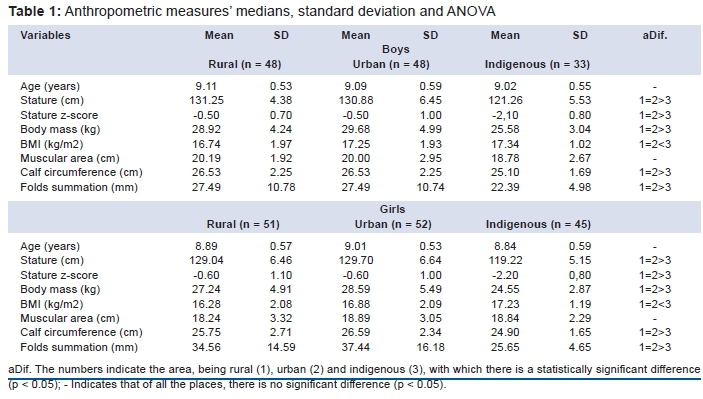
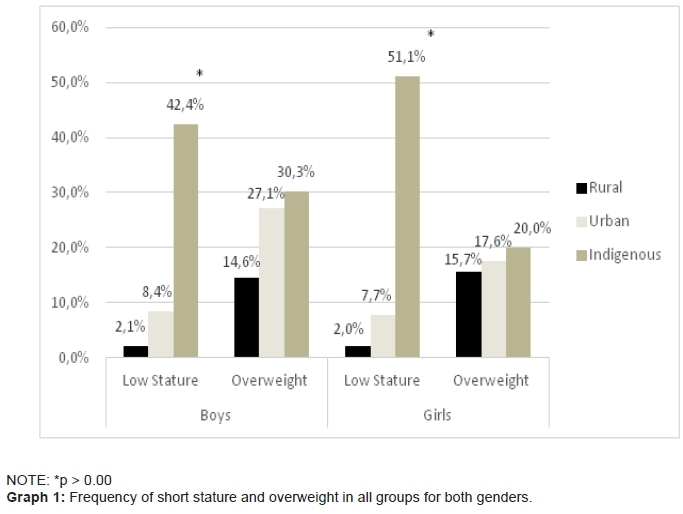
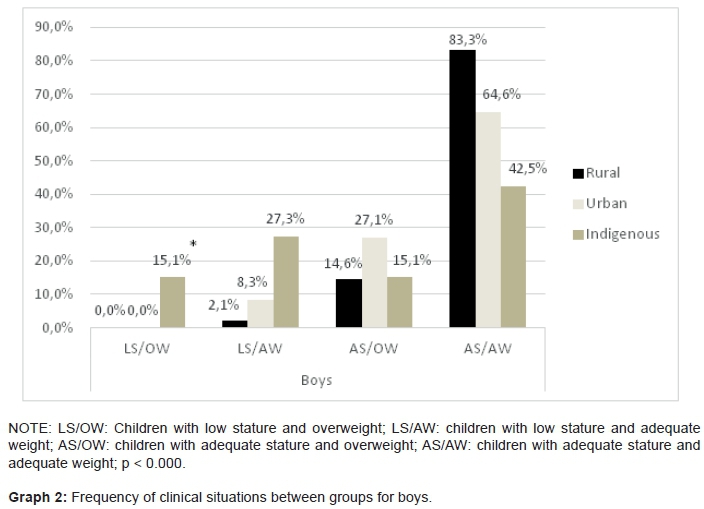
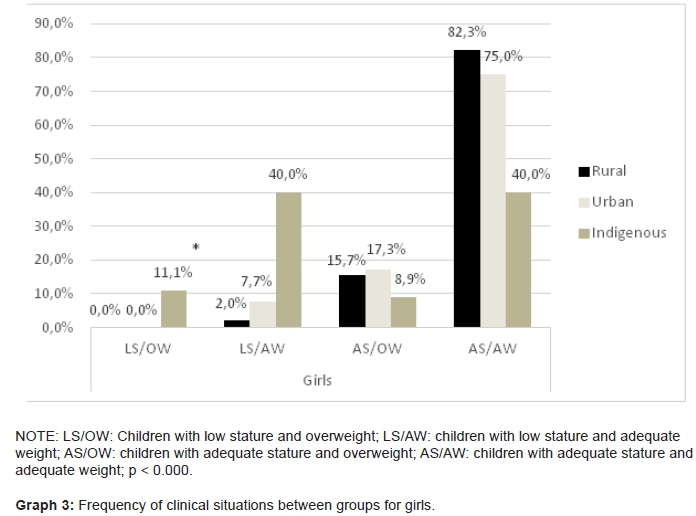
<body><![CDATA[<p>&nbsp;</p>     <p><font face="Verdana, Arial, Helvetica, sans-serif" size="3"><b>RESULTS</b></font></p>     <p><font face="Verdana, Arial, Helvetica, sans-serif" size="2">In this study,    277 children participated (148 boys) who attended school between 8 and 9 years    of age, of both genders, living in three regions of the municipality of Nova    Laranjeiras, Paran&aacute;, Brazil. The sample was divided into 100 children    (48 boys) in the urban group, 99 (48 boys) from the rural area and 78 (33 boys)    from the indigenous land (IL).</font></p>     <p><font face="Verdana, Arial, Helvetica, sans-serif" size="2">The anthropometric    measurements between the three groups were compared by means of ANOVA. The averages    and standard deviations of anthropometric variables are presented in <a href="/img/revistas/rbcdh/v26n1/10t1.jpg">Table    1</a>. The indigenous group showed lower stature and body mass compared to the    urban and rural groups for both genders. The BMI of the indigenous group was    higher than the other two groups, for both genders. Age did not differ between    the groups.</font></p>     <p><font face="Verdana, Arial, Helvetica, sans-serif" size="2">The frequency of    short stature was higher in the indigenous group, followed by the urban and    rural group, and the prevalence of 42.4%, 8.4% and 2.1%, respectively, in boys    (x<sup>2 </sup>= 27.8; p = 0.000). In indian girls was also more frequent short    stature, when compared to the other two groups (x<sup>2 </sup>= 44.2; p &lt;    0.000), 51.1% reaching indigenous group, 7.7% in the urban group and 2% in the    rural group. <a href="/img/revistas/rbcdh/v26n1/10f01.jpg">Graph 1</a> shows    the percentage values of stunting and overweight by gender.</font></p>     <p><font face="Verdana, Arial, Helvetica, sans-serif" size="2">For the frequency    of overweight among boys, there was no significant difference (x<sup>2 </sup>=    3.33; p = 0.188). The prevalence was 14.6% in the rural area, 27.1% for the    group in urban area, and 30.3% for the indigenous area. For the girls' group,    there was no significant difference regarding overweight (x<sup>2 </sup>=0.31;    p = 0.856). In the rural area, the prevalence was 15.7%, 17.6% in the urban    area, and 20% in the IL.</font></p>     <p>&nbsp;</p>     <p align="center"><font face="Verdana, Arial, Helvetica, sans-serif" size="2"><a href="/img/revistas/rbcdh/v26n1/10f02.jpg">Graph    2</a></font></p>     <p align="center">&nbsp;</p>     <p><font face="Verdana, Arial, Helvetica, sans-serif" size="2">The combination    of overweight and short stature was higher in the indigenous group, in both    boys (x<sup>2 </sup>= 3.75; p = 0.000) and girls (x<sup>2 </sup>= 45.40; p =    0.000 girls) in relation to urban and rural groups. Only the indigenous group    presented children with both, and the prevalence of overweight and short stature    of 15.1% in boys and 11.1% in girls. Table 2 presents the percentage values    of clinical situations analysed for males, and <a href="/img/revistas/rbcdh/v26n1/10f03.jpg">Graph    3</a> for females.</font></p>     ]]></body>
<body><![CDATA[<p><font face="Verdana, Arial, Helvetica, sans-serif" size="2">In the rural area    most children presented appropriate stature and appropriate weight in both genders    (83.3% boys; 82.3% girls), as well as in the urban area (64.6% boys; 75% girls).    Indigenous girls presented a higher prevalence of short stature and appropriate    weight, and 40% in both.</font></p>     <p>&nbsp;</p>     <p><font face="Verdana, Arial, Helvetica, sans-serif" size="3"><b>DISCUSSION</b></font></p>     <p><font face="Verdana, Arial, Helvetica, sans-serif" size="2">The results of    anthropometric measurements for males and females (<a href="/img/revistas/rbcdh/v26n1/10t1.jpg">Table    1</a>) indicate that the children of the urban and rural areas tend to have    significantly higher stature and body mass in relation to indigenous children.    Studies point to a consistent difference in favour of the urban areas in Europe<sup>15    </sup>and Mexico<sup>16</sup>, while others point to similarities in Australia    and the United States<sup>17</sup>. It is important to highlight the difficulty    of defining and comparing urban and rural areas. In some places, the rural and    urban areas can overlap, especially in small towns where the countryside is    very close to the urban area, as is the case for this research.</font></p>     <p><font face="Verdana, Arial, Helvetica, sans-serif" size="2">In this study,    the frequency of excessive weight did not differ between the groups, for both    sexes. An increase of overweight in Brazilian children and adolescents was identified    in all regions and ethnic groups. Among the group of indigenous boys, the prevalence    of overweight was 30.3%, and for the group of indigenous girls it was 20%. A    lower prevalence was observed in Chilean indigenous children (6 years), who    showed 16% of obesity<sup>18</sup>. By analysing Xavante indigenous teenagers,    the prevalence of overweight was lower for the boys and the girls, with 22.7%    and 35.5%, respectively<sup>19</sup>. The difference stands out in the age group    surveyed in both studies, noting that in adolescence, anthropometric differences    between the sexes are more pronounced.</font></p>     <p><font face="Verdana, Arial, Helvetica, sans-serif" size="2">In this research,    the prevalence of overweight of boys from the rural region was 14.6% and 27.1%    was urban, among girls was 15.7% in 17.6% in urban and rural, not differed between    the groups. On the other hand, a greater prevalence of overweight was found    in urban areas (14%) than in rural areas (6.7%) in a study carried out in Santa    Catarina State municipalities and of Rio Grande do Sul, Brazil<sup>20</sup>.    Analysing by region, similar frequencies were presented in a study in the inner    city of Paran&aacute; (Londrina-PR) with a sample of 4289 subjects of both genders    and between the ages of 7 and 17 years. Ratios of 12.3% of overweight were found    in boys and 13.7% in girls<sup>21</sup>. In a study done in northeastern Brazil,    seeking to assess overweight and obesity in schoolchildren in Campina Grande,    PB, it was found that the prevalence of overweight and obesity was 23.5%. It    was more common among students of the private system (49.1%), than those of    the public one (17.1%), and in boys (31.2%) than girls (16%)<sup>22</sup>. No    studies have compared the prevalence of overweight in the three regions analysed.</font></p>     <p><font face="Verdana, Arial, Helvetica, sans-serif" size="2">The processes of    social change in the last few centuries have influenced the current state of    indigenous peoples, such as displacement of different ethnicities for the villages    - near the tribal lands with cities due to urban sprawl - which has increased    the demographic rate in restricted spaces, changes in habits and customs of    ancient tradition, subsistence difficulties, a shortage of land for planting,    the introduction of processed foods, and physical inactivity<sup>5</sup>. These    transformations may have contributed to the similar prevalence of excess weight    compared with other non-indigenous populations.</font></p>     <p><font face="Verdana, Arial, Helvetica, sans-serif" size="2">This relationship    is shown in a study<sup>23</sup> that demonstrated the influence of changing    cultural habits on the prevalence of hypertension and BMI values. The study    found higher levels of blood pressure and BMI in indigenous people with some    knowledge of Portuguese, than others without any knowledge-that is, those who    had greater contact with the eating habits of industrialised societies.</font></p>     <p><font face="Verdana, Arial, Helvetica, sans-serif" size="2">The prevalence    of stunting was different among groups, as the height of the indigenous group    was shorter in relation to the urban and rural groups. Among the indigenous,    42.4% of boys and 51.1% of girls showed stunting. These results corroborate    with another study done with the indigenous population, which shows, in general,    an average stature that is less than that of the national population<sup>8,9</sup>.</font></p>     <p><font face="Verdana, Arial, Helvetica, sans-serif" size="2">When combining    the presence of stunting and overweight, only the indigenous group presented    the two clinical situations simultaneously, being prevalent in 15.1% of indigenous    children, and 11.1% indigenous girls. These data suggest that short stature    has influenced the high prevalence of overweight in the indigenous group, which    is associated with environmental factors and lifestyle changes that have been    taking place with indigenous peoples in the last century. The short stature    of the indigenous population may be related to a genetic adaptive process, as    ancestors from Asia<sup>24</sup>, and the hostile environment, including a poor    diet, and health problems evidenced after European colonisation.</font></p>     ]]></body>
<body><![CDATA[<p><font face="Verdana, Arial, Helvetica, sans-serif" size="2">The relationship    of genetics with other cardiovascular risk factors such as diabetes was investigated    in indigenous peoples. Studies carried out on the population of Mby&aacute;    Guarani-Rio de Janeiro State indicated a risk for chronic diseases, showing    that efforts are needed to control the risk factors.</font></p>     <p><font face="Verdana, Arial, Helvetica, sans-serif" size="2">Studying the genetic    influence on obesity and its relationship with other risk factors in Brazilian    indigenous children is of paramount importance. Therefore, it is suggested that    studies evaluate genetic parameters associated with obesity in indigenous populations,    in an attempt to elucidate issues on the development of obesity, and how this    is influenced by changes in the lifestyle of these indigenous peoples, and the    association with their genetic makeup.</font></p>     <p><font face="Verdana, Arial, Helvetica, sans-serif" size="2">In conclusion,    the stunting of indigenous peoples is shown in different surveys, and can reflect    processes of adaptation to the environment. However, further research is necessary    in order to identify possible causes and analyse the consequences for this population.    Regardless of the zone to which they belong, the children showed high levels    of obesity. This fact reflects lifestyle changes, poor eating habits and a sedentary    lifestyle in different urban and rural regions in the country and other regions    of the world..</font></p>     <p>&nbsp;</p>     <p><font face="Verdana, Arial, Helvetica, sans-serif" size="3"><b>ACKNOWLEDGMENTS</b></font></p>     <p><font face="Verdana, Arial, Helvetica, sans-serif" size="2">We thank UNICENTRO    for allowing the license for doctorate; the Bio-Cultural Anthropology Laboratory/FEF    and CIPED/FCM of UNICAMP by being the host during the doctorate; FUNAI for allowing    us to study the indigenous land; UEPG for the hours dedicated to preparing this    article; and to the Quality of Life Core/DEF/UFPR for its invaluable contribution    to the realisation of this article.</font></p>     <p>&nbsp;</p>     <p><font face="Verdana, Arial, Helvetica, sans-serif" size="3"><b>REFERENCES</b></font></p>     <!-- ref --><p><font face="Verdana, Arial, Helvetica, sans-serif" size="2">1. Wang Y, Lobstein    T. Worldwide trends in childhood overweight and obesity. Int J Pediatr Obes.    2006;1(1):11-25. DOI: <a href="http://dx.doi.org/10.1080/17477160600586747" target="_blank">http://dx.doi.org/10.1080/17477160600586747</a></font>&nbsp;&nbsp;&nbsp;&nbsp;&nbsp;&nbsp;&nbsp;&nbsp;[&#160;<a href="javascript:void(0);" onclick="javascript: window.open('/scielo.php?script=sci_nlinks&ref=2519823&pid=S0104-1282201600010001000001&lng=','','width=640,height=500,resizable=yes,scrollbars=1,menubar=yes,');">Links</a>&#160;]<!-- end-ref --><!-- ref --><p><font face="Verdana, Arial, Helvetica, sans-serif" size="2">2. Conde WL, Monteiro    CA. Body mass index cutoff points for evaluation of nutritional status in Brazilian    children and adolescents. J Pediatr (Rio J). 2006;82(4):266-72. DOI: <a href="http://dx.doi.org/10.2223/JPED.1502" target="_blank">http://dx.doi.org/10.2223/JPED.1502</a></font>&nbsp;&nbsp;&nbsp;&nbsp;&nbsp;&nbsp;&nbsp;&nbsp;[&#160;<a href="javascript:void(0);" onclick="javascript: window.open('/scielo.php?script=sci_nlinks&ref=2519824&pid=S0104-1282201600010001000002&lng=','','width=640,height=500,resizable=yes,scrollbars=1,menubar=yes,');">Links</a>&#160;]<!-- end-ref --><!-- ref --><p><font face="Verdana, Arial, Helvetica, sans-serif" size="2">3. Leavitt MO.    Department of Health and Human Services. Disaster Med Public Health Prep. 2007;1(1):7.    DOI: <a href="http://dx.doi.org/10.1097/DMP.0b013e3180cac8c7" target="_blank">http://dx.doi.org/10.1097/DMP.0b013e3180cac8c7</a></font>&nbsp;&nbsp;&nbsp;&nbsp;&nbsp;&nbsp;&nbsp;&nbsp;[&#160;<a href="javascript:void(0);" onclick="javascript: window.open('/scielo.php?script=sci_nlinks&ref=2519825&pid=S0104-1282201600010001000003&lng=','','width=640,height=500,resizable=yes,scrollbars=1,menubar=yes,');">Links</a>&#160;]<!-- end-ref --><!-- ref --><p><font face="Verdana, Arial, Helvetica, sans-serif" size="2">4. World Health    Organization (WHO). Global strategy for diet, physical activity and health.    Geneva: WHO; 2004. [Cited 2010 aug 22] Available from: <a href="http://www.who.int/dietphysicalactivity/strategy/eb11344/strategy_english_web.pdf" target="_blank">http://www.who.int/dietphysicalactivity/strategy/eb11344/strategy_english_web.pdf</a>.    &nbsp;&nbsp;&nbsp;&nbsp;&nbsp;&nbsp;&nbsp;&nbsp;[&#160;<a href="javascript:void(0);" onclick="javascript: window.open('/scielo.php?script=sci_nlinks&ref=2519826&pid=S0104-1282201600010001000004&lng=','','width=640,height=500,resizable=yes,scrollbars=1,menubar=yes,');">Links</a>&#160;]<!-- end-ref --></font></p>     <!-- ref --><p><font face="Verdana, Arial, Helvetica, sans-serif" size="2">5. Ribas DLB, Philippi    ST. Aspectos alimentares e nutricionais de m&atilde;es e crian&ccedil;as ind&iacute;genas    Terena, Mato Grosso do Sul. In: Coimbra Jr CEA, Santos RV, Escobar AL. Epidemiologia    e sa&uacute;de dos povos ind&iacute;genas no Brasil. Rio de Janeiro: Fiocruz/ABRASCO;    2003; p.73-88.    &nbsp;&nbsp;&nbsp;&nbsp;&nbsp;&nbsp;&nbsp;&nbsp;[&#160;<a href="javascript:void(0);" onclick="javascript: window.open('/scielo.php?script=sci_nlinks&ref=2519828&pid=S0104-1282201600010001000005&lng=','','width=640,height=500,resizable=yes,scrollbars=1,menubar=yes,');">Links</a>&#160;]<!-- end-ref --></font></p>     <!-- ref --><p><font face="Verdana, Arial, Helvetica, sans-serif" size="2">6. Instituto Brasileiro    de Geografia e Estatistica (IBGE). Pesquisa de Or&ccedil;amentos Familiares    2008-2009. Antropometria e estado nutricional de crian&ccedil;as, adolescentes    e adultos no Brasil. Rio de Janeiro: IBGE; 2010. [Cited 2013 fev 20] Available    from: <a href="http://www.ibge.gov.br/home/estatistica/populacao/condicaodevida/pof/2008_2009_encaa/default.shtm" target="_blank">http://www.ibge.gov.br/home/estatistica/populacao/condicaodevida/pof/2008    _2009_encaa/default.shtm</a></font>&nbsp;&nbsp;&nbsp;&nbsp;&nbsp;&nbsp;&nbsp;&nbsp;[&#160;<a href="javascript:void(0);" onclick="javascript: window.open('/scielo.php?script=sci_nlinks&ref=2519830&pid=S0104-1282201600010001000006&lng=','','width=640,height=500,resizable=yes,scrollbars=1,menubar=yes,');">Links</a>&#160;]<!-- end-ref --><!-- ref --><p><font face="Verdana, Arial, Helvetica, sans-serif" size="2">7. Kiess W, Reich    A, Muller G, Meyer K, Galler A, Bennek J, et al. Clinical aspects of obesity    in childhood and adolescence. Int J Obes Relat Metab Disord. 2001;25(Suppl 1):S75-9.    DOI: <a href="http://dx.doi.org/10.1038/sj.ijo.0801704" target="_blank">http://dx.doi.org/10.1038/sj.ijo.0801704</a></font>&nbsp;&nbsp;&nbsp;&nbsp;&nbsp;&nbsp;&nbsp;&nbsp;[&#160;<a href="javascript:void(0);" onclick="javascript: window.open('/scielo.php?script=sci_nlinks&ref=2519831&pid=S0104-1282201600010001000007&lng=','','width=640,height=500,resizable=yes,scrollbars=1,menubar=yes,');">Links</a>&#160;]<!-- end-ref --><!-- ref --><p><font face="Verdana, Arial, Helvetica, sans-serif" size="2">8. Coimbra Jr,    CEA, Santos, RV, Welch JR, Cardoso AM, Souza MC, Garnelo L, et al. The First    National Survey of Indigenous People's Health and Nutrition in Brazil: rationale,    methodology, and overview of results. BMC Public Health. 2013;13:52. DOI: <a href="http://dx.doi.org/10.1186/1471-2458-13-52" target="_blank">http://dx.doi.org/10.1186/1471-2458-13-52</a></font>&nbsp;&nbsp;&nbsp;&nbsp;&nbsp;&nbsp;&nbsp;&nbsp;[&#160;<a href="javascript:void(0);" onclick="javascript: window.open('/scielo.php?script=sci_nlinks&ref=2519832&pid=S0104-1282201600010001000008&lng=','','width=640,height=500,resizable=yes,scrollbars=1,menubar=yes,');">Links</a>&#160;]<!-- end-ref --><!-- ref --><p><font face="Verdana, Arial, Helvetica, sans-serif" size="2">9. Santos RV. Crescimento    f&iacute;sico e estado nutricional de popula&ccedil;&otilde;es ind&iacute;genas    brasileiras. Cad Saude Publica. 1993;9(Suppl 1):S46-57. DOI: <a href="http://dx.doi.org/10.1590/S0102-311X1993000500006" target="_blank">http://dx.doi.org/10.1590/S0102-311X1993000500006</a></font>&nbsp;&nbsp;&nbsp;&nbsp;&nbsp;&nbsp;&nbsp;&nbsp;[&#160;<a href="javascript:void(0);" onclick="javascript: window.open('/scielo.php?script=sci_nlinks&ref=2519833&pid=S0104-1282201600010001000009&lng=','','width=640,height=500,resizable=yes,scrollbars=1,menubar=yes,');">Links</a>&#160;]<!-- end-ref --><!-- ref --><p><font face="Verdana, Arial, Helvetica, sans-serif" size="2">10. Santos RV,    Coimbra Jr CEA. Cen&aacute;rios e tend&ecirc;ncias da sa&uacute;de e da epidemiologia    dos povos ind&iacute;genas no Brasil. In: Coimbra Jr. CEA, Santos RV, Escobar    AL. Epidemiologia e sa&uacute;de dos povos ind&iacute;genas no Brasil. Rio de    Janeiro: Fiocruz; 2003; p.13-47.    &nbsp;&nbsp;&nbsp;&nbsp;&nbsp;&nbsp;&nbsp;&nbsp;[&#160;<a href="javascript:void(0);" onclick="javascript: window.open('/scielo.php?script=sci_nlinks&ref=2519834&pid=S0104-1282201600010001000010&lng=','','width=640,height=500,resizable=yes,scrollbars=1,menubar=yes,');">Links</a>&#160;]<!-- end-ref --></font></p>     <!-- ref --><p><font face="Verdana, Arial, Helvetica, sans-serif" size="2">11. Cardoso AM,    Mattos IE, Koifman RJ. Preval&ecirc;ncia de fatores de risco para doen&ccedil;as    cardiovasculares na popula&ccedil;&atilde;o Guarani-Mby&aacute; do Estado do    Rio de Janeiro. Cad Saude Publica. 2001;17(2):345-54. DOI: <a href="http://dx.doi.org/10.1590/S0102-311X2001000200009" target="_blank">http://dx.doi.org/10.1590/S0102-311X2001000200009</a></font>&nbsp;&nbsp;&nbsp;&nbsp;&nbsp;&nbsp;&nbsp;&nbsp;[&#160;<a href="javascript:void(0);" onclick="javascript: window.open('/scielo.php?script=sci_nlinks&ref=2519836&pid=S0104-1282201600010001000011&lng=','','width=640,height=500,resizable=yes,scrollbars=1,menubar=yes,');">Links</a>&#160;]<!-- end-ref --><!-- ref --><p><font face="Verdana, Arial, Helvetica, sans-serif" size="2">12. Vieira Filho    JPB. Emerg&ecirc;ncia do diabetes melito tipo II entre os Xavantes. Rev Assoc    Med Bras. 1996;42(1):61.    &nbsp;&nbsp;&nbsp;&nbsp;&nbsp;&nbsp;&nbsp;&nbsp;[&#160;<a href="javascript:void(0);" onclick="javascript: window.open('/scielo.php?script=sci_nlinks&ref=2519837&pid=S0104-1282201600010001000012&lng=','','width=640,height=500,resizable=yes,scrollbars=1,menubar=yes,');">Links</a>&#160;]<!-- end-ref --></font></p>     <!-- ref --><p><font face="Verdana, Arial, Helvetica, sans-serif" size="2">13. Instituto Brasileiro    de Geografia e Estat&iacute;stica (IBGE). Censo Demogr&aacute;fico 2000. Rio    de Janeiro: IBGE; 2000.    &nbsp;&nbsp;&nbsp;&nbsp;&nbsp;&nbsp;&nbsp;&nbsp;[&#160;<a href="javascript:void(0);" onclick="javascript: window.open('/scielo.php?script=sci_nlinks&ref=2519839&pid=S0104-1282201600010001000013&lng=','','width=640,height=500,resizable=yes,scrollbars=1,menubar=yes,');">Links</a>&#160;]<!-- end-ref --></font></p>     <!-- ref --><p><font face="Verdana, Arial, Helvetica, sans-serif" size="2">14. Lohman TG,    Roche AF, Martorel R. Anthropometrics standartization reference manual. Champaign,    IL: Human Kinetics; 1988.    &nbsp;&nbsp;&nbsp;&nbsp;&nbsp;&nbsp;&nbsp;&nbsp;[&#160;<a href="javascript:void(0);" onclick="javascript: window.open('/scielo.php?script=sci_nlinks&ref=2519841&pid=S0104-1282201600010001000014&lng=','','width=640,height=500,resizable=yes,scrollbars=1,menubar=yes,');">Links</a>&#160;]<!-- end-ref --></font></p>     <!-- ref --><p><font face="Verdana, Arial, Helvetica, sans-serif" size="2">15. Bielicki T.    Physical Growth as a measure of economic web-being of populations: the twentieth    century. In: Falkner F, Tanner J.M. Human growth: a comprehensive treatise.    2nd ed. V.3. New York: Plenum Press; 1986; p. 283-385.    &nbsp;&nbsp;&nbsp;&nbsp;&nbsp;&nbsp;&nbsp;&nbsp;[&#160;<a href="javascript:void(0);" onclick="javascript: window.open('/scielo.php?script=sci_nlinks&ref=2519843&pid=S0104-1282201600010001000015&lng=','','width=640,height=500,resizable=yes,scrollbars=1,menubar=yes,');">Links</a>&#160;]<!-- end-ref --></font></p>     ]]></body>
<body><![CDATA[<!-- ref --><p><font face="Verdana, Arial, Helvetica, sans-serif" size="2">16. Pe&ntilde;a    Reyes ME, Tan SK , Malina RM. Urban-rural contrasts in the physical fitness    of school children in Oaxaca, Mexico. Am J Hum Biol. 2003;15(6):800-13. DOI:    <a href="http://dx.doi.org/10.1002/ajhb.10218" target="_blank">http://dx.doi.org/10.1002/ajhb.10218</a></font>&nbsp;&nbsp;&nbsp;&nbsp;&nbsp;&nbsp;&nbsp;&nbsp;[&#160;<a href="javascript:void(0);" onclick="javascript: window.open('/scielo.php?script=sci_nlinks&ref=2519845&pid=S0104-1282201600010001000016&lng=','','width=640,height=500,resizable=yes,scrollbars=1,menubar=yes,');">Links</a>&#160;]<!-- end-ref --><!-- ref --><p><font face="Verdana, Arial, Helvetica, sans-serif" size="2">17. Eveleth PB,    Tanner JM. Worldwide variation in human growth. New York: Cambridge University    Press; 1990.    &nbsp;&nbsp;&nbsp;&nbsp;&nbsp;&nbsp;&nbsp;&nbsp;[&#160;<a href="javascript:void(0);" onclick="javascript: window.open('/scielo.php?script=sci_nlinks&ref=2519846&pid=S0104-1282201600010001000017&lng=','','width=640,height=500,resizable=yes,scrollbars=1,menubar=yes,');">Links</a>&#160;]<!-- end-ref --></font></p>     <!-- ref --><p><font face="Verdana, Arial, Helvetica, sans-serif" size="2">18. Bustos P, Mu&ntilde;oz    S, Vargas C, Amigo H. Poverty and indigenous origin as risk factors of nutritional    problems among children who enroll in school. Salud Publ Mex. 2009;51(3):187-93.    DOI: <a href="http://dx.doi.org/10.1590/S0036-36342009000300008" target="_blank">http://dx.doi.org/10.1590/S0036-36342009000300008</a></font>&nbsp;&nbsp;&nbsp;&nbsp;&nbsp;&nbsp;&nbsp;&nbsp;[&#160;<a href="javascript:void(0);" onclick="javascript: window.open('/scielo.php?script=sci_nlinks&ref=2519848&pid=S0104-1282201600010001000018&lng=','','width=640,height=500,resizable=yes,scrollbars=1,menubar=yes,');">Links</a>&#160;]<!-- end-ref --><!-- ref --><p><font face="Verdana, Arial, Helvetica, sans-serif" size="2">19. Leite MS, Santos    RV, Gugelmin AS, Coimbra Jr CEA. Crescimento f&iacute;sico e perfil nutricional    da popula&ccedil;&atilde;o ind&iacute;gena Xav&aacute;nte de Sangradouro-Volta    Grande, Mato Grosso, Brasil. Cad Saude Publica. 2006;22(2):265-76. DOI: <a href="http://dx.doi.org/10.1590/S0102-311X2006000200004" target="_blank">http://dx.doi.org/10.1590/S0102-311X2006000200004</a></font>&nbsp;&nbsp;&nbsp;&nbsp;&nbsp;&nbsp;&nbsp;&nbsp;[&#160;<a href="javascript:void(0);" onclick="javascript: window.open('/scielo.php?script=sci_nlinks&ref=2519849&pid=S0104-1282201600010001000019&lng=','','width=640,height=500,resizable=yes,scrollbars=1,menubar=yes,');">Links</a>&#160;]<!-- end-ref --><!-- ref --><p><font face="Verdana, Arial, Helvetica, sans-serif" size="2">20. Pelegrini A,    Silva DAS, Petroski EL, Glaner MF. Estado nutricional e fatores associados em    escolares domiciliados na &aacute;rea rural e urbana. Rev Nutr. 2010; 23(5):839-46.    DOI: <a href="http://dx.doi.org/10.1590/S1415-52732010000500014" target="_blank">http://dx.doi.org/10.1590/S1415-52732010000500014</a></font>&nbsp;&nbsp;&nbsp;&nbsp;&nbsp;&nbsp;&nbsp;&nbsp;[&#160;<a href="javascript:void(0);" onclick="javascript: window.open('/scielo.php?script=sci_nlinks&ref=2519850&pid=S0104-1282201600010001000020&lng=','','width=640,height=500,resizable=yes,scrollbars=1,menubar=yes,');">Links</a>&#160;]<!-- end-ref --><!-- ref --><p><font face="Verdana, Arial, Helvetica, sans-serif" size="2">21. Guedes DP,    Guedes JERP. Preval&ecirc;ncia de sobrepeso e obesidade em crian&ccedil;as e    adolescentes do munic&iacute;pio de Londrina (PR), Brasil. Motriz. 1998;4(1):18-25.    &nbsp;&nbsp;&nbsp;&nbsp;&nbsp;&nbsp;&nbsp;&nbsp;[&#160;<a href="javascript:void(0);" onclick="javascript: window.open('/scielo.php?script=sci_nlinks&ref=2519851&pid=S0104-1282201600010001000021&lng=','','width=640,height=500,resizable=yes,scrollbars=1,menubar=yes,');">Links</a>&#160;]<!-- end-ref --></font></p>     <!-- ref --><p><font face="Verdana, Arial, Helvetica, sans-serif" size="2">22. Medeiros CCM,    Cardoso MAA, Pereira RAR, Alves GTA, Fran&ccedil;a ISX, Coura AS, et al. Estado    nutricional e h&aacute;bitos de vida em escolares. J Hum Growth Dev. 2011;21(3):789-97.    &nbsp;&nbsp;&nbsp;&nbsp;&nbsp;&nbsp;&nbsp;&nbsp;[&#160;<a href="javascript:void(0);" onclick="javascript: window.open('/scielo.php?script=sci_nlinks&ref=2519853&pid=S0104-1282201600010001000022&lng=','','width=640,height=500,resizable=yes,scrollbars=1,menubar=yes,');">Links</a>&#160;]<!-- end-ref --></font></p>     ]]></body>
<body><![CDATA[<!-- ref --><p><font face="Verdana, Arial, Helvetica, sans-serif" size="2">23. Mancilha-Carvalho    JJ, Carvalho JV, Lima JAC, Silva NAS. Aus&ecirc;ncia de Fatores de Risco de    Doen&ccedil;a Coron&aacute;ria em &Iacute;ndios Yanomami e Influ&ecirc;ncia    da Acultura&ccedil;&atilde;o na Press&atilde;o Arterial. Arq Bras Cardiol. 1992;59(4):275-83.    &nbsp;&nbsp;&nbsp;&nbsp;&nbsp;&nbsp;&nbsp;&nbsp;[&#160;<a href="javascript:void(0);" onclick="javascript: window.open('/scielo.php?script=sci_nlinks&ref=2519855&pid=S0104-1282201600010001000023&lng=','','width=640,height=500,resizable=yes,scrollbars=1,menubar=yes,');">Links</a>&#160;]<!-- end-ref --></font></p>     <!-- ref --><p><font face="Verdana, Arial, Helvetica, sans-serif" size="2">24. Ribeiro DM,    Figueiredo MS, Costa FF, Sonati MF. Haplotypes of the alpha-globin gene regulatory    element in two Brazilian native populations. Am J Phys Anthropol. 2003;121(1):58-62.    DOI: <a href="http://dx.doi.org/10.1002/ajpa.10193" target="_blank">http://dx.doi.org/10.1002/ajpa.10193</a></font>&nbsp;&nbsp;&nbsp;&nbsp;&nbsp;&nbsp;&nbsp;&nbsp;[&#160;<a href="javascript:void(0);" onclick="javascript: window.open('/scielo.php?script=sci_nlinks&ref=2519857&pid=S0104-1282201600010001000024&lng=','','width=640,height=500,resizable=yes,scrollbars=1,menubar=yes,');">Links</a>&#160;]<!-- end-ref --><p>&nbsp;</p>     <p>&nbsp;</p>     <p><font face="Verdana, Arial, Helvetica, sans-serif" size="2">Manuscript submitted:    Jan 9 2016    <br>   Accepted for publication Feb 18 2016</font></p>     <p>&nbsp;</p>     <p>&nbsp;</p>     <p><font face="Verdana, Arial, Helvetica, sans-serif" size="2"><a name="back"></a><b><a href="#top">*</a>    Corresponding author:</b> Itamar Adriano Tagliari - E-mail: <a href="mailto:itagliari@ig.com.br">itagliari@ig.com.br</a></font></p>     ]]></body>
<body><![CDATA[ ]]></body>
<back>
<ref-list>
<ref id="B1">
<label>1</label><nlm-citation citation-type="journal">
<person-group person-group-type="author">
<name>
<surname><![CDATA[Wang]]></surname>
<given-names><![CDATA[Y]]></given-names>
</name>
<name>
<surname><![CDATA[Lobstein]]></surname>
<given-names><![CDATA[T]]></given-names>
</name>
</person-group>
<article-title xml:lang="en"><![CDATA[Worldwide trends in childhood overweight and obesity]]></article-title>
<source><![CDATA[Int J Pediatr Obes]]></source>
<year>2006</year>
<volume>1</volume>
<numero>1</numero>
<issue>1</issue>
<page-range>11-25</page-range></nlm-citation>
</ref>
<ref id="B2">
<label>2</label><nlm-citation citation-type="journal">
<person-group person-group-type="author">
<name>
<surname><![CDATA[Conde]]></surname>
<given-names><![CDATA[WL]]></given-names>
</name>
<name>
<surname><![CDATA[Monteiro]]></surname>
<given-names><![CDATA[CA]]></given-names>
</name>
</person-group>
<article-title xml:lang="en"><![CDATA[Body mass index cutoff points for evaluation of nutritional status in Brazilian children and adolescents]]></article-title>
<source><![CDATA[J Pediatr (Rio J)]]></source>
<year>2006</year>
<volume>82</volume>
<numero>4</numero>
<issue>4</issue>
<page-range>266-72</page-range></nlm-citation>
</ref>
<ref id="B3">
<label>3</label><nlm-citation citation-type="journal">
<person-group person-group-type="author">
<name>
<surname><![CDATA[Leavitt]]></surname>
<given-names><![CDATA[MO]]></given-names>
</name>
</person-group>
<article-title xml:lang="en"><![CDATA[Department of Health and Human Services]]></article-title>
<source><![CDATA[Disaster Med Public Health Prep]]></source>
<year>2007</year>
<volume>1</volume>
<numero>1</numero>
<issue>1</issue>
<page-range>7</page-range></nlm-citation>
</ref>
<ref id="B4">
<label>4</label><nlm-citation citation-type="book">
<collab>World Health Organization</collab>
<source><![CDATA[Global strategy for diet, physical activity and health]]></source>
<year>2004</year>
<publisher-loc><![CDATA[Geneva ]]></publisher-loc>
<publisher-name><![CDATA[WHO]]></publisher-name>
</nlm-citation>
</ref>
<ref id="B5">
<label>5</label><nlm-citation citation-type="book">
<person-group person-group-type="author">
<name>
<surname><![CDATA[Ribas]]></surname>
<given-names><![CDATA[DLB]]></given-names>
</name>
<name>
<surname><![CDATA[Philippi]]></surname>
<given-names><![CDATA[ST]]></given-names>
</name>
</person-group>
<article-title xml:lang="pt"><![CDATA[Aspectos alimentares e nutricionais de mães e crianças indígenas Terena, Mato Grosso do Sul]]></article-title>
<person-group person-group-type="editor">
<name>
<surname><![CDATA[Coimbra Jr]]></surname>
<given-names><![CDATA[CEA]]></given-names>
</name>
<name>
<surname><![CDATA[Santos]]></surname>
<given-names><![CDATA[RV]]></given-names>
</name>
<name>
<surname><![CDATA[Escobar]]></surname>
<given-names><![CDATA[AL]]></given-names>
</name>
</person-group>
<source><![CDATA[Epidemiologia e saúde dos povos indígenas no Brasil]]></source>
<year>2003</year>
<page-range>73-88</page-range><publisher-loc><![CDATA[Rio de Janeiro ]]></publisher-loc>
<publisher-name><![CDATA[Fiocruz/ABRASCO]]></publisher-name>
</nlm-citation>
</ref>
<ref id="B6">
<label>6</label><nlm-citation citation-type="book">
<collab>Instituto Brasileiro de Geografia e Estatistica</collab>
<source><![CDATA[Pesquisa de Orçamentos Familiares 2008-2009: Antropometria e estado nutricional de crianças, adolescentes e adultos no Brasil]]></source>
<year>2010</year>
<publisher-loc><![CDATA[Rio de Janeiro ]]></publisher-loc>
<publisher-name><![CDATA[IBGE]]></publisher-name>
</nlm-citation>
</ref>
<ref id="B7">
<label>7</label><nlm-citation citation-type="journal">
<person-group person-group-type="author">
<name>
<surname><![CDATA[Kiess]]></surname>
<given-names><![CDATA[W]]></given-names>
</name>
<name>
<surname><![CDATA[Reich]]></surname>
<given-names><![CDATA[A]]></given-names>
</name>
<name>
<surname><![CDATA[Muller]]></surname>
<given-names><![CDATA[G]]></given-names>
</name>
<name>
<surname><![CDATA[Meyer]]></surname>
<given-names><![CDATA[K]]></given-names>
</name>
<name>
<surname><![CDATA[Galler]]></surname>
<given-names><![CDATA[A]]></given-names>
</name>
<name>
<surname><![CDATA[Bennek]]></surname>
<given-names><![CDATA[J]]></given-names>
</name>
</person-group>
<article-title xml:lang="en"><![CDATA[Clinical aspects of obesity in childhood and adolescence]]></article-title>
<source><![CDATA[Int J Obes Relat Metab Disord]]></source>
<year>2001</year>
<volume>25</volume>
<numero>^s1</numero>
<issue>^s1</issue>
<supplement>1</supplement>
<page-range>S75-9</page-range></nlm-citation>
</ref>
<ref id="B8">
<label>8</label><nlm-citation citation-type="journal">
<person-group person-group-type="author">
<name>
<surname><![CDATA[Coimbra Jr]]></surname>
<given-names><![CDATA[CEA]]></given-names>
</name>
<name>
<surname><![CDATA[Santos]]></surname>
<given-names><![CDATA[RV]]></given-names>
</name>
<name>
<surname><![CDATA[Welch]]></surname>
<given-names><![CDATA[JR]]></given-names>
</name>
<name>
<surname><![CDATA[Cardoso]]></surname>
<given-names><![CDATA[AM]]></given-names>
</name>
<name>
<surname><![CDATA[Souza]]></surname>
<given-names><![CDATA[MC]]></given-names>
</name>
<name>
<surname><![CDATA[Garnelo]]></surname>
<given-names><![CDATA[L]]></given-names>
</name>
</person-group>
<article-title xml:lang="en"><![CDATA[The First National Survey of Indigenous People's Health and Nutrition in Brazil: rationale, methodology, and overview of results]]></article-title>
<source><![CDATA[BMC Public Health]]></source>
<year>2013</year>
<volume>13</volume>
<page-range>52</page-range></nlm-citation>
</ref>
<ref id="B9">
<label>9</label><nlm-citation citation-type="journal">
<person-group person-group-type="author">
<name>
<surname><![CDATA[Santos]]></surname>
<given-names><![CDATA[RV]]></given-names>
</name>
</person-group>
<article-title xml:lang="pt"><![CDATA[Crescimento físico e estado nutricional de populações indígenas brasileiras]]></article-title>
<source><![CDATA[Cad Saude Publica]]></source>
<year>1993</year>
<volume>9</volume>
<numero>^s1</numero>
<issue>^s1</issue>
<supplement>1</supplement>
<page-range>S46-57</page-range></nlm-citation>
</ref>
<ref id="B10">
<label>10</label><nlm-citation citation-type="book">
<person-group person-group-type="author">
<name>
<surname><![CDATA[Santos]]></surname>
<given-names><![CDATA[RV]]></given-names>
</name>
<name>
<surname><![CDATA[Coimbra Jr]]></surname>
<given-names><![CDATA[CEA]]></given-names>
</name>
</person-group>
<article-title xml:lang="pt"><![CDATA[Cenários e tendências da saúde e da epidemiologia dos povos indígenas no Brasil]]></article-title>
<person-group person-group-type="editor">
<name>
<surname><![CDATA[Coimbra Jr.]]></surname>
<given-names><![CDATA[CEA]]></given-names>
</name>
<name>
<surname><![CDATA[Santos]]></surname>
<given-names><![CDATA[RV]]></given-names>
</name>
<name>
<surname><![CDATA[Escobar]]></surname>
<given-names><![CDATA[AL]]></given-names>
</name>
</person-group>
<source><![CDATA[Epidemiologia e saúde dos povos indígenas no Brasil]]></source>
<year>2003</year>
<page-range>13-47</page-range><publisher-loc><![CDATA[Rio de Janeiro ]]></publisher-loc>
<publisher-name><![CDATA[Fiocruz]]></publisher-name>
</nlm-citation>
</ref>
<ref id="B11">
<label>11</label><nlm-citation citation-type="journal">
<person-group person-group-type="author">
<name>
<surname><![CDATA[Cardoso]]></surname>
<given-names><![CDATA[AM]]></given-names>
</name>
<name>
<surname><![CDATA[Mattos]]></surname>
<given-names><![CDATA[IE]]></given-names>
</name>
<name>
<surname><![CDATA[Koifman]]></surname>
<given-names><![CDATA[RJ]]></given-names>
</name>
</person-group>
<article-title xml:lang="pt"><![CDATA[Prevalência de fatores de risco para doenças cardiovasculares na população Guarani-Mbyá do Estado do Rio de Janeiro]]></article-title>
<source><![CDATA[Cad Saude Publica]]></source>
<year>2001</year>
<volume>17</volume>
<numero>2</numero>
<issue>2</issue>
<page-range>345-54</page-range></nlm-citation>
</ref>
<ref id="B12">
<label>12</label><nlm-citation citation-type="journal">
<person-group person-group-type="author">
<name>
<surname><![CDATA[Vieira Filho]]></surname>
<given-names><![CDATA[JPB]]></given-names>
</name>
</person-group>
<article-title xml:lang="pt"><![CDATA[Emergência do diabetes melito tipo II entre os Xavantes]]></article-title>
<source><![CDATA[Rev Assoc Med Bras]]></source>
<year>1996</year>
<volume>42</volume>
<numero>1</numero>
<issue>1</issue>
<page-range>61</page-range></nlm-citation>
</ref>
<ref id="B13">
<label>13</label><nlm-citation citation-type="book">
<collab>Instituto Brasileiro de Geografia e Estatística</collab>
<source><![CDATA[Censo Demográfico 2000]]></source>
<year>2000</year>
<publisher-loc><![CDATA[Rio de Janeiro ]]></publisher-loc>
<publisher-name><![CDATA[IBGE]]></publisher-name>
</nlm-citation>
</ref>
<ref id="B14">
<label>14</label><nlm-citation citation-type="book">
<person-group person-group-type="author">
<name>
<surname><![CDATA[Lohman]]></surname>
<given-names><![CDATA[TG]]></given-names>
</name>
<name>
<surname><![CDATA[Roche]]></surname>
<given-names><![CDATA[AF]]></given-names>
</name>
<name>
<surname><![CDATA[Martorel]]></surname>
<given-names><![CDATA[R]]></given-names>
</name>
</person-group>
<source><![CDATA[Anthropometrics standartization reference manual]]></source>
<year>1988</year>
<publisher-loc><![CDATA[Champaign^eIL IL]]></publisher-loc>
<publisher-name><![CDATA[Human Kinetics]]></publisher-name>
</nlm-citation>
</ref>
<ref id="B15">
<label>15</label><nlm-citation citation-type="book">
<person-group person-group-type="author">
<name>
<surname><![CDATA[Bielicki]]></surname>
<given-names><![CDATA[T]]></given-names>
</name>
</person-group>
<article-title xml:lang="en"><![CDATA[Physical Growth as a measure of economic web-being of populations: the twentieth century]]></article-title>
<person-group person-group-type="editor">
<name>
<surname><![CDATA[Falkner]]></surname>
<given-names><![CDATA[F]]></given-names>
</name>
<name>
<surname><![CDATA[Tanner]]></surname>
<given-names><![CDATA[J.M]]></given-names>
</name>
</person-group>
<source><![CDATA[Human growth: a comprehensive treatise]]></source>
<year>1986</year>
<page-range>283-385</page-range><publisher-loc><![CDATA[New York ]]></publisher-loc>
<publisher-name><![CDATA[Plenum Press]]></publisher-name>
</nlm-citation>
</ref>
<ref id="B16">
<label>16</label><nlm-citation citation-type="journal">
<person-group person-group-type="author">
<name>
<surname><![CDATA[Peña Reyes]]></surname>
<given-names><![CDATA[ME]]></given-names>
</name>
<name>
<surname><![CDATA[Tan]]></surname>
<given-names><![CDATA[SK]]></given-names>
</name>
<name>
<surname><![CDATA[Malina]]></surname>
<given-names><![CDATA[RM]]></given-names>
</name>
</person-group>
<article-title xml:lang="en"><![CDATA[Urban-rural contrasts in the physical fitness of school children in Oaxaca, Mexico]]></article-title>
<source><![CDATA[Am J Hum Biol]]></source>
<year>2003</year>
<volume>15</volume>
<numero>6</numero>
<issue>6</issue>
<page-range>800-13</page-range></nlm-citation>
</ref>
<ref id="B17">
<label>17</label><nlm-citation citation-type="book">
<person-group person-group-type="author">
<name>
<surname><![CDATA[Eveleth]]></surname>
<given-names><![CDATA[PB]]></given-names>
</name>
<name>
<surname><![CDATA[Tanner]]></surname>
<given-names><![CDATA[JM]]></given-names>
</name>
</person-group>
<source><![CDATA[Worldwide variation in human growth]]></source>
<year>1990</year>
<publisher-loc><![CDATA[New York ]]></publisher-loc>
<publisher-name><![CDATA[Cambridge University Press]]></publisher-name>
</nlm-citation>
</ref>
<ref id="B18">
<label>18</label><nlm-citation citation-type="journal">
<person-group person-group-type="author">
<name>
<surname><![CDATA[Bustos]]></surname>
<given-names><![CDATA[P]]></given-names>
</name>
<name>
<surname><![CDATA[Muñoz]]></surname>
<given-names><![CDATA[S]]></given-names>
</name>
<name>
<surname><![CDATA[Vargas]]></surname>
<given-names><![CDATA[C]]></given-names>
</name>
<name>
<surname><![CDATA[Amigo]]></surname>
<given-names><![CDATA[H]]></given-names>
</name>
</person-group>
<article-title xml:lang="en"><![CDATA[Poverty and indigenous origin as risk factors of nutritional problems among children who enroll in school]]></article-title>
<source><![CDATA[Salud Publ Mex]]></source>
<year>2009</year>
<volume>51</volume>
<numero>3</numero>
<issue>3</issue>
<page-range>187-93</page-range></nlm-citation>
</ref>
<ref id="B19">
<label>19</label><nlm-citation citation-type="journal">
<person-group person-group-type="author">
<name>
<surname><![CDATA[Leite]]></surname>
<given-names><![CDATA[MS]]></given-names>
</name>
<name>
<surname><![CDATA[Santos]]></surname>
<given-names><![CDATA[RV]]></given-names>
</name>
<name>
<surname><![CDATA[Gugelmin]]></surname>
<given-names><![CDATA[AS]]></given-names>
</name>
<name>
<surname><![CDATA[Coimbra Jr]]></surname>
<given-names><![CDATA[CEA]]></given-names>
</name>
</person-group>
<article-title xml:lang="pt"><![CDATA[Crescimento físico e perfil nutricional da população indígena Xavánte de Sangradouro-Volta Grande, Mato Grosso, Brasil]]></article-title>
<source><![CDATA[Cad Saude Publica]]></source>
<year>2006</year>
<volume>22</volume>
<numero>2</numero>
<issue>2</issue>
<page-range>265-76</page-range></nlm-citation>
</ref>
<ref id="B20">
<label>20</label><nlm-citation citation-type="journal">
<person-group person-group-type="author">
<name>
<surname><![CDATA[Pelegrini]]></surname>
<given-names><![CDATA[A]]></given-names>
</name>
<name>
<surname><![CDATA[Silva]]></surname>
<given-names><![CDATA[DAS]]></given-names>
</name>
<name>
<surname><![CDATA[Petroski]]></surname>
<given-names><![CDATA[EL]]></given-names>
</name>
<name>
<surname><![CDATA[Glaner]]></surname>
<given-names><![CDATA[MF]]></given-names>
</name>
</person-group>
<article-title xml:lang="pt"><![CDATA[Estado nutricional e fatores associados em escolares domiciliados na área rural e urbana]]></article-title>
<source><![CDATA[Rev Nutr]]></source>
<year>2010</year>
<volume>23</volume>
<numero>5</numero>
<issue>5</issue>
<page-range>839-46</page-range></nlm-citation>
</ref>
<ref id="B21">
<label>21</label><nlm-citation citation-type="journal">
<person-group person-group-type="author">
<name>
<surname><![CDATA[Guedes]]></surname>
<given-names><![CDATA[DP]]></given-names>
</name>
<name>
<surname><![CDATA[Guedes]]></surname>
<given-names><![CDATA[JERP]]></given-names>
</name>
</person-group>
<article-title xml:lang="pt"><![CDATA[Prevalência de sobrepeso e obesidade em crianças e adolescentes do município de Londrina (PR), Brasil]]></article-title>
<source><![CDATA[Motriz]]></source>
<year>1998</year>
<volume>4</volume>
<numero>1</numero>
<issue>1</issue>
<page-range>18-25</page-range></nlm-citation>
</ref>
<ref id="B22">
<label>22</label><nlm-citation citation-type="journal">
<person-group person-group-type="author">
<name>
<surname><![CDATA[Medeiros]]></surname>
<given-names><![CDATA[CCM]]></given-names>
</name>
<name>
<surname><![CDATA[Cardoso]]></surname>
<given-names><![CDATA[MAA]]></given-names>
</name>
<name>
<surname><![CDATA[Pereira]]></surname>
<given-names><![CDATA[RAR]]></given-names>
</name>
<name>
<surname><![CDATA[Alves]]></surname>
<given-names><![CDATA[GTA]]></given-names>
</name>
<name>
<surname><![CDATA[França]]></surname>
<given-names><![CDATA[ISX]]></given-names>
</name>
<name>
<surname><![CDATA[Coura]]></surname>
<given-names><![CDATA[AS]]></given-names>
</name>
</person-group>
<article-title xml:lang="pt"><![CDATA[Estado nutricional e hábitos de vida em escolares]]></article-title>
<source><![CDATA[J Hum Growth Dev]]></source>
<year>2011</year>
<volume>21</volume>
<numero>3</numero>
<issue>3</issue>
<page-range>789-97</page-range></nlm-citation>
</ref>
<ref id="B23">
<label>23</label><nlm-citation citation-type="journal">
<person-group person-group-type="author">
<name>
<surname><![CDATA[Mancilha-Carvalho]]></surname>
<given-names><![CDATA[JJ]]></given-names>
</name>
<name>
<surname><![CDATA[Carvalho]]></surname>
<given-names><![CDATA[JV]]></given-names>
</name>
<name>
<surname><![CDATA[Lima]]></surname>
<given-names><![CDATA[JAC]]></given-names>
</name>
<name>
<surname><![CDATA[Silva]]></surname>
<given-names><![CDATA[NAS]]></given-names>
</name>
</person-group>
<article-title xml:lang="pt"><![CDATA[Ausência de Fatores de Risco de Doença Coronária em Índios Yanomami e Influência da Aculturação na Pressão Arterial]]></article-title>
<source><![CDATA[Arq Bras Cardiol]]></source>
<year>1992</year>
<volume>59</volume>
<numero>4</numero>
<issue>4</issue>
<page-range>275-83</page-range></nlm-citation>
</ref>
<ref id="B24">
<label>24</label><nlm-citation citation-type="journal">
<person-group person-group-type="author">
<name>
<surname><![CDATA[Ribeiro]]></surname>
<given-names><![CDATA[DM]]></given-names>
</name>
<name>
<surname><![CDATA[Figueiredo]]></surname>
<given-names><![CDATA[MS]]></given-names>
</name>
<name>
<surname><![CDATA[Costa]]></surname>
<given-names><![CDATA[FF]]></given-names>
</name>
<name>
<surname><![CDATA[Sonati]]></surname>
<given-names><![CDATA[MF]]></given-names>
</name>
</person-group>
<article-title xml:lang="en"><![CDATA[Haplotypes of the alpha-globin gene regulatory element in two Brazilian native populations]]></article-title>
<source><![CDATA[Am J Phys Anthropol]]></source>
<year>2003</year>
<volume>121</volume>
<numero>1</numero>
<issue>1</issue>
<page-range>58-62</page-range></nlm-citation>
</ref>
</ref-list>
</back>
</article>