<?xml version="1.0" encoding="ISO-8859-1"?><article xmlns:mml="http://www.w3.org/1998/Math/MathML" xmlns:xlink="http://www.w3.org/1999/xlink" xmlns:xsi="http://www.w3.org/2001/XMLSchema-instance">
<front>
<journal-meta>
<journal-id>0104-1282</journal-id>
<journal-title><![CDATA[Journal of Human Growth and Development]]></journal-title>
<abbrev-journal-title><![CDATA[J. Hum. Growth Dev.]]></abbrev-journal-title>
<issn>0104-1282</issn>
<publisher>
<publisher-name><![CDATA[Centro de Estudos de Crescimento e Desenvolvimento do Ser Humano]]></publisher-name>
</publisher>
</journal-meta>
<article-meta>
<article-id>S0104-12822018000200002</article-id>
<article-id pub-id-type="doi">10.7322/jhgd.147215</article-id>
<title-group>
<article-title xml:lang="en"><![CDATA[Characteristics of medication use during lactation]]></article-title>
<article-title xml:lang="pt"><![CDATA[Características do uso de medicamentos durante a lactação]]></article-title>
</title-group>
<contrib-group>
<contrib contrib-type="author">
<name>
<surname><![CDATA[Hernandes]]></surname>
<given-names><![CDATA[Taís Albano]]></given-names>
</name>
<xref ref-type="aff" rid="A01"/>
</contrib>
<contrib contrib-type="author">
<name>
<surname><![CDATA[Fuginami]]></surname>
<given-names><![CDATA[Alessandra Nikaido]]></given-names>
</name>
<xref ref-type="aff" rid="A01"/>
</contrib>
<contrib contrib-type="author">
<name>
<surname><![CDATA[Raimundo]]></surname>
<given-names><![CDATA[Enrique Caetano]]></given-names>
</name>
<xref ref-type="aff" rid="A01"/>
</contrib>
<contrib contrib-type="author">
<name>
<surname><![CDATA[Cardoso]]></surname>
<given-names><![CDATA[Cristina Peres]]></given-names>
</name>
<xref ref-type="aff" rid="A01"/>
</contrib>
<contrib contrib-type="author">
<name>
<surname><![CDATA[Higa]]></surname>
<given-names><![CDATA[Elza de Fátima Ribeiro]]></given-names>
</name>
<xref ref-type="aff" rid="A01"/>
</contrib>
<contrib contrib-type="author">
<name>
<surname><![CDATA[Lazarini]]></surname>
<given-names><![CDATA[Carlos Alberto]]></given-names>
</name>
<xref ref-type="aff" rid="A01"/>
</contrib>
</contrib-group>
<aff id="A01">
<institution><![CDATA[,Marília School of Medicine Marília  ]]></institution>
<addr-line><![CDATA[Marília SP]]></addr-line>
<country>Brazil</country>
</aff>
<pub-date pub-type="pub">
<day>00</day>
<month>00</month>
<year>2018</year>
</pub-date>
<pub-date pub-type="epub">
<day>00</day>
<month>00</month>
<year>2018</year>
</pub-date>
<volume>28</volume>
<numero>2</numero>
<fpage>113</fpage>
<lpage>119</lpage>
<copyright-statement/>
<copyright-year/>
<self-uri xlink:href="http://pepsic.bvsalud.org/scielo.php?script=sci_arttext&amp;pid=S0104-12822018000200002&amp;lng=en&amp;nrm=iso"></self-uri><self-uri xlink:href="http://pepsic.bvsalud.org/scielo.php?script=sci_abstract&amp;pid=S0104-12822018000200002&amp;lng=en&amp;nrm=iso"></self-uri><self-uri xlink:href="http://pepsic.bvsalud.org/scielo.php?script=sci_pdf&amp;pid=S0104-12822018000200002&amp;lng=en&amp;nrm=iso"></self-uri><abstract abstract-type="short" xml:lang="en"><p><![CDATA[INTRODUCTION: The importance of breastfeeding is undisputed. It provides benefits to infants, nursing mothers, families, and society as a whole. The World Health Organization encourages a diet of exclusive breastfeeding until six months of age; however, this routine may be unfeasible for many reasons, one of which is the mother's use of medication. OBJECTIVE: To characterize medications used by nursing mothers in terms of risk categories, place of care and medical professionals responsible for the prescription, and the extent of medical advice received by the mothers. METHODS: This is a retrospective, quantitative, and cross-sectional study. The data were collected from Brazil's Family Health Strategies (ESF) program and included information on 161 nursing mothers from 2012 and 2013 and their use of medications while breastfeeding. The data were considered in absolute and relative frequencies and compared to the secondary variables in the study in order to determine whether any associations existed. The chi-square test was applied as part of the analysis. RESULTS: Of the nursing mothers interviewed, 55.9% reported taking medication. The most frequent groups of medications were those affecting the genito-urinary system and sex hormones, endocrine system, followed by systemic and cardiovascular medications. In the ESF program, general practitioners were the medical professionals who most frequently prescribed medication to these women, followed by gynecologists. Of the women who received prescriptions, 64.4% received some type of medical advice. The statistical analysis revealed a positive correlation between risk category and medical specialty (p=0.03), as well as between risk category and place of care (p=0.001). CONCLUSION: The most frequently used drug class was that of contraceptives. All medication classified as contraindicated was found to have been prescribed as part of primary care by general practitioners. Thus, these results reflect the need for more qualified professionals throughout Brazil's public health care network.]]></p></abstract>
<abstract abstract-type="short" xml:lang="pt"><p><![CDATA[INTRODUÇÃO: É inquestionável a importância do aleitamento materno. Seus benefícios abrangem o lactente, a nutriz, a família e a sociedade. A Organização Mundial de Saúde preconiza o aleitamento exclusivo até os seis meses de idade, o qual pode ser comprometido por alguns motivos, dentre eles o uso de medicamentos. OBJETIVO: Caracterizar os medicamentos utilizados por nutrizes, no que se refere a: categorias de risco; locais e responsáveis pela prescrição médica e orientações recebidas. MÉTODO: estudo transversal, retrospectivo, quantitativo. Os dados foram coletados na Estratégia de Saúde da Família (ESF) com 161 nutrizes nos anos de 2012 e 2013, por meio de questionário estruturado, contendo informações sobre o uso de medicamentos durante a lactação. Os dados foram apresentados em frequências absolutas e relativas, e comparados às variáveis selecionadas no estudo para verificação da existência de associação, utilizando-se o Teste do Qui-quadrado. RESULTADOS: 55,9% das entrevistadas referiram uso de medicamentos, predominando os que atuam no Sistema hormonal, seguidos dos de uso sistêmico e cardivascular. O clínico geral foi o que mais prescreveu, seguido do ginecologista, na ESF. 64,4% das entrevistadas receberam algum tipo de orientação. A análise estatística demonstrou associação positiva entre categoria de risco e as variáveis especialidade médica (p=0,03) e local de atendimento (p=0,001). CONCLUSÃO: A classe de medicamento mais utilizada foi a dos anticoncepcionais. Todo medicamento classificado como contra indicado foi prescrito, na Atenção Primária, pelo clínico geral. Sendo assim, destaca-se a necessidade de profissionais qualificados em toda rede de atenção à saúde.]]></p></abstract>
<kwd-group>
<kwd lng="en"><![CDATA[breastfeeding]]></kwd>
<kwd lng="en"><![CDATA[prescription medications]]></kwd>
<kwd lng="en"><![CDATA[lactation]]></kwd>
<kwd lng="en"><![CDATA[maternal-infant health]]></kwd>
<kwd lng="en"><![CDATA[primary health care]]></kwd>
<kwd lng="pt"><![CDATA[aleitamento materno]]></kwd>
<kwd lng="pt"><![CDATA[prescrições de medicamentos]]></kwd>
<kwd lng="pt"><![CDATA[lactação]]></kwd>
<kwd lng="pt"><![CDATA[saúde materno-infantil]]></kwd>
<kwd lng="pt"><![CDATA[atenção primária à saúde]]></kwd>
</kwd-group>
</article-meta>
</front><body><![CDATA[ <p align="right"><font size="2" face="Verdana, Arial, Helvetica, sans-serif"><b>ORIGINAL    ARTICLE</b></font></p>     <p>&nbsp;</p>     <p><font face="Verdana, Arial, Helvetica, sans-serif" size="4"><b><a name="top"></a>Characteristics    of medication use during lactation</b></font></p>     <p>&nbsp;</p>     <p>&nbsp;</p>     <p><font face="Verdana, Arial, Helvetica, sans-serif" size="2"><b>Ta&iacute;s    Albano Hernandes; Alessandra Nikaido Fuginami; Enrique Caetano Raimundo; Cristina    Peres Cardoso; Elza de F&aacute;tima Ribeiro Higa; Carlos Alberto Lazarini</b></font></p>     <p><font face="Verdana, Arial, Helvetica, sans-serif" size="2">Mar&iacute;lia    School of Medicine Mar&iacute;lia (SP), Brazil</font></p>     <p><font face="Verdana, Arial, Helvetica, sans-serif" size="2"><a href="#corresp">Correspondence</a></font></p>     <p>&nbsp;</p>     <p>&nbsp;</p> <hr noshade size="1">     ]]></body>
<body><![CDATA[<p><font face="Verdana, Arial, Helvetica, sans-serif" size="2"><b>ABSTRACT</b></font></p>     <p><font face="Verdana, Arial, Helvetica, sans-serif" size="2"><b>INTRODUCTION</b>:    The importance of breastfeeding is undisputed. It provides benefits to infants,    nursing mothers, families, and society as a whole. The World Health Organization    encourages a diet of exclusive breastfeeding until six months of age; however,    this routine may be unfeasible for many reasons, one of which is the mother's    use of medication.    <br>   <b>OBJECTIVE</b>: To characterize medications used by nursing mothers in terms    of risk categories, place of care and medical professionals responsible for    the prescription, and the extent of medical advice received by the mothers.    <br>   <b>METHODS</b>: This is a retrospective, quantitative, and cross-sectional study.    The data were collected from Brazil's Family Health Strategies (ESF) program    and included information on 161 nursing mothers from 2012 and 2013 and their    use of medications while breastfeeding. The data were considered in absolute    and relative frequencies and compared to the secondary variables in the study    in order to determine whether any associations existed. The chi-square test    was applied as part of the analysis.    <br>   <b>RESULTS</b>: Of the nursing mothers interviewed, 55.9% reported taking medication.    The most frequent groups of medications were those affecting the genito-urinary    system and sex hormones, endocrine system, followed by systemic and cardiovascular    medications. In the ESF program, general practitioners were the medical professionals    who most frequently prescribed medication to these women, followed by gynecologists.    Of the women who received prescriptions, 64.4% received some type of medical    advice. The statistical analysis revealed a positive correlation between risk    category and medical specialty (p=0.03), as well as between risk category and    place of care (p=0.001).    <br>   <b>CONCLUSION</b>: The most frequently used drug class was that of contraceptives.    All medication classified as contraindicated was found to have been prescribed    as part of primary care by general practitioners. Thus, these results reflect    the need for more qualified professionals throughout Brazil's public health    care network.</font></p>     <p><font face="Verdana, Arial, Helvetica, sans-serif" size="2"><b>Keywords</b>:    breastfeeding, prescription medications, lactation, maternal-infant health,    primary health care.</font></p> <hr noshade size="1">     <p>&nbsp;</p>     <p>&nbsp;</p>     <p><font face="Verdana, Arial, Helvetica, sans-serif" size="3"><b>INTRODUCTION</b></font></p>     ]]></body>
<body><![CDATA[<p><font face="Verdana, Arial, Helvetica, sans-serif" size="2">Breastfeeding is    an age-old practice among humans and is influenced by multiple issues, including    biological, psychological, spiritual, family-related, environmental, social,    and economic factors<sup>1</sup>.</font></p>     <p><font face="Verdana, Arial, Helvetica, sans-serif" size="2">Breast milk is    a complete food that contains vitamins, minerals, fats, sugars, and proteins,    and it is recommended for the proper nutrition of newborns. In addition to its    nutritional advantages, breast milk promotes the best development of the baby's    oral cavity, prevents diarrhea and respiratory infections, and boosts immunological    protection, thus decreasing infant mortality<sup>2</sup>. It also protects against    overweight and diabetes throughout life<sup>3</sup>.</font></p>     <p><font face="Verdana, Arial, Helvetica, sans-serif" size="2">It addition to    supplying the baby's nutritional needs, breastfeeding encourages close interaction    between mother and child, with benefits for the baby's physiological, cognitive    and emotional development<sup>4</sup>.</font></p>     <p><font face="Verdana, Arial, Helvetica, sans-serif" size="2">Brazilian legislation    guarantees women the right to breastfeed their children. The World Health Organization    (WHO) and the Brazilian Ministry of Health encourage a diet of exclusive breastfeeding    until six months of age and consistent breastfeeding until two years of age,    with the gradual introduction of new foods. Brazil's Constitution and public    health care laws mandate maternity leave, as well as the right to day care and    breastfeeding breaks<sup>5</sup>. Despite these options and recommendations,    early termination of breastfeeding is common<sup>6</sup>. Premature weaning    may lead to delayed neurological and psychomotor development in the first three    years of life<sup>7</sup>.</font></p>     <p><font face="Verdana, Arial, Helvetica, sans-serif" size="2">Many factors may    contribute to premature weaning. These include the mother's lack of knowledge    on the advantages and importance of breastfeeding<sup>8,9</sup>, insufficiently    trained health care professionals, public policies that only weakly promote    breastfeeding, women's increasingly active role in the labor market<sup>10</sup>,    a lack of interest on the part of the newborn, decreased breast milk production    and expression, decreased nutritional capacity of the mother's breast milk,    physical problems in the breasts<sup>11</sup>, and the use of medications during    lactation<sup>12</sup>.</font></p>     <p><font face="Verdana, Arial, Helvetica, sans-serif" size="2">Because the use    of pharmaceuticals during lactation can contribute to early weaning, the Brazilian    Ministry of Health provides guidelines on medications that are safe for consumption    during breastfeeding, identifying the drugs according to their category of risk.    The categories established by the Brazilian Ministry of Health are compatible    with breastfeeding, potential for risk if used during breastfeeding, and contraindicated    during breastfeeding<sup>13</sup>.</font></p>     <p><font face="Verdana, Arial, Helvetica, sans-serif" size="2">Brazil's public    primary care system consists of two types of practices: family health care centers,    known locally as USFs, and basic health care centers, known locally as UBSs.    Most nursing mothers visit USFs for their initial treatment and may visit or    be transferred to UBSs or secondary or tertiary care centers for more urgent    or specialized care. Care at USFs is provided solely by general practitioners.    A previous study found that the most commonly used medications in one UBS, were    iron and vitamin supplements (59%), nonsteroidal anti-inflammatory drugs, or    NSAIDs (15%), hormones (2%), antibiotics (7%), and antifever medications (2%),    with only 1% of patients discontinuing breastfeeding because they needed to    use lithium carbonate<sup>14</sup>. Other drugs responsible for discontinuation    included diazepam, which caused sleepiness in the newborn; doxepin, which induced    vomiting and jaundice in the baby, and ethinylestradiol, a hormonal contraceptive    that has been found to decrease the production of breast milk<sup>15</sup>.</font></p>     <p><font face="Verdana, Arial, Helvetica, sans-serif" size="2">In another study,    also performed at a UBS in Brazil, 80% of the participants used medication during    breastfeeding; NSAIDs were the most commonly used (58%), followed by contraceptives    (11%) and antianemic drugs (11%). In the study, 58.3% of the nursing mothers    received no medical advice regarding the use of medication while breastfeeding<sup>16</sup>.</font></p>     <p><font face="Verdana, Arial, Helvetica, sans-serif" size="2">According to the    Brazilian Ministry of Health, some of these medications are not safe for use    while breastfeeding. This risk is compounded by the lack of research on this    topic in the country. Thus, medical professionals responsible for prescribing    medication to nursing mothers must receive more information in an attempt to    improve care for both mothers and babies during this important time. If prescription    medication is necessary in this period, the medical professionals must know    the factors involved, particularly in terms of the metabolic and physiological    aspects of human breast milk, since it is these issues which determine the safety    of the drug use during breastfeeding<sup>13</sup>. Therefore, the motivation    for this research was the need for knowledge and training on the use of medications    during lactation by all professionals in the health care network who care for    breastfeeding women and their children.</font></p>     <p><font face="Verdana, Arial, Helvetica, sans-serif" size="2">In light of these    factors, this study sought to characterize the medications taken by nursing    mothers in terms of risk categories, places and medical professionals responsible    for the prescription, and the medical advice received by the mothers.</font></p>     ]]></body>
<body><![CDATA[<p>&nbsp;</p>     <p><font face="Verdana, Arial, Helvetica, sans-serif" size="3"><b>METHODS</b></font></p>     <p><font face="Verdana, Arial, Helvetica, sans-serif" size="2">This was a cross-sectional,    retrospective, and quantitative study performed in a city located in the central-western    region of S&atilde;o Paulo State, the population of which is approximately 230,000    inhabitants.</font></p>     <p><font face="Verdana, Arial, Helvetica, sans-serif" size="2">The subjects were    mothers who met the inclusion criteria: they were patients enrolled in Brazil's    Family Health Strategies (ESF) program who had breastfed in 2012 and 2013. The    sample size was calculated using the following statistical parameters: total    live births in the southern region of the city (the region which had the highest    number of births; n=467), a sampling error of 5%, a 95% confidence level and    a maximum percentage of 78%; thus, 161 nursing mothers were required.</font></p>     <p><font face="Verdana, Arial, Helvetica, sans-serif" size="2">Data was collected    through at-home interviews using a standardized and semi-structured questionnaire    adapted from Fragoso <i>et al</i>.<sup>17</sup> Data was collected on sociodemographic    characteristics (mother's age, level of schooling, and age of the baby) and    medications (use, drug class, prescribing physician's medical specialty, place    of prescription, and advice received on use during breastfeeding).</font></p>     <p><font face="Verdana, Arial, Helvetica, sans-serif" size="2">Patients were excluded    from the study if they missed more than three medical visits and if they changed    the USF in which they were enrolled.</font></p>     <p><font face="Verdana, Arial, Helvetica, sans-serif" size="2">In order to identify    the medications, the researcher asked each nursing mother to present all of    the medications she was taking. The categories into which the drugs were classified    were those provided by the Anatomical Therapeutic Chemical Classification System    (ATC)<sup>18</sup>. After their identification, the drugs were classified by    risk of use during breastfeeding<sup>19</sup>.</font></p>     <p><font face="Verdana, Arial, Helvetica, sans-serif" size="2">The data were processed    and analyzed using the SPSS Software, version 17.0. Sociodemographic variables    and variables involving the medications are presented as absolute and relative    frequencies. Category of risk was treated as an independent variable and was    compared to the following dependent variables: the stage of lactation during    which the medication was prescribed, the prescribing physician's medical specialty,    the place where the prescription was made, and whether the nursing mother received    medical advice. The chi-square test was used to determine any associations between    the variables. Associations between variables were considered statistically    significant when p</font><font size="2">&#8804;</font><font face="Verdana, Arial, Helvetica, sans-serif" size="2">0.05.</font></p>     <p><font face="Verdana, Arial, Helvetica, sans-serif" size="2">The study was approved    by the Research Ethics Committee of the Mar&iacute;lia School of Medicine under    case number 133.616 and by the Municipal Research Assessment Board run by the    Municipal Health Secretariat (COMAP) under case number 373/12-SS.</font></p>     <p>&nbsp;</p>     ]]></body>
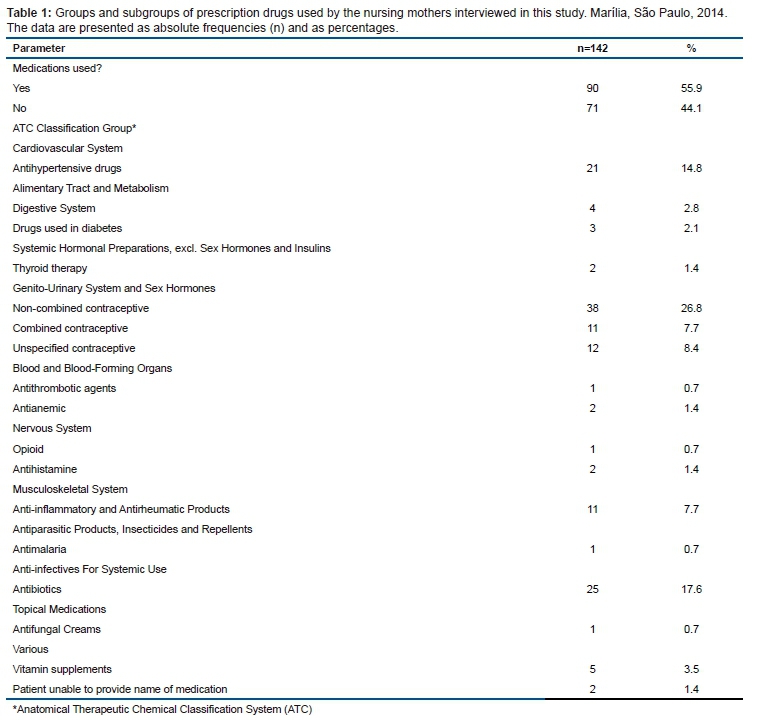
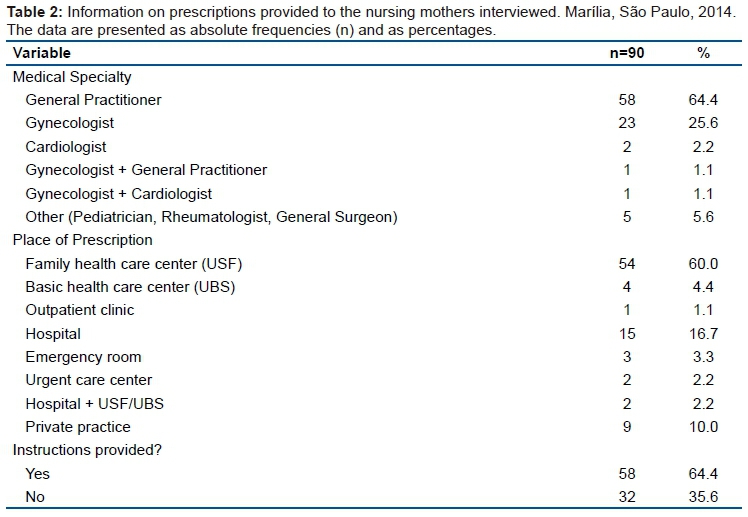
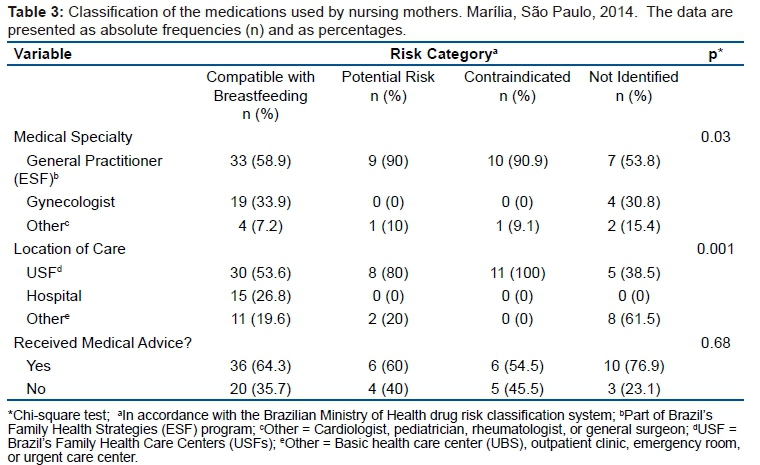
<body><![CDATA[<p><font face="Verdana, Arial, Helvetica, sans-serif" size="3"><b>RESULTS</b></font></p>     <p><font face="Verdana, Arial, Helvetica, sans-serif" size="2">The sociodemographic    data of the 161 participants revealed a predominance of patients between 20    and 29 years of age and a majority of patients who had completed high school    as their highest level of schooling.</font></p>     <p><font face="Verdana, Arial, Helvetica, sans-serif" size="2">Most subjects reported    having used some type of medication while breastfeeding. <a href="/img/revistas/rbcdh/v28n2/02t1.jpg">Table    1</a> describes the 142 prescription drugs that were used by the mothers interviewed.    The most commonly used drugs were those in the hormonal system ATC group, followed    by the anti-infectives for systemic use group and the cardiovascular system    group.</font></p>     <p><font face="Verdana, Arial, Helvetica, sans-serif" size="2">General practitioners    were the most common medical specialists to prescribe drugs to these mothers,    followed by gynecologists. Most of the prescriptions were provided at USFs,    followed by UBSs. Most of the interviewees received some type of medical advice    regarding which medications were safe to use while breastfeeding (<a href="/img/revistas/rbcdh/v28n2/02t2.jpg">Table    2</a>).</font></p>     <p><font face="Verdana, Arial, Helvetica, sans-serif" size="2">The statistical    analysis showed a positive correlation between risk classification and the variables    representing the prescribing physician's specialty and the place of care. The    highest percentages of prescriptions of drugs with potential for risk if used    during breastfeeding and of drugs contraindicated during breastfeeding were    made by general practitioners in the ESF program (<a href="/img/revistas/rbcdh/v28n2/02t3.jpg">Table    3</a>).</font></p>     <p>&nbsp;</p>     <p><font face="Verdana, Arial, Helvetica, sans-serif" size="3"><b>DISCUSSION</b></font></p>     <p><font face="Verdana, Arial, Helvetica, sans-serif" size="2">The socioeconomic    data on the patients' age and level of schooling in the present study resemble    those from a study performed in the state of Rio de Janeiro, in which the majority    of patients were between 21 and 30 years of age and in which the highest level    of schooling of 46% of the patients was a completed high school education<sup>17</sup>.    Variables such as age and schooling have been described as factors associated    with early weaning; studies have suggested that the lower the mother's level    of schooling, the earlier the weaning tends to take place<sup>20</sup>. In agreement    with these findings, another cross-sectional study demonstrated that mothers    with less schooling are more likely to introduce foods in their children's diet    prematurely<sup>21</sup>. It is also worth mentioning that marital status can    also be a determinant of early weaning. Married women seem to be more likely    to breastfeed<sup>22</sup>. As detailed in <a href="/img/revistas/rbcdh/v28n2/02t1.jpg">Table    1</a>, the interviews revealed that 90 of the nursing mothers (55.9%) used prescription    medications. These data are slightly lower than those observed in a study on    nursing mothers treated at a public hospital, in which 78% of the mothers reported    using prescribed medication<sup>17</sup>. The current findings were also lower    than those in a study on nursing mothers treated at a UBS (80%)<sup>16</sup>.    In these previous studies, the most commonly prescribed medications were NSAIDs,    prescriptions for which ranged from 58%16 to 61.5%<sup>17</sup>.</font></p>     <p><font face="Verdana, Arial, Helvetica, sans-serif" size="2">In a cross-sectional    study on mothers of infants less than 6 months of age treated in UBSs in the    inland cities of S&atilde;o Paulo State, 93% of the medications the mothers    used had been prescribed to them. The most common prescriptions were for vitamins    and iron supplements (59%); antibiotics and antihypertensive drugs totaled only    2% and 1%, respectively<sup>14</sup>. According to a study carried out in a    clinic in the Netherlands, 65.9% of 451 breastfeeding women used some type of    medication, while 40.8% used vitamin supplements, and 7.1% oral contraceptives<sup>23</sup>.</font></p>     <p><font face="Verdana, Arial, Helvetica, sans-serif" size="2">In the current    study, the most commonly used medications were oral contraceptives, followed    by antibiotics and antihypertensive drugs. The high percentage of contraceptive    use may be a factor of the predominantly young age of the nursing mothers involved    in the study, most of whom were still of childbearing potential. We consider    it important to classify contraceptives as combined or non-combined, since the    former are contraindicated during lactation: the presence of the estrogen component    compromises the breast milk production<sup>13</sup>.</font></p>     ]]></body>
<body><![CDATA[<p><font face="Verdana, Arial, Helvetica, sans-serif" size="2">In our study, 7.7%    of the contraceptives prescribed were combined. However, 8.4% of the women interviewed    were unable to specify which contraceptive they used. According to the Brazilian    Ministry of Health's risk categories, the antihypertensive drugs and antibiotics    prescribed to the women in this study have a potential for risk if used during    breastfeeding. Furthermore, 12.2% of the nursing mothers used contraindicated    drugs in this period. This finding differed from a study on mothers treated    at the hospital level, where all of the drugs prescribed were in the Ministry    of Health's "compatible with breastfeeding" category<sup>17</sup>. In general,    studies show that most women use prescription drugs during lactation, but different    drug classes are used at different rates, and study results may be influenced    by country, the number of nursing mothers considered, and the type of health    care service or center where the data is obtained.</font></p>     <p><font face="Verdana, Arial, Helvetica, sans-serif" size="2">As <a href="/img/revistas/rbcdh/v28n2/02t2.jpg">Table    2</a> details, most of the medications were prescribed to the women in this    study by general practitioners. The nursing mothers interviewed in the present    study were treated as part of the ESF program, but the results go against the    purpose and proposals of Brazil's primary health care system: given the longitudinal    nature of the program, the point of this care is not to limit prevention measures    only to the prescription of medication<sup>24</sup>; both primary and secondary    prevention measures must be prioritized. Though Brazil's USFs do not have gynecologists    on staff, the presence of the gynecologists in the data can be explained by    the fact that some of the nursing mothers interviewed were treated in a hospital    setting.</font></p>     <p><font face="Verdana, Arial, Helvetica, sans-serif" size="2">In the interviews,    64.4% of the mothers reported having received some kind of medical advice. This    rate was similar to those in the literature, in which 76.9% of the mothers were    advised on the use of the drugs by doctors or nurses<sup>17,20</sup>.</font></p>     <p><font face="Verdana, Arial, Helvetica, sans-serif" size="2"><a href="/img/revistas/rbcdh/v28n2/02t3.jpg">Table    3</a> demonstrates that drug risk classification was positively correlated with    the prescribing physician's medical specialty and with the place of care. As    mentioned previously, all medication classified as contraindicated was found    to have been prescribed as part of primary care (in a local UBS or USF) by general    practitioners. This behavior may be a factor of the prescribing physician's    medical education, since general practitioners do not routinely have experience    with breastfeeding mothers and the types of medications considered safe for    them. The presence of gynecologists may have contributed to the lack of contraindicated    prescriptions in the other places of care, since OBGYNs are theoretically more    qualified to manage these medications during this phase of patients' lives.    According to recommendations from the Brazilian Ministry of Health, when pharmacological    treatment is required during breastfeeding, the risks to the health of the mother    and the child be carefully evaluated so that mothers can be appropriately treated    without interrupting breastfeeding<sup>19</sup>.</font></p>     <p><font face="Verdana, Arial, Helvetica, sans-serif" size="2">The statistical    analysis showed no positive correlation between medical advice being given and    the risk category of the medications prescribed (<a href="/img/revistas/rbcdh/v28n2/02t3.jpg">Table    3</a>). However, nine nursing mothers received prescriptions for drugs classified    as contraindicated or having the potential for risk if used during breastfeeding.    These erroneous prescriptions reflect the need for better training for professionals    involved in treating nursing mothers, who require specialized care<sup>25</sup>.</font></p>     <p>&nbsp;</p>     <p><font face="Verdana, Arial, Helvetica, sans-serif" size="3"><b>CONCLUSION</b></font></p>     <p><font face="Verdana, Arial, Helvetica, sans-serif" size="2">In terms of sociodemographic    data, most of the nursing mothers interviewed in this study were under thirty    years of age and had a high-school-level education. The most frequently used    drug class was that of contraceptives. Because approximately one fifth of the    mothers interviewed reported using combined contraceptives, which are contraindicated    by the Brazilian Ministry of Health, and because close to one third of the mothers    were prescribed drugs that had a potential for risk if used during breastfeeding,    these results reflect the importance of improving the quality of care when it    comes to prescribing medications to this population. One limitation of this    study is the lack of information on the likely medical issues experienced by    these patients, which may have been able to explain the prescription of contraindicated    pharmaceuticals.</font></p>     <p><font face="Verdana, Arial, Helvetica, sans-serif" size="2">This study provides    evidence that most of the patients interviewed received medical advice regarding    the use of medication while breastfeeding, and also that every case in which    contraindicated medication was prescribed occurred in a visit with a general    practitioner as part of primary care.</font></p>     <p><font face="Verdana, Arial, Helvetica, sans-serif" size="2">These results therefore    reflect the need for qualified professionals throughout Brazil's public health    care network, since more properly trained professionals will provide more accurate    prescriptions and advice regarding the use of medication that is compatible    with breastfeeding and will therefore provide better care to both mothers and    children.</font></p>     ]]></body>
<body><![CDATA[<p>&nbsp;</p>     <p><font face="Verdana, Arial, Helvetica, sans-serif" size="3"><b>REFERENCES&nbsp;</b></font></p>     <!-- ref --><p><font face="Verdana, Arial, Helvetica, sans-serif" size="2">1. Corintio MN.    Manual de aleitamento materno. 3&ordf; ed. S&atilde;o Paulo: FEBRASGO, 2015.    &nbsp;&nbsp;&nbsp;&nbsp;&nbsp;&nbsp;&nbsp;&nbsp;[&#160;<a href="javascript:void(0);" onclick="javascript: window.open('/scielo.php?script=sci_nlinks&ref=2535519&pid=S0104-1282201800020000200001&lng=','','width=640,height=500,resizable=yes,scrollbars=1,menubar=yes,');">Links</a>&#160;]<!-- end-ref --></font></p>     <!-- ref --><p><font face="Verdana, Arial, Helvetica, sans-serif" size="2">2. Moura ERBB,    Florentino ECL, Bezerra MEB, Machado ALG. Investiga&ccedil;&atilde;o dos fatores    sociais que interferem na dura&ccedil;&atilde;o do aleitamento materno exclusivo.    Rev Intert. 2015;8(2):94-116. DOI: <a href="http://dx.doi.org/10.22280/revintervol8ed2.203" target="_blank">http://dx.doi.org/10.22280/revintervol8ed2.203</a></font>&nbsp;&nbsp;&nbsp;&nbsp;&nbsp;&nbsp;&nbsp;&nbsp;[&#160;<a href="javascript:void(0);" onclick="javascript: window.open('/scielo.php?script=sci_nlinks&ref=2535521&pid=S0104-1282201800020000200002&lng=','','width=640,height=500,resizable=yes,scrollbars=1,menubar=yes,');">Links</a>&#160;]<!-- end-ref --><!-- ref --><p><font face="Verdana, Arial, Helvetica, sans-serif" size="2">3. Victora CG,    Barros AJD, Fran&ccedil;a GVA, Bahl R, Horton S, Krasevec J, et al. Amamenta&ccedil;&atilde;o    no s&eacute;culo 21: epidemiologia, mecanismos, e efeitos ao longo da vida.    Epidemiol Serv Sa&uacute;de. 2016;1-24.    &nbsp;&nbsp;&nbsp;&nbsp;&nbsp;&nbsp;&nbsp;&nbsp;[&#160;<a href="javascript:void(0);" onclick="javascript: window.open('/scielo.php?script=sci_nlinks&ref=2535522&pid=S0104-1282201800020000200003&lng=','','width=640,height=500,resizable=yes,scrollbars=1,menubar=yes,');">Links</a>&#160;]<!-- end-ref --></font></p>     <!-- ref --><p><font face="Verdana, Arial, Helvetica, sans-serif" size="2">4. Dias EG, Alves    JCS, Santos MRA, Pereira PG. Preval&ecirc;ncia do aleitamento materno exclusivo    at&eacute; o sexto m&ecirc;s no munic&iacute;pio de Mamonas-MG em 2013. Rev    Contexto Sa&uacute;de. 2015;15(29):81-90. DOI: <a href="http://dx.doi.org/10.21527/2176-7114.2015.29.81-90" target="_blank">http://dx.doi.org/10.21527/2176-7114.2015.29.81-90</a></font>&nbsp;&nbsp;&nbsp;&nbsp;&nbsp;&nbsp;&nbsp;&nbsp;[&#160;<a href="javascript:void(0);" onclick="javascript: window.open('/scielo.php?script=sci_nlinks&ref=2535524&pid=S0104-1282201800020000200004&lng=','','width=640,height=500,resizable=yes,scrollbars=1,menubar=yes,');">Links</a>&#160;]<!-- end-ref --><!-- ref --><p><font face="Verdana, Arial, Helvetica, sans-serif" size="2">5. Brasil. Minist&eacute;rio    da Sa&uacute;de. Centro Brasileiro de An&aacute;lise e Planejamento. Pesquisa    nacional demogr&aacute;fica e sa&uacute;de da crian&ccedil;a e da mulher PNDS    2006: dimens&otilde;es do processo reprodutivo e da sa&uacute;de da crian&ccedil;a.    [cited 2017 Nov 20] Available from: <a href="http://bvsms.saude.gov.br/bvs/publicacoes/pnds_crianca_mulher.pdf" target="_blank">http://bvsms.saude.gov.br/bvs/publicacoes/pnds_crianca_mulher.pdf</a>.    &nbsp;&nbsp;&nbsp;&nbsp;&nbsp;&nbsp;&nbsp;&nbsp;[&#160;<a href="javascript:void(0);" onclick="javascript: window.open('/scielo.php?script=sci_nlinks&ref=2535525&pid=S0104-1282201800020000200005&lng=','','width=640,height=500,resizable=yes,scrollbars=1,menubar=yes,');">Links</a>&#160;]<!-- end-ref --></font></p>     ]]></body>
<body><![CDATA[<!-- ref --><p><font face="Verdana, Arial, Helvetica, sans-serif" size="2">6. Prado CVC, Fabbro    MRC, Ferreira GI. Desmame precoce na perspectiva de pu&eacute;rperas: uma abordagem    dial&oacute;gica. Texto Contexto Enferm. 2016;25(2):e1580015. DOI: <a href="http://dx.doi.org/10.1590/0104-07072016001580015" target="_blank">http://dx.doi.org/10.1590/0104-07072016001580015</a></font>&nbsp;&nbsp;&nbsp;&nbsp;&nbsp;&nbsp;&nbsp;&nbsp;[&#160;<a href="javascript:void(0);" onclick="javascript: window.open('/scielo.php?script=sci_nlinks&ref=2535527&pid=S0104-1282201800020000200006&lng=','','width=640,height=500,resizable=yes,scrollbars=1,menubar=yes,');">Links</a>&#160;]<!-- end-ref --><!-- ref --><p><font face="Verdana, Arial, Helvetica, sans-serif" size="2">7. Severiano AAO,    Dantas DS, Oliveira VLC, Lopes JM, Souza DE, Magalh&atilde;es AG. Associa&ccedil;&atilde;o    entre amamenta&ccedil;&atilde;o, fatores obst&eacute;tricos e o desenvolvimento    infantil de crian&ccedil;as do interior do nordeste brasileiro. J Hum Growth    Dev. 2017;27(2):158-65. DOI: <a href="http://dx.doi.org/10.7322/jhgd.114483" target="_blank">http://dx.doi.org/10.7322/jhgd.114483</a></font>&nbsp;&nbsp;&nbsp;&nbsp;&nbsp;&nbsp;&nbsp;&nbsp;[&#160;<a href="javascript:void(0);" onclick="javascript: window.open('/scielo.php?script=sci_nlinks&ref=2535528&pid=S0104-1282201800020000200007&lng=','','width=640,height=500,resizable=yes,scrollbars=1,menubar=yes,');">Links</a>&#160;]<!-- end-ref --><!-- ref --><p><font face="Verdana, Arial, Helvetica, sans-serif" size="2">8. Fonseca-Machado    MO, Haas VJ, Stefanello J, Nakano AMS, Gomes-Sponholz F. Aleitamento materno:    conhecimento e pr&aacute;tica. Rev Esc Enferm USP. 2012;46(4):809-15. DOI: <a href="http://dx.doi.org/10.1590/S0080-62342012000400004" target="_blank">http://dx.doi.org/10.1590/S0080-62342012000400004</a></font>&nbsp;&nbsp;&nbsp;&nbsp;&nbsp;&nbsp;&nbsp;&nbsp;[&#160;<a href="javascript:void(0);" onclick="javascript: window.open('/scielo.php?script=sci_nlinks&ref=2535529&pid=S0104-1282201800020000200008&lng=','','width=640,height=500,resizable=yes,scrollbars=1,menubar=yes,');">Links</a>&#160;]<!-- end-ref --><!-- ref --><p><font face="Verdana, Arial, Helvetica, sans-serif" size="2">9. Silva NM, Waterkemper    R, Silva EF, Cordova FP, Bonilha ALL. Conhecimento de pu&eacute;rperas sobre    amamenta&ccedil;&atilde;o exclusiva. Rev Bras Enferm. 2014;67(2):290-5. DOI:    <a href="http://dx.doi.org/10.5935/0034-7167.20140039" target="_blank">http://dx.doi.org/10.5935/0034-7167.20140039</a></font>&nbsp;&nbsp;&nbsp;&nbsp;&nbsp;&nbsp;&nbsp;&nbsp;[&#160;<a href="javascript:void(0);" onclick="javascript: window.open('/scielo.php?script=sci_nlinks&ref=2535530&pid=S0104-1282201800020000200009&lng=','','width=640,height=500,resizable=yes,scrollbars=1,menubar=yes,');">Links</a>&#160;]<!-- end-ref --><!-- ref --><p><font face="Verdana, Arial, Helvetica, sans-serif" size="2">10. Silva CA, Davim    RMB. Mulher trabalhadora e fatores que interferem na amamenta&ccedil;&atilde;o:    revis&atilde;o integrativa. Rev Rene. 2012;13(5):1208-1217. DOI: <a href="http://dx.doi.org/10.15253/rev%20rene.v13i5.4143" target="_blank">http://dx.doi.org/10.15253/rev%20rene.v13i5.4143</a></font>&nbsp;&nbsp;&nbsp;&nbsp;&nbsp;&nbsp;&nbsp;&nbsp;[&#160;<a href="javascript:void(0);" onclick="javascript: window.open('/scielo.php?script=sci_nlinks&ref=2535531&pid=S0104-1282201800020000200010&lng=','','width=640,height=500,resizable=yes,scrollbars=1,menubar=yes,');">Links</a>&#160;]<!-- end-ref --><!-- ref --><p><font face="Verdana, Arial, Helvetica, sans-serif" size="2">11. Hernandes TA,    Fuginami AN, Raimundo EC, Cardoso CP, Higa EFR, Lazarini CA. Significado e dificuldades    da amamenta&ccedil;&atilde;o: representa&ccedil;&atilde;o social das m&atilde;es.    Rev Psicol Diversid Sa&uacute;de. 2017;6(4):247-57. DOI: <a href="http://dx.doi.org/10.17267/2317-3394rpds.v6i4.1692" target="_blank">http://dx.doi.org/10.17267/2317-3394rpds.v6i4.1692</a></font>&nbsp;&nbsp;&nbsp;&nbsp;&nbsp;&nbsp;&nbsp;&nbsp;[&#160;<a href="javascript:void(0);" onclick="javascript: window.open('/scielo.php?script=sci_nlinks&ref=2535532&pid=S0104-1282201800020000200011&lng=','','width=640,height=500,resizable=yes,scrollbars=1,menubar=yes,');">Links</a>&#160;]<!-- end-ref --><!-- ref --><p><font face="Verdana, Arial, Helvetica, sans-serif" size="2">12. Barbosa JAG,    Santos FPC, Silva PMC. Fatores associados &agrave; baixa ades&atilde;o ao aleitamento    materno exclusivo e ao desmame precoce. Rev Tecer. 2013;6(11):154-65. DOI: <a href="http://dx.doi.org/10.15601/1983-7631/rt.v6n11p154-16" target="_blank">http://dx.doi.org/10.15601/1983-7631/rt.v6n11p154-16</a></font>&nbsp;&nbsp;&nbsp;&nbsp;&nbsp;&nbsp;&nbsp;&nbsp;[&#160;<a href="javascript:void(0);" onclick="javascript: window.open('/scielo.php?script=sci_nlinks&ref=2535533&pid=S0104-1282201800020000200012&lng=','','width=640,height=500,resizable=yes,scrollbars=1,menubar=yes,');">Links</a>&#160;]<!-- end-ref --><!-- ref --><p><font face="Verdana, Arial, Helvetica, sans-serif" size="2">13. Brasil. Minist&eacute;rio    da Sa&uacute;de. Secretaria de Aten&ccedil;&atilde;o &agrave; Sa&uacute;de.    Departamento de Aten&ccedil;&atilde;o B&aacute;sica. Sa&uacute;de da crian&ccedil;a:    aleitamento materno e alimenta&ccedil;&atilde;o complementar. 2ed. Bras&iacute;lia:    Minist&eacute;rio da Sa&uacute;de, 2015.    &nbsp;&nbsp;&nbsp;&nbsp;&nbsp;&nbsp;&nbsp;&nbsp;[&#160;<a href="javascript:void(0);" onclick="javascript: window.open('/scielo.php?script=sci_nlinks&ref=2535534&pid=S0104-1282201800020000200013&lng=','','width=640,height=500,resizable=yes,scrollbars=1,menubar=yes,');">Links</a>&#160;]<!-- end-ref --></font></p>     <!-- ref --><p><font face="Verdana, Arial, Helvetica, sans-serif" size="2">14. Del Ciampo    LA, Ferraz IS, Daneluzzi JC, Ricco RG, Martinelli Junior CE. Aleitamento materno    e uso de medicamentos durante a lacta&ccedil;&atilde;o. Rev Paul Pediatr. 2007;25(4):355-7.    DOI: <a href="http://dx.doi.org/10.1590/S0103-05822007000400010" target="_blank">http://dx.doi.org/10.1590/S0103-05822007000400010</a></font>&nbsp;&nbsp;&nbsp;&nbsp;&nbsp;&nbsp;&nbsp;&nbsp;[&#160;<a href="javascript:void(0);" onclick="javascript: window.open('/scielo.php?script=sci_nlinks&ref=2535536&pid=S0104-1282201800020000200014&lng=','','width=640,height=500,resizable=yes,scrollbars=1,menubar=yes,');">Links</a>&#160;]<!-- end-ref --><!-- ref --><p><font face="Verdana, Arial, Helvetica, sans-serif" size="2">15. Queiroz RFC,    Santos SLF, Pessoa CV, Borges RN, Barros KBT. Aleitamento materno e uso de medicamentos    por pu&eacute;rperas em um munic&iacute;pio do estado do Cear&aacute;. Bol Inform    Geum. 2015;6(3):7-14.    &nbsp;&nbsp;&nbsp;&nbsp;&nbsp;&nbsp;&nbsp;&nbsp;[&#160;<a href="javascript:void(0);" onclick="javascript: window.open('/scielo.php?script=sci_nlinks&ref=2535537&pid=S0104-1282201800020000200015&lng=','','width=640,height=500,resizable=yes,scrollbars=1,menubar=yes,');">Links</a>&#160;]<!-- end-ref --></font></p>     <!-- ref --><p><font face="Verdana, Arial, Helvetica, sans-serif" size="2">16. Mota LS, Chaves    EMC, Barbosa RCM, Amaral JF, Farias LM, Almeida, PC. Uso de medicamentos durante    a lacta&ccedil;&atilde;o por usu&aacute;rias de uma unidade b&aacute;sica de    sa&uacute;de. Rev Rene. 2013;14(1):139-47. DOI: <a href="http://dx.doi.org/10.15253/rev%20rene.v14i1.3344" target="_blank">http://dx.doi.org/10.15253/rev%20rene.v14i1.3344</a></font>&nbsp;&nbsp;&nbsp;&nbsp;&nbsp;&nbsp;&nbsp;&nbsp;[&#160;<a href="javascript:void(0);" onclick="javascript: window.open('/scielo.php?script=sci_nlinks&ref=2535539&pid=S0104-1282201800020000200016&lng=','','width=640,height=500,resizable=yes,scrollbars=1,menubar=yes,');">Links</a>&#160;]<!-- end-ref --><!-- ref --><p><font face="Verdana, Arial, Helvetica, sans-serif" size="2">17. Fragoso VMS,    Silva ED, Mota JM. Lactantes em tratamento medicamentoso da rede p&uacute;blica    de sa&uacute;de. Rev Bras Promo&ccedil; Sa&uacute;de. 2014;27(2):283-90. DOI:    <a href="http://dx.doi.org/10.5020/18061230.2014.p283" target="_blank">http://dx.doi.org/10.5020/18061230.2014.p283</a></font>&nbsp;&nbsp;&nbsp;&nbsp;&nbsp;&nbsp;&nbsp;&nbsp;[&#160;<a href="javascript:void(0);" onclick="javascript: window.open('/scielo.php?script=sci_nlinks&ref=2535540&pid=S0104-1282201800020000200017&lng=','','width=640,height=500,resizable=yes,scrollbars=1,menubar=yes,');">Links</a>&#160;]<!-- end-ref --><!-- ref --><p><font face="Verdana, Arial, Helvetica, sans-serif" size="2">18. World Health    Organization (WHO). Collaborating Centre for Drug Statistics Methodology. Guidelines    for ATC classification and DDD assignment 2013. Oslo: 2012 [cited 2017 Oct 4].    Available from: <a href="https://www.whocc.no/filearchive/publications/1_2013guidelines.pdf" target="_blank">https://www.whocc.no/filearchive/publications/1_2013guidelines.pdf</a>.    &nbsp;&nbsp;&nbsp;&nbsp;&nbsp;&nbsp;&nbsp;&nbsp;[&#160;<a href="javascript:void(0);" onclick="javascript: window.open('/scielo.php?script=sci_nlinks&ref=2535541&pid=S0104-1282201800020000200018&lng=','','width=640,height=500,resizable=yes,scrollbars=1,menubar=yes,');">Links</a>&#160;]<!-- end-ref --></font></p>     <!-- ref --><p><font face="Verdana, Arial, Helvetica, sans-serif" size="2">19. Brasil. Minist&eacute;rio    da Sa&uacute;de. Secretaria de Aten&ccedil;&atilde;o &agrave; Sa&uacute;de.    Departamento de a&ccedil;&otilde;es pragm&aacute;ticas e estrat&eacute;gicas.    Amamenta&ccedil;&atilde;o e uso de medicamentos e outras subst&acirc;ncias.    2ed. Bras&iacute;lia: Minist&eacute;rio da Sa&uacute;de, 2014. [cited 2018 Fev    12]. Available from: <a href="http://bvsms.saude.gov.br/bvs/publicacoes/amamentacao_uso_medicamentos_outras_substancias.pdf." target="_blank">bvsms.saude.gov.br/bvs/publicacoes/amamentacao_uso_medicamentos_outras_substancias.pdf.    &nbsp;&nbsp;&nbsp;&nbsp;&nbsp;&nbsp;&nbsp;&nbsp;[&#160;<a href="javascript:void(0);" onclick="javascript: window.open('/scielo.php?script=sci_nlinks&ref=2535543&pid=S0104-1282201800020000200019&lng=','','width=640,height=500,resizable=yes,scrollbars=1,menubar=yes,');">Links</a>&#160;]<!-- end-ref --></a></font></p>     <!-- ref --><p><font face="Verdana, Arial, Helvetica, sans-serif" size="2">20. Teter MSH,    Oselame GB, Neves EB. Amamenta&ccedil;&atilde;o e desmame precoce em lactantes    de Curitiba. Espa&ccedil;o Sa&uacute;de. 2015;16(4):55-63. DOI: <a href="http://dx.doi.org/10.22421/1517-7130.2015v16n4p54" target="_blank">http://dx.doi.org/10.22421/1517-7130.2015v16n4p54</a></font>&nbsp;&nbsp;&nbsp;&nbsp;&nbsp;&nbsp;&nbsp;&nbsp;[&#160;<a href="javascript:void(0);" onclick="javascript: window.open('/scielo.php?script=sci_nlinks&ref=2535545&pid=S0104-1282201800020000200020&lng=','','width=640,height=500,resizable=yes,scrollbars=1,menubar=yes,');">Links</a>&#160;]<!-- end-ref --><!-- ref --><p><font face="Verdana, Arial, Helvetica, sans-serif" size="2">21. Pereira RSV,    Oliveira MIC, Andrade CLT, Brito AS. Fatores associados ao aleitamento materno    exclusivo: o papel do cuidado na aten&ccedil;&atilde;o b&aacute;sica. Cad Sa&uacute;de    P&uacute;blica. 2010;26(12):2343-54. DOI: <a href="http://dx.doi.org/10.1590/S0102-311X2010001200013" target="_blank">http://dx.doi.org/10.1590/S0102-311X2010001200013</a></font>&nbsp;&nbsp;&nbsp;&nbsp;&nbsp;&nbsp;&nbsp;&nbsp;[&#160;<a href="javascript:void(0);" onclick="javascript: window.open('/scielo.php?script=sci_nlinks&ref=2535546&pid=S0104-1282201800020000200021&lng=','','width=640,height=500,resizable=yes,scrollbars=1,menubar=yes,');">Links</a>&#160;]<!-- end-ref --><!-- ref --><p><font face="Verdana, Arial, Helvetica, sans-serif" size="2">22. Dodt RCM, Ferreira    AMV, Nascimento LA, Mac&ecirc;do AC, Joventino ES, Ximenes LB. Influ&ecirc;ncia    de estrat&eacute;gia de educa&ccedil;&atilde;o em sa&uacute;de mediada por &aacute;lbum    seriado sobre a autoefic&aacute;cia materna para amamentar. Texto Contexto Enferm.    2013;22(3):610-8. DOI: <a href="http://dx.doi.org/10.1590/S0104-07072013000300006" target="_blank">http://dx.doi.org/10.1590/S0104-07072013000300006</a></font>&nbsp;&nbsp;&nbsp;&nbsp;&nbsp;&nbsp;&nbsp;&nbsp;[&#160;<a href="javascript:void(0);" onclick="javascript: window.open('/scielo.php?script=sci_nlinks&ref=2535547&pid=S0104-1282201800020000200022&lng=','','width=640,height=500,resizable=yes,scrollbars=1,menubar=yes,');">Links</a>&#160;]<!-- end-ref --><!-- ref --><p><font face="Verdana, Arial, Helvetica, sans-serif" size="2">23.E Schirm E,    Schwagermann MP, Tobi H, Jong-van den Berg LT. Drug use during breastfeeding.    Eur J Clin Nutr. 2004;58(2):386-90. DOI: <a href="http://dx.doi.org/10.1038/sj.ejcn.1601799" target="_blank">http://dx.doi.org/10.1038/sj.ejcn.1601799</a></font>&nbsp;&nbsp;&nbsp;&nbsp;&nbsp;&nbsp;&nbsp;&nbsp;[&#160;<a href="javascript:void(0);" onclick="javascript: window.open('/scielo.php?script=sci_nlinks&ref=2535548&pid=S0104-1282201800020000200023&lng=','','width=640,height=500,resizable=yes,scrollbars=1,menubar=yes,');">Links</a>&#160;]<!-- end-ref --><!-- ref --><p><font face="Verdana, Arial, Helvetica, sans-serif" size="2">24. Vitoi NC, Fogal    AS, Nascimento CM, Franceschini SCC, Ribeiro AQ. Preval&ecirc;ncia e fatores    associados ao diabetes em idosos no munic&iacute;pio de Vi&ccedil;osa, Minas    Gerais. Rev Bras Epidemiol. 2015;18(4):953-65. DOI: <a href="http://dx.doi.org/10.1590/1980-5497201500040022" target="_blank">http://dx.doi.org/10.1590/1980-5497201500040022</a></font>&nbsp;&nbsp;&nbsp;&nbsp;&nbsp;&nbsp;&nbsp;&nbsp;[&#160;<a href="javascript:void(0);" onclick="javascript: window.open('/scielo.php?script=sci_nlinks&ref=2535549&pid=S0104-1282201800020000200024&lng=','','width=640,height=500,resizable=yes,scrollbars=1,menubar=yes,');">Links</a>&#160;]<!-- end-ref --><!-- ref --><p><font face="Verdana, Arial, Helvetica, sans-serif" size="2">25. Maciel JMMP,    Ramos AGB. Uso de medicamentos durante a lacta&ccedil;&atilde;o: um fator para    a suspen&ccedil;&atilde;o do aleitamemento materno. Rev Pesq Interdiscipl. 2017;(2):504-13.    DOI: <a href="http://dx.doi.org/10.24219/rpi.v2i2.274" target="_blank">http://dx.doi.org/10.24219/rpi.v2i2.274</a></font>&nbsp;&nbsp;&nbsp;&nbsp;&nbsp;&nbsp;&nbsp;&nbsp;[&#160;<a href="javascript:void(0);" onclick="javascript: window.open('/scielo.php?script=sci_nlinks&ref=2535550&pid=S0104-1282201800020000200025&lng=','','width=640,height=500,resizable=yes,scrollbars=1,menubar=yes,');">Links</a>&#160;]<!-- end-ref --><p>&nbsp;</p>     <p>&nbsp;</p>     <p><font face="Verdana, Arial, Helvetica, sans-serif" size="2"><a href="#top" name="corresp"><img src="/img/revistas/rbcdh/v28n2/seta.jpg" border="0"></a>    <b>Correspondence</b>:    <br>   Carlos Alberto Lazarini    <br>   <a href="mailto:lazarini@famema.br">lazarini@famema.br</a></font></p>     <p><font face="Verdana, Arial, Helvetica, sans-serif" size="2">Manuscript received:    January 2018    ]]></body>
<body><![CDATA[<br>   Manuscript accepted: April 2018    <br>   Version of record online: June 2018</font></p>      ]]></body>
<back>
<ref-list>
<ref id="B1">
<label>1</label><nlm-citation citation-type="book">
<person-group person-group-type="author">
<name>
<surname><![CDATA[Corintio]]></surname>
<given-names><![CDATA[MN]]></given-names>
</name>
</person-group>
<source><![CDATA[Manual de aleitamento materno]]></source>
<year>2015</year>
<edition>3</edition>
<publisher-loc><![CDATA[São Paulo ]]></publisher-loc>
<publisher-name><![CDATA[FEBRASGO]]></publisher-name>
</nlm-citation>
</ref>
<ref id="B2">
<label>2</label><nlm-citation citation-type="journal">
<person-group person-group-type="author">
<name>
<surname><![CDATA[Moura]]></surname>
<given-names><![CDATA[ERBB]]></given-names>
</name>
<name>
<surname><![CDATA[Florentino]]></surname>
<given-names><![CDATA[ECL]]></given-names>
</name>
<name>
<surname><![CDATA[Bezerra]]></surname>
<given-names><![CDATA[MEB]]></given-names>
</name>
<name>
<surname><![CDATA[Machado]]></surname>
<given-names><![CDATA[ALG]]></given-names>
</name>
</person-group>
<article-title xml:lang="pt"><![CDATA[Investigação dos fatores sociais que interferem na duração do aleitamento materno exclusivo]]></article-title>
<source><![CDATA[Rev Intert]]></source>
<year>2015</year>
<volume>8</volume>
<numero>2</numero>
<issue>2</issue>
<page-range>94-116</page-range></nlm-citation>
</ref>
<ref id="B3">
<label>3</label><nlm-citation citation-type="journal">
<person-group person-group-type="author">
<name>
<surname><![CDATA[Victora]]></surname>
<given-names><![CDATA[CG]]></given-names>
</name>
<name>
<surname><![CDATA[Barros]]></surname>
<given-names><![CDATA[AJD]]></given-names>
</name>
<name>
<surname><![CDATA[França]]></surname>
<given-names><![CDATA[GVA]]></given-names>
</name>
<name>
<surname><![CDATA[Bahl]]></surname>
<given-names><![CDATA[R]]></given-names>
</name>
<name>
<surname><![CDATA[Horton]]></surname>
<given-names><![CDATA[S]]></given-names>
</name>
<name>
<surname><![CDATA[Krasevec]]></surname>
<given-names><![CDATA[J]]></given-names>
</name>
</person-group>
<article-title xml:lang="pt"><![CDATA[Amamentação no século 21: epidemiologia, mecanismos, e efeitos ao longo da vida]]></article-title>
<source><![CDATA[Epidemiol Serv Saúde]]></source>
<year>2016</year>
<page-range>1-24</page-range></nlm-citation>
</ref>
<ref id="B4">
<label>4</label><nlm-citation citation-type="journal">
<person-group person-group-type="author">
<name>
<surname><![CDATA[Dias]]></surname>
<given-names><![CDATA[EG]]></given-names>
</name>
<name>
<surname><![CDATA[Alves]]></surname>
<given-names><![CDATA[JCS]]></given-names>
</name>
<name>
<surname><![CDATA[Santos]]></surname>
<given-names><![CDATA[MRA]]></given-names>
</name>
<name>
<surname><![CDATA[Pereira]]></surname>
<given-names><![CDATA[PG]]></given-names>
</name>
</person-group>
<article-title xml:lang="pt"><![CDATA[Prevalência do aleitamento materno exclusivo até o sexto mês no município de Mamonas-MG em 2013]]></article-title>
<source><![CDATA[Rev Contexto Saúde]]></source>
<year>2015</year>
<volume>15</volume>
<numero>29</numero>
<issue>29</issue>
<page-range>81-90</page-range></nlm-citation>
</ref>
<ref id="B5">
<label>5</label><nlm-citation citation-type="">
<collab>Brasil^dMinistério da Saúde. Centro Brasileiro de Análise e Planejamento</collab>
<source><![CDATA[Pesquisa nacional demográfica e saúde da criança e da mulher PNDS 2006: dimensões do processo reprodutivo e da saúde da criança]]></source>
<year></year>
</nlm-citation>
</ref>
<ref id="B6">
<label>6</label><nlm-citation citation-type="journal">
<person-group person-group-type="author">
<name>
<surname><![CDATA[Prado]]></surname>
<given-names><![CDATA[CVC]]></given-names>
</name>
<name>
<surname><![CDATA[Fabbro]]></surname>
<given-names><![CDATA[MRC]]></given-names>
</name>
<name>
<surname><![CDATA[Ferreira]]></surname>
<given-names><![CDATA[GI]]></given-names>
</name>
</person-group>
<article-title xml:lang="pt"><![CDATA[Desmame precoce na perspectiva de puérperas: uma abordagem dialógica]]></article-title>
<source><![CDATA[Texto Contexto Enferm]]></source>
<year>2016</year>
<volume>25</volume>
<numero>2</numero>
<issue>2</issue>
<page-range>e1580015</page-range></nlm-citation>
</ref>
<ref id="B7">
<label>7</label><nlm-citation citation-type="journal">
<person-group person-group-type="author">
<name>
<surname><![CDATA[Severiano]]></surname>
<given-names><![CDATA[AAO]]></given-names>
</name>
<name>
<surname><![CDATA[Dantas]]></surname>
<given-names><![CDATA[DS]]></given-names>
</name>
<name>
<surname><![CDATA[Oliveira]]></surname>
<given-names><![CDATA[VLC]]></given-names>
</name>
<name>
<surname><![CDATA[Lopes]]></surname>
<given-names><![CDATA[JM]]></given-names>
</name>
<name>
<surname><![CDATA[Souza]]></surname>
<given-names><![CDATA[DE]]></given-names>
</name>
<name>
<surname><![CDATA[Magalhães]]></surname>
<given-names><![CDATA[AG]]></given-names>
</name>
</person-group>
<article-title xml:lang="pt"><![CDATA[Associação entre amamentação, fatores obstétricos e o desenvolvimento infantil de crianças do interior do nordeste brasileiro]]></article-title>
<source><![CDATA[J Hum Growth Dev]]></source>
<year>2017</year>
<volume>27</volume>
<numero>2</numero>
<issue>2</issue>
<page-range>158-65</page-range></nlm-citation>
</ref>
<ref id="B8">
<label>8</label><nlm-citation citation-type="journal">
<person-group person-group-type="author">
<name>
<surname><![CDATA[Fonseca-Machado]]></surname>
<given-names><![CDATA[MO]]></given-names>
</name>
<name>
<surname><![CDATA[Haas]]></surname>
<given-names><![CDATA[VJ]]></given-names>
</name>
<name>
<surname><![CDATA[Stefanello]]></surname>
<given-names><![CDATA[J]]></given-names>
</name>
<name>
<surname><![CDATA[Nakano]]></surname>
<given-names><![CDATA[AMS]]></given-names>
</name>
<name>
<surname><![CDATA[Gomes-Sponholz]]></surname>
<given-names><![CDATA[F]]></given-names>
</name>
</person-group>
<article-title xml:lang="pt"><![CDATA[Aleitamento materno: conhecimento e prática]]></article-title>
<source><![CDATA[Rev Esc Enferm USP]]></source>
<year>2012</year>
<volume>46</volume>
<numero>4</numero>
<issue>4</issue>
<page-range>809-15</page-range></nlm-citation>
</ref>
<ref id="B9">
<label>9</label><nlm-citation citation-type="journal">
<person-group person-group-type="author">
<name>
<surname><![CDATA[Silva]]></surname>
<given-names><![CDATA[NM]]></given-names>
</name>
<name>
<surname><![CDATA[Waterkemper]]></surname>
<given-names><![CDATA[R]]></given-names>
</name>
<name>
<surname><![CDATA[Silva]]></surname>
<given-names><![CDATA[EF]]></given-names>
</name>
<name>
<surname><![CDATA[Cordova]]></surname>
<given-names><![CDATA[FP]]></given-names>
</name>
<name>
<surname><![CDATA[Bonilha]]></surname>
<given-names><![CDATA[ALL]]></given-names>
</name>
</person-group>
<article-title xml:lang="pt"><![CDATA[Conhecimento de puérperas sobre amamentação exclusiva]]></article-title>
<source><![CDATA[Rev Bras Enferm]]></source>
<year>2014</year>
<volume>67</volume>
<numero>2</numero>
<issue>2</issue>
<page-range>290-5</page-range></nlm-citation>
</ref>
<ref id="B10">
<label>10</label><nlm-citation citation-type="journal">
<person-group person-group-type="author">
<name>
<surname><![CDATA[Silva]]></surname>
<given-names><![CDATA[CA]]></given-names>
</name>
<name>
<surname><![CDATA[Davim]]></surname>
<given-names><![CDATA[RMB]]></given-names>
</name>
</person-group>
<article-title xml:lang="pt"><![CDATA[Mulher trabalhadora e fatores que interferem na amamentação: revisão integrativa]]></article-title>
<source><![CDATA[Rev Rene]]></source>
<year>2012</year>
<volume>13</volume>
<numero>5</numero>
<issue>5</issue>
<page-range>1208-1217</page-range></nlm-citation>
</ref>
<ref id="B11">
<label>11</label><nlm-citation citation-type="journal">
<person-group person-group-type="author">
<name>
<surname><![CDATA[Hernandes]]></surname>
<given-names><![CDATA[TA]]></given-names>
</name>
<name>
<surname><![CDATA[Fuginami]]></surname>
<given-names><![CDATA[AN]]></given-names>
</name>
<name>
<surname><![CDATA[Raimundo]]></surname>
<given-names><![CDATA[EC]]></given-names>
</name>
<name>
<surname><![CDATA[Cardoso]]></surname>
<given-names><![CDATA[CP]]></given-names>
</name>
<name>
<surname><![CDATA[Higa]]></surname>
<given-names><![CDATA[EFR]]></given-names>
</name>
<name>
<surname><![CDATA[Lazarini]]></surname>
<given-names><![CDATA[CA]]></given-names>
</name>
</person-group>
<article-title xml:lang="pt"><![CDATA[Significado e dificuldades da amamentação: representação social das mães]]></article-title>
<source><![CDATA[Rev Psicol Diversid Saúde]]></source>
<year>2017</year>
<volume>6</volume>
<numero>4</numero>
<issue>4</issue>
<page-range>247-57</page-range></nlm-citation>
</ref>
<ref id="B12">
<label>12</label><nlm-citation citation-type="journal">
<person-group person-group-type="author">
<name>
<surname><![CDATA[Barbosa]]></surname>
<given-names><![CDATA[JAG]]></given-names>
</name>
<name>
<surname><![CDATA[Santos]]></surname>
<given-names><![CDATA[FPC]]></given-names>
</name>
<name>
<surname><![CDATA[Silva]]></surname>
<given-names><![CDATA[PMC]]></given-names>
</name>
</person-group>
<article-title xml:lang="pt"><![CDATA[Fatores associados à baixa adesão ao aleitamento materno exclusivo e ao desmame precoce]]></article-title>
<source><![CDATA[Rev Tecer]]></source>
<year>2013</year>
<volume>6</volume>
<numero>11</numero>
<issue>11</issue>
<page-range>154-65</page-range></nlm-citation>
</ref>
<ref id="B13">
<label>13</label><nlm-citation citation-type="book">
<collab>Brasil^dMinistério da Saúde. Secretaria de Atenção à Saúde. Departamento de Atenção Básica</collab>
<source><![CDATA[Saúde da criança: aleitamento materno e alimentação complementar]]></source>
<year>2015</year>
<edition>2</edition>
<publisher-loc><![CDATA[Brasília ]]></publisher-loc>
<publisher-name><![CDATA[Ministério da Saúde]]></publisher-name>
</nlm-citation>
</ref>
<ref id="B14">
<label>14</label><nlm-citation citation-type="journal">
<person-group person-group-type="author">
<name>
<surname><![CDATA[Del Ciampo]]></surname>
<given-names><![CDATA[LA]]></given-names>
</name>
<name>
<surname><![CDATA[Ferraz]]></surname>
<given-names><![CDATA[IS]]></given-names>
</name>
<name>
<surname><![CDATA[Daneluzzi]]></surname>
<given-names><![CDATA[JC]]></given-names>
</name>
<name>
<surname><![CDATA[Ricco]]></surname>
<given-names><![CDATA[RG]]></given-names>
</name>
<name>
<surname><![CDATA[Martinelli Junior]]></surname>
<given-names><![CDATA[CE]]></given-names>
</name>
</person-group>
<article-title xml:lang="pt"><![CDATA[Aleitamento materno e uso de medicamentos durante a lactação]]></article-title>
<source><![CDATA[Rev Paul Pediatr]]></source>
<year>2007</year>
<volume>25</volume>
<numero>4</numero>
<issue>4</issue>
<page-range>355-7</page-range></nlm-citation>
</ref>
<ref id="B15">
<label>15</label><nlm-citation citation-type="journal">
<person-group person-group-type="author">
<name>
<surname><![CDATA[Queiroz]]></surname>
<given-names><![CDATA[RFC]]></given-names>
</name>
<name>
<surname><![CDATA[Santos]]></surname>
<given-names><![CDATA[SLF]]></given-names>
</name>
<name>
<surname><![CDATA[Pessoa]]></surname>
<given-names><![CDATA[CV]]></given-names>
</name>
<name>
<surname><![CDATA[Borges]]></surname>
<given-names><![CDATA[RN]]></given-names>
</name>
<name>
<surname><![CDATA[Barros]]></surname>
<given-names><![CDATA[KBT]]></given-names>
</name>
</person-group>
<article-title xml:lang="pt"><![CDATA[Aleitamento materno e uso de medicamentos por puérperas em um município do estado do Ceará]]></article-title>
<source><![CDATA[Bol Inform Geum]]></source>
<year>2015</year>
<volume>6</volume>
<numero>3</numero>
<issue>3</issue>
<page-range>7-14</page-range></nlm-citation>
</ref>
<ref id="B16">
<label>16</label><nlm-citation citation-type="journal">
<person-group person-group-type="author">
<name>
<surname><![CDATA[Mota]]></surname>
<given-names><![CDATA[LS]]></given-names>
</name>
<name>
<surname><![CDATA[Chaves]]></surname>
<given-names><![CDATA[EMC]]></given-names>
</name>
<name>
<surname><![CDATA[Barbosa]]></surname>
<given-names><![CDATA[RCM]]></given-names>
</name>
<name>
<surname><![CDATA[Amaral]]></surname>
<given-names><![CDATA[JF]]></given-names>
</name>
<name>
<surname><![CDATA[Farias]]></surname>
<given-names><![CDATA[LM]]></given-names>
</name>
<name>
<surname><![CDATA[Almeida]]></surname>
<given-names><![CDATA[PC]]></given-names>
</name>
</person-group>
<article-title xml:lang="pt"><![CDATA[Uso de medicamentos durante a lactação por usuárias de uma unidade básica de saúde]]></article-title>
<source><![CDATA[Rev Rene]]></source>
<year>2013</year>
<volume>14</volume>
<numero>1</numero>
<issue>1</issue>
<page-range>139-47</page-range></nlm-citation>
</ref>
<ref id="B17">
<label>17</label><nlm-citation citation-type="journal">
<person-group person-group-type="author">
<name>
<surname><![CDATA[Fragoso]]></surname>
<given-names><![CDATA[VMS]]></given-names>
</name>
<name>
<surname><![CDATA[Silva]]></surname>
<given-names><![CDATA[ED]]></given-names>
</name>
<name>
<surname><![CDATA[Mota]]></surname>
<given-names><![CDATA[JM]]></given-names>
</name>
</person-group>
<article-title xml:lang="pt"><![CDATA[Lactantes em tratamento medicamentoso da rede pública de saúde]]></article-title>
<source><![CDATA[Rev Bras Promoç Saúde]]></source>
<year>2014</year>
<volume>27</volume>
<numero>2</numero>
<issue>2</issue>
<page-range>283-90</page-range></nlm-citation>
</ref>
<ref id="B18">
<label>18</label><nlm-citation citation-type="">
<collab>World Health Organization</collab>
<source><![CDATA[Collaborating Centre for Drug Statistics Methodology: Guidelines for ATC classification and DDD assignment 2013]]></source>
<year>2012</year>
<publisher-loc><![CDATA[Oslo ]]></publisher-loc>
</nlm-citation>
</ref>
<ref id="B19">
<label>19</label><nlm-citation citation-type="book">
<collab>Brasil^dMinistério da Saúde. Secretaria de Atenção à Saúde. Departamento de ações pragmáticas e estratégicas</collab>
<source><![CDATA[Amamentação e uso de medicamentos e outras substâncias]]></source>
<year>2014</year>
<edition>2</edition>
<publisher-loc><![CDATA[Brasília ]]></publisher-loc>
<publisher-name><![CDATA[Ministério da Saúde]]></publisher-name>
</nlm-citation>
</ref>
<ref id="B20">
<label>20</label><nlm-citation citation-type="journal">
<person-group person-group-type="author">
<name>
<surname><![CDATA[Teter]]></surname>
<given-names><![CDATA[MSH]]></given-names>
</name>
<name>
<surname><![CDATA[Oselame]]></surname>
<given-names><![CDATA[GB]]></given-names>
</name>
<name>
<surname><![CDATA[Neves]]></surname>
<given-names><![CDATA[EB]]></given-names>
</name>
</person-group>
<article-title xml:lang="pt"><![CDATA[Amamentação e desmame precoce em lactantes de Curitiba]]></article-title>
<source><![CDATA[Espaço Saúde]]></source>
<year>2015</year>
<volume>16</volume>
<numero>4</numero>
<issue>4</issue>
<page-range>55-63</page-range></nlm-citation>
</ref>
<ref id="B21">
<label>21</label><nlm-citation citation-type="journal">
<person-group person-group-type="author">
<name>
<surname><![CDATA[Pereira]]></surname>
<given-names><![CDATA[RSV]]></given-names>
</name>
<name>
<surname><![CDATA[Oliveira]]></surname>
<given-names><![CDATA[MIC]]></given-names>
</name>
<name>
<surname><![CDATA[Andrade]]></surname>
<given-names><![CDATA[CLT]]></given-names>
</name>
<name>
<surname><![CDATA[Brito]]></surname>
<given-names><![CDATA[AS]]></given-names>
</name>
</person-group>
<article-title xml:lang="pt"><![CDATA[Fatores associados ao aleitamento materno exclusivo: o papel do cuidado na atenção básica]]></article-title>
<source><![CDATA[Cad Saúde Pública]]></source>
<year>2010</year>
<volume>26</volume>
<numero>12</numero>
<issue>12</issue>
<page-range>2343-54</page-range></nlm-citation>
</ref>
<ref id="B22">
<label>22</label><nlm-citation citation-type="journal">
<person-group person-group-type="author">
<name>
<surname><![CDATA[Dodt]]></surname>
<given-names><![CDATA[RCM]]></given-names>
</name>
<name>
<surname><![CDATA[Ferreira]]></surname>
<given-names><![CDATA[AMV]]></given-names>
</name>
<name>
<surname><![CDATA[Nascimento]]></surname>
<given-names><![CDATA[LA]]></given-names>
</name>
<name>
<surname><![CDATA[Macêdo]]></surname>
<given-names><![CDATA[AC]]></given-names>
</name>
<name>
<surname><![CDATA[Joventino]]></surname>
<given-names><![CDATA[ES]]></given-names>
</name>
<name>
<surname><![CDATA[Ximenes]]></surname>
<given-names><![CDATA[LB]]></given-names>
</name>
</person-group>
<article-title xml:lang="pt"><![CDATA[Influência de estratégia de educação em saúde mediada por álbum seriado sobre a autoeficácia materna para amamentar]]></article-title>
<source><![CDATA[Texto Contexto Enferm]]></source>
<year>2013</year>
<volume>22</volume>
<numero>3</numero>
<issue>3</issue>
<page-range>610-8</page-range></nlm-citation>
</ref>
<ref id="B23">
<label>23</label><nlm-citation citation-type="journal">
<person-group person-group-type="author">
<name>
<surname><![CDATA[E Schirm]]></surname>
<given-names><![CDATA[E]]></given-names>
</name>
<name>
<surname><![CDATA[Schwagermann]]></surname>
<given-names><![CDATA[MP]]></given-names>
</name>
<name>
<surname><![CDATA[Tobi]]></surname>
<given-names><![CDATA[H]]></given-names>
</name>
<name>
<surname><![CDATA[Jong-van den Berg]]></surname>
<given-names><![CDATA[LT]]></given-names>
</name>
</person-group>
<article-title xml:lang="en"><![CDATA[Drug use during breastfeeding]]></article-title>
<source><![CDATA[Eur J Clin Nutr]]></source>
<year>2004</year>
<volume>58</volume>
<numero>2</numero>
<issue>2</issue>
<page-range>386-90</page-range></nlm-citation>
</ref>
<ref id="B24">
<label>24</label><nlm-citation citation-type="journal">
<person-group person-group-type="author">
<name>
<surname><![CDATA[Vitoi]]></surname>
<given-names><![CDATA[NC]]></given-names>
</name>
<name>
<surname><![CDATA[Fogal]]></surname>
<given-names><![CDATA[AS]]></given-names>
</name>
<name>
<surname><![CDATA[Nascimento]]></surname>
<given-names><![CDATA[CM]]></given-names>
</name>
<name>
<surname><![CDATA[Franceschini]]></surname>
<given-names><![CDATA[SCC]]></given-names>
</name>
<name>
<surname><![CDATA[Ribeiro]]></surname>
<given-names><![CDATA[AQ]]></given-names>
</name>
</person-group>
<article-title xml:lang="pt"><![CDATA[Prevalência e fatores associados ao diabetes em idosos no município de Viçosa, Minas Gerais]]></article-title>
<source><![CDATA[Rev Bras Epidemiol]]></source>
<year>2015</year>
<volume>18</volume>
<numero>4</numero>
<issue>4</issue>
<page-range>953-65</page-range></nlm-citation>
</ref>
<ref id="B25">
<label>25</label><nlm-citation citation-type="journal">
<person-group person-group-type="author">
<name>
<surname><![CDATA[Maciel]]></surname>
<given-names><![CDATA[JMMP]]></given-names>
</name>
<name>
<surname><![CDATA[Ramos]]></surname>
<given-names><![CDATA[AGB]]></given-names>
</name>
</person-group>
<article-title xml:lang="pt"><![CDATA[Uso de medicamentos durante a lactação: um fator para a suspenção do aleitamemento materno]]></article-title>
<source><![CDATA[Rev Pesq Interdiscipl]]></source>
<year>2017</year>
<volume>(2)</volume>
<page-range>504-13</page-range></nlm-citation>
</ref>
</ref-list>
</back>
</article>
