<?xml version="1.0" encoding="ISO-8859-1"?><article xmlns:mml="http://www.w3.org/1998/Math/MathML" xmlns:xlink="http://www.w3.org/1999/xlink" xmlns:xsi="http://www.w3.org/2001/XMLSchema-instance">
<front>
<journal-meta>
<journal-id>0104-1282</journal-id>
<journal-title><![CDATA[Journal of Human Growth and Development]]></journal-title>
<abbrev-journal-title><![CDATA[J. Hum. Growth Dev.]]></abbrev-journal-title>
<issn>0104-1282</issn>
<publisher>
<publisher-name><![CDATA[Centro de Estudos de Crescimento e Desenvolvimento do Ser Humano]]></publisher-name>
</publisher>
</journal-meta>
<article-meta>
<article-id>S0104-12822020000100010</article-id>
<article-id pub-id-type="doi">10.7322/jhgd.v30.9973</article-id>
<title-group>
<article-title xml:lang="en"><![CDATA[Brazilian Girls Who Practice Classical Ballet Develop Different Motor Strategies Regarding Postural Stability]]></article-title>
<article-title xml:lang="pt"><![CDATA[Meninas Brasileiras que Praticam Balé Clássico Desenvolvem Diferentes Estratégias de Controle Postural]]></article-title>
</title-group>
<contrib-group>
<contrib contrib-type="author">
<name>
<surname><![CDATA[Santos]]></surname>
<given-names><![CDATA[Rafaela Noleto dos]]></given-names>
</name>
<xref ref-type="aff" rid="A01"/>
</contrib>
<contrib contrib-type="author">
<name>
<surname><![CDATA[Bittar]]></surname>
<given-names><![CDATA[Adriano Jabur]]></given-names>
</name>
<xref ref-type="aff" rid="A02"/>
</contrib>
<contrib contrib-type="author">
<name>
<surname><![CDATA[Hamu]]></surname>
<given-names><![CDATA[Tânia Cristina Dias da Silva]]></given-names>
</name>
<xref ref-type="aff" rid="A02"/>
</contrib>
<contrib contrib-type="author">
<name>
<surname><![CDATA[Picon]]></surname>
<given-names><![CDATA[Andreja Paley]]></given-names>
</name>
<xref ref-type="aff" rid="A03"/>
</contrib>
<contrib contrib-type="author">
<name>
<surname><![CDATA[Formiga]]></surname>
<given-names><![CDATA[Cibelle Kayenne Martins Roberto]]></given-names>
</name>
<xref ref-type="aff" rid="A01"/>
<xref ref-type="aff" rid="A02"/>
</contrib>
</contrib-group>
<aff id="A01">
<institution><![CDATA[,State University of Goiás  ]]></institution>
<addr-line><![CDATA[Anápolis Goiás]]></addr-line>
<country>Brazil</country>
</aff>
<aff id="A02">
<institution><![CDATA[,State University of Goiás Departament of Physical Therapy ]]></institution>
<addr-line><![CDATA[Goiânia Goiás]]></addr-line>
<country>Brazil</country>
</aff>
<aff id="A03">
<institution><![CDATA[,Sciences at University of São Paulo Medical School ]]></institution>
<addr-line><![CDATA[São Paulo São Paulo]]></addr-line>
<country>Brazil</country>
</aff>
<pub-date pub-type="pub">
<day>00</day>
<month>04</month>
<year>2020</year>
</pub-date>
<pub-date pub-type="epub">
<day>00</day>
<month>04</month>
<year>2020</year>
</pub-date>
<volume>30</volume>
<numero>1</numero>
<fpage>84</fpage>
<lpage>93</lpage>
<copyright-statement/>
<copyright-year/>
<self-uri xlink:href="http://pepsic.bvsalud.org/scielo.php?script=sci_arttext&amp;pid=S0104-12822020000100010&amp;lng=en&amp;nrm=iso"></self-uri><self-uri xlink:href="http://pepsic.bvsalud.org/scielo.php?script=sci_abstract&amp;pid=S0104-12822020000100010&amp;lng=en&amp;nrm=iso"></self-uri><self-uri xlink:href="http://pepsic.bvsalud.org/scielo.php?script=sci_pdf&amp;pid=S0104-12822020000100010&amp;lng=en&amp;nrm=iso"></self-uri><abstract abstract-type="short" xml:lang="en"><p><![CDATA[INTRODUCTION: The growth and development of children is a product of the interaction of biological and environmental factors. Dance practice can optimize various aspects of motor control, coordination and balance in childhood and adolescenceOBJECTIVE: The objective of the present study was to verify how the practice of classical ballet, at a professional level, can influence the plantar pressures and balance of children and adolescents, as well as to verify if subjects' vision and posture of the upper limbs can interfere in this resultMETHODS: Cross-sectional study performed with 111 girls aged 10 to 15 years who practice classical ballet (n = 56) and non-dancers (n = 55). Anthropometry (BMI), plantar pressures and postural stability (baropodometry platform) were assessed. Three different conditions: eyes open (EO), eyes closed (EC) and arms outstretched (AO) were observed. Data analysis performed by using group comparison and correlation testsRESULTS: Those who practiced classical ballet placed less weight onto the left forefoot, presented lower values of maximum pressure and plantar surface area in all the evaluated conditions and moved less in the stabilometry analysis. It also observed that ballet dancers were more influenced by vision and positioning of the upper limbs than the group of non-dancers. Length of time as a dancer influenced the results foundCONCLUSIONS: Girls who practice classical ballet have specific characteristics of plantar pressure and develop different postural control strategies when compared to typical girls of similar age, especially in the arms outstretch position]]></p></abstract>
<abstract abstract-type="short" xml:lang="pt"><p><![CDATA[INTRODUÇÃO: O crescimento e o desenvolvimento de crianças é produto da interação de fatores biológicos e ambientais. A prática de dança pode otimizar vários aspectos do controle motor, da coordenação e do equilíbrio na infância e adolescênciaOBJETIVO: O objetivo do presente estudo foi verificar como a prática do balé clássico, em nível profissional, pode influenciar as pressões plantares e o controle postural de crianças e adolescentes, assim como verificar se a visão e a posição dos membros superiores pode interferir neste resultadoMÉTODO: Estudo transversal desenvolvido com 111 meninas com idades entre 10 e 15 anos praticantes (n = 56) e não praticantes (n = 55) de balé clássico. Foram avaliados os dados antropométricos (IMC), as pressões plantares e a estabilidade postural (baropodometria). Três diferentes condições: olhos abertos (OA), olhos fechados (OF) e braços abertos (BA) foram observadas. A análise de dados foi realizada por meio da comparação de grupos e testes de correlaçãoRESULTADOS: As praticantes de balé clássico realizaram menor descarga de peso em antepé E, apresentaram menores valores de pressão máxima e área de superfície plantar em todas as condições avaliadas e tiveram menores deslocamentos posturais. Observou-se ainda que as bailarinas foram mais influenciadas pela visão e posicionamento dos membros superiores do que o grupo das não praticantes de balé, e que o tempo de dança interferiu de forma a modificar os resultados encontradosCONCLUSÃO: Meninas que praticam balé classico têm características específicas de pressão plantar e desenvolvem diferentes estratégias de controle postural quando comparadas a meninas típicas da mesma idade, principalmente na posição de braços abertos]]></p></abstract>
<kwd-group>
<kwd lng="en"><![CDATA[child development]]></kwd>
<kwd lng="en"><![CDATA[postural balance and dance]]></kwd>
<kwd lng="pt"><![CDATA[desenvolvimento infantil]]></kwd>
<kwd lng="pt"><![CDATA[controle postural]]></kwd>
<kwd lng="pt"><![CDATA[equilíbrio e dança]]></kwd>
</kwd-group>
</article-meta>
</front><body><![CDATA[  	  	     <p align="right"><font size="2" face="Verdana, Arial, Helvetica, sans-serif"><b>ORIGINAL    ARTICLE</b></font></p> 	    <p>&nbsp;</p> 	     <p><font face="Verdana, Arial, Helvetica, sans-serif" size="4"><b><a name="top"></a>Brazilian    Girls Who Practice Classical Ballet Develop Different Motor Strategies Regarding    Postural Stability</b></font></p>     <p>&nbsp;</p>     <p><b><font face="Verdana, Arial, Helvetica, sans-serif" size="3"><a name="top"></a>Meninas    Brasileiras que Praticam Bal&eacute; Cl&aacute;ssico Desenvolvem Diferentes    Estrat&eacute;gias de Controle Postural</font></b></p>     <p>&nbsp;</p>     <p>&nbsp;</p> 	    <p><font face="Verdana, Arial, Helvetica, sans-serif" size="2"><b>Rafaela Noleto dos Santos<sup>I</sup>; Adriano Jabur Bittar<sup>II</sup>; T&acirc;nia Cristina Dias da Silva Hamu<sup>II</sup>; Andreja Paley Picon<sup>III</sup>; Cibelle Kayenne Martins Roberto Formiga<sup>I</sup><sup>, </sup><sup>II</sup></b></font></p> 	    <p><font face="Verdana, Arial, Helvetica, sans-serif" size="2"><sup>I</sup>Postgraduation in Applied Sciences to Health Products, State University of Goi&aacute;s, An&aacute;polis, Goi&aacute;s, Brazil    ]]></body>
<body><![CDATA[<br><sup>II</sup>Departament of Physical Therapy, State University of Goi&aacute;s, Goi&acirc;nia, Goi&aacute;s, Brazil    <br><sup>III</sup>Postgraduation in Rehabilitation Sciences at University of S&atilde;o Paulo Medical School, S&atilde;o Paulo, S&atilde;o Paulo, Brazil</font></p> 	    <p><font face="Verdana, Arial, Helvetica, sans-serif" size="2"><a href="#corresp">Correspondence</a></font></p> 	    <p>&nbsp;</p> 	    <p>&nbsp;</p> <hr noshade size="1"> 	    <p><font face="Verdana, Arial, Helvetica, sans-serif" size="2"><b>ABSTRACT</b></font></p> 	    <p><font face="Verdana, Arial, Helvetica, sans-serif" size="2"><b>INTRODUCTION</b>: The growth and development of children is a product of the interaction of biological and environmental factors. Dance practice can optimize various aspects of motor control, coordination and balance in childhood and adolescence    <br><b>OBJECTIVE</b>: The objective of the present study was to verify how the practice of classical ballet, at a professional level, can influence the plantar pressures and balance of children and adolescents, as well as to verify if subjects' vision and posture of the upper limbs can interfere in this result    <br><b>METHODS</b>: Cross-sectional study performed with 111 girls aged 10 to 15 years who practice classical ballet (n = 56) and non-dancers (n = 55). Anthropometry (BMI), plantar pressures and postural stability (baropodometry platform) were assessed. Three different conditions: eyes open (EO), eyes closed (EC) and arms outstretched (AO) were observed. Data analysis performed by using group comparison and correlation tests    <br><b>RESULTS</b>: Those who practiced classical ballet placed less weight onto the left forefoot, presented lower values of maximum pressure and plantar surface area in all the evaluated conditions and moved less in the stabilometry analysis. It also observed that ballet dancers were more influenced by vision and positioning of the upper limbs than the group of non-dancers. Length of time as a dancer influenced the results found    ]]></body>
<body><![CDATA[<br><b>CONCLUSIONS</b>: Girls who practice classical ballet have specific characteristics of plantar pressure and develop different postural control strategies when compared to typical girls of similar age, especially in the arms outstretch position</font></p> 	    <p><font face="Verdana, Arial, Helvetica, sans-serif" size="2"><b>Keywords</b>: child development, postural balance and dance.</font></p> <hr noshade size="1"> 	     <p>&nbsp;</p> 	     <p>&nbsp;</p> 	    <p><font face="Verdana, Arial, Helvetica, sans-serif" size="2"><b>Authors summary</b></font></p>     <p><b><font face="Verdana, Arial, Helvetica, sans-serif" size="2">Why was this    study done?</font></b></p> 	    <p><font face="Verdana, Arial, Helvetica, sans-serif" size="2">This study was done because girls who practice Classical Ballet have different body characteristics (BMI and fat percentage) and motor control (coordination, balance and body awareness) than girls of the same age who do not practice this activity and this is already well documented in literature. However, the real motor strategies that professional dancers or students use to execute the complex sequences of movements to which they are subjected daily are still not well studied. The objective was then to elucidate these motor strategies that dancers use to maintain postural control in the face of different conditions.</font></p> 	     <p><font face="Verdana, Arial, Helvetica, sans-serif" size="2"><b>What did the    researchers do and find?</b></font></p> 	    <p><font face="Verdana, Arial, Helvetica, sans-serif" size="2">The researchers analyzed plantar pressures and displacements in the stabilometric analysis (Baropodometry) under different conditions of positioning of the upper limbs and visual influence and compared the results between two groups of girls with similar ages (n = 111), dancers and non-dancers. They found that girls who practice Ballet have characteristics of different plantar pressures, smaller displacements in stabilometry and that they are more dependent on vision. It was noticed that these results are related to different postural control strategies, in view of motor abundance, discussed in the article.</font></p> 	     <p><font face="Verdana, Arial, Helvetica, sans-serif" size="2"><b>What do these    findings mean?</b></font></p> 	    ]]></body>
<body><![CDATA[<p><font face="Verdana, Arial, Helvetica, sans-serif" size="2">These findings mean that regular and systematic physical activity has an influence on how the body behaves in the face of diverse motor challenges and on static measures such as plantar pressures.</font></p> 	    <p><font face="Verdana, Arial, Helvetica, sans-serif" size="2">The findings of the present study may contribute to the understanding of postural motor strategies of children and adolescents who practice Classical Ballet, with implications for the practice of systematic training and the prevention of long-term injuries. Based on this, it is possible to develop programs focused on the improvement and development of correct strategies for coordination and management of instabilities in motor abundance, so that there are no harmful effects of great variability in balance and movement.</font></p> 	    <p>&nbsp;</p> 	     <p><font face="Verdana, Arial, Helvetica, sans-serif" size="3"><b>INTRODUCTION</b></font></p> 	    <p><font face="Verdana, Arial, Helvetica, sans-serif" size="2">To maintain balance being on vertical position is a complex task and requires a combination of sensory and motor control<sup>1</sup>. Classical ballet dancers maintain postural stability during challenging tasks more easily than non-dancers, and proprioceptive and visual stimuli are key sensory inputs for that<sup>2-5</sup>.</font></p> 	    <p><font face="Verdana, Arial, Helvetica, sans-serif" size="2">Dance training improves balance and movement capacity by developing specific dynamic postural strategies that relevant to its mandatory requirements<sup>6</sup>. The commands required to modulate the vertical posture is linked to the specificity and complexity of the execution of the movement. Such association is important for sports or artistic activities where body orientation and balance control are critical to optimizing performance. An important question is whether specific postural training is beneficial for permanent control during common postures and new challenging postures<sup>5,7</sup>.</font></p> 	    <p><font face="Verdana, Arial, Helvetica, sans-serif" size="2">On the other hand, dynamic balance strategies seem to be influenced by growth accelerations, which can distort proprioceptive references and representations of the body. In static balance, young dancers' postural control is less efficient than that of adults, and they are more dependent on vision<sup>8</sup>. Classical ballet dancers must have sophisticated balance mechanisms to effectively position themselves during the complex choreographic sequences of their performances, with multidirectional activities at different amplitudes and angles of rotation<sup>9</sup>.</font></p> 	    <p><font face="Verdana, Arial, Helvetica, sans-serif" size="2">A review of the literature showed that researches that use force platforms or kinematic systems indicated the importance of vision to maintain balance and the need to understand the postural balance characteristics of this population. Few studies analyzing the influence of upper limb positioning was found and most of them did not control this positioning, so the dancers could have assumed different positions to achieve a better balance<sup>3</sup>.</font></p> 	    <p><font face="Verdana, Arial, Helvetica, sans-serif" size="2">The traditional view of the science of movement that tended to universally associate variability with decreases in performance and pathology is no longer sustainable. Instruments and methodologies are discussed in the context of postural coordination and control. Variability may play a functional role in the detection and exploration of stability limits<sup>10,11</sup>.</font></p> 	    <p><font face="Verdana, Arial, Helvetica, sans-serif" size="2">In this sense, the objective of the present study was to verify how classical ballet practice at a vocational level can influence the plantar pressures and variability of girls' postural control and to verify if vision and the position of the upper limbs can influence this result. The hypothesis is that dancers present different strategies of postural stability, which may be represented by different values of plantar surface pressure, plantar surface area and variations of the Center of Pressure when compared to non-dancers, but they are more dependent on vision.</font></p> 	    ]]></body>
<body><![CDATA[<p>&nbsp;</p> 	     <p><font face="Verdana, Arial, Helvetica, sans-serif" size="3"><b>METHODS</b></font></p> 	    <p><font face="Verdana, Arial, Helvetica, sans-serif" size="2"><b>Study characterization and Participants</b></font></p> 	    <p><font face="Verdana, Arial, Helvetica, sans-serif" size="2">This is cross-sectional observational study that was carried out in two schools in the city of Goi&acirc;nia, Goi&aacute;s, Brazil. The sample consisted of 111 healthy girls aged 10 to 15 years and divided into two groups. Group 1 (n = 56): Classical ballet dancers at a vocational level in a public school for ballet; Group 2 (n = 55): girls attending a public school who did not practice Ballet or any other physical activity after school.</font></p> 	    <p><font face="Verdana, Arial, Helvetica, sans-serif" size="2">Criteria for inclusion in the groups: females aged 10 to 15 years studying in the selected school and previous signing of the written informed consent form (WICF). For Group 1, it was also a criterion to have at least four years of classical ballet practice.</font></p> 	    <p><font face="Verdana, Arial, Helvetica, sans-serif" size="2">Exclusion criteria for both groups: girls with orthopedic problems (congenital clubfoot, hip dislocation, etc.) or with problems of neurological origin (cerebral palsy, Down syndrome, etc.) or with sensory problems (visual impairment, hearing impairment, etc.).</font></p> 	    <p><font face="Verdana, Arial, Helvetica, sans-serif" size="2">The participants' parents or their legal guardians had to sign the WICF and the participants also provided assent to take part.</font></p> 	    <p><font face="Verdana, Arial, Helvetica, sans-serif" size="2"><b>Instruments and procedures</b></font></p> 	    <p><font face="Verdana, Arial, Helvetica, sans-serif" size="2">The physical evaluations were performed by trained evaluators and took place in the schools, in rooms reserved for 15 to 20 minutes with each participant. Body mass was obtained with the use of a Filizola<sup>&reg;</sup> scale (series 3134, n&ordm;. 86713 with divisions of 100 grams and maximum load of 150 kilos). Height was measured by a stadiometer with fixed base and mobile cursor. The BMI was expressed in kilogram per square mass (kg / m<sup>2</sup>).</font></p> 	    <p><font face="Verdana, Arial, Helvetica, sans-serif" size="2">For the analysis of plantar pressures and postural stability, a baropodometry platform with a Midcaptures piezoelectric quartz sensor was used, with a sampling frequency of 150 Hz, and data analysis was performed by FootWork<sup>&reg; </sup>software.</font></p> 	    ]]></body>
<body><![CDATA[<p><font face="Verdana, Arial, Helvetica, sans-serif" size="2">In this study, we defined maximum pressure peak as the highest pressure value detected throughout a measurement (12,13), and the Quilopascal unit (kPa) was used. The mean pressure peak was defined as the mean of all pressure values for each measurement<sup>13</sup>, described as a percentage to represent the forefoot and rearfoot weight load on each side.</font></p> 	    <p><font face="Verdana, Arial, Helvetica, sans-serif" size="2">The plantar surface area corresponds to the measurement of the foot contact region with the platform sensors. It is determined by the sum of the area of all sensors activated within a given region<sup>14</sup>. In this study, we analyzed the data referring to the plantar surface of the left foot (L) and right (R) by using the square centimeter unit (cm<sup>2</sup>).</font></p> 	    <p><font face="Verdana, Arial, Helvetica, sans-serif" size="2">The arch index and foot type were calculated according to Staheli <i>et al.</i><sup>15</sup> and postural stability was analyzed through stabilometric parameters derived from the spatial and temporal behavior of the pressure center<sup>16</sup>.</font></p> 	    <p><font face="Verdana, Arial, Helvetica, sans-serif" size="2">The evaluations were performed in static orthostatic posture, being repeated twice with 60 seconds of in the same position in each repetition, in three different conditions as follows: eyes open (EO), eyes closed (EC) and arms outstretched (AO). In the EO and EC positions, arms were along the body and in AO position eyes were open. The AO position is with arms open in abduction with shoulders at the angle of 90&deg; and straight elbows and wrists. The girls were given the command to stand on the platform with one foot next to the other in their usual posture and with eyes open they should be looking ahead at a fixed point at the eye level 1.5 meters from the wall. The feet were allowed to be positioned in the habitual posture so that the analysis was done simulating the posture adopted daily.</font></p> 	    <p><font face="Verdana, Arial, Helvetica, sans-serif" size="2">The study was prepared in accordance with the Regulatory Guidelines and Norms for Research Involving Human Beings (Resolution no. 466/2012 of the National Health Council) and approved by the Research Ethics Committee with Human Beings under the number CAAE 65387717.4.0000.8113.</font></p> 	    <p><font face="Verdana, Arial, Helvetica, sans-serif" size="2"><b>Data Analysis </b></font></p> 	    <p><font face="Verdana, Arial, Helvetica, sans-serif" size="2">The statistical analysis was performed with Statistical Package for Social Sciences (SPSS), version 23.0 (IBM Corp. Released 2015. IBM SPSS Statistics for Windows, Version 23.0. Armonk, NY: IBM Corp.).Normality was verified by Kolmogorov-Smirnov test. The descriptive analysis was processed using mean and standard deviation. The statistical procedures used were the Student's t-test for the comparison of the means between the groups and the paired Student's T test for the intragroup comparisons. For the correlation with the dance practice in the group of dancers, the Pearson correlation test was performed. In all tests, a significance level of 5% (p </font><font size="2">&#8804;</font><font face="Verdana, Arial, Helvetica, sans-serif" size="2"> 0.05) was considered.</font></p> 	    <p>&nbsp;</p> 	     <p><font face="Verdana, Arial, Helvetica, sans-serif" size="3"><b>RESULTS</b></font></p> 	     <p><font face="Verdana, Arial, Helvetica, sans-serif" size="2">The study sample    consisted of 111 girls, 10 to 15 years of age (mean = 12.21 &plusmn; 1.21),    predominantly right-handed, distributed in Group 1 (n = 56; mean age = 12, 32    &plusmn; 1.32) vocational classical ballet dancers; and Group 2 (n = 55, mean    age = 12.09 &plusmn; 1.09) non-dancers. The average dance time of the dancers    was 6.98 (&plusmn; 1.92) years, with a daily exercise routine corresponding    to classes and rehearsals three to six times a week, around two to five hours    a day. <a href="/img/revistas/rbcdh/v30n1/10t1.jpg">Table 1</a> shows the sample characterization.</font></p> 	    ]]></body>
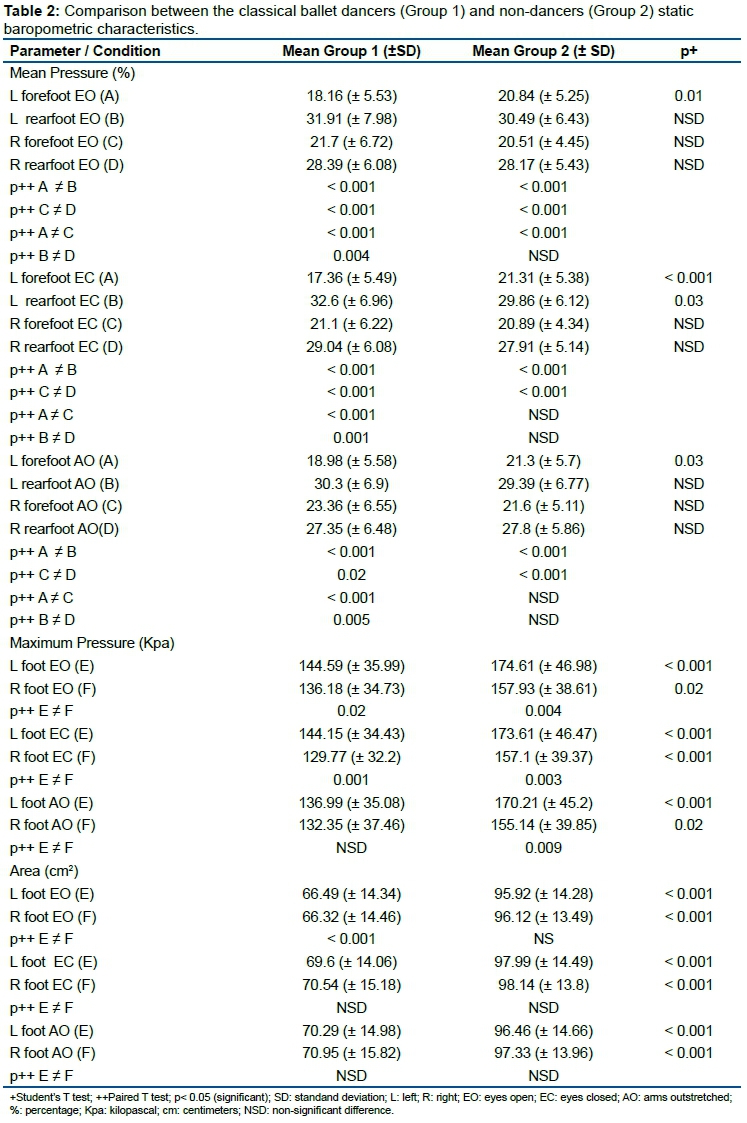
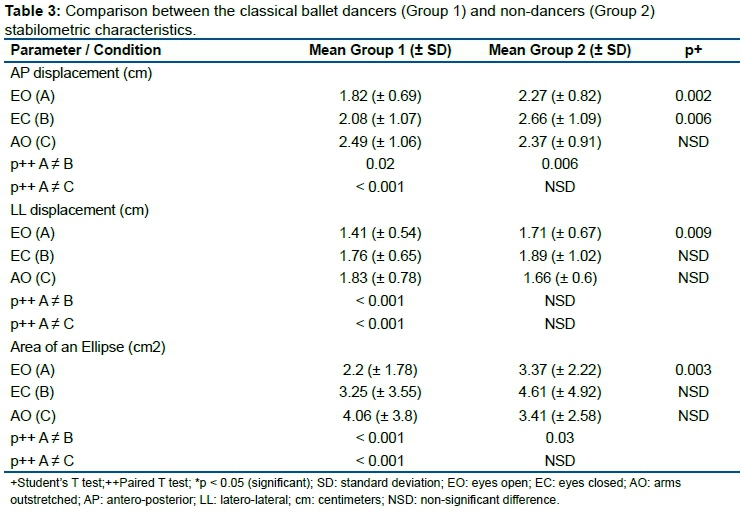
<body><![CDATA[<p><font face="Verdana, Arial, Helvetica, sans-serif" size="2"><b>Mean Pressure Analysis </b></font></p> 	     <p><font face="Verdana, Arial, Helvetica, sans-serif" size="2">In the three conditions    assessed, the dancers loaded less weight on the L forefoot when compared to    non-dancers. In the EC condition, a higher mean pressure on the left rearfoot    was also significant in this group. In the intragroup evaluation, for the three    conditions, the dancers' weight load is more intensely placed on the L rearfoot.    In Group 2, bodyweight loading is more usual on the rearfoot, with no difference    between L and R (<a href="/img/revistas/rbcdh/v30n1/10t2.jpg">Table 2</a>).</font></p> 	    <p><font face="Verdana, Arial, Helvetica, sans-serif" size="2"><b>Maximum Pressure Analysis</b></font></p> 	     <p><font face="Verdana, Arial, Helvetica, sans-serif" size="2">In all the assessed    conditions, the female ballet dancers had lower values of maximum pressure on    both L and R foot when compared with the girls who did not practice that activity.    It is also possible to notice that such values were lower on the R foot for    both groups, except for the AO condition in the group of dancers, whose difference    was not significant (<a href="/img/revistas/rbcdh/v30n1/10t2.jpg">Table 2</a>).</font></p> 	    <p><font face="Verdana, Arial, Helvetica, sans-serif" size="2"><b>Analysis of the Plantar Surface Area </b></font></p> 	     <p><font face="Verdana, Arial, Helvetica, sans-serif" size="2">In the comparison    of the groups, in all evaluated conditions, the female ballet dancers had lower    values of plantar surface area, both on the L and R foot, being these values    smaller on the R foot in the EO condition. It is noteworthy that most of them    had cavus feet (56% had L cavus foot and 57% had R cavus foot), whereas most    of those who did not practice classical ballet had normal feet (71% had normal    L foot and 76% had normal R foot) (<a href="/img/revistas/rbcdh/v30n1/10t2.jpg">Table 2</a>).</font></p> 	    <p><font face="Verdana, Arial, Helvetica, sans-serif" size="2"><b>Stabilometry </b></font></p> 	     <p><font face="Verdana, Arial, Helvetica, sans-serif" size="2">The group of dancers    presented lower antero-posterior displacement (AP) in the EO and EC conditions    and lower latero-lateral displacement (LL) and ellipse area in the EO condition    (<a href="/img/revistas/rbcdh/v30n1/10t3.jpg">Table 3</a>).</font></p> 	     <p><font face="Verdana, Arial, Helvetica, sans-serif" size="2">It is possible    to notice that, in general, the dancers presented lower displacements in the    stabilometric analysis than the non-dancers in the open and closed eyes conditions.    However, it is possible to identify a different influence with the open arms.    Although not significant, the movements of the group of dancers show a tendency    to be larger in the open arms position (<a href="/img/revistas/rbcdh/v30n1/10f01.jpg">Figure 1</a>).</font></p> 	    <p><font face="Verdana, Arial, Helvetica, sans-serif" size="2"><b>Influence of Vision </b></font></p> 	     ]]></body>
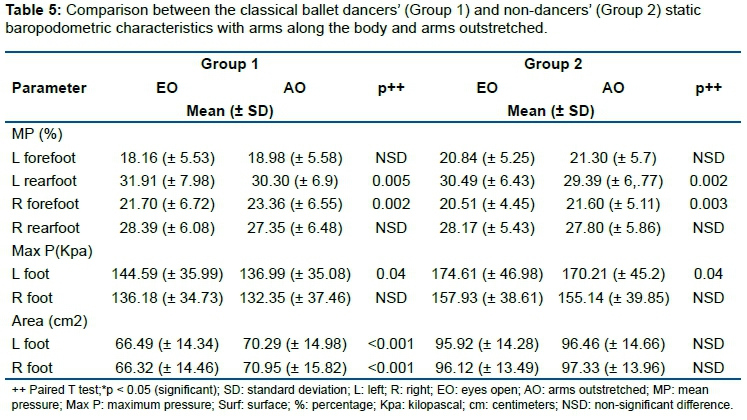
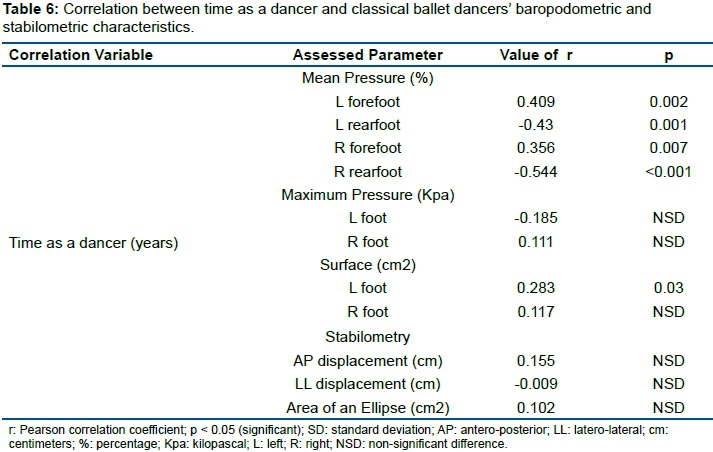
<body><![CDATA[<p><font face="Verdana, Arial, Helvetica, sans-serif" size="2">For both groups,    the "eyes closed" condition influenced in a larger surface area of contact on    both feet. In the stabilometry, it was possible to observe greater displacements    and area of an ellipse. However, such difference was not significant for Group    2 in the LL displacement (<a href="/img/revistas/rbcdh/v30n1/10t3.jpg">Tables 3</a> and <a href="/img/revistas/rbcdh/v30n1/10t4.jpg">4</a>).</font></p> 	    <p><font face="Verdana, Arial, Helvetica, sans-serif" size="2"><b>Influence of the Upper Limbs position </b></font></p> 	     <p><font face="Verdana, Arial, Helvetica, sans-serif" size="2">The 90&ordm; abduction    position of the upper limbs had the same influence on the static baropodometric    parameters in both groups, leading to: lower mean pressure on the L rearfoot,    higher mean pressure on the R forefoot and lower maximum pressure in the standing    position. However, only the female ballet dancers had larger contact surfaces    in both feet and higher values in all stabilometric parameters (<a href="/img/revistas/rbcdh/v30n1/10t3.jpg">Tables    3</a> and <a href="/img/revistas/rbcdh/v30n1/10t5.jpg">5</a>).</font></p> 	    <p><font face="Verdana, Arial, Helvetica, sans-serif" size="2"><b>Dance practice, Baropodometry and Stabilometry</b></font></p> 	     <p><font face="Verdana, Arial, Helvetica, sans-serif" size="2">Through the analysis    of Pearson's correlation it was observed that the longer the time of dance practice    in years, the greater the mean pressure on the forefoot for both feet, in addition    to a larger surface contact on the L foot. In the stabilometric parameters,    there were no significant correlations (<a href="/img/revistas/rbcdh/v30n1/10t6.jpg">Table 6</a>).</font></p> 	    <p>&nbsp;</p> 	     <p><font face="Verdana, Arial, Helvetica, sans-serif" size="3"><b>DISCUSSION</b></font></p> 	    <p><font face="Verdana, Arial, Helvetica, sans-serif" size="2">This study has brought evidence on how the practice of classical ballet in a systematic and professionalizing way can influence plantar pressures and postural stability strategies of girls. It was observed, in short, that classical Ballet dancers placed lower bodyweight load on the L forefoot, had lower values of maximum pressure and plantar surface area in all the conditions assessed and had less displacements according to the stabilometric analysis. It was also observed that they were more influenced by vision and position of the upper limbs than the group of non-dancers, and that the time of dance practice influenced in the development of specific motor strategies.</font></p> 	    <p><font face="Verdana, Arial, Helvetica, sans-serif" size="2">It is expected that dancers with a certain level of experience have a greater mastery over body movements and therefore a better postural control and this is already well studied in the literature. The movements performed always happen with the eyes opened and with great influence of these for the sensorial feedback necessary for a good execution, since the arms are in constant change and combination of different lines of movements. Knowing what this movement brings of influence on the postural control or on the motor strategies for their maintenance is what has not yet been studied and is not yet clear. This study showed that opening the arms causes different responses both in static baropodometry and in the stabilometry of girls, with similar ages and different motor experiences.</font></p> 	    <p><font face="Verdana, Arial, Helvetica, sans-serif" size="2">The analysis of normal pressure distribution on the feet is characterized by a 60% occurrence in the rearfoot, 8% in the midfoot and 28% in the forefoot, considering both sides<sup>17</sup>. The girls who were evaluated here had similar results, with a higher peak pressure on the rearfoot. However, when comparing groups, this was more evident in dancers on their L foot.</font></p> 	    ]]></body>
<body><![CDATA[<p><font face="Verdana, Arial, Helvetica, sans-serif" size="2">The nature of pressure distribution on cavus feet is not yet entirely clear, and different conclusions were drawn from comparisons with normal feet. One study showed greater pressure on the heel and lateral forefoot and lower pressure and contact area in the midfoot and hallux<sup>18</sup>. Another study showed that there is an increase in pressure on both forefoot and rearfoot<sup>19</sup> in cavus feet when compared to normal ones. The dancers of the present study, for the most part, have cavus feet and a lower mean pressure value on the L forefoot when compared to the Group 2 of girls, with predominantly normal feet.</font></p> 	    <p><font face="Verdana, Arial, Helvetica, sans-serif" size="2">The cavus foot is most often caused by muscle imbalance, which causes the plantar arch to become excessively high and to decrease the plantar surface area<sup>20</sup>. This is aggravated by the use of ballet pointe shoes since they make compression on the feet and limit the areas of plantar contact<sup>21</sup>. The dancers of the present study also had smaller plantar surface area.</font></p> 	    <p><font face="Verdana, Arial, Helvetica, sans-serif" size="2">Conventionally, the dominant side of an individual is used to perform tasks, whereas the non-dominant side is used to support or maintain balance<sup>22</sup>. In classical ballet, there is a difference in muscular effort and coordination capacity required for the support leg and gesture leg, respectively, in the execution of asymmetric movements. However, the effect of lateral dominance on the performance of such movements has not yet been studied. Generally, the choice of which leg to use is made individually, since most movements involve unilateral postures on a small supporting base<sup>22,23</sup>.</font></p> 	    <p><font face="Verdana, Arial, Helvetica, sans-serif" size="2">Younger, inexperienced dancers have less laterality skills than the more experienced dancers because of training effects<sup>22</sup>. The dancers of the present study, who are mostly right-handle and young, presented higher mean pressures on the L rearfoot, which may be justified because this is the most frequently used support leg.</font></p> 	    <p><font face="Verdana, Arial, Helvetica, sans-serif" size="2">Maximum pressure is the highest pressure value detected during a measurement<sup>12</sup> and in the group of dancers this value was lower in all the conditions assessed. This may represent a better control of the stabilizing muscles, since the dance practice leads to a better postural stability and dancers present a more active posture control in relation to untrained individuals<sup>3,4,6,24</sup>. These data also corroborate with the stabilometry findings shown here.</font></p> 	    <p><font face="Verdana, Arial, Helvetica, sans-serif" size="2">Studies such as those previously mentioned show lower postural oscillation as better balance control, but some researchers argue that this may be interpreted differently5. It has already been analyzed that athletes with a high demand for balance control, such as those participating in martial arts and gymnastics, have greater postural oscillation than non-athletes<sup>25,26</sup>. The common controversy comes from the interpretation of the results of the Romberg test, which is used to assess the neurological function for balance, in which high postural oscillation is a sign of postural disorders. However, this should not be interpreted as a worse balance, but rather attributed to more demanding motor tasks of sports practice<sup>5</sup>.</font></p> 	    <p><font face="Verdana, Arial, Helvetica, sans-serif" size="2">Highly qualified athletes, in the face of the body's disruption to environmental stimuli, can successfully manage postural instabilities despite increased oscillation. According to the idea of motor abundance, this is good for qualified motor performance<sup>27</sup>. When the center of pression behaves as a fixed point there is resistance to disturbances, but less flexibility and adaptation when a change in the postural state is required<sup>10</sup>. Most probably, a greater postural oscillation allows the rapid and precise change of body position, which is crucial for ballet practice<sup>5</sup> and the variability functionality depends on the task being performed<sup>10</sup>. The relation between variability and stability is complex and variability can not be equated with instability without knowing about the dynamics of movement<sup>11</sup>.</font></p> 	    <p><font face="Verdana, Arial, Helvetica, sans-serif" size="2">Based on this assumption, it may be possible to justify the results found here for the higher values of stabilometry and plantar surface area found for the group of dancers in the condition of the upper limbs abducted to 90&ordm;, being this a motor control strategy used by them as a common practice in ballet. Opening the arms is not an activity commonly used by typical children and adolescents in their usual motor activities and is therefore not a motor strategy of choice unless an imbalance is triggered. For dancers, however, this is a recurring situation, given that hardly a ballet movement is done with the arms along the body. It is then possible to justify that in this position the group of dancers has developed greater motor strategies of displacement and maintenance of balance.</font></p> 	    <p><font face="Verdana, Arial, Helvetica, sans-serif" size="2">There is a general consensus in the literature that dancers use proprioceptive and visual stimuli as their fundamental sensory inputs<sup>2</sup>. Their balancing abilities are superior to those of non-dancers when their eyes are open, but not with eyes closed, suggesting that the ability to change acutely from one balancing mechanism to another is not sophisticated<sup>2,5,8,9,28</sup>. This fact may explain the greater changes observed in the stabilometry of the dancers group when compared to the open and closed eyes conditions.</font></p> 	    <p><font face="Verdana, Arial, Helvetica, sans-serif" size="2">There were no significant correlations between the stabilometric parameters and time as a dancer, probably because all the dancers of the sample have professional level and similar experience, so that it was not possible to perceive the effect of training on the postural balance as described in the literature<sup>29</sup>.</font></p> 	    ]]></body>
<body><![CDATA[<p><font face="Verdana, Arial, Helvetica, sans-serif" size="2">As regards the static baropodometric data, as time as dancers increases, the higher was the mean pressure on the forefoot, in addition to a larger contact area. The long period of training required to become a dancer produces postural memories for an anatomical configuration of the foot. This specificity is independent of the level of difficulty, and considers both the postural stability and the structure of the motor control<sup>7</sup>. Thus, new studies are necessary to understand the effects of ballet in the long term on the biomechanics of dancers' feet.</font></p> 	    <p><font face="Verdana, Arial, Helvetica, sans-serif" size="2">The results shown here suggest that dancers at the vocational level, when compared to ordinary girls who do not experience classical ballet practice, had lower weight load on the L forefoot weight and lower values of plantar surface area, which may be related to higher prevalence of cavus feet. In relation to postural stability, they present lower values of maximum pressure and lower displacements in the stabilometric analysis. However, they were more vision-dependent and had greater displacements with upper limbs abducted to 90&ordm;, which may be related to different motor control strategies. The findings on the influence of the upper limbs posture suggest that due to the more frequent use of the upper limbs in daily motor activities, the dancers presented a more significant influence of this posture in both static baropodemetry and stabilometry. Further research is needed to elucidate the actual motor balance strategy in that population.</font></p> 	    <p><font face="Verdana, Arial, Helvetica, sans-serif" size="2">The findings of the present study may contribute to the understanding of postural motor strategies of children and adolescents who practice ballet, with implications in the practice of systematic training and prevention of long-term injuries. Based on this, it is possible to develop programs focused on the improvement and development of correct strategies for coordination and management of instabilities within motor abundance<sup>27</sup>, so that the harmful effects of much variability in balance and movement do not occur<sup>11</sup>.</font></p> 	    <p><font face="Verdana, Arial, Helvetica, sans-serif" size="2">We conclude that girls who practice classical ballet have specific characteristics of plantar pressure and develop different postural control strategies when compared to typical girls of similar age, especially in the arms outstretch position. The findings of the present study may contribute to the understanding of postural motor strategies of children and adolescents who practice ballet, with implications in the practice of systematic training and prevention of long-term injuries. Based on this, it is possible to develop programs focused on the improvement and development of correct strategies for coordination and management of instabilities of each person.</font></p> 	    <p>&nbsp;</p> 	     <p><font face="Verdana, Arial, Helvetica, sans-serif" size="3"><b>Acknowledgments</b></font></p> 	    <p><font face="Verdana, Arial, Helvetica, sans-serif" size="2">To the team of professionals of the Centro de Educa&ccedil;&atilde;o Profissional em Artes Basileu Fran&ccedil;a (CEPABF) for the trust and support that made this study possible. To the team of professionals of the Instituto Estadual de Educa&ccedil;&atilde;o (IEG) for the partnership and for allowing us to carry out the research with its students. To the dancers, to all the girls of the selected public school and to the parents who promptly accepted to participate in this research and both collaborated for this result.</font></p> 	    <p><font face="Verdana, Arial, Helvetica, sans-serif" size="2"><b>Conflict of interest:</b></font></p> 	    <p><font face="Verdana, Arial, Helvetica, sans-serif" size="2">Authors state no conflict of interest.</font></p> 	    <p><font face="Verdana, Arial, Helvetica, sans-serif" size="2"><b>Disclosure statement: </b></font></p> 	    ]]></body>
<body><![CDATA[<p><font face="Verdana, Arial, Helvetica, sans-serif" size="2">No author has any financial interest or received any financial benefit from this research.</font></p> 	    <p>&nbsp;</p> 	    <p><font face="Verdana, Arial, Helvetica, sans-serif" size="3"><b>REFERENCES</b></font></p> 	    <!-- ref --><p><font face="Verdana, Arial, Helvetica, sans-serif" size="2">1.Krityakiarana W, Jongkamonwiwat N. Comparison of Balance Performance Between Thai Classical Dancers and Non-Dancers. J Danc Med Sci. 2016;20(2):72-8. DOI: <a href="http://doi.org/10.12678/1089-313X.20.2.72" target="_blank">http://doi.org/10.12678/1089-313X.20.2.72</a></font>&nbsp;&nbsp;&nbsp;&nbsp;&nbsp;&nbsp;&nbsp;&nbsp;[&#160;<a href="javascript:void(0);" onclick="javascript: window.open('/scielo.php?script=sci_nlinks&ref=2550912&pid=S0104-1282202000010001000001&lng=','','width=640,height=500,resizable=yes,scrollbars=1,menubar=yes,');">Links</a>&#160;]<!-- end-ref --><!-- ref --><p><font face="Verdana, Arial, Helvetica, sans-serif" size="2">2.P&eacute;rez RM, Solana RS, Murillo DB, Hern&aacute;ndez FJM. Visual availability, balance performance and movement complexity in dancers. Gait Posture. 2014;40(4):556-60. DOI: <a href="http://doi.org/10.1016/j.gaitpost.2014.06.021" target="_blank">http://doi.org/10.1016/j.gaitpost.2014.06.021</a></font>&nbsp;&nbsp;&nbsp;&nbsp;&nbsp;&nbsp;&nbsp;&nbsp;[&#160;<a href="javascript:void(0);" onclick="javascript: window.open('/scielo.php?script=sci_nlinks&ref=2550913&pid=S0104-1282202000010001000002&lng=','','width=640,height=500,resizable=yes,scrollbars=1,menubar=yes,');">Links</a>&#160;]<!-- end-ref --><!-- ref --><p><font face="Verdana, Arial, Helvetica, sans-serif" size="2">3.Costa MSS, Ferreira AS, Felicio LR. Static and dynamic balance in bal&eacute; dancers: a literature review. Fisioter Pesqui. 2013;20(3):299-305. DOI: <a href="https://doi.org/10.1590/S1809-29502013000300016" target="_blank">https://doi.org/10.1590/S1809-29502013000300016</a></font>&nbsp;&nbsp;&nbsp;&nbsp;&nbsp;&nbsp;&nbsp;&nbsp;[&#160;<a href="javascript:void(0);" onclick="javascript: window.open('/scielo.php?script=sci_nlinks&ref=2550914&pid=S0104-1282202000010001000003&lng=','','width=640,height=500,resizable=yes,scrollbars=1,menubar=yes,');">Links</a>&#160;]<!-- end-ref --><!-- ref --><p><font face="Verdana, Arial, Helvetica, sans-serif" size="2">4. Cheng HS, Law CL, Pan HF, Hsiao YP, Hu JH, Chuang FK, et al. Preliminary results of dancing exercise on postural stability in adolescent females. Kaohsiung J Med Sci. 2011;27(12): 566-72. DOI: <a href="https://doi.org/10.1016/j.kjms.2011.06.032" target="_blank">https://doi.org/10.1016/j.kjms.2011.06.032</a></font>&nbsp;&nbsp;&nbsp;&nbsp;&nbsp;&nbsp;&nbsp;&nbsp;[&#160;<a href="javascript:void(0);" onclick="javascript: window.open('/scielo.php?script=sci_nlinks&ref=2550915&pid=S0104-1282202000010001000004&lng=','','width=640,height=500,resizable=yes,scrollbars=1,menubar=yes,');">Links</a>&#160;]<!-- end-ref --><!-- ref --><p><font face="Verdana, Arial, Helvetica, sans-serif" size="2">5.Michalska J, Kamieniarz A, Fredyk A, Bacik B, Juras G, Stomka KJ. Effect of expertise in bal&eacute; dance on static and functional balance. Gait Posture. 2018;64:68-74. DOI: <a href="https://doi.org/10.1016/j.gaitpost.2018.05.034" target="_blank">https://doi.org/10.1016/j.gaitpost.2018.05.034</a></font>&nbsp;&nbsp;&nbsp;&nbsp;&nbsp;&nbsp;&nbsp;&nbsp;[&#160;<a href="javascript:void(0);" onclick="javascript: window.open('/scielo.php?script=sci_nlinks&ref=2550916&pid=S0104-1282202000010001000005&lng=','','width=640,height=500,resizable=yes,scrollbars=1,menubar=yes,');">Links</a>&#160;]<!-- end-ref --><!-- ref --><p><font face="Verdana, Arial, Helvetica, sans-serif" size="2">6.Rein S, Fabian T, Zwipp H, Rammelt S, Weindel S. Postural control and functional ankle stability in professional and amateur dancers. Clin Neurophysiol. 2011;122(8): 1602-10. DOI: <a href="https://doi.org/10.1016/j.clinph.2011.01.004" target="_blank">https://doi.org/10.1016/j.clinph.2011.01.004</a></font>&nbsp;&nbsp;&nbsp;&nbsp;&nbsp;&nbsp;&nbsp;&nbsp;[&#160;<a href="javascript:void(0);" onclick="javascript: window.open('/scielo.php?script=sci_nlinks&ref=2550917&pid=S0104-1282202000010001000006&lng=','','width=640,height=500,resizable=yes,scrollbars=1,menubar=yes,');">Links</a>&#160;]<!-- end-ref --><!-- ref --><p><font face="Verdana, Arial, Helvetica, sans-serif" size="2">7.Casabona A, Leonardi G, Aimola E, La Grua G, Polizzi CM, Cioni M, et al. Specificity of foot configuration during bipedal stance in bal&eacute; dancers. Gait Posture. 2016;46:91-7. DOI: <a href="https://doi.org/10.1016/j.gaitpost.2016.02.019" target="_blank">https://doi.org/10.1016/j.gaitpost.2016.02.019</a></font>&nbsp;&nbsp;&nbsp;&nbsp;&nbsp;&nbsp;&nbsp;&nbsp;[&#160;<a href="javascript:void(0);" onclick="javascript: window.open('/scielo.php?script=sci_nlinks&ref=2550918&pid=S0104-1282202000010001000007&lng=','','width=640,height=500,resizable=yes,scrollbars=1,menubar=yes,');">Links</a>&#160;]<!-- end-ref --><!-- ref --><p><font face="Verdana, Arial, Helvetica, sans-serif" size="2">8.Bruyneel AV, Bertrand M, Mesure S. Influence of foot position and vision on dynamic postural strategies during the "grand pli&eacute;" bal&eacute; movement (squatting) in young and adult bal&eacute; dancers. Neurosci Lett. 2018;678:22-8. DOI: <a href="https://doi.org/10.1016/j.neulet.2018.04.046" target="_blank">https://doi.org/10.1016/j.neulet.2018.04.046</a></font>&nbsp;&nbsp;&nbsp;&nbsp;&nbsp;&nbsp;&nbsp;&nbsp;[&#160;<a href="javascript:void(0);" onclick="javascript: window.open('/scielo.php?script=sci_nlinks&ref=2550919&pid=S0104-1282202000010001000008&lng=','','width=640,height=500,resizable=yes,scrollbars=1,menubar=yes,');">Links</a>&#160;]<!-- end-ref --><!-- ref --><p><font face="Verdana, Arial, Helvetica, sans-serif" size="2">9.Hutt K, Redding E. The effect of an eyes-closed dance-specific training program on dynamic balance in elite pre-professional bal&eacute; dancers: a randomized controlled pilot study. J Danc Med Sci. 2014;18(1):3-11. DOI: <a href="https://doi.org/10.12678/1089-313X.18.1.3" target="_blank">https://doi.org/10.12678/1089-313X.18.1.3</a></font>&nbsp;&nbsp;&nbsp;&nbsp;&nbsp;&nbsp;&nbsp;&nbsp;[&#160;<a href="javascript:void(0);" onclick="javascript: window.open('/scielo.php?script=sci_nlinks&ref=2550920&pid=S0104-1282202000010001000009&lng=','','width=640,height=500,resizable=yes,scrollbars=1,menubar=yes,');">Links</a>&#160;]<!-- end-ref --><!-- ref --><p><font face="Verdana, Arial, Helvetica, sans-serif" size="2">10.van Emmerik REA, van Wegen EEH. On the functional aspects of variability in postural control. Exerc Sport Sci Rev. 2002;30(4):177-83. DOI: <a href="https://doi.org/10.1097/00003677-200210000-00007" target="_blank">https://doi.org/10.1097/00003677-200210000-00007</a></font>&nbsp;&nbsp;&nbsp;&nbsp;&nbsp;&nbsp;&nbsp;&nbsp;[&#160;<a href="javascript:void(0);" onclick="javascript: window.open('/scielo.php?script=sci_nlinks&ref=2550921&pid=S0104-1282202000010001000010&lng=','','width=640,height=500,resizable=yes,scrollbars=1,menubar=yes,');">Links</a>&#160;]<!-- end-ref --><!-- ref --><p><font face="Verdana, Arial, Helvetica, sans-serif" size="2">11.van Emmerik REA, van Wegen EEH. On Variability and Stability in Human Movement. J Appl Biomech. 2000;16: 394-406. DOI: <a href="https://doi.org/10.1123/jab.16.4.394" target="_blank">https://doi.org/10.1123/jab.16.4.394</a></font>&nbsp;&nbsp;&nbsp;&nbsp;&nbsp;&nbsp;&nbsp;&nbsp;[&#160;<a href="javascript:void(0);" onclick="javascript: window.open('/scielo.php?script=sci_nlinks&ref=2550922&pid=S0104-1282202000010001000011&lng=','','width=640,height=500,resizable=yes,scrollbars=1,menubar=yes,');">Links</a>&#160;]<!-- end-ref --><!-- ref --><p><font face="Verdana, Arial, Helvetica, sans-serif" size="2">12.Giacomozzi C. Hardware performance assessment recommendations and tools for baropodometric sensor systems. Ann Ist Super Sanit&agrave;. 2010;46(2):158-67. DOI: <a href="https://doi.org/10.4415/ANN_10_02_09" target="_blank">https://doi.org/10.4415/ANN_10_02_09</a></font>&nbsp;&nbsp;&nbsp;&nbsp;&nbsp;&nbsp;&nbsp;&nbsp;[&#160;<a href="javascript:void(0);" onclick="javascript: window.open('/scielo.php?script=sci_nlinks&ref=2550923&pid=S0104-1282202000010001000012&lng=','','width=640,height=500,resizable=yes,scrollbars=1,menubar=yes,');">Links</a>&#160;]<!-- end-ref --><!-- ref --><p><font face="Verdana, Arial, Helvetica, sans-serif" size="2">13.Orlin MN, McPoil TG. Plantar Pressure Assessment. Phys Ther. 2000;80(4):399-409. DOI: <a href="https://doi.org/10.1093/ptj/80.4.399" target="_blank">https://doi.org/10.1093/ptj/80.4.399</a></font>&nbsp;&nbsp;&nbsp;&nbsp;&nbsp;&nbsp;&nbsp;&nbsp;[&#160;<a href="javascript:void(0);" onclick="javascript: window.open('/scielo.php?script=sci_nlinks&ref=2550924&pid=S0104-1282202000010001000013&lng=','','width=640,height=500,resizable=yes,scrollbars=1,menubar=yes,');">Links</a>&#160;]<!-- end-ref --><!-- ref --><p><font face="Verdana, Arial, Helvetica, sans-serif" size="2">14.Filippin NT, Barbosa VLP, Sacco ICN, Costa PHL. Effects of obesity on plantar pressure distribution in children. Rev Bras Fisioter. 2007;11(6):495-501. DOI: <a href="http://doi.org/10.1590/S1413-35552007000600012" target="_blank">http://doi.org/10.1590/S1413-35552007000600012</a></font>&nbsp;&nbsp;&nbsp;&nbsp;&nbsp;&nbsp;&nbsp;&nbsp;[&#160;<a href="javascript:void(0);" onclick="javascript: window.open('/scielo.php?script=sci_nlinks&ref=2550925&pid=S0104-1282202000010001000014&lng=','','width=640,height=500,resizable=yes,scrollbars=1,menubar=yes,');">Links</a>&#160;]<!-- end-ref --><!-- ref --><p><font face="Verdana, Arial, Helvetica, sans-serif" size="2">15.Staheli LT, Chew DE, Corbett M. The longitudinal arch. A survey of eight hundred and eight-two feet in normal children and adults. J Bone Joint Surg Am. 1987;69(3): 426-8.    &nbsp;&nbsp;&nbsp;&nbsp;&nbsp;&nbsp;&nbsp;&nbsp;[&#160;<a href="javascript:void(0);" onclick="javascript: window.open('/scielo.php?script=sci_nlinks&ref=2550926&pid=S0104-1282202000010001000015&lng=','','width=640,height=500,resizable=yes,scrollbars=1,menubar=yes,');">Links</a>&#160;]<!-- end-ref --></font></p> 	    <!-- ref --><p><font face="Verdana, Arial, Helvetica, sans-serif" size="2">16.Syed N, Karvannan H, Maiya AG, Binukumar B, Prem V, Chakravarty RD. Plantar pressure distribution among asymptomatic individuals: a cross-sectional study. Foot Ankle Spec. 2012;5(2):102-6. DOI: <a href="http://doi.org/10.1177/1938640011434503" target="_blank">http://doi.org/10.1177/1938640011434503</a></font>&nbsp;&nbsp;&nbsp;&nbsp;&nbsp;&nbsp;&nbsp;&nbsp;[&#160;<a href="javascript:void(0);" onclick="javascript: window.open('/scielo.php?script=sci_nlinks&ref=2550928&pid=S0104-1282202000010001000016&lng=','','width=640,height=500,resizable=yes,scrollbars=1,menubar=yes,');">Links</a>&#160;]<!-- end-ref --><!-- ref --><p><font face="Verdana, Arial, Helvetica, sans-serif" size="2">17.Cavanagh PR, Rodgers MM, Liboshi A. Pressure distribution under symptom-free feet during barefoot standing. Foot Ankle Int. 1987;7(5):262-76. DOI: <a href="http://doi.org/10.1177/107110078700700502" target="_blank">http://doi.org/10.1177/107110078700700502</a></font>&nbsp;&nbsp;&nbsp;&nbsp;&nbsp;&nbsp;&nbsp;&nbsp;[&#160;<a href="javascript:void(0);" onclick="javascript: window.open('/scielo.php?script=sci_nlinks&ref=2550929&pid=S0104-1282202000010001000017&lng=','','width=640,height=500,resizable=yes,scrollbars=1,menubar=yes,');">Links</a>&#160;]<!-- end-ref --><!-- ref --><p><font face="Verdana, Arial, Helvetica, sans-serif" size="2">18.Buldt AK, Forghany S, Landorf KB, Levinger P, Murley GS, Menz HB. Foot posture is associated with plantar pressure during gait: A comparison of normal, planus and cavus feet. Gait Posture. 2018;62:235-40. DOI: <a href="http://doi.org/10.1016/j.gaitpost.2018.03.005" target="_blank">http://doi.org/10.1016/j.gaitpost.2018.03.005</a></font>&nbsp;&nbsp;&nbsp;&nbsp;&nbsp;&nbsp;&nbsp;&nbsp;[&#160;<a href="javascript:void(0);" onclick="javascript: window.open('/scielo.php?script=sci_nlinks&ref=2550930&pid=S0104-1282202000010001000018&lng=','','width=640,height=500,resizable=yes,scrollbars=1,menubar=yes,');">Links</a>&#160;]<!-- end-ref --><!-- ref --><p><font face="Verdana, Arial, Helvetica, sans-serif" size="2">19.Burns J, Crosbie J, Hunt A, Ouvrier R. The effect of pes cavus on foot pain and plantar pressure. Clin Biomech. 2005;20(9):877-82. DOI: <a href="http://doi.org/10.1016/j.clinbiomech.2005(9).03.006" target="_blank">http://doi.org/10.1016/j.clinbiomech.2005(9).03.006</a></font>&nbsp;&nbsp;&nbsp;&nbsp;&nbsp;&nbsp;&nbsp;&nbsp;[&#160;<a href="javascript:void(0);" onclick="javascript: window.open('/scielo.php?script=sci_nlinks&ref=2550931&pid=S0104-1282202000010001000019&lng=','','width=640,height=500,resizable=yes,scrollbars=1,menubar=yes,');">Links</a>&#160;]<!-- end-ref --><!-- ref --><p><font face="Verdana, Arial, Helvetica, sans-serif" size="2">20.Rosenbaum AJ, Lisella J, Patel N, Phillips N. The cavus foot. Med Clin North Am. 2014;98(2):301-12. DOI: <a href="http://doi.org/10.1016/j.mcna.2013.10.008" target="_blank">http://doi.org/10.1016/j.mcna.2013.10.008</a></font>&nbsp;&nbsp;&nbsp;&nbsp;&nbsp;&nbsp;&nbsp;&nbsp;[&#160;<a href="javascript:void(0);" onclick="javascript: window.open('/scielo.php?script=sci_nlinks&ref=2550932&pid=S0104-1282202000010001000020&lng=','','width=640,height=500,resizable=yes,scrollbars=1,menubar=yes,');">Links</a>&#160;]<!-- end-ref --><!-- ref --><p><font face="Verdana, Arial, Helvetica, sans-serif" size="2">21.Costa PHL, Nora FGA, Vieira MF, Bosch K, Rosenbaum D. Single leg balancing in bal&eacute;: Effects of shoe conditions and poses. Gait Posture. 2013;37(3:419-23. DOI: <a href="http://doi.org/10.1016/j.gaitpost.2012.08.015" target="_blank">http://doi.org/10.1016/j.gaitpost.2012.08.015</a></font>&nbsp;&nbsp;&nbsp;&nbsp;&nbsp;&nbsp;&nbsp;&nbsp;[&#160;<a href="javascript:void(0);" onclick="javascript: window.open('/scielo.php?script=sci_nlinks&ref=2550933&pid=S0104-1282202000010001000021&lng=','','width=640,height=500,resizable=yes,scrollbars=1,menubar=yes,');">Links</a>&#160;]<!-- end-ref --><!-- ref --><p><font face="Verdana, Arial, Helvetica, sans-serif" size="2">22.Lin CW, Su FC, Wu HW, Lin CF. Effects of leg dominance on performance of bal&eacute; turns (pirouettes) by experienced and novice dancers. J Sport Sci. 2013;31(16):1781-8. DOI: <a href="http://doi.org/10.1080/02640414.2013.803585" target="_blank">http://doi.org/10.1080/02640414.2013.803585</a></font>&nbsp;&nbsp;&nbsp;&nbsp;&nbsp;&nbsp;&nbsp;&nbsp;[&#160;<a href="javascript:void(0);" onclick="javascript: window.open('/scielo.php?script=sci_nlinks&ref=2550934&pid=S0104-1282202000010001000022&lng=','','width=640,height=500,resizable=yes,scrollbars=1,menubar=yes,');">Links</a>&#160;]<!-- end-ref --><!-- ref --><p><font face="Verdana, Arial, Helvetica, sans-serif" size="2">23.Kilby MC, Newell KM. Intra- and inter-foot coordination in quiet standing: Footwear and posture effects. Gait Posture. 2012;35(3):511-16. DOI: <a href="http://doi.org/10.1016/j.gaitpost.2011.11.018" target="_blank">http://doi.org/10.1016/j.gaitpost.2011.11.018</a></font>&nbsp;&nbsp;&nbsp;&nbsp;&nbsp;&nbsp;&nbsp;&nbsp;[&#160;<a href="javascript:void(0);" onclick="javascript: window.open('/scielo.php?script=sci_nlinks&ref=2550935&pid=S0104-1282202000010001000023&lng=','','width=640,height=500,resizable=yes,scrollbars=1,menubar=yes,');">Links</a>&#160;]<!-- end-ref --><!-- ref --><p><font face="Verdana, Arial, Helvetica, sans-serif" size="2">24.Ku PX, Osman NAA, Yusof A, Abas WAW. Biomechanical evaluation of the relationship between postural control and body mass index. J Biomech. 2012;45(9): 1638-42. DOI: <a href="http://doi.org/10.1016/j.jbiomech.2012.03.029" target="_blank">http://doi.org/10.1016/j.jbiomech.2012.03.029</a></font>&nbsp;&nbsp;&nbsp;&nbsp;&nbsp;&nbsp;&nbsp;&nbsp;[&#160;<a href="javascript:void(0);" onclick="javascript: window.open('/scielo.php?script=sci_nlinks&ref=2550936&pid=S0104-1282202000010001000024&lng=','','width=640,height=500,resizable=yes,scrollbars=1,menubar=yes,');">Links</a>&#160;]<!-- end-ref --><!-- ref --><p><font face="Verdana, Arial, Helvetica, sans-serif" size="2">25.Gautier G, Thouvarecq R, Larue J. Influence of experience on postural control: effect of expertise in gymnastics. J Mot Behav. 2008;40(5):400-8. DOI: <a href="http://doi.org/10.3200/JMBR.40.5.400-408" target="_blank">http://doi.org/10.3200/JMBR.40.5.400-408</a></font>&nbsp;&nbsp;&nbsp;&nbsp;&nbsp;&nbsp;&nbsp;&nbsp;[&#160;<a href="javascript:void(0);" onclick="javascript: window.open('/scielo.php?script=sci_nlinks&ref=2550937&pid=S0104-1282202000010001000025&lng=','','width=640,height=500,resizable=yes,scrollbars=1,menubar=yes,');">Links</a>&#160;]<!-- end-ref --><!-- ref --><p><font face="Verdana, Arial, Helvetica, sans-serif" size="2">26.Juras G, Rzepko M, Kr&oacute;l P, Czarny W, Bajorek W, Stomka K, et al. The effect of expertise in karate on postural control in quiet standing. Arch Budo Sci. 2013;9(3):205-9.    &nbsp;&nbsp;&nbsp;&nbsp;&nbsp;&nbsp;&nbsp;&nbsp;[&#160;<a href="javascript:void(0);" onclick="javascript: window.open('/scielo.php?script=sci_nlinks&ref=2550938&pid=S0104-1282202000010001000026&lng=','','width=640,height=500,resizable=yes,scrollbars=1,menubar=yes,');">Links</a>&#160;]<!-- end-ref --></font></p> 	    <!-- ref --><p><font face="Verdana, Arial, Helvetica, sans-serif" size="2">27.Latash ML. The bliss (not the problem) of motor abundance (not redundancy). Exp Brain Res. 2012;217(1): 1-5. DOI: <a href="http://doi.org/10.1007/s00221-012-3000-4" target="_blank">http://doi.org/10.1007/s00221-012-3000-4</a></font>&nbsp;&nbsp;&nbsp;&nbsp;&nbsp;&nbsp;&nbsp;&nbsp;[&#160;<a href="javascript:void(0);" onclick="javascript: window.open('/scielo.php?script=sci_nlinks&ref=2550940&pid=S0104-1282202000010001000027&lng=','','width=640,height=500,resizable=yes,scrollbars=1,menubar=yes,');">Links</a>&#160;]<!-- end-ref --><!-- ref --><p><font face="Verdana, Arial, Helvetica, sans-serif" size="2">28.Mello MC, Ferreira AS, Felicio LR. Postural control during different unipodal positions in professional bal&eacute; dancers. J Danc Med Sci. 2017;21(4):151-5. DOI: <a href="http://doi.org/10.12678/1089-313X.21.4.151" target="_blank">http://doi.org/10.12678/1089-313X.21.4.151</a></font>&nbsp;&nbsp;&nbsp;&nbsp;&nbsp;&nbsp;&nbsp;&nbsp;[&#160;<a href="javascript:void(0);" onclick="javascript: window.open('/scielo.php?script=sci_nlinks&ref=2550941&pid=S0104-1282202000010001000028&lng=','','width=640,height=500,resizable=yes,scrollbars=1,menubar=yes,');">Links</a>&#160;]<!-- end-ref --><!-- ref --><p><font face="Verdana, Arial, Helvetica, sans-serif" size="2">29.Hopper DM, Grisbrook TL, Newnham PJ, Edwards DJ. The effects of vestibular stimulation and fatigue on postural control in classical bal&eacute; dancers. J Danc Med Sci. 2014;18(2):67-73. DOI: <a href="http://doi.org/10.12678/1089-313X.18.2.67" target="_blank">http://doi.org/10.12678/1089-313X.18.2.67</a></font>&nbsp;&nbsp;&nbsp;&nbsp;&nbsp;&nbsp;&nbsp;&nbsp;[&#160;<a href="javascript:void(0);" onclick="javascript: window.open('/scielo.php?script=sci_nlinks&ref=2550942&pid=S0104-1282202000010001000029&lng=','','width=640,height=500,resizable=yes,scrollbars=1,menubar=yes,');">Links</a>&#160;]<!-- end-ref --><p>&nbsp;</p> 	    <p>&nbsp;</p> 	     <p><font face="Verdana, Arial, Helvetica, sans-serif" size="2"><a href="#top" name="corresp"><img src="/img/revistas/rbcdh/v30n1/seta.jpg" border="0"></a>    <b>Correspondence</b>:    <br>   <a href="mailto:rafinhanoleto@hotmail.com">rafinhanoleto@hotmail.com</a></font></p> 	    <p><font face="Verdana, Arial, Helvetica, sans-serif" size="2">Manuscript received: March 2019    <br> Manuscript accepted: August 2019    ]]></body>
<body><![CDATA[<br> Version of record online: March 2020</font></p>           ]]></body>
<back>
<ref-list>
<ref id="B1">
<label>1</label><nlm-citation citation-type="journal">
<person-group person-group-type="author">
<name>
<surname><![CDATA[Krityakiarana]]></surname>
<given-names><![CDATA[W]]></given-names>
</name>
<name>
<surname><![CDATA[Jongkamonwiwat]]></surname>
<given-names><![CDATA[N]]></given-names>
</name>
</person-group>
<article-title xml:lang="en"><![CDATA[Comparison of Balance Performance Between Thai Classical Dancers and Non-Dancers]]></article-title>
<source><![CDATA[J Danc Med Sci]]></source>
<year>2016</year>
<volume>20</volume>
<numero>2</numero>
<issue>2</issue>
<page-range>72-8</page-range></nlm-citation>
</ref>
<ref id="B2">
<label>2</label><nlm-citation citation-type="journal">
<person-group person-group-type="author">
<name>
<surname><![CDATA[Pérez]]></surname>
<given-names><![CDATA[RM]]></given-names>
</name>
<name>
<surname><![CDATA[Solana]]></surname>
<given-names><![CDATA[RS]]></given-names>
</name>
<name>
<surname><![CDATA[Murillo]]></surname>
<given-names><![CDATA[DB]]></given-names>
</name>
<name>
<surname><![CDATA[Hernández]]></surname>
<given-names><![CDATA[FJM]]></given-names>
</name>
</person-group>
<article-title xml:lang="en"><![CDATA[Visual availability, balance performance and movement complexity in dancers]]></article-title>
<source><![CDATA[Gait Posture]]></source>
<year>2014</year>
<volume>40</volume>
<numero>4</numero>
<issue>4</issue>
<page-range>556-60</page-range></nlm-citation>
</ref>
<ref id="B3">
<label>3</label><nlm-citation citation-type="journal">
<person-group person-group-type="author">
<name>
<surname><![CDATA[Costa]]></surname>
<given-names><![CDATA[MSS]]></given-names>
</name>
<name>
<surname><![CDATA[Ferreira]]></surname>
<given-names><![CDATA[AS]]></given-names>
</name>
<name>
<surname><![CDATA[Felicio]]></surname>
<given-names><![CDATA[LR]]></given-names>
</name>
</person-group>
<article-title xml:lang="en"><![CDATA[Static and dynamic balance in balé dancers: a literature review]]></article-title>
<source><![CDATA[Fisioter Pesqui]]></source>
<year>2013</year>
<volume>20</volume>
<numero>3</numero>
<issue>3</issue>
<page-range>299-305</page-range></nlm-citation>
</ref>
<ref id="B4">
<label>4</label><nlm-citation citation-type="journal">
<person-group person-group-type="author">
<name>
<surname><![CDATA[Cheng]]></surname>
<given-names><![CDATA[HS]]></given-names>
</name>
<name>
<surname><![CDATA[Law]]></surname>
<given-names><![CDATA[CL]]></given-names>
</name>
<name>
<surname><![CDATA[Pan]]></surname>
<given-names><![CDATA[HF]]></given-names>
</name>
<name>
<surname><![CDATA[Hsiao]]></surname>
<given-names><![CDATA[YP]]></given-names>
</name>
<name>
<surname><![CDATA[Hu]]></surname>
<given-names><![CDATA[JH]]></given-names>
</name>
<name>
<surname><![CDATA[Chuang]]></surname>
<given-names><![CDATA[FK]]></given-names>
</name>
</person-group>
<article-title xml:lang="en"><![CDATA[Preliminary results of dancing exercise on postural stability in adolescent females]]></article-title>
<source><![CDATA[Kaohsiung J Med Sci]]></source>
<year>2011</year>
<volume>27</volume>
<numero>12</numero>
<issue>12</issue>
<page-range>566-72</page-range></nlm-citation>
</ref>
<ref id="B5">
<label>5</label><nlm-citation citation-type="journal">
<person-group person-group-type="author">
<name>
<surname><![CDATA[Michalska]]></surname>
<given-names><![CDATA[J]]></given-names>
</name>
<name>
<surname><![CDATA[Kamieniarz]]></surname>
<given-names><![CDATA[A]]></given-names>
</name>
<name>
<surname><![CDATA[Fredyk]]></surname>
<given-names><![CDATA[A]]></given-names>
</name>
<name>
<surname><![CDATA[Bacik]]></surname>
<given-names><![CDATA[B]]></given-names>
</name>
<name>
<surname><![CDATA[Juras]]></surname>
<given-names><![CDATA[G]]></given-names>
</name>
<name>
<surname><![CDATA[Stomka]]></surname>
<given-names><![CDATA[KJ]]></given-names>
</name>
</person-group>
<article-title xml:lang="en"><![CDATA[Effect of expertise in balé dance on static and functional balance]]></article-title>
<source><![CDATA[Gait Posture]]></source>
<year>2018</year>
<volume>64</volume>
<page-range>68-74</page-range></nlm-citation>
</ref>
<ref id="B6">
<label>6</label><nlm-citation citation-type="journal">
<person-group person-group-type="author">
<name>
<surname><![CDATA[Rein]]></surname>
<given-names><![CDATA[S]]></given-names>
</name>
<name>
<surname><![CDATA[Fabian]]></surname>
<given-names><![CDATA[T]]></given-names>
</name>
<name>
<surname><![CDATA[Zwipp]]></surname>
<given-names><![CDATA[H]]></given-names>
</name>
<name>
<surname><![CDATA[Rammelt]]></surname>
<given-names><![CDATA[S]]></given-names>
</name>
<name>
<surname><![CDATA[Weindel]]></surname>
<given-names><![CDATA[S]]></given-names>
</name>
</person-group>
<article-title xml:lang="en"><![CDATA[Postural control and functional ankle stability in professional and amateur dancers]]></article-title>
<source><![CDATA[Clin Neurophysiol]]></source>
<year>2011</year>
<volume>122</volume>
<numero>8</numero>
<issue>8</issue>
<page-range>1602-10</page-range></nlm-citation>
</ref>
<ref id="B7">
<label>7</label><nlm-citation citation-type="journal">
<person-group person-group-type="author">
<name>
<surname><![CDATA[Casabona]]></surname>
<given-names><![CDATA[A]]></given-names>
</name>
<name>
<surname><![CDATA[Leonardi]]></surname>
<given-names><![CDATA[G]]></given-names>
</name>
<name>
<surname><![CDATA[Aimola]]></surname>
<given-names><![CDATA[E]]></given-names>
</name>
<name>
<surname><![CDATA[La Grua]]></surname>
<given-names><![CDATA[G]]></given-names>
</name>
<name>
<surname><![CDATA[Polizzi]]></surname>
<given-names><![CDATA[CM]]></given-names>
</name>
<name>
<surname><![CDATA[Cioni]]></surname>
<given-names><![CDATA[M]]></given-names>
</name>
</person-group>
<article-title xml:lang="en"><![CDATA[Specificity of foot configuration during bipedal stance in balé dancers]]></article-title>
<source><![CDATA[Gait Posture]]></source>
<year>2016</year>
<volume>46</volume>
<page-range>91-7</page-range></nlm-citation>
</ref>
<ref id="B8">
<label>8</label><nlm-citation citation-type="journal">
<person-group person-group-type="author">
<name>
<surname><![CDATA[Bruyneel]]></surname>
<given-names><![CDATA[AV]]></given-names>
</name>
<name>
<surname><![CDATA[Bertrand]]></surname>
<given-names><![CDATA[M]]></given-names>
</name>
<name>
<surname><![CDATA[Mesure]]></surname>
<given-names><![CDATA[S]]></given-names>
</name>
</person-group>
<article-title xml:lang="en"><![CDATA[Influence of foot position and vision on dynamic postural strategies during the "grand plié" balé movement (squatting) in young and adult balé dancers]]></article-title>
<source><![CDATA[Neurosci Lett]]></source>
<year>2018</year>
<volume>678</volume>
<page-range>22-8</page-range></nlm-citation>
</ref>
<ref id="B9">
<label>9</label><nlm-citation citation-type="journal">
<person-group person-group-type="author">
<name>
<surname><![CDATA[Hutt]]></surname>
<given-names><![CDATA[K]]></given-names>
</name>
<name>
<surname><![CDATA[Redding]]></surname>
<given-names><![CDATA[E]]></given-names>
</name>
</person-group>
<article-title xml:lang="en"><![CDATA[The effect of an eyes-closed dance-specific training program on dynamic balance in elite pre-professional balé dancers: a randomized controlled pilot study]]></article-title>
<source><![CDATA[J Danc Med Sci]]></source>
<year>2014</year>
<volume>18</volume>
<numero>1</numero>
<issue>1</issue>
<page-range>3-11</page-range></nlm-citation>
</ref>
<ref id="B10">
<label>10</label><nlm-citation citation-type="journal">
<person-group person-group-type="author">
<name>
<surname><![CDATA[van Emmerik]]></surname>
<given-names><![CDATA[REA]]></given-names>
</name>
<name>
<surname><![CDATA[van Wegen]]></surname>
<given-names><![CDATA[EEH]]></given-names>
</name>
</person-group>
<article-title xml:lang="en"><![CDATA[On the functional aspects of variability in postural control]]></article-title>
<source><![CDATA[Exerc Sport Sci Rev]]></source>
<year>2002</year>
<volume>30</volume>
<numero>4</numero>
<issue>4</issue>
<page-range>177-83</page-range></nlm-citation>
</ref>
<ref id="B11">
<label>11</label><nlm-citation citation-type="journal">
<person-group person-group-type="author">
<name>
<surname><![CDATA[van Emmerik]]></surname>
<given-names><![CDATA[REA]]></given-names>
</name>
<name>
<surname><![CDATA[van Wegen]]></surname>
<given-names><![CDATA[EEH]]></given-names>
</name>
</person-group>
<article-title xml:lang="en"><![CDATA[On Variability and Stability in Human Movement]]></article-title>
<source><![CDATA[J Appl Biomech]]></source>
<year>2000</year>
<volume>16</volume>
<page-range>394-406</page-range></nlm-citation>
</ref>
<ref id="B12">
<label>12</label><nlm-citation citation-type="journal">
<person-group person-group-type="author">
<name>
<surname><![CDATA[Giacomozzi]]></surname>
<given-names><![CDATA[C]]></given-names>
</name>
</person-group>
<article-title xml:lang="en"><![CDATA[Hardware performance assessment recommendations and tools for baropodometric sensor systems]]></article-title>
<source><![CDATA[Ann Ist Super Sanità]]></source>
<year>2010</year>
<volume>46</volume>
<numero>2</numero>
<issue>2</issue>
<page-range>158-67</page-range></nlm-citation>
</ref>
<ref id="B13">
<label>13</label><nlm-citation citation-type="journal">
<person-group person-group-type="author">
<name>
<surname><![CDATA[Orlin]]></surname>
<given-names><![CDATA[MN]]></given-names>
</name>
<name>
<surname><![CDATA[McPoil]]></surname>
<given-names><![CDATA[TG]]></given-names>
</name>
</person-group>
<article-title xml:lang="en"><![CDATA[Plantar Pressure Assessment]]></article-title>
<source><![CDATA[Phys Ther]]></source>
<year>2000</year>
<volume>80</volume>
<numero>4</numero>
<issue>4</issue>
<page-range>399-409</page-range></nlm-citation>
</ref>
<ref id="B14">
<label>14</label><nlm-citation citation-type="journal">
<person-group person-group-type="author">
<name>
<surname><![CDATA[Filippin]]></surname>
<given-names><![CDATA[NT]]></given-names>
</name>
<name>
<surname><![CDATA[Barbosa]]></surname>
<given-names><![CDATA[VLP]]></given-names>
</name>
<name>
<surname><![CDATA[Sacco]]></surname>
<given-names><![CDATA[ICN]]></given-names>
</name>
<name>
<surname><![CDATA[Costa]]></surname>
<given-names><![CDATA[PHL]]></given-names>
</name>
</person-group>
<article-title xml:lang="en"><![CDATA[Effects of obesity on plantar pressure distribution in children]]></article-title>
<source><![CDATA[Rev Bras Fisioter]]></source>
<year>2007</year>
<volume>11</volume>
<numero>6</numero>
<issue>6</issue>
<page-range>495-501</page-range></nlm-citation>
</ref>
<ref id="B15">
<label>15</label><nlm-citation citation-type="journal">
<person-group person-group-type="author">
<name>
<surname><![CDATA[Staheli]]></surname>
<given-names><![CDATA[LT]]></given-names>
</name>
<name>
<surname><![CDATA[Chew]]></surname>
<given-names><![CDATA[DE]]></given-names>
</name>
<name>
<surname><![CDATA[Corbett]]></surname>
<given-names><![CDATA[M]]></given-names>
</name>
</person-group>
<article-title xml:lang="en"><![CDATA[The longitudinal arch: A survey of eight hundred and eight-two feet in normal children and adults]]></article-title>
<source><![CDATA[J Bone Joint Surg Am]]></source>
<year>1987</year>
<volume>69</volume>
<numero>3</numero>
<issue>3</issue>
<page-range>426-8</page-range></nlm-citation>
</ref>
<ref id="B16">
<label>16</label><nlm-citation citation-type="journal">
<person-group person-group-type="author">
<name>
<surname><![CDATA[Syed]]></surname>
<given-names><![CDATA[N]]></given-names>
</name>
<name>
<surname><![CDATA[Karvannan]]></surname>
<given-names><![CDATA[H]]></given-names>
</name>
<name>
<surname><![CDATA[Maiya]]></surname>
<given-names><![CDATA[AG]]></given-names>
</name>
<name>
<surname><![CDATA[Binukumar]]></surname>
<given-names><![CDATA[B]]></given-names>
</name>
<name>
<surname><![CDATA[Prem]]></surname>
<given-names><![CDATA[V]]></given-names>
</name>
<name>
<surname><![CDATA[Chakravarty]]></surname>
<given-names><![CDATA[RD]]></given-names>
</name>
</person-group>
<article-title xml:lang="en"><![CDATA[Plantar pressure distribution among asymptomatic individuals: a cross-sectional study]]></article-title>
<source><![CDATA[Foot Ankle Spec]]></source>
<year>2012</year>
<volume>5</volume>
<numero>2</numero>
<issue>2</issue>
<page-range>102-6</page-range></nlm-citation>
</ref>
<ref id="B17">
<label>17</label><nlm-citation citation-type="journal">
<person-group person-group-type="author">
<name>
<surname><![CDATA[Cavanagh]]></surname>
<given-names><![CDATA[PR]]></given-names>
</name>
<name>
<surname><![CDATA[Rodgers]]></surname>
<given-names><![CDATA[MM]]></given-names>
</name>
<name>
<surname><![CDATA[Liboshi]]></surname>
<given-names><![CDATA[A]]></given-names>
</name>
</person-group>
<article-title xml:lang="en"><![CDATA[Pressure distribution under symptom-free feet during barefoot standing]]></article-title>
<source><![CDATA[Foot Ankle Int]]></source>
<year>1987</year>
<volume>7</volume>
<numero>5</numero>
<issue>5</issue>
<page-range>262-76</page-range></nlm-citation>
</ref>
<ref id="B18">
<label>18</label><nlm-citation citation-type="journal">
<person-group person-group-type="author">
<name>
<surname><![CDATA[Buldt]]></surname>
<given-names><![CDATA[AK]]></given-names>
</name>
<name>
<surname><![CDATA[Forghany]]></surname>
<given-names><![CDATA[S]]></given-names>
</name>
<name>
<surname><![CDATA[Landorf]]></surname>
<given-names><![CDATA[KB]]></given-names>
</name>
<name>
<surname><![CDATA[Levinger]]></surname>
<given-names><![CDATA[P]]></given-names>
</name>
<name>
<surname><![CDATA[Murley]]></surname>
<given-names><![CDATA[GS]]></given-names>
</name>
<name>
<surname><![CDATA[Menz]]></surname>
<given-names><![CDATA[HB]]></given-names>
</name>
</person-group>
<article-title xml:lang="en"><![CDATA[Foot posture is associated with plantar pressure during gait: A comparison of normal, planus and cavus feet]]></article-title>
<source><![CDATA[Gait Posture]]></source>
<year>2018</year>
<volume>62</volume>
<page-range>235-40</page-range></nlm-citation>
</ref>
<ref id="B19">
<label>19</label><nlm-citation citation-type="journal">
<person-group person-group-type="author">
<name>
<surname><![CDATA[Burns]]></surname>
<given-names><![CDATA[J]]></given-names>
</name>
<name>
<surname><![CDATA[Crosbie]]></surname>
<given-names><![CDATA[J]]></given-names>
</name>
<name>
<surname><![CDATA[Hunt]]></surname>
<given-names><![CDATA[A]]></given-names>
</name>
<name>
<surname><![CDATA[Ouvrier]]></surname>
<given-names><![CDATA[R]]></given-names>
</name>
</person-group>
<article-title xml:lang="en"><![CDATA[The effect of pes cavus on foot pain and plantar pressure]]></article-title>
<source><![CDATA[Clin Biomech]]></source>
<year>2005</year>
<volume>20</volume>
<numero>9</numero>
<issue>9</issue>
<page-range>877-82</page-range></nlm-citation>
</ref>
<ref id="B20">
<label>20</label><nlm-citation citation-type="journal">
<person-group person-group-type="author">
<name>
<surname><![CDATA[Rosenbaum]]></surname>
<given-names><![CDATA[AJ]]></given-names>
</name>
<name>
<surname><![CDATA[Lisella]]></surname>
<given-names><![CDATA[J]]></given-names>
</name>
<name>
<surname><![CDATA[Patel]]></surname>
<given-names><![CDATA[N]]></given-names>
</name>
<name>
<surname><![CDATA[Phillips]]></surname>
<given-names><![CDATA[N]]></given-names>
</name>
</person-group>
<article-title xml:lang="en"><![CDATA[The cavus foot]]></article-title>
<source><![CDATA[Med Clin North Am]]></source>
<year>2014</year>
<volume>98</volume>
<numero>2</numero>
<issue>2</issue>
<page-range>301-12</page-range></nlm-citation>
</ref>
<ref id="B21">
<label>21</label><nlm-citation citation-type="journal">
<person-group person-group-type="author">
<name>
<surname><![CDATA[Costa]]></surname>
<given-names><![CDATA[PHL]]></given-names>
</name>
<name>
<surname><![CDATA[Nora]]></surname>
<given-names><![CDATA[FGA]]></given-names>
</name>
<name>
<surname><![CDATA[Vieira]]></surname>
<given-names><![CDATA[MF]]></given-names>
</name>
<name>
<surname><![CDATA[Bosch]]></surname>
<given-names><![CDATA[K]]></given-names>
</name>
<name>
<surname><![CDATA[Rosenbaum]]></surname>
<given-names><![CDATA[D]]></given-names>
</name>
</person-group>
<article-title xml:lang="en"><![CDATA[Single leg balancing in balé: Effects of shoe conditions and poses]]></article-title>
<source><![CDATA[Gait Posture]]></source>
<year>2013</year>
<volume>37(3</volume>
<page-range>419-23</page-range></nlm-citation>
</ref>
<ref id="B22">
<label>22</label><nlm-citation citation-type="journal">
<person-group person-group-type="author">
<name>
<surname><![CDATA[Lin]]></surname>
<given-names><![CDATA[CW]]></given-names>
</name>
<name>
<surname><![CDATA[Su]]></surname>
<given-names><![CDATA[FC]]></given-names>
</name>
<name>
<surname><![CDATA[Wu]]></surname>
<given-names><![CDATA[HW]]></given-names>
</name>
<name>
<surname><![CDATA[Lin]]></surname>
<given-names><![CDATA[CF]]></given-names>
</name>
</person-group>
<article-title xml:lang="en"><![CDATA[Effects of leg dominance on performance of balé turns (pirouettes) by experienced and novice dancers]]></article-title>
<source><![CDATA[J Sport Sci]]></source>
<year>2013</year>
<volume>31</volume>
<numero>16</numero>
<issue>16</issue>
<page-range>1781-8</page-range></nlm-citation>
</ref>
<ref id="B23">
<label>23</label><nlm-citation citation-type="journal">
<person-group person-group-type="author">
<name>
<surname><![CDATA[Kilby]]></surname>
<given-names><![CDATA[MC]]></given-names>
</name>
<name>
<surname><![CDATA[Newell]]></surname>
<given-names><![CDATA[KM]]></given-names>
</name>
</person-group>
<article-title xml:lang="en"><![CDATA[Intra- and inter-foot coordination in quiet standing: Footwear and posture effects]]></article-title>
<source><![CDATA[Gait Posture]]></source>
<year>2012</year>
<volume>35</volume>
<numero>3</numero>
<issue>3</issue>
<page-range>511-16</page-range></nlm-citation>
</ref>
<ref id="B24">
<label>24</label><nlm-citation citation-type="journal">
<person-group person-group-type="author">
<name>
<surname><![CDATA[Ku]]></surname>
<given-names><![CDATA[PX]]></given-names>
</name>
<name>
<surname><![CDATA[Osman]]></surname>
<given-names><![CDATA[NAA]]></given-names>
</name>
<name>
<surname><![CDATA[Yusof]]></surname>
<given-names><![CDATA[A]]></given-names>
</name>
<name>
<surname><![CDATA[Abas]]></surname>
<given-names><![CDATA[WAW]]></given-names>
</name>
</person-group>
<article-title xml:lang="en"><![CDATA[Biomechanical evaluation of the relationship between postural control and body mass index]]></article-title>
<source><![CDATA[J Biomech]]></source>
<year>2012</year>
<volume>45</volume>
<numero>9</numero>
<issue>9</issue>
<page-range>1638-42</page-range></nlm-citation>
</ref>
<ref id="B25">
<label>25</label><nlm-citation citation-type="journal">
<person-group person-group-type="author">
<name>
<surname><![CDATA[Gautier]]></surname>
<given-names><![CDATA[G]]></given-names>
</name>
<name>
<surname><![CDATA[Thouvarecq]]></surname>
<given-names><![CDATA[R]]></given-names>
</name>
<name>
<surname><![CDATA[Larue]]></surname>
<given-names><![CDATA[J]]></given-names>
</name>
</person-group>
<article-title xml:lang="en"><![CDATA[Influence of experience on postural control: effect of expertise in gymnastics]]></article-title>
<source><![CDATA[J Mot Behav]]></source>
<year>2008</year>
<volume>40</volume>
<numero>5</numero>
<issue>5</issue>
<page-range>400-8</page-range></nlm-citation>
</ref>
<ref id="B26">
<label>26</label><nlm-citation citation-type="journal">
<person-group person-group-type="author">
<name>
<surname><![CDATA[Juras]]></surname>
<given-names><![CDATA[G]]></given-names>
</name>
<name>
<surname><![CDATA[Rzepko]]></surname>
<given-names><![CDATA[M]]></given-names>
</name>
<name>
<surname><![CDATA[Król]]></surname>
<given-names><![CDATA[P]]></given-names>
</name>
<name>
<surname><![CDATA[Czarny]]></surname>
<given-names><![CDATA[W]]></given-names>
</name>
<name>
<surname><![CDATA[Bajorek]]></surname>
<given-names><![CDATA[W]]></given-names>
</name>
<name>
<surname><![CDATA[Stomka]]></surname>
<given-names><![CDATA[K]]></given-names>
</name>
</person-group>
<article-title xml:lang="en"><![CDATA[The effect of expertise in karate on postural control in quiet standing]]></article-title>
<source><![CDATA[Arch Budo Sci]]></source>
<year>2013</year>
<volume>9</volume>
<numero>3</numero>
<issue>3</issue>
<page-range>205-9</page-range></nlm-citation>
</ref>
<ref id="B27">
<label>27</label><nlm-citation citation-type="journal">
<person-group person-group-type="author">
<name>
<surname><![CDATA[Latash]]></surname>
<given-names><![CDATA[ML]]></given-names>
</name>
</person-group>
<article-title xml:lang="en"><![CDATA[The bliss (not the problem) of motor abundance (not redundancy)]]></article-title>
<source><![CDATA[Exp Brain Res]]></source>
<year>2012</year>
<volume>217</volume>
<numero>1</numero>
<issue>1</issue>
<page-range>1-5</page-range></nlm-citation>
</ref>
<ref id="B28">
<label>28</label><nlm-citation citation-type="journal">
<person-group person-group-type="author">
<name>
<surname><![CDATA[Mello]]></surname>
<given-names><![CDATA[MC]]></given-names>
</name>
<name>
<surname><![CDATA[Ferreira]]></surname>
<given-names><![CDATA[AS]]></given-names>
</name>
<name>
<surname><![CDATA[Felicio]]></surname>
<given-names><![CDATA[LR]]></given-names>
</name>
</person-group>
<article-title xml:lang="en"><![CDATA[Postural control during different unipodal positions in professional balé dancers]]></article-title>
<source><![CDATA[J Danc Med Sci]]></source>
<year>2017</year>
<volume>21</volume>
<numero>4</numero>
<issue>4</issue>
<page-range>151-5</page-range></nlm-citation>
</ref>
<ref id="B29">
<label>29</label><nlm-citation citation-type="journal">
<person-group person-group-type="author">
<name>
<surname><![CDATA[Hopper]]></surname>
<given-names><![CDATA[DM]]></given-names>
</name>
<name>
<surname><![CDATA[Grisbrook]]></surname>
<given-names><![CDATA[TL]]></given-names>
</name>
<name>
<surname><![CDATA[Newnham]]></surname>
<given-names><![CDATA[PJ]]></given-names>
</name>
<name>
<surname><![CDATA[Edwards]]></surname>
<given-names><![CDATA[DJ]]></given-names>
</name>
</person-group>
<article-title xml:lang="en"><![CDATA[The effects of vestibular stimulation and fatigue on postural control in classical balé dancers]]></article-title>
<source><![CDATA[J Danc Med Sci]]></source>
<year>2014</year>
<volume>18</volume>
<numero>2</numero>
<issue>2</issue>
<page-range>67-73</page-range></nlm-citation>
</ref>
</ref-list>
</back>
</article>
