<?xml version="1.0" encoding="ISO-8859-1"?><article xmlns:mml="http://www.w3.org/1998/Math/MathML" xmlns:xlink="http://www.w3.org/1999/xlink" xmlns:xsi="http://www.w3.org/2001/XMLSchema-instance">
<front>
<journal-meta>
<journal-id>0104-1282</journal-id>
<journal-title><![CDATA[Journal of Human Growth and Development]]></journal-title>
<abbrev-journal-title><![CDATA[Rev. bras. crescimento desenvolv. hum.]]></abbrev-journal-title>
<issn>0104-1282</issn>
<publisher>
<publisher-name><![CDATA[Centro de Estudos de Crescimento e Desenvolvimento do Ser Humano]]></publisher-name>
</publisher>
</journal-meta>
<article-meta>
<article-id>S0104-12822012000100004</article-id>
<title-group>
<article-title xml:lang="en"><![CDATA[Prevalence and characteristics of women with a history of abortion among women who became pregnant]]></article-title>
<article-title xml:lang="pt"><![CDATA[Prevalência e características de mulheres com aborto entre mulheres com histórico de gestação]]></article-title>
</title-group>
<contrib-group>
<contrib contrib-type="author">
<name>
<surname><![CDATA[Silva]]></surname>
<given-names><![CDATA[Rebeca de Souza e]]></given-names>
</name>
<xref ref-type="aff" rid="A01"/>
</contrib>
<contrib contrib-type="author">
<name>
<surname><![CDATA[Carneiro]]></surname>
<given-names><![CDATA[Marta Camila Mendes de Oliveira]]></given-names>
</name>
<xref ref-type="aff" rid="A01"/>
</contrib>
<contrib contrib-type="author">
<name>
<surname><![CDATA[Drezett]]></surname>
<given-names><![CDATA[Jefferson]]></given-names>
</name>
<xref ref-type="aff" rid="A02"/>
</contrib>
<contrib contrib-type="author">
<name>
<surname><![CDATA[Andreoni]]></surname>
<given-names><![CDATA[Solange]]></given-names>
</name>
<xref ref-type="aff" rid="A01"/>
</contrib>
</contrib-group>
<aff id="A01">
<institution><![CDATA[,Universidade Federal de São Paulo Departamento de Medicina Preventiva ]]></institution>
<addr-line><![CDATA[ ]]></addr-line>
</aff>
<aff id="A02">
<institution><![CDATA[,Hospital Pérola Byington Núcleo de Violência Sexual e Aborto ]]></institution>
<addr-line><![CDATA[ ]]></addr-line>
</aff>
<pub-date pub-type="pub">
<day>00</day>
<month>00</month>
<year>2012</year>
</pub-date>
<pub-date pub-type="epub">
<day>00</day>
<month>00</month>
<year>2012</year>
</pub-date>
<volume>22</volume>
<numero>1</numero>
<fpage>27</fpage>
<lpage>33</lpage>
<copyright-statement/>
<copyright-year/>
<self-uri xlink:href="http://pepsic.bvsalud.org/scielo.php?script=sci_arttext&amp;pid=S0104-12822012000100004&amp;lng=en&amp;nrm=iso"></self-uri><self-uri xlink:href="http://pepsic.bvsalud.org/scielo.php?script=sci_abstract&amp;pid=S0104-12822012000100004&amp;lng=en&amp;nrm=iso"></self-uri><self-uri xlink:href="http://pepsic.bvsalud.org/scielo.php?script=sci_pdf&amp;pid=S0104-12822012000100004&amp;lng=en&amp;nrm=iso"></self-uri><abstract abstract-type="short" xml:lang="en"><p><![CDATA[OBJECTIVE: To evaluate the prevalence and characteristics of women with history of induced abortion among those who became pregnant, living in Vila Mariana, São Paulo, in 2006. METHODS: This was a cross-sectional study involving 555 women, aged 15-49 with history of pregnancy. The women were classified as being without abortion (68.5%), with spontaneous abortion (22.7%) or induced abortion (8.8%). Age, education, number of live births, difference of number of children from the desired, and acceptance of abortion comprised the initial multinomial logistic regression model to describe the profile of women. RESULTS: The odds ratio of having carried on without abortion induced abortion was 28.3 times (p<0.001) for those who had no children, 6.4 times (p<0.001) among those who accept abortion, and 4.9 times higher (p=0.002) in under 4 years of study, increased by 8% for each one year increment in age (p<0.001). The odds ratio of having a spontaneous miscarriage over without abortion was 15.0 times (p<0.001) for those who had no children; 3.6 times higher (p=0.055) in under 4 years of study, increased by 5% per year of age (p<0.001) and acceptance of abortion practice was not significant. CONCLUSIONS: The main factor for the occurrence of abortion was not having live births, indicating a tendency of abortions to occur in the early reproductive life. Less education and acceptance of the practice were other variables associated with induced abortion. There was evidence of omission of the statement of abortion in the responses of the interviewees.]]></p></abstract>
<abstract abstract-type="short" xml:lang="pt"><p><![CDATA[OBJETIVO: Avaliar prevalência e características de mulheres residentes em Vila Mariana, São Paulo, com história de aborto entre as que engravidaram. MÉTODO: Estudo transversal com amostra aleatória de 555 mulheres entre 15-49 anos que engravidaram de total de 1.121 entrevistadas, classificadas em sem aborto (68,5%), aborto espontâneo (22,7%) ou aborto induzido (8,8%). Idade, defasagem, escolaridade, nascidos vivos, e aceitação da prática do aborto compuseram modelo de regressão logística multinomial para descrever perfil das mulheres. RESULTADOS: A razão de chances de ter realizado aborto induzido sobre sem aborto foi 28,3 vezes maior (p < 0,001) para as que não tiveram filhos; 6,4 vezes maior (p < 0,001) entre as que aceitam o aborto; e 4,9 vezes maior (p = 0,002) nas com menos de quatro anos de estudo; aumentando 8% cada incremento de um ano na idade (p < 0,001). A razão de chances de ter aborto espontâneo sobre sem aborto foi 15,0 vezes maior (p < 0,001) para as que não tiveram filhos; não significante nas que aceitam o aborto induzido; e 3,6 vezes maior (p = 0,055) nas com menos de 4 anos de estudo; aumentando 5% a cada ano de incremento (p < 0,001). CONCLUSÕES: O fator preponderante para ocorrência de aborto foi não ter filhos nascidos vivos, indicando tendência dos abortos ocorrerem no início da vida reprodutiva. Menor escolaridade e aceitação da prática foram outras variáveis associadas ao aborto induzido. Observou-se indício de omissão da declaração do aborto induzido nas respostas das entrevistadas.]]></p></abstract>
<kwd-group>
<kwd lng="en"><![CDATA[induced abortion]]></kwd>
<kwd lng="en"><![CDATA[spontaneous abortion]]></kwd>
<kwd lng="en"><![CDATA[logistic models]]></kwd>
<kwd lng="en"><![CDATA[reproductive health]]></kwd>
<kwd lng="pt"><![CDATA[Aborto Induzido]]></kwd>
<kwd lng="pt"><![CDATA[Aborto Espontâneo]]></kwd>
<kwd lng="pt"><![CDATA[Modelos Logísticos]]></kwd>
<kwd lng="pt"><![CDATA[Saúde Reprodutiva]]></kwd>
</kwd-group>
</article-meta>
</front><body><![CDATA[ <p align="right"><font size="2" face="Verdana, Arial, Helvetica, sans-serif"><b>ORIGINAL  RESEARCH</b></font></p>    <p>&nbsp;</p>    <p><a name="top"></a><font face="Verdana, Arial, Helvetica, sans-serif" size="4"><b>Prevalence  and characteristics of women with a history of abortion among women who became  pregnant</b> </font></p>    <p>&nbsp;</p>    <p>&nbsp;</p>    <p><font face="Verdana, Arial, Helvetica, sans-serif" size="2"><b>Rebeca  de Souza e Silva<sup>I</sup>; Marta Camila Mendes de Oliveira Carneiro<sup>I</sup>;  Jefferson Drezett<sup>II</sup>; Solange Andreoni<sup>I</sup></b></font></p>    <p><font face="Verdana, Arial, Helvetica, sans-serif" size="2"><sup>I</sup>Departamento  de Medicina Preventiva da Universidade Federal de S&atilde;o Paulo (UNIFESP)    <br>  <sup>II</sup>N&uacute;cleo de Viol&ecirc;ncia Sexual e Aborto Previsto em Lei  do Hospital P&eacute;rola Byington</font></p>    <p><font face="Verdana, Arial, Helvetica, sans-serif" size="2"><a href="#back">Corresponding  author</a></font></p>    <p>&nbsp;</p>    ]]></body>
<body><![CDATA[<p>&nbsp;</p><hr size="1" noshade>     <p><font face="Verdana, Arial, Helvetica, sans-serif" size="2"><b>ABSTRACT</b></font></p>    <p><font face="Verdana, Arial, Helvetica, sans-serif" size="2"><b>OBJECTIVE:</b>  To evaluate the prevalence and characteristics of women with history of induced  abortion among those who became pregnant, living in Vila Mariana, S&atilde;o Paulo,  in 2006.    <br> <b>METHODS:</b> This was a cross-sectional study involving 555 women,  aged 15-49 with history of pregnancy. The women were classified as being without  abortion (68.5%), with spontaneous abortion (22.7%) or induced abortion (8.8%).  Age, education, number of live births, difference of number of children from the  desired, and acceptance of abortion comprised the initial multinomial logistic  regression model to describe the profile of women.    <br> <b>RESULTS:</b> The odds  ratio of having carried on without abortion induced abortion was 28.3 times (p&lt;0.001)  for those who had no children, 6.4 times (p&lt;0.001) among those who accept abortion,  and 4.9 times higher (p=0.002) in under 4 years of study, increased by 8% for  each one year increment in age (p&lt;0.001). The odds ratio of having a spontaneous  miscarriage over without abortion was 15.0 times (p&lt;0.001) for those who had  no children; 3.6 times higher (p=0.055) in under 4 years of study, increased by  5% per year of age (p&lt;0.001) and acceptance of abortion practice was not significant.    <br>  <b>CONCLUSIONS:</b> The main factor for the occurrence of abortion was not having  live births, indicating a tendency of abortions to occur in the early reproductive  life. Less education and acceptance of the practice were other variables associated  with induced abortion. There was evidence of omission of the statement of abortion  in the responses of the interviewees.</font></p>    <p><font face="Verdana, Arial, Helvetica, sans-serif" size="2"><b>Key  words:</b> induced abortion; spontaneous abortion; logistic models; reproductive  health.</font></p><hr size="1" noshade>     <p>&nbsp;</p>    <p>&nbsp;</p>    <p><font face="Verdana, Arial, Helvetica, sans-serif" size="3"><b>INTRODUCTION</b></font></p>    ]]></body>
<body><![CDATA[<p><font face="Verdana, Arial, Helvetica, sans-serif" size="2">Induced  abortion is an issue debated worldwide, whose motives and consequences affect  women who decide to interrupt pregnancy<sup>1</sup>. Brazilian studies indicate  difficulties in assessing accurately the levels and trends of induced abortion  due to the obstacles and particularities in the process of obtaining the basic  information<sup>2-5</sup>.</font></p>    <p><font face="Verdana, Arial, Helvetica, sans-serif" size="2">Those  difficulties are tied to both the fact that it is an illegal and clandestine practice,  as well as to the psychological, social, religious and cultural aspects associated  with the subject. The stigma that permeates the termination of pregnancy can lead  to deliberate omission of women when they are interviewed; often causing induced  abortion to be hidden or to be declared as spontaneous.</font></p>    <p><font face="Verdana, Arial, Helvetica, sans-serif" size="2">This  issue is also present in hospitalizations for post-abortion uterine evacuation  that are performed through the Unified Health System in Brazil<sup>3</sup>. It  is believed that a significant portion of medical care arises from non-informed  induced abortions, either incomplete or with complications. The Alan Guttmacher  Institute (1994)<sup>6</sup> estimates that between 700 thousand and 1.4 million  induced abortions occurred in Brazil in the early 90s, based on the assumption  that the number of admissions for post-abortion complications is one third to  one fifth of the total cases<sup>6</sup>.</font></p>    <p><font face="Verdana, Arial, Helvetica, sans-serif" size="2">Underreporting  of abortion does not necessarily reflect their status as clandestine. Singh &amp;  Wulf (1994)<sup>7</sup> found that in the American states where voluntary abortion  is permitted, half of the women who had an abortion omitted this information when  directly questioned<sup>7</sup>. Correa and Freitas (1997)<sup>8</sup> suggested  new scenarios from the correction factor applied to official records in order  to minimize this obstacle.</font></p>    <p><font face="Verdana, Arial, Helvetica, sans-serif" size="2">The  problem of underestimation has motivated the use of indirect techniques (IT) for  data collection. Randomized response techniques, self-completion <b>questionnaires</b>  or sealed ballot boxes allow better estimation of the prevalence of illegal abortion,  because they provide the most appropriate conditions of secrecy and confidentiality.  On the other hand, the use of IT restricts the characterization of the phenomenon,  because they work with a limited number of questions<sup>5,9-12</sup>.</font></p>    <p><font face="Verdana, Arial, Helvetica, sans-serif" size="2">Most  Latin American countries classify abortion as a crime, although some laws are  permissive, as in the case of forced pregnancy by rape or to prevent the mother's  death<sup>6</sup>. In Brazil, articles 124 to 128 of the Penal Code<sup>13</sup>  take into account these two aspects of abortion, corroborating to direct surveys  to produce underestimated numbers. Silva (1998)<sup>9</sup> showed that 80% of  women hide induced abortions to unknown interviewers, a condition that is not  differential by category or subgroup, allowing the use of cross-sectional studies  to obtain more elaborate profiles of these women<sup>9</sup>.</font></p>    <p><font face="Verdana, Arial, Helvetica, sans-serif" size="2">The  difficulty and high costs in obtaining the basic data are obstacles to epidemiological  studies. Although Fusco et al (2008)<sup>2</sup> consider that studies are more  needed in vulnerable populations with high impact of abortion in the maternal  morbidity and mortality rates, other initiatives to map those trends in the country  should be considered.</font></p>    <p><font face="Verdana, Arial, Helvetica, sans-serif" size="2">Thus,  the objective is to characterize and estimate the prevalences of women who had  induced and spontaneous abortions among women of childbearing age with at least  one pregnancy in a population of middle/high income.</font></p>    <p>&nbsp;</p>    <p><font face="Verdana, Arial, Helvetica, sans-serif" size="3"><b>METHODS</b></font></p>    ]]></body>
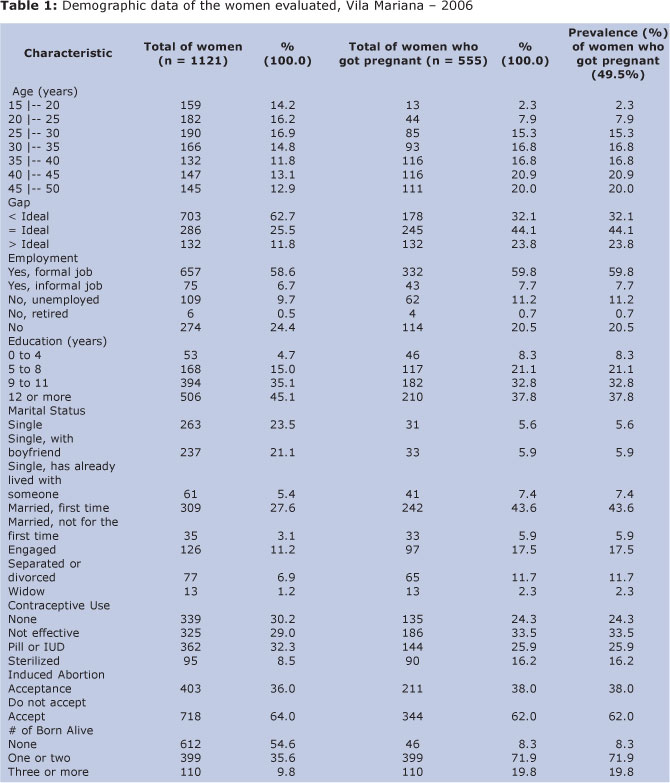
<body><![CDATA[<p><font face="Verdana, Arial, Helvetica, sans-serif" size="2">This  study was part of the project "Integrality in Health", Department of Preventive  Medicine of UNIFESP, funded by CNPq, process no 403258/2005-7, held in the region  covered by Hospital S&atilde;o Paulo, subdistrict of Vila Mariana, focusing on  epidemiology of induced abortion and their relationship with the local health  services. The study was approved by the Research Ethics Committee of Universidade  Federal de S&atilde;o Paulo (process number 0110/06).</font></p>    <p><font face="Verdana, Arial, Helvetica, sans-serif" size="2">This  was a cross-sectional study carried out in women aged 15 to 49 years old with  history of pregnancy, residing in the subdistrict of Vila Mariana, S&atilde;o  Paulo, in 2006. The study sample consisted of 1121 women, of which 555 women had  a history of pregnancy. The final sample size (555) provided a maximum error of  2% (0.02) in the estimation of a proportion of 0.088 (8.8%), assuming an infinite  population.</font></p>    <p><font face="Verdana, Arial, Helvetica, sans-serif" size="2">We  used a random sampling procedure often utilized in the assessments of immunization  coverage, with low cost and compatible estimates with the ones obtained from simple  random sampling<sup>14</sup>. The blocks of the subdistrict of Vila Mariana were  numbered in circular clockwise order. Seventy-five blocks were randomly selected,  and using the circular route and a casual start, their households should be covered  until 16 interviews were completed. The procedure makes no provision for losses.  Face to face interviews were carried out by trained female interviewers.</font></p>    <p><font face="Verdana, Arial, Helvetica, sans-serif" size="2">Each  woman was classified into one of three mutually exclusive categories according  to Abortion: Without Abortion, when the woman said she never had any kind of abortion;  Spontaneous Abortion, when the woman declared at least one miscarriage and no  induced abortion; and Induced Abortion, when the woman declared at least one induced  abortion. The age of the woman at the time of the occurrence of the abortion events  was not asked.</font></p>    <p><font face="Verdana, Arial, Helvetica, sans-serif" size="2">The  independent variables were: Age, in complete years at the time of the interview;  Gap, difference between number of live births and number of children considered  ideal by the woman (categorized as Less than Ideal, Equal to Ideal, and Greater  than Ideal); Employment (Yes if formal or informal, and No if no work, unemployed  or retired); Education (completed years of study, at intervals of 0 to 4, 5 to  8, 9 to 11, 12 or more); Marital Status at time of interview (Single and Not Single  - if married, engaged, separated, divorced or widowed); Current Use of Contraception  Methods (None, Oral hormonal contraceptives or intrauterine device (IUD), Sterilization,  and Others, if used any other method); Opinion on Induced Abortion (Accepted -  at least one situation, Does Not Accept - in no situation); and Number of Live  Births (None, One or More).</font></p>    <p><font face="Verdana, Arial, Helvetica, sans-serif" size="2">For  data analysis, frequency tables were constructed to cross-classify the women based  on abortion and the independent variables. The generalized likelihood ratio chi-square  test was performed to investigate possible associations between having or not  some kind of abortion with each of the independent variables.</font></p>    <p><font face="Verdana, Arial, Helvetica, sans-serif" size="2">Multinomial  logistic regression models were used to determine which of the independent variables  best describe the abortion status of these women. The odds ratios of women with  spontaneous abortion on women without abortion, and women with induced abortion  on women without abortion were calculated over a reference class, as well as their  95% confidence intervals. The backward procedure for removing variables was used  to obtain the final model in order to include variables only with observed significance  lower than 5% using the Wald chi-square test. Statistical analyses were performed  with the SPSS program, version 15.0.</font></p>    <p>&nbsp;</p>    <p><font face="Verdana, Arial, Helvetica, sans-serif" size="3"><b>RESULTS</b></font></p>    <p><font face="Verdana, Arial, Helvetica, sans-serif" size="2">Among  the 1121 women aged 15 to 49 years old, 555 (49.5%) reported at least one pregnancy.  The median age of the 1121 women was 30.9 years and the median age of the 555  women was 37 years old. A total of 1266 pregnancies was observed, resulting in  1001 live births (79.1%); 175 spontaneous abortions (13.8%); 71 induced abortions  (5.6%); 18 ongoing pregnancies (1.4%); and one stillbirth (0.1%). The mean number  of children was 0.9 for 1121 women and 1.8 for the 555 women.</font></p>    ]]></body>
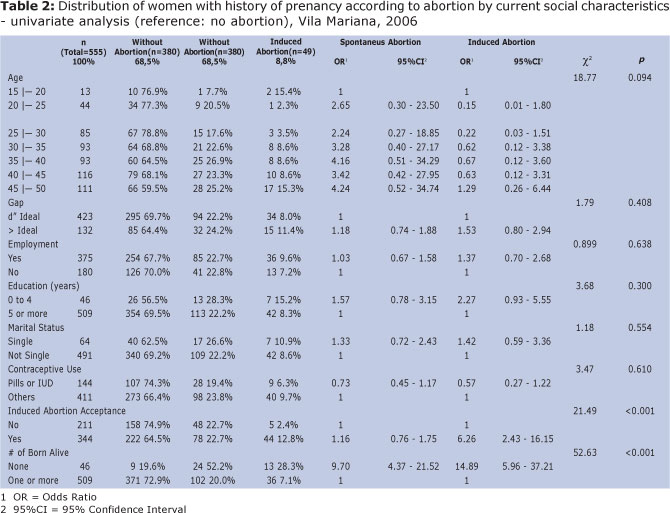
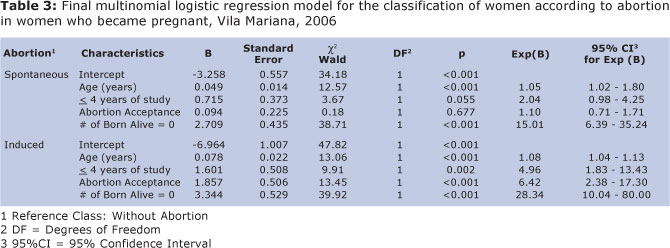
<body><![CDATA[<p><font face="Verdana, Arial, Helvetica, sans-serif" size="2">The  profile of these women is presented in <a href="/img/revistas/rbcdh/v22n1/en_04t01.jpg">Table  1</a>. It is observed that the total 1121 women interviewed were allocated proportionately  in the five-year age groups considered. On the other hand, the number of women  increases with age group among those with history of pregnancy. Most women work  and have more than 8 years of education.</font></p>    <p><font face="Verdana, Arial, Helvetica, sans-serif" size="2"><a href="/img/revistas/rbcdh/v22n1/en_04t01.jpg">Table  1</a> also displays the prevalence of women that reported to have had at least  one pregnancy. The prevalence increased with age group, with higher values occurring  in women aged 35 or more. The highest prevalences of women with history of pregnancy  occurred among those who had up to four years of study (86.8%), had been married,  were sterilized or did not use contraceptive methods (<a href="/img/revistas/rbcdh/v22n1/en_04t01.jpg">Table  1</a>).</font></p>    <p><font face="Verdana, Arial, Helvetica, sans-serif" size="2">From  the 555 women with history of pregnancy, 380 (68.5%) reported never having had  any kind of abortion, 126 (22.7%) reported to have had at least one spontaneous  abortion and no induced abortion, and 49 (8.8%) admitted to have had at least  one induced abortion (<a href="/img/revistas/rbcdh/v22n1/en_04t02.jpg">Table 2</a>).  The analysis of the association of abortion with each independent variable showed  that the acceptance of the practice of abortion and not to have any live births  were strongly associated with induced abortion (<a href="/img/revistas/rbcdh/v22n1/en_04t02.jpg">Table  2</a>).</font></p>    <p><font face="Verdana, Arial, Helvetica, sans-serif" size="2">All  independent variables were included in the initial logistic regression model.  The results for the final model are presented in <a href="/img/revistas/rbcdh/v22n1/en_04t03.jpg">Table  3</a>. The odds ratio of having induced an abortion over not having abortions  was 28.3 times (p&lt;0.001) among women with no live births, 6.4 times (p&lt;0.001)  for women who accept the practice of abortion, 4.9 times (p=0.002) among those  with less than four full years of study, and increased by 8% for each one year  increment in the age of the women (p&lt;0.001). The odds ratio of having one or  more spontaneous abortions over without abortion had a similar behavior. The odds  ratio was 15 times (p&lt;0.001) among women with no live births and two times  (p=0.055) for women with less than four years of study, and increased by 5% for  each one year increment in the age of the women (p&lt;0.001). However, in this  case, the odds ratio among women who accept abortion over the ones who totally  reject the idea was not statistically significant (p=0.677). In summary, lower  educational level was associated with a higher proportion of a history of pregnancy  and abortions and not having a child was the variable with the greatest weight  in the occurrence of abortion.</font></p>    <p><font face="Verdana, Arial, Helvetica, sans-serif" size="2">No  not report of complications due to induced abortion was found in this study.</font></p>    <p>&nbsp;</p>    <p><font face="Verdana, Arial, Helvetica, sans-serif" size="3"><b>DISCUSSION</b></font></p>    <p><font face="Verdana, Arial, Helvetica, sans-serif" size="2">The  subdistrict of Vila Mariana has privileged socioeconomic indicators, with a monthly  income of around nine times the minimum wage and nearly 80% of the population  with eight or more years of education. Data from Funda&ccedil;&atilde;o Sistema  Estadual de An&aacute;lise de Dados<sup>15</sup> indicate that the region is unique  in the city of S&atilde;o Paulo, with an average of 1.5 children per woman in  2009, a figure that is similar to that of some European countries<sup>15</sup>.</font></p>    <p><font face="Verdana, Arial, Helvetica, sans-serif" size="2">With  these indicators, it is possible to assume that a significant portion of the women  living in the region has sufficient economic condition to resort to safe clandestine  clinics to stop an unwanted pregnancy, with low risk of morbidity and mortality.  At the same time, these women have more resources to develop strategies to if  an abortion was performed, or to claim that the termination of an unwanted pregnancy  was related to a spontaneous loss.</font></p>    <p><font face="Verdana, Arial, Helvetica, sans-serif" size="2">The  low level of fecundity found in women living in Vila Mariana was consistent with  data pointing the FSEADE - the late cusp to fecundity, with concentration of live  births among women aged 30 to 40 years<sup>15</sup>. The same occurred on the  age distribution, with most five-year age groups allocating a similar proportion  of women with a median age of 30.9 years. In addition, the high proportion of  women with eight or more years of study and reduced average number of 0.9 children  per woman, were consistent with the low fertility<sup>15</sup>.</font></p>    ]]></body>
<body><![CDATA[<p><font face="Verdana, Arial, Helvetica, sans-serif" size="2">Studies  conducted by Silva (1998)<sup>9</sup> and Santos (2005)<sup>16</sup> showed that  women who seek induced abortion are young, unmarried, childless and in early reproductive  life<sup>9,16</sup>. In this study, the abortion may have occurred at any time  of the woman's reproductive life, prior to its statement. This limitation, however,  can little distort the findings, since it is expected that the proportion of women  with induced abortion at the beginning of reproductive life exceeds that of other  ages.</font></p>    <p><font face="Verdana, Arial, Helvetica, sans-serif" size="2">Even  for women with better socioeconomic conditions, the beginning of sexual and reproductive  life is a more difficult moment to prevent pregnancy, either by the nature of  casual relationships or by the lower prevalence of effective contraceptive use<sup>9</sup>.  The National Survey on Demography and Health<sup>17</sup>, 1998, indicates that  among couples with two living children, 90% of women and 88% of men do not want  another pregnancy. Among couples with one child, 50% expressed intention not to  enlarge the family<sup>17</sup>.</font></p>    <p><font face="Verdana, Arial, Helvetica, sans-serif" size="2">According  to Sorrentino (2001)<sup>18</sup>, in a scenario where there are no adequate and  safe practices to prevent pregnancy, and the national total fertility rate of  2.5 children per woman, the occurrence of unwanted pregnancies tends to be frequent.  Although the proportion of pregnancies ending in miscarriage (13.8%) found in  this study shows the expected, according to data of Barini et al. (2000)<sup>19</sup>,  the value was 4.5 times greater than that observed for induced abortion, indicating  the possibility of failure in the statements<sup>19</sup>. In addition, the prevalence  of 4.3% for induced abortion proved to be far below other research reports in  the region and the municipality of S&atilde;o Paulo<sup>9,10</sup>.</font></p>    <p><font face="Verdana, Arial, Helvetica, sans-serif" size="2">The  number of induced abortions shows consistent decline in recent decades, a result  of improvements in the quality of reproductive planning in the country. The socioeconomic  indicators of Vila Mariana suggest that this population is among the most benefited  by contraceptives advances. However, this factor seems insufficient to explain  the lack of induced abortion statements found; even considering that part of the  respondents went through the beginning of reproductive life for almost 30 years,  when supply and access to contraceptives were more restricted. Thus, it is considered  that part of the interviewees may have hidden induced abortion in their responses.</font></p>    <p><font face="Verdana, Arial, Helvetica, sans-serif" size="2">Women  with a history of pregnancy had proportionately less education, possibly due to  lower information about contraceptive methods or less access to regular and continuous  use. This variable did not influence the position stated with respect to acceptance  of induced abortion, a history of pregnancy being not against the practice. The  data suggests that almost 60% of women could face an unintended pregnancy and  resort to an illegal abortion. On the other hand, the history of not having a  child born showed greater weight in the statement of abortion.</font></p>    <p><font face="Verdana, Arial, Helvetica, sans-serif" size="2">History  of pregnancy was less common among younger women aged 20 years or less (8.2%).  This finding reflects both the late onset of fertility recorded for the region  evaluated, as it can indicate the strength not to report unintented pregnancies  for younger women.</font></p>    <p><font face="Verdana, Arial, Helvetica, sans-serif" size="2">Assuming  that the absence of such information is not differential by subgroups of women<sup>9</sup>,  inferences that induced abortion has been deliberately concealed can be found  in all groups of respondents. The prevalence of women with previous pregnancy  that had practiced abortion showed to be lower than the expected, even considering  a margin of error on the sampling process ranging from 6.8% to 10.8%. One can  say that about 1/3 of abortions reported as spontaneous were in fact induced<sup>6</sup>.</font></p>    <p><font face="Verdana, Arial, Helvetica, sans-serif" size="2">Induced  abortion is central in the debate on reproductive health since the 1990s, both  in Brazil and in Latin America and the Caribbean. The consensus is that its criminalization  and subsequent underground end up increasing maternal morbidity and mortality,  especially for poorer women who perform abortions in unsanitary conditions<sup>6</sup>.</font></p>    <p><font face="Verdana, Arial, Helvetica, sans-serif" size="2">In  Brazil, the official reason of maternal death is 76 for every 100,000 live births,  mostly involving women with limited financial resources<sup>20</sup>. In fact,  almost 80% of slum dwellers who resort to illegal abortions reported complications,  especially bleeding<sup>2</sup>. In contrast, a study conducted by in S&atilde;o  Paulo found 5% of women reporting some type of sequel<sup>9</sup>. In a research  in Vila Madalena subdistrict, S&atilde;o Paulo, two complications were found in  20% of cases<sup>10</sup>. This evidence suggests that the higher socioeconomic  level allows women to seek health services, although illegal, but perform abortions  under less unsafe conditions. In this study, the interviewees did not report complications  by induced abortion.</font></p>    <p><font face="Verdana, Arial, Helvetica, sans-serif" size="2">A  recent study on the magnitude of abortion in Brazil, summarizing the major researches  over the past 20 years shows that most women who terminate a pregnancy is between  20 and 29 years, stable, up to eight years of study, work, are Catholic, have  at least one child and use some contraception<sup>12</sup>. In this investigation,  however, it was expected a higher incidence of abortion among unmarried, young  and childless women, considering the favorable socioeconomic profile of the population,  as evidenced by Santos (2005)<sup>16</sup>.</font></p>    ]]></body>
<body><![CDATA[<p><font face="Verdana, Arial, Helvetica, sans-serif" size="2">In  this respect, the results on the occurrence of abortions, induced or spontaneous,  showed predominant among women who had no live birth. However, it was expected  that miscarriages accompanied the profile of women with a pregnancy and were more  frequent among those with a live birth. This finding is strongly suggestive that  induced abortion may have been declared as spontaneous in the interviews.</font></p>    <p><font face="Verdana, Arial, Helvetica, sans-serif" size="2">Being  young or unmarried was not important to explain the occurrence of induced abortion.  It is possible that social changes have reduced the bias against young women who  become pregnant before marriage, exerting less pressure to interrupt pregnancy.  On the other hand, there was a greater tendency to postpone the first child's  birth, particularly among women with higher income condition, interfering with  the concentration of induced abortion among younger women. Confronted with unwanted  pregnancy, more childless women resort to abortion, regardless marital status  or age.</font></p>    <p><font face="Verdana, Arial, Helvetica, sans-serif" size="2">An  important factor associated with induced abortion was accepting its practice in  some situation, at least in those prescribed by legislation, with chance 6.4 times  greater. Silva &amp; Vieira (2009)<sup>21</sup> found that single women living  in S&atilde;o Paulo resort to abortion, even contrary to its practice<sup>21</sup>.  This observation is not necessarily inconsistent.</font></p>    <p><font face="Verdana, Arial, Helvetica, sans-serif" size="2">According  to Sihvo et al. (2003)<sup>22</sup>, socioeconomic factors and different types  of relationships affect the decision to terminate the pregnancy. This decision  may be different at each stage of a woman's life, referring to the social representations  and perceptions of appropriate conditions for the exercise of motherhood.</font></p>    <p><font face="Verdana, Arial, Helvetica, sans-serif" size="2">The  improvement and expansion of access to reproductive planning services to modern  effective and safe contraceptives, sex and reproductive education programs, and  public policies for gender equality are essential to avoid unwanted pregnancy.  Still, there are not sufficient resources to eradicate this problem. Therefore,  the decriminalization of abortion is a matter of public health and human rights,  which guarantees equal access to health services that provide safe and humane  conditions.</font></p>    <p>&nbsp;</p>    <p><font face="Verdana, Arial, Helvetica, sans-serif" size="3"><b>REFERENCES</b></font></p>    <!-- ref --><p><font face="Verdana, Arial, Helvetica, sans-serif" size="2">1.  Hardy E, Costa R, Rodrigues T, Moraes T. Caracter&iacute;sticas atuais associadas  &agrave; hist&oacute;ria de aborto provocado. Rev Sa&uacute;de P&uacute;blica,  1994;28(1):82-5.    &nbsp;&nbsp;&nbsp;&nbsp;&nbsp;&nbsp;&nbsp;&nbsp;[&#160;<a href="javascript:void(0);" onclick="javascript: window.open('/scielo.php?script=sci_nlinks&ref=2484400&pid=S0104-1282201200010000400001&lng=','','width=640,height=500,resizable=yes,scrollbars=1,menubar=yes,');">Links</a>&#160;]<!-- end-ref --></font></p>    <!-- ref --><p><font face="Verdana, Arial, Helvetica, sans-serif" size="2">2.  Fusco CLB, Andreoni S, Silva RS. Epidemiologia do aborto inseguro em uma popula&ccedil;&atilde;o  em situa&ccedil;&atilde;o de pobreza: Favela Inajar de Souza, S&atilde;o Paulo.  Rev Bras Epidemiol 2008; 11(1):78-88.    &nbsp;&nbsp;&nbsp;&nbsp;&nbsp;&nbsp;&nbsp;&nbsp;[&#160;<a href="javascript:void(0);" onclick="javascript: window.open('/scielo.php?script=sci_nlinks&ref=2484402&pid=S0104-1282201200010000400002&lng=','','width=640,height=500,resizable=yes,scrollbars=1,menubar=yes,');">Links</a>&#160;]<!-- end-ref --></font></p>    <!-- ref --><p><font face="Verdana, Arial, Helvetica, sans-serif" size="2">3.  Fonseca W, Misago C, Correia LL, Parente JAM, Oliveira FC. Determinantes do aborto  provocado entre mulheres admitidas em hospitais em localidade da regi&atilde;o  Nordeste do Brasil. Rev Sa&uacute;de P&uacute;blica, 1996;30(1):13-18.    &nbsp;&nbsp;&nbsp;&nbsp;&nbsp;&nbsp;&nbsp;&nbsp;[&#160;<a href="javascript:void(0);" onclick="javascript: window.open('/scielo.php?script=sci_nlinks&ref=2484404&pid=S0104-1282201200010000400003&lng=','','width=640,height=500,resizable=yes,scrollbars=1,menubar=yes,');">Links</a>&#160;]<!-- end-ref --></font></p>    <!-- ref --><p><font face="Verdana, Arial, Helvetica, sans-serif" size="2">4.  Osis MJD, Hardy E, Faundes A, Rodrigues T. Dificuldades para obter informa&ccedil;&otilde;es  da popula&ccedil;&atilde;o de mulheres sobre aborto ilegal. Rev Sa&uacute;de P&uacute;blica,  1996;30(5):444-51.    &nbsp;&nbsp;&nbsp;&nbsp;&nbsp;&nbsp;&nbsp;&nbsp;[&#160;<a href="javascript:void(0);" onclick="javascript: window.open('/scielo.php?script=sci_nlinks&ref=2484406&pid=S0104-1282201200010000400004&lng=','','width=640,height=500,resizable=yes,scrollbars=1,menubar=yes,');">Links</a>&#160;]<!-- end-ref --></font></p>    <!-- ref --><p><font face="Verdana, Arial, Helvetica, sans-serif" size="2">5.  Silva RS. O uso da T&eacute;cnica de Resposta ao Azar (TRA) na caracteriza&ccedil;&atilde;o  do aborto ilegal. Rev Bras Estudos Pop, 1993;10(1/2):41-56.    &nbsp;&nbsp;&nbsp;&nbsp;&nbsp;&nbsp;&nbsp;&nbsp;[&#160;<a href="javascript:void(0);" onclick="javascript: window.open('/scielo.php?script=sci_nlinks&ref=2484408&pid=S0104-1282201200010000400005&lng=','','width=640,height=500,resizable=yes,scrollbars=1,menubar=yes,');">Links</a>&#160;]<!-- end-ref --></font></p>    <!-- ref --><p><font face="Verdana, Arial, Helvetica, sans-serif" size="2">6.  Alan Guttmacher Institute. Aborto clandestino: una realidad latinoamericana. Alan  Guttmacher Institute &#91;monografia en la Internet&#93;. 1994 &#91;citado 2006  Jul 13&#93;. Dispon&iacute;vel em: <a href="http://www.womenslinkworldwide.org/pdf/sp_proj_laicia_amicus_app_AGISP.pdf" target="_blank">http://www.womenslinkworldwide.org/pdf/sp_proj_laicia_amicus_app_AGISP.pdf</a></font>&nbsp;&nbsp;&nbsp;&nbsp;&nbsp;&nbsp;&nbsp;&nbsp;[&#160;<a href="javascript:void(0);" onclick="javascript: window.open('/scielo.php?script=sci_nlinks&ref=2484410&pid=S0104-1282201200010000400006&lng=','','width=640,height=500,resizable=yes,scrollbars=1,menubar=yes,');">Links</a>&#160;]<!-- end-ref --><!-- ref --><p><font face="Verdana, Arial, Helvetica, sans-serif" size="2">7.  Singh S, Wulf D. Estimated Levels of Induced Abortion in Six Latin American Countries.  International Family Planning Perspectives, 1994;20:4-13.    &nbsp;&nbsp;&nbsp;&nbsp;&nbsp;&nbsp;&nbsp;&nbsp;[&#160;<a href="javascript:void(0);" onclick="javascript: window.open('/scielo.php?script=sci_nlinks&ref=2484411&pid=S0104-1282201200010000400007&lng=','','width=640,height=500,resizable=yes,scrollbars=1,menubar=yes,');">Links</a>&#160;]<!-- end-ref --></font></p>    ]]></body>
<body><![CDATA[<!-- ref --><p><font face="Verdana, Arial, Helvetica, sans-serif" size="2">8.  Corr&ecirc;a S, Freitas A. Atualizando os dados sobre a interrup&ccedil;&atilde;o  volunt&aacute;ria da gravidez no Brasil. Estudos Feministas, 1997;5(2):389-95.    &nbsp;&nbsp;&nbsp;&nbsp;&nbsp;&nbsp;&nbsp;&nbsp;[&#160;<a href="javascript:void(0);" onclick="javascript: window.open('/scielo.php?script=sci_nlinks&ref=2484413&pid=S0104-1282201200010000400008&lng=','','width=640,height=500,resizable=yes,scrollbars=1,menubar=yes,');">Links</a>&#160;]<!-- end-ref --></font></p>    <!-- ref --><p><font face="Verdana, Arial, Helvetica, sans-serif" size="2">9.  Silva RS. Padr&otilde;es de aborto provocado na Grande S&atilde;o Paulo, Brasil.  Rev Sa&uacute;de P&uacute;blica. 1998; 32(1):7-17.    &nbsp;&nbsp;&nbsp;&nbsp;&nbsp;&nbsp;&nbsp;&nbsp;[&#160;<a href="javascript:void(0);" onclick="javascript: window.open('/scielo.php?script=sci_nlinks&ref=2484415&pid=S0104-1282201200010000400009&lng=','','width=640,height=500,resizable=yes,scrollbars=1,menubar=yes,');">Links</a>&#160;]<!-- end-ref --></font></p>    <!-- ref --><p><font face="Verdana, Arial, Helvetica, sans-serif" size="2">10.  Silva RS, Fusco CLB. Sa&uacute;de Reprodutiva, fecundidade e aborto provocado:  an&aacute;lise de seis inqu&eacute;ritos populacionais realizados em S&atilde;o  Paulo, Brasil. Rev Sa&uacute;de &Eacute;tica &amp; Justi&ccedil;a, 2008;13(2):79-94.    &nbsp;&nbsp;&nbsp;&nbsp;&nbsp;&nbsp;&nbsp;&nbsp;[&#160;<a href="javascript:void(0);" onclick="javascript: window.open('/scielo.php?script=sci_nlinks&ref=2484417&pid=S0104-1282201200010000400010&lng=','','width=640,height=500,resizable=yes,scrollbars=1,menubar=yes,');">Links</a>&#160;]<!-- end-ref --></font></p>    <!-- ref --><p><font face="Verdana, Arial, Helvetica, sans-serif" size="2">11.  Olinto MTA, Moreira Filho DC. Estimativa de aborto induzido: compara&ccedil;&atilde;o  entre duas metodologias. Rev Panam Salud Publica, 2004;15(5):331-6.    &nbsp;&nbsp;&nbsp;&nbsp;&nbsp;&nbsp;&nbsp;&nbsp;[&#160;<a href="javascript:void(0);" onclick="javascript: window.open('/scielo.php?script=sci_nlinks&ref=2484419&pid=S0104-1282201200010000400011&lng=','','width=640,height=500,resizable=yes,scrollbars=1,menubar=yes,');">Links</a>&#160;]<!-- end-ref --></font></p>    <!-- ref --><p><font face="Verdana, Arial, Helvetica, sans-serif" size="2">12.  Diniz D. Aborto e Sa&uacute;de P&uacute;blica: 20 anos de pesquisas no Brasil.  CFEMEA - Centro Feminista de Estudos e Assessoria &#91;documento online&#93;.  2009 &#91;acesso em 05 jan 2009&#93;. Dispon&iacute;vel em: <a href="http://www.cfemea.org.br/noticias/detalhes.asp?IDNoticia=691" target="_blank">http://www.cfemea.org.br/noticias/detalhes.asp?IDNoticia=691</a></font>&nbsp;&nbsp;&nbsp;&nbsp;&nbsp;&nbsp;&nbsp;&nbsp;[&#160;<a href="javascript:void(0);" onclick="javascript: window.open('/scielo.php?script=sci_nlinks&ref=2484421&pid=S0104-1282201200010000400012&lng=','','width=640,height=500,resizable=yes,scrollbars=1,menubar=yes,');">Links</a>&#160;]<!-- end-ref --><!-- ref --><p><font face="Verdana, Arial, Helvetica, sans-serif" size="2">13.  Brasil. C&oacute;digo Penal: Decreto lei n. 1.004, de 21 de outubro de 1969. 4a  ed. S&atilde;o Paulo: Saraiva; 1971.    &nbsp;&nbsp;&nbsp;&nbsp;&nbsp;&nbsp;&nbsp;&nbsp;[&#160;<a href="javascript:void(0);" onclick="javascript: window.open('/scielo.php?script=sci_nlinks&ref=2484422&pid=S0104-1282201200010000400013&lng=','','width=640,height=500,resizable=yes,scrollbars=1,menubar=yes,');">Links</a>&#160;]<!-- end-ref --></font></p>    <!-- ref --><p><font face="Verdana, Arial, Helvetica, sans-serif" size="2">14.  Cardoso MRA. Compara&ccedil;&atilde;o entre tr&ecirc;s m&eacute;todos de amostragem  que visam &agrave; estima&ccedil;&atilde;o da cobertura vacinal &#91;disserta&ccedil;&atilde;o&#93;.  S&atilde;o Paulo: Faculdade de Sa&uacute;de P&uacute;blica da Universidade de  S&atilde;o Paulo; 1990.    &nbsp;&nbsp;&nbsp;&nbsp;&nbsp;&nbsp;&nbsp;&nbsp;[&#160;<a href="javascript:void(0);" onclick="javascript: window.open('/scielo.php?script=sci_nlinks&ref=2484424&pid=S0104-1282201200010000400014&lng=','','width=640,height=500,resizable=yes,scrollbars=1,menubar=yes,');">Links</a>&#160;]<!-- end-ref --></font></p>    <!-- ref --><p><font face="Verdana, Arial, Helvetica, sans-serif" size="2">15.  Funda&ccedil;&atilde;o Sistema Estadual de An&aacute;lise de Dados. Secretaria  de Economia e Planejamento. Perfil Municipal de S&atilde;o Paulo, 2009 &#91;documento  online&#93;. 2009. Dispon&iacute;vel em: <a href="http://www.seade.gov.br/produtos/perfil/perfil.php" target="_blank">http://www.seade.gov.br/produtos/perfil/perfil.php</a></font>&nbsp;&nbsp;&nbsp;&nbsp;&nbsp;&nbsp;&nbsp;&nbsp;[&#160;<a href="javascript:void(0);" onclick="javascript: window.open('/scielo.php?script=sci_nlinks&ref=2484426&pid=S0104-1282201200010000400015&lng=','','width=640,height=500,resizable=yes,scrollbars=1,menubar=yes,');">Links</a>&#160;]<!-- end-ref --><!-- ref --><p><font face="Verdana, Arial, Helvetica, sans-serif" size="2">16.  Santos EBC. Aborto induzido: ocorr&ecirc;ncia e caracter&iacute;sticas no antigo  subdistrito de Vila Madalena, S&atilde;o Paulo, Brasil - 2000 &#91;disserta&ccedil;&atilde;o&#93;.  S&atilde;o Paulo: Universidade Federal de S&atilde;o Paulo. Escola Paulista de  Medicina; 2005.    &nbsp;&nbsp;&nbsp;&nbsp;&nbsp;&nbsp;&nbsp;&nbsp;[&#160;<a href="javascript:void(0);" onclick="javascript: window.open('/scielo.php?script=sci_nlinks&ref=2484427&pid=S0104-1282201200010000400016&lng=','','width=640,height=500,resizable=yes,scrollbars=1,menubar=yes,');">Links</a>&#160;]<!-- end-ref --></font></p>    <!-- ref --><p><font face="Verdana, Arial, Helvetica, sans-serif" size="2">17.  Sociedade Civil Bem-Estar Familiar no Brasil - BEMFAM. Relat&oacute;rio Preliminar.  USA: London International Group; 1998.    &nbsp;&nbsp;&nbsp;&nbsp;&nbsp;&nbsp;&nbsp;&nbsp;[&#160;<a href="javascript:void(0);" onclick="javascript: window.open('/scielo.php?script=sci_nlinks&ref=2484429&pid=S0104-1282201200010000400017&lng=','','width=640,height=500,resizable=yes,scrollbars=1,menubar=yes,');">Links</a>&#160;]<!-- end-ref --></font></p>    <!-- ref --><p><font face="Verdana, Arial, Helvetica, sans-serif" size="2">18.  Sorrentino SR. Aborto inseguro. In: Rede Nacional Feminista de Sa&uacute;de e  Direitos Reprodutivos. Sa&uacute;de da mulher e direitos reprodutivos: dossi&ecirc;s.  S&atilde;o Paulo: Rede Nacional Feminista de Sa&uacute;de e Direitos Reprodutivos,  2001. p. 41-72.    &nbsp;&nbsp;&nbsp;&nbsp;&nbsp;&nbsp;&nbsp;&nbsp;[&#160;<a href="javascript:void(0);" onclick="javascript: window.open('/scielo.php?script=sci_nlinks&ref=2484431&pid=S0104-1282201200010000400018&lng=','','width=640,height=500,resizable=yes,scrollbars=1,menubar=yes,');">Links</a>&#160;]<!-- end-ref --></font></p>    ]]></body>
<body><![CDATA[<!-- ref --><p><font face="Verdana, Arial, Helvetica, sans-serif" size="2">19.  Barini R, Couto E, Mota MM, Santos CTM, Leiber SR, Batista SCS. Fatores associados  ao aborto espont&acirc;neo recorrente. Rev Bras Ginecol Obstet, 2000;22(4): 217-23.    &nbsp;&nbsp;&nbsp;&nbsp;&nbsp;&nbsp;&nbsp;&nbsp;[&#160;<a href="javascript:void(0);" onclick="javascript: window.open('/scielo.php?script=sci_nlinks&ref=2484433&pid=S0104-1282201200010000400019&lng=','','width=640,height=500,resizable=yes,scrollbars=1,menubar=yes,');">Links</a>&#160;]<!-- end-ref --></font></p>    <!-- ref --><p><font face="Verdana, Arial, Helvetica, sans-serif" size="2">20.  Adesse L, Monteiro MFG. Magnitude do aborto no Brasil: Aspectos epidemiol&oacute;gicos  e s&oacute;cio-culturais. Instituto de Medicina Social - IMS &#91;documento online&#93;.  2008. Dispon&iacute;vel em <a href="http://www.ipas.org.br/arquivos/factsh_mag.pdf" target="_blank">http://www.ipas.org.br/arquivos/factsh_mag.pdf</a>  04 janeiro 2008.    &nbsp;&nbsp;&nbsp;&nbsp;&nbsp;&nbsp;&nbsp;&nbsp;[&#160;<a href="javascript:void(0);" onclick="javascript: window.open('/scielo.php?script=sci_nlinks&ref=2484435&pid=S0104-1282201200010000400020&lng=','','width=640,height=500,resizable=yes,scrollbars=1,menubar=yes,');">Links</a>&#160;]<!-- end-ref --></font></p>    <!-- ref --><p><font face="Verdana, Arial, Helvetica, sans-serif" size="2">21.  Silva RS, Vieira EM. Aborto provocado: sua dimens&atilde;o e caracter&iacute;sticas  entre mulheres solteiras e casadas da cidade de S&atilde;o Paulo, Brasil. Cad  Sa&uacute;de P&uacute;blica, 2009;25(1):179-87.    &nbsp;&nbsp;&nbsp;&nbsp;&nbsp;&nbsp;&nbsp;&nbsp;[&#160;<a href="javascript:void(0);" onclick="javascript: window.open('/scielo.php?script=sci_nlinks&ref=2484437&pid=S0104-1282201200010000400021&lng=','','width=640,height=500,resizable=yes,scrollbars=1,menubar=yes,');">Links</a>&#160;]<!-- end-ref --></font></p>    <!-- ref --><p><font face="Verdana, Arial, Helvetica, sans-serif" size="2">22.  Sihvo S, Bajos N, Ducot B, Kaminski M. Women's life cycle and abortion decision  in unintended pregnancies. J Epidemiol Community Health, 2003; 57(8):601-5.    &nbsp;&nbsp;&nbsp;&nbsp;&nbsp;&nbsp;&nbsp;&nbsp;[&#160;<a href="javascript:void(0);" onclick="javascript: window.open('/scielo.php?script=sci_nlinks&ref=2484439&pid=S0104-1282201200010000400022&lng=','','width=640,height=500,resizable=yes,scrollbars=1,menubar=yes,');">Links</a>&#160;]<!-- end-ref --></font></p>    <p>&nbsp;</p>    <p>&nbsp;</p>    ]]></body>
<body><![CDATA[<p><font face="Verdana, Arial, Helvetica, sans-serif" size="2"><b><a name="back"></a><a href="#top"><img src="/img/revistas/rbcdh/v22n1/seta.jpg" border="0"></a>Corresponding  author:    <br> </b> <a href="mailto:rebecaprev@globo.com">rebecaprev@globo.com</a></font></p>    <p><font face="Verdana, Arial, Helvetica, sans-serif" size="2">Manuscript  submitted Oct 08 2011    <br> Accepted for publication Feb 15 2012.</font></p>      ]]></body>
<back>
<ref-list>
<ref id="B1">
<label>1</label><nlm-citation citation-type="journal">
<person-group person-group-type="author">
<name>
<surname><![CDATA[Hardy]]></surname>
<given-names><![CDATA[E]]></given-names>
</name>
<name>
<surname><![CDATA[Costa]]></surname>
<given-names><![CDATA[R]]></given-names>
</name>
<name>
<surname><![CDATA[Rodrigues]]></surname>
<given-names><![CDATA[T]]></given-names>
</name>
<name>
<surname><![CDATA[Moraes]]></surname>
<given-names><![CDATA[T]]></given-names>
</name>
</person-group>
<article-title xml:lang="pt"><![CDATA[Características atuais associadas à história de aborto provocado]]></article-title>
<source><![CDATA[Rev Saúde Pública,]]></source>
<year>1994</year>
<volume>28</volume>
<numero>1</numero>
<issue>1</issue>
<page-range>82-5</page-range></nlm-citation>
</ref>
<ref id="B2">
<label>2</label><nlm-citation citation-type="journal">
<person-group person-group-type="author">
<name>
<surname><![CDATA[Fusco]]></surname>
<given-names><![CDATA[CLB]]></given-names>
</name>
<name>
<surname><![CDATA[Andreoni]]></surname>
<given-names><![CDATA[S]]></given-names>
</name>
<name>
<surname><![CDATA[Silva]]></surname>
<given-names><![CDATA[RS]]></given-names>
</name>
</person-group>
<article-title xml:lang="pt"><![CDATA[Epidemiologia do aborto inseguro em uma população em situação de pobreza: Favela Inajar de Souza, São Paulo]]></article-title>
<source><![CDATA[Rev Bras Epidemiol]]></source>
<year>2008</year>
<volume>11</volume>
<numero>1</numero>
<issue>1</issue>
<page-range>78-88</page-range></nlm-citation>
</ref>
<ref id="B3">
<label>3</label><nlm-citation citation-type="journal">
<person-group person-group-type="author">
<name>
<surname><![CDATA[Fonseca]]></surname>
<given-names><![CDATA[W]]></given-names>
</name>
<name>
<surname><![CDATA[Misago]]></surname>
<given-names><![CDATA[C]]></given-names>
</name>
<name>
<surname><![CDATA[Correia]]></surname>
<given-names><![CDATA[LL]]></given-names>
</name>
<name>
<surname><![CDATA[Parente]]></surname>
<given-names><![CDATA[JAM]]></given-names>
</name>
<name>
<surname><![CDATA[Oliveira]]></surname>
<given-names><![CDATA[FC]]></given-names>
</name>
</person-group>
<article-title xml:lang="pt"><![CDATA[Determinantes do aborto provocado entre mulheres admitidas em hospitais em localidade da região Nordeste do Brasil]]></article-title>
<source><![CDATA[Rev Saúde Pública,]]></source>
<year>1996</year>
<volume>30</volume>
<numero>1</numero>
<issue>1</issue>
<page-range>13-18</page-range></nlm-citation>
</ref>
<ref id="B4">
<label>4</label><nlm-citation citation-type="journal">
<person-group person-group-type="author">
<name>
<surname><![CDATA[Osis]]></surname>
<given-names><![CDATA[MJD]]></given-names>
</name>
<name>
<surname><![CDATA[Hardy]]></surname>
<given-names><![CDATA[E]]></given-names>
</name>
<name>
<surname><![CDATA[Faundes]]></surname>
<given-names><![CDATA[A]]></given-names>
</name>
<name>
<surname><![CDATA[Rodrigues]]></surname>
<given-names><![CDATA[T]]></given-names>
</name>
</person-group>
<article-title xml:lang="pt"><![CDATA[Dificuldades para obter informações da população de mulheres sobre aborto ilegal]]></article-title>
<source><![CDATA[Rev Saúde Pública,]]></source>
<year>1996</year>
<volume>30</volume>
<numero>5</numero>
<issue>5</issue>
<page-range>444-51</page-range></nlm-citation>
</ref>
<ref id="B5">
<label>5</label><nlm-citation citation-type="journal">
<person-group person-group-type="author">
<name>
<surname><![CDATA[Silva]]></surname>
<given-names><![CDATA[RS]]></given-names>
</name>
</person-group>
<article-title xml:lang="pt"><![CDATA[O uso da Técnica de Resposta ao Azar (TRA) na caracterização do aborto ilegal]]></article-title>
<source><![CDATA[Rev Bras Estudos Pop,]]></source>
<year>1993</year>
<volume>10</volume>
<numero>1/2</numero>
<issue>1/2</issue>
<page-range>41-56</page-range></nlm-citation>
</ref>
<ref id="B6">
<label>6</label><nlm-citation citation-type="book">
<collab>Alan Guttmacher Institute</collab>
<source><![CDATA[Aborto clandestino: una realidad latinoamericana]]></source>
<year></year>
<publisher-name><![CDATA[Alan Guttmacher Institute]]></publisher-name>
</nlm-citation>
</ref>
<ref id="B7">
<label>7</label><nlm-citation citation-type="journal">
<person-group person-group-type="author">
<name>
<surname><![CDATA[Singh]]></surname>
<given-names><![CDATA[S]]></given-names>
</name>
<name>
<surname><![CDATA[Wulf]]></surname>
<given-names><![CDATA[D]]></given-names>
</name>
</person-group>
<article-title xml:lang="en"><![CDATA[Estimated Levels of Induced Abortion in Six Latin American Countries]]></article-title>
<source><![CDATA[International Family Planning Perspectives,]]></source>
<year>1994</year>
<volume>20</volume>
<page-range>4-13</page-range></nlm-citation>
</ref>
<ref id="B8">
<label>8</label><nlm-citation citation-type="journal">
<person-group person-group-type="author">
<name>
<surname><![CDATA[Corrêa]]></surname>
<given-names><![CDATA[S]]></given-names>
</name>
<name>
<surname><![CDATA[Freitas]]></surname>
<given-names><![CDATA[A]]></given-names>
</name>
</person-group>
<article-title xml:lang="pt"><![CDATA[Atualizando os dados sobre a interrupção voluntária da gravidez no Brasil]]></article-title>
<source><![CDATA[Estudos Feministas,]]></source>
<year>1997</year>
<volume>5</volume>
<numero>2</numero>
<issue>2</issue>
<page-range>389-95</page-range></nlm-citation>
</ref>
<ref id="B9">
<label>9</label><nlm-citation citation-type="journal">
<person-group person-group-type="author">
<name>
<surname><![CDATA[Silva]]></surname>
<given-names><![CDATA[RS]]></given-names>
</name>
</person-group>
<article-title xml:lang="pt"><![CDATA[Padrões de aborto provocado na Grande São Paulo, Brasil]]></article-title>
<source><![CDATA[Rev Saúde Pública]]></source>
<year>1998</year>
<volume>32</volume>
<numero>1</numero>
<issue>1</issue>
<page-range>7-17</page-range></nlm-citation>
</ref>
<ref id="B10">
<label>10</label><nlm-citation citation-type="journal">
<person-group person-group-type="author">
<name>
<surname><![CDATA[Silva]]></surname>
<given-names><![CDATA[RS]]></given-names>
</name>
<name>
<surname><![CDATA[Fusco]]></surname>
<given-names><![CDATA[CLB]]></given-names>
</name>
</person-group>
<article-title xml:lang="pt"><![CDATA[Saúde Reprodutiva, fecundidade e aborto provocado: análise de seis inquéritos populacionais realizados em São Paulo, Brasil]]></article-title>
<source><![CDATA[Rev Saúde Ética & Justiça,]]></source>
<year>2008</year>
<volume>13</volume>
<numero>2</numero>
<issue>2</issue>
<page-range>79-94</page-range></nlm-citation>
</ref>
<ref id="B11">
<label>11</label><nlm-citation citation-type="journal">
<person-group person-group-type="author">
<name>
<surname><![CDATA[Olinto]]></surname>
<given-names><![CDATA[MTA]]></given-names>
</name>
<name>
<surname><![CDATA[Moreira Filho]]></surname>
<given-names><![CDATA[DC]]></given-names>
</name>
</person-group>
<article-title xml:lang="pt"><![CDATA[Estimativa de aborto induzido: comparação entre duas metodologias]]></article-title>
<source><![CDATA[Rev Panam Salud Publica,]]></source>
<year>2004</year>
<volume>15</volume>
<numero>5</numero>
<issue>5</issue>
<page-range>331-6</page-range></nlm-citation>
</ref>
<ref id="B12">
<label>12</label><nlm-citation citation-type="book">
<person-group person-group-type="author">
<name>
<surname><![CDATA[Diniz]]></surname>
<given-names><![CDATA[D]]></given-names>
</name>
</person-group>
<source><![CDATA[Aborto e Saúde Pública: 20 anos de pesquisas no Brasil]]></source>
<year>2009</year>
<publisher-name><![CDATA[CFEMEA - Centro Feminista de Estudos e Assessoria]]></publisher-name>
</nlm-citation>
</ref>
<ref id="B13">
<label>13</label><nlm-citation citation-type="book">
<collab>Brasil</collab>
<source><![CDATA[Código Penal: Decreto lei n. 1.004, de 21 de outubro de 1969]]></source>
<year>1971</year>
<edition>4</edition>
<publisher-loc><![CDATA[São Paulo ]]></publisher-loc>
<publisher-name><![CDATA[Saraiva]]></publisher-name>
</nlm-citation>
</ref>
<ref id="B14">
<label>14</label><nlm-citation citation-type="book">
<person-group person-group-type="author">
<name>
<surname><![CDATA[Cardoso]]></surname>
<given-names><![CDATA[MRA]]></given-names>
</name>
</person-group>
<source><![CDATA[Comparação entre três métodos de amostragem que visam à estimação da cobertura vacinal]]></source>
<year>1990</year>
<publisher-loc><![CDATA[São Paulo ]]></publisher-loc>
<publisher-name><![CDATA[Faculdade de Saúde Pública da Universidade de São Paulo]]></publisher-name>
</nlm-citation>
</ref>
<ref id="B15">
<label>15</label><nlm-citation citation-type="">
<collab>Fundação Sistema Estadual de Análise de Dados^dSecretaria de Economia e Planejamento</collab>
<source><![CDATA[Perfil Municipal de São Paulo, 2009]]></source>
<year>2009</year>
</nlm-citation>
</ref>
<ref id="B16">
<label>16</label><nlm-citation citation-type="book">
<person-group person-group-type="author">
<name>
<surname><![CDATA[Santos]]></surname>
<given-names><![CDATA[EBC]]></given-names>
</name>
</person-group>
<source><![CDATA[Aborto induzido: ocorrência e características no antigo subdistrito de Vila Madalena, São Paulo, Brasil - 2000]]></source>
<year>2005</year>
<publisher-loc><![CDATA[São Paulo ]]></publisher-loc>
<publisher-name><![CDATA[Universidade Federal de São Paulo. Escola Paulista de Medicina]]></publisher-name>
</nlm-citation>
</ref>
<ref id="B17">
<label>17</label><nlm-citation citation-type="book">
<person-group person-group-type="author">
<name>
<surname><![CDATA[Sociedade Civil Bem-Estar Familiar no Brasil -]]></surname>
<given-names><![CDATA[BEMFAM]]></given-names>
</name>
</person-group>
<source><![CDATA[Relatório Preliminar]]></source>
<year>1998</year>
<publisher-name><![CDATA[London International Group]]></publisher-name>
</nlm-citation>
</ref>
<ref id="B18">
<label>18</label><nlm-citation citation-type="book">
<person-group person-group-type="author">
<name>
<surname><![CDATA[Sorrentino]]></surname>
<given-names><![CDATA[SR]]></given-names>
</name>
</person-group>
<article-title xml:lang="pt"><![CDATA[Aborto inseguro]]></article-title>
<collab>Rede Nacional Feminista de Saúde e Direitos Reprodutivos</collab>
<source><![CDATA[Saúde da mulher e direitos reprodutivos: dossiês]]></source>
<year>2001</year>
<page-range>41-72</page-range><publisher-loc><![CDATA[São Paulo ]]></publisher-loc>
<publisher-name><![CDATA[Rede Nacional Feminista de Saúde e Direitos Reprodutivos]]></publisher-name>
</nlm-citation>
</ref>
<ref id="B19">
<label>19</label><nlm-citation citation-type="journal">
<person-group person-group-type="author">
<name>
<surname><![CDATA[Barini]]></surname>
<given-names><![CDATA[R]]></given-names>
</name>
<name>
<surname><![CDATA[Couto]]></surname>
<given-names><![CDATA[E]]></given-names>
</name>
<name>
<surname><![CDATA[Mota]]></surname>
<given-names><![CDATA[MM]]></given-names>
</name>
<name>
<surname><![CDATA[Santos]]></surname>
<given-names><![CDATA[CTM]]></given-names>
</name>
<name>
<surname><![CDATA[Leiber]]></surname>
<given-names><![CDATA[SR]]></given-names>
</name>
<name>
<surname><![CDATA[Batista]]></surname>
<given-names><![CDATA[SCS]]></given-names>
</name>
</person-group>
<article-title xml:lang="pt"><![CDATA[Fatores associados ao aborto espontâneo recorrente]]></article-title>
<source><![CDATA[Rev Bras Ginecol Obstet,]]></source>
<year>2000</year>
<volume>22</volume>
<numero>4</numero>
<issue>4</issue>
<page-range>217-23</page-range></nlm-citation>
</ref>
<ref id="B20">
<label>20</label><nlm-citation citation-type="book">
<person-group person-group-type="author">
<name>
<surname><![CDATA[Adesse]]></surname>
<given-names><![CDATA[L]]></given-names>
</name>
<name>
<surname><![CDATA[Monteiro]]></surname>
<given-names><![CDATA[MFG]]></given-names>
</name>
</person-group>
<source><![CDATA[Magnitude do aborto no Brasil: Aspectos epidemiológicos e sócio-culturais]]></source>
<year>2008</year>
<publisher-name><![CDATA[Instituto de Medicina Social - IMS]]></publisher-name>
</nlm-citation>
</ref>
<ref id="B21">
<label>21</label><nlm-citation citation-type="journal">
<person-group person-group-type="author">
<name>
<surname><![CDATA[Silva]]></surname>
<given-names><![CDATA[RS]]></given-names>
</name>
<name>
<surname><![CDATA[Vieira]]></surname>
<given-names><![CDATA[EM]]></given-names>
</name>
</person-group>
<article-title xml:lang="pt"><![CDATA[Aborto provocado: sua dimensão e características entre mulheres solteiras e casadas da cidade de São Paulo, Brasil]]></article-title>
<source><![CDATA[Cad Saúde Pública,]]></source>
<year>2009</year>
<volume>25</volume>
<numero>1</numero>
<issue>1</issue>
<page-range>179-87</page-range></nlm-citation>
</ref>
<ref id="B22">
<label>22</label><nlm-citation citation-type="journal">
<person-group person-group-type="author">
<name>
<surname><![CDATA[Sihvo]]></surname>
<given-names><![CDATA[S]]></given-names>
</name>
<name>
<surname><![CDATA[Bajos]]></surname>
<given-names><![CDATA[N]]></given-names>
</name>
<name>
<surname><![CDATA[Ducot]]></surname>
<given-names><![CDATA[B]]></given-names>
</name>
<name>
<surname><![CDATA[Kaminski]]></surname>
<given-names><![CDATA[M]]></given-names>
</name>
</person-group>
<article-title xml:lang="en"><![CDATA[Women's life cycle and abortion decision in unintended pregnancies]]></article-title>
<source><![CDATA[J Epidemiol Community Health,]]></source>
<year>2003</year>
<volume>57</volume>
<numero>8</numero>
<issue>8</issue>
<page-range>601-5</page-range></nlm-citation>
</ref>
</ref-list>
</back>
</article>
