<?xml version="1.0" encoding="ISO-8859-1"?><article xmlns:mml="http://www.w3.org/1998/Math/MathML" xmlns:xlink="http://www.w3.org/1999/xlink" xmlns:xsi="http://www.w3.org/2001/XMLSchema-instance">
<front>
<journal-meta>
<journal-id>0104-1282</journal-id>
<journal-title><![CDATA[Journal of Human Growth and Development]]></journal-title>
<abbrev-journal-title><![CDATA[Rev. bras. crescimento desenvolv. hum.]]></abbrev-journal-title>
<issn>0104-1282</issn>
<publisher>
<publisher-name><![CDATA[Centro de Estudos de Crescimento e Desenvolvimento do Ser Humano]]></publisher-name>
</publisher>
</journal-meta>
<article-meta>
<article-id>S0104-12822014000300004</article-id>
<title-group>
<article-title xml:lang="en"><![CDATA[Professional activity in the context of health education: a systematic review]]></article-title>
<article-title xml:lang="pt"><![CDATA[O fazer de profissionais no contexto da educação em saúde: uma revisão sistemática]]></article-title>
</title-group>
<contrib-group>
<contrib contrib-type="author">
<name>
<surname><![CDATA[Bezerra]]></surname>
<given-names><![CDATA[Italla Maria Pinheiro]]></given-names>
</name>
<xref ref-type="aff" rid="A01"/>
<xref ref-type="aff" rid="A02"/>
</contrib>
<contrib contrib-type="author">
<name>
<surname><![CDATA[Machado]]></surname>
<given-names><![CDATA[Maria de Fátima Antero Sousa]]></given-names>
</name>
</contrib>
<contrib contrib-type="author">
<name>
<surname><![CDATA[Souza]]></surname>
<given-names><![CDATA[Orivaldo Florencio de]]></given-names>
</name>
</contrib>
<contrib contrib-type="author">
<name>
<surname><![CDATA[Antão]]></surname>
<given-names><![CDATA[Jennifer Yohanna Ferreira de Lima]]></given-names>
</name>
</contrib>
<contrib contrib-type="author">
<name>
<surname><![CDATA[Dantas]]></surname>
<given-names><![CDATA[Maria Natália Leite]]></given-names>
</name>
</contrib>
<contrib contrib-type="author">
<name>
<surname><![CDATA[Reis]]></surname>
<given-names><![CDATA[Alberto Olavo Advincula]]></given-names>
</name>
<xref ref-type="aff" rid="A01"/>
</contrib>
<contrib contrib-type="author">
<name>
<surname><![CDATA[Martins]]></surname>
<given-names><![CDATA[Ana Aline Andrade]]></given-names>
</name>
</contrib>
<contrib contrib-type="author">
<name>
<surname><![CDATA[Abreu]]></surname>
<given-names><![CDATA[Luiz Carlos de]]></given-names>
</name>
<xref ref-type="aff" rid="A01"/>
</contrib>
</contrib-group>
<aff id="A01">
<institution><![CDATA[,Faculdade de Medicina do ABC Departamento de Ciências Básicas Laboratório de Delineamento e Escrita Científica]]></institution>
<addr-line><![CDATA[Santo André SP]]></addr-line>
<country>Brazil</country>
</aff>
<aff id="A02">
<institution><![CDATA[,Universidade Regional do Cariri Faculdade de Juazeiro do Norte ]]></institution>
<addr-line><![CDATA[ ]]></addr-line>
</aff>
<pub-date pub-type="pub">
<day>00</day>
<month>00</month>
<year>2014</year>
</pub-date>
<pub-date pub-type="epub">
<day>00</day>
<month>00</month>
<year>2014</year>
</pub-date>
<volume>24</volume>
<numero>3</numero>
<fpage>255</fpage>
<lpage>262</lpage>
<copyright-statement/>
<copyright-year/>
<self-uri xlink:href="http://pepsic.bvsalud.org/scielo.php?script=sci_arttext&amp;pid=S0104-12822014000300004&amp;lng=en&amp;nrm=iso"></self-uri><self-uri xlink:href="http://pepsic.bvsalud.org/scielo.php?script=sci_abstract&amp;pid=S0104-12822014000300004&amp;lng=en&amp;nrm=iso"></self-uri><self-uri xlink:href="http://pepsic.bvsalud.org/scielo.php?script=sci_pdf&amp;pid=S0104-12822014000300004&amp;lng=en&amp;nrm=iso"></self-uri><abstract abstract-type="short" xml:lang="en"><p><![CDATA[Describe educational practices performed by health professionals with reference to the paradigm of health promotion. It is systematic review the search for articles in databases: Medline, Lilacs and SciELO, published during the period from 2003 to 2013. The search was performed using the integrated method, using the terms: health promotion, health education and experiences. Given the results, was possible to demonstrate the importance of conducting health education experiences in different contexts: primary care, hospitals and schools with various themes and methodologies adopted. However, although these experiences implemented primarily with a view to promoting health, highlighting elements such as autonomy, empowerment and decision-making, it was found that even if educational actions on normative health are carried out they weaken the process of the empowerment of the individuals involved.]]></p></abstract>
<abstract abstract-type="short" xml:lang="pt"><p><![CDATA[Descrever as práticas educativas realizadas por profissionais de saúde tomando como referência o modelo da promoção da saúde. Trata-se de revisão sistemática realizada a partir da busca de artigos nas bases de dados: Medline, Lilacs e Scielo, considerando o período de 2003 a 2013. A busca foi realizada por meio do método integrado, utilizando-se os termos: promoção da saúde, educação em saúde e vivências. Diante os resultados foi possível evidenciar a importância da realização de vivências de educação em saúde em diferentes contextos: atenção primária, hospitalar e escolar, com diversos temas e metodologias adotadas. No entanto, embora essas vivências tenham sido implementadas, em sua maioria, com vista à promoção da saúde, destacando elementos como autonomia, empoderamento e tomada de decisão, perceberam-se ainda ações de educação em saúde normativas, o que fragilizam o processo de empoderamento dos indivíduos.]]></p></abstract>
<kwd-group>
<kwd lng="en"><![CDATA[Health promotion]]></kwd>
<kwd lng="en"><![CDATA[health education]]></kwd>
<kwd lng="en"><![CDATA[experiences]]></kwd>
<kwd lng="pt"><![CDATA[promoção da saúde]]></kwd>
<kwd lng="pt"><![CDATA[educação em saúde]]></kwd>
<kwd lng="pt"><![CDATA[vivências]]></kwd>
</kwd-group>
</article-meta>
</front><body><![CDATA[ <p align="right"><font size="2" face="Verdana, Arial, Helvetica, sans-serif"><b>ORIGINAL    RESEARCH</b></font></p>     <p>&nbsp;</p>     <p><font face="Verdana, Arial, Helvetica, sans-serif" size="4"><b>Professional    activity in the context of health education:</b> <b>a systematic review</b></font></p>     <p>&nbsp;</p>     <p>&nbsp;</p>     <p><font face="Verdana, Arial, Helvetica, sans-serif" size="2"><b>Italla Maria    Pinheiro Bezerra<sup>I</sup><sup>, </sup><sup>II</sup>; Maria de F&aacute;tima    Antero Sousa Machado<sup>III</sup>; Orivaldo Florencio de Souza<sup>V</sup>;    Jennifer Yohanna Ferreira de Lima Ant&atilde;o<sup>IV</sup>; Maria Nat&aacute;lia    Leite Dantas<sup>IV</sup>; Alberto Olavo Advincula Reis<sup>I</sup>; Ana Aline    Andrade Martins<sup>IV</sup>; Luiz Carlos de Abreu<sup>I</sup></b></font></p>     <p><font face="Verdana, Arial, Helvetica, sans-serif" size="2"><sup>I</sup>Laborat&oacute;rio    de Delineamento e Escrita Cient&iacute;fica. Departamento de Ci&ecirc;ncias    B&aacute;sicas, Faculdade de Medicina do ABC, Av. Pr&iacute;ncipe de Gales,    821, 09060-650. Santo Andr&eacute;, SP, Brazil    <br>   <sup>II</sup>Docente da Faculdade de Juazeiro do Norte- FJN e da Universidade    Regional do Cariri-URCA    <br>   <sup>III</sup>Doutora em Enfermagem. Juazeiro do Norte- Cear&aacute;, Brazil    <br>   <sup>IV</sup>Especialista em Sa&uacute;de da Fam&iacute;lia. Juazeiro do Norte-Cear&aacute;,    Brazil</font></p>     ]]></body>
<body><![CDATA[<p>&nbsp;</p>     <p>&nbsp;</p> <hr noshade size="1">     <p><font face="Verdana, Arial, Helvetica, sans-serif" size="2"><b>ABSTRACT</b></font></p>     <p><font face="Verdana, Arial, Helvetica, sans-serif" size="2">Describe educational    practices performed by health professionals with reference to the paradigm of    health promotion. It is systematic review the search for articles in databases:    Medline, Lilacs and SciELO, published during the period from 2003 to 2013. The    search was performed using the integrated method, using the terms: health promotion,    health education and experiences. Given the results, was possible to demonstrate    the importance of conducting health education experiences in different contexts:    primary care, hospitals and schools with various themes and methodologies adopted.    However, although these experiences implemented primarily with a view to promoting    health, highlighting elements such as autonomy, empowerment and decision-making,    it was found that even if educational actions on normative health are carried    out they weaken the process of the empowerment of the individuals involved.</font></p>     <p><font face="Verdana, Arial, Helvetica, sans-serif" size="2"><b>Key words</b>:    Health promotion, health education, experiences.</font></p> <hr noshade size="1">     <p>&nbsp;</p>     <p>&nbsp;</p>     <p><font face="Verdana, Arial, Helvetica, sans-serif" size="3"><b>INTRODUCTION</b></font></p>     <p><font face="Verdana, Arial, Helvetica, sans-serif" size="2">The educational    activities undertaken in the health field for many decades have been characterized    as normative procedures, of hygienic discourse within the perspective of the    control and prevention of diseases<sup>1,2</sup>.</font></p>     <p><font face="Verdana, Arial, Helvetica, sans-serif" size="2">It may, however,    be said that the concepts and objectives of health education have been adapted    in accordance with the changes in the paradigm that have come about in the health    sector, in response to the notable medicalization of health<sup>3</sup>.</font></p>     ]]></body>
<body><![CDATA[<p><font face="Verdana, Arial, Helvetica, sans-serif" size="2">Thus it is that    one understands that an element that came to reinforce these changes were the    discussions on health promotion, with special emphasis on the Lalonde Report    of 1976, as this is seen as an initial landmark of modern health promotion in    Canada. This report made it evident that the traditional assistencialist pattern    was inefficient and stated that health is determined by a set of factors which    may be grouped under four headings: Human biology, Environment, Life styles    and the Organization of health attention<sup>4</sup>.</font></p>     <p><font face="Verdana, Arial, Helvetica, sans-serif" size="2">Another landmark    which contributed to the consolidation of the concept of health promotion occurred    as from the 1st International Health Promotion Congress, which concluded with    the Letter from Ottawa and initiated a movement in Canada since known as Health    Promotion<sup>5</sup>.</font></p>     <p><font face="Verdana, Arial, Helvetica, sans-serif" size="2">After these movements    health promotion came to be defined as the "process of the enabling of the community    to act in the improvement of its quality of life and health, including a greater    participation in the control of this process"<sup>6</sup>.</font></p>     <p><font face="Verdana, Arial, Helvetica, sans-serif" size="2">Thus, within the    process of health promotion, educational actions should be developed and implemented    in such a way as to be coherent with the promotion of the health of individuals,    seeing that this latter should present itself as an instrument capable of stimulating    the empowerment of the individuals involved in the activities <sup>7,8</sup>.</font></p>     <p><font face="Verdana, Arial, Helvetica, sans-serif" size="2">Within this perspective,    on the Brazilian scene there arose a new public assistance model after the Health    Reform movement which led, as a major conquest, to the creation of a health    system named the Unified Health System - SUS, governed by the principles of    universality, integrality and equity<sup>9</sup><sub>.</sub></font></p>     <p><font face="Verdana, Arial, Helvetica, sans-serif" size="2">The same has been    consolidated as a public assistence model as from the implantation of the Family    Health Strategy (Estrat&eacute;gia de Sa&uacute;de da Fam&iacute;lia- ESF)<sup>10,11</sup>.</font></p>     <p><font face="Verdana, Arial, Helvetica, sans-serif" size="2">The assistance    implemented by the ESF diverges from the traditional model as it proposes changes    in the conception of the health-disease process, and invests, also, in health    promotion actions which relate health to living conditions and quality of life    <sup>12</sup>.</font></p>     <p><font face="Verdana, Arial, Helvetica, sans-serif" size="2">Thus it is understood    that actions in health education, so important in the construction of the ideas    of care and integrality are believed to be relevant to the undertaking of a    study which may express the organization and characterization of these educational    actions arising from scientific production.</font></p>     <p><font face="Verdana, Arial, Helvetica, sans-serif" size="2">The objective is    thus to analyze the educational practices conducted by professionals on the    basis of the health promotion paradigm.</font></p>     <p>&nbsp;</p>     ]]></body>
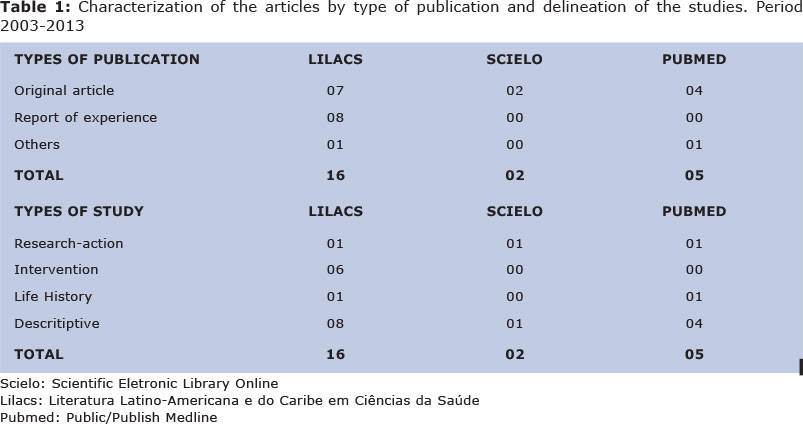
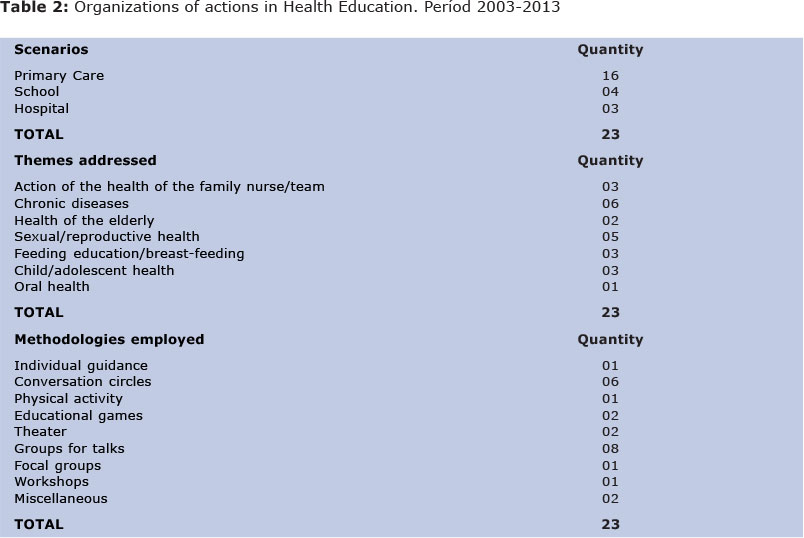
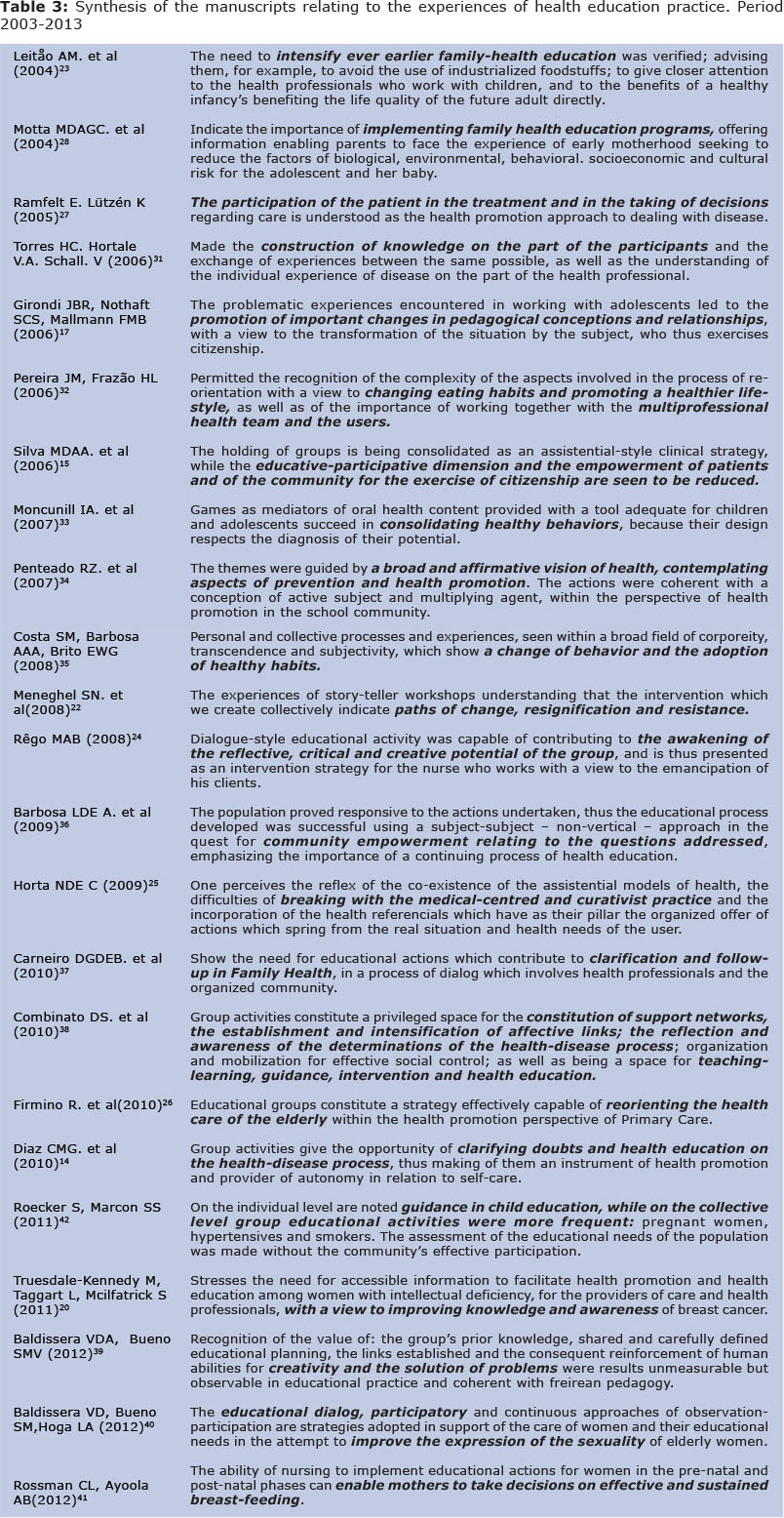
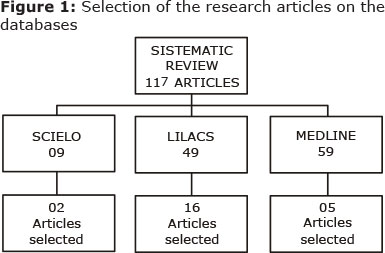
<body><![CDATA[<p><font face="Verdana, Arial, Helvetica, sans-serif" size="3"><b>METHODS</b></font></p>     <p><font face="Verdana, Arial, Helvetica, sans-serif" size="2">This is a systematic    survey carried out in the following stages: establishment of the hypothesis    and the objectives of the survey; establishment of the criteria for the inclusion    and exclusion of articles (selection of sample); definition of the information    to be culled from the articles selected, analysis of the results, discussion    and presentation of the results and the publication of the survey.</font></p>     <p><font face="Verdana, Arial, Helvetica, sans-serif" size="2">The following question    was formulated to guide the survey: Do the educational practices carried out    by the professionals concerned adopt distinct forms of organization and are    they consistent with the presuppositions of health promotion?</font></p>     <p><font face="Verdana, Arial, Helvetica, sans-serif" size="2">For the selection    of the articles to be analyzed a search was undertaken in the databases: Medline,    Lilacs and the Scientific Electronic Library - SciELo for articles published    during the period 2003 to 2013, inclusive. The search was undertaken by means    of the integrated method, using the terms: health promotion, health education    and experiences.</font></p>     <p><font face="Verdana, Arial, Helvetica, sans-serif" size="2">The inclusion criteria    defined for this present survey were that the studies should: deal with experiences    of educational practice, be articles, and have been published in Portuguese,    English or Spanish. Thus doctoral theses, masters' dissertations and letters    to the reader were excluded from this survey.</font></p>     <p><font face="Verdana, Arial, Helvetica, sans-serif" size="2">As may be seen    in <a href="#f1">figure 01</a>, 117 articles were found which addressed health    education, though after an exhaustive examination of the same on the basis of    a questionnaire for the identification of educational experiences, only articles    which assessed some experience in health education undertaken in health service    units were selected, thus giving a total of 23 studies, whether national or    foreign. See <a href="#f1">figure 01</a>.</font></p>     <p align="center"><a name="f1"></a></p>     <p align="center">&nbsp;</p>     <p align="center"><img src="/img/revistas/rbcdh/v24n3/04f01.jpg"></p>     <p align="center">&nbsp;</p>     ]]></body>
<body><![CDATA[<p><font face="Verdana, Arial, Helvetica, sans-serif" size="2">The articles were    then organized in tables which illustrate the characterization of the articles    as to type, year of publication and methodological approach adopted, as also    the organization of those actions and the evidence of the results obtained.</font></p>     <p>&nbsp;</p>     <p><font face="Verdana, Arial, Helvetica, sans-serif" size="3"><b>RESULTS</b></font></p>     <p><font face="Verdana, Arial, Helvetica, sans-serif" size="2">The distribution    of the manuscripts is set out in table form, as described below: <a href="/img/revistas/rbcdh/v24n3/04t01.jpg">table    1</a> classifies the articles by type of publication and description of the    contents; <a href="/img/revistas/rbcdh/v24n3/04t02.jpg">table 2</a> gives a characterization of    the health education actions described and <a href="/img/revistas/rbcdh/v24n3/04t03.jpg">table    3</a>, a synthesis of the results obtained, giving the perceived evidence on    the basis of the experiences studied.</font></p>     <p>&nbsp;</p>     <p><font face="Verdana, Arial, Helvetica, sans-serif" size="3"><b>DISCUSSION</b></font></p>     <p><font face="Verdana, Arial, Helvetica, sans-serif" size="2">In the light of    the transformation of the health paradigm, health education comes to acquire    a new configuration, in the sense of corresponding to the principles underlying    health promotion as regards the changes in behavior and the improvement in the    health of the population<sup>3</sup>. Thus, changes are called for - extending    from the organization of these practices to the health education model to be    applied.</font></p>     <p><font face="Verdana, Arial, Helvetica, sans-serif" size="2">In the light of    the above, it will be seen that the various scenarios in which health education    is practiced are addressed in the articles evaluated. However, units of primary    health care predominate as the preferred space for the implementation of the    actions - which are rarely undertaken in other scenarios.</font></p>     <p><font face="Verdana, Arial, Helvetica, sans-serif" size="2">In this same line    of enquiry, other research highlights the Family Health Strategy (the ESF) as    a basic element in the practical application of health education in the light    of the modifications made to conventional health care practices to create a    work model focusing on prevention and the promotion of family health, guided    by the principles of integrality and the hierarchical structuring of actions    in health service units<sup>13</sup><sub>.</sub></font></p>     <p><font face="Verdana, Arial, Helvetica, sans-serif" size="2">However, hospital    institutions have also been the scene for the development of these educational    actions, as a study has demonstrated. These argue that as one works on health    education in a hospital unit, it becomes possible to develop a new view of care    within the daily routine, as also to develop ideas and a team spirit to appreciate    the knowledge of each person, giving due attention to his beliefs, culture,    values, in defence of genuine care developed by an interdisciplinary team<sup>14</sup>.</font></p>     ]]></body>
<body><![CDATA[<p><font face="Verdana, Arial, Helvetica, sans-serif" size="2">We consider a change    of paradigm to be possible as regards health promotion in the atmosphere of    the hospital, where clinical practice and technique still predominate<sup>15</sup><sub>.    </sub>It is important to emphasize that the present needs of the individual    require that a new vision, a new posture, another culture should be cultivated    within hospitals with a view to working on health rather than disease.</font></p>     <p><font face="Verdana, Arial, Helvetica, sans-serif" size="2">However, even though    health services are highly important in guaranteeing the attention of individuals    and populations, the health conditions of the communities do not depend only    on them. Many health promotion and protection actions are undertaken by organizations    which do not belong to the sector. Thus, for example, the educational actions    undertaken in schools are noteworthy and are considered to be fundamental for    the promotion of health<sup>16</sup>.</font></p>     <p><font face="Verdana, Arial, Helvetica, sans-serif" size="2">Within this context,    on approaching sexuality within the school scene it is evidently of great importance    to create an atmosphere favorable to health promotion by means of health education,    seeing that this would act as a meaningful social space whither the adolescent    could take his experiences and expectations regarding life and express his curiosity    as regards sexuality, among other aspects of health<sup>17</sup>.</font></p>     <p><font face="Verdana, Arial, Helvetica, sans-serif" size="2">Thus it is important    to underline that it is not enough just to open a space for the promotion of    health, it is, further, necessary that that space should permit the creation,    in the users, of the awareness of their co-responsibility for these health promotion    practices, in the mobilization, training and development in the apprenticeship    of both individual and social abilities to deal with the health-disease process<sup>18</sup>.</font></p>     <p><font face="Verdana, Arial, Helvetica, sans-serif" size="2">Noteworthy among    the themes addressed within these different contexts, are the investigations    into chronic diseases as well as the focus on sexual and reproductive health.    These investigations sought to identify the relationship between the actions    of health education and their influence on the promotion of the health of individuals.    It is thus perceived that the ability of nursing to implement educational actions    for women in the pre- and post-natal periods may train the mothers to take decisions    to ensure efficacious and sustained breast-feeding<sup>19</sup>.</font></p>     <p><font face="Verdana, Arial, Helvetica, sans-serif" size="2">It has not yet    been possible to establish the need to make information accessible for the purpose    of promoting health promotion and education among women with some intellectual    deficiency, or the carers or health professionals so as to perfect their knowledge    and awareness regarding breast cancer<sup>20</sup><sub>.</sub></font></p>     <p><font face="Verdana, Arial, Helvetica, sans-serif" size="2">Investigations    inherent to sexual and reproductive health are justified as this is a broad    field which constitutes one of the integrating themes within the group of the    health promotion of the individual and the community, whereas, on the other    hand, the addition of groups predisposed to sexual and reproductive risk is    growing and calls for the intensification of health education actions within    this context<sup>14</sup>.</font></p>     <p><font face="Verdana, Arial, Helvetica, sans-serif" size="2">However, whereas    on one hand it is considered important to work on this theme among the elderly    population, on the other, sexual and reproductive health is a theme which is    frequently discussed with adolescents, when the subject is broached in the school    context with this public<sup>17</sup>.</font></p>     <p><font face="Verdana, Arial, Helvetica, sans-serif" size="2">On another point,    there are authors who highlight the fact that the Brazilian scene presents an    increased proportion of women with AIDS, though the mortality rate among this    population is smaller, which means that events related to the heterosexualization,    femininization and interiorization of this disease draw attention to the need    for action by means of the empowerment of the individuals concerned<sup>22</sup>.</font></p>     <p><font face="Verdana, Arial, Helvetica, sans-serif" size="2">Educational actions    have also been carried out to attend to chronic diseases, a fact which may be    justified by the increase in these diseases at the present time. When considering    this reality, therefore, studies point to the existence of two therapeutical    options made available to the public sector: those addressed to acute crises    and the demand seeking to address chronic diseases<sup>21</sup>.</font></p>     ]]></body>
<body><![CDATA[<p><font face="Verdana, Arial, Helvetica, sans-serif" size="2">Thus in the articles    assessed, when the follow-up of Systemic Arterial Hypertension - SAH in children    in the context of the ESF was investigated, it was discovered that there is    a need ever earlier to intensify education related to the health of families,    advising them, for example, to avoid the use of manufactures foodstuffs; to    pay more attention to the health professionals who work with children, and the    benefits of a healthy childhood which directly influences the quality of life    of the future adult<sup>23</sup>.</font></p>     <p><font face="Verdana, Arial, Helvetica, sans-serif" size="2">Thus, in working    with health education as an intervention strategy with sufferers of diabetes,    authors concluded that educational activity as a nursing intervention strategy    contributed to the awakening of the critical and creative reflection of the    group, constituting an intervention strategy for the nurse who seeks the emancipation    of his clients<sup>24</sup>.</font></p>     <p><font face="Verdana, Arial, Helvetica, sans-serif" size="2">As regards the    methodologies adopted for the implementation of the health education actions    assessed, various of them were investigated including: educational groups, conversation    groups, games, theater and workshops.</font></p>     <p><font face="Verdana, Arial, Helvetica, sans-serif" size="2">The use of the    group as a strategy for the practice of health education emerges as an instrument    which relates the various spheres of human life: the social sphere, seeing that    it permits the approximation, growth and sharing of interests and expectations,    builds up subjects who, in their turn, construct communities; and the biological,    which abbreviates the various environmental, constitutional and genetic determinations,    as well as expressing the personal attitude of each one, in the way in which    he interacts with the internal, physical, psychic and external environment<sup>15.    </sup></font></p>     <p><font face="Verdana, Arial, Helvetica, sans-serif" size="2">In the study of    the above-mentioned aspects, the educational actions of eight Family Health    Units (FHU) located in Cuiab&aacute;-MT-Brazil, which took place by means of    educational groups in which the professional nurse participated, were assessed<sup>15</sup>.    The actions were undertaken in the form of group activities as health promotion    actions. With this same focus, though undertaken in the municipalities of Belo    Horizonte-MG-Brazil and Contagem-MG-Brazil, the actions were assessed in groups    developed by health professionals of the Health Units<sup>25</sup>.</font></p>     <p><font face="Verdana, Arial, Helvetica, sans-serif" size="2">The educational    practices of a Gynecological-Obstetric Unit of a public hospital in Rio Grande    do Sul- RS- Brazil were also assessed. These occurred during guidance groups    on health promotion in pregnancy and the puerperium. Forty-nine guidance sessions    were held in which 54 pregnant women, 34 companions and 136 puerperae, as well    as professionals of the health team and academic nursing personnel, took part<sup>14</sup>.</font></p>     <p><font face="Verdana, Arial, Helvetica, sans-serif" size="2">However, other    studies bet on conversation groups as efficient instruments for health promotion,    emphasizing that these groups permitted the participants to have their say as    the subjects of the discourse. Thus narrative investigation arises as characteristic    of the cooperative process in which the participants play the role, which they    themselves live, and relate their stories, all at one and the same time<sup>22</sup>.</font></p>     <p><font face="Verdana, Arial, Helvetica, sans-serif" size="2">Within this context,    the above-mentioned authors concluded, as the result of their investigation,    that the story-teller workshops were efficacious, thus pointing the way forward    to change, re-signification and resistance, evidence which corroborates that    of another study that emphasizes that group activities create the opportunity    for the clarification of doubts and health education on the health-disease process,    thus becoming an instrument for health promotion and provider of autonomy with    regard to self-care<sup>14</sup>.</font></p>     <p><font face="Verdana, Arial, Helvetica, sans-serif" size="2">Further corroborating    those same authors, research reveals the effectiveness of educational groups    as a strategy capable of re-orienting the health care of the elderly within    the perspective of health promotion in Basic Care<sup>26</sup>.</font></p>     <p><font face="Verdana, Arial, Helvetica, sans-serif" size="2">The attempt to    include educational games has also been evidenced<sup>30</sup>. Within this    context, in considering the importance of the various ways of implementing actions    so that they attend to the principles of health promotion, the attempt to use    educational games contrasts with traditional pedagogy seeing that it allows    the pupil to be the active agent of his own knowledge<sup>27</sup>.</font></p>     ]]></body>
<body><![CDATA[<p><font face="Verdana, Arial, Helvetica, sans-serif" size="2">It is, however,    necessary to understand that, depending on how the educational actions are used    they may become simply a means of transmission of information, thus betraying    their original objective - that of creating conditions such as would produce    a transformation of behavior, also being practices that would result in cure,    encouraging the medicalization of society in the search for responses to disease.</font></p>     <p><font face="Verdana, Arial, Helvetica, sans-serif" size="2">Within this context,    some results of the studies under analysis stand out as pointing to educational    actions consistent with health promotion at the same time as traditional actions,    undertaken simply for the transmission of information, are also evidenced.</font></p>     <p><font face="Verdana, Arial, Helvetica, sans-serif" size="2">It is clear that    the nurses hold groups with existing programmatic clippings in force in the    practice of traditional public health, reduced to collective information on    diseases and their treatment, becoming consolidated as an assistentialist strategy    while the dimension of empowerment for the exercise of citizenship is reduced<sup>15</sup>.</font></p>     <p><font face="Verdana, Arial, Helvetica, sans-serif" size="2">When the practice    of groups as health promotion actions within the family health strategy was    investigated, the use of traditional educational methodologies, such as talks    for the transmission of information, became clear, as also did the slight participation    of the members of the group because these do not often attend to their needs    seeing that they are organized in accordance with the interest of the professional    concerned<sup>25</sup>.</font></p>     <p><font face="Verdana, Arial, Helvetica, sans-serif" size="2">Within the prospect    of health promotion contributing to a possible change in behavior, the reflective,    critical and creative potential of the group may be presented as evidence, thus    constituting an important intervention strategy for the nurse who works with    a view to the emancipation of their clients<sup>24</sup>.</font></p>     <p><font face="Verdana, Arial, Helvetica, sans-serif" size="2">The authors conclude,    further, that group activities give the opportunity for the clarification of    doubts and health education regarding the health-disease process, thus becoming    a tool for health promotion and provider of autonomy in terms of self-care<sup>14</sup>.    They should thus be accessible so as to facilitate the health promotion which    perfects individuals' knowledge and awareness<sup>23</sup> .</font></p>     <p><font face="Verdana, Arial, Helvetica, sans-serif" size="2">Also noteworthy    are some studies which emphasize decision-making in health, made possible by    the undertaking of educational actions within the perspective of health promotion<sup>20</sup>.</font></p>     <p><font face="Verdana, Arial, Helvetica, sans-serif" size="2">Health education    groups are thus seen as providing an atmosphere which promotes individual and    collective empowerment as they give value to the participation of the population    in general, strengthening the social control of the services as well as making    educational work more adequate. They, therefore, promote personal social development    by disseminating information and stimulating dialog. It should be emphasized    that enabling people to learn during their lives is a crucial element in the    various phases of their lives as it enables them to face up to and take decisions    as regards the maintenance of their health<sup>28</sup>.</font></p>     <p><font face="Verdana, Arial, Helvetica, sans-serif" size="2">It should be emphasized    that educational actions constitute the range of situations which characterize    the delivery of services to the population and that the involvement of all the    actors is an unequalled condition for the full exercise of public health<sup>29</sup>.    Thus the systematic action on the part of government and associated organizations    is necessary to reach the population, as for example, women and the new-born    with a view to effective attendance<sup>30</sup>. It is therefore understood    that actions consistent with the presuppositions of health promotion are of    great importance for the achievement of quality of life and equity in health;    the implementation of these actions being a challenge in view of the predominance    of curative and individualistic practices.</font></p>     <p><font face="Verdana, Arial, Helvetica, sans-serif" size="2">Finally, health    education, understood as an instrument to make health promotion actions viable,    has been gaining ground since the Ottawa Conference, though in Brazil it has    advanced on the basis of the process of health reform, more precisely with the    change of the public assistance model which has been making new practices in    the sector possible and affirming the impossibility of separating clinical work    and health promotion.</font></p>     ]]></body>
<body><![CDATA[<p><font face="Verdana, Arial, Helvetica, sans-serif" size="2">Researchers are    concerned as regards the organization of these actions as to whether they are    consistent with health promotion. The challenge for health professionals is    that they should work within the health promotion perspective, seeing that they    are involved in a model which seeks the empowerment of the users.</font></p>     <p>&nbsp;</p>     <p><font face="Verdana, Arial, Helvetica, sans-serif" size="3"><b>REFERENCES</b></font></p>     <!-- ref --><p><font face="Verdana, Arial, Helvetica, sans-serif" size="2">1. Rocha V, Schall    VT, Lemos ES. A contribui&ccedil;&atilde;o de um museu de ci&ecirc;ncias na    forma&ccedil;&atilde;o de concep&ccedil;&otilde;es sobre sa&uacute;de de jovens    visitantes. Interface - Comunic., Sa&uacute;de, Educ. 2010; 14: 183-96. Dispon&iacute;vel    em: &lt;<a href="http://www.scielo.br/pdf/icse/v14n32/15.pdf" target="_blank">http://www.scielo.br/pdf/icse/v14n32/15.pdf</a>&gt;.    Acesso em: 24 nov. 2011. doi: 10.1590/S1414-32832010000100015.    &nbsp;&nbsp;&nbsp;&nbsp;&nbsp;&nbsp;&nbsp;&nbsp;[&#160;<a href="javascript:void(0);" onclick="javascript: window.open('/scielo.php?script=sci_nlinks&ref=2507820&pid=S0104-1282201400030000400001&lng=','','width=640,height=500,resizable=yes,scrollbars=1,menubar=yes,');">Links</a>&#160;]<!-- end-ref --></font></p>     <!-- ref --><p><font face="Verdana, Arial, Helvetica, sans-serif" size="2">2. Alves VS. Um    modelo de educa&ccedil;&atilde;o em sa&uacute;de para o Programa Sa&uacute;de    da Fam&iacute;lia: pela integralidade da aten&ccedil;&atilde;o e reorienta&ccedil;&atilde;o    do modelo assistencial. Interface (Botucatu), 2005: 9.    &nbsp;&nbsp;&nbsp;&nbsp;&nbsp;&nbsp;&nbsp;&nbsp;[&#160;<a href="javascript:void(0);" onclick="javascript: window.open('/scielo.php?script=sci_nlinks&ref=2507822&pid=S0104-1282201400030000400002&lng=','','width=640,height=500,resizable=yes,scrollbars=1,menubar=yes,');">Links</a>&#160;]<!-- end-ref --></font></p>     <!-- ref --><p><font face="Verdana, Arial, Helvetica, sans-serif" size="2">3. Maciel MED.    Educa&ccedil;&atilde;o em sa&uacute;de: conceitos e prop&oacute;sitos. Cogitare    Enferm.2009; 14&ordm;: 773-6.    &nbsp;&nbsp;&nbsp;&nbsp;&nbsp;&nbsp;&nbsp;&nbsp;[&#160;<a href="javascript:void(0);" onclick="javascript: window.open('/scielo.php?script=sci_nlinks&ref=2507824&pid=S0104-1282201400030000400003&lng=','','width=640,height=500,resizable=yes,scrollbars=1,menubar=yes,');">Links</a>&#160;]<!-- end-ref --></font></p>     <!-- ref --><p><font face="Verdana, Arial, Helvetica, sans-serif" size="2">4. Carvalho SR.    As contradi&ccedil;&otilde;es da promo&ccedil;&atilde;o &agrave; sa&uacute;de    em rela&ccedil;&atilde;o &agrave; produ&ccedil;&atilde;o de sujeitos e a mudan&ccedil;a    social. Ci&ecirc;nc. sa&uacute;de coletiva. 2004; 9: 669-678.    &nbsp;&nbsp;&nbsp;&nbsp;&nbsp;&nbsp;&nbsp;&nbsp;[&#160;<a href="javascript:void(0);" onclick="javascript: window.open('/scielo.php?script=sci_nlinks&ref=2507826&pid=S0104-1282201400030000400004&lng=','','width=640,height=500,resizable=yes,scrollbars=1,menubar=yes,');">Links</a>&#160;]<!-- end-ref --></font></p>     <!-- ref --><p><font face="Verdana, Arial, Helvetica, sans-serif" size="2">5. Buss PM. Promo&ccedil;&atilde;o    da sa&uacute;de e qualidade de vida. Ci&ecirc;nc e Sa&uacute;de Coletiva. 2000,    5: 163-77-5.    &nbsp;&nbsp;&nbsp;&nbsp;&nbsp;&nbsp;&nbsp;&nbsp;[&#160;<a href="javascript:void(0);" onclick="javascript: window.open('/scielo.php?script=sci_nlinks&ref=2507828&pid=S0104-1282201400030000400005&lng=','','width=640,height=500,resizable=yes,scrollbars=1,menubar=yes,');">Links</a>&#160;]<!-- end-ref --></font></p>     <!-- ref --><p><font face="Verdana, Arial, Helvetica, sans-serif" size="2">6. Brasil. Minist&eacute;rio    da Sa&uacute;de. Projeto promo&ccedil;&atilde;o de sa&uacute;de: Carta de Ottawa.    Secretaria de Pol&iacute;tica de Sa&uacute;de. Bras&iacute;lia, DF, 2001.    &nbsp;&nbsp;&nbsp;&nbsp;&nbsp;&nbsp;&nbsp;&nbsp;[&#160;<a href="javascript:void(0);" onclick="javascript: window.open('/scielo.php?script=sci_nlinks&ref=2507830&pid=S0104-1282201400030000400006&lng=','','width=640,height=500,resizable=yes,scrollbars=1,menubar=yes,');">Links</a>&#160;]<!-- end-ref --></font></p>     <!-- ref --><p><font face="Verdana, Arial, Helvetica, sans-serif" size="2">7. Bordenave JD,    Pereira AM. <i>Estrat&eacute;gias ensino-aprendizagem</i>. 28.ed. Petr&oacute;polis:    Vozes, 2007.    &nbsp;&nbsp;&nbsp;&nbsp;&nbsp;&nbsp;&nbsp;&nbsp;[&#160;<a href="javascript:void(0);" onclick="javascript: window.open('/scielo.php?script=sci_nlinks&ref=2507832&pid=S0104-1282201400030000400007&lng=','','width=640,height=500,resizable=yes,scrollbars=1,menubar=yes,');">Links</a>&#160;]<!-- end-ref --></font></p>     <!-- ref --><p><font face="Verdana, Arial, Helvetica, sans-serif" size="2">8. Freire P. <i>Educa&ccedil;&atilde;o    e mudan&ccedil;as</i>. 30.ed. Rio de Janeiro: Paz e Terra, 2007.    &nbsp;&nbsp;&nbsp;&nbsp;&nbsp;&nbsp;&nbsp;&nbsp;[&#160;<a href="javascript:void(0);" onclick="javascript: window.open('/scielo.php?script=sci_nlinks&ref=2507834&pid=S0104-1282201400030000400008&lng=','','width=640,height=500,resizable=yes,scrollbars=1,menubar=yes,');">Links</a>&#160;]<!-- end-ref --></font></p>     <!-- ref --><p><font face="Verdana, Arial, Helvetica, sans-serif" size="2">9. Pontes APM,    Cesso RGD, Oliveira DC, Gomes AMT. Facilidades de acesso reveladas pelos usu&aacute;rios    do Sistema &Uacute;nico de Sa&uacute;de. Rev. bras. Enferm. 2010; 63.    &nbsp;&nbsp;&nbsp;&nbsp;&nbsp;&nbsp;&nbsp;&nbsp;[&#160;<a href="javascript:void(0);" onclick="javascript: window.open('/scielo.php?script=sci_nlinks&ref=2507836&pid=S0104-1282201400030000400009&lng=','','width=640,height=500,resizable=yes,scrollbars=1,menubar=yes,');">Links</a>&#160;]<!-- end-ref --></font></p>     <!-- ref --><p><font face="Verdana, Arial, Helvetica, sans-serif" size="2">10. Minist&eacute;rio    da Sa&uacute;de (BR). Sa&uacute;de dentro de casa: Programa de Sa&uacute;de    da Fam&iacute;lia<i>. </i>Funda&ccedil;&atilde;o Nacional da Sa&uacute;de. Bras&iacute;lia,    DF, 1994.    &nbsp;&nbsp;&nbsp;&nbsp;&nbsp;&nbsp;&nbsp;&nbsp;[&#160;<a href="javascript:void(0);" onclick="javascript: window.open('/scielo.php?script=sci_nlinks&ref=2507838&pid=S0104-1282201400030000400010&lng=','','width=640,height=500,resizable=yes,scrollbars=1,menubar=yes,');">Links</a>&#160;]<!-- end-ref --></font></p>     <!-- ref --><p><font face="Verdana, Arial, Helvetica, sans-serif" size="2">11. Minist&eacute;rio    da Sa&uacute;de (BR). Pol&iacute;tica Nacional da Promo&ccedil;&atilde;o da    Sa&uacute;de. <i>Secretaria de Vigil&acirc;ncia a Sa&uacute;de. </i>Secretaria    da Aten&ccedil;&atilde;o B&aacute;sica. Bras&iacute;lia, DF: 2006.    &nbsp;&nbsp;&nbsp;&nbsp;&nbsp;&nbsp;&nbsp;&nbsp;[&#160;<a href="javascript:void(0);" onclick="javascript: window.open('/scielo.php?script=sci_nlinks&ref=2507840&pid=S0104-1282201400030000400011&lng=','','width=640,height=500,resizable=yes,scrollbars=1,menubar=yes,');">Links</a>&#160;]<!-- end-ref --></font></p>     <!-- ref --><p><font face="Verdana, Arial, Helvetica, sans-serif" size="2">12. Tesser CD,    Garcia AV,Argenta CE, Vendrusculo C. Concep&ccedil;&otilde;es de promo&ccedil;&atilde;o    da sa&uacute;de que permeiam o ide&aacute;rio de equipes da estrat&eacute;gia    sa&uacute;de da fam&iacute;lia da grande Florian&oacute;polis. R. Sa&uacute;de    P&uacute;bl. Santa Cat. 2010; 3.    &nbsp;&nbsp;&nbsp;&nbsp;&nbsp;&nbsp;&nbsp;&nbsp;[&#160;<a href="javascript:void(0);" onclick="javascript: window.open('/scielo.php?script=sci_nlinks&ref=2507842&pid=S0104-1282201400030000400012&lng=','','width=640,height=500,resizable=yes,scrollbars=1,menubar=yes,');">Links</a>&#160;]<!-- end-ref --></font></p>     <!-- ref --><p><font face="Verdana, Arial, Helvetica, sans-serif" size="2">13. Roecker S,    Marcon SS. Educa&ccedil;&atilde;o em sa&uacute;de. Relatos das viv&ecirc;ncias    de enfermeiros com a Estrat&eacute;gia da Sa&uacute;de Familiar. Invest. educ.    enferm nov. 2011; 29: 381-90.    &nbsp;&nbsp;&nbsp;&nbsp;&nbsp;&nbsp;&nbsp;&nbsp;[&#160;<a href="javascript:void(0);" onclick="javascript: window.open('/scielo.php?script=sci_nlinks&ref=2507844&pid=S0104-1282201400030000400013&lng=','','width=640,height=500,resizable=yes,scrollbars=1,menubar=yes,');">Links</a>&#160;]<!-- end-ref --></font></p>     <!-- ref --><p><font face="Verdana, Arial, Helvetica, sans-serif" size="2">14. Diaz CMG, Hoffmann    IC, Costenaro RGS, Soares RS, Silva BR, Lavall BC. Viv&ecirc;ncias educativas    da equipe de sa&uacute;de em Unidade gineco-obst&eacute;trica. Cogitare Enferm.    2010; 15: 364-7.    &nbsp;&nbsp;&nbsp;&nbsp;&nbsp;&nbsp;&nbsp;&nbsp;[&#160;<a href="javascript:void(0);" onclick="javascript: window.open('/scielo.php?script=sci_nlinks&ref=2507846&pid=S0104-1282201400030000400014&lng=','','width=640,height=500,resizable=yes,scrollbars=1,menubar=yes,');">Links</a>&#160;]<!-- end-ref --></font></p>     <!-- ref --><p><font face="Verdana, Arial, Helvetica, sans-serif" size="2">15. Silva MAM,    Pinheiro AKB, Souza &Acirc;M A, Moreira ACA. Promo&ccedil;&atilde;o da sa&uacute;de    em ambientes hospitalares.<i> </i>Rev. bras. enferm. [online]. 2011; 64: 596-599.    Dispon&iacute;vel em: <a href="http://www.scielo.br/scielo.php?script%20=sci_serial&pid=0034-7167&lng=en&nrm=iso" target="_blank">http://www.scielo.br/scielo.php?script    =sci_serial&amp;pid=0034-7167&amp;lng=en&amp;nrm=iso</a>.    &nbsp;&nbsp;&nbsp;&nbsp;&nbsp;&nbsp;&nbsp;&nbsp;[&#160;<a href="javascript:void(0);" onclick="javascript: window.open('/scielo.php?script=sci_nlinks&ref=2507848&pid=S0104-1282201400030000400015&lng=','','width=640,height=500,resizable=yes,scrollbars=1,menubar=yes,');">Links</a>&#160;]<!-- end-ref --></font></p>     <!-- ref --><p><font face="Verdana, Arial, Helvetica, sans-serif" size="2">16. Paim JS. Desafios    para Sa&uacute;de Coletiva no s&eacute;culo XXI. Salvador-Ba: EDUFBA, 2009:90</font>&nbsp;&nbsp;&nbsp;&nbsp;&nbsp;&nbsp;&nbsp;&nbsp;[&#160;<a href="javascript:void(0);" onclick="javascript: window.open('/scielo.php?script=sci_nlinks&ref=2507850&pid=S0104-1282201400030000400016&lng=','','width=640,height=500,resizable=yes,scrollbars=1,menubar=yes,');">Links</a>&#160;]<!-- end-ref --><!-- ref --><p><font face="Verdana, Arial, Helvetica, sans-serif" size="2">17. Girondi JBR,    Nothaf SC dos S, Mallmann FMB. A metodologia problematizadora utilizada pelo    enfermeiro na educa&ccedil;&atilde;o sexual de adolescentes. Cogitare Enferm.    2006; 11:161-5.    &nbsp;&nbsp;&nbsp;&nbsp;&nbsp;&nbsp;&nbsp;&nbsp;[&#160;<a href="javascript:void(0);" onclick="javascript: window.open('/scielo.php?script=sci_nlinks&ref=2507851&pid=S0104-1282201400030000400017&lng=','','width=640,height=500,resizable=yes,scrollbars=1,menubar=yes,');">Links</a>&#160;]<!-- end-ref --></font></p>     <!-- ref --><p><font face="Verdana, Arial, Helvetica, sans-serif" size="2">18. Machado MFAS,    Vieira, NFC. Educa&ccedil;&atilde;o em sa&uacute;de: o olhar da equipe de sa&uacute;de    da fam&iacute;lia e a participa&ccedil;&atilde;o do usu&aacute;rio. Rev. Latino-Am.    Enfermagem.2009:17.    &nbsp;&nbsp;&nbsp;&nbsp;&nbsp;&nbsp;&nbsp;&nbsp;[&#160;<a href="javascript:void(0);" onclick="javascript: window.open('/scielo.php?script=sci_nlinks&ref=2507853&pid=S0104-1282201400030000400018&lng=','','width=640,height=500,resizable=yes,scrollbars=1,menubar=yes,');">Links</a>&#160;]<!-- end-ref --></font></p>     <!-- ref --><p><font face="Verdana, Arial, Helvetica, sans-serif" size="2">19. Rossman CL,    Ayolla AB. Promover experi&ecirc;ncias de amamenta&ccedil;&atilde;o. individualizados.    MCN Am J Matern Child Nurs. 2012; 37:193-199.    &nbsp;&nbsp;&nbsp;&nbsp;&nbsp;&nbsp;&nbsp;&nbsp;[&#160;<a href="javascript:void(0);" onclick="javascript: window.open('/scielo.php?script=sci_nlinks&ref=2507855&pid=S0104-1282201400030000400019&lng=','','width=640,height=500,resizable=yes,scrollbars=1,menubar=yes,');">Links</a>&#160;]<!-- end-ref --></font></p>     ]]></body>
<body><![CDATA[<!-- ref --><p><font face="Verdana, Arial, Helvetica, sans-serif" size="2">20. Maria Truesdale-Kennedy<sup>1</sup>,    Laurence Taggart<sup>2</sup>, Sonja McIlfatrick<sup>3. </sup>Breast cancer knowledge    among women with intellectual disabilities and their experiences of receiving    breast mammography. Journal of Advanced Nursing. 2011. 67: 1294-1304.    &nbsp;&nbsp;&nbsp;&nbsp;&nbsp;&nbsp;&nbsp;&nbsp;[&#160;<a href="javascript:void(0);" onclick="javascript: window.open('/scielo.php?script=sci_nlinks&ref=2507857&pid=S0104-1282201400030000400020&lng=','','width=640,height=500,resizable=yes,scrollbars=1,menubar=yes,');">Links</a>&#160;]<!-- end-ref --></font></p>     <!-- ref --><p><font face="Verdana, Arial, Helvetica, sans-serif" size="2">21. Moretti AC.    et al . Pr&aacute;ticas corporais/atividade f&iacute;sica e pol&iacute;ticas    p&uacute;blicas de promo&ccedil;&atilde;o da sa&uacute;de. Sa&uacute;de soc.2009;18.    &nbsp;&nbsp;&nbsp;&nbsp;&nbsp;&nbsp;&nbsp;&nbsp;[&#160;<a href="javascript:void(0);" onclick="javascript: window.open('/scielo.php?script=sci_nlinks&ref=2507859&pid=S0104-1282201400030000400021&lng=','','width=640,height=500,resizable=yes,scrollbars=1,menubar=yes,');">Links</a>&#160;]<!-- end-ref --></font></p>     <!-- ref --><p><font face="Verdana, Arial, Helvetica, sans-serif" size="2">22. Meneghel SN,    Farina O, Silva LB da, Walter L, Brito SG, Selli L, Schneider V. Hist&oacute;rias    de Dor e de Vida: oficinas de contadores de hist&oacute;rias. Sa&uacute;de Soc.    2008; 17: 220-228</font>&nbsp;&nbsp;&nbsp;&nbsp;&nbsp;&nbsp;&nbsp;&nbsp;[&#160;<a href="javascript:void(0);" onclick="javascript: window.open('/scielo.php?script=sci_nlinks&ref=2507861&pid=S0104-1282201400030000400022&lng=','','width=640,height=500,resizable=yes,scrollbars=1,menubar=yes,');">Links</a>&#160;]<!-- end-ref --><!-- ref --><p><font face="Verdana, Arial, Helvetica, sans-serif" size="2">23. Leit&aring;o    A, Souza C, Silva E, Barbosa E, Santos E, Ramos E, Lima G, Silveira L, Ramos    L, Silva M, Nascimento S. Preven&ccedil;&aring;o de hipertens&aring;o arterial    em crian&ccedil;as de 3 a 12 anos na comunidade de Jo&aring;o Paulo II. Divulg.    sa&uacute;de debate 2004 dez; 3: 66-68.    &nbsp;&nbsp;&nbsp;&nbsp;&nbsp;&nbsp;&nbsp;&nbsp;[&#160;<a href="javascript:void(0);" onclick="javascript: window.open('/scielo.php?script=sci_nlinks&ref=2507862&pid=S0104-1282201400030000400023&lng=','','width=640,height=500,resizable=yes,scrollbars=1,menubar=yes,');">Links</a>&#160;]<!-- end-ref --></font></p>     <!-- ref --><p><font face="Verdana, Arial, Helvetica, sans-serif" size="2">24. R&ecirc;go    MAB. Educa&ccedil;&atilde;o para sa&uacute;de como estrat&eacute;gia de interven&ccedil;&atilde;o    de enfermagem junto &agrave;s pessoas portadoras de diabetes. <i>Rev Eletr&ocirc;nica    Enferm</i> [peri&oacute;dico na internet]. 2008 [acesso em 28 janeiro 2013];    10(1):263-5. Dispon&iacute;vel em: <a href="http://www.fen.ufg.br/revista/v10/n1/v10n1a30.htm" target="_blank">http://www.fen.ufg.br/revista/v10/n1/v10n1a30.htm</a></font>&nbsp;&nbsp;&nbsp;&nbsp;&nbsp;&nbsp;&nbsp;&nbsp;[&#160;<a href="javascript:void(0);" onclick="javascript: window.open('/scielo.php?script=sci_nlinks&ref=2507864&pid=S0104-1282201400030000400024&lng=','','width=640,height=500,resizable=yes,scrollbars=1,menubar=yes,');">Links</a>&#160;]<!-- end-ref --><!-- ref --><p><font face="Verdana, Arial, Helvetica, sans-serif" size="2">25. Horta NC, Sena    RR, Silva MEO, Tavares TS, Caldeira IM. A pr&aacute;tica de grupos como a&ccedil;&atilde;o    de promo&ccedil;&atilde;o da sa&uacute;de na estrat&eacute;gia sa&uacute;de    da fam&iacute;lia. Rev. APS jul/set. 2009; 12: 293-301.    &nbsp;&nbsp;&nbsp;&nbsp;&nbsp;&nbsp;&nbsp;&nbsp;[&#160;<a href="javascript:void(0);" onclick="javascript: window.open('/scielo.php?script=sci_nlinks&ref=2507865&pid=S0104-1282201400030000400025&lng=','','width=640,height=500,resizable=yes,scrollbars=1,menubar=yes,');">Links</a>&#160;]<!-- end-ref --></font></p>     ]]></body>
<body><![CDATA[<!-- ref --><p><font face="Verdana, Arial, Helvetica, sans-serif" size="2">26. Firmino R,    Patr&iacute;cio J, Rodrigues L, Cruz P, Vasconcelos AC. Educa&ccedil;&atilde;o    popular e promo&ccedil;&atilde;o da sa&uacute;de do idoso: reflex&otilde;es    a partir de uma experi&ecirc;ncia de extens&atilde;o universit&aacute;ria com    grupos de idosos em Jo&atilde;o Pessoa-PB. Rev. APS out.-dez. 2010; 13: 523-30.    &nbsp;&nbsp;&nbsp;&nbsp;&nbsp;&nbsp;&nbsp;&nbsp;[&#160;<a href="javascript:void(0);" onclick="javascript: window.open('/scielo.php?script=sci_nlinks&ref=2507867&pid=S0104-1282201400030000400026&lng=','','width=640,height=500,resizable=yes,scrollbars=1,menubar=yes,');">Links</a>&#160;]<!-- end-ref --></font></p>     <!-- ref --><p><font face="Verdana, Arial, Helvetica, sans-serif" size="2">27. Ramfelt, L&uuml;tz&eacute;n    K. Patients with cancer: their approaches to participation in treatment plan    decisions. Rev. Nurs Ethics Mar. 2005, 12: 143-55.    &nbsp;&nbsp;&nbsp;&nbsp;&nbsp;&nbsp;&nbsp;&nbsp;[&#160;<a href="javascript:void(0);" onclick="javascript: window.open('/scielo.php?script=sci_nlinks&ref=2507869&pid=S0104-1282201400030000400027&lng=','','width=640,height=500,resizable=yes,scrollbars=1,menubar=yes,');">Links</a>&#160;]<!-- end-ref --></font></p>     <!-- ref --><p><font face="Verdana, Arial, Helvetica, sans-serif" size="2">28. Motta MGC,    Ribeiro Nair RR, Pedro ENR, Coelho DF. Adolescent mother experience and her    family. Acta sci., Health sci. 2004; 26: 249-256.    &nbsp;&nbsp;&nbsp;&nbsp;&nbsp;&nbsp;&nbsp;&nbsp;[&#160;<a href="javascript:void(0);" onclick="javascript: window.open('/scielo.php?script=sci_nlinks&ref=2507871&pid=S0104-1282201400030000400028&lng=','','width=640,height=500,resizable=yes,scrollbars=1,menubar=yes,');">Links</a>&#160;]<!-- end-ref --></font></p>     <!-- ref --><p><font face="Verdana, Arial, Helvetica, sans-serif" size="2">29. Atrash HK,    Carpentier R. The evolving role of public health in the delivery of health care.    Journal of Human Growth and Development, 2012; 22(3): 396-399.    &nbsp;&nbsp;&nbsp;&nbsp;&nbsp;&nbsp;&nbsp;&nbsp;[&#160;<a href="javascript:void(0);" onclick="javascript: window.open('/scielo.php?script=sci_nlinks&ref=2507873&pid=S0104-1282201400030000400029&lng=','','width=640,height=500,resizable=yes,scrollbars=1,menubar=yes,');">Links</a>&#160;]<!-- end-ref --></font></p>     <!-- ref --><p><font face="Verdana, Arial, Helvetica, sans-serif" size="2">30. Atrash HK.    Childhood mortality: still a global priority. Journal of Human Growth and Development,    2013; 23(3): 257-260.    &nbsp;&nbsp;&nbsp;&nbsp;&nbsp;&nbsp;&nbsp;&nbsp;[&#160;<a href="javascript:void(0);" onclick="javascript: window.open('/scielo.php?script=sci_nlinks&ref=2507875&pid=S0104-1282201400030000400030&lng=','','width=640,height=500,resizable=yes,scrollbars=1,menubar=yes,');">Links</a>&#160;]<!-- end-ref --></font></p>     ]]></body>
<body><![CDATA[<!-- ref --><p><font face="Verdana, Arial, Helvetica, sans-serif" size="2">31. Torres HC,    Hortale VA, Schall V. A experi&ecirc;ncia de jogos em grupos operativos Na educa&ccedil;&atilde;o    em sa&uacute;de para diab&eacute;tico. Cad. Sa&uacute;de P&uacute;blica, Rio    de Janeiro. 2003; 19: 1039-1047.    &nbsp;&nbsp;&nbsp;&nbsp;&nbsp;&nbsp;&nbsp;&nbsp;[&#160;<a href="javascript:void(0);" onclick="javascript: window.open('/scielo.php?script=sci_nlinks&ref=2507877&pid=S0104-1282201400030000400031&lng=','','width=640,height=500,resizable=yes,scrollbars=1,menubar=yes,');">Links</a>&#160;]<!-- end-ref --></font></p>     <!-- ref --><p><font face="Verdana, Arial, Helvetica, sans-serif" size="2">32. Pereira J M,    Helene L M F. Reeduca&ccedil;&atilde;o alimentar e um grupo de pessoas com sobrepeso    e Obesidade: relato de experi&ecirc;ncia. Revista Espa&ccedil;o para a Sa&uacute;de,    Londrina. 2006; 7: 32-38</font>&nbsp;&nbsp;&nbsp;&nbsp;&nbsp;&nbsp;&nbsp;&nbsp;[&#160;<a href="javascript:void(0);" onclick="javascript: window.open('/scielo.php?script=sci_nlinks&ref=2507879&pid=S0104-1282201400030000400032&lng=','','width=640,height=500,resizable=yes,scrollbars=1,menubar=yes,');">Links</a>&#160;]<!-- end-ref --><!-- ref --><p><font face="Verdana, Arial, Helvetica, sans-serif" size="2">33. Moncunill IA,    Hilas,E, Calamari SE, Molina G, Cornejo LS. Estrategia mediadora para la promoci&oacute;n    de salud bucal en ni&ntilde;os y adolescentes con s&iacute;ndrome de Down/ No    disponible. Rev. S&iacute;ndr. Down. 2007; 24: 62-67.    &nbsp;&nbsp;&nbsp;&nbsp;&nbsp;&nbsp;&nbsp;&nbsp;[&#160;<a href="javascript:void(0);" onclick="javascript: window.open('/scielo.php?script=sci_nlinks&ref=2507880&pid=S0104-1282201400030000400033&lng=','','width=640,height=500,resizable=yes,scrollbars=1,menubar=yes,');">Links</a>&#160;]<!-- end-ref --></font></p>     <!-- ref --><p><font face="Verdana, Arial, Helvetica, sans-serif" size="2">34. Penteado RZ,    Camargo AMD, Rodrigues CF, Silva CR, Ross D, Silva JTC. et al. Viv&ecirc;ncia    de voz com crian&ccedil;as:an&aacute;lise do processo educativo em sa&uacute;de    vocal. Dist&uacute;rb Comun, S&atilde;o Paulo. 2007; 19: 237-246.    &nbsp;&nbsp;&nbsp;&nbsp;&nbsp;&nbsp;&nbsp;&nbsp;[&#160;<a href="javascript:void(0);" onclick="javascript: window.open('/scielo.php?script=sci_nlinks&ref=2507882&pid=S0104-1282201400030000400034&lng=','','width=640,height=500,resizable=yes,scrollbars=1,menubar=yes,');">Links</a>&#160;]<!-- end-ref --></font></p>     <!-- ref --><p><font face="Verdana, Arial, Helvetica, sans-serif" size="2">35. Costa GD, Cotta    RMM, Ferreira MLSM, Reis JR, Franceschini SCC. Sa&uacute;de da fam&iacute;lia:    desafios no processo de reorienta&ccedil;&atilde;o do modelo assistencial. Rev    Bras Enferm Bras&iacute;lia. 2009; 62: 113-8</font>&nbsp;&nbsp;&nbsp;&nbsp;&nbsp;&nbsp;&nbsp;&nbsp;[&#160;<a href="javascript:void(0);" onclick="javascript: window.open('/scielo.php?script=sci_nlinks&ref=2507884&pid=S0104-1282201400030000400035&lng=','','width=640,height=500,resizable=yes,scrollbars=1,menubar=yes,');">Links</a>&#160;]<!-- end-ref --><!-- ref --><p><font face="Verdana, Arial, Helvetica, sans-serif" size="2">36. Barbosa LA,    Sampaio ALA, Melo ALA, Macedo APN, Machado MFAS. A educa&ccedil;&atilde;o em    sa&uacute;de como instrumento na Preven&ccedil;&atilde;o de parasitoses. RBPS,    Fortaleza. 2009; 22: 272-278.    &nbsp;&nbsp;&nbsp;&nbsp;&nbsp;&nbsp;&nbsp;&nbsp;[&#160;<a href="javascript:void(0);" onclick="javascript: window.open('/scielo.php?script=sci_nlinks&ref=2507885&pid=S0104-1282201400030000400036&lng=','','width=640,height=500,resizable=yes,scrollbars=1,menubar=yes,');">Links</a>&#160;]<!-- end-ref --></font></p>     ]]></body>
<body><![CDATA[<!-- ref --><p><font face="Verdana, Arial, Helvetica, sans-serif" size="2">37. Carneiro DGB,    Magalh&atilde;es KLO, Vasconcelos ACCP, Cruz PJSC. O agente comunit&aacute;rio    de sa&uacute;de e a promo&ccedil;&atilde;o da seguran&ccedil;a alimentar e nutricional    na estrat&eacute;gia sa&uacute;de da fam&iacute;lia: reflex&otilde;es a partir    de uma experi&ecirc;ncia educativa. Rev. APS;13(4), out.-dez. 2010.    &nbsp;&nbsp;&nbsp;&nbsp;&nbsp;&nbsp;&nbsp;&nbsp;[&#160;<a href="javascript:void(0);" onclick="javascript: window.open('/scielo.php?script=sci_nlinks&ref=2507887&pid=S0104-1282201400030000400037&lng=','','width=640,height=500,resizable=yes,scrollbars=1,menubar=yes,');">Links</a>&#160;]<!-- end-ref --></font></p>     <!-- ref --><p><font face="Verdana, Arial, Helvetica, sans-serif" size="2">38. Combinato DS,    Dalla Vecchia M., Lopes EG, Manoel RA, Marino HD, Oliveira AC. et al. "Grupos    de conversa": sa&uacute;de da pessoa Idosa na estrat&eacute;gia sa&uacute;de    da fam&iacute;lia. Psicologia &amp; Sociedade. 2010; 22: 558-568.    &nbsp;&nbsp;&nbsp;&nbsp;&nbsp;&nbsp;&nbsp;&nbsp;[&#160;<a href="javascript:void(0);" onclick="javascript: window.open('/scielo.php?script=sci_nlinks&ref=2507889&pid=S0104-1282201400030000400038&lng=','','width=640,height=500,resizable=yes,scrollbars=1,menubar=yes,');">Links</a>&#160;]<!-- end-ref --></font></p>     <!-- ref --><p><font face="Verdana, Arial, Helvetica, sans-serif" size="2">39. Baldissera    VDA, Bueno SMV. O lazer e a sa&uacute;de mental das pessoas hipertensas: converg&ecirc;ncia    na educa&ccedil;&atilde;o para a sa&uacute;de. Rev Esc Enferm USP. 2012; 46:    380-7.    &nbsp;&nbsp;&nbsp;&nbsp;&nbsp;&nbsp;&nbsp;&nbsp;[&#160;<a href="javascript:void(0);" onclick="javascript: window.open('/scielo.php?script=sci_nlinks&ref=2507891&pid=S0104-1282201400030000400039&lng=','','width=640,height=500,resizable=yes,scrollbars=1,menubar=yes,');">Links</a>&#160;]<!-- end-ref --></font></p>     <!-- ref --><p><font face="Verdana, Arial, Helvetica, sans-serif" size="2">40. Baldissera    VD, Bueno SM, Hoga LA. Improvement of older women's sexuality through emancipatory    education. Health Care Women Int. 2012;33: 956-72.    &nbsp;&nbsp;&nbsp;&nbsp;&nbsp;&nbsp;&nbsp;&nbsp;[&#160;<a href="javascript:void(0);" onclick="javascript: window.open('/scielo.php?script=sci_nlinks&ref=2507893&pid=S0104-1282201400030000400040&lng=','','width=640,height=500,resizable=yes,scrollbars=1,menubar=yes,');">Links</a>&#160;]<!-- end-ref --></font></p>     <!-- ref --><p><font face="Verdana, Arial, Helvetica, sans-serif" size="2">41. Rossman CL,    Ayoola AB. MCN. Promoting individualized breastfeeding experiences. Am J Matern    Child Nurs. 2012;37: 193-9.    &nbsp;&nbsp;&nbsp;&nbsp;&nbsp;&nbsp;&nbsp;&nbsp;[&#160;<a href="javascript:void(0);" onclick="javascript: window.open('/scielo.php?script=sci_nlinks&ref=2507895&pid=S0104-1282201400030000400041&lng=','','width=640,height=500,resizable=yes,scrollbars=1,menubar=yes,');">Links</a>&#160;]<!-- end-ref --></font></p>     ]]></body>
<body><![CDATA[<!-- ref --><p><font face="Verdana, Arial, Helvetica, sans-serif" size="2">42. Roecker S,    Marcon SS. Educa&ccedil;&atilde;o em sa&uacute;de. Relatos das viv&ecirc;ncias    de enfermeiros com a Estrat&eacute;gia da Sa&uacute;de Familiar. Invest. educ.    enferm nov. 2011; 29: 381-90.    &nbsp;&nbsp;&nbsp;&nbsp;&nbsp;&nbsp;&nbsp;&nbsp;[&#160;<a href="javascript:void(0);" onclick="javascript: window.open('/scielo.php?script=sci_nlinks&ref=2507897&pid=S0104-1282201400030000400042&lng=','','width=640,height=500,resizable=yes,scrollbars=1,menubar=yes,');">Links</a>&#160;]<!-- end-ref --></font></p>     <p>&nbsp;</p>     <p>&nbsp;</p>     <p><font face="Verdana, Arial, Helvetica, sans-serif" size="2">Manuscript submitted    Feb 05 2014    <br>   Accepted for publication Oct 21 2014</font></p>     <p>&nbsp;</p>     <p>&nbsp;</p>     <p><font face="Verdana, Arial, Helvetica, sans-serif" size="2"><b>Corresponding    author: </b><a href="mailto:nuep@fjn.edu.br">nuep@fjn.edu.br</a></font></p>      ]]></body>
<back>
<ref-list>
<ref id="B1">
<label>1</label><nlm-citation citation-type="journal">
<person-group person-group-type="author">
<name>
<surname><![CDATA[Rocha]]></surname>
<given-names><![CDATA[V]]></given-names>
</name>
<name>
<surname><![CDATA[Schall]]></surname>
<given-names><![CDATA[VT]]></given-names>
</name>
<name>
<surname><![CDATA[Lemos]]></surname>
<given-names><![CDATA[ES]]></given-names>
</name>
</person-group>
<article-title xml:lang="pt"><![CDATA[A contribuição de um museu de ciências na formação de concepções sobre saúde de jovens visitantes]]></article-title>
<source><![CDATA[Interface - Comunic., Saúde, Educ.]]></source>
<year>2010</year>
<volume>14</volume>
<page-range>183-96</page-range></nlm-citation>
</ref>
<ref id="B2">
<label>2</label><nlm-citation citation-type="journal">
<person-group person-group-type="author">
<name>
<surname><![CDATA[Alves]]></surname>
<given-names><![CDATA[VS]]></given-names>
</name>
</person-group>
<article-title xml:lang="pt"><![CDATA[Um modelo de educação em saúde para o Programa Saúde da Família: pela integralidade da atenção e reorientação do modelo assistencial]]></article-title>
<source><![CDATA[Interface (Botucatu),]]></source>
<year>2005</year>
<page-range>9</page-range></nlm-citation>
</ref>
<ref id="B3">
<label>3</label><nlm-citation citation-type="journal">
<person-group person-group-type="author">
<name>
<surname><![CDATA[Maciel]]></surname>
<given-names><![CDATA[MED]]></given-names>
</name>
</person-group>
<article-title xml:lang="pt"><![CDATA[Educação em saúde: conceitos e propósitos]]></article-title>
<source><![CDATA[Cogitare Enferm.]]></source>
<year>2009</year>
<volume>14</volume>
<page-range>773-6</page-range></nlm-citation>
</ref>
<ref id="B4">
<label>4</label><nlm-citation citation-type="journal">
<person-group person-group-type="author">
<name>
<surname><![CDATA[Carvalho]]></surname>
<given-names><![CDATA[SR]]></given-names>
</name>
</person-group>
<article-title xml:lang="pt"><![CDATA[As contradições da promoção à saúde em relação à produção de sujeitos e a mudança social]]></article-title>
<source><![CDATA[Ciênc. saúde coletiva]]></source>
<year>2004</year>
<volume>9</volume>
<page-range>669-678</page-range></nlm-citation>
</ref>
<ref id="B5">
<label>5</label><nlm-citation citation-type="journal">
<person-group person-group-type="author">
<name>
<surname><![CDATA[Buss]]></surname>
<given-names><![CDATA[PM]]></given-names>
</name>
</person-group>
<article-title xml:lang="pt"><![CDATA[Promoção da saúde e qualidade de vida]]></article-title>
<source><![CDATA[Ciênc e Saúde Coletiva.]]></source>
<year>2000</year>
<volume>5</volume>
<page-range>163-77-5</page-range></nlm-citation>
</ref>
<ref id="B6">
<label>6</label><nlm-citation citation-type="book">
<collab>Brasil^dMinistério da Saúde</collab>
<source><![CDATA[Projeto promoção de saúde: Carta de Ottawa]]></source>
<year>2001</year>
<publisher-loc><![CDATA[Brasília^eDF DF]]></publisher-loc>
<publisher-name><![CDATA[Secretaria de Política de Saúde]]></publisher-name>
</nlm-citation>
</ref>
<ref id="B7">
<label>7</label><nlm-citation citation-type="book">
<person-group person-group-type="author">
<name>
<surname><![CDATA[Bordenave]]></surname>
<given-names><![CDATA[JD]]></given-names>
</name>
<name>
<surname><![CDATA[Pereira]]></surname>
<given-names><![CDATA[AM]]></given-names>
</name>
</person-group>
<source><![CDATA[Estratégias ensino-aprendizagem]]></source>
<year>2007</year>
<edition>28</edition>
<publisher-loc><![CDATA[Petrópolis ]]></publisher-loc>
<publisher-name><![CDATA[Vozes]]></publisher-name>
</nlm-citation>
</ref>
<ref id="B8">
<label>8</label><nlm-citation citation-type="book">
<person-group person-group-type="author">
<name>
<surname><![CDATA[Freire]]></surname>
<given-names><![CDATA[P]]></given-names>
</name>
</person-group>
<source><![CDATA[Educação e mudanças]]></source>
<year>2007</year>
<edition>30</edition>
<publisher-loc><![CDATA[Rio de Janeiro ]]></publisher-loc>
<publisher-name><![CDATA[Paz e Terra]]></publisher-name>
</nlm-citation>
</ref>
<ref id="B9">
<label>9</label><nlm-citation citation-type="journal">
<person-group person-group-type="author">
<name>
<surname><![CDATA[Pontes]]></surname>
<given-names><![CDATA[APM]]></given-names>
</name>
<name>
<surname><![CDATA[Cesso]]></surname>
<given-names><![CDATA[RGD]]></given-names>
</name>
<name>
<surname><![CDATA[Oliveira]]></surname>
<given-names><![CDATA[DC]]></given-names>
</name>
<name>
<surname><![CDATA[Gomes]]></surname>
<given-names><![CDATA[AMT]]></given-names>
</name>
</person-group>
<article-title xml:lang="pt"><![CDATA[Facilidades de acesso reveladas pelos usuários do Sistema Único de Saúde]]></article-title>
<source><![CDATA[Rev. bras. Enferm.]]></source>
<year>2010</year>
<page-range>63</page-range></nlm-citation>
</ref>
<ref id="B10">
<label>10</label><nlm-citation citation-type="book">
<collab>BR^dMinistério da Saúde</collab>
<source><![CDATA[Saúde dentro de casa: Programa de Saúde da Família]]></source>
<year>1994</year>
<publisher-loc><![CDATA[Brasília^eDF DF]]></publisher-loc>
<publisher-name><![CDATA[Fundação Nacional da Saúde]]></publisher-name>
</nlm-citation>
</ref>
<ref id="B11">
<label>11</label><nlm-citation citation-type="book">
<collab>BR^dMinistério da Saúde</collab>
<source><![CDATA[Política Nacional da Promoção da Saúde: Secretaria de Vigilância a Saúde]]></source>
<year>2006</year>
<publisher-loc><![CDATA[Brasília^eDF DF]]></publisher-loc>
<publisher-name><![CDATA[Secretaria da Atenção Básica]]></publisher-name>
</nlm-citation>
</ref>
<ref id="B12">
<label>12</label><nlm-citation citation-type="journal">
<person-group person-group-type="author">
<name>
<surname><![CDATA[Tesser]]></surname>
<given-names><![CDATA[CD]]></given-names>
</name>
<name>
<surname><![CDATA[Garcia]]></surname>
<given-names><![CDATA[AV]]></given-names>
</name>
<name>
<surname><![CDATA[Argenta]]></surname>
<given-names><![CDATA[CE]]></given-names>
</name>
<name>
<surname><![CDATA[Vendrusculo]]></surname>
<given-names><![CDATA[C]]></given-names>
</name>
</person-group>
<article-title xml:lang="pt"><![CDATA[Concepções de promoção da saúde que permeiam o ideário de equipes da estratégia saúde da família da grande Florianópolis]]></article-title>
<source><![CDATA[R. Saúde Públ. Santa Cat.]]></source>
<year>2010</year>
<page-range>3</page-range></nlm-citation>
</ref>
<ref id="B13">
<label>13</label><nlm-citation citation-type="journal">
<person-group person-group-type="author">
<name>
<surname><![CDATA[Roecker]]></surname>
<given-names><![CDATA[S]]></given-names>
</name>
<name>
<surname><![CDATA[Marcon]]></surname>
<given-names><![CDATA[SS]]></given-names>
</name>
</person-group>
<article-title xml:lang="pt"><![CDATA[Educação em saúde: Relatos das vivências de enfermeiros com a Estratégia da Saúde Familiar]]></article-title>
<source><![CDATA[Invest. educ. enferm nov]]></source>
<year>2011</year>
<volume>29</volume>
<page-range>381-90</page-range></nlm-citation>
</ref>
<ref id="B14">
<label>14</label><nlm-citation citation-type="journal">
<person-group person-group-type="author">
<name>
<surname><![CDATA[Diaz]]></surname>
<given-names><![CDATA[CMG]]></given-names>
</name>
<name>
<surname><![CDATA[Hoffmann]]></surname>
<given-names><![CDATA[IC]]></given-names>
</name>
<name>
<surname><![CDATA[Costenaro]]></surname>
<given-names><![CDATA[RGS]]></given-names>
</name>
<name>
<surname><![CDATA[Soares]]></surname>
<given-names><![CDATA[RS]]></given-names>
</name>
<name>
<surname><![CDATA[Silva]]></surname>
<given-names><![CDATA[BR]]></given-names>
</name>
<name>
<surname><![CDATA[Lavall]]></surname>
<given-names><![CDATA[BC]]></given-names>
</name>
</person-group>
<article-title xml:lang="pt"><![CDATA[Vivências educativas da equipe de saúde em Unidade gineco-obstétrica]]></article-title>
<source><![CDATA[Cogitare Enferm]]></source>
<year>2010</year>
<volume>15</volume>
<page-range>364-7</page-range></nlm-citation>
</ref>
<ref id="B15">
<label>15</label><nlm-citation citation-type="journal">
<person-group person-group-type="author">
<name>
<surname><![CDATA[Silva]]></surname>
<given-names><![CDATA[MAM]]></given-names>
</name>
<name>
<surname><![CDATA[Pinheiro]]></surname>
<given-names><![CDATA[AKB]]></given-names>
</name>
<name>
<surname><![CDATA[Souza ÂM]]></surname>
<given-names><![CDATA[A]]></given-names>
</name>
<name>
<surname><![CDATA[Moreira]]></surname>
<given-names><![CDATA[ACA]]></given-names>
</name>
</person-group>
<article-title xml:lang="pt"><![CDATA[Promoção da saúde em ambientes hospitalares]]></article-title>
<source><![CDATA[Rev. bras. enferm. &#91;online&#93;.]]></source>
<year>2011</year>
<volume>64</volume>
<page-range>596-599</page-range></nlm-citation>
</ref>
<ref id="B16">
<label>16</label><nlm-citation citation-type="book">
<person-group person-group-type="author">
<name>
<surname><![CDATA[Paim]]></surname>
<given-names><![CDATA[JS]]></given-names>
</name>
</person-group>
<source><![CDATA[Desafios para Saúde Coletiva no século XXI]]></source>
<year>2009</year>
<page-range>90</page-range><publisher-loc><![CDATA[Salvador^eBa Ba]]></publisher-loc>
<publisher-name><![CDATA[EDUFBA]]></publisher-name>
</nlm-citation>
</ref>
<ref id="B17">
<label>17</label><nlm-citation citation-type="journal">
<person-group person-group-type="author">
<name>
<surname><![CDATA[Girondi]]></surname>
<given-names><![CDATA[JBR]]></given-names>
</name>
<name>
<surname><![CDATA[Nothaf SC dos]]></surname>
<given-names><![CDATA[S]]></given-names>
</name>
<name>
<surname><![CDATA[Mallmann]]></surname>
<given-names><![CDATA[FMB]]></given-names>
</name>
</person-group>
<article-title xml:lang="pt"><![CDATA[A metodologia problematizadora utilizada pelo enfermeiro na educação sexual de adolescentes]]></article-title>
<source><![CDATA[Cogitare Enferm]]></source>
<year>2006</year>
<volume>11</volume>
<page-range>161-5</page-range></nlm-citation>
</ref>
<ref id="B18">
<label>18</label><nlm-citation citation-type="journal">
<person-group person-group-type="author">
<name>
<surname><![CDATA[Machado]]></surname>
<given-names><![CDATA[MFAS]]></given-names>
</name>
<name>
<surname><![CDATA[Vieira]]></surname>
<given-names><![CDATA[NFC]]></given-names>
</name>
</person-group>
<article-title xml:lang="pt"><![CDATA[Educação em saúde: o olhar da equipe de saúde da família e a participação do usuário]]></article-title>
<source><![CDATA[Rev. Latino-Am. Enfermagem.]]></source>
<year>2009</year>
<page-range>17</page-range></nlm-citation>
</ref>
<ref id="B19">
<label>19</label><nlm-citation citation-type="journal">
<person-group person-group-type="author">
<name>
<surname><![CDATA[Rossman]]></surname>
<given-names><![CDATA[CL]]></given-names>
</name>
<name>
<surname><![CDATA[Ayolla]]></surname>
<given-names><![CDATA[AB]]></given-names>
</name>
</person-group>
<article-title xml:lang="pt"><![CDATA[Promover experiências de amamentação: individualizados]]></article-title>
<source><![CDATA[MCN Am J Matern Child Nurs]]></source>
<year>2012</year>
<volume>37</volume>
<page-range>193-199</page-range></nlm-citation>
</ref>
<ref id="B20">
<label>20</label><nlm-citation citation-type="journal">
<person-group person-group-type="author">
<name>
<surname><![CDATA[Truesdale-Kennedy]]></surname>
<given-names><![CDATA[Maria]]></given-names>
</name>
<name>
<surname><![CDATA[Taggart]]></surname>
<given-names><![CDATA[Laurence]]></given-names>
</name>
<name>
<surname><![CDATA[McIlfatrick]]></surname>
<given-names><![CDATA[Sonja]]></given-names>
</name>
</person-group>
<article-title xml:lang="en"><![CDATA[Breast cancer knowledge among women with intellectual disabilities and their experiences of receiving breast mammography]]></article-title>
<source><![CDATA[Journal of Advanced Nursing.]]></source>
<year>2011</year>
<volume>67</volume>
<page-range>1294-1304</page-range></nlm-citation>
</ref>
<ref id="B21">
<label>21</label><nlm-citation citation-type="journal">
<person-group person-group-type="author">
<name>
<surname><![CDATA[Moretti]]></surname>
<given-names><![CDATA[AC]]></given-names>
</name>
</person-group>
<article-title xml:lang="pt"><![CDATA[et al: Práticas corporais/atividade física e políticas públicas de promoção da saúde]]></article-title>
<source><![CDATA[Saúde soc.]]></source>
<year>2009</year>
<page-range>18</page-range></nlm-citation>
</ref>
<ref id="B22">
<label>22</label><nlm-citation citation-type="journal">
<person-group person-group-type="author">
<name>
<surname><![CDATA[Meneghel]]></surname>
<given-names><![CDATA[SN]]></given-names>
</name>
<name>
<surname><![CDATA[Farina]]></surname>
<given-names><![CDATA[O]]></given-names>
</name>
<name>
<surname><![CDATA[Silva LB]]></surname>
<given-names><![CDATA[da]]></given-names>
</name>
<name>
<surname><![CDATA[Walter]]></surname>
<given-names><![CDATA[L]]></given-names>
</name>
<name>
<surname><![CDATA[Brito]]></surname>
<given-names><![CDATA[SG]]></given-names>
</name>
<name>
<surname><![CDATA[Selli]]></surname>
<given-names><![CDATA[L]]></given-names>
</name>
<name>
<surname><![CDATA[Schneider]]></surname>
<given-names><![CDATA[V]]></given-names>
</name>
</person-group>
<article-title xml:lang="pt"><![CDATA[Histórias de Dor e de Vida: oficinas de contadores de histórias]]></article-title>
<source><![CDATA[Saúde Soc]]></source>
<year>2008</year>
<volume>17</volume>
<page-range>220-228</page-range></nlm-citation>
</ref>
<ref id="B23">
<label>23</label><nlm-citation citation-type="journal">
<person-group person-group-type="author">
<name>
<surname><![CDATA[Leitåo]]></surname>
<given-names><![CDATA[A]]></given-names>
</name>
<name>
<surname><![CDATA[Souza]]></surname>
<given-names><![CDATA[C]]></given-names>
</name>
<name>
<surname><![CDATA[Silva]]></surname>
<given-names><![CDATA[E]]></given-names>
</name>
<name>
<surname><![CDATA[Barbosa]]></surname>
<given-names><![CDATA[E]]></given-names>
</name>
<name>
<surname><![CDATA[Santos]]></surname>
<given-names><![CDATA[E]]></given-names>
</name>
<name>
<surname><![CDATA[Ramos]]></surname>
<given-names><![CDATA[E]]></given-names>
</name>
<name>
<surname><![CDATA[Lima]]></surname>
<given-names><![CDATA[G]]></given-names>
</name>
<name>
<surname><![CDATA[Silveira]]></surname>
<given-names><![CDATA[L]]></given-names>
</name>
<name>
<surname><![CDATA[Ramos]]></surname>
<given-names><![CDATA[L]]></given-names>
</name>
<name>
<surname><![CDATA[Silva]]></surname>
<given-names><![CDATA[M]]></given-names>
</name>
<name>
<surname><![CDATA[Nascimento]]></surname>
<given-names><![CDATA[S]]></given-names>
</name>
</person-group>
<article-title xml:lang="pt"><![CDATA[Prevençåo de hipertensåo arterial em crianças de 3 a 12 anos na comunidade de Joåo Paulo II]]></article-title>
<source><![CDATA[Divulg. saúde debate]]></source>
<year>2004</year>
<month> d</month>
<day>ez</day>
<volume>3</volume>
<page-range>66-68</page-range></nlm-citation>
</ref>
<ref id="B24">
<label>24</label><nlm-citation citation-type="journal">
<person-group person-group-type="author">
<name>
<surname><![CDATA[Rêgo]]></surname>
<given-names><![CDATA[MAB]]></given-names>
</name>
</person-group>
<article-title xml:lang="pt"><![CDATA[Educação para saúde como estratégia de intervenção de enfermagem junto às pessoas portadoras de diabetes]]></article-title>
<source><![CDATA[Rev Eletrônica Enferm]]></source>
<year>2008</year>
<volume>10</volume>
<numero>1</numero>
<issue>1</issue>
<page-range>263-5</page-range></nlm-citation>
</ref>
<ref id="B25">
<label>25</label><nlm-citation citation-type="journal">
<person-group person-group-type="author">
<name>
<surname><![CDATA[Horta]]></surname>
<given-names><![CDATA[NC]]></given-names>
</name>
<name>
<surname><![CDATA[Sena]]></surname>
<given-names><![CDATA[RR]]></given-names>
</name>
<name>
<surname><![CDATA[Silva]]></surname>
<given-names><![CDATA[MEO]]></given-names>
</name>
<name>
<surname><![CDATA[Tavares]]></surname>
<given-names><![CDATA[TS]]></given-names>
</name>
<name>
<surname><![CDATA[Caldeira]]></surname>
<given-names><![CDATA[IM]]></given-names>
</name>
</person-group>
<article-title xml:lang="pt"><![CDATA[A prática de grupos como ação de promoção da saúde na estratégia saúde da família]]></article-title>
<source><![CDATA[Rev. APS jul/set]]></source>
<year>2009</year>
<volume>12</volume>
<page-range>293-301</page-range></nlm-citation>
</ref>
<ref id="B26">
<label>26</label><nlm-citation citation-type="journal">
<person-group person-group-type="author">
<name>
<surname><![CDATA[Firmino]]></surname>
<given-names><![CDATA[R]]></given-names>
</name>
<name>
<surname><![CDATA[Patrício]]></surname>
<given-names><![CDATA[J]]></given-names>
</name>
<name>
<surname><![CDATA[Rodrigues]]></surname>
<given-names><![CDATA[L]]></given-names>
</name>
<name>
<surname><![CDATA[Cruz]]></surname>
<given-names><![CDATA[P]]></given-names>
</name>
<name>
<surname><![CDATA[Vasconcelos]]></surname>
<given-names><![CDATA[AC]]></given-names>
</name>
</person-group>
<article-title xml:lang="pt"><![CDATA[Educação popular e promoção da saúde do idoso: reflexões a partir de uma experiência de extensão universitária com grupos de idosos em João Pessoa-PB]]></article-title>
<source><![CDATA[Rev. APS out.-dez]]></source>
<year>2010</year>
<volume>13</volume>
<page-range>523-30</page-range></nlm-citation>
</ref>
<ref id="B27">
<label>27</label><nlm-citation citation-type="journal">
<person-group person-group-type="author">
<name>
<surname><![CDATA[Ramfelt]]></surname>
<given-names><![CDATA[Lützén K]]></given-names>
</name>
</person-group>
<article-title xml:lang="en"><![CDATA[Patients with cancer: their approaches to participation in treatment plan decisions]]></article-title>
<source><![CDATA[Rev. Nurs Ethics Mar.]]></source>
<year>2005</year>
<volume>12</volume>
<page-range>143-55</page-range></nlm-citation>
</ref>
<ref id="B28">
<label>28</label><nlm-citation citation-type="journal">
<person-group person-group-type="author">
<name>
<surname><![CDATA[Motta]]></surname>
<given-names><![CDATA[MGC]]></given-names>
</name>
<name>
<surname><![CDATA[Ribeiro Nair]]></surname>
<given-names><![CDATA[RR]]></given-names>
</name>
<name>
<surname><![CDATA[Pedro]]></surname>
<given-names><![CDATA[ENR]]></given-names>
</name>
<name>
<surname><![CDATA[Coelho]]></surname>
<given-names><![CDATA[DF]]></given-names>
</name>
</person-group>
<article-title xml:lang="en"><![CDATA[Adolescent mother experience and her family]]></article-title>
<source><![CDATA[Acta sci., Health sci]]></source>
<year>2004</year>
<volume>26</volume>
<page-range>249-256</page-range></nlm-citation>
</ref>
<ref id="B29">
<label>29</label><nlm-citation citation-type="journal">
<person-group person-group-type="author">
<name>
<surname><![CDATA[Atrash]]></surname>
<given-names><![CDATA[HK]]></given-names>
</name>
<name>
<surname><![CDATA[Carpentier]]></surname>
<given-names><![CDATA[R]]></given-names>
</name>
</person-group>
<article-title xml:lang="en"><![CDATA[The evolving role of public health in the delivery of health care]]></article-title>
<source><![CDATA[Journal of Human Growth and Development,]]></source>
<year>2012</year>
<volume>22</volume>
<numero>3</numero>
<issue>3</issue>
<page-range>396-399</page-range></nlm-citation>
</ref>
<ref id="B30">
<label>30</label><nlm-citation citation-type="journal">
<person-group person-group-type="author">
<name>
<surname><![CDATA[Atrash]]></surname>
<given-names><![CDATA[HK]]></given-names>
</name>
</person-group>
<article-title xml:lang="en"><![CDATA[Childhood mortality: still a global priority]]></article-title>
<source><![CDATA[Journal of Human Growth and Development,]]></source>
<year>2013</year>
<volume>23</volume>
<numero>3</numero>
<issue>3</issue>
<page-range>257-260</page-range></nlm-citation>
</ref>
<ref id="B31">
<label>31</label><nlm-citation citation-type="journal">
<person-group person-group-type="author">
<name>
<surname><![CDATA[Torres]]></surname>
<given-names><![CDATA[HC]]></given-names>
</name>
<name>
<surname><![CDATA[Hortale]]></surname>
<given-names><![CDATA[VA]]></given-names>
</name>
<name>
<surname><![CDATA[Schall]]></surname>
<given-names><![CDATA[V]]></given-names>
</name>
</person-group>
<article-title xml:lang="pt"><![CDATA[A experiência de jogos em grupos operativos Na educação em saúde para diabético]]></article-title>
<source><![CDATA[Cad. Saúde Pública, Rio de Janeiro]]></source>
<year>2003</year>
<volume>19</volume>
<page-range>1039-1047</page-range></nlm-citation>
</ref>
<ref id="B32">
<label>32</label><nlm-citation citation-type="journal">
<person-group person-group-type="author">
<name>
<surname><![CDATA[Pereira J]]></surname>
<given-names><![CDATA[M]]></given-names>
</name>
<name>
<surname><![CDATA[Helene L M]]></surname>
<given-names><![CDATA[F]]></given-names>
</name>
</person-group>
<article-title xml:lang="pt"><![CDATA[Reeducação alimentar e um grupo de pessoas com sobrepeso e Obesidade: relato de experiência]]></article-title>
<source><![CDATA[Revista Espaço para a Saúde, Londrina]]></source>
<year>2006</year>
<volume>7</volume>
<page-range>32-38</page-range></nlm-citation>
</ref>
<ref id="B33">
<label>33</label><nlm-citation citation-type="journal">
<person-group person-group-type="author">
<name>
<surname><![CDATA[Moncunill]]></surname>
<given-names><![CDATA[IA]]></given-names>
</name>
<name>
<surname><![CDATA[Hilas]]></surname>
<given-names><![CDATA[E]]></given-names>
</name>
<name>
<surname><![CDATA[Calamari]]></surname>
<given-names><![CDATA[SE]]></given-names>
</name>
<name>
<surname><![CDATA[Molina]]></surname>
<given-names><![CDATA[G]]></given-names>
</name>
<name>
<surname><![CDATA[Cornejo]]></surname>
<given-names><![CDATA[LS]]></given-names>
</name>
</person-group>
<source><![CDATA[Rev. Síndr. Down]]></source>
<year>2007</year>
<volume>24</volume>
<page-range>62-67</page-range></nlm-citation>
</ref>
<ref id="B34">
<label>34</label><nlm-citation citation-type="journal">
<person-group person-group-type="author">
<name>
<surname><![CDATA[Penteado]]></surname>
<given-names><![CDATA[RZ]]></given-names>
</name>
<name>
<surname><![CDATA[Camargo]]></surname>
<given-names><![CDATA[AMD]]></given-names>
</name>
<name>
<surname><![CDATA[Rodrigues]]></surname>
<given-names><![CDATA[CF]]></given-names>
</name>
<name>
<surname><![CDATA[Silva]]></surname>
<given-names><![CDATA[CR]]></given-names>
</name>
<name>
<surname><![CDATA[Ross]]></surname>
<given-names><![CDATA[D]]></given-names>
</name>
<name>
<surname><![CDATA[Silva]]></surname>
<given-names><![CDATA[JTC]]></given-names>
</name>
</person-group>
<article-title xml:lang="pt"><![CDATA[et al: Vivência de voz com crianças:análise do processo educativo em saúde vocal]]></article-title>
<source><![CDATA[Distúrb Comun, São Paulo]]></source>
<year>2007</year>
<volume>19</volume>
<page-range>237-246</page-range></nlm-citation>
</ref>
<ref id="B35">
<label>35</label><nlm-citation citation-type="journal">
<person-group person-group-type="author">
<name>
<surname><![CDATA[Costa]]></surname>
<given-names><![CDATA[GD]]></given-names>
</name>
<name>
<surname><![CDATA[Cotta]]></surname>
<given-names><![CDATA[RMM]]></given-names>
</name>
<name>
<surname><![CDATA[Ferreira]]></surname>
<given-names><![CDATA[MLSM]]></given-names>
</name>
<name>
<surname><![CDATA[Reis]]></surname>
<given-names><![CDATA[JR]]></given-names>
</name>
<name>
<surname><![CDATA[Franceschini]]></surname>
<given-names><![CDATA[SCC]]></given-names>
</name>
</person-group>
<article-title xml:lang="pt"><![CDATA[Saúde da família: desafios no processo de reorientação do modelo assistencial]]></article-title>
<source><![CDATA[Rev Bras Enferm Brasília]]></source>
<year>2009</year>
<volume>62</volume>
<page-range>113-8</page-range></nlm-citation>
</ref>
<ref id="B36">
<label>36</label><nlm-citation citation-type="journal">
<person-group person-group-type="author">
<name>
<surname><![CDATA[Barbosa]]></surname>
<given-names><![CDATA[LA]]></given-names>
</name>
<name>
<surname><![CDATA[Sampaio]]></surname>
<given-names><![CDATA[ALA]]></given-names>
</name>
<name>
<surname><![CDATA[Melo]]></surname>
<given-names><![CDATA[ALA]]></given-names>
</name>
<name>
<surname><![CDATA[Macedo]]></surname>
<given-names><![CDATA[APN]]></given-names>
</name>
<name>
<surname><![CDATA[Machado]]></surname>
<given-names><![CDATA[MFAS]]></given-names>
</name>
</person-group>
<article-title xml:lang="pt"><![CDATA[A educação em saúde como instrumento na Prevenção de parasitoses]]></article-title>
<source><![CDATA[RBPS, Fortaleza]]></source>
<year>2009</year>
<volume>22</volume>
<page-range>272-278</page-range></nlm-citation>
</ref>
<ref id="B37">
<label>37</label><nlm-citation citation-type="journal">
<person-group person-group-type="author">
<name>
<surname><![CDATA[Carneiro]]></surname>
<given-names><![CDATA[DGB]]></given-names>
</name>
<name>
<surname><![CDATA[Magalhães]]></surname>
<given-names><![CDATA[KLO]]></given-names>
</name>
<name>
<surname><![CDATA[Vasconcelos]]></surname>
<given-names><![CDATA[ACCP]]></given-names>
</name>
<name>
<surname><![CDATA[Cruz]]></surname>
<given-names><![CDATA[PJSC]]></given-names>
</name>
</person-group>
<article-title xml:lang="pt"><![CDATA[O agente comunitário de saúde e a promoção da segurança alimentar e nutricional na estratégia saúde da família: reflexões a partir de uma experiência educativa]]></article-title>
<source><![CDATA[Rev. APS]]></source>
<year>out.</year>
<month>-d</month>
<day>ez</day>
<volume>13</volume>
<numero>4</numero>
<issue>4</issue>
</nlm-citation>
</ref>
<ref id="B38">
<label>38</label><nlm-citation citation-type="journal">
<person-group person-group-type="author">
<name>
<surname><![CDATA[Combinato]]></surname>
<given-names><![CDATA[DS]]></given-names>
</name>
<name>
<surname><![CDATA[Dalla Vecchia]]></surname>
<given-names><![CDATA[M.]]></given-names>
</name>
<name>
<surname><![CDATA[Lopes]]></surname>
<given-names><![CDATA[EG]]></given-names>
</name>
<name>
<surname><![CDATA[Manoel]]></surname>
<given-names><![CDATA[RA]]></given-names>
</name>
<name>
<surname><![CDATA[Marino]]></surname>
<given-names><![CDATA[HD]]></given-names>
</name>
<name>
<surname><![CDATA[Oliveira]]></surname>
<given-names><![CDATA[AC]]></given-names>
</name>
</person-group>
<article-title xml:lang="pt"><![CDATA[et al: "Grupos de conversa": saúde da pessoa Idosa na estratégia saúde da família]]></article-title>
<source><![CDATA[Psicologia & Sociedade]]></source>
<year>2010</year>
<volume>22</volume>
<page-range>558-568</page-range></nlm-citation>
</ref>
<ref id="B39">
<label>39</label><nlm-citation citation-type="journal">
<person-group person-group-type="author">
<name>
<surname><![CDATA[Baldissera]]></surname>
<given-names><![CDATA[VDA]]></given-names>
</name>
<name>
<surname><![CDATA[Bueno]]></surname>
<given-names><![CDATA[SMV]]></given-names>
</name>
</person-group>
<article-title xml:lang="pt"><![CDATA[O lazer e a saúde mental das pessoas hipertensas: convergência na educação para a saúde]]></article-title>
<source><![CDATA[Rev Esc Enferm USP]]></source>
<year>2012</year>
<volume>46</volume>
<page-range>380-7</page-range></nlm-citation>
</ref>
<ref id="B40">
<label>40</label><nlm-citation citation-type="journal">
<person-group person-group-type="author">
<name>
<surname><![CDATA[Baldissera]]></surname>
<given-names><![CDATA[VD]]></given-names>
</name>
<name>
<surname><![CDATA[Bueno]]></surname>
<given-names><![CDATA[SM]]></given-names>
</name>
<name>
<surname><![CDATA[Hoga]]></surname>
<given-names><![CDATA[LA]]></given-names>
</name>
</person-group>
<article-title xml:lang="en"><![CDATA[Improvement of older women's sexuality through emancipatory education]]></article-title>
<source><![CDATA[Health Care Women Int]]></source>
<year>2012</year>
<volume>33</volume>
<page-range>956-72</page-range></nlm-citation>
</ref>
<ref id="B41">
<label>41</label><nlm-citation citation-type="journal">
<person-group person-group-type="author">
<name>
<surname><![CDATA[Rossman]]></surname>
<given-names><![CDATA[CL]]></given-names>
</name>
<name>
<surname><![CDATA[Ayoola]]></surname>
<given-names><![CDATA[AB]]></given-names>
</name>
</person-group>
<article-title xml:lang="en"><![CDATA[MCN: Promoting individualized breastfeeding experiences]]></article-title>
<source><![CDATA[Am J Matern Child Nurs]]></source>
<year>2012</year>
<volume>37</volume>
<page-range>193-9</page-range></nlm-citation>
</ref>
<ref id="B42">
<label>42</label><nlm-citation citation-type="journal">
<person-group person-group-type="author">
<name>
<surname><![CDATA[Roecker]]></surname>
<given-names><![CDATA[S]]></given-names>
</name>
<name>
<surname><![CDATA[Marcon]]></surname>
<given-names><![CDATA[SS]]></given-names>
</name>
</person-group>
<article-title xml:lang="pt"><![CDATA[Educação em saúde: Relatos das vivências de enfermeiros com a Estratégia da Saúde Familiar]]></article-title>
<source><![CDATA[Invest. educ. enferm nov]]></source>
<year>2011</year>
<volume>29</volume>
<page-range>381-90</page-range></nlm-citation>
</ref>
</ref-list>
</back>
</article>