<?xml version="1.0" encoding="ISO-8859-1"?><article xmlns:mml="http://www.w3.org/1998/Math/MathML" xmlns:xlink="http://www.w3.org/1999/xlink" xmlns:xsi="http://www.w3.org/2001/XMLSchema-instance">
<front>
<journal-meta>
<journal-id>0104-1282</journal-id>
<journal-title><![CDATA[Journal of Human Growth and Development]]></journal-title>
<abbrev-journal-title><![CDATA[Rev. bras. crescimento desenvolv. hum.]]></abbrev-journal-title>
<issn>0104-1282</issn>
<publisher>
<publisher-name><![CDATA[Centro de Estudos de Crescimento e Desenvolvimento do Ser Humano]]></publisher-name>
</publisher>
</journal-meta>
<article-meta>
<article-id>S0104-12822014000300006</article-id>
<title-group>
<article-title xml:lang="en"><![CDATA[Prevalence and factors associated with depression in medical students]]></article-title>
<article-title xml:lang="pt"><![CDATA[Prevalência e fatores associados à depressão em estudantes de medicina]]></article-title>
</title-group>
<contrib-group>
<contrib contrib-type="author">
<name>
<surname><![CDATA[Paula]]></surname>
<given-names><![CDATA[Juliane dos Anjos de]]></given-names>
</name>
</contrib>
<contrib contrib-type="author">
<name>
<surname><![CDATA[Borges]]></surname>
<given-names><![CDATA[Ada Maria Farias Sousa]]></given-names>
</name>
<xref ref-type="aff" rid="A01"/>
</contrib>
<contrib contrib-type="author">
<name>
<surname><![CDATA[Bezerra]]></surname>
<given-names><![CDATA[Louise Rayra Alves]]></given-names>
</name>
<xref ref-type="aff" rid="A01"/>
</contrib>
<contrib contrib-type="author">
<name>
<surname><![CDATA[Parente]]></surname>
<given-names><![CDATA[Helena Vieira]]></given-names>
</name>
<xref ref-type="aff" rid="A01"/>
</contrib>
<contrib contrib-type="author">
<name>
<surname><![CDATA[Paula]]></surname>
<given-names><![CDATA[Rafael César dos Anjos de]]></given-names>
</name>
</contrib>
<contrib contrib-type="author">
<name>
<surname><![CDATA[Wajnsztejn]]></surname>
<given-names><![CDATA[Rubens]]></given-names>
</name>
<xref ref-type="aff" rid="A02"/>
</contrib>
<contrib contrib-type="author">
<name>
<surname><![CDATA[Carvalho]]></surname>
<given-names><![CDATA[Alzira Alves de Siqueira]]></given-names>
</name>
<xref ref-type="aff" rid="A03"/>
</contrib>
<contrib contrib-type="author">
<name>
<surname><![CDATA[Valenti]]></surname>
<given-names><![CDATA[Vitor Engrácia]]></given-names>
</name>
<xref ref-type="aff" rid="A03"/>
</contrib>
<contrib contrib-type="author">
<name>
<surname><![CDATA[Abreu]]></surname>
<given-names><![CDATA[Luiz Carlos de]]></given-names>
</name>
<xref ref-type="aff" rid="A03"/>
</contrib>
</contrib-group>
<aff id="A01">
<institution><![CDATA[,Faculty of Medicine, Juazeiro do Norte- Estácio  ]]></institution>
<addr-line><![CDATA[ Ceará]]></addr-line>
<country>Brazil</country>
</aff>
<aff id="A02">
<institution><![CDATA[,Faculty of Medicine at ABC Department of Neuroscience ]]></institution>
<addr-line><![CDATA[Santo André SP]]></addr-line>
<country>Brazil</country>
</aff>
<aff id="A03">
<institution><![CDATA[,Faculty of Medicine at ABC Department of Collective Health Collective Laboratory for Design of Studies and Scientific Writing]]></institution>
<addr-line><![CDATA[Santo André SP]]></addr-line>
<country>Brazil</country>
</aff>
<pub-date pub-type="pub">
<day>00</day>
<month>00</month>
<year>2014</year>
</pub-date>
<pub-date pub-type="epub">
<day>00</day>
<month>00</month>
<year>2014</year>
</pub-date>
<volume>24</volume>
<numero>3</numero>
<fpage>274</fpage>
<lpage>281</lpage>
<copyright-statement/>
<copyright-year/>
<self-uri xlink:href="http://pepsic.bvsalud.org/scielo.php?script=sci_arttext&amp;pid=S0104-12822014000300006&amp;lng=en&amp;nrm=iso"></self-uri><self-uri xlink:href="http://pepsic.bvsalud.org/scielo.php?script=sci_abstract&amp;pid=S0104-12822014000300006&amp;lng=en&amp;nrm=iso"></self-uri><self-uri xlink:href="http://pepsic.bvsalud.org/scielo.php?script=sci_pdf&amp;pid=S0104-12822014000300006&amp;lng=en&amp;nrm=iso"></self-uri><abstract abstract-type="short" xml:lang="en"><p><![CDATA[INTRODUCTION: depression, besides causing great psychological distress, may lead to poor academic performance and social relationships. OBJECTIVE: to examine the prevalence of depressive symptoms in medical students from a northeastern region of Brazil. METHODS: the population comprised 1024 students from first to twelfth semesters of two medical schools in Cariri, Ceará, Brazil. We used the questionnaire on sociodemographic characteristics and the Beck Depression Inventory II version. RESULTS: the prevalence in this population for the diagnosis of depression was 28.8%.652 (63.7%) complied with all protocols to stay in research. After logistic regression, had a negative impact on studentsmental health: female Odds Ratio adjusted (ORa) (95% CI): 1.83 (1.19 to 2.82), reasonable physical health ORa (95% CI): 3.15 (2 0.09 to 4, 73), uncertainty about professional future ORa (95% CI): 2.97 (1.65 to 5.34), desire to change course ORa (95% CI): 2.51 (1.63 to 3.86), good social relationship but without participation in social activities ORa (95% CI): 1.96 (1.27 to 3.04), relationship difficulties ORa (95% CI): 11.40 (4.32 to 30.14) and rare leisure activities (95% CI): 2.45 (1.49 to 4.04) or eventual leisure activities ORa (95% CI): 3.04 (1.70 to 5.42). CONCLUSION: there was a high prevalence of depression among medical students in this region. Female, reasonable physical health, uncertainty over future career, desire to change course, do not participate in social activities and / or difficulties in relationships, sporadic or rare leisure activity were associated with increased risk of developing depressive symptoms.]]></p></abstract>
<abstract abstract-type="short" xml:lang="pt"><p><![CDATA[INTRODUÇÃO: a depressão, além de causar grande sofrimento psíquico, pode levar a prejuízos no desempenho acadêmico e nos relacionamentos sociais. OBJETIVO: estimar a prevalência de sintomas depressivos e sua associação com aspectos sociodemográficos e psicossociais em estudantes de medicina de uma região do Sertão Nordestino, Brasil. MÉTODO: apopulação foi constituída por 1024 estudantes do primeiro ao décimo segundo períodos do curso de medicina de duas escolas médicas do Cariri, Sertão Nordestino, Ceará, Brasil. Utilizou-se o questionário de caracterização sociodemográfica e o Inventário de Depressão de Beck versão II. RESULTADOS: a prevalência encontrada nessa população para o diagnóstico de depressão foi de 28,8%. 652 (63,7%) cumpriram com todos os protocolos para permanência na pesquisa. Apresentaram impacto negativo na saúde mental dos estudantes no modelo ajustado de regressão logística: sexo feminino OddsRatio ajustado (ORa) (IC95%): 1,83(1,19-2,82), saúde física razoável ORa (IC95%): 3,15(2,09-4,73), incerteza quanto ao futuro profissional ORa (IC95%): 2,97(1,65-5,34), desejo de mudar de curso ORa (IC95%):2,51(1,63-3,86), relacionamento social bom porém sem participação de atividades sociais ORa (IC95%): 1,96(1,27-3,04),dificuldades de relacionamento ORa (IC95%): 11,40(4,32-30,14) e raras atividades de lazer ORa (IC95%): 2,45(1,49-4,04) ou esporádicas atividades de lazer ORa (IC95%): 3,04(1,70-5,42. CONCLUSÃO: observou-se alta prevalência de depressão nos estudantes de medicina nesta região. Sexo feminino, saúde física razoável, incerteza quanto ao futuro profissional, desejo de mudar de curso, não participação de atividades sociais e/ou dificuldades de relacionamentos, esporádica ou rara atividade de lazer foram associados a maior chance de desenvolver sintomas depressivos.]]></p></abstract>
<kwd-group>
<kwd lng="en"><![CDATA[depression]]></kwd>
<kwd lng="en"><![CDATA[students]]></kwd>
<kwd lng="en"><![CDATA[medical]]></kwd>
<kwd lng="en"><![CDATA[prevalence]]></kwd>
<kwd lng="en"><![CDATA[depressive disorder]]></kwd>
<kwd lng="en"><![CDATA[education medical]]></kwd>
<kwd lng="pt"><![CDATA[depressão]]></kwd>
<kwd lng="pt"><![CDATA[estudantes de medicina]]></kwd>
<kwd lng="pt"><![CDATA[prevalência]]></kwd>
<kwd lng="pt"><![CDATA[transtorno depressivo]]></kwd>
<kwd lng="pt"><![CDATA[educação médica]]></kwd>
</kwd-group>
</article-meta>
</front><body><![CDATA[ <p align="right"><font size="2" face="Verdana, Arial, Helvetica, sans-serif"><b>ORIGINAL    RESEARCH</b></font></p>     <p>&nbsp;</p>     <p><font face="Verdana, Arial, Helvetica, sans-serif" size="4"><b>Prevalence and    factors associated with depression in medical students</b></font></p>     <p>&nbsp;</p>     <p>&nbsp;</p>     <p><font face="Verdana, Arial, Helvetica, sans-serif" size="2"><b>Juliane dos    Anjos de Paula<sup>I</sup>; Ada Maria Farias Sousa Borges<sup>II</sup>; Louise    Rayra Alves Bezerra<sup>II</sup>; Helena Vieira Parente<sup>II</sup>; Rafael    C&eacute;sar dos Anjos de Paula<sup>III</sup>; Rubens Wajnsztejn<sup>IV</sup>;    Alzira Alves de Siqueira Carvalho<sup>V</sup>; Vitor Engr&aacute;cia Valenti<sup>V</sup>;    Luiz Carlos de Abreu<sup>V</sup></b></font></p>     <p><font face="Verdana, Arial, Helvetica, sans-serif" size="2"><sup>I</sup>Psychiatrist.    Master in Health Sciences. Postgraduate Program in Health Sciences. Faculty    of Medicine of ABC, Santo Andr&eacute;, SP, Brazil    <br>   <sup>II</sup>Faculty of Medicine, Juazeiro do Norte- Est&aacute;cio/FMJ. Cear&aacute;,    Brazil    <br>   <sup>III</sup>Doctor, Medical Residency Program in Neurology. University Hospital    Edgar Santos - UFBA/BA. Salvador, Bahia, Brazil    <br>   <sup>IV</sup>Professor of Pediatric Neurology. Department of Neuroscience. Faculty    of Medicine at ABC. Santo Andr&eacute;, SP. Brazil    ]]></body>
<body><![CDATA[<br>   <sup>V</sup>Laboratory for Design of Studies and Scientific Writing. Department    of Collective Health Collective. Faculty of Medicine at ABC. Santo Andr&eacute;,    SP. Brazil</font></p>     <p>&nbsp;</p>     <p>&nbsp;</p> <hr noshade size="1">     <p><font face="Verdana, Arial, Helvetica, sans-serif" size="2"><b>ABSTRACT</b></font></p>     <p><font face="Verdana, Arial, Helvetica, sans-serif" size="2"><b>INTRODUCTION</b>:    depression, besides causing great psychological distress, may lead to poor academic    performance and social relationships.    <br>   <b>OBJECTIVE</b>: to examine the prevalence of depressive symptoms in medical    students from a northeastern region of Brazil.    <br>   <b>METHODS</b>: the population comprised 1024 students from first to twelfth    semesters of two medical schools in Cariri, Cear&aacute;, Brazil. We used the    questionnaire on sociodemographic characteristics and the Beck Depression Inventory    II version.    <br>   <b>RESULTS</b>: the prevalence in this population for the diagnosis of depression    was 28.8%.652 (63.7%) complied with all protocols to stay in research. After    logistic regression, had a negative impact on studentsmental health: female    Odds Ratio adjusted (ORa) (95% CI): 1.83 (1.19 to 2.82), reasonable physical    health ORa (95% CI): 3.15 (2 0.09 to 4, 73), uncertainty about professional    future ORa (95% CI): 2.97 (1.65 to 5.34), desire to change course ORa (95% CI):    2.51 (1.63 to 3.86), good social relationship but without participation in social    activities ORa (95% CI): 1.96 (1.27 to 3.04), relationship difficulties ORa    (95% CI): 11.40 (4.32 to 30.14) and rare leisure activities (95% CI): 2.45 (1.49    to 4.04) or eventual leisure activities ORa (95% CI): 3.04 (1.70 to 5.42).    <br>   <b>CONCLUSION</b>: there was a high prevalence of depression among medical students    in this region. Female, reasonable physical health, uncertainty over future    career, desire to change course, do not participate in social activities and    / or difficulties in relationships, sporadic or rare leisure activity were associated    with increased risk of developing depressive symptoms.</font></p>     <p><font face="Verdana, Arial, Helvetica, sans-serif" size="2"><b>Key words</b>:    depression, students, medical, prevalence, depressive disorder, education medical.</font></p> <hr noshade size="1">     ]]></body>
<body><![CDATA[<p>&nbsp;</p>     <p>&nbsp;</p>     <p><font face="Verdana, Arial, Helvetica, sans-serif" size="3"><b>INTRODUCTION</b></font></p>     <p><font face="Verdana, Arial, Helvetica, sans-serif" size="2">Depression is a    significant contributor to the global burden of disease and affects people in    all communities across the world. Today, depression is estimated to affect 350    million people. The World Mental Health Survey conducted in 17 countries found    that on average about 1 in 20 people reported having had an episode of depression    in the previous year<sup>1</sup>.</font></p>     <p><font face="Verdana, Arial, Helvetica, sans-serif" size="2">The clinical symptoms    of depression<sup>2,3 </sup>are; depressed mood, sadness, loss of interest,    significant weight loss or gain, insomnia or hypersomnia, agitation or psychomotor    retardation, fatigue or loss of energy, feelings of worthlessness or excessive    or inappropriate guilt, indecisiveness or diminished ability to think or concentrate    and recurrent thoughts of death. Besides causing great psychological distress,    depression can lead to poor academic performance and social relationships<sup>4</sup>.</font></p>     <p><font face="Verdana, Arial, Helvetica, sans-serif" size="2">The term depression    has been used in several studies to denote both depressive symptoms and depressive    disorders; however the presence of symptoms may not necessarily correspond to    a depressive episode.</font></p>     <p><font face="Verdana, Arial, Helvetica, sans-serif" size="2">Factors closely    related to depression are drug abuse and suicide; many individuals seek drugs    as a way to relieve symptoms of depression or alternatively, depression can    be related to the withdrawal from a substance<sup>5</sup>. Suicide is an important    indicator of the severity of a depressive episode<sup>2</sup>.</font></p>     <p><font face="Verdana, Arial, Helvetica, sans-serif" size="2">Throughout life,    the prevalence of depressive disorders in the general population is around 7%,    while that of depressive symptoms is around 12.6%<sup>2,3</sup>. These symptoms    can impair the functional and psychosocial lives of individuals, and, when not    recognized and treated, may constitute a risk for a major depressive disorder<sup>4</sup>.</font></p>     <p><font face="Verdana, Arial, Helvetica, sans-serif" size="2">Studies performed<sup>6,7</sup>with    college students revealed rates of illness for some types of psychiatric disorder    at the time of graduation of around 15-25%.Depressive and anxiety disorders    were the most prevalent<sup>6,7</sup>.</font></p>     <p><font face="Verdana, Arial, Helvetica, sans-serif" size="2">Among university    students, students from medical school have been consistently targeted in research    related to depression, presenting prevalence for depressive disorders ranging    from 8-64%<sup>5-9</sup>. This wide variation may be explained by the variety    of existing validated instruments for surveying depressive symptoms in nonclinical    populations as well as the different established cut-off points.</font></p>     ]]></body>
<body><![CDATA[<p><font face="Verdana, Arial, Helvetica, sans-serif" size="2">It has been suggested    that stressful events during medical training are possible triggers of depressive    symptoms such as: little leisure time, contact with disease and death, the aggressiveness    inherent in many medical procedures, difficulty in communicating bad news to    patients and their families and "problem patients" <sup>10</sup>.</font></p>     <p><font face="Verdana, Arial, Helvetica, sans-serif" size="2">Depression is a    public health problem and although it is prevalent among higher education professionals<sup>6,7</sup>,    it affects many strata of society<sup>6,7</sup>. In view of the above, the objective    of this study was to estimate the prevalence of depressive symptoms and their    association with the sociodemographic and psychosocial aspects of medical students    from a northeastern region of Brazil.</font></p>     <p>&nbsp;</p>     <p><font face="Verdana, Arial, Helvetica, sans-serif" size="3"><b>METHODS</b></font></p>     <p><font face="Verdana, Arial, Helvetica, sans-serif" size="2">This was a cross-sectional    study conducted from September to November 2013, with a population consisting    of 1024 medical students; 356 students from the Federal University of Cariri    (UFCa) and 668 students from the Faculty of Medicine Juazeiro do Norte - Estacio/FMJ.</font></p>     <p><font face="Verdana, Arial, Helvetica, sans-serif" size="2">The students signed    a "Free and Informed Consent" form (FIC) prior to participation in the study.    Filling in the sociodemographic questionnaire and the Beck Depression Inventory    version II were characterized as inclusion criteria.</font></p>     <p><font face="Verdana, Arial, Helvetica, sans-serif" size="2">The choice of which    courses to include in the study was made due to their similar number of semesters    and academic years. The undergraduate course in medicine is divided into three    modules: basic (1<sup>st</sup> to 4<sup>th</sup> semester), intermediate (5<sup>th</sup>    to 8<sup>th</sup> semester) and internship (9<sup>th</sup> to 12<sup>th</sup>    semester).</font></p>     <p><font face="Verdana, Arial, Helvetica, sans-serif" size="2">Of the potential    population (1024), 652 (63.7%) fulfilled all the relevant criteria to remain    in the study. Any students who participated in the survey as facilitators were    excluded.</font></p>     <p><font face="Verdana, Arial, Helvetica, sans-serif" size="2">The sociodemographic    characterization questionnaire was applied, containing 24 questions, in addition    to the following supplementary data: course duration, university, age, sex,    skin color, state and country of birth, marital status, offspring, religion,    place of residence, transportation used to get to college, remunerated activities,    physical health, alcohol and tobacco use, lifestyle, social relationships, satisfaction    with the course, among others; together with the Beck Depression Inventory version    II (BDI-II).</font></p>     <p><font face="Verdana, Arial, Helvetica, sans-serif" size="2">The BDI-II is a    standardized, self-administered questionnaire configured as a self-assessed    measurement of the symptoms of depression. It consists of 21 statements which    vary in intensity from zero to three, thus having a final score ranging from    zero to 63.</font></p>     ]]></body>
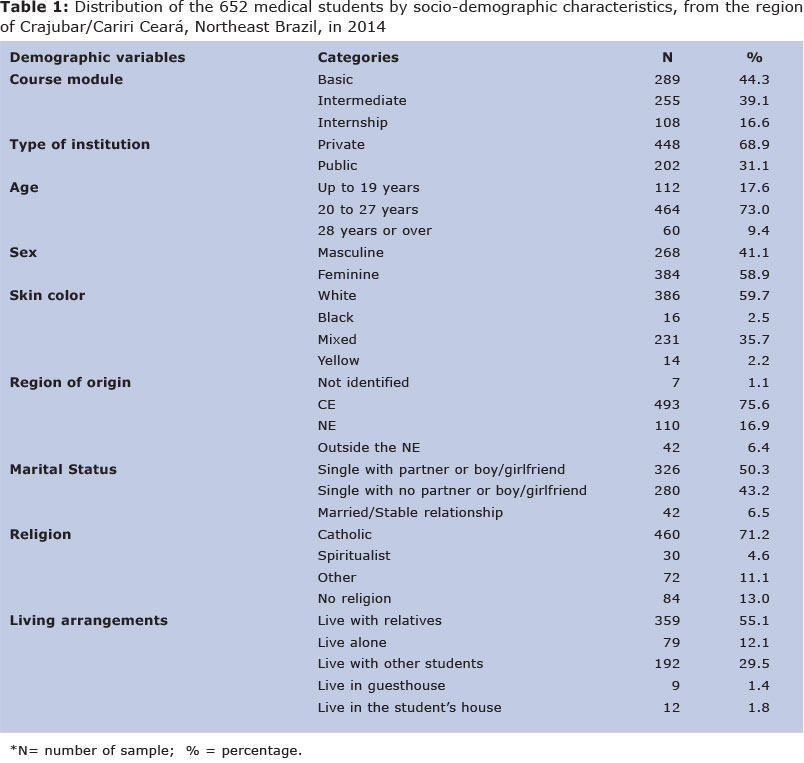
<body><![CDATA[<p><font face="Verdana, Arial, Helvetica, sans-serif" size="2">The established    cut-off points followed the criteria of the most recent BDI-II validated in    Brazil in community samples, with zero to ten points corresponding to normal    and from 11-points onwards constituting depression<sup>11,12</sup>.</font></p>     <p><font face="Verdana, Arial, Helvetica, sans-serif" size="2">Depression was    adopted as the dependent variable, analyzed according to the independent variables    sex, institution of higher learning, the course module, age, religion, marital    status, perceived physical health, tobacco use, alcohol use, leisure activities,    quality of social relationships, uncertainty regarding future career and desire    to change courses.</font></p>     <p><font face="Verdana, Arial, Helvetica, sans-serif" size="2">From the completed    questionnaires a database was designed in the STATA program, version 12, in    which were developed descriptive and inferential statistics, using tables with    absolute and relative frequencies, mean, standard deviation, maximum, minimum,    prevalence coefficient and the Pearson's chi-squared test, adopting a statistical    significance value of pd" 0.05.</font></p>     <p><font face="Verdana, Arial, Helvetica, sans-serif" size="2">After the Chi-Squared    test, from the variables which presented a p-value of up to 0.2 with the variable    depression, a multinomial logistic model was developed, obtaining Odds Ratio    (OR) values as a function of the variables retained in this model, allowing    the interpretation the OR estimates and confidence interval (CI) already adjusted    for variables involved in this analysis<sup>13,14</sup>.</font></p>     <p><font face="Verdana, Arial, Helvetica, sans-serif" size="2">The project was    approved by the Ethics Committee of the Faculty of Medicine of ABC, Opinion    number: 268.234.</font></p>     <p>&nbsp;</p>     <p><font face="Verdana, Arial, Helvetica, sans-serif" size="3"><b>RESULTS</b></font></p>     <p><font face="Verdana, Arial, Helvetica, sans-serif" size="2"><a href="/img/revistas/rbcdh/v24n3/html/06t01a04.htm">Tables    1 to 4</a> present the descriptive and associative events of depression.</font></p>     <p><font face="Verdana, Arial, Helvetica, sans-serif" size="2">The study included    652 students (63.7%) distributed in all semesters of medical school at two institutions    located in the region of Cariri, one private (68.9%) and the other public (31.1%).    The majority of the participants were; enrolled in the basic module (44.3%),    female (58.9%), with a mean age of 22.74 &plusmn; 3.68 and the highest concentration    in the range of 20 to 27 years old (73.0%), the skin color was predominantly    white (58.9%) (<a href="/img/revistas/rbcdh/v24n3/06t01.jpg">Table 1</a>).</font></p>     <p><font face="Verdana, Arial, Helvetica, sans-serif" size="2">Most students came    from the state of Cear&aacute; (75.6%), while 93.5% were unmarried, 50.3% were    in a loving relationship and 71.2% were Catholic. More than half lived with    their family (55.1%) and 29.5% lived with other students (<a href="/img/revistas/rbcdh/v24n3/06t01.jpg">Table    1</a>). Regarding social relationships, 60.7% reported relating well with friends    and relatives and frequently participated in social activities. 40.5% of the    students occasionally took part in leisure activities and 66.3% chose medical    school willingly.</font></p>     ]]></body>
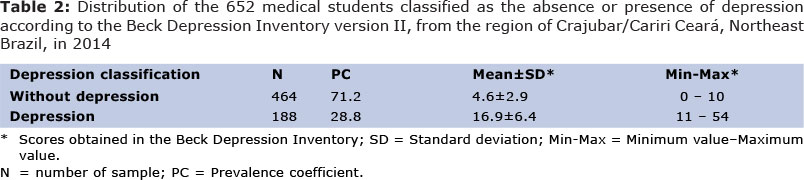
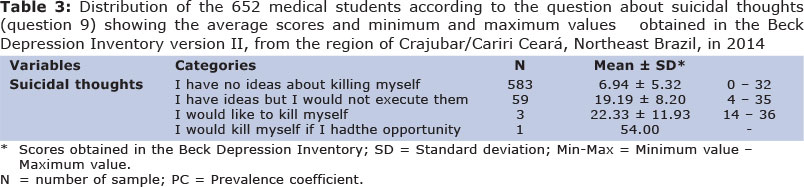
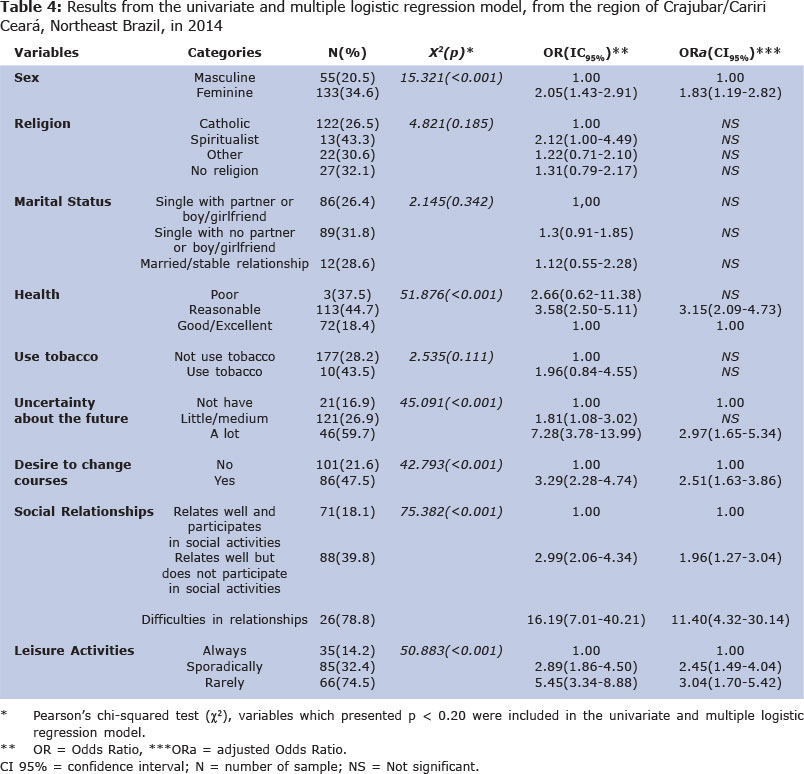
<body><![CDATA[<p><font face="Verdana, Arial, Helvetica, sans-serif" size="2">Generally, the    main form of transport for the students was their own car (46.6%). The majority    of students did not carry out any remunerated activities (82.5%), but it was    observed that students from the public Higher Education Institution (HEI), although    mostly not engaging in any paid activity (65.3%) did carry out more educational    activities with a grant (30.2%) when compared with the private school students    (3.3%), this fact probably reflects the distinct opportunities in the HEI. Most    students described their physical health as good, consumed alcohol but did not    use tobacco.</font></p>     <p><font face="Verdana, Arial, Helvetica, sans-serif" size="2">The prevalence    found in this population for the diagnosis of depression was 28.8%, and the    average score of the depressed students in the BDI-II was 16.9 &plusmn; 6.4    (<a href="/img/revistas/rbcdh/v24n3/06t02.jpg">Table 2</a>), 10.34% of the students had suicidal    thoughts (<a href="/img/revistas/rbcdh/v24n3/06t03.jpg">Table 3</a>).</font></p>     <p><font face="Verdana, Arial, Helvetica, sans-serif" size="2">Following the Pearson's    chi-squared test, the variables (p &lt; 0.20) selected for the logistic regression    model were: sex (p &lt; 0.001), religion (p = 0.185), physical health (p &lt;    0.001), smoking (p = 0.111), uncertainty about professional future (p &lt; 0.001),    desire to change courses (p &lt; 0.001), social relationships (p &lt; 0.001)    and leisure activities (p &lt; 0.001). Since marital status (p = 0.342) was    a factor commonly associated with depressive symptoms the decision was made    to include this variable in the logistic regression (<a href="/img/revistas/rbcdh/v24n3/06t04.jpg">Table    4</a>).</font></p>     <p><font face="Verdana, Arial, Helvetica, sans-serif" size="2">The following variables    were not entered in the logistic regression model: institution of higher education    (p = 0.441), course module (p = 0.439), age (p = 0.950) and alcohol use (p =    0.472).</font></p>     <p><font face="Verdana, Arial, Helvetica, sans-serif" size="2">In the adjusted    model, the selected variables were able to explain 23.54% of the diagnosis of    depression in the study participants (r<sup>2</sup> = 0.2354).</font></p>     <p>&nbsp;</p>     <p><font face="Verdana, Arial, Helvetica, sans-serif" size="3"><b>DISCUSSION</b></font></p>     <p><font face="Verdana, Arial, Helvetica, sans-serif" size="2">The prevalence    of depressive symptoms and associated factors in medical students in a northeastern    region of Brazil was highlighted as a serious public health problem<sup>1, 4</sup>.</font></p>     <p><font face="Verdana, Arial, Helvetica, sans-serif" size="2">The prevalence    of depressive symptoms found was 28.8%, and the mean BDI-II score was 16.9 &plusmn;    6.4 (<a href="/img/revistas/rbcdh/v24n3/06t02.jpg">Table 2</a>); the prevalence of depressive disorders    in the general population is around 7% and depressive symptoms throughout life,    around 12.6%<sup>2,3</sup>.</font></p>     <p><font face="Verdana, Arial, Helvetica, sans-serif" size="2">These symptoms    may also lead to disturbance in the functional and psychosocial lives of the    individuals, and may pose a risk for major depressive disorders when not recognized    and treated<sup>4</sup>.</font></p>     ]]></body>
<body><![CDATA[<p><font face="Verdana, Arial, Helvetica, sans-serif" size="2">It was observed    that the higher the intensity of suicidal thoughts reported in question 9 of    the BDI-II, the greater the average overall score found. Of the 10.34% of students    who had some suicidal thoughts at the time of evaluation, the majority had scores    for depression (BDI&gt; 10) (<a href="/img/revistas/rbcdh/v24n3/06t03.jpg">Table 3</a>).</font></p>     <p><font face="Verdana, Arial, Helvetica, sans-serif" size="2">Studies<sup>8,9,15-20    </sup>using the BDI with cut-off points similar to those used in this study,    found that the prevalence of depressive symptoms ranged from 13.9% to 48.2%.This    broad variation seems to be indicative of bias in the data collection, which    hinders comparisons between studies, only allowing them to be treated as similar.</font></p>     <p><font face="Verdana, Arial, Helvetica, sans-serif" size="2">A higher prevalence    of depressive symptoms has been reported in students in the basic module<sup>21</sup>.    One study<sup>9 </sup>found that almost half (48.2%) the students had depressive    symptoms, and of these, 20.7% had mild symptoms, 16.6% moderate symptoms, and    10.9% severe symptoms. The prevalence of these symptoms was higher among first    (64%) and second year (62%) students, and lowest in fourth year students (33%)<sup>9</sup>.</font></p>     <p><font face="Verdana, Arial, Helvetica, sans-serif" size="2">In this study,    it was found that the prevalence of depressive symptoms decreased as the course    progressed, going from 31.1% in the basic module, to 27.8% in the intermediate    module and 25% during the internship. The higher incidence of depression during    the basic module could be related to changes in the routine of students entering    medical school who receive a large amount of information, increased workload    related to their studies and an abrupt change in the method of study<sup>22</sup>.</font></p>     <p><font face="Verdana, Arial, Helvetica, sans-serif" size="2">On the other hand,    the findings of Melo-Carrilho et al<sup>23 </sup>verified a significant increase    in depressive symptoms in medical students attending the eighth semester (fourth    year); this fact was associated with the beginning of the internship. In agreement,    Costa et al<sup>15</sup> estimated the prevalence of depressive symptoms in    students during the medicine internship to be around 40.5%. Factors such as    contact with disease and death, the aggression inherent in many interventions,    difficulties in communicating bad news, in addition to the need for specialization    at the end of the course may be responsible for this symptomatology<sup>8</sup>.</font></p>     <p><font face="Verdana, Arial, Helvetica, sans-serif" size="2">In the instrument    used, the BDI-II, suicide is the most serious negative outcome of a depressive    disorder. Studies<sup>20,24 </sup>have related suicidal thoughts among medical    students to; stressful events, severe depressive and anxiety symptoms, loss    of control, personality disorder, and lack of stable relationships.</font></p>     <p><font face="Verdana, Arial, Helvetica, sans-serif" size="2">In the first analysis,    using the chi-squared test, an association was found between depressive symptoms    and the following variables: gender, physical health, uncertainty regarding    professional future, desire to change courses, social relationships and leisure    activities (<a href="/img/revistas/rbcdh/v24n3/06t04.jpg">Table 4</a>).</font></p>     <p><font face="Verdana, Arial, Helvetica, sans-serif" size="2">After logistic    regression, we found that women had a 1.83 times higher chance of developing    depression compared to men (<a href="/img/revistas/rbcdh/v24n3/06t04.jpg">Table 4</a>). Studies    have shown that the female sex is a significant risk factor for depression both    in university populations and in the general population.<sup> 9,25-27</sup>.</font></p>     <p><font face="Verdana, Arial, Helvetica, sans-serif" size="2">The presence and    severity of depressive symptoms have been linked to the early university years    and the female sex<sup>9</sup>. Jadoon et al <sup>25</sup>verified that females    had 2.01 more chances for depression than their male peers. Over the years the    gap between activities considered male and female has narrowed, leaving responsibilities    almost equivalent, but it has been observed that students of different sexes    have a distinct response pattern to stress<sup>22</sup>.</font></p>     <p><font face="Verdana, Arial, Helvetica, sans-serif" size="2">Generally speaking,    women in our society, besides accumulating academic and professional activities,    have multiple roles such as motherhood, home and social responsibilities, as    well as an increased predisposition to mood changes resulting from hormonal    influences, which could partly explain the higher predisposition to depressive    disorders in this population<sup>28</sup>.</font></p>     ]]></body>
<body><![CDATA[<p><font face="Verdana, Arial, Helvetica, sans-serif" size="2">In the adjusted    model, religion, marital status and tobacco use showed no statistical significance    in this study (<a href="/img/revistas/rbcdh/v24n3/06t04.jpg">Table 4</a>). In a study by Jadoon    et al. <sup>25</sup>, age, marital status, location, and household income were    not determining factors in the prevalence of depression in medical students.    However, in relation to smoking, some studies have shown higher chances for    depression in tobacco users. Among the medical students smokers were 2.2 times    more likely to have depressive symptoms than non-smokers<sup>29</sup>.</font></p>     <p><font face="Verdana, Arial, Helvetica, sans-serif" size="2">Another study<sup>30    </sup>on this issue verified that students who smoked regularly had significantly    higher levels of depression. Our results demonstrated an odds ratio of 1.96    CI95% (0.84 to 4.55) for depressive symptoms in smokers, which was not statistically    significant.</font></p>     <p><font face="Verdana, Arial, Helvetica, sans-serif" size="2">Vasegh &amp; Mohammadi<sup>31</sup>suggested    that religious belief could be a possible protective factor for depressive and    anxiety symptoms, but no statistical significance was found for depression.</font></p>     <p><font face="Verdana, Arial, Helvetica, sans-serif" size="2">The perception    of physical health as reasonable compared to a perception of good health presented    3.15 times more chances of leading to depression (<a href="/img/revistas/rbcdh/v24n3/06t04.jpg">Table    4</a>). Studies focusing on quality of life detected a significant deterioration    in the vitality, physical and mental health domains in a prospective study on    the quality of life related to the health of medical students<sup>32,33</sup>.</font></p>     <p><font face="Verdana, Arial, Helvetica, sans-serif" size="2">Among the students    who had a lot of uncertainty about their professional future; the chance of    depression was 2.97 higher than in those who had no uncertainty about their    future (<a href="/img/revistas/rbcdh/v24n3/06t04.jpg">Table 4</a>). In related studies<sup>32,33</sup>    it was suggested that an exhaustive workload, lack of time for physical activities    and a decrease in leisure activities on a daily basis may be related to poor    physical and mental performance.</font></p>     <p><font face="Verdana, Arial, Helvetica, sans-serif" size="2">The uncertainty    about their professional future as well as the desire to change courses presented    increasing occurrence as the student had doubts about what they aimed for in    the future (<a href="/img/revistas/rbcdh/v24n3/06t04.jpg">Table 4</a>). Studies<sup>34,35 </sup>evaluating    the correlation between the degree of satisfaction of medical students with    their course and the score obtained in the Beck Depression Inventory (BDI),    verified that the greater the involvement and satisfaction of the student in    their course, the lower the presence of symptoms of depression, with lower scores    in the BDI.</font></p>     <p><font face="Verdana, Arial, Helvetica, sans-serif" size="2">The chances of    depression in those who related well but did not participate in social activities    were 1.96 times higher compared to those who were well-connected (<a href="/img/revistas/rbcdh/v24n3/06t04.jpg">Table    4</a>). Those who claimed to have relationship difficulties presented 11.40    times more chances of depression compared to those who related well and participated    in social activities. Those who sporadically and rarely participated in leisure    activities were more vulnerable to suffer from depressive symptoms, the odds    being 2.45 times and 3.04 times respectively for the development of the disease    (<a href="/img/revistas/rbcdh/v24n3/06t04.jpg">Table 4</a>).</font></p>     <p><font face="Verdana, Arial, Helvetica, sans-serif" size="2">Costa et al <sup>15</sup>assessed    students during internship and found that the variables with the greatest impact    associated with the onset of depressive symptoms were: thoughts of leaving the    course, emotional stress and regular academic performance.</font></p>     <p><font face="Verdana, Arial, Helvetica, sans-serif" size="2">The adjusted model    was able to explain 23.54% of the diagnosis of depression in the study participants;    a relatively high value considering depression is a multifactorial disease (<a href="/img/revistas/rbcdh/v24n3/06t04.jpg">Table    4</a>). In addition to environmental causes, other factors such as temperament,    for example neuroticism; genetics, for example individuals with first-degree    relatives who have major depressive disorders have a 2-4 times higher risk of    developing the disease than the general population; physiological factors such    as endocrine disease and course modifications are involved in the development    of symptoms <sup>2</sup>.</font></p>     <p><font face="Verdana, Arial, Helvetica, sans-serif" size="2">Finally it was    found that the prevalence of depression in medical students was higher than    in the general population<sup>2</sup>. In comparative studies it was found that    the prevalence ranged from 13.9% to 48.2%. However, these studies<sup> 8,9,15-20    </sup>were performed using previous versions of the BDI. The results expressed    in <a href="/img/revistas/rbcdh/v24n3/html/06t01a04.htm">tables 1-4</a> report similar prevalences    although with a version of the instrument which is more current and more reliable    regarding the composition and analysis of the results.</font></p>     ]]></body>
<body><![CDATA[<p><font face="Verdana, Arial, Helvetica, sans-serif" size="2">The suicidal thoughts    referred to by question 9 in the BDI-II were directly proportional to the severity    of depression according to the score obtained in this instrument.</font></p>     <p><font face="Verdana, Arial, Helvetica, sans-serif" size="2">On the other hand,    even when diagnosed, the medical students did not seek professional help<sup>36,37</sup>.    Protocols<sup>23 </sup>have been suggested for the implementation of psychoeducation    programs with the aim of enhancing adhesion of the individual to a treatment    routine. Rethinking the role of the institution and the medical curriculum in    causing, maintaining and preventing the detected symptoms could alleviate this    problem<sup>15,20</sup>.</font></p>     <p><font face="Verdana, Arial, Helvetica, sans-serif" size="2">In the region of    Cariri, in the cities of Juazeiro do Norte - Cear&aacute;, Brazil and Barbalha,    Cear&aacute;, Brazil, in the two medical schools studied there is a shortage    of mental health services focused on psychiatric and psychological support to    medical students.</font></p>     <p><font face="Verdana, Arial, Helvetica, sans-serif" size="2">Of the 100% of    students who could have composed the sample, 63.7% actually participated in    the research. This response rate is similar to other studies on universities<sup>25,20,36,38</sup>.</font></p>     <p><font face="Verdana, Arial, Helvetica, sans-serif" size="2">From the point    of view of limitations of the study, it appears that depressed patients may    present significant somatic complaints and individuals with clinical disease    often present more depressive symptoms. The uncertainty regarding their professional    future, desire to change courses, relationship difficulties and level of participation    in social and leisure activities could also be interpreted as resulting from    the depressed state due to symptoms such as pessimism, low self-esteem, impaired    decision-making capacity and feelings of isolation which may have corresponded    to the moment of depression.</font></p>     <p><font face="Verdana, Arial, Helvetica, sans-serif" size="2">Another limitation    concerning the use of the BDI-II, which aims to detect depressive symptoms and    not the presence or absence of a depressive episode, is that it is not possible    either to establish a temporal relationship between the onset of symptoms and    entering university as the BDI- II only evaluates the presence of symptoms in    the previous two weeks, or to establish causality between the associations found.    These findings on the prevalence of depressive symptoms in medical students    are expected to impact on conduct in the field of public health, seeing that    imminent actions may be directed to take care of the professionals who look    after people.</font></p>     <p><font face="Verdana, Arial, Helvetica, sans-serif" size="2">As emphasized by    Atrash and Karpentier<sup>39</sup>, health is often defined as a result of complex    interactions, being something which is in constant motion and depends on regular    attention and active maintenance. In particular, achieving good quality public    health depends not only on the ability to make the right choices relating to    the environment which determines the current state of health of a population,    but also to make the right choices and take appropriate action to avoid foreseeable    threats. On the other hand, translational medicine processes should be seen    as essential for better handling the serious problems faced by the Public Health,    such as depression, as it involves possible processes to improve the quality    of life of the people involved.</font></p>     <p><font face="Verdana, Arial, Helvetica, sans-serif" size="2">In conclusion,    it was found that in the region of Cariri, located in northeastern Brazil, the    overall prevalence of depressive symptoms in medical students was 28.8%. The    female sex, reasonable physical health, uncertainty over future career, desire    to change courses, not participating in social activities and/or difficulties    in relationships and sporadic or rare leisure activity were associated with    a higher risk of developing depressive symptoms. Such associations can also    be considered as arising from depressive symptoms resulting in a negative perception    of the facts and social isolation. Rethinking the role of the institution and    the medical curriculum in the causing, maintenance and prevention of the detected    symptoms could be one solution to minimize the impact on the mental health of    medical students.</font></p>     <p>&nbsp;</p>     <p><font face="Verdana, Arial, Helvetica, sans-serif" size="3"><b>REFERENCES</b></font></p>     ]]></body>
<body><![CDATA[<!-- ref --><p><font face="Verdana, Arial, Helvetica, sans-serif" size="2">1. Organiza&ccedil;&atilde;o    Mundial da Sa&uacute;de. Mental Health Home. Dispon&iacute;vel em: <a href="http://www.who.int/mental_health/management/depression/en/" target="_blank">http://www.who.int/mental_health/management/depression/en/</a>    Acesso em 17/11/2012.    &nbsp;&nbsp;&nbsp;&nbsp;&nbsp;&nbsp;&nbsp;&nbsp;[&#160;<a href="javascript:void(0);" onclick="javascript: window.open('/scielo.php?script=sci_nlinks&ref=2508301&pid=S0104-1282201400030000600001&lng=','','width=640,height=500,resizable=yes,scrollbars=1,menubar=yes,');">Links</a>&#160;]<!-- end-ref --></font></p>     <!-- ref --><p><font face="Verdana, Arial, Helvetica, sans-serif" size="2">2. American Psychiatric    Association. Diagnostic and statistical manualof mental disorders: DSM-5. Washington:    American Psychiatric Publishing; 2013.    &nbsp;&nbsp;&nbsp;&nbsp;&nbsp;&nbsp;&nbsp;&nbsp;[&#160;<a href="javascript:void(0);" onclick="javascript: window.open('/scielo.php?script=sci_nlinks&ref=2508303&pid=S0104-1282201400030000600002&lng=','','width=640,height=500,resizable=yes,scrollbars=1,menubar=yes,');">Links</a>&#160;]<!-- end-ref --></font></p>     <!-- ref --><p><font face="Verdana, Arial, Helvetica, sans-serif" size="2">3. CID-10. Classifica&ccedil;&atilde;o    Internacional das doen&ccedil;as e problemas relacionados &agrave; sa&uacute;de.    S&atilde;o Paulo: EDUSP; 1997.    &nbsp;&nbsp;&nbsp;&nbsp;&nbsp;&nbsp;&nbsp;&nbsp;[&#160;<a href="javascript:void(0);" onclick="javascript: window.open('/scielo.php?script=sci_nlinks&ref=2508305&pid=S0104-1282201400030000600003&lng=','','width=640,height=500,resizable=yes,scrollbars=1,menubar=yes,');">Links</a>&#160;]<!-- end-ref --></font></p>     <!-- ref --><p><font face="Verdana, Arial, Helvetica, sans-serif" size="2">4. Rodrigues RS,    Santos SC, Cataldo Neto A et al. Depress&atilde;o em alunos de medicina. Acta    M&eacute;dica 2006; 27:374-380.    &nbsp;&nbsp;&nbsp;&nbsp;&nbsp;&nbsp;&nbsp;&nbsp;[&#160;<a href="javascript:void(0);" onclick="javascript: window.open('/scielo.php?script=sci_nlinks&ref=2508307&pid=S0104-1282201400030000600004&lng=','','width=640,height=500,resizable=yes,scrollbars=1,menubar=yes,');">Links</a>&#160;]<!-- end-ref --></font></p>     <!-- ref --><p><font face="Verdana, Arial, Helvetica, sans-serif" size="2">5. Chiapetti N,    Serbena CA. Uso de &aacute;lcool, tabaco e drogas por estudantes da &aacute;rea    de sa&uacute;de de uma Universidade de Curitiba. Psicologia: Reflex&atilde;o    e Cr&iacute;tica 2007;20(2):303-136.    &nbsp;&nbsp;&nbsp;&nbsp;&nbsp;&nbsp;&nbsp;&nbsp;[&#160;<a href="javascript:void(0);" onclick="javascript: window.open('/scielo.php?script=sci_nlinks&ref=2508309&pid=S0104-1282201400030000600005&lng=','','width=640,height=500,resizable=yes,scrollbars=1,menubar=yes,');">Links</a>&#160;]<!-- end-ref --></font></p>     ]]></body>
<body><![CDATA[<!-- ref --><p><font face="Verdana, Arial, Helvetica, sans-serif" size="2">6. Cerchiari EAN,    Caetano D, Faccenda O. Preval&ecirc;ncia de transtornos menores em estudantes    universit&aacute;rios. Estudos em Psicologia 2005; 10(3): 413 -420.    &nbsp;&nbsp;&nbsp;&nbsp;&nbsp;&nbsp;&nbsp;&nbsp;[&#160;<a href="javascript:void(0);" onclick="javascript: window.open('/scielo.php?script=sci_nlinks&ref=2508311&pid=S0104-1282201400030000600006&lng=','','width=640,height=500,resizable=yes,scrollbars=1,menubar=yes,');">Links</a>&#160;]<!-- end-ref --></font></p>     <!-- ref --><p><font face="Verdana, Arial, Helvetica, sans-serif" size="2">7. Cavestro JM,    Rocha FL. Preval&ecirc;ncia de depress&atilde;o entre estudantes universit&aacute;rios.    J. Bras. Psiquiatr2006; 55 (4): 264-67.    &nbsp;&nbsp;&nbsp;&nbsp;&nbsp;&nbsp;&nbsp;&nbsp;[&#160;<a href="javascript:void(0);" onclick="javascript: window.open('/scielo.php?script=sci_nlinks&ref=2508313&pid=S0104-1282201400030000600007&lng=','','width=640,height=500,resizable=yes,scrollbars=1,menubar=yes,');">Links</a>&#160;]<!-- end-ref --></font></p>     <!-- ref --><p><font face="Verdana, Arial, Helvetica, sans-serif" size="2">8. Baldassin S,    Alves TC, de Andrade AG, Nogueira Martins LA.The characteristics of depressive    symptoms in medical students during medical education and training: a cross-sectional    study. BMC Med Educ 2008 Dec 11;8:60. doi: 10.1186/1472-6920-8-60.    &nbsp;&nbsp;&nbsp;&nbsp;&nbsp;&nbsp;&nbsp;&nbsp;[&#160;<a href="javascript:void(0);" onclick="javascript: window.open('/scielo.php?script=sci_nlinks&ref=2508315&pid=S0104-1282201400030000600008&lng=','','width=640,height=500,resizable=yes,scrollbars=1,menubar=yes,');">Links</a>&#160;]<!-- end-ref --></font></p>     <!-- ref --><p><font face="Verdana, Arial, Helvetica, sans-serif" size="2">9. Al-Faris EA,    Irfan F, Van der Vleuten CP, Naeem N, Alsalem A, Alamiri N, Alraiyes T, Alfowzan    M, Alabdulsalam A, Ababtain A et al: The prevalence and correlates of depressive    symptoms from an Arabian setting: a wakeup call. Medical teacher 2012; 34 (1):S32-36.    &nbsp;&nbsp;&nbsp;&nbsp;&nbsp;&nbsp;&nbsp;&nbsp;[&#160;<a href="javascript:void(0);" onclick="javascript: window.open('/scielo.php?script=sci_nlinks&ref=2508317&pid=S0104-1282201400030000600009&lng=','','width=640,height=500,resizable=yes,scrollbars=1,menubar=yes,');">Links</a>&#160;]<!-- end-ref --></font></p>     <!-- ref --><p><font face="Verdana, Arial, Helvetica, sans-serif" size="2">10. Silva LCG,    Rodrigues MMP. Eventos estressantes na rela&ccedil;&atilde;o com o paciente    e estrat&eacute;gias de enfrentamento: estudo com acad&ecirc;micos de medicina.    J Bras Psiquiatr 2004;53(3): 185-96.    &nbsp;&nbsp;&nbsp;&nbsp;&nbsp;&nbsp;&nbsp;&nbsp;[&#160;<a href="javascript:void(0);" onclick="javascript: window.open('/scielo.php?script=sci_nlinks&ref=2508319&pid=S0104-1282201400030000600010&lng=','','width=640,height=500,resizable=yes,scrollbars=1,menubar=yes,');">Links</a>&#160;]<!-- end-ref --></font></p>     ]]></body>
<body><![CDATA[<!-- ref --><p><font face="Verdana, Arial, Helvetica, sans-serif" size="2">11. Wang YP, Gorenstein    C. Psychometric properties of the Beck Depression Inventory-II: a comprehensive    review. Rev Bras Psiquiatr 2013; 35(4): 416-431</font>&nbsp;&nbsp;&nbsp;&nbsp;&nbsp;&nbsp;&nbsp;&nbsp;[&#160;<a href="javascript:void(0);" onclick="javascript: window.open('/scielo.php?script=sci_nlinks&ref=2508321&pid=S0104-1282201400030000600011&lng=','','width=640,height=500,resizable=yes,scrollbars=1,menubar=yes,');">Links</a>&#160;]<!-- end-ref --><!-- ref --><p><font face="Verdana, Arial, Helvetica, sans-serif" size="2">12. Gomes-Oliveira    MH, Gorenstein C, Neto FL, Andrade LH, Wang YP. Validation of the Brazilian    Portuguese version of the Beck Depression Inventory-II in a community sample.    RevBrasPsiquiatr 2012;34(4):389-394.    &nbsp;&nbsp;&nbsp;&nbsp;&nbsp;&nbsp;&nbsp;&nbsp;[&#160;<a href="javascript:void(0);" onclick="javascript: window.open('/scielo.php?script=sci_nlinks&ref=2508322&pid=S0104-1282201400030000600012&lng=','','width=640,height=500,resizable=yes,scrollbars=1,menubar=yes,');">Links</a>&#160;]<!-- end-ref --></font></p>     <!-- ref --><p><font face="Verdana, Arial, Helvetica, sans-serif" size="2">13. Kleinbaum DG,    Kupper LL, Nizam A, Muller KE. Applied regression analysis and other multivariable    methods. Chapter two.Australia: Brooks/Cole; 2008.    &nbsp;&nbsp;&nbsp;&nbsp;&nbsp;&nbsp;&nbsp;&nbsp;[&#160;<a href="javascript:void(0);" onclick="javascript: window.open('/scielo.php?script=sci_nlinks&ref=2508324&pid=S0104-1282201400030000600013&lng=','','width=640,height=500,resizable=yes,scrollbars=1,menubar=yes,');">Links</a>&#160;]<!-- end-ref --></font></p>     <!-- ref --><p><font face="Verdana, Arial, Helvetica, sans-serif" size="2">14. Hamilton, LC.    Statistics with Stata : updated for version 12. Eighth edition. Cengage; 2012;    &nbsp;&nbsp;&nbsp;&nbsp;&nbsp;&nbsp;&nbsp;&nbsp;[&#160;<a href="javascript:void(0);" onclick="javascript: window.open('/scielo.php?script=sci_nlinks&ref=2508326&pid=S0104-1282201400030000600014&lng=','','width=640,height=500,resizable=yes,scrollbars=1,menubar=yes,');">Links</a>&#160;]<!-- end-ref --></font></p>     <!-- ref --><p><font face="Verdana, Arial, Helvetica, sans-serif" size="2">15. Costa EF, Santana    YS, Santos AT, Martins LA, Melo EV, Andrade TM. Depressive symptoms among medical    intern students in a Brazilian public university. Rev Assoc Med Bras 2012 Jan-Feb;58(1):53-9.    &nbsp;&nbsp;&nbsp;&nbsp;&nbsp;&nbsp;&nbsp;&nbsp;[&#160;<a href="javascript:void(0);" onclick="javascript: window.open('/scielo.php?script=sci_nlinks&ref=2508328&pid=S0104-1282201400030000600015&lng=','','width=640,height=500,resizable=yes,scrollbars=1,menubar=yes,');">Links</a>&#160;]<!-- end-ref --></font></p>     <!-- ref --><p><font face="Verdana, Arial, Helvetica, sans-serif" size="2">16. Sherina MS,    Rampal L, KanesonN.Psychological stress among undergraduate medical students.    Med J Malaysia 2004 Jun;59(2):207-11.    &nbsp;&nbsp;&nbsp;&nbsp;&nbsp;&nbsp;&nbsp;&nbsp;[&#160;<a href="javascript:void(0);" onclick="javascript: window.open('/scielo.php?script=sci_nlinks&ref=2508330&pid=S0104-1282201400030000600016&lng=','','width=640,height=500,resizable=yes,scrollbars=1,menubar=yes,');">Links</a>&#160;]<!-- end-ref --></font></p>     <!-- ref --><p><font face="Verdana, Arial, Helvetica, sans-serif" size="2">17. Ahmed I, Banu    H, Al-Fageer R, Al-SuwaidiR. Cognitive emotions: depression and anxiety in medical    students and staff. J CritCare 2009 Sep;24(3):e1-7. doi: 10.1016/j. jcrc. 2009.    06.003.    &nbsp;&nbsp;&nbsp;&nbsp;&nbsp;&nbsp;&nbsp;&nbsp;[&#160;<a href="javascript:void(0);" onclick="javascript: window.open('/scielo.php?script=sci_nlinks&ref=2508332&pid=S0104-1282201400030000600017&lng=','','width=640,height=500,resizable=yes,scrollbars=1,menubar=yes,');">Links</a>&#160;]<!-- end-ref --></font></p>     <!-- ref --><p><font face="Verdana, Arial, Helvetica, sans-serif" size="2">18. Givens JL,    Tjia J. Depressed medical students' use of mental health services and barriers    to use. AcadMed 2002 Sep;77(9):918-21.    &nbsp;&nbsp;&nbsp;&nbsp;&nbsp;&nbsp;&nbsp;&nbsp;[&#160;<a href="javascript:void(0);" onclick="javascript: window.open('/scielo.php?script=sci_nlinks&ref=2508334&pid=S0104-1282201400030000600018&lng=','','width=640,height=500,resizable=yes,scrollbars=1,menubar=yes,');">Links</a>&#160;]<!-- end-ref --></font></p>     <!-- ref --><p><font face="Verdana, Arial, Helvetica, sans-serif" size="2">19. Sun L, Sun    LN, Sun YH, Yang LS, Wu HY, Zhang DD, Cao HY, Sun Y.Correlations between psychological    symptoms and social relationships among medical undergraduates in Anhui Province    of China. Int J PsychiatryMed 2011;42(1):29-47.    &nbsp;&nbsp;&nbsp;&nbsp;&nbsp;&nbsp;&nbsp;&nbsp;[&#160;<a href="javascript:void(0);" onclick="javascript: window.open('/scielo.php?script=sci_nlinks&ref=2508336&pid=S0104-1282201400030000600019&lng=','','width=640,height=500,resizable=yes,scrollbars=1,menubar=yes,');">Links</a>&#160;]<!-- end-ref --></font></p>     <!-- ref --><p><font face="Verdana, Arial, Helvetica, sans-serif" size="2">20. Curran TA,    Gawley E, Casey P, Gill M, Crumlish N. Depression, suicidality and alcohol abuse    among medical and business students. Ir Med J 2009 Sep;102(8):249-52.    &nbsp;&nbsp;&nbsp;&nbsp;&nbsp;&nbsp;&nbsp;&nbsp;[&#160;<a href="javascript:void(0);" onclick="javascript: window.open('/scielo.php?script=sci_nlinks&ref=2508338&pid=S0104-1282201400030000600020&lng=','','width=640,height=500,resizable=yes,scrollbars=1,menubar=yes,');">Links</a>&#160;]<!-- end-ref --></font></p>     <!-- ref --><p><font face="Verdana, Arial, Helvetica, sans-serif" size="2">21. Aktekin M1,    Karaman T, Senol YY, Erdem S, Erengin H, Akaydin M. Anxiety, depression and    stressful life events among medical students: a prospective study in Antalya,    Turkey. MedEduc 2001 Jan;35(1):12-7.    &nbsp;&nbsp;&nbsp;&nbsp;&nbsp;&nbsp;&nbsp;&nbsp;[&#160;<a href="javascript:void(0);" onclick="javascript: window.open('/scielo.php?script=sci_nlinks&ref=2508340&pid=S0104-1282201400030000600021&lng=','','width=640,height=500,resizable=yes,scrollbars=1,menubar=yes,');">Links</a>&#160;]<!-- end-ref --></font></p>     <!-- ref --><p><font face="Verdana, Arial, Helvetica, sans-serif" size="2">22. Colares MFA.    As Fontes de tensa&THORN;o no curso me&igrave;dico: um estudo psicome&igrave;trico.    Ribeira&THORN;o Preto. Disserta&ccedil;&atilde;o [Mestrado] - Universidade de    S&atilde;oPaulo;1999.    &nbsp;&nbsp;&nbsp;&nbsp;&nbsp;&nbsp;&nbsp;&nbsp;[&#160;<a href="javascript:void(0);" onclick="javascript: window.open('/scielo.php?script=sci_nlinks&ref=2508342&pid=S0104-1282201400030000600022&lng=','','width=640,height=500,resizable=yes,scrollbars=1,menubar=yes,');">Links</a>&#160;]<!-- end-ref --></font></p>     <!-- ref --><p><font face="Verdana, Arial, Helvetica, sans-serif" size="2">23. Melo-Carrillo    A, Van Oudenhove L, Lopez-Avila A. Depressive symptoms among Mexican medical    students: high prevalence and the effect of a group psychoeducation intervention.    J AffectDisord 2012 Feb;136(3):1098-103. doi: 10.1016/j.jad.2011.10.040.    &nbsp;&nbsp;&nbsp;&nbsp;&nbsp;&nbsp;&nbsp;&nbsp;[&#160;<a href="javascript:void(0);" onclick="javascript: window.open('/scielo.php?script=sci_nlinks&ref=2508344&pid=S0104-1282201400030000600023&lng=','','width=640,height=500,resizable=yes,scrollbars=1,menubar=yes,');">Links</a>&#160;]<!-- end-ref --></font></p>     <!-- ref --><p><font face="Verdana, Arial, Helvetica, sans-serif" size="2">24. Tyssen R, Vaglum    P, Gr&oslash;nvold NT, EkebergO.Suicidal ideation among medical students and    young physicians: a nationwide and prospective study of prevalence and predictors.    J Affect Disord 2001 Apr; 64(1): 69-79.    &nbsp;&nbsp;&nbsp;&nbsp;&nbsp;&nbsp;&nbsp;&nbsp;[&#160;<a href="javascript:void(0);" onclick="javascript: window.open('/scielo.php?script=sci_nlinks&ref=2508346&pid=S0104-1282201400030000600024&lng=','','width=640,height=500,resizable=yes,scrollbars=1,menubar=yes,');">Links</a>&#160;]<!-- end-ref --></font></p>     <!-- ref --><p><font face="Verdana, Arial, Helvetica, sans-serif" size="2">25. Jadoon NA,    Yaqoob R, Raza A, Shehzad MA, Zeshan SC. Anxiety and depression among medical    students: a cross-sectional study. J Pak Med Assoc 2010 Aug; 60(8): 699-702.    &nbsp;&nbsp;&nbsp;&nbsp;&nbsp;&nbsp;&nbsp;&nbsp;[&#160;<a href="javascript:void(0);" onclick="javascript: window.open('/scielo.php?script=sci_nlinks&ref=2508348&pid=S0104-1282201400030000600025&lng=','','width=640,height=500,resizable=yes,scrollbars=1,menubar=yes,');">Links</a>&#160;]<!-- end-ref --></font></p>     <!-- ref --><p><font face="Verdana, Arial, Helvetica, sans-serif" size="2">26. Roh MS, Jeon    HJ, Kim H, Han SK, HahmBJ.The prevalence and impact of depression among medical    students: a nationwide cross-sectional study in South Korea. AcadMed 2010 Aug;85(8):1384-90.    doi: 10.1097/ACM. 0b013 e 3181df5 e 43.    &nbsp;&nbsp;&nbsp;&nbsp;&nbsp;&nbsp;&nbsp;&nbsp;[&#160;<a href="javascript:void(0);" onclick="javascript: window.open('/scielo.php?script=sci_nlinks&ref=2508350&pid=S0104-1282201400030000600026&lng=','','width=640,height=500,resizable=yes,scrollbars=1,menubar=yes,');">Links</a>&#160;]<!-- end-ref --></font></p>     <!-- ref --><p><font face="Verdana, Arial, Helvetica, sans-serif" size="2">27. AlviT,Assad    F, RamzanM,Khan FA. Depression, anxiety and their associated factors among medical    students.JColl Physicians SurgPak 2010 Feb; 20(2):122-6.    &nbsp;&nbsp;&nbsp;&nbsp;&nbsp;&nbsp;&nbsp;&nbsp;[&#160;<a href="javascript:void(0);" onclick="javascript: window.open('/scielo.php?script=sci_nlinks&ref=2508352&pid=S0104-1282201400030000600027&lng=','','width=640,height=500,resizable=yes,scrollbars=1,menubar=yes,');">Links</a>&#160;]<!-- end-ref --></font></p>     <!-- ref --><p><font face="Verdana, Arial, Helvetica, sans-serif" size="2">28. Brandtner M,    Bardagi M. Sintomatologia de Depress&atilde;o e Ansiedade em Estudantes de uma    Universidade Privada do Rio Grande do Sul. Gerais: Revista Interinstitucional    de Psicologia, Gerais: Revista Interinstitucional de Psicologia 2009 jul-dez;    2 (2): 81-91.    &nbsp;&nbsp;&nbsp;&nbsp;&nbsp;&nbsp;&nbsp;&nbsp;[&#160;<a href="javascript:void(0);" onclick="javascript: window.open('/scielo.php?script=sci_nlinks&ref=2508354&pid=S0104-1282201400030000600028&lng=','','width=640,height=500,resizable=yes,scrollbars=1,menubar=yes,');">Links</a>&#160;]<!-- end-ref --></font></p>     <!-- ref --><p><font face="Verdana, Arial, Helvetica, sans-serif" size="2">29. G&uuml;le&ccedil;    M, Bakir B, Ozer M, U&ccedil;ar M, Kili&ccedil; S, Hasde M. Association between    cigarette smoking and depressive symptoms among military medical students in    Turkey. Psychiatry Res 2005 Apr 30;134(3):281-6.    &nbsp;&nbsp;&nbsp;&nbsp;&nbsp;&nbsp;&nbsp;&nbsp;[&#160;<a href="javascript:void(0);" onclick="javascript: window.open('/scielo.php?script=sci_nlinks&ref=2508356&pid=S0104-1282201400030000600029&lng=','','width=640,height=500,resizable=yes,scrollbars=1,menubar=yes,');">Links</a>&#160;]<!-- end-ref --></font></p>     <!-- ref --><p><font face="Verdana, Arial, Helvetica, sans-serif" size="2">30. Aniebue PN,    OnyemaGO.Prevalence of depressive symptoms among Nigerian medical undergraduates.    TropDoct 2008 Jul;38(3):157-8. doi: 10.1258/td.2007.070202.    &nbsp;&nbsp;&nbsp;&nbsp;&nbsp;&nbsp;&nbsp;&nbsp;[&#160;<a href="javascript:void(0);" onclick="javascript: window.open('/scielo.php?script=sci_nlinks&ref=2508358&pid=S0104-1282201400030000600030&lng=','','width=640,height=500,resizable=yes,scrollbars=1,menubar=yes,');">Links</a>&#160;]<!-- end-ref --></font></p>     <!-- ref --><p><font face="Verdana, Arial, Helvetica, sans-serif" size="2">31. Vasegh S, MohammadiMR.Religiosity,    anxiety, and depression among a sample of Iranian medical students. Int J PsychiatryMed    2007;37(2):213-27.    &nbsp;&nbsp;&nbsp;&nbsp;&nbsp;&nbsp;&nbsp;&nbsp;[&#160;<a href="javascript:void(0);" onclick="javascript: window.open('/scielo.php?script=sci_nlinks&ref=2508360&pid=S0104-1282201400030000600031&lng=','','width=640,height=500,resizable=yes,scrollbars=1,menubar=yes,');">Links</a>&#160;]<!-- end-ref --></font></p>     <!-- ref --><p><font face="Verdana, Arial, Helvetica, sans-serif" size="2">32. Alves JGB,    Tenorio M, Anjos AG, Figueroa JN. Qualidade de vida em estudantes de Medicina    no in&iacute;cio e final do curso: avalia&ccedil;&atilde;o pelo Whoqol-bref.    Rev. bras. educ. med 2010 Mar. 34(1): 91-96. <a href="http://dx.doi.org/10.1590/S0100-55022010000100011" target="_blank">http://dx.doi.org/10.1590/S0100-55022010000100011</a>.    &nbsp;&nbsp;&nbsp;&nbsp;&nbsp;&nbsp;&nbsp;&nbsp;[&#160;<a href="javascript:void(0);" onclick="javascript: window.open('/scielo.php?script=sci_nlinks&ref=2508362&pid=S0104-1282201400030000600032&lng=','','width=640,height=500,resizable=yes,scrollbars=1,menubar=yes,');">Links</a>&#160;]<!-- end-ref --></font></p>     <!-- ref --><p><font face="Verdana, Arial, Helvetica, sans-serif" size="2">33. Meyer C, Guimaraes    ACA, Machado Z, Parcias SR. Qualidade de vida e estresse ocupacional em estudantes    de medicina. Rev. bras. educ. med 2012 Dec; 36(4): 489-498.    &nbsp;&nbsp;&nbsp;&nbsp;&nbsp;&nbsp;&nbsp;&nbsp;[&#160;<a href="javascript:void(0);" onclick="javascript: window.open('/scielo.php?script=sci_nlinks&ref=2508364&pid=S0104-1282201400030000600033&lng=','','width=640,height=500,resizable=yes,scrollbars=1,menubar=yes,');">Links</a>&#160;]<!-- end-ref --></font></p>     <!-- ref --><p><font face="Verdana, Arial, Helvetica, sans-serif" size="2">34. Rezende CHA,    Abra&THORN;o CB, Coelho EP, Passos LBS. Prevalencia de Sintomas Depressivos    entre Estudantes de Me- dicina da Universidade Federal de Uberlandia. RevBrasEducMed    2008;32(3):315-23.    &nbsp;&nbsp;&nbsp;&nbsp;&nbsp;&nbsp;&nbsp;&nbsp;[&#160;<a href="javascript:void(0);" onclick="javascript: window.open('/scielo.php?script=sci_nlinks&ref=2508366&pid=S0104-1282201400030000600034&lng=','','width=640,height=500,resizable=yes,scrollbars=1,menubar=yes,');">Links</a>&#160;]<!-- end-ref --></font></p>     <!-- ref --><p><font face="Verdana, Arial, Helvetica, sans-serif" size="2">35. Swami V1, Chamorro-Premuzic    T, Sinniah D, Maniam T, Kannan K, Stanistreet D, FurnhamA.General health mediates    the relationship between loneliness, life satisfaction and depression. A study    with Malaysian medical students. Soc Psychiatry PsychiatrEpidemiol 2007 Feb;42(2):161-6.    &nbsp;&nbsp;&nbsp;&nbsp;&nbsp;&nbsp;&nbsp;&nbsp;[&#160;<a href="javascript:void(0);" onclick="javascript: window.open('/scielo.php?script=sci_nlinks&ref=2508368&pid=S0104-1282201400030000600035&lng=','','width=640,height=500,resizable=yes,scrollbars=1,menubar=yes,');">Links</a>&#160;]<!-- end-ref --></font></p>     <!-- ref --><p><font face="Verdana, Arial, Helvetica, sans-serif" size="2">36. Schwenk TL,    Davis L, Wimsatt LA. Depression, stigma, and suicidal ideation in medical students.    JAMA 2010 Sep 15;304(11):1181-90. doi: 10.1001/jama.2010.1300.    &nbsp;&nbsp;&nbsp;&nbsp;&nbsp;&nbsp;&nbsp;&nbsp;[&#160;<a href="javascript:void(0);" onclick="javascript: window.open('/scielo.php?script=sci_nlinks&ref=2508370&pid=S0104-1282201400030000600036&lng=','','width=640,height=500,resizable=yes,scrollbars=1,menubar=yes,');">Links</a>&#160;]<!-- end-ref --></font></p>     <!-- ref --><p><font face="Verdana, Arial, Helvetica, sans-serif" size="2">37. Chang E, Eddins-Folensbee    F, Porter B, Coverdale J.Utilization of counseling services at one medical school.    South Med J 2013 Aug;106(8):449-53. doi: 10.1097/SMJ.0b013e3182a05994.    &nbsp;&nbsp;&nbsp;&nbsp;&nbsp;&nbsp;&nbsp;&nbsp;[&#160;<a href="javascript:void(0);" onclick="javascript: window.open('/scielo.php?script=sci_nlinks&ref=2508372&pid=S0104-1282201400030000600037&lng=','','width=640,height=500,resizable=yes,scrollbars=1,menubar=yes,');">Links</a>&#160;]<!-- end-ref --></font></p>     <!-- ref --><p><font face="Verdana, Arial, Helvetica, sans-serif" size="2">38. Chang E, Eddins-Folensbee    F, Coverdale J. Survey of the prevalence of burnout, stress, depression, and    the use of supports by medical students at one school. AcadPsychiatry 2012 May    ;36(3):177-82. doi: 10.1176/appi.ap.11040079.    &nbsp;&nbsp;&nbsp;&nbsp;&nbsp;&nbsp;&nbsp;&nbsp;[&#160;<a href="javascript:void(0);" onclick="javascript: window.open('/scielo.php?script=sci_nlinks&ref=2508374&pid=S0104-1282201400030000600038&lng=','','width=640,height=500,resizable=yes,scrollbars=1,menubar=yes,');">Links</a>&#160;]<!-- end-ref --></font></p>     <!-- ref --><p><font face="Verdana, Arial, Helvetica, sans-serif" size="2">39. Atrash HK,    Carpentier R. The evolving role of public health in the delivery of health care.    Journal of Human Growth and Development. 2012; 22(3): 396-399.    &nbsp;&nbsp;&nbsp;&nbsp;&nbsp;&nbsp;&nbsp;&nbsp;[&#160;<a href="javascript:void(0);" onclick="javascript: window.open('/scielo.php?script=sci_nlinks&ref=2508376&pid=S0104-1282201400030000600039&lng=','','width=640,height=500,resizable=yes,scrollbars=1,menubar=yes,');">Links</a>&#160;]<!-- end-ref --></font></p>     <!-- ref --><p><font face="Verdana, Arial, Helvetica, sans-serif" size="2">40. Figueiredo    JL, Vinegoni C, de Abreu LC. Perinatal health and translational medicine. Journal    of Human Growth and Development. 2013; 23(2): 125-127.    &nbsp;&nbsp;&nbsp;&nbsp;&nbsp;&nbsp;&nbsp;&nbsp;[&#160;<a href="javascript:void(0);" onclick="javascript: window.open('/scielo.php?script=sci_nlinks&ref=2508378&pid=S0104-1282201400030000600040&lng=','','width=640,height=500,resizable=yes,scrollbars=1,menubar=yes,');">Links</a>&#160;]<!-- end-ref --></font></p>     <p>&nbsp;</p>     ]]></body>
<body><![CDATA[<p>&nbsp;</p>     <p><font face="Verdana, Arial, Helvetica, sans-serif" size="2">Manuscript submitted    May 19 2014    <br>   Accepted for publication Oct 21 2014</font></p>     <p>&nbsp;</p>     <p>&nbsp;</p>     <p><font face="Verdana, Arial, Helvetica, sans-serif" size="2"><b>Clinical applications    of the study: Interventions are vital in the field of Public Health to take    care of the professionals who look after the population. Medical students with    a high prevalence of depression have difficulty caring for people both during    and after their graduation when exercising their function as doctors.</b>    <br>   Article arising from the dissertation of a postgraduate degree in Health Sciences    at the Faculty of Medicine, ABC: "Prevalence of Depressive Symptoms and Associated    Factors in Medical Students of Northeastern Sert&atilde;o", Santo Andr&eacute;,    SP, 2014.    <br>   <b>Corresponding author: </b><a href="mailto:julianepaula2@hotmail.com">julianepaula2@hotmail.com</a></font></p>      ]]></body>
<back>
<ref-list>
<ref id="B1">
<label>1</label><nlm-citation citation-type="">
<collab>Organização Mundial da Saúde</collab>
<source><![CDATA[Mental Health Home]]></source>
<year></year>
</nlm-citation>
</ref>
<ref id="B2">
<label>2</label><nlm-citation citation-type="book">
<collab>American Psychiatric Association</collab>
<source><![CDATA[Diagnostic and statistical manualof mental disorders: DSM-5]]></source>
<year>2013</year>
<publisher-loc><![CDATA[Washington ]]></publisher-loc>
<publisher-name><![CDATA[American Psychiatric Publishing]]></publisher-name>
</nlm-citation>
</ref>
<ref id="B3">
<label>3</label><nlm-citation citation-type="book">
<collab>CID-10</collab>
<source><![CDATA[Classificação Internacional das doenças e problemas relacionados à saúde]]></source>
<year>1997</year>
<publisher-loc><![CDATA[São Paulo ]]></publisher-loc>
<publisher-name><![CDATA[EDUSP]]></publisher-name>
</nlm-citation>
</ref>
<ref id="B4">
<label>4</label><nlm-citation citation-type="journal">
<person-group person-group-type="author">
<name>
<surname><![CDATA[Rodrigues]]></surname>
<given-names><![CDATA[RS]]></given-names>
</name>
<name>
<surname><![CDATA[Santos]]></surname>
<given-names><![CDATA[SC]]></given-names>
</name>
<name>
<surname><![CDATA[Cataldo Neto]]></surname>
<given-names><![CDATA[A]]></given-names>
</name>
</person-group>
<article-title xml:lang="pt"><![CDATA[Depressão em alunos de medicina]]></article-title>
<source><![CDATA[Acta Médica]]></source>
<year>2006</year>
<volume>27</volume>
<page-range>374-380</page-range></nlm-citation>
</ref>
<ref id="B5">
<label>5</label><nlm-citation citation-type="journal">
<person-group person-group-type="author">
<name>
<surname><![CDATA[Chiapetti]]></surname>
<given-names><![CDATA[N]]></given-names>
</name>
<name>
<surname><![CDATA[Serbena]]></surname>
<given-names><![CDATA[CA]]></given-names>
</name>
</person-group>
<article-title xml:lang="pt"><![CDATA[Uso de álcool, tabaco e drogas por estudantes da área de saúde de uma Universidade de Curitiba]]></article-title>
<source><![CDATA[Psicologia: Reflexão e Crítica]]></source>
<year>2007</year>
<volume>20</volume>
<numero>2</numero>
<issue>2</issue>
<page-range>303-136</page-range></nlm-citation>
</ref>
<ref id="B6">
<label>6</label><nlm-citation citation-type="journal">
<person-group person-group-type="author">
<name>
<surname><![CDATA[Cerchiari]]></surname>
<given-names><![CDATA[EAN]]></given-names>
</name>
<name>
<surname><![CDATA[Caetano]]></surname>
<given-names><![CDATA[D]]></given-names>
</name>
<name>
<surname><![CDATA[Faccenda]]></surname>
<given-names><![CDATA[O]]></given-names>
</name>
</person-group>
<article-title xml:lang="pt"><![CDATA[Prevalência de transtornos menores em estudantes universitários]]></article-title>
<source><![CDATA[Estudos em Psicologia]]></source>
<year>2005</year>
<volume>10</volume>
<numero>3</numero>
<issue>3</issue>
<page-range>413 -420</page-range></nlm-citation>
</ref>
<ref id="B7">
<label>7</label><nlm-citation citation-type="journal">
<person-group person-group-type="author">
<name>
<surname><![CDATA[Cavestro]]></surname>
<given-names><![CDATA[JM]]></given-names>
</name>
<name>
<surname><![CDATA[Rocha]]></surname>
<given-names><![CDATA[FL]]></given-names>
</name>
</person-group>
<article-title xml:lang="pt"><![CDATA[Prevalência de depressão entre estudantes universitários]]></article-title>
<source><![CDATA[J. Bras. Psiquiatr]]></source>
<year>2006</year>
<volume>55</volume>
<numero>4</numero>
<issue>4</issue>
<page-range>264-67</page-range></nlm-citation>
</ref>
<ref id="B8">
<label>8</label><nlm-citation citation-type="journal">
<person-group person-group-type="author">
<name>
<surname><![CDATA[Baldassin]]></surname>
<given-names><![CDATA[S]]></given-names>
</name>
<name>
<surname><![CDATA[Alves]]></surname>
<given-names><![CDATA[TC]]></given-names>
</name>
<name>
<surname><![CDATA[de Andrade]]></surname>
<given-names><![CDATA[AG]]></given-names>
</name>
<name>
<surname><![CDATA[Nogueira Martins]]></surname>
<given-names><![CDATA[LA]]></given-names>
</name>
</person-group>
<article-title xml:lang="en"><![CDATA[The characteristics of depressive symptoms in medical students during medical education and training: a cross-sectional study]]></article-title>
<source><![CDATA[BMC Med Educ]]></source>
<year>2008</year>
<month> D</month>
<day>ec</day>
<volume>8</volume>
<page-range>60</page-range></nlm-citation>
</ref>
<ref id="B9">
<label>9</label><nlm-citation citation-type="journal">
<person-group person-group-type="author">
<name>
<surname><![CDATA[Al-Faris]]></surname>
<given-names><![CDATA[EA]]></given-names>
</name>
<name>
<surname><![CDATA[Irfan]]></surname>
<given-names><![CDATA[F]]></given-names>
</name>
<name>
<surname><![CDATA[Van der Vleuten]]></surname>
<given-names><![CDATA[CP]]></given-names>
</name>
<name>
<surname><![CDATA[Naeem]]></surname>
<given-names><![CDATA[N]]></given-names>
</name>
<name>
<surname><![CDATA[Alsalem]]></surname>
<given-names><![CDATA[A]]></given-names>
</name>
<name>
<surname><![CDATA[Alamiri]]></surname>
<given-names><![CDATA[N]]></given-names>
</name>
<name>
<surname><![CDATA[Alraiyes]]></surname>
<given-names><![CDATA[T]]></given-names>
</name>
<name>
<surname><![CDATA[Alfowzan]]></surname>
<given-names><![CDATA[M]]></given-names>
</name>
<name>
<surname><![CDATA[Alabdulsalam]]></surname>
<given-names><![CDATA[A]]></given-names>
</name>
<name>
<surname><![CDATA[Ababtain]]></surname>
<given-names><![CDATA[A]]></given-names>
</name>
</person-group>
<article-title xml:lang="en"><![CDATA[The prevalence and correlates of depressive symptoms from an Arabian setting: a wakeup call]]></article-title>
<source><![CDATA[Medical teacher]]></source>
<year>2012</year>
<volume>34</volume>
<numero>1</numero>
<issue>1</issue>
<page-range>S32-36</page-range></nlm-citation>
</ref>
<ref id="B10">
<label>10</label><nlm-citation citation-type="journal">
<person-group person-group-type="author">
<name>
<surname><![CDATA[Silva]]></surname>
<given-names><![CDATA[LCG]]></given-names>
</name>
<name>
<surname><![CDATA[Rodrigues]]></surname>
<given-names><![CDATA[MMP]]></given-names>
</name>
</person-group>
<article-title xml:lang="pt"><![CDATA[Eventos estressantes na relação com o paciente e estratégias de enfrentamento: estudo com acadêmicos de medicina]]></article-title>
<source><![CDATA[J Bras Psiquiatr]]></source>
<year>2004</year>
<volume>53</volume>
<numero>3</numero>
<issue>3</issue>
<page-range>185-96</page-range></nlm-citation>
</ref>
<ref id="B11">
<label>11</label><nlm-citation citation-type="journal">
<person-group person-group-type="author">
<name>
<surname><![CDATA[Wang]]></surname>
<given-names><![CDATA[YP]]></given-names>
</name>
<name>
<surname><![CDATA[Gorenstein]]></surname>
<given-names><![CDATA[C]]></given-names>
</name>
</person-group>
<article-title xml:lang="en"><![CDATA[Psychometric properties of the Beck Depression Inventory-II: a comprehensive review]]></article-title>
<source><![CDATA[Rev Bras Psiquiatr]]></source>
<year>2013</year>
<volume>35</volume>
<numero>4</numero>
<issue>4</issue>
<page-range>416-431</page-range></nlm-citation>
</ref>
<ref id="B12">
<label>12</label><nlm-citation citation-type="journal">
<person-group person-group-type="author">
<name>
<surname><![CDATA[Gomes-Oliveira]]></surname>
<given-names><![CDATA[MH]]></given-names>
</name>
<name>
<surname><![CDATA[Gorenstein]]></surname>
<given-names><![CDATA[C]]></given-names>
</name>
<name>
<surname><![CDATA[Neto]]></surname>
<given-names><![CDATA[FL]]></given-names>
</name>
<name>
<surname><![CDATA[Andrade]]></surname>
<given-names><![CDATA[LH]]></given-names>
</name>
<name>
<surname><![CDATA[Wang]]></surname>
<given-names><![CDATA[YP]]></given-names>
</name>
</person-group>
<article-title xml:lang="en"><![CDATA[Validation of the Brazilian Portuguese version of the Beck Depression Inventory-II in a community sample]]></article-title>
<source><![CDATA[RevBrasPsiquiatr]]></source>
<year>2012</year>
<volume>34</volume>
<numero>4</numero>
<issue>4</issue>
<page-range>389-394</page-range></nlm-citation>
</ref>
<ref id="B13">
<label>13</label><nlm-citation citation-type="book">
<person-group person-group-type="author">
<name>
<surname><![CDATA[Kleinbaum]]></surname>
<given-names><![CDATA[DG]]></given-names>
</name>
<name>
<surname><![CDATA[Kupper]]></surname>
<given-names><![CDATA[LL]]></given-names>
</name>
<name>
<surname><![CDATA[Nizam]]></surname>
<given-names><![CDATA[A]]></given-names>
</name>
<name>
<surname><![CDATA[Muller]]></surname>
<given-names><![CDATA[KE]]></given-names>
</name>
</person-group>
<source><![CDATA[Applied regression analysis and other multivariable methods: Chapter two]]></source>
<year>2008</year>
<publisher-name><![CDATA[Brooks/Cole]]></publisher-name>
</nlm-citation>
</ref>
<ref id="B14">
<label>14</label><nlm-citation citation-type="book">
<person-group person-group-type="author">
<name>
<surname><![CDATA[Hamilton]]></surname>
<given-names><![CDATA[LC]]></given-names>
</name>
</person-group>
<source><![CDATA[Statistics with Stata: updated for version 12]]></source>
<year>2012</year>
<edition>Eighth</edition>
<publisher-name><![CDATA[Cengage]]></publisher-name>
</nlm-citation>
</ref>
<ref id="B15">
<label>15</label><nlm-citation citation-type="journal">
<person-group person-group-type="author">
<name>
<surname><![CDATA[Costa]]></surname>
<given-names><![CDATA[EF]]></given-names>
</name>
<name>
<surname><![CDATA[Santana]]></surname>
<given-names><![CDATA[YS]]></given-names>
</name>
<name>
<surname><![CDATA[Santos]]></surname>
<given-names><![CDATA[AT]]></given-names>
</name>
<name>
<surname><![CDATA[Martins]]></surname>
<given-names><![CDATA[LA]]></given-names>
</name>
<name>
<surname><![CDATA[Melo]]></surname>
<given-names><![CDATA[EV]]></given-names>
</name>
<name>
<surname><![CDATA[Andrade]]></surname>
<given-names><![CDATA[TM]]></given-names>
</name>
</person-group>
<article-title xml:lang="en"><![CDATA[Depressive symptoms among medical intern students in a Brazilian public university]]></article-title>
<source><![CDATA[Rev Assoc Med Bras]]></source>
<year>2012</year>
<month> J</month>
<day>an</day>
<volume>58</volume>
<numero>1</numero>
<issue>1</issue>
<page-range>53-9</page-range></nlm-citation>
</ref>
<ref id="B16">
<label>16</label><nlm-citation citation-type="journal">
<person-group person-group-type="author">
<name>
<surname><![CDATA[Sherina]]></surname>
<given-names><![CDATA[MS]]></given-names>
</name>
<name>
<surname><![CDATA[Rampal]]></surname>
<given-names><![CDATA[L]]></given-names>
</name>
<name>
<surname><![CDATA[Kaneson]]></surname>
<given-names><![CDATA[N]]></given-names>
</name>
</person-group>
<article-title xml:lang="en"><![CDATA[Psychological stress among undergraduate medical students]]></article-title>
<source><![CDATA[Med J Malaysia]]></source>
<year>2004</year>
<month> J</month>
<day>un</day>
<volume>59</volume>
<numero>2</numero>
<issue>2</issue>
<page-range>207-11</page-range></nlm-citation>
</ref>
<ref id="B17">
<label>17</label><nlm-citation citation-type="journal">
<person-group person-group-type="author">
<name>
<surname><![CDATA[Ahmed]]></surname>
<given-names><![CDATA[I]]></given-names>
</name>
<name>
<surname><![CDATA[Banu]]></surname>
<given-names><![CDATA[H]]></given-names>
</name>
<name>
<surname><![CDATA[Al-Fageer]]></surname>
<given-names><![CDATA[R]]></given-names>
</name>
<name>
<surname><![CDATA[Al-Suwaid]]></surname>
<given-names><![CDATA[iR]]></given-names>
</name>
</person-group>
<article-title xml:lang="en"><![CDATA[Cognitive emotions: depression and anxiety in medical students and staff]]></article-title>
<source><![CDATA[J CritCare]]></source>
<year>2009</year>
<month> S</month>
<day>ep</day>
<volume>24</volume>
<numero>3</numero>
<issue>3</issue>
<page-range>e1-7</page-range></nlm-citation>
</ref>
<ref id="B18">
<label>18</label><nlm-citation citation-type="journal">
<person-group person-group-type="author">
<name>
<surname><![CDATA[Givens]]></surname>
<given-names><![CDATA[JL]]></given-names>
</name>
<name>
<surname><![CDATA[Tjia]]></surname>
<given-names><![CDATA[J]]></given-names>
</name>
</person-group>
<article-title xml:lang="en"><![CDATA[Depressed medical students' use of mental health services and barriers to use]]></article-title>
<source><![CDATA[AcadMed]]></source>
<year>2002</year>
<month> S</month>
<day>ep</day>
<volume>77</volume>
<numero>9</numero>
<issue>9</issue>
<page-range>918-21</page-range></nlm-citation>
</ref>
<ref id="B19">
<label>19</label><nlm-citation citation-type="journal">
<person-group person-group-type="author">
<name>
<surname><![CDATA[Sun]]></surname>
<given-names><![CDATA[L]]></given-names>
</name>
<name>
<surname><![CDATA[Sun]]></surname>
<given-names><![CDATA[LN]]></given-names>
</name>
<name>
<surname><![CDATA[Sun]]></surname>
<given-names><![CDATA[YH]]></given-names>
</name>
<name>
<surname><![CDATA[Yang]]></surname>
<given-names><![CDATA[LS]]></given-names>
</name>
<name>
<surname><![CDATA[Wu]]></surname>
<given-names><![CDATA[HY]]></given-names>
</name>
<name>
<surname><![CDATA[Zhang]]></surname>
<given-names><![CDATA[DD]]></given-names>
</name>
<name>
<surname><![CDATA[Cao]]></surname>
<given-names><![CDATA[HY]]></given-names>
</name>
<name>
<surname><![CDATA[Sun]]></surname>
<given-names><![CDATA[Y]]></given-names>
</name>
</person-group>
<article-title xml:lang="en"><![CDATA[Correlations between psychological symptoms and social relationships among medical undergraduates in Anhui Province of China]]></article-title>
<source><![CDATA[Int J PsychiatryMed]]></source>
<year>2011</year>
<volume>42</volume>
<numero>1</numero>
<issue>1</issue>
<page-range>29-47</page-range></nlm-citation>
</ref>
<ref id="B20">
<label>20</label><nlm-citation citation-type="journal">
<person-group person-group-type="author">
<name>
<surname><![CDATA[Curran]]></surname>
<given-names><![CDATA[TA]]></given-names>
</name>
<name>
<surname><![CDATA[Gawley]]></surname>
<given-names><![CDATA[E]]></given-names>
</name>
<name>
<surname><![CDATA[Casey]]></surname>
<given-names><![CDATA[P]]></given-names>
</name>
<name>
<surname><![CDATA[Gill]]></surname>
<given-names><![CDATA[M]]></given-names>
</name>
<name>
<surname><![CDATA[Crumlish]]></surname>
<given-names><![CDATA[N]]></given-names>
</name>
</person-group>
<article-title xml:lang="en"><![CDATA[Depression, suicidality and alcohol abuse among medical and business students]]></article-title>
<source><![CDATA[Ir Med J]]></source>
<year>2009</year>
<month> S</month>
<day>ep</day>
<volume>102</volume>
<numero>8</numero>
<issue>8</issue>
<page-range>249-52</page-range></nlm-citation>
</ref>
<ref id="B21">
<label>21</label><nlm-citation citation-type="journal">
<person-group person-group-type="author">
<name>
<surname><![CDATA[Aktekin]]></surname>
<given-names><![CDATA[M1]]></given-names>
</name>
<name>
<surname><![CDATA[Karaman]]></surname>
<given-names><![CDATA[T]]></given-names>
</name>
<name>
<surname><![CDATA[Senol]]></surname>
<given-names><![CDATA[YY]]></given-names>
</name>
<name>
<surname><![CDATA[Erdem]]></surname>
<given-names><![CDATA[S]]></given-names>
</name>
<name>
<surname><![CDATA[Erengin]]></surname>
<given-names><![CDATA[H]]></given-names>
</name>
<name>
<surname><![CDATA[Akaydin]]></surname>
<given-names><![CDATA[M]]></given-names>
</name>
</person-group>
<article-title xml:lang="en"><![CDATA[Anxiety, depression and stressful life events among medical students: a prospective study in Antalya, Turkey]]></article-title>
<source><![CDATA[MedEduc]]></source>
<year>2001</year>
<month> J</month>
<day>an</day>
<volume>35</volume>
<numero>1</numero>
<issue>1</issue>
<page-range>12-7</page-range></nlm-citation>
</ref>
<ref id="B22">
<label>22</label><nlm-citation citation-type="">
<person-group person-group-type="author">
<name>
<surname><![CDATA[Colares]]></surname>
<given-names><![CDATA[MFA]]></given-names>
</name>
</person-group>
<source><![CDATA[As Fontes de tensaÞo no curso meìdico: um estudo psicomeìtrico]]></source>
<year></year>
<publisher-loc><![CDATA[RibeiraÞo Preto ]]></publisher-loc>
</nlm-citation>
</ref>
<ref id="B23">
<label>23</label><nlm-citation citation-type="journal">
<person-group person-group-type="author">
<name>
<surname><![CDATA[Melo-Carrillo]]></surname>
<given-names><![CDATA[A]]></given-names>
</name>
<name>
<surname><![CDATA[Van Oudenhove]]></surname>
<given-names><![CDATA[L]]></given-names>
</name>
<name>
<surname><![CDATA[Lopez-Avila]]></surname>
<given-names><![CDATA[A]]></given-names>
</name>
</person-group>
<article-title xml:lang="en"><![CDATA[Depressive symptoms among Mexican medical students: high prevalence and the effect of a group psychoeducation intervention]]></article-title>
<source><![CDATA[J AffectDisord]]></source>
<year>2012</year>
<month> F</month>
<day>eb</day>
<volume>136</volume>
<numero>3</numero>
<issue>3</issue>
<page-range>1098-103</page-range></nlm-citation>
</ref>
<ref id="B24">
<label>24</label><nlm-citation citation-type="journal">
<person-group person-group-type="author">
<name>
<surname><![CDATA[Tyssen]]></surname>
<given-names><![CDATA[R]]></given-names>
</name>
<name>
<surname><![CDATA[Vaglum]]></surname>
<given-names><![CDATA[P]]></given-names>
</name>
<name>
<surname><![CDATA[Grønvold]]></surname>
<given-names><![CDATA[NT]]></given-names>
</name>
<name>
<surname><![CDATA[Ekeberg]]></surname>
<given-names><![CDATA[O]]></given-names>
</name>
</person-group>
<article-title xml:lang="en"><![CDATA[Suicidal ideation among medical students and young physicians: a nationwide and prospective study of prevalence and predictors]]></article-title>
<source><![CDATA[J Affect Disord]]></source>
<year>2001</year>
<month> A</month>
<day>pr</day>
<volume>64</volume>
<numero>1</numero>
<issue>1</issue>
<page-range>69-79</page-range></nlm-citation>
</ref>
<ref id="B25">
<label>25</label><nlm-citation citation-type="journal">
<person-group person-group-type="author">
<name>
<surname><![CDATA[Jadoon]]></surname>
<given-names><![CDATA[NA]]></given-names>
</name>
<name>
<surname><![CDATA[Yaqoob]]></surname>
<given-names><![CDATA[R]]></given-names>
</name>
<name>
<surname><![CDATA[Raza]]></surname>
<given-names><![CDATA[A]]></given-names>
</name>
<name>
<surname><![CDATA[Shehzad]]></surname>
<given-names><![CDATA[MA]]></given-names>
</name>
<name>
<surname><![CDATA[Zeshan]]></surname>
<given-names><![CDATA[SC]]></given-names>
</name>
</person-group>
<article-title xml:lang="en"><![CDATA[Anxiety and depression among medical students: a cross-sectional study]]></article-title>
<source><![CDATA[J Pak Med Assoc]]></source>
<year>2010</year>
<month> A</month>
<day>ug</day>
<volume>60</volume>
<numero>8</numero>
<issue>8</issue>
<page-range>699-702</page-range></nlm-citation>
</ref>
<ref id="B26">
<label>26</label><nlm-citation citation-type="journal">
<person-group person-group-type="author">
<name>
<surname><![CDATA[Roh]]></surname>
<given-names><![CDATA[MS]]></given-names>
</name>
<name>
<surname><![CDATA[Jeon]]></surname>
<given-names><![CDATA[HJ]]></given-names>
</name>
<name>
<surname><![CDATA[Kim]]></surname>
<given-names><![CDATA[H]]></given-names>
</name>
<name>
<surname><![CDATA[Han]]></surname>
<given-names><![CDATA[SK]]></given-names>
</name>
<name>
<surname><![CDATA[Hahm]]></surname>
<given-names><![CDATA[BJ]]></given-names>
</name>
</person-group>
<article-title xml:lang="en"><![CDATA[The prevalence and impact of depression among medical students: a nationwide cross-sectional study in South Korea]]></article-title>
<source><![CDATA[AcadMed]]></source>
<year>2010</year>
<month> A</month>
<day>ug</day>
<volume>85</volume>
<numero>8</numero>
<issue>8</issue>
<page-range>1384-90</page-range></nlm-citation>
</ref>
<ref id="B27">
<label>27</label><nlm-citation citation-type="journal">
<person-group person-group-type="author">
<name>
<surname><![CDATA[Alvi]]></surname>
<given-names><![CDATA[T]]></given-names>
</name>
<name>
<surname><![CDATA[Assad]]></surname>
<given-names><![CDATA[F]]></given-names>
</name>
<name>
<surname><![CDATA[Ramzan]]></surname>
<given-names><![CDATA[M]]></given-names>
</name>
<name>
<surname><![CDATA[Khan]]></surname>
<given-names><![CDATA[FA]]></given-names>
</name>
</person-group>
<article-title xml:lang="en"><![CDATA[Depression, anxiety and their associated factors among medical students]]></article-title>
<source><![CDATA[JColl Physicians Surg Pak]]></source>
<year>2010</year>
<month> F</month>
<day>eb</day>
<volume>20</volume>
<numero>2</numero>
<issue>2</issue>
<page-range>122-6</page-range></nlm-citation>
</ref>
<ref id="B28">
<label>28</label><nlm-citation citation-type="journal">
<person-group person-group-type="author">
<name>
<surname><![CDATA[Brandtner]]></surname>
<given-names><![CDATA[M]]></given-names>
</name>
<name>
<surname><![CDATA[Bardagi]]></surname>
<given-names><![CDATA[M]]></given-names>
</name>
</person-group>
<article-title xml:lang="pt"><![CDATA[Sintomatologia de Depressão e Ansiedade em Estudantes de uma Universidade Privada do Rio Grande do Sul: Gerais: Revista Interinstitucional de Psicologia, Gerais]]></article-title>
<source><![CDATA[Revista Interinstitucional de Psicologia]]></source>
<year>2009</year>
<month> j</month>
<day>ul</day>
<volume>2</volume>
<numero>2</numero>
<issue>2</issue>
<page-range>81-91</page-range></nlm-citation>
</ref>
<ref id="B29">
<label>29</label><nlm-citation citation-type="journal">
<person-group person-group-type="author">
<name>
<surname><![CDATA[Güleç]]></surname>
<given-names><![CDATA[M]]></given-names>
</name>
<name>
<surname><![CDATA[Bakir]]></surname>
<given-names><![CDATA[B]]></given-names>
</name>
<name>
<surname><![CDATA[Ozer]]></surname>
<given-names><![CDATA[M]]></given-names>
</name>
<name>
<surname><![CDATA[Uçar]]></surname>
<given-names><![CDATA[M]]></given-names>
</name>
<name>
<surname><![CDATA[Kiliç]]></surname>
<given-names><![CDATA[S]]></given-names>
</name>
<name>
<surname><![CDATA[Hasde]]></surname>
<given-names><![CDATA[M]]></given-names>
</name>
</person-group>
<article-title xml:lang="en"><![CDATA[Association between cigarette smoking and depressive symptoms among military medical students in Turkey]]></article-title>
<source><![CDATA[Psychiatry Res]]></source>
<year>2005</year>
<month> A</month>
<day>pr</day>
<volume>134</volume>
<numero>3</numero>
<issue>3</issue>
<page-range>281-6</page-range></nlm-citation>
</ref>
<ref id="B30">
<label>30</label><nlm-citation citation-type="journal">
<person-group person-group-type="author">
<name>
<surname><![CDATA[Aniebue]]></surname>
<given-names><![CDATA[PN]]></given-names>
</name>
<name>
<surname><![CDATA[Onyema]]></surname>
<given-names><![CDATA[GO]]></given-names>
</name>
</person-group>
<article-title xml:lang="en"><![CDATA[Prevalence of depressive symptoms among Nigerian medical undergraduates]]></article-title>
<source><![CDATA[TropDoct]]></source>
<year>2008</year>
<month> J</month>
<day>ul</day>
<volume>38</volume>
<numero>3</numero>
<issue>3</issue>
<page-range>157-8</page-range></nlm-citation>
</ref>
<ref id="B31">
<label>31</label><nlm-citation citation-type="journal">
<person-group person-group-type="author">
<name>
<surname><![CDATA[Vasegh]]></surname>
<given-names><![CDATA[S]]></given-names>
</name>
<name>
<surname><![CDATA[Mohammadi]]></surname>
<given-names><![CDATA[MR]]></given-names>
</name>
</person-group>
<article-title xml:lang="en"><![CDATA[Religiosity, anxiety, and depression among a sample of Iranian medical students]]></article-title>
<source><![CDATA[Int J PsychiatryMed]]></source>
<year>2007</year>
<volume>37</volume>
<numero>2</numero>
<issue>2</issue>
<page-range>213-27</page-range></nlm-citation>
</ref>
<ref id="B32">
<label>32</label><nlm-citation citation-type="journal">
<person-group person-group-type="author">
<name>
<surname><![CDATA[Alves]]></surname>
<given-names><![CDATA[JGB]]></given-names>
</name>
<name>
<surname><![CDATA[Tenorio]]></surname>
<given-names><![CDATA[M]]></given-names>
</name>
<name>
<surname><![CDATA[Anjos]]></surname>
<given-names><![CDATA[AG]]></given-names>
</name>
<name>
<surname><![CDATA[Figueroa]]></surname>
<given-names><![CDATA[JN]]></given-names>
</name>
</person-group>
<article-title xml:lang="pt"><![CDATA[Qualidade de vida em estudantes de Medicina no início e final do curso: avaliação pelo Whoqol-bref]]></article-title>
<source><![CDATA[Rev. bras. educ. med]]></source>
<year>2010</year>
<month> M</month>
<day>ar</day>
<volume>34</volume>
<numero>1</numero>
<issue>1</issue>
<page-range>91-96</page-range></nlm-citation>
</ref>
<ref id="B33">
<label>33</label><nlm-citation citation-type="journal">
<person-group person-group-type="author">
<name>
<surname><![CDATA[Meyer]]></surname>
<given-names><![CDATA[C]]></given-names>
</name>
<name>
<surname><![CDATA[Guimaraes]]></surname>
<given-names><![CDATA[ACA]]></given-names>
</name>
<name>
<surname><![CDATA[Machado]]></surname>
<given-names><![CDATA[Z]]></given-names>
</name>
<name>
<surname><![CDATA[Parcias]]></surname>
<given-names><![CDATA[SR]]></given-names>
</name>
</person-group>
<article-title xml:lang="pt"><![CDATA[Qualidade de vida e estresse ocupacional em estudantes de medicina]]></article-title>
<source><![CDATA[Rev. bras. educ. med]]></source>
<year>2012</year>
<month> D</month>
<day>ec</day>
<volume>36</volume>
<numero>4</numero>
<issue>4</issue>
<page-range>489-498</page-range></nlm-citation>
</ref>
<ref id="B34">
<label>34</label><nlm-citation citation-type="journal">
<person-group person-group-type="author">
<name>
<surname><![CDATA[Rezende]]></surname>
<given-names><![CDATA[CHA]]></given-names>
</name>
<name>
<surname><![CDATA[AbraÞo]]></surname>
<given-names><![CDATA[CB]]></given-names>
</name>
<name>
<surname><![CDATA[Coelho]]></surname>
<given-names><![CDATA[EP]]></given-names>
</name>
<name>
<surname><![CDATA[Passos]]></surname>
<given-names><![CDATA[LBS]]></given-names>
</name>
</person-group>
<article-title xml:lang="pt"><![CDATA[Prevalencia de Sintomas Depressivos entre Estudantes de Me- dicina da Universidade Federal de Uberlandia]]></article-title>
<source><![CDATA[RevBrasEducMed]]></source>
<year>2008</year>
<volume>32</volume>
<numero>3</numero>
<issue>3</issue>
<page-range>315-23</page-range></nlm-citation>
</ref>
<ref id="B35">
<label>35</label><nlm-citation citation-type="journal">
<person-group person-group-type="author">
<name>
<surname><![CDATA[Swami]]></surname>
<given-names><![CDATA[V1]]></given-names>
</name>
<name>
<surname><![CDATA[Chamorro-Premuzic]]></surname>
<given-names><![CDATA[T]]></given-names>
</name>
<name>
<surname><![CDATA[Sinniah]]></surname>
<given-names><![CDATA[D]]></given-names>
</name>
<name>
<surname><![CDATA[Maniam]]></surname>
<given-names><![CDATA[T]]></given-names>
</name>
<name>
<surname><![CDATA[Kannan]]></surname>
<given-names><![CDATA[K]]></given-names>
</name>
<name>
<surname><![CDATA[Stanistreet]]></surname>
<given-names><![CDATA[D]]></given-names>
</name>
<name>
<surname><![CDATA[Furnham]]></surname>
<given-names><![CDATA[A]]></given-names>
</name>
</person-group>
<article-title xml:lang="en"><![CDATA[General health mediates the relationship between loneliness, life satisfaction and depression: A study with Malaysian medical students]]></article-title>
<source><![CDATA[Soc Psychiatry PsychiatrEpidemiol]]></source>
<year>2007</year>
<month> F</month>
<day>eb</day>
<volume>42</volume>
<numero>2</numero>
<issue>2</issue>
<page-range>161-6</page-range></nlm-citation>
</ref>
<ref id="B36">
<label>36</label><nlm-citation citation-type="journal">
<person-group person-group-type="author">
<name>
<surname><![CDATA[Schwenk]]></surname>
<given-names><![CDATA[TL]]></given-names>
</name>
<name>
<surname><![CDATA[Davis]]></surname>
<given-names><![CDATA[L]]></given-names>
</name>
<name>
<surname><![CDATA[Wimsatt]]></surname>
<given-names><![CDATA[LA]]></given-names>
</name>
</person-group>
<article-title xml:lang="en"><![CDATA[Depression, stigma, and suicidal ideation in medical students]]></article-title>
<source><![CDATA[JAMA]]></source>
<year>2010</year>
<month> S</month>
<day>ep</day>
<volume>304</volume>
<numero>11</numero>
<issue>11</issue>
<page-range>1181-90</page-range></nlm-citation>
</ref>
<ref id="B37">
<label>37</label><nlm-citation citation-type="journal">
<person-group person-group-type="author">
<name>
<surname><![CDATA[Chang]]></surname>
<given-names><![CDATA[E]]></given-names>
</name>
<name>
<surname><![CDATA[Eddins-Folensbee]]></surname>
<given-names><![CDATA[F]]></given-names>
</name>
<name>
<surname><![CDATA[Porter]]></surname>
<given-names><![CDATA[B]]></given-names>
</name>
<name>
<surname><![CDATA[Coverdale]]></surname>
<given-names><![CDATA[J]]></given-names>
</name>
</person-group>
<article-title xml:lang="en"><![CDATA[Utilization of counseling services at one medical school]]></article-title>
<source><![CDATA[South Med J]]></source>
<year>2013</year>
<month> A</month>
<day>ug</day>
<volume>106</volume>
<numero>8</numero>
<issue>8</issue>
<page-range>449-53</page-range></nlm-citation>
</ref>
<ref id="B38">
<label>38</label><nlm-citation citation-type="journal">
<person-group person-group-type="author">
<name>
<surname><![CDATA[Chang]]></surname>
<given-names><![CDATA[E]]></given-names>
</name>
<name>
<surname><![CDATA[Eddins-Folensbee]]></surname>
<given-names><![CDATA[F]]></given-names>
</name>
<name>
<surname><![CDATA[Coverdale]]></surname>
<given-names><![CDATA[J]]></given-names>
</name>
</person-group>
<article-title xml:lang="en"><![CDATA[Survey of the prevalence of burnout, stress, depression, and the use of supports by medical students at one school]]></article-title>
<source><![CDATA[AcadPsychiatry]]></source>
<year>2012</year>
<month> M</month>
<day>ay</day>
<volume>36</volume>
<numero>3</numero>
<issue>3</issue>
<page-range>177-82</page-range></nlm-citation>
</ref>
<ref id="B39">
<label>39</label><nlm-citation citation-type="journal">
<person-group person-group-type="author">
<name>
<surname><![CDATA[Atrash]]></surname>
<given-names><![CDATA[HK]]></given-names>
</name>
<name>
<surname><![CDATA[Carpentier]]></surname>
<given-names><![CDATA[R]]></given-names>
</name>
</person-group>
<article-title xml:lang="en"><![CDATA[The evolving role of public health in the delivery of health care]]></article-title>
<source><![CDATA[Journal of Human Growth and Development]]></source>
<year>2012</year>
<volume>22</volume>
<numero>3</numero>
<issue>3</issue>
<page-range>396-399</page-range></nlm-citation>
</ref>
<ref id="B40">
<label>40</label><nlm-citation citation-type="journal">
<person-group person-group-type="author">
<name>
<surname><![CDATA[Figueiredo]]></surname>
<given-names><![CDATA[JL]]></given-names>
</name>
<name>
<surname><![CDATA[Vinegoni]]></surname>
<given-names><![CDATA[C]]></given-names>
</name>
<name>
<surname><![CDATA[de Abreu]]></surname>
<given-names><![CDATA[LC]]></given-names>
</name>
</person-group>
<article-title xml:lang="en"><![CDATA[Perinatal health and translational medicine]]></article-title>
<source><![CDATA[Journal of Human Growth and Development]]></source>
<year>2013</year>
<volume>23</volume>
<numero>2</numero>
<issue>2</issue>
<page-range>125-127</page-range></nlm-citation>
</ref>
</ref-list>
</back>
</article>