<?xml version="1.0" encoding="ISO-8859-1"?><article xmlns:mml="http://www.w3.org/1998/Math/MathML" xmlns:xlink="http://www.w3.org/1999/xlink" xmlns:xsi="http://www.w3.org/2001/XMLSchema-instance">
<front>
<journal-meta>
<journal-id>0104-1282</journal-id>
<journal-title><![CDATA[Journal of Human Growth and Development]]></journal-title>
<abbrev-journal-title><![CDATA[J. Hum. Growth Dev.]]></abbrev-journal-title>
<issn>0104-1282</issn>
<publisher>
<publisher-name><![CDATA[Centro de Estudos de Crescimento e Desenvolvimento do Ser Humano]]></publisher-name>
</publisher>
</journal-meta>
<article-meta>
<article-id>S0104-12822017000200012</article-id>
<article-id pub-id-type="doi">10.7322/jhgd.115027</article-id>
<title-group>
<article-title xml:lang="en"><![CDATA[Academic achievement associated with motor performance and sex in different subcultures]]></article-title>
<article-title xml:lang="pt"><![CDATA[Desempenho escolar associado ao desempenho motor e ao sexo em diferentes subculturas nordestinas]]></article-title>
</title-group>
<contrib-group>
<contrib contrib-type="author">
<name>
<surname><![CDATA[Nobre]]></surname>
<given-names><![CDATA[Francisco Salviano Sales]]></given-names>
</name>
<xref ref-type="aff" rid="A01"/>
</contrib>
<contrib contrib-type="author">
<name>
<surname><![CDATA[Bandeira]]></surname>
<given-names><![CDATA[Paulo Felipe Ribeiro]]></given-names>
</name>
<xref ref-type="aff" rid="A02"/>
</contrib>
<contrib contrib-type="author">
<name>
<surname><![CDATA[Valentini]]></surname>
<given-names><![CDATA[Nadia Cristina]]></given-names>
</name>
<xref ref-type="aff" rid="A02"/>
</contrib>
</contrib-group>
<aff id="A01">
<institution><![CDATA[,Federal Institut of Ceará  ]]></institution>
<addr-line><![CDATA[ ]]></addr-line>
</aff>
<aff id="A02">
<institution><![CDATA[,Federal University of Rio Grande do Sul School of Physical Education ]]></institution>
<addr-line><![CDATA[ ]]></addr-line>
</aff>
<pub-date pub-type="pub">
<day>00</day>
<month>00</month>
<year>2017</year>
</pub-date>
<pub-date pub-type="epub">
<day>00</day>
<month>00</month>
<year>2017</year>
</pub-date>
<volume>27</volume>
<numero>2</numero>
<fpage>213</fpage>
<lpage>218</lpage>
<copyright-statement/>
<copyright-year/>
<self-uri xlink:href="http://pepsic.bvsalud.org/scielo.php?script=sci_arttext&amp;pid=S0104-12822017000200012&amp;lng=en&amp;nrm=iso"></self-uri><self-uri xlink:href="http://pepsic.bvsalud.org/scielo.php?script=sci_abstract&amp;pid=S0104-12822017000200012&amp;lng=en&amp;nrm=iso"></self-uri><self-uri xlink:href="http://pepsic.bvsalud.org/scielo.php?script=sci_pdf&amp;pid=S0104-12822017000200012&amp;lng=en&amp;nrm=iso"></self-uri><abstract abstract-type="short" xml:lang="en"><p><![CDATA[INTRODUCTION: School and motor performances demonstrates achievements of children throughout childhood. Gender and the child's developmental context interfere with the differentiated trends of intensity and direction of school and motor performance. OBJECTIVE: To analyze the association among school performance, motor performance, and the sex of children of different subcultures. METHOD: The study included 233 children aged 7 to 10 years, 127 boys (8.2 ± 0.92 years) and 106 girls (8.4 ± 0.85 years), from three different subcultures (semi-arid, mountainous, and coastal weather) of Northeast Brazil. Data were collected from the School Performance Test and the Test of Gross Motor Development-2. Descriptive statistics, comparisons, and multivariate multiple linear regressions were used for analysis. RESULTS: It was found that school delays were prevalent in boys, and motor delays, specifically in object control skills, were prevalent in girls. Motor performance is positively associated with performance in writing, reading, and arithmetic, but this relationship is specific for each subculture. CONCLUSION: There was an association among school performance, motor performance, and the sex of children in different Northeastern subcultures, evidencing the influence of subcultures and gender on the children's performance.]]></p></abstract>
<abstract abstract-type="short" xml:lang="pt"><p><![CDATA[INTRODUÇÃO: O desempenho escolar e motor retratam conquistas de crianças ao longo da infância. O sexo e o contexto de desenvolvimento da criança interferem nas tendências diferenciadas de intensidade e direções do desempenho escolar e motor. OBJETIVO: Analisar a associação entre o desempenho escolar, o desempenho motor e sexo de crianças de diferentes subculturas. MÉTODO: Participaram da pesquisa 233 crianças oriundas de três diferentes subculturas (semiárido, serrana e litorânea) do Nordeste do Brasil. Os dados foram coletados a partir do Teste de Desempenho Escolar e o Test of Gross Motor Development-2. Para analise utilizaram-se da estatística descritiva, comparações e regressão linear múltipla multivariada. RESULTADOS: Verificou-se que atrasos escolares foram prevalentes nos meninos e os atrasos motores, especificamente em habilidades de controle de objetos, nas meninas. O desempenho motor associou-se positivamente com o desempenho na escrita, leitura e aritmética, sendo, porém, essa relação específica para cada subcultura. CONCLUSÃO: Houve associação entre desempenho escolar, motor e o sexo de crianças nas diferentes subculturas nordestinas, evidenciando a influencia das subculturas e do sexo no desempenho dessas crianças.]]></p></abstract>
<kwd-group>
<kwd lng="en"><![CDATA[environment]]></kwd>
<kwd lng="en"><![CDATA[school performance]]></kwd>
<kwd lng="en"><![CDATA[motor performance]]></kwd>
<kwd lng="en"><![CDATA[child development]]></kwd>
<kwd lng="pt"><![CDATA[ambiente]]></kwd>
<kwd lng="pt"><![CDATA[desempenho escolar]]></kwd>
<kwd lng="pt"><![CDATA[desempenho motor]]></kwd>
<kwd lng="pt"><![CDATA[desenvolvimento infantil]]></kwd>
</kwd-group>
</article-meta>
</front><body><![CDATA[ <p align="right"><font size="2" face="Verdana, Arial, Helvetica, sans-serif"><b>ORIGINAL    ARTICLE</b></font></p>     <p>&nbsp;</p>     <p><font face="Verdana, Arial, Helvetica, sans-serif" size="4"><b><a name="top"></a>Academic    achievement associated with motor performance and sex in different subcultures</b></font></p>     <p>&nbsp;</p>     <p>&nbsp;</p>     <p><font face="Verdana, Arial, Helvetica, sans-serif" size="2"><b>Francisco Salviano    Sales Nobre<sup>I</sup>; Paulo Felipe Ribeiro Bandeira<sup>II</sup>; Nadia Cristina    Valentini<sup>II</sup></b></font></p>     <p><font face="Verdana, Arial, Helvetica, sans-serif" size="2"><sup>I</sup>Study    Group on Motor Development and Health of child and adolescent - Federal Institut    of Cear&aacute;    <br>   <sup>II</sup>Study Group on Motor Evaluation and Intervention School of Physical    Education / Federal University of Rio Grande do Sul</font></p>     <p><font face="Verdana, Arial, Helvetica, sans-serif" size="2"><a href="#corresp">Correspondence</a></font></p>     <p>&nbsp;</p>     ]]></body>
<body><![CDATA[<p>&nbsp;</p> <hr noshade size="1">     <p><font face="Verdana, Arial, Helvetica, sans-serif" size="2"><b>ABSTRACT</b></font></p>     <p><font face="Verdana, Arial, Helvetica, sans-serif" size="2"><b>INTRODUCTION</b>:    School and motor performances demonstrates achievements of children throughout    childhood. Gender and the child's developmental context interfere with the differentiated    trends of intensity and direction of school and motor performance.    <br>   <b>OBJECTIVE</b>: To analyze the association among school performance, motor    performance, and the sex of children of different subcultures.    <br>   <b>METHOD</b>: The study included 233 children aged 7 to 10 years, 127 boys    (8.2 &plusmn; 0.92 years) and 106 girls (8.4 &plusmn; 0.85 years), from three    different subcultures (semi-arid, mountainous, and coastal weather) of Northeast    Brazil. Data were collected from the School Performance Test and the Test of    Gross Motor Development-2. Descriptive statistics, comparisons, and multivariate    multiple linear regressions were used for analysis.    <br>   <b>RESULTS</b>: It was found that school delays were prevalent in boys, and    motor delays, specifically in object control skills, were prevalent in girls.    Motor performance is positively associated with performance in writing, reading,    and arithmetic, but this relationship is specific for each subculture.    <br>   <b>CONCLUSION</b>: There was an association among school performance, motor    performance, and the sex of children in different Northeastern subcultures,    evidencing the influence of subcultures and gender on the children's performance.</font></p>     <p><font face="Verdana, Arial, Helvetica, sans-serif" size="2"><b>Keywords</b>:    environment, school performance, motor performance, child development</font></p> <hr noshade size="1">     <p>&nbsp;</p>     <p>&nbsp;</p>     ]]></body>
<body><![CDATA[<p><font face="Verdana, Arial, Helvetica, sans-serif" size="3"><b>INTRODUCTION</b></font></p>     <p><font face="Verdana, Arial, Helvetica, sans-serif" size="2">Associations between    cognitive performance and motor performance have been the focus of recent research<sup>1-3</sup>.    It is known in neuroscience that motor and cognitive functions are performed    by the same brain structures. For example, the cerebellum is involved in both    motor and cognitive functions, and the prefrontal cortex plays an important    role in these structures through neural connections<sup>4,5</sup>. Motor performance    may act as a control parameter for the development of cognitive and perceptual    abilities<sup>6</sup>. Furthermore, children with cognitive deficits also present    deficits in school performance variables such as arithmetic, reading, and writing<sup>7</sup>.</font></p>     <p><font face="Verdana, Arial, Helvetica, sans-serif" size="2">From an ecological    perspective, it is known that personal characteristics - for example, the child's    gender and development context - interfere in the differentiated tendencies    of intensity and directions of school and motor performance<sup>8,9</sup>. Delays    in school and motor performance are reported as more prevalent in socioeconomically    impoverished populations<sup>9-12</sup>. Regarding gender, school performance    impairment is more frequent among boys<sup>13</sup>, while delays in motor performance,    especially in skills involving manipulation of elements (balls, rackets, clubs),    are more prevalent among girls<sup>14</sup>.</font></p>     <p><font face="Verdana, Arial, Helvetica, sans-serif" size="2">Because of its    important educational repercussions, this theme needs research in Brazil, working    together with evidence of an association between school performance and motor    performance<sup>1-3</sup>. Thus, the objective of this study is to analyses    the association among school performance, motor performance, and the sex of    children of different subcultures.</font></p>     <p>&nbsp;</p>     <p><font face="Verdana, Arial, Helvetica, sans-serif" size="3"><b>METHODS</b></font></p>     <p><font face="Verdana, Arial, Helvetica, sans-serif" size="2"><b>Participants</b></font></p>     <p><font face="Verdana, Arial, Helvetica, sans-serif" size="2">The participant    group consisted of children living in socially vulnerable communities in Northeastern    Brazil. The population was composed of 272 children, and from a voluntary and    non-probabilistic sample, 233 comprised the study sample. Parents and/or legal    guardians signed the Free and Informed Consent Form (TCLE) of all participants.    This work was approved by the Ethics Committee in Research with Human Beings    (Process n&ordm; 19861).</font></p>     <p><font face="Verdana, Arial, Helvetica, sans-serif" size="2"><b>Assessment of    School Performance</b></font></p>     <p><font face="Verdana, Arial, Helvetica, sans-serif" size="2">The School Performance    Test (SPT) developed by Stein<sup>15</sup> was used to evaluate the fundamental    academic abilities, specifically, writing, arithmetic, and reading. The SPT    is intended for the evaluation of students between 2nd and 7th grade of elementary    school. The said instrument is composed of three subtests: a) writing (writing    of the proper name and isolated words presented in the form of dictation); B)    arithmetic (oral solution of problems and calculation of arithmetic operations    in writing); and C) reading (recognition of words isolated from context). The    gross score (GS) of each subtest and the total gross score (TGS) of the entire    SPT are converted by means of a table in the classifications of upper, middle,    and lower for each school series. That way, the information can be used to compare    the performance of one individual to another.</font></p>     ]]></body>
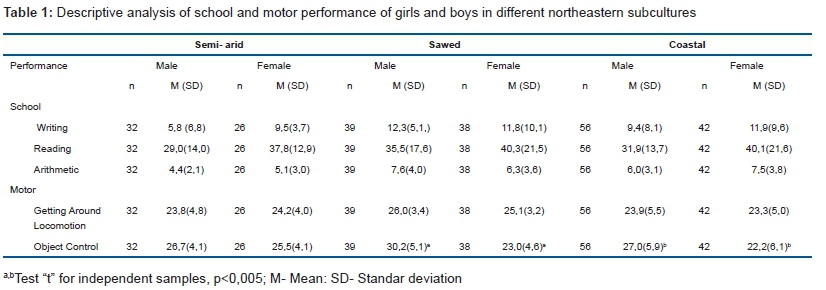
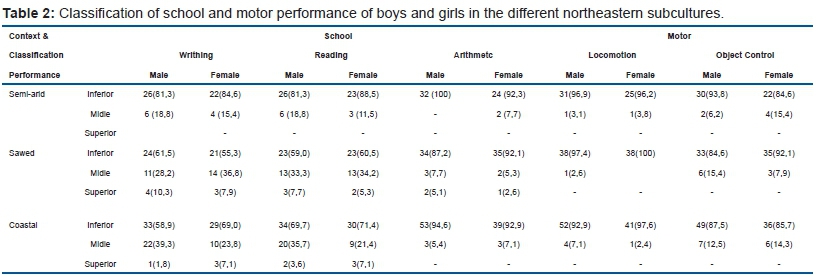
<body><![CDATA[<p><font face="Verdana, Arial, Helvetica, sans-serif" size="2"><b>Motor Performance    Evaluation</b></font></p>     <p><font face="Verdana, Arial, Helvetica, sans-serif" size="2">Motor performance    was evaluated by the Test of Gross Motor Development-2 (TGMD-2; Ulrich)<sup>16</sup>,    which was authenticated for the Brazilian population<sup>17</sup>. The TGMD-2    is a process-oriented instrument that evaluates the performance characteristics    of six HLOC locomotion skills (running, galloping, one-legged jumping, passing    jumping, horizontal jumping, and lateral running) and six HCO object controlling    skills (bounce a ball, rebut, catch, kick, fling over, and fling under). Each    skill is evaluated considering the presence or absence of three to five performance    criteria<sup>16,17</sup>.</font></p>     <p><font face="Verdana, Arial, Helvetica, sans-serif" size="2"><b>Data Analysis</b></font></p>     <p><font face="Verdana, Arial, Helvetica, sans-serif" size="2">Descriptive statistics    of the frequency distribution type (absolute and relative values) were used    to describe the school performance characteristics of boys and girls in each    subculture. Average and standard deviation were used to describe the characteristics    of school performance and locomotor skills and to control objects according    to sex and context. Test 't' for independent samples was used to compare school    performance and motor skills performance of locomotion and object control between    boys and girls according to context. Cohen's 'd' was used to estimate the size    of the effect.</font></p>     <p><font face="Verdana, Arial, Helvetica, sans-serif" size="2">A multivariate    multiple linear regression model was conducted through structural equation models    to evaluate possible associations between dependent variables - performance    in arithmetic, writing, and reading - and independent variables: gender (0-    female, 1- male) and motor skills (gross locomotion score and object control).    The square distance of Mahalanobis (D<sup>2</sup>) verified the existence of    outliers, and the normality of the variables was evaluated by the coefficients    of asymmetry (sk) and kurtosis (ku) uni and multivariate. Possible multicollinearities    were investigated using VIF (variance inflation factor); FIV&gt; 5 were considered    as indicators of multicollinearity<sup>18</sup>. We used AMOS&reg; software    (see 22, SPSS, an IBM&reg;Company, Chicago, IL, USA) and SPSS Statistics (see    21, SPSS, an IBM&reg;Company).</font></p>     <p>&nbsp;</p>     <p><font face="Verdana, Arial, Helvetica, sans-serif" size="3"><b>RESULTS</b></font></p>     <p><font face="Verdana, Arial, Helvetica, sans-serif" size="2">This study included    233 children, 127 boys (8.2 &plusmn; 0.92 years) and 106 girls (8.4 &plusmn;    0.85 years), in the age group between 7 and 10 years old (8.2 + 0.9 years),    attending the 2nd, 3rd, and 4th years of the initial grades of elementary school    I, from three different subcultures (58 semi-arid, 77 mountainous, and 98 coastal    weather).</font></p>     <p><font face="Verdana, Arial, Helvetica, sans-serif" size="2">The average and    standard deviations of the gross motor and school performance scores in all    subtests in each subculture of the Northeast are presented in <a href="/img/revistas/rbcdh/v27n2/12t1.jpg">Table    1</a>. Differences between boys and girls were observed in school performance    according to context. Regarding motor performance, exclusively in object control    skills, only boys showed better performance when compared to girls in the mountain    context (t = 6.481, p &lt;0.001, Cohen's d = 1.50) and the coastal context (t    = 3.907 p &lt; 0.001, Cohen's d = 0.81) (<a href="/img/revistas/rbcdh/v27n2/12t1.jpg">Table    1</a>).</font></p>     <p><font face="Verdana, Arial, Helvetica, sans-serif" size="2">The results of    school performance indicate a lower achievement than expected for the range    of education, regardless of gender and context. The performance in arithmetic    was the most compromised, varying between 87.2% and 100% of performance categorized    as inferior. The results regarding motor performance categorizations, based    on a percentile lower than and/or equal to 5, showed that the great majority    of the study participants were classified as inferior in performance (poor or    very poor) when compared to the national norms established by the authors of    the test<sup>15</sup>. <a href="/img/revistas/rbcdh/v27n2/12t2.jpg">Table 2</a>    presents the school performance and motor performance categorizations for the    three Northeastern subcultures in the subtests for both sexes (<a href="/img/revistas/rbcdh/v27n2/12t2.jpg">Table    2</a>).</font></p>     ]]></body>
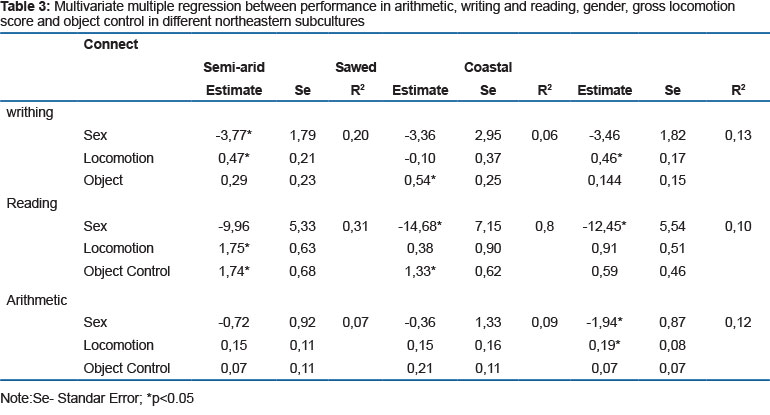
<body><![CDATA[<p><font face="Verdana, Arial, Helvetica, sans-serif" size="2">No variable presented    FVD &lt;5, indicating multicollinearity. In relation to the associations, the    female sex was positively associated with writing performance in the semi-arid    context. In the serrano and littoral contexts, the performance in reading stands    out. In arithmetic, there was only association in the coastal context. These    results indicate superiority in the performance of girls in these school skills    in their respective contexts.</font></p>     <p><font face="Verdana, Arial, Helvetica, sans-serif" size="2">Regarding associations    between motor performance and academic performance, locomotor skills were positively    associated with writing in the semi-arid and coastal contexts, with reading    in the semi-arid context and with arithmetic in the coastal context. Object    control skills were also positively and significantly associated with writing    in the mountain context, with reading in the semi-arid and serrano contexts.    <a href="/img/revistas/rbcdh/v27n2/12t3.jpg">Table 3</a> presents the values    of the standardized estimates, standard error, and R<sup>2</sup> of the models    (<a href="/img/revistas/rbcdh/v27n2/12t3.jpg">Table 3</a>).</font></p>     <p>&nbsp;</p>     <p><font face="Verdana, Arial, Helvetica, sans-serif" size="3"><b>DISCUSSION</b></font></p>     <p><font face="Verdana, Arial, Helvetica, sans-serif" size="2">Children at social    risk present school and motor delays, evidencing a lower school performance    in reading, writing, and mathematics in the three subcultures of Northeastern    Brazil (semi-arid, mountainous, and coastal weather). It was found that school    delays were prevalent in boys, and motor delays, specifically in object control    skills, were prevalent in girls. Motor performance was positively associated    with performance in writing, reading, and arithmetic, but this relationship    was specific for each subculture.</font></p>     <p><font face="Verdana, Arial, Helvetica, sans-serif" size="2">Regardless of the    geographical region and culture of the children, residing in socially vulnerable    communities is a risk factor for poor school performance. The results of this    study confirm previous studies<sup>9,11</sup> and reinforce the arguments that    point to the socioeconomic level as the best predictor of school performance.</font></p>     <p><font face="Verdana, Arial, Helvetica, sans-serif" size="2">When it is found    that children from the semi-arid context have the worse school performance,    it is worth noting that despite the fact that the school census points to an    improvement in the professional qualification of the semi-arid teachers in recent    years, the regions classified as non-semi-arid still present a higher number    of teachers with a higher level<sup>19</sup>. In addition, it is not uncommon    to have cases in the semi-arid context in which the teachers' graduation is    given through the short degree, where the understanding persists that students    in the initial grades of basic education do not require better professional    qualification of teachers<sup>20</sup>.</font></p>     <p><font face="Verdana, Arial, Helvetica, sans-serif" size="2">In general, the    results suggest the need for ongoing training of teachers working in communities    of social vulnerability and of specific compensatory strategies in school and    motor performance to enable these children to reach higher levels of school    performance that allow progress in subsequent grades without abandoning teaching    for poor performance.</font></p>     <p><font face="Verdana, Arial, Helvetica, sans-serif" size="2">Regarding differences    in school performance between the sexes, tests applied in educational assessments    in the country have shown that boys perform better in mathematics and girls    in reading<sup>11,21</sup>. This fact was only partially confirmed in this study,    as a better performance of girls was observed in all subtests of school performance.</font></p>     <p><font face="Verdana, Arial, Helvetica, sans-serif" size="2">On the subject,    Capellini <i>et al.</i><sup>13</sup>, comment that greater difficulties to learn    factual knowledge are more present in males. However, neuroscience recognizes    that the brains of boys and girls are more alike than different, and such similarity    is more common in adolescence with the event of puberty and brain plasticity    that occurs according to the experiences in contexts<sup>22</sup>. In fact,    in the present study it was observed that boys seemed to be encouraged earlier    to help their parents in their professional activities (in the field in the    mountain context and in artisanal fishing in the village of fishermen). In general,    the families expected more dedication from the girls in school activities. This    fact may partly explain the results found.</font></p>     ]]></body>
<body><![CDATA[<p><font face="Verdana, Arial, Helvetica, sans-serif" size="2">The low level of    motor proficiency of children identified in this study may be as worrying as    the level observed in school performance. It should be noted, however, that    the phenomenon of motor delays occurs in different countries, including children    of high socioeconomic level<sup>23</sup>, as well as those attended by non-sports    social projects<sup>10</sup>. Yet it is known that this phenomenon of motor    delays is more prevalent in schoolchildren living in situations of social vulnerability<sup>24</sup>,    as observed in the present study.</font></p>     <p><font face="Verdana, Arial, Helvetica, sans-serif" size="2">Regarding the influences    of sex on motor performance, as can be seen in <a href="/img/revistas/rbcdh/v27n2/12t2.jpg">Table    2</a>, the results of this research corroborate with the literature that indicates    similar performance in locomotion skills<sup>10,14</sup>, but with a predominance    of better performance in motor skills, particularly the control of objects,    in males<sup>10,14,23,24</sup>. In general, these motor delays can be explained    by the weakness and disintegration of primordial environments to promote human    development, first at home and then at school. In this way, the creation of    other contexts and promoters of development would be necessary to overcome the    coexisting deficiencies in the primordial environments<sup>25</sup>.</font></p>     <p><font face="Verdana, Arial, Helvetica, sans-serif" size="2">The results presented    in <a href="/img/revistas/rbcdh/v27n2/12t3.jpg">Table 3</a>, when evidencing    associations between the locomotor and control abilities of objects with performance    in writing, reading, and arithmetic, confirm the hypothesis of the present study,    suggesting that the associations are specific to each context. For example,    coastal schoolchildren presented a greater influence of locomotor skills on    writing and arithmetic performance, whereas for mountainous students, motor    proficiency in object control skills influences writing and reading performance.    On the other hand, in the semi-arid context, the proficiency in locomotion and    control of the object influences the performance in writing and, mainly, reading.</font></p>     <p><font face="Verdana, Arial, Helvetica, sans-serif" size="2">A previous study    by Westendorp <i>et al</i>.<sup>1</sup>, in Australia showed a similar trend    as observed in the present study. The authors report that Australian children    showed significant correlations between performance in locomotor skills with    writing and reading as well as significant correlations between performance    in mathematics and object control skills. According to the authors, for Australian    children, reading performance is importantly associated with locomotor performance,    although there has been a tendency for math to be a predictor for performance    in object control skills.</font></p>     <p><font face="Verdana, Arial, Helvetica, sans-serif" size="2">It is recommended    to prioritize the development of control skills of objects with requisition,    since we may require a rapid adaptation, stimulating more strongly the activation    of the prefrontal cortex and cerebellum, which are also required in cognitive    activities<sup>1</sup>. The results of the present study extend this recommendation    and show that the importance of developing locomotor skill proficiency cannot    be minimized.</font></p>     <p><font face="Verdana, Arial, Helvetica, sans-serif" size="2">It is a fact that    there is an educational crisis in Brazil involving students, teachers, family,    school, and the educational system as a whole<sup>9</sup>. The results of this    study show that, specifically in socioeconomically disadvantaged contexts, this    reality is detrimental to school performance and even more harmful to the development    of motor skills, considering that for the population's belief system<sup>26</sup>,    such abilities are rarely interpreted as essential to life. Although low, school    performance still remains important for these families, while little importance    is given to motor proficiency.</font></p>     <p><font face="Verdana, Arial, Helvetica, sans-serif" size="2">All efforts should    be made to minimize the impact that social-risk environments have on children's    development. Such actions require the adoption of public policies that aim to    extend the permanence of children in educational environments that offer programmes    that extrapolate their mere function of social assistance and that contribute    to the physical, cognitive, affective, and motor development of learners.</font></p>     <p><font face="Verdana, Arial, Helvetica, sans-serif" size="2">The Brazilian educational    policies of the last 20 years, in response to the demands of the social policies    formulated by international agencies for the reduction of poverty, have given    rise to a public school that confuses its role of teaching with a role of social    reception<sup>27</sup>. As a result, in the short term learning fails to promote    cognitive and motor learning, and in the long term eliminates the possibility    of full development of learners.</font></p>     <p><font face="Verdana, Arial, Helvetica, sans-serif" size="2">All efforts should    be made to minimize the impact that social-risk environments have on the development    of children. Such actions require the adoption of public policies that aim to    extend the permanence of children in educational environments that offer programmes    that extrapolate their mere function of social assistance and that contribute    to the physical, cognitive, affective, and motor development of learners.</font></p>     <p>&nbsp;</p>     ]]></body>
<body><![CDATA[<p><font face="Verdana, Arial, Helvetica, sans-serif" size="3"><b>CONCLUSION</b></font></p>     <p><font face="Verdana, Arial, Helvetica, sans-serif" size="2">There was an association    among school performance, motor performance, and the sex of children in different    Northeastern subcultures, evidencing the influence of subcultures and gender    on the performance of these children. There was more compromised academic performance    among boys, whereas motor performance in activities of object control was impaired    among girls in situations of social risk.</font></p>     <p>&nbsp;</p>     <p><font face="Verdana, Arial, Helvetica, sans-serif" size="3"><b>REFERENCES</b></font></p>     <!-- ref --><p><font face="Verdana, Arial, Helvetica, sans-serif" size="2">1. Westendorp M,    Hartman E, Houwen S, Smith J, Visscher C. The relationship between gross motorskills    and academic achievement in children with learning disabilities. Res Dev Disabil.    2011;32(6):2773-9. DOI: <a href="http://dx.doi.org/10.1016/j.ridd.2011.05.032" target="_blank">http://dx.doi.org/10.1016/j.ridd.2011.05.032</a></font>&nbsp;&nbsp;&nbsp;&nbsp;&nbsp;&nbsp;&nbsp;&nbsp;[&#160;<a href="javascript:void(0);" onclick="javascript: window.open('/scielo.php?script=sci_nlinks&ref=2530823&pid=S0104-1282201700020001200001&lng=','','width=640,height=500,resizable=yes,scrollbars=1,menubar=yes,');">Links</a>&#160;]<!-- end-ref --><!-- ref --><p><font face="Verdana, Arial, Helvetica, sans-serif" size="2">2. L opes L, Santos    R, Pereira B, Lopes VP. Associations between Gross motor coordination and academic    achievement in elementary school children. Hum Mov Sci. 2013;32(1):9-20. DOI:    <a href="http://dx.doi.org/10.1016/j.humov.2012.05.005" target="_blank">http://dx.doi.org/10.1016/j.humov.2012.05.005</a></font>&nbsp;&nbsp;&nbsp;&nbsp;&nbsp;&nbsp;&nbsp;&nbsp;[&#160;<a href="javascript:void(0);" onclick="javascript: window.open('/scielo.php?script=sci_nlinks&ref=2530824&pid=S0104-1282201700020001200002&lng=','','width=640,height=500,resizable=yes,scrollbars=1,menubar=yes,');">Links</a>&#160;]<!-- end-ref --><!-- ref --><p><font face="Verdana, Arial, Helvetica, sans-serif" size="2">3. Saraiva JP,    Rodrigues LP. Desenvolvimento motor e sucesso acad&ecirc;mico. Que rela&ccedil;&atilde;o    em crian&ccedil;as e jovens? Rev Port Educa&ccedil;&atilde;o. 2011;24(1):193-211.    DOI: <a href="https://dx.doi.org/10.21814/rpe.3045" target="_blank">https://dx.doi.org/10.21814/rpe.3045</a></font>&nbsp;&nbsp;&nbsp;&nbsp;&nbsp;&nbsp;&nbsp;&nbsp;[&#160;<a href="javascript:void(0);" onclick="javascript: window.open('/scielo.php?script=sci_nlinks&ref=2530825&pid=S0104-1282201700020001200003&lng=','','width=640,height=500,resizable=yes,scrollbars=1,menubar=yes,');">Links</a>&#160;]<!-- end-ref --><!-- ref --><p><font face="Verdana, Arial, Helvetica, sans-serif" size="2">4. Diamond A. Close    interrelation of motor development and cognitive development and of the cerebellum    and prefrontal cortex. Child Dev. 2000;71(1):44-56. DOI: <a href="https://dx.doi.org/10.1111/1467-8624.00117" target="_blank">https://dx.doi.org/10.1111/1467-8624.00117</a></font>&nbsp;&nbsp;&nbsp;&nbsp;&nbsp;&nbsp;&nbsp;&nbsp;[&#160;<a href="javascript:void(0);" onclick="javascript: window.open('/scielo.php?script=sci_nlinks&ref=2530826&pid=S0104-1282201700020001200004&lng=','','width=640,height=500,resizable=yes,scrollbars=1,menubar=yes,');">Links</a>&#160;]<!-- end-ref --><!-- ref --><p><font face="Verdana, Arial, Helvetica, sans-serif" size="2">5. Stoodley CJ.    The cerebellum and cognition: evidence from functional imaging studies. Cerebellum.    2012;11(2):352-65. DOI: <a href="https://dx.doi.org/10.1007/s12311-011-0260-7" target="_blank">https://dx.doi.org/10.1007/s12311-011-0260-7</a></font>&nbsp;&nbsp;&nbsp;&nbsp;&nbsp;&nbsp;&nbsp;&nbsp;[&#160;<a href="javascript:void(0);" onclick="javascript: window.open('/scielo.php?script=sci_nlinks&ref=2530827&pid=S0104-1282201700020001200005&lng=','','width=640,height=500,resizable=yes,scrollbars=1,menubar=yes,');">Links</a>&#160;]<!-- end-ref --><!-- ref --><p><font face="Verdana, Arial, Helvetica, sans-serif" size="2">6. Bushnell EW,    Boudreau JP. Motor development and the mind: The potential role of motor abilities    as a determinant of aspects of perceptual development. Child Dev. 1993;64(4):1005-21.    DOI: <a href="https://dx.doi.org/10.1111/j.1467-8624.1993.tb04184.x" target="_blank">https://dx.doi.org/10.1111/j.1467-8624.1993.tb04184.x</a></font>&nbsp;&nbsp;&nbsp;&nbsp;&nbsp;&nbsp;&nbsp;&nbsp;[&#160;<a href="javascript:void(0);" onclick="javascript: window.open('/scielo.php?script=sci_nlinks&ref=2530828&pid=S0104-1282201700020001200006&lng=','','width=640,height=500,resizable=yes,scrollbars=1,menubar=yes,');">Links</a>&#160;]<!-- end-ref --><!-- ref --><p><font face="Verdana, Arial, Helvetica, sans-serif" size="2">7. Alloway TP,    Archibald L. Working memory and learning in children with developmental coordination    disorder and specific language impairment. J Learn Disabil. 2008;41(3):251-62.    DOI: <a href="https://dx.doi.org/10.1177/0022219408315815" target="_blank">https://dx.doi.org/10.1177/0022219408315815</a></font>&nbsp;&nbsp;&nbsp;&nbsp;&nbsp;&nbsp;&nbsp;&nbsp;[&#160;<a href="javascript:void(0);" onclick="javascript: window.open('/scielo.php?script=sci_nlinks&ref=2530829&pid=S0104-1282201700020001200007&lng=','','width=640,height=500,resizable=yes,scrollbars=1,menubar=yes,');">Links</a>&#160;]<!-- end-ref --><!-- ref --><p><font face="Verdana, Arial, Helvetica, sans-serif" size="2">8. Nobre FSS, Coutinho    MTC, Valentini NC. The ecology of motor development in coastal schoolchildren    of Brazil northeast. J Hum Growth Dev. 2014;24(3):263-73. DOI: <a href="https://dx.doi.org/10.7322/jhdg.88910" target="_blank">https://dx.doi.org/10.7322/jhdg.88910</a></font>&nbsp;&nbsp;&nbsp;&nbsp;&nbsp;&nbsp;&nbsp;&nbsp;[&#160;<a href="javascript:void(0);" onclick="javascript: window.open('/scielo.php?script=sci_nlinks&ref=2530830&pid=S0104-1282201700020001200008&lng=','','width=640,height=500,resizable=yes,scrollbars=1,menubar=yes,');">Links</a>&#160;]<!-- end-ref --><!-- ref --><p><font face="Verdana, Arial, Helvetica, sans-serif" size="2">9. Padilha F, &Eacute;rnica    M, Batista AAG, Pudenzi L. As regularidades e exce&ccedil;&otilde;es no desempenho    do Ideb dos munic&iacute;pios. Estudos Aval Educ. 2012;23(51):58-81. DOI: <a href="http://dx.doi.org/10.18222/eae235120121948" target="_blank">http://dx.doi.org/10.18222/eae235120121948</a></font>&nbsp;&nbsp;&nbsp;&nbsp;&nbsp;&nbsp;&nbsp;&nbsp;[&#160;<a href="javascript:void(0);" onclick="javascript: window.open('/scielo.php?script=sci_nlinks&ref=2530831&pid=S0104-1282201700020001200009&lng=','','width=640,height=500,resizable=yes,scrollbars=1,menubar=yes,');">Links</a>&#160;]<!-- end-ref --><!-- ref --><p><font face="Verdana, Arial, Helvetica, sans-serif" size="2">10. Goodway JD,    Robinson LE, Crowe H. Gender differences in fundamental motor skill development    in disadvantaged preschoolers from two geographical regions. Res Q Exerc Sport.    2010; 81(1):7-24. DOI: <a href="http://dx.doi.org/10.1080/02701367.2010.10599624" target="_blank">http://dx.doi.org/10.1080/02701367.2010.10599624</a></font>&nbsp;&nbsp;&nbsp;&nbsp;&nbsp;&nbsp;&nbsp;&nbsp;[&#160;<a href="javascript:void(0);" onclick="javascript: window.open('/scielo.php?script=sci_nlinks&ref=2530832&pid=S0104-1282201700020001200010&lng=','','width=640,height=500,resizable=yes,scrollbars=1,menubar=yes,');">Links</a>&#160;]<!-- end-ref --><!-- ref --><p><font face="Verdana, Arial, Helvetica, sans-serif" size="2">11. Alves MTG,    Soares JF. Contexto escolar e indicadores educacionais: condi&ccedil;&otilde;es    desiguais para a efetiva&ccedil;&atilde;o de uma pol&iacute;tica de avalia&ccedil;&atilde;o    educacional. Educ Pesqui. 2013;39(1):177-94. DOI: <a href="http://dx.doi.org/10.1590/S1517-97022013000100012" target="_blank">http://dx.doi.org/10.1590/S1517-97022013000100012</a></font>&nbsp;&nbsp;&nbsp;&nbsp;&nbsp;&nbsp;&nbsp;&nbsp;[&#160;<a href="javascript:void(0);" onclick="javascript: window.open('/scielo.php?script=sci_nlinks&ref=2530833&pid=S0104-1282201700020001200011&lng=','','width=640,height=500,resizable=yes,scrollbars=1,menubar=yes,');">Links</a>&#160;]<!-- end-ref --><!-- ref --><p><font face="Verdana, Arial, Helvetica, sans-serif" size="2">12. Silva SCP,    Gabbard C, Ries LG, Bobbio TG. Interlimb coordination and academic performance    in elementary school children. Pediatr Int. 2016;58(10):967-73. DOI: <a href="http://dx.doi.org/10.1111/ped.12972" target="_blank">http://dx.doi.org/10.1111/ped.12972</a></font>&nbsp;&nbsp;&nbsp;&nbsp;&nbsp;&nbsp;&nbsp;&nbsp;[&#160;<a href="javascript:void(0);" onclick="javascript: window.open('/scielo.php?script=sci_nlinks&ref=2530834&pid=S0104-1282201700020001200012&lng=','','width=640,height=500,resizable=yes,scrollbars=1,menubar=yes,');">Links</a>&#160;]<!-- end-ref --><!-- ref --><p><font face="Verdana, Arial, Helvetica, sans-serif" size="2">13. Capellini AS,    Tonelotto JMF, Ciasca SM. Medidas de desempenho escolar: avalia&ccedil;&atilde;o    formal e opini&atilde;o de professores. Estud Psicol. 2004;21(2):79-90. DOI:    <a href="http://dx.doi.org/10.1590/S0103-166X2004000200006" target="_blank">http://dx.doi.org/10.1590/S0103-166X2004000200006</a></font>&nbsp;&nbsp;&nbsp;&nbsp;&nbsp;&nbsp;&nbsp;&nbsp;[&#160;<a href="javascript:void(0);" onclick="javascript: window.open('/scielo.php?script=sci_nlinks&ref=2530835&pid=S0104-1282201700020001200013&lng=','','width=640,height=500,resizable=yes,scrollbars=1,menubar=yes,');">Links</a>&#160;]<!-- end-ref --><!-- ref --><p><font face="Verdana, Arial, Helvetica, sans-serif" size="2">14. Spessato BC,    Gabbard C, Valentini N, Rudisill M. Gender differences in Brazilian children's    fundamental movement skill performance. Early Child Dev Care. 2013;183(7):916-23.    DOI: <a href="http://dx.doi.org/10.1080/03004430.2012.689761" target="_blank">http://dx.doi.org/10.1080/03004430.2012.689761</a></font>&nbsp;&nbsp;&nbsp;&nbsp;&nbsp;&nbsp;&nbsp;&nbsp;[&#160;<a href="javascript:void(0);" onclick="javascript: window.open('/scielo.php?script=sci_nlinks&ref=2530836&pid=S0104-1282201700020001200014&lng=','','width=640,height=500,resizable=yes,scrollbars=1,menubar=yes,');">Links</a>&#160;]<!-- end-ref --><!-- ref --><p><font face="Verdana, Arial, Helvetica, sans-serif" size="2">15. Stein LM. TED:    teste de desempenho escolar: manual para aplica&ccedil;&atilde;o e interpreta&ccedil;&atilde;o.    S&atilde;o Paulo: Casa do Psic&oacute;logo; 1994; p.1-32.    &nbsp;&nbsp;&nbsp;&nbsp;&nbsp;&nbsp;&nbsp;&nbsp;[&#160;<a href="javascript:void(0);" onclick="javascript: window.open('/scielo.php?script=sci_nlinks&ref=2530837&pid=S0104-1282201700020001200015&lng=','','width=640,height=500,resizable=yes,scrollbars=1,menubar=yes,');">Links</a>&#160;]<!-- end-ref --></font></p>     ]]></body>
<body><![CDATA[<!-- ref --><p><font face="Verdana, Arial, Helvetica, sans-serif" size="2">16. Ulrich, DA.    TGMD 2 - Test of gross motor development examiner's manual. 2 ed. Austin: Proed;    2000; p.4-60.    &nbsp;&nbsp;&nbsp;&nbsp;&nbsp;&nbsp;&nbsp;&nbsp;[&#160;<a href="javascript:void(0);" onclick="javascript: window.open('/scielo.php?script=sci_nlinks&ref=2530839&pid=S0104-1282201700020001200016&lng=','','width=640,height=500,resizable=yes,scrollbars=1,menubar=yes,');">Links</a>&#160;]<!-- end-ref --></font></p>     <!-- ref --><p><font face="Verdana, Arial, Helvetica, sans-serif" size="2">17. Valentini NC.    Validity and reliability of the TGMD -2 for Brazilian children. J Mot Behav.    2012;44(4):275-80. DOI: <a href="http://dx.doi.org/10.1080/00222895.2012.700967" target="_blank">http://dx.doi.org/10.1080/00222895.2012.700967</a></font>&nbsp;&nbsp;&nbsp;&nbsp;&nbsp;&nbsp;&nbsp;&nbsp;[&#160;<a href="javascript:void(0);" onclick="javascript: window.open('/scielo.php?script=sci_nlinks&ref=2530841&pid=S0104-1282201700020001200017&lng=','','width=640,height=500,resizable=yes,scrollbars=1,menubar=yes,');">Links</a>&#160;]<!-- end-ref --><!-- ref --><p><font face="Verdana, Arial, Helvetica, sans-serif" size="2">18. Maroco J. An&aacute;lise    de equa&ccedil;&otilde;es estruturais: fundamentos te&oacute;ricos, software    &amp; aplica&ccedil;&otilde;es. 2&ordf; ed. P&ecirc;ro Pinheiro: ReportNumber;    2014; p.111.    &nbsp;&nbsp;&nbsp;&nbsp;&nbsp;&nbsp;&nbsp;&nbsp;[&#160;<a href="javascript:void(0);" onclick="javascript: window.open('/scielo.php?script=sci_nlinks&ref=2530842&pid=S0104-1282201700020001200018&lng=','','width=640,height=500,resizable=yes,scrollbars=1,menubar=yes,');">Links</a>&#160;]<!-- end-ref --></font></p>     <!-- ref --><p><font face="Verdana, Arial, Helvetica, sans-serif" size="2">19. Ribeiro ECM,    Rodrigues LO, Silva MMC. Condi&ccedil;&otilde;es educacionais no Semi&aacute;rido    Brasileiro. [cited 2013 Apr 12]. Available from: <a href="http://www.ipece.ce.gov.br/publicacoes/textos_discussao/TD_85.pdf" target="_blank">http://www.ipece.ce.gov.br/publicacoes/textos_discussao/TD_85.pdf</a></font>&nbsp;&nbsp;&nbsp;&nbsp;&nbsp;&nbsp;&nbsp;&nbsp;[&#160;<a href="javascript:void(0);" onclick="javascript: window.open('/scielo.php?script=sci_nlinks&ref=2530844&pid=S0104-1282201700020001200019&lng=','','width=640,height=500,resizable=yes,scrollbars=1,menubar=yes,');">Links</a>&#160;]<!-- end-ref --><!-- ref --><p><font face="Verdana, Arial, Helvetica, sans-serif" size="2">20. Nascimento    J&Aacute;, Marques LR. Por uma qualidade da educa&ccedil;&atilde;o do semi&aacute;rido.    [cited 2017 Aug 18]. Available from: <a href="https://periodicos.ufpel.edu.br/ojs2/index.php/pensamentoplural/article/.../4260" target="_blank">https://periodicos.ufpel.edu.br/ojs2/index.php/pensamentoplural/article/.../4260</a></font>&nbsp;&nbsp;&nbsp;&nbsp;&nbsp;&nbsp;&nbsp;&nbsp;[&#160;<a href="javascript:void(0);" onclick="javascript: window.open('/scielo.php?script=sci_nlinks&ref=2530845&pid=S0104-1282201700020001200020&lng=','','width=640,height=500,resizable=yes,scrollbars=1,menubar=yes,');">Links</a>&#160;]<!-- end-ref --><!-- ref --><p><font face="Verdana, Arial, Helvetica, sans-serif" size="2">21. Dias TL; Enumo    SRF, Turini FA. Avalia&ccedil;&atilde;o do desempenho acad&ecirc;mico de alunos    do ensino fundamental em Vit&oacute;ria, Esp&iacute;rito Santo. Estud Psicol.    2006;23(4): 381-90. DOI: <a href="http://dx.doi.org/10.1590/S0103-166X2006000400006" target="_blank">http://dx.doi.org/10.1590/S0103-166X2006000400006</a></font>&nbsp;&nbsp;&nbsp;&nbsp;&nbsp;&nbsp;&nbsp;&nbsp;[&#160;<a href="javascript:void(0);" onclick="javascript: window.open('/scielo.php?script=sci_nlinks&ref=2530846&pid=S0104-1282201700020001200021&lng=','','width=640,height=500,resizable=yes,scrollbars=1,menubar=yes,');">Links</a>&#160;]<!-- end-ref --><!-- ref --><p><font face="Verdana, Arial, Helvetica, sans-serif" size="2">22. Eliot L. C&eacute;rebro    azul ou rosa: o impacto das diferen&ccedil;as de g&ecirc;nero na educa&ccedil;&atilde;o.    Porto Alegre: Penso; 2013; p.14.    &nbsp;&nbsp;&nbsp;&nbsp;&nbsp;&nbsp;&nbsp;&nbsp;[&#160;<a href="javascript:void(0);" onclick="javascript: window.open('/scielo.php?script=sci_nlinks&ref=2530847&pid=S0104-1282201700020001200022&lng=','','width=640,height=500,resizable=yes,scrollbars=1,menubar=yes,');">Links</a>&#160;]<!-- end-ref --></font></p>     ]]></body>
<body><![CDATA[<!-- ref --><p><font face="Verdana, Arial, Helvetica, sans-serif" size="2">23. Brauner LM,    Valentini NC. An&aacute;lise do desempenho motor de crian&ccedil;as participantes    de um programa de atividades f&iacute;sicas. Rev Educ F&iacute;sica UEM. 2009;20    (2):205-16. <a href="http://dx.doi.org/10.4025/reveducfis.v20i2.6070" target="_blank">http://dx.doi.org/10.4025/reveducfis.v20i2.6070</a></font>&nbsp;&nbsp;&nbsp;&nbsp;&nbsp;&nbsp;&nbsp;&nbsp;[&#160;<a href="javascript:void(0);" onclick="javascript: window.open('/scielo.php?script=sci_nlinks&ref=2530849&pid=S0104-1282201700020001200023&lng=','','width=640,height=500,resizable=yes,scrollbars=1,menubar=yes,');">Links</a>&#160;]<!-- end-ref --><!-- ref --><p><font face="Verdana, Arial, Helvetica, sans-serif" size="2">24. Costa CLA,    Nobre GC, Nobre FSS, Valentini NC. Efeito de um programa de interven&ccedil;&atilde;o    motora sobre o desenvolvimento motor de crian&ccedil;as em situa&ccedil;&atilde;o    de risco social na Regi&atilde;o do Cariri-CE. Rev Educ F&iacute;s UEM. 2014;25(3):353-64.    DOI: <a href="http://dx.doi.org/10.4025/reveducfis.v25i3.21968" target="_blank">http://dx.doi.org/10.4025/reveducfis.v25i3.21968</a></font>&nbsp;&nbsp;&nbsp;&nbsp;&nbsp;&nbsp;&nbsp;&nbsp;[&#160;<a href="javascript:void(0);" onclick="javascript: window.open('/scielo.php?script=sci_nlinks&ref=2530850&pid=S0104-1282201700020001200024&lng=','','width=640,height=500,resizable=yes,scrollbars=1,menubar=yes,');">Links</a>&#160;]<!-- end-ref --><!-- ref --><p><font face="Verdana, Arial, Helvetica, sans-serif" size="2">25. Bronfenbrenner    U. A ecologia do desenvolvimento humano: experimentos naturais e planejados.    Porto Alegre: Artes M&eacute;dica; 1996; p.161-81.    &nbsp;&nbsp;&nbsp;&nbsp;&nbsp;&nbsp;&nbsp;&nbsp;[&#160;<a href="javascript:void(0);" onclick="javascript: window.open('/scielo.php?script=sci_nlinks&ref=2530851&pid=S0104-1282201700020001200025&lng=','','width=640,height=500,resizable=yes,scrollbars=1,menubar=yes,');">Links</a>&#160;]<!-- end-ref --></font></p>     <!-- ref --><p><font face="Verdana, Arial, Helvetica, sans-serif" size="2">26. Molina Neto    V. Cren&ccedil;as do professorado de educa&ccedil;&atilde;o f&iacute;sica das    escolas p&uacute;blicas de Porto Alegre - RS, Brasil. Movimento. 2003;9(1):145-69.    &nbsp;&nbsp;&nbsp;&nbsp;&nbsp;&nbsp;&nbsp;&nbsp;[&#160;<a href="javascript:void(0);" onclick="javascript: window.open('/scielo.php?script=sci_nlinks&ref=2530853&pid=S0104-1282201700020001200026&lng=','','width=640,height=500,resizable=yes,scrollbars=1,menubar=yes,');">Links</a>&#160;]<!-- end-ref --></font></p>     <!-- ref --><p><font face="Verdana, Arial, Helvetica, sans-serif" size="2">27. Lib&acirc;neo    JC. O dualismo perverso da escola p&uacute;blica brasileira: escola do conhecimento    para os ricos, escola do acolhimento social para os pobres. Educ Pesqui. 2012;38(1):13-28.    DOI: <a href="http://dx.doi.org/10.1590/S1517-97022011005000001" target="_blank">http://dx.doi.org/10.1590/S1517-97022011005000001</a></font>&nbsp;&nbsp;&nbsp;&nbsp;&nbsp;&nbsp;&nbsp;&nbsp;[&#160;<a href="javascript:void(0);" onclick="javascript: window.open('/scielo.php?script=sci_nlinks&ref=2530855&pid=S0104-1282201700020001200027&lng=','','width=640,height=500,resizable=yes,scrollbars=1,menubar=yes,');">Links</a>&#160;]<!-- end-ref --><p>&nbsp;</p>     <p>&nbsp;</p>     <p><font face="Verdana, Arial, Helvetica, sans-serif" size="2"><a href="#top" name="corresp"><img src="/img/revistas/rbcdh/v27n2/seta.jpg" border="0"></a>    <b>Correspondence</b>:    ]]></body>
<body><![CDATA[<br>   <a href="mailto:salvianonobre@gmail.com">salvianonobre@gmail.com</a></font></p>     <p><font face="Verdana, Arial, Helvetica, sans-serif" size="2">Manuscript received:    10 June 2017    <br>   Manuscript accepted: 02 July 2017    <br>   Version of record online: 06 September 2017</font></p>      ]]></body>
<back>
<ref-list>
<ref id="B1">
<label>1</label><nlm-citation citation-type="journal">
<person-group person-group-type="author">
<name>
<surname><![CDATA[Westendorp]]></surname>
<given-names><![CDATA[M]]></given-names>
</name>
<name>
<surname><![CDATA[Hartman]]></surname>
<given-names><![CDATA[E]]></given-names>
</name>
<name>
<surname><![CDATA[Houwen]]></surname>
<given-names><![CDATA[S]]></given-names>
</name>
<name>
<surname><![CDATA[Smith]]></surname>
<given-names><![CDATA[J]]></given-names>
</name>
<name>
<surname><![CDATA[Visscher]]></surname>
<given-names><![CDATA[C]]></given-names>
</name>
</person-group>
<article-title xml:lang="en"><![CDATA[The relationship between gross motorskills and academic achievement in children with learning disabilities]]></article-title>
<source><![CDATA[Res Dev Disabil]]></source>
<year>2011</year>
<volume>32</volume>
<numero>6</numero>
<issue>6</issue>
<page-range>2773-9</page-range></nlm-citation>
</ref>
<ref id="B2">
<label>2</label><nlm-citation citation-type="journal">
<person-group person-group-type="author">
<name>
<surname><![CDATA[L opes]]></surname>
<given-names><![CDATA[L]]></given-names>
</name>
<name>
<surname><![CDATA[Santos]]></surname>
<given-names><![CDATA[R]]></given-names>
</name>
<name>
<surname><![CDATA[Pereira]]></surname>
<given-names><![CDATA[B]]></given-names>
</name>
<name>
<surname><![CDATA[Lopes]]></surname>
<given-names><![CDATA[VP]]></given-names>
</name>
</person-group>
<article-title xml:lang="en"><![CDATA[Associations between Gross motor coordination and academic achievement in elementary school children]]></article-title>
<source><![CDATA[Hum Mov Sci]]></source>
<year>2013</year>
<volume>32</volume>
<numero>1</numero>
<issue>1</issue>
<page-range>9-20</page-range></nlm-citation>
</ref>
<ref id="B3">
<label>3</label><nlm-citation citation-type="journal">
<person-group person-group-type="author">
<name>
<surname><![CDATA[Saraiva]]></surname>
<given-names><![CDATA[JP]]></given-names>
</name>
<name>
<surname><![CDATA[Rodrigues]]></surname>
<given-names><![CDATA[LP]]></given-names>
</name>
</person-group>
<article-title xml:lang="pt"><![CDATA[Desenvolvimento motor e sucesso acadêmico: Que relação em crianças e jovens?]]></article-title>
<source><![CDATA[Rev Port Educação]]></source>
<year>2011</year>
<volume>24</volume>
<numero>1</numero>
<issue>1</issue>
<page-range>193-211</page-range></nlm-citation>
</ref>
<ref id="B4">
<label>4</label><nlm-citation citation-type="journal">
<person-group person-group-type="author">
<name>
<surname><![CDATA[Diamond]]></surname>
<given-names><![CDATA[A]]></given-names>
</name>
</person-group>
<article-title xml:lang="en"><![CDATA[Close interrelation of motor development and cognitive development and of the cerebellum and prefrontal cortex]]></article-title>
<source><![CDATA[Child Dev]]></source>
<year>2000</year>
<volume>71</volume>
<numero>1</numero>
<issue>1</issue>
<page-range>44-56</page-range></nlm-citation>
</ref>
<ref id="B5">
<label>5</label><nlm-citation citation-type="journal">
<person-group person-group-type="author">
<name>
<surname><![CDATA[Stoodley]]></surname>
<given-names><![CDATA[CJ]]></given-names>
</name>
</person-group>
<article-title xml:lang="en"><![CDATA[The cerebellum and cognition: evidence from functional imaging studies]]></article-title>
<source><![CDATA[Cerebellum]]></source>
<year>2012</year>
<volume>11</volume>
<numero>2</numero>
<issue>2</issue>
<page-range>352-65</page-range></nlm-citation>
</ref>
<ref id="B6">
<label>6</label><nlm-citation citation-type="journal">
<person-group person-group-type="author">
<name>
<surname><![CDATA[Bushnell]]></surname>
<given-names><![CDATA[EW]]></given-names>
</name>
<name>
<surname><![CDATA[Boudreau]]></surname>
<given-names><![CDATA[JP]]></given-names>
</name>
</person-group>
<article-title xml:lang="en"><![CDATA[Motor development and the mind: The potential role of motor abilities as a determinant of aspects of perceptual development]]></article-title>
<source><![CDATA[Child Dev]]></source>
<year>1993</year>
<volume>64</volume>
<numero>4</numero>
<issue>4</issue>
<page-range>1005-21</page-range></nlm-citation>
</ref>
<ref id="B7">
<label>7</label><nlm-citation citation-type="journal">
<person-group person-group-type="author">
<name>
<surname><![CDATA[Alloway]]></surname>
<given-names><![CDATA[TP]]></given-names>
</name>
<name>
<surname><![CDATA[Archibald]]></surname>
<given-names><![CDATA[L]]></given-names>
</name>
</person-group>
<article-title xml:lang="en"><![CDATA[Working memory and learning in children with developmental coordination disorder and specific language impairment]]></article-title>
<source><![CDATA[J Learn Disabil]]></source>
<year>2008</year>
<volume>41</volume>
<numero>3</numero>
<issue>3</issue>
<page-range>251-62</page-range></nlm-citation>
</ref>
<ref id="B8">
<label>8</label><nlm-citation citation-type="journal">
<person-group person-group-type="author">
<name>
<surname><![CDATA[Nobre]]></surname>
<given-names><![CDATA[FSS]]></given-names>
</name>
<name>
<surname><![CDATA[Coutinho]]></surname>
<given-names><![CDATA[MTC]]></given-names>
</name>
<name>
<surname><![CDATA[Valentini]]></surname>
<given-names><![CDATA[NC]]></given-names>
</name>
</person-group>
<article-title xml:lang="en"><![CDATA[The ecology of motor development in coastal schoolchildren of Brazil northeast]]></article-title>
<source><![CDATA[J Hum Growth Dev]]></source>
<year>2014</year>
<volume>24</volume>
<numero>3</numero>
<issue>3</issue>
<page-range>263-73</page-range></nlm-citation>
</ref>
<ref id="B9">
<label>9</label><nlm-citation citation-type="journal">
<person-group person-group-type="author">
<name>
<surname><![CDATA[Padilha]]></surname>
<given-names><![CDATA[F]]></given-names>
</name>
<name>
<surname><![CDATA[Érnica]]></surname>
<given-names><![CDATA[M]]></given-names>
</name>
<name>
<surname><![CDATA[Batista]]></surname>
<given-names><![CDATA[AAG]]></given-names>
</name>
<name>
<surname><![CDATA[Pudenzi]]></surname>
<given-names><![CDATA[L]]></given-names>
</name>
</person-group>
<article-title xml:lang="pt"><![CDATA[As regularidades e exceções no desempenho do Ideb dos municípios]]></article-title>
<source><![CDATA[Estudos Aval Educ]]></source>
<year>2012</year>
<volume>23</volume>
<numero>51</numero>
<issue>51</issue>
<page-range>58-81</page-range></nlm-citation>
</ref>
<ref id="B10">
<label>10</label><nlm-citation citation-type="journal">
<person-group person-group-type="author">
<name>
<surname><![CDATA[Goodway]]></surname>
<given-names><![CDATA[JD]]></given-names>
</name>
<name>
<surname><![CDATA[Robinson]]></surname>
<given-names><![CDATA[LE]]></given-names>
</name>
<name>
<surname><![CDATA[Crowe]]></surname>
<given-names><![CDATA[H]]></given-names>
</name>
</person-group>
<article-title xml:lang="en"><![CDATA[Gender differences in fundamental motor skill development in disadvantaged preschoolers from two geographical regions]]></article-title>
<source><![CDATA[Res Q Exerc Sport]]></source>
<year>2010</year>
<volume>81</volume>
<numero>1</numero>
<issue>1</issue>
<page-range>7-24</page-range></nlm-citation>
</ref>
<ref id="B11">
<label>11</label><nlm-citation citation-type="journal">
<person-group person-group-type="author">
<name>
<surname><![CDATA[Alves]]></surname>
<given-names><![CDATA[MTG]]></given-names>
</name>
<name>
<surname><![CDATA[Soares]]></surname>
<given-names><![CDATA[JF]]></given-names>
</name>
</person-group>
<article-title xml:lang="pt"><![CDATA[Contexto escolar e indicadores educacionais: condições desiguais para a efetivação de uma política de avaliação educacional]]></article-title>
<source><![CDATA[Educ Pesqui]]></source>
<year>2013</year>
<volume>39</volume>
<numero>1</numero>
<issue>1</issue>
<page-range>177-94</page-range></nlm-citation>
</ref>
<ref id="B12">
<label>12</label><nlm-citation citation-type="journal">
<person-group person-group-type="author">
<name>
<surname><![CDATA[Silva]]></surname>
<given-names><![CDATA[SCP]]></given-names>
</name>
<name>
<surname><![CDATA[Gabbard]]></surname>
<given-names><![CDATA[C]]></given-names>
</name>
<name>
<surname><![CDATA[Ries]]></surname>
<given-names><![CDATA[LG]]></given-names>
</name>
<name>
<surname><![CDATA[Bobbio]]></surname>
<given-names><![CDATA[TG]]></given-names>
</name>
</person-group>
<article-title xml:lang="en"><![CDATA[Interlimb coordination and academic performance in elementary school children]]></article-title>
<source><![CDATA[Pediatr Int]]></source>
<year>2016</year>
<volume>58</volume>
<numero>10</numero>
<issue>10</issue>
<page-range>967-73</page-range></nlm-citation>
</ref>
<ref id="B13">
<label>13</label><nlm-citation citation-type="journal">
<person-group person-group-type="author">
<name>
<surname><![CDATA[Capellini]]></surname>
<given-names><![CDATA[AS]]></given-names>
</name>
<name>
<surname><![CDATA[Tonelotto]]></surname>
<given-names><![CDATA[JMF]]></given-names>
</name>
<name>
<surname><![CDATA[Ciasca]]></surname>
<given-names><![CDATA[SM]]></given-names>
</name>
</person-group>
<article-title xml:lang="pt"><![CDATA[Medidas de desempenho escolar: avaliação formal e opinião de professores]]></article-title>
<source><![CDATA[Estud Psicol]]></source>
<year>2004</year>
<volume>21</volume>
<numero>2</numero>
<issue>2</issue>
<page-range>79-90</page-range></nlm-citation>
</ref>
<ref id="B14">
<label>14</label><nlm-citation citation-type="journal">
<person-group person-group-type="author">
<name>
<surname><![CDATA[Spessato]]></surname>
<given-names><![CDATA[BC]]></given-names>
</name>
<name>
<surname><![CDATA[Gabbard]]></surname>
<given-names><![CDATA[C]]></given-names>
</name>
<name>
<surname><![CDATA[Valentini]]></surname>
<given-names><![CDATA[N]]></given-names>
</name>
<name>
<surname><![CDATA[Rudisill]]></surname>
<given-names><![CDATA[M]]></given-names>
</name>
</person-group>
<article-title xml:lang="en"><![CDATA[Gender differences in Brazilian children's fundamental movement skill performance]]></article-title>
<source><![CDATA[Early Child Dev Care]]></source>
<year>2013</year>
<volume>183</volume>
<numero>7</numero>
<issue>7</issue>
<page-range>916-23</page-range></nlm-citation>
</ref>
<ref id="B15">
<label>15</label><nlm-citation citation-type="book">
<person-group person-group-type="author">
<name>
<surname><![CDATA[Stein]]></surname>
<given-names><![CDATA[LM]]></given-names>
</name>
</person-group>
<source><![CDATA[TED: teste de desempenho escolar: manual para aplicação e interpretação]]></source>
<year>1994</year>
<page-range>1-32</page-range><publisher-loc><![CDATA[São Paulo ]]></publisher-loc>
<publisher-name><![CDATA[Casa do Psicólogo]]></publisher-name>
</nlm-citation>
</ref>
<ref id="B16">
<label>16</label><nlm-citation citation-type="book">
<person-group person-group-type="author">
<name>
<surname><![CDATA[Ulrich]]></surname>
<given-names><![CDATA[DA]]></given-names>
</name>
</person-group>
<source><![CDATA[TGMD 2 - Test of gross motor development examiner's manual]]></source>
<year>2000</year>
<page-range>4-60</page-range><publisher-loc><![CDATA[Austin ]]></publisher-loc>
<publisher-name><![CDATA[Proed]]></publisher-name>
</nlm-citation>
</ref>
<ref id="B17">
<label>17</label><nlm-citation citation-type="journal">
<person-group person-group-type="author">
<name>
<surname><![CDATA[Valentini]]></surname>
<given-names><![CDATA[NC]]></given-names>
</name>
</person-group>
<article-title xml:lang="en"><![CDATA[Validity and reliability of the TGMD -2 for Brazilian children]]></article-title>
<source><![CDATA[J Mot Behav]]></source>
<year>2012</year>
<volume>44</volume>
<numero>4</numero>
<issue>4</issue>
<page-range>275-80</page-range></nlm-citation>
</ref>
<ref id="B18">
<label>18</label><nlm-citation citation-type="book">
<person-group person-group-type="author">
<name>
<surname><![CDATA[Maroco]]></surname>
<given-names><![CDATA[J]]></given-names>
</name>
</person-group>
<source><![CDATA[Análise de equações estruturais: fundamentos teóricos, software & aplicações]]></source>
<year>2014</year>
<edition>2ª</edition>
<page-range>111</page-range><publisher-loc><![CDATA[Pêro Pinheiro ]]></publisher-loc>
<publisher-name><![CDATA[ReportNumber]]></publisher-name>
</nlm-citation>
</ref>
<ref id="B19">
<label>19</label><nlm-citation citation-type="">
<person-group person-group-type="author">
<name>
<surname><![CDATA[Ribeiro]]></surname>
<given-names><![CDATA[ECM]]></given-names>
</name>
<name>
<surname><![CDATA[Rodrigues]]></surname>
<given-names><![CDATA[LO]]></given-names>
</name>
<name>
<surname><![CDATA[Silva]]></surname>
<given-names><![CDATA[MMC]]></given-names>
</name>
</person-group>
<source><![CDATA[Condições educacionais no Semiárido Brasileiro]]></source>
<year></year>
</nlm-citation>
</ref>
<ref id="B20">
<label>20</label><nlm-citation citation-type="">
<person-group person-group-type="author">
<name>
<surname><![CDATA[Nascimento]]></surname>
<given-names><![CDATA[JÁ]]></given-names>
</name>
<name>
<surname><![CDATA[Marques]]></surname>
<given-names><![CDATA[LR]]></given-names>
</name>
</person-group>
<source><![CDATA[Por uma qualidade da educação do semiárido]]></source>
<year></year>
</nlm-citation>
</ref>
<ref id="B21">
<label>21</label><nlm-citation citation-type="journal">
<person-group person-group-type="author">
<name>
<surname><![CDATA[Dias TL; Enumo]]></surname>
<given-names><![CDATA[SRF]]></given-names>
</name>
<name>
<surname><![CDATA[Turini]]></surname>
<given-names><![CDATA[FA]]></given-names>
</name>
</person-group>
<article-title xml:lang="pt"><![CDATA[Avaliação do desempenho acadêmico de alunos do ensino fundamental em Vitória, Espírito Santo]]></article-title>
<source><![CDATA[Estud Psicol]]></source>
<year>2006</year>
<volume>23</volume>
<numero>4</numero>
<issue>4</issue>
<page-range>381-90</page-range></nlm-citation>
</ref>
<ref id="B22">
<label>22</label><nlm-citation citation-type="book">
<person-group person-group-type="author">
<name>
<surname><![CDATA[Eliot]]></surname>
<given-names><![CDATA[L]]></given-names>
</name>
</person-group>
<source><![CDATA[Cérebro azul ou rosa: o impacto das diferenças de gênero na educação]]></source>
<year>2013</year>
<page-range>14</page-range><publisher-loc><![CDATA[Porto Alegre ]]></publisher-loc>
<publisher-name><![CDATA[Penso]]></publisher-name>
</nlm-citation>
</ref>
<ref id="B23">
<label>23</label><nlm-citation citation-type="journal">
<person-group person-group-type="author">
<name>
<surname><![CDATA[Brauner]]></surname>
<given-names><![CDATA[LM]]></given-names>
</name>
<name>
<surname><![CDATA[Valentini]]></surname>
<given-names><![CDATA[NC]]></given-names>
</name>
</person-group>
<article-title xml:lang="pt"><![CDATA[Análise do desempenho motor de crianças participantes de um programa de atividades físicas]]></article-title>
<source><![CDATA[Rev Educ Física UEM]]></source>
<year>2009</year>
<volume>20</volume>
<numero>2</numero>
<issue>2</issue>
<page-range>205-16</page-range></nlm-citation>
</ref>
<ref id="B24">
<label>24</label><nlm-citation citation-type="journal">
<person-group person-group-type="author">
<name>
<surname><![CDATA[Costa]]></surname>
<given-names><![CDATA[CLA]]></given-names>
</name>
<name>
<surname><![CDATA[Nobre]]></surname>
<given-names><![CDATA[GC]]></given-names>
</name>
<name>
<surname><![CDATA[Nobre]]></surname>
<given-names><![CDATA[FSS]]></given-names>
</name>
<name>
<surname><![CDATA[Valentini]]></surname>
<given-names><![CDATA[NC]]></given-names>
</name>
</person-group>
<article-title xml:lang="pt"><![CDATA[Efeito de um programa de intervenção motora sobre o desenvolvimento motor de crianças em situação de risco social na Região do Cariri-CE]]></article-title>
<source><![CDATA[Rev Educ Fís UEM]]></source>
<year>2014</year>
<volume>25</volume>
<numero>3</numero>
<issue>3</issue>
<page-range>353-64</page-range></nlm-citation>
</ref>
<ref id="B25">
<label>25</label><nlm-citation citation-type="book">
<person-group person-group-type="author">
<name>
<surname><![CDATA[Bronfenbrenner]]></surname>
<given-names><![CDATA[U]]></given-names>
</name>
</person-group>
<source><![CDATA[A ecologia do desenvolvimento humano: experimentos naturais e planejados]]></source>
<year>1996</year>
<page-range>161-81</page-range><publisher-loc><![CDATA[Porto Alegre ]]></publisher-loc>
<publisher-name><![CDATA[Artes Médica]]></publisher-name>
</nlm-citation>
</ref>
<ref id="B26">
<label>26</label><nlm-citation citation-type="journal">
<person-group person-group-type="author">
<name>
<surname><![CDATA[Molina Neto]]></surname>
<given-names><![CDATA[V]]></given-names>
</name>
</person-group>
<article-title xml:lang="pt"><![CDATA[Crenças do professorado de educação física das escolas públicas de Porto Alegre - RS, Brasil]]></article-title>
<source><![CDATA[Movimento]]></source>
<year>2003</year>
<volume>9</volume>
<numero>1</numero>
<issue>1</issue>
<page-range>145-69</page-range></nlm-citation>
</ref>
<ref id="B27">
<label>27</label><nlm-citation citation-type="journal">
<person-group person-group-type="author">
<name>
<surname><![CDATA[Libâneo]]></surname>
<given-names><![CDATA[JC]]></given-names>
</name>
</person-group>
<article-title xml:lang="pt"><![CDATA[O dualismo perverso da escola pública brasileira: escola do conhecimento para os ricos, escola do acolhimento social para os pobres]]></article-title>
<source><![CDATA[Educ Pesqui]]></source>
<year>2012</year>
<volume>38</volume>
<numero>1</numero>
<issue>1</issue>
<page-range>13-28</page-range></nlm-citation>
</ref>
</ref-list>
</back>
</article>
