<?xml version="1.0" encoding="ISO-8859-1"?><article xmlns:mml="http://www.w3.org/1998/Math/MathML" xmlns:xlink="http://www.w3.org/1999/xlink" xmlns:xsi="http://www.w3.org/2001/XMLSchema-instance">
<front>
<journal-meta>
<journal-id>0104-1282</journal-id>
<journal-title><![CDATA[Journal of Human Growth and Development]]></journal-title>
<abbrev-journal-title><![CDATA[J. Hum. Growth Dev.]]></abbrev-journal-title>
<issn>0104-1282</issn>
<publisher>
<publisher-name><![CDATA[Centro de Estudos de Crescimento e Desenvolvimento do Ser Humano]]></publisher-name>
</publisher>
</journal-meta>
<article-meta>
<article-id>S0104-12822018000300015</article-id>
<article-id pub-id-type="doi">10.7322/jhgd.152194</article-id>
<title-group>
<article-title xml:lang="en"><![CDATA[Evaluation of the performance of tuberculosis control actions and services of the family health strategies]]></article-title>
<article-title xml:lang="pt"><![CDATA[Avaliação do desempenho das ações e serviços de controle da Tuberculose pela estratégia saúde da família]]></article-title>
</title-group>
<contrib-group>
<contrib contrib-type="author">
<name>
<surname><![CDATA[Santana]]></surname>
<given-names><![CDATA[Fábia Maria de]]></given-names>
</name>
<xref ref-type="aff" rid="A01"/>
<xref ref-type="aff" rid="A02"/>
</contrib>
<contrib contrib-type="author">
<name>
<surname><![CDATA[Machado]]></surname>
<given-names><![CDATA[Ana Paula de Araújo]]></given-names>
</name>
<xref ref-type="aff" rid="A03"/>
</contrib>
<contrib contrib-type="author">
<name>
<surname><![CDATA[Monhol]]></surname>
<given-names><![CDATA[Patrícia Poleto]]></given-names>
</name>
<xref ref-type="aff" rid="A03"/>
</contrib>
<contrib contrib-type="author">
<name>
<surname><![CDATA[Azzalis]]></surname>
<given-names><![CDATA[Ligia Ajaime]]></given-names>
</name>
<xref ref-type="aff" rid="A04"/>
<xref ref-type="aff" rid="A05"/>
</contrib>
<contrib contrib-type="author">
<name>
<surname><![CDATA[Junqueira]]></surname>
<given-names><![CDATA[Virginia B. C.]]></given-names>
</name>
<xref ref-type="aff" rid="A04"/>
<xref ref-type="aff" rid="A05"/>
</contrib>
<contrib contrib-type="author">
<name>
<surname><![CDATA[Feder]]></surname>
<given-names><![CDATA[David]]></given-names>
</name>
<xref ref-type="aff" rid="A04"/>
<xref ref-type="aff" rid="A05"/>
</contrib>
<contrib contrib-type="author">
<name>
<surname><![CDATA[Morená]]></surname>
<given-names><![CDATA[Leela]]></given-names>
</name>
<xref ref-type="aff" rid="A06"/>
<xref ref-type="aff" rid="A07"/>
</contrib>
<contrib contrib-type="author">
<name>
<surname><![CDATA[Fonseca]]></surname>
<given-names><![CDATA[Fernando Luiz Affonso]]></given-names>
</name>
<xref ref-type="aff" rid="A02"/>
<xref ref-type="aff" rid="A06"/>
<xref ref-type="aff" rid="A07"/>
</contrib>
</contrib-group>
<aff id="A01">
<institution><![CDATA[,School of Government in Public Health of the State of Pernambuco  ]]></institution>
<addr-line><![CDATA[ ]]></addr-line>
</aff>
<aff id="A02">
<institution><![CDATA[,Faculty of Medicine of ABC  ]]></institution>
<addr-line><![CDATA[Santo André SP]]></addr-line>
<country>Brazil</country>
</aff>
<aff id="A03">
<institution><![CDATA[,School of Sciences of Santa Casa de Misericórdia de Vitória Laboratory of Scientific Writing ]]></institution>
<addr-line><![CDATA[ ]]></addr-line>
</aff>
<aff id="A04">
<institution><![CDATA[,Federal University of São Paulo Department of Pharmaceutical Sciences ]]></institution>
<addr-line><![CDATA[Diadema SP]]></addr-line>
</aff>
<aff id="A05">
<institution><![CDATA[,ABC Medical School Laboratory of Clinical Analysis ]]></institution>
<addr-line><![CDATA[Santo André SP]]></addr-line>
<country>Brazil</country>
</aff>
<aff id="A06">
<institution><![CDATA[,Federal University of the Valley of the São Francisco Collegiate of Medicine ]]></institution>
<addr-line><![CDATA[Petrolina Pe]]></addr-line>
<country>Brazil</country>
</aff>
<aff id="A07">
<institution><![CDATA[,ABC Medical School Laboratory of Study Design and Scientific Writing ]]></institution>
<addr-line><![CDATA[Santo André SP]]></addr-line>
<country>Brazil</country>
</aff>
<pub-date pub-type="pub">
<day>00</day>
<month>00</month>
<year>2018</year>
</pub-date>
<pub-date pub-type="epub">
<day>00</day>
<month>00</month>
<year>2018</year>
</pub-date>
<volume>28</volume>
<numero>3</numero>
<fpage>337</fpage>
<lpage>347</lpage>
<copyright-statement/>
<copyright-year/>
<self-uri xlink:href="http://pepsic.bvsalud.org/scielo.php?script=sci_arttext&amp;pid=S0104-12822018000300015&amp;lng=en&amp;nrm=iso"></self-uri><self-uri xlink:href="http://pepsic.bvsalud.org/scielo.php?script=sci_abstract&amp;pid=S0104-12822018000300015&amp;lng=en&amp;nrm=iso"></self-uri><self-uri xlink:href="http://pepsic.bvsalud.org/scielo.php?script=sci_pdf&amp;pid=S0104-12822018000300015&amp;lng=en&amp;nrm=iso"></self-uri><abstract abstract-type="short" xml:lang="en"><p><![CDATA[INTRODUCTION: Front of the persistence of tuberculosis in several municipalities in the country, the Ministry of Health (MS) established the National Tuberculosis Control Plan (NTCP), whose goals were to integrate 100% of the Brazilian municipalities in the fight against the disease. OBJECTIVE: To evaluate the performance of tuberculosis (TB) control actions and services of the Family Health Strategies in the city of Salgueiro-PE. METHOD: Cross-sectional, quantitative and descriptive survey study that evaluated health services in the city of Salgueiro-Pe, involving 40 participants. The data were selected through the steps of specific questions for the evaluation of TB, in addition to the questions on the epidemiological situation and the current state of health. In order to know the conditions for the control of TB in the municipality, a script was also elaborated with orientations directed to the manager. RESULTS: The results of our study showed a population aged from 34 to 59 years with a predominance of males (70%) and incomplete elementary school (37.5%). Regarding the place of diagnosis, the hospital had a higher prevalence of cases diagnosed with tuberculosis with 62.5%. 85,0% performed the Directly Observed Treatment. The averages of the evaluated actions showed that the municipality of Salgueiro-PE does not develop actions of health education and active search of symptomatic respiratory patients, The results were favorable only for the accomplishment of sputum bacilloscopy, monthly consultations of control and medical monitoring. CONCLUSION: The results showed weaknesses in the performance of actions and services by the Family Health Strategy in the municipality of Salgueiro, with damage to TB control and treatment.]]></p></abstract>
<abstract abstract-type="short" xml:lang="pt"><p><![CDATA[INTRODUÇÃO: A atenção básica é resultado do desenvolvimento e consolidação do SUS através do programa de Estratégia Saúde da Família. Diante do quadro de persistência da tuberculose em vários municípios do País, o Ministério da Saúde (MS) estabeleceu o Plano Nacional de Controle da Tuberculose (PNCT) cujas metas eram integrar 100% dos municípios brasileiros na luta contra a doença. OBJETIVO: Avaliar o desempenho das ações e serviços de controle da tuberculose (TB) da Estratégia Saúde da Família no município de Salgueiro-PE. MÉTODO: Trata-se de estudo transversal, quantitativo e descritivo de inquérito que avaliou serviços de saúde na cidade de Salgueiro-PE, envolvendo 40 participantes. Os dados foram coletados através de questionário com perguntas específicas para cada componente organizacional essencial da atenção básica para as ações de controle da TB, além de perguntas sobre o perfil do paciente, informações clínicas epidemiológicas e estado atual de saúde. A fim de conhecer as políticas realizadas no controle da TB no município em estudo, foi também elaborado um roteiro com perguntas direcionadas ao gestor. RESULTADOS: Houve predominância do sexo masculino com 28 (70%), com ensino fundamental incompleto 15 (37,5%) e com faixa etária de 34 a 59 anos de idade. Quanto ao local do diagnóstico, o hospital teve maior prevalência de casos diagnosticados com tuberculose com 62,5%, os que realizavam tratamento supervisionado foram 85,0%. As médias das ações avaliadas demonstraram que o município de Salgueiro-PE não desenvolve ações de educação em saúde e busca ativa de sintomáticos respiratórios, obtendo médias favoráveis apenas para realização da baciloscopia de diagnóstico, consultas mensais de controle e acompanhamento medicamentoso. CONCLUSÃO: Houve fragilidades no desempenho das ações e serviços pela estratégia saúde da família no munícipio de Salgueiro, com prejuízos ao controle e ao tratamento, sendo necessário o fortalecimento das ações e serviços no combate à doença.]]></p></abstract>
<kwd-group>
<kwd lng="en"><![CDATA[Tuberculosis]]></kwd>
<kwd lng="en"><![CDATA[primary health care]]></kwd>
<kwd lng="en"><![CDATA[evaluation of health services]]></kwd>
<kwd lng="pt"><![CDATA[Tuberculose]]></kwd>
<kwd lng="pt"><![CDATA[atenção primária à saúde]]></kwd>
<kwd lng="pt"><![CDATA[avaliação dos serviços de saúde]]></kwd>
</kwd-group>
</article-meta>
</front><body><![CDATA[ <p align="right"><font size="2" face="Verdana, Arial, Helvetica, sans-serif"><b>ORIGINAL    ARTICLE</b></font></p>     <p>&nbsp;</p>     <p><font face="Verdana, Arial, Helvetica, sans-serif" size="4"><b><a name="top"></a>Evaluation    of the performance of tuberculosis control actions and services of the family    health strategies</b></font></p>     <p>&nbsp;</p>     <p>&nbsp;</p>     <p><font face="Verdana, Arial, Helvetica, sans-serif" size="2"><b>F&aacute;bia    Maria de Santana<sup>I</sup><sup>, </sup><sup>II</sup>; Ana Paula de Ara&uacute;jo    Machado<sup>III</sup>; Patr&iacute;cia Poleto Monhol<sup>III</sup>; Ligia Ajaime    Azzalis<sup>IV</sup>; Virginia B. C. Junqueira<sup>IV</sup>; David Feder<sup>IV</sup>;    Leela Moren&aacute;<sup>V</sup>; Fernando Luiz Affonso Fonseca<sup>II</sup><sup>,    </sup><sup>IV</sup></b></font></p>     <p><font face="Verdana, Arial, Helvetica, sans-serif" size="2"><sup>I</sup>Sanitary    Physiotherapist by the School of Government in Public Health of the State of    Pernambuco, Master's Degree in Health Sciences by ABC Medical School, Santo    Andr&eacute;, SP, Brazil    <br>   <sup>II</sup>Commission for Postgraduate, Research and Innovation. Postgraduate    Program in Health Sciences. Faculty of Medicine of ABC, Santo Andr&eacute;,    SP, Brazil    <br>   <sup>III</sup>School of Sciences of Santa Casa de Miseric&oacute;rdia de Vit&oacute;ria    (EMESCAM), Laboratory of Scientific Writing - Nursing    <br>   <sup>IV</sup>Department of Pharmaceutical Sciences, Federal University of S&atilde;o    Paulo, UNIFESP, Diadema, SP. Laboratory of Clinical Analysis, ABC Medical School,    Santo Andr&eacute;, SP, Brazil    ]]></body>
<body><![CDATA[<br>   <sup>V</sup>Federal University of the Valley of the S&atilde;o Francisco - Collegiate    of Medicine, Petrolina, Pe, Brazil. Laboratory of Study Design and Scientific    Writing, ABC Medical School, Santo Andr&eacute;, SP, Brazil</font></p>     <p>&nbsp;</p>     <p>&nbsp;</p> <hr noshade size="1">     <p><font face="Verdana, Arial, Helvetica, sans-serif" size="2"><b>ABSTRACT</b></font></p>     <p><font face="Verdana, Arial, Helvetica, sans-serif" size="2"><b>INTRODUCTION</b>:    Front of the persistence of tuberculosis in several municipalities in the country,    the Ministry of Health (MS) established the National Tuberculosis Control Plan    (NTCP), whose goals were to integrate 100% of the Brazilian municipalities in    the fight against the disease.    <br>   <b>OBJECTIVE</b>: To evaluate the performance of tuberculosis (TB) control actions    and services of the Family Health Strategies in the city of Salgueiro-PE.    <br>   <b>METHOD</b>: Cross-sectional, quantitative and descriptive survey study that    evaluated health services in the city of Salgueiro-Pe, involving 40 participants.    The data were selected through the steps of specific questions for the evaluation    of TB, in addition to the questions on the epidemiological situation and the    current state of health. In order to know the conditions for the control of    TB in the municipality, a script was also elaborated with orientations directed    to the manager.    <br>   <b>RESULTS</b>: The results of our study showed a population aged from 34 to    59 years with a predominance of males (70%) and incomplete elementary school    (37.5%). Regarding the place of diagnosis, the hospital had a higher prevalence    of cases diagnosed with tuberculosis with 62.5%. 85,0% performed the Directly    Observed Treatment. The averages of the evaluated actions showed that the municipality    of Salgueiro-PE does not develop actions of health education and active search    of symptomatic respiratory patients, The results were favorable only for the    accomplishment of sputum bacilloscopy, monthly consultations of control and    medical monitoring.    <br>   <b>CONCLUSION</b>: The results showed weaknesses in the performance of actions    and services by the Family Health Strategy in the municipality of Salgueiro,    with damage to TB control and treatment.</font></p>     <p><font face="Verdana, Arial, Helvetica, sans-serif" size="2"><b>Keywords</b>:    Tuberculosis, primary health care, evaluation of health services.</font></p> <hr noshade size="1">     ]]></body>
<body><![CDATA[<p>&nbsp;</p>     <p>&nbsp;</p>     <p><font face="Verdana, Arial, Helvetica, sans-serif" size="3"><b>INTRODUCTION</b></font></p>     <p><font face="Verdana, Arial, Helvetica, sans-serif" size="2">Basic care is the    result of the development and consolidation of the Health Unic System (HUS)    through the Family Health Strategy (FHS) program. Created in 1994, the FHS covered    63% of the Brazilian population in 2015 and has been associated with the reduction    in infant mortality and the number of preventable hospitalizations<sup>1</sup>.    Basic care is the result of the development and consolidation of Unified Health    System (UHS) through the Family Health Strategy (FHS) program. A study conducted    in Belo-Horizonte-MG with a sample of 7,778 adults, showed that individuals    attended by the FHT had a better performance in health usage when compared to    non-SUS users. In this context, the Family Health Strategy has been an important    tool in the management of diseases prevalent in national epidemiology, such    as tuberculosis (TB)<sup>2</sup>.</font></p>     <p><font face="Verdana, Arial, Helvetica, sans-serif" size="2">TB is an infectious    disease, considered a public health problem, punctuating with high magnitude,    transcendence and vulnerability in the criteria for disease selection and priority    aggravations to epidemiological surveillance<sup>3</sup>.</font></p>     <p><font face="Verdana, Arial, Helvetica, sans-serif" size="2">In 1993, the WHO    declared a state of emergency against TB. As a reflection, Brazil developed    strategies within the FHS signaling its position through the creation of the    Emergency Plan for Tuberculosis Control, the first strategy of the Ministry    of Health in the fight against tuberculosis<sup>4</sup>. In a short time another    strategy was defined, the National Policy for the Control of Tuberculosis (NPCT),    resulting from the need to increase considerations about the tuberculosis problem,    with a view to making interventions in the health system in Brazil and on the    possible contributions that the incorporation of new technologies may lead to    on the disease surveillance system<sup>5</sup>.</font></p>     <p><font face="Verdana, Arial, Helvetica, sans-serif" size="2">The NPCT understands    TB treatment as a responsibility of all HUS services and recognizes the need    to integrate basic care, including programs of community agents and family health,    aiming at greater access to the management of this disease. Therefore, basic    care is structured as the first point of attention and the main entry point    of the system, consisting of a multidisciplinary team that covers the entire    population, integrating, coordinating care and attending to their health needs.    Decree No. 7,508, of July 28, 2011, which is regulated by Law No. 8,080 / 90,    defines that "universal, equal and orderly access to health actions and services    starts at the entrance door of the HUS and it is completed in the regionalized    and hierarchical network"<sup>6</sup>.</font></p>     <p><font face="Verdana, Arial, Helvetica, sans-serif" size="2">Among the activities    performed by primary care, besides the diagnosis and treatment of TB are: active    search for respiratory symptoms (people with cough and expectoration for more    than 3 weeks), supervising the control of contacts of patients with bacilli    in the community, notifying the Information System called SINAN, follow-up of    the cases under treatment, ensuring the performance of the diagnostic tests,    participating in the operationalization of the treatment directly observed in    the municipality, and following the prophylactic control measures<sup>7</sup>.</font></p>     <p><font face="Verdana, Arial, Helvetica, sans-serif" size="2">The definition    of TB as a priority in the public health agenda at local level runs through    operational and political obstacles, such as the distribution of resources prioritizing    other situations such as urgency / emergency and dengue care. There is a gap    in the financing policy for TB and a municipal management pattern that is not    very committed to disease control, and the manager's involvement in incorporating,    investing and supporting the management of TB control actions is fundamental,    assuming the disease as a priority in the municipal health agenda<sup>8</sup>.</font></p>     <p><font face="Verdana, Arial, Helvetica, sans-serif" size="2">Thus, the purpose    of this manuscript is to analyze the performance of tuberculosis control actions    and services of the Family Health Strategy.</font></p>     ]]></body>
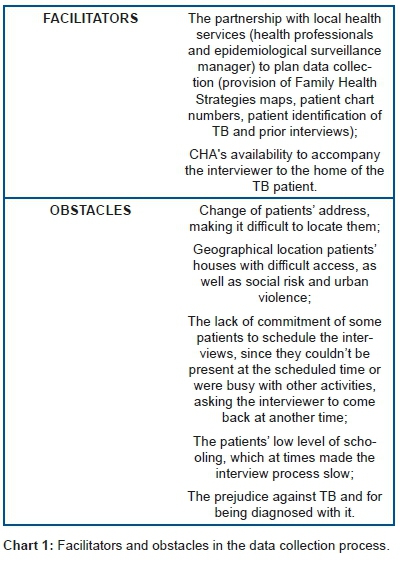
<body><![CDATA[<p>&nbsp;</p>     <p><font face="Verdana, Arial, Helvetica, sans-serif" size="3"><b>METHODS</b></font></p>     <p><font face="Verdana, Arial, Helvetica, sans-serif" size="2"><b>Type of study</b></font></p>     <p><font face="Verdana, Arial, Helvetica, sans-serif" size="2">Descriptive survey    study for the evaluation of health services, of a quantitative nature and cross-sectional    character.</font></p>     <p><font face="Verdana, Arial, Helvetica, sans-serif" size="2"><b>Sample selection    process</b></font></p>     <p><font face="Verdana, Arial, Helvetica, sans-serif" size="2">The research used    the structure of the 18 Family Health Strategies (FHS) of the municipality of    Salgueiro-PE to locate the addresses of TB patients. Data were collected at    the homes of each patient who had or was still under TB treatment, through the    participant researcher with the community health agents (CHA). During the collection    period, some elements were facilitators and others obstacles to this process    (<a href="/img/revistas/rbcdh/v28n3/15t1.jpg">Table 1</a>).</font></p>     <p>&nbsp;</p>     <p align="center"><img src="/img/revistas/rbcdh/v28n3/15c1.jpg"></p>     <p>&nbsp;</p>     <p><font face="Verdana, Arial, Helvetica, sans-serif" size="2">The study followed    the principles normalized by the National Health Council (CNS), by resolution    n. 466, December 2012, taking into consideration the ethical aspects that regulate    the research involving human beings</font></p>     ]]></body>
<body><![CDATA[<p><font face="Verdana, Arial, Helvetica, sans-serif" size="2">All the patients    selected read or were informed about the free and clarify consent term (FCCT),    approved by the ethics and research committee of the ABC Medical School (opinion    no. 1,893,761).</font></p>     <p><font face="Verdana, Arial, Helvetica, sans-serif" size="2"><b>Participants</b></font></p>     <p><font face="Verdana, Arial, Helvetica, sans-serif" size="2">To select the sample    of the research, an analysis was carried out together with the epidemiological    surveillance to identify the number of cases described in the registry book    and follow-up of the treatment of patients with tuberculosis from January 2014    to September 2016. A population of 84 TB patients enrolled in the family health    strategy was obtained. The following criteria were used as inclusion criterion:    age 18 years or older, having good cognition, living in the city of Salgueiro    / PE, who performed or performed the treatment at FHS and consent to the study    by signing the FCCT. Exclusion Criteria: TB patients who are in the prison system.</font></p>     <p><font face="Verdana, Arial, Helvetica, sans-serif" size="2"><b>Data collection    instrument</b></font></p>     <p><font face="Verdana, Arial, Helvetica, sans-serif" size="2">The research data    were collected through a questionnaire developed for TB patients from the Primary    Care Assessment Tool<sup>9</sup>, validated and adapted for TB attention<sup>10</sup>.    The instrument contains 86 specific questions for each essential organizational    component of basic care for TB control actions, as well as questions on patient    profile, clinical epidemiological information and current health status.</font></p>     <p><font face="Verdana, Arial, Helvetica, sans-serif" size="2">The Likert scale    was used to evaluate the level of agreement in opinion polls. A value of 0 to    5 was assigned. "Zero" identified the "do not know or do not apply" response    and values from 1 to 5 record the degree of preference (or agreement) relationship    of the statements.</font></p>     <p><font face="Verdana, Arial, Helvetica, sans-serif" size="2">To better identify    which policies exist in the municipality of Salgueiro-PE for TB control, an    interview script was developed for the main actor (manager) involved in the    reorganization process of health services.</font></p>     <p><font face="Verdana, Arial, Helvetica, sans-serif" size="2"><b>Statistical    analysis</b></font></p>     <p><font face="Verdana, Arial, Helvetica, sans-serif" size="2">Absolute and relative    values were used to describe the characteristics of the qualitative variables    for the quantitative variables, median and percentiles. A confidence level of    95% was used for all analyzes and the statistical program used was the Data    Analysis and Statistical Software for Professionals (Stata) version 11.0&reg;.    After obtaining the averages, these were related to the Likert scale.</font></p>     <p><font face="Verdana, Arial, Helvetica, sans-serif" size="2">The main aspects    and variables analyzed were:</font></p>     ]]></body>
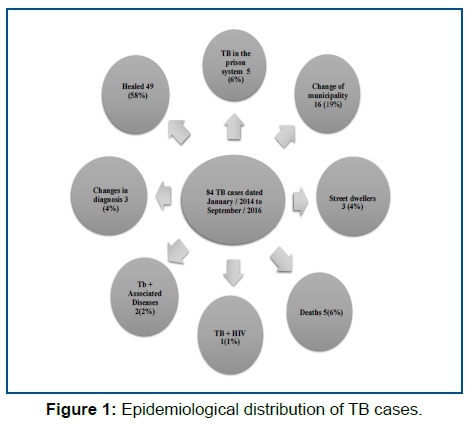
<body><![CDATA[<blockquote>        <p><font size="2">&#9679;</font><font face="Verdana, Arial, Helvetica, sans-serif" size="2">Regarding      the sociodemographic character: Sex, age, and schooling</font></p>       <p><font size="2">&#9679;</font><font face="Verdana, Arial, Helvetica, sans-serif" size="2">Regarding      health education: conducting health education on subjects other than TB, Participation      of TB patients in groups in health services, Educational work carried out      by health professionals in the community.</font></p>       <p><font size="2">&#9679;</font><font face="Verdana, Arial, Helvetica, sans-serif" size="2">Regarding      medication control: Access to medical care if malaise due to medication, the      absence of medication during treatment for TB</font></p>       <p><font size="2">&#9679;</font><font face="Verdana, Arial, Helvetica, sans-serif" size="2">Regarding      the previous diagnosis and follow-up in the treatment of TB: Offer by the      health services of the recipients for monthly sputum examination; Visit of      health professionals to deliver the recipients for sputum collection; Actions      with churches, neighborhood associations, for delivery of the recipients for      sputum collection; Performing the skin test by the health services; Monthly      consultation offered by health services.</font></p> </blockquote>     <p>&nbsp;</p>     <p><font face="Verdana, Arial, Helvetica, sans-serif" size="3"><b>RESULTS</b></font></p>     <p><font face="Verdana, Arial, Helvetica, sans-serif" size="2">Of the 84 registered    cases of tuberculosis, 16 (19%) of the patients moved to another municipality,    49 (58%) with discharge for cure, 5 (6%) in the prison system, 3 (4%) with changes    on diagnosis, 2 (2%) TB with associated diseases such as pneumonia and pleural    effusion, 1 (1%) TB + HIV, 5 (6%) deaths and 3 (4%) wanderers (without fixed    residence). Thus, the sample studied consisted of 40 patients. <a href="#f01">Figure    1</a>, below, presents the process of locating tuberculosis cases (<a href="#f01">Figure    1</a>).</font></p>     <p><a name="f01"></a></p>     <p>&nbsp;</p>     ]]></body>
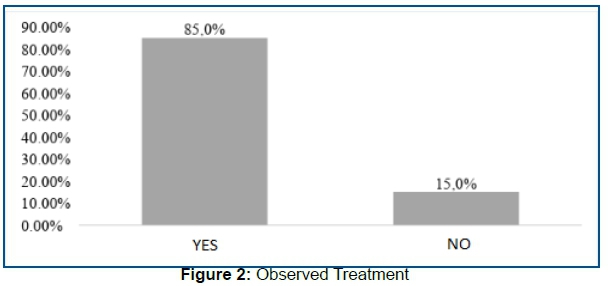
<body><![CDATA[<p align="center"><img src="/img/revistas/rbcdh/v28n3/15f01.jpg"></p>     <p>&nbsp;</p>     <p><font face="Verdana, Arial, Helvetica, sans-serif" size="3"><b>DISCUSSION</b></font></p>     <p><font face="Verdana, Arial, Helvetica, sans-serif" size="2">The incidence rate    of TB in Brazil is high<sup>12,13</sup>. In 2013, Brazil registered 71,123 new    cases of tuberculosis, equivalent to an incidence rate of 35.4 cases per 100,000    inhabitant which indicates a decrease of 20.3% in relation to 2003 when the    rate was 44.4 cases per 100 thousand people. Also, in 2013, 4,406 deaths per    TB were reported at a rate of 23 deaths per 100,000 inhabitants. Brazil ranks    the 16th place among the 22 countries with the highest TB prevalence and 111th    in terms of incidence rates. According to the Ministry of Health, in 2011 were    estimated 9 million new cases of the disease in the world, in addition to 1.4    million deaths<sup>14,12</sup>.</font></p>     <p><font face="Verdana, Arial, Helvetica, sans-serif" size="2">In Pernambuco,    there is an average of 4,230 new cases of tuberculosis per year. The State presented    the 4th place in disease detection rate and 2nd place in mortality in the country    and 1st place in number of cases in the Northeast in 2010, being Recife the    Brazilian capital with the highest incidence rate (48.2%), and one of the municipalities    that make up the I Regional Health Administration (I GERES), which holds 70%    of tuberculosis cases among the 12 GERES of the state<sup>15</sup>.</font></p>     <p><font face="Verdana, Arial, Helvetica, sans-serif" size="2">In Brazil, the    number of tuberculosis cases in males is twice the number of females, around    50 per 100,000 inhabitants<sup>11</sup>. In this study, the socio-demographic    characteristic revealed that of the 40 TB patients, there was a predominance    of males with 70% (28), compacting with national information<sup>16</sup>. This    trend may be related to the greater exposure of men outside the home and also    because, culturally, men resort less to health services<sup>17</sup>.</font></p>     <p><font face="Verdana, Arial, Helvetica, sans-serif" size="2">The sociodemographic    characterization of the eligible participate sample (40 patients) was predominantly    male (70%), 30% (12) had incomplete primary education and 37.5% (15) were between    the ages of 34 to 59 years of age (<a href="/img/revistas/rbcdh/v28n3/15t1.jpg">table    1</a>).</font></p>     <p><font face="Verdana, Arial, Helvetica, sans-serif" size="2">When asked about    the primary diagnosis site, the hospital environment had a higher prevalence    of diagnosed cases with tuberculosis with 62.5% (25) versus 37.5% (15) of diagnoses    within the FHS.</font></p>     <p><font face="Verdana, Arial, Helvetica, sans-serif" size="2">Participants were    also questioned about directly observed treatment (DOT), a strategy established    by the National Tuberculosis Control Program (NTCP) to regulate and enable the    quality of TB patient care, with the primary action being the supervision of    medication, made by a professional or person properly qualified for this purpose,    and it should be performed in any environment, which is more comfortable for    the user<sup>11,10</sup>. The DOT helps reduce the possibility of drug resistance,    withdrawal from treatment and encouraging adherence to therapy.</font></p>     <p><font face="Verdana, Arial, Helvetica, sans-serif" size="2">Among the TB patients    interviewed, 85.0% (34) performed the DOT, with only 15.0% (6) who did not (<a href="/img/revistas/rbcdh/v28n3/15f02.jpg">Figure    2</a>). Regarding the place of care, 27.5% (11) performed the supervised treatment    at the FHS and 72.5% (29) at home.</font></p>     ]]></body>
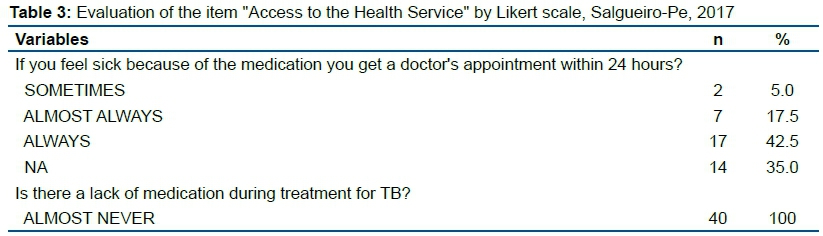
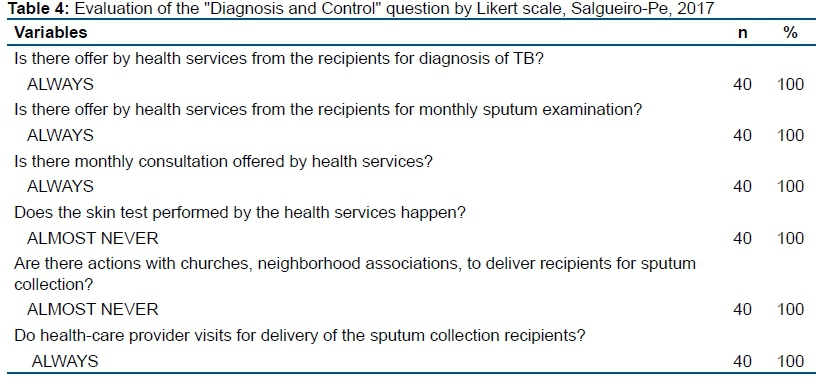
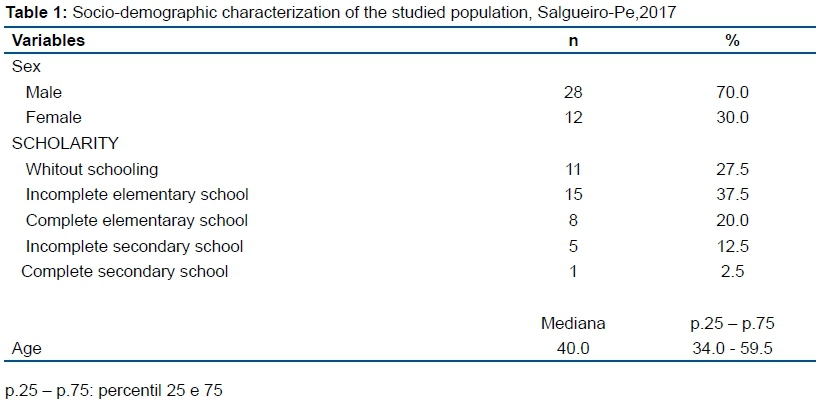
<body><![CDATA[<p><font face="Verdana, Arial, Helvetica, sans-serif" size="2">About the relation    to the variables: "health education activity on subjects other than TB", "participation    of TB patients in groups in the health services", <a href="/img/revistas/rbcdh/v28n3/15t2.jpg">Table    2</a> shows a non-favorable average indicating that the largest number of patients    reported do not perform any of the activities. However, the variable "Educational    work carried out by health professionals in the community" obtained an average    of 45%, indicating a regular level (<a href="/img/revistas/rbcdh/v28n3/15t2.jpg">table    2</a>).</font></p>     <p><font face="Verdana, Arial, Helvetica, sans-serif" size="2">The results found    for the variables: "access to medical care within 24 hours when an incident    caused by the use of medication happens", obtained a regular average indicating    that the study patients commonly have access to the health service. The data    collected on a Likert scale for "lack of medication" obtained an average of    100% for the "almost never" response, presenting a favorable level, that is,    almost never missing medication (<a href="/img/revistas/rbcdh/v28n3/15t3.jpg">Table    3</a>).</font></p>     <p><font face="Verdana, Arial, Helvetica, sans-serif" size="2">The mean reached    in the four variables: "offer by the health services of the recipients for diagnosis    of TB"; "Offer by the health services of the recipients for monthly sputum examination";    "Monthly consultation offered by health services"; "Visits by health professionals    to deliver the recipients for sputum collection", in the services of the FHS    were favorable, that is, the recipients were always offered for diagnosis and    examination as well as monthly consultation of control and visit of health professionals    were done.</font></p>     <p><font face="Verdana, Arial, Helvetica, sans-serif" size="2">However, the results    were not favorable in the variables " skin test performed by the health services";    "Service actions with churches, neighborhood associations, for delivery of recipients    for sputum collection", that is, these activities are never performed by FHS.</font></p>     <p><font face="Verdana, Arial, Helvetica, sans-serif" size="2"><b>Sociodemographic    Characterization</b></font></p>     <p><font face="Verdana, Arial, Helvetica, sans-serif" size="2">About schooling,    the study showed a higher frequency among patients with incomplete primary education,    37.5% (15) of the sample. In a research performed in Rio de Janeiro, referring    to the distribution of monthly consultations of tuberculosis according to demographic    and clinical variables of the users, almost 40% corresponded to individuals    without schooling or incomplete elementary education<sup>18</sup>.</font></p>     <p><font face="Verdana, Arial, Helvetica, sans-serif" size="2">According to Lindoso    <i>et al</i>.<sup>19 </sup>and Santos<i> et al</i>.<sup>20</sup>, people with    low educational level have a lower adherence to TB treatment, because they have    an erroneous perception of the disease and do not seek health services, regarding    the diagnosis and treatment, and increasing the abandonment number<sup>19,20</sup>.</font></p>     <p><font face="Verdana, Arial, Helvetica, sans-serif" size="2">The interviewees    under study were within the economically active age group, between 34 to 59    years of age. These data corroborate with a study conducted by Ferrer <i>et    al</i>.<sup>21</sup>. in Santa Catarina, where the highest rates found were    in the age groups of 30-44 and 45-59 years and with a study carried out in the    city of Teresina-PI. In this study, the incidence was between the age group    older than 50 years<sup>21,22</sup>.</font></p>     <p><font face="Verdana, Arial, Helvetica, sans-serif" size="2">Regarding the diagnosis    site, the hospital had a higher prevalence of cases diagnosed with tuberculosis    with 62.5%, as presented in surveys carried out by Silva Sobrinho23 and Ponters    <i>et al</i>.<sup>24</sup> , where this reality reflects a reversal of the flow    of treatment and diagnosis of tuberculosis, since primary health care is recommended    as a preferential gateway to the HUS. Thus, its noted the difficulty of the    basic network in identifying and meeting the needs of the community, which causes    overcrowding of the emergency sector with problems that could be solved in other    levels of attention<sup>23,24</sup>.</font></p>     <p><font face="Verdana, Arial, Helvetica, sans-serif" size="2"><b>Directly Observed    Treatment</b></font></p>     ]]></body>
<body><![CDATA[<p><font face="Verdana, Arial, Helvetica, sans-serif" size="2">The Ministry of    Health, together with the NTCP, makes control of the primary drug treatment    in the fight against tuberculosis, having as one of the pillars of the DOT,    the distribution of the medication in the intention to have a better control    in the use of the drugs used in Brazil<sup>19</sup>.</font></p>     <p><font face="Verdana, Arial, Helvetica, sans-serif" size="2">Discontinuation    of therapy is one of the major obstacles to TB cure and it is considered a multifactorial    problem. According to a study by Chirinos <i>et al</i>.<sup>25</sup>, the sociodemographic    factors are the ones that are most related to this abandonment, so it is recommended    that this team has effective and vigilant control over drug therapy<sup>26</sup>.    For Souza <i>et al.</i><sup>26</sup> .the greatest difficulties in TB control    are the delay in seeking the health service due to the fear of diagnosis, as    well as the fear of discrimination by society, therefore it is necessary that    users are familiarized with the health team of FHS.</font></p>     <p><font face="Verdana, Arial, Helvetica, sans-serif" size="2">Among the TB patients    interviewed, 85% performed supervised treatment and only 15% did not participate    in the DOT. Regarding the place of care, 27.5% had supervised treatment at the    FHS and 72.5% at home. Research carried out in several municipalities in the    country shows that primary care effectively performs the DOT, but still can    not reach a total of 100% of patients<sup>4</sup>.</font></p>     <p><font face="Verdana, Arial, Helvetica, sans-serif" size="2"><b>Health education</b></font></p>     <p><font face="Verdana, Arial, Helvetica, sans-serif" size="2">The variables "health    education activity on subjects besides TB", "TB patients participation in health    services groups", obtained a non-favorable result, indicating that they did    not perform any of these activities. However, the variable "Educational work    carried out by health professionals in the community" obtained an average of    45% indicating a regular level. These data reveal the conception of the health-disease    process is still very closely linked to the clinic itself, showing a discrepancy    with what is proposed by the principles and guidelines of the HUS, which has    health education as a basis for health promotion<sup>27-30</sup>.</font></p>     <p><font face="Verdana, Arial, Helvetica, sans-serif" size="2">In addition, the    study shows that the service evaluated does not develop health education actions    in TB control, especially in the indicator "patient participation in groups",    even though these actions are considered by the Ministry of Health and recommended    in the NTCP as a primary strategy control and adherence to TB treatment.</font></p>     <p><font face="Verdana, Arial, Helvetica, sans-serif" size="2">Health education    should be developed through organized and teamwork, being used as a strategy    for TB control, developing patient empowerment, and promoting dialogue between    health professionals and users, citizen autonomy and the encouragement of an    active posture of these subjects in their political and social environments,    developing opportunities to enlarge the understanding of the problems and to    reflect on the intervention about the reality in which they live, privileging    the promotion of their autonomy<sup>31, 32</sup>.</font></p>     <p><font face="Verdana, Arial, Helvetica, sans-serif" size="2">Teamwork was codified    by the group as the primary point for the performance of the family health strategy.    During the decoding/problematization, the major contributions of the subjects    were shown through the perspective that the common goal of care and health promotion    of the population can only be achieved through teamwork.</font></p>     <p><font face="Verdana, Arial, Helvetica, sans-serif" size="2">A study by S&aacute;    <i>et al</i>.<sup>31</sup> corroborates our findings, where health education    practices are incipient and not very expressive in the work process of primary    health care professionals<sup>26</sup>.</font></p>     <p><font face="Verdana, Arial, Helvetica, sans-serif" size="2">One of the strategies    considered a priority by the NTCP is predicted to increase case detection in    different socioeconomic and clinical epidemiological scenarios by strengthening    the primary health care (PHC) service system. It is extremely important that    the family health team acts in the surveillance, prevention and control of the    disease<sup>33-35</sup>.</font></p>     ]]></body>
<body><![CDATA[<p><font face="Verdana, Arial, Helvetica, sans-serif" size="2"><b>Access to Health    Service</b></font></p>     <p><font face="Verdana, Arial, Helvetica, sans-serif" size="2">The results found    in this study show that medical care within 24 hours was regular, indicating    access to the health service. This aspect diminishes the incidence of treatment    abandonment of tuberculosis since health professionals are accessible to guide,    evaluate and monitor the health status of the TB carrier. According toSantos    <i>et al</i>.<sup>20</sup> and Rodrigues <i>et al.</i><sup>34</sup>, the perception    of the relations with the health service and the institutional field can be    factors that contribute or not to the abandonment of the treatment, since the    side effects presented by the patients can cause extra consultations to treat    the complaints<sup>20,35</sup>.</font></p>     <p><font face="Verdana, Arial, Helvetica, sans-serif" size="2">The data about    "lack of medication" averaged 100%, presenting a favorable level, that is, never    or almost never missing medication. The delivery of the medication is exclusive    to the health services, as they can not be sold in pharmacies, and the misuse    of medication is one of the risk factors for the patient to become resistant    to the drug, because of this, the treatment can't be interrupted. The NTCP,    when refers to TB control, is primarily aimed at breaking the chain of transmission    and the main means to achieve this goal is to perform the diagnosis and early    treatment so that bacilli are not disseminated, with the outcome of curing the    disease<sup>11,13</sup>.</font></p>     <p><font face="Verdana, Arial, Helvetica, sans-serif" size="2">A study conducted    by Lafaiete <i>et al.</i><sup>35</sup> indicate that the results are favorable    with medical care within 24 hours, with access to drugs for the treatment of    TB. This fact reveals an adequate planning and distribution of drugs by the    team that coordinates the treatment control program in the municipality, as    they include essential steps in the selection, procurement, distribution and    appropriate use of the drug.</font></p>     <p><font face="Verdana, Arial, Helvetica, sans-serif" size="2"><b>Diagnosis</b></font></p>     <p><font face="Verdana, Arial, Helvetica, sans-serif" size="2">Bacilloscopy is    used in public health to confirm the diagnosis of TB since it is a simple and    safe technique, it has two important purposes in TB control: detection of bacilliferous    cases, responsible for the chain of transmission, and control of treatment and    efficacy. For this reason, it is recommended that in all TB diagnoses a bacilloscopy    for confirmation be requested and that it be performed every month, that the    communicants and other citizens perform the skin test (PST), for an early diagnosis<sup>11,36</sup>.</font></p>     <p><font face="Verdana, Arial, Helvetica, sans-serif" size="2">The follow-up of    TB treatment was evaluated through periodic sputum controls in the variables:    "offer by the health services of the recipients to diagnose TB"; "Offer by recipients    health services for monthly sputum examination"; "Monthly consultation offered    by health services"; "Visits by health professionals to deliver the recipients    for sputum collection". The results showed that such monitoring has been a priority    in the city of Salgueiro, presenting favorable percentage levels (<a href="/img/revistas/rbcdh/v28n3/15t4.jpg">table    4</a>). Corroborating with a study carried out by Lima <i>et al</i>.<sup>37</sup>,    who presented positive results regarding the performance of follow-up smear    microscopy.</font></p>     <p><font face="Verdana, Arial, Helvetica, sans-serif" size="2">Control actions    such as "perform the skin test by the health services" and "actions with churches,    neighborhood associations, to deliver the recipient for sputum collection",    have had unfavorable results, which determines that the municipality has not    met all the goals of the NTCP, which has only been conducting clinical actions,    and regarding promotion and prevention actions, such as active search and exams    for early diagnosis, such as PST, has not performed them in the municipality    under study . These data are corroborated with studies carried out by Oliveira<sup>38</sup>    in Ribeir&atilde;o Preto - SP, showing the same profile where the diagnostic    bacilloscopy is performed, but the active search is not done.</font></p>     <p><font face="Verdana, Arial, Helvetica, sans-serif" size="2">The supply of recipients    for sputum examination in the community and the PST, has been the priority action    in the active search for respiratory symptoms, becoming part of the routine    of services and mainly primary health care, in order to obtain the early detection    of cases of TB. Having as an instrument of work the family and the home, the    FHS has a privileged space for these actions<sup>39,40</sup>.</font></p>     <p><font face="Verdana, Arial, Helvetica, sans-serif" size="2"><b>Repercussions    in the Field of Public Health</b></font></p>     ]]></body>
<body><![CDATA[<p><font face="Verdana, Arial, Helvetica, sans-serif" size="2">In relation to    the TB control policy established in the city of Salgueiro, health education    and the active search for respiratory symptomatology, in the variables "Participation    of TB patients in groups in health services", "actions with churches, neighborhood    associations, for delivery of recipients for sputum collection ", did not obtain    favorable averages, that is, the municipality does not perform these activities,    and can be justified as shown by Silva <i>et al.</i><sup>41</sup> research to    the inexistence of a policy of permanent education, consistent with the existing    epidemiological situation and the turnover of health professionals is related    to the political-partisan discontinuity in the municipality, which may hinder    the maintenance of qualified health teams to deal with TB in primary care services.</font></p>     <p><font face="Verdana, Arial, Helvetica, sans-serif" size="2">In this way, it    is important to highlight the study conducted by Queiroz <i>et al.</i><sup>42</sup>    and Terra<i> et al.</i><sup>43 </sup>on the identification of problems related    to therapeutic adherence and TB control, in which they highlighted that issues    related to the qualification of the teams need to reach a greater discussion    and execution, since most of the professionals who work in primary care have    already experienced the training process centered on the curativist model and    not on health promotion.</font></p>     <p><font face="Verdana, Arial, Helvetica, sans-serif" size="2">For Samico <i>et    al.</i><sup>44</sup>,, health evaluation has become an effective alternative    to provide answers regarding planned and executed actions, providing information    on the way health systems users function, quality, effectiveness, safety and    satisfaction. Thus, this study allowed the verification of actions, such as    health education and the active search for respiratory symptomatic patients,    which, even if it did not occur, the manager reported being executed. This leads    to the generation of information that will give managers and health professionals    the need to reflect and intervene in these indicators to modify the epidemiological    picture presented by the disease, indicating the need for research and research    that produce positive results in the disease process and improvement of the    population's health<sup>45,46</sup>.</font></p>     <p><font face="Verdana, Arial, Helvetica, sans-serif" size="2">It is observed    that TB patients are mostly young adults with low schooling and males, which    generates a social-economic problem for families, since the disease often leaves    this group unable to work, taking from the provider the condition of livelihood.</font></p>     <p><font face="Verdana, Arial, Helvetica, sans-serif" size="2">Although the municipality    has favorable conditions to carry out tuberculosis control actions in primary    care, it is possible to detect a large concentration of diagnoses identified    by the hospital's network, causing a reversal of the flow of care and diagnosis    of tuberculosis. There was a satisfactory performance in relation to the activities    related to the offer of treatment actions, such as medical care, bacilloscopy,    and medications. As a result of the non-execution of some health indicators    such as an active search for respiratory symptomatic and health education, TB    control actions remain at a favorable, non-favorable and regular level, which    determines that there is no linearity in TB control actions in the FHS.</font></p>     <p><font face="Verdana, Arial, Helvetica, sans-serif" size="2">Therefore, the    findings of this study point to the need to implement policies aimed at health    education and active search for respiratory symptomatic patients, with actions    directed not only at the sick but also at the family and community levels. For    this, the commitment of the management in the actions established in the control    of TB in the municipality, as well as the health professionals and the population    involved, must know its real assignments, in order to fulfill the goals suggested    by the World Health Organization (WHO) and MH in the fight against the disease.</font></p>     <p>&nbsp;</p>     <p><font face="Verdana, Arial, Helvetica, sans-serif" size="3"><b>CONCLUSION</b></font></p>     <p><font face="Verdana, Arial, Helvetica, sans-serif" size="2">The evaluation    of the performance of tuberculosis control actions and services of the family    health strategy in the city of Salgueiro-PE pointed to weaknesses in the diagnosis    of TB, as seen in the flow of care and diagnosis of tuberculosis, absence in    the actions of health education and search active respiratory symptomatic, which    end up causing damage to the control and treatment of tuberculosis.</font></p>     <p>&nbsp;</p>     ]]></body>
<body><![CDATA[<p><font face="Verdana, Arial, Helvetica, sans-serif" size="3"><b>REFERENCES</b></font></p>     <!-- ref --><p><font face="Verdana, Arial, Helvetica, sans-serif" size="2">1.Andrade MV, Coelho    AQ, Xavier Neto M, Carvalho LR, Atun R, Castro MC. Brazil's Family Health Strategy:    factors associated with programme uptake and coverage expansion over 15 years    (1998-2012). Health Policy Plan. 2018;33(3):368-80. DOI: <a href="http://dx.doi.org/10.1093/heapol/czx189" target="_blank">http://dx.doi.org/10.1093/heapol/czx189</a></font>&nbsp;&nbsp;&nbsp;&nbsp;&nbsp;&nbsp;&nbsp;&nbsp;[&#160;<a href="javascript:void(0);" onclick="javascript: window.open('/scielo.php?script=sci_nlinks&ref=2540266&pid=S0104-1282201800030001500001&lng=','','width=640,height=500,resizable=yes,scrollbars=1,menubar=yes,');">Links</a>&#160;]<!-- end-ref --><!-- ref --><p><font face="Verdana, Arial, Helvetica, sans-serif" size="2">2.Lima-Costa MF,    Turci MA, Macinko J. Estrat&eacute;gia Sa&uacute;de da Fam&iacute;lia em compara&ccedil;&atilde;o    a outras fontes de aten&ccedil;&atilde;o: indicadores de uso e qualidade dos    servi&ccedil;os de sa&uacute;de em Belo Horizonte, Minas Gerais, Brasil. Cadernos    de Sa&uacute;de P&uacute;blica, 2013;29(7):1370-80. DOI: <a href="http://dx.doi.org/10.1590/S0102-311X2013000700011" target="_blank">http://dx.doi.org/10.1590/S0102-311X2013000700011</a></font>&nbsp;&nbsp;&nbsp;&nbsp;&nbsp;&nbsp;&nbsp;&nbsp;[&#160;<a href="javascript:void(0);" onclick="javascript: window.open('/scielo.php?script=sci_nlinks&ref=2540267&pid=S0104-1282201800030001500002&lng=','','width=640,height=500,resizable=yes,scrollbars=1,menubar=yes,');">Links</a>&#160;]<!-- end-ref --><!-- ref --><p><font face="Verdana, Arial, Helvetica, sans-serif" size="2">3.Lacerda SNB,    Temoteo RCA, Figueiredo TMRM, Luna FDT, Sousa MAN, Abreu LC, et al. Individual    and social vulnerabilities upon acquiring tuberculosis: a literature systematic    review. Int Arch Med. 2014;7:35. DOI: <a href="http://dx.doi.org/10.1186/1755-7682-7-35" target="_blank">http://dx.doi.org/10.1186/1755-7682-7-35</a></font>&nbsp;&nbsp;&nbsp;&nbsp;&nbsp;&nbsp;&nbsp;&nbsp;[&#160;<a href="javascript:void(0);" onclick="javascript: window.open('/scielo.php?script=sci_nlinks&ref=2540268&pid=S0104-1282201800030001500003&lng=','','width=640,height=500,resizable=yes,scrollbars=1,menubar=yes,');">Links</a>&#160;]<!-- end-ref --><!-- ref --><p><font face="Verdana, Arial, Helvetica, sans-serif" size="2">4.Hijjar MA, Gerhardt    G, Teixeira GM, Procopio MJ. Retrospecto do controle da tuberculose no Brasil.    Rev Sa&uacute;de P&uacute;blica. 2007;41(Suppl.1):50-7. DOI: <a href="http://dx.doi.org/10.1590/S0034-89102007000800008" target="_blank">http://dx.doi.org/10.1590/S0034-89102007000800008</a></font>&nbsp;&nbsp;&nbsp;&nbsp;&nbsp;&nbsp;&nbsp;&nbsp;[&#160;<a href="javascript:void(0);" onclick="javascript: window.open('/scielo.php?script=sci_nlinks&ref=2540269&pid=S0104-1282201800030001500004&lng=','','width=640,height=500,resizable=yes,scrollbars=1,menubar=yes,');">Links</a>&#160;]<!-- end-ref --><!-- ref --><p><font face="Verdana, Arial, Helvetica, sans-serif" size="2">5.Souza WV, Albuquerque    MFM, Barcellos CC, Ximenes RAA, Carvalho MS. Tuberculose no Brasil: constru&ccedil;&atilde;o    de um sistema de vigil&acirc;ncia de base territorial. Rev Sa&uacute;de P&uacute;blica.    2005;39(1):82-9. DOI: <a href="http://dx.doi.org/10.1590/S0034-89102005000100011" target="_blank">http://dx.doi.org/10.1590/S0034-89102005000100011</a></font>&nbsp;&nbsp;&nbsp;&nbsp;&nbsp;&nbsp;&nbsp;&nbsp;[&#160;<a href="javascript:void(0);" onclick="javascript: window.open('/scielo.php?script=sci_nlinks&ref=2540270&pid=S0104-1282201800030001500005&lng=','','width=640,height=500,resizable=yes,scrollbars=1,menubar=yes,');">Links</a>&#160;]<!-- end-ref --><!-- ref --><p><font face="Verdana, Arial, Helvetica, sans-serif" size="2">6.Brasil. Minist&eacute;rio    da Sa&uacute;de. Secretaria de Aten&ccedil;&atilde;o &agrave; Sa&uacute;de.    Departamento de Aten&ccedil;&atilde;o B&aacute;sica. Pol&iacute;tica Nacional    de Aten&ccedil;&atilde;o B&aacute;sica. Bras&iacute;lia: Minist&eacute;rio da    Sa&uacute;de, 2012.    &nbsp;&nbsp;&nbsp;&nbsp;&nbsp;&nbsp;&nbsp;&nbsp;[&#160;<a href="javascript:void(0);" onclick="javascript: window.open('/scielo.php?script=sci_nlinks&ref=2540271&pid=S0104-1282201800030001500006&lng=','','width=640,height=500,resizable=yes,scrollbars=1,menubar=yes,');">Links</a>&#160;]<!-- end-ref --></font></p>     <!-- ref --><p><font face="Verdana, Arial, Helvetica, sans-serif" size="2">7.Brasil. Minist&eacute;rio    da Sa&uacute;de. Secretaria de Vigil&acirc;ncia em Sa&uacute;de. Departamento    de Vigil&acirc;ncia das Doen&ccedil;as Transmiss&iacute;veis. Experi&ecirc;ncias    de monitoramento e avalia&ccedil;&atilde;o no controle da tuberculose no Brasil.    Bras&iacute;lia: Minist&eacute;rio de Sa&uacute;de, 2013.    &nbsp;&nbsp;&nbsp;&nbsp;&nbsp;&nbsp;&nbsp;&nbsp;[&#160;<a href="javascript:void(0);" onclick="javascript: window.open('/scielo.php?script=sci_nlinks&ref=2540273&pid=S0104-1282201800030001500007&lng=','','width=640,height=500,resizable=yes,scrollbars=1,menubar=yes,');">Links</a>&#160;]<!-- end-ref --></font></p>     ]]></body>
<body><![CDATA[<!-- ref --><p><font face="Verdana, Arial, Helvetica, sans-serif" size="2">8.Santos MLSG,    Villa TCS, Vendramini SHF, Gonz&aacute;les RIC, Palha PF, Santos NSGM, et al.    A ger&ecirc;ncia das a&ccedil;&otilde;es de controle da tuberculose em munic&iacute;pios    priorit&aacute;rios do interior paulista. Texto Contexto Enferm. 2010;19(1):64-9.    DOI: <a href="http://dx.doi.org/10.1590/S0104-07072010000100007" target="_blank">http://dx.doi.org/10.1590/S0104-07072010000100007</a></font>&nbsp;&nbsp;&nbsp;&nbsp;&nbsp;&nbsp;&nbsp;&nbsp;[&#160;<a href="javascript:void(0);" onclick="javascript: window.open('/scielo.php?script=sci_nlinks&ref=2540275&pid=S0104-1282201800030001500008&lng=','','width=640,height=500,resizable=yes,scrollbars=1,menubar=yes,');">Links</a>&#160;]<!-- end-ref --><!-- ref --><p><font face="Verdana, Arial, Helvetica, sans-serif" size="2">9.Almeida C, Macinko    J. Valida&ccedil;&atilde;o de uma metodologia r&aacute;pida das caracter&iacute;sticas    organizacionais e do desempenho dos servi&ccedil;os de aten&ccedil;&atilde;o    b&aacute;sica do Sistema &Uacute;nico de Sa&uacute;de (SUS) em n&iacute;vel    local. Bras&iacute;lia: Organiza&ccedil;&atilde;o Pan-Americana de Sa&uacute;de,    2006.    &nbsp;&nbsp;&nbsp;&nbsp;&nbsp;&nbsp;&nbsp;&nbsp;[&#160;<a href="javascript:void(0);" onclick="javascript: window.open('/scielo.php?script=sci_nlinks&ref=2540276&pid=S0104-1282201800030001500009&lng=','','width=640,height=500,resizable=yes,scrollbars=1,menubar=yes,');">Links</a>&#160;]<!-- end-ref --></font></p>     <!-- ref --><p><font face="Verdana, Arial, Helvetica, sans-serif" size="2">10.Ruffino-Neto    A, Villa TCS. Tuberculose: pesquisas operacionais. S&atilde;o Paulo: FUNPEC,    2010.    &nbsp;&nbsp;&nbsp;&nbsp;&nbsp;&nbsp;&nbsp;&nbsp;[&#160;<a href="javascript:void(0);" onclick="javascript: window.open('/scielo.php?script=sci_nlinks&ref=2540278&pid=S0104-1282201800030001500010&lng=','','width=640,height=500,resizable=yes,scrollbars=1,menubar=yes,');">Links</a>&#160;]<!-- end-ref --></font></p>     <!-- ref --><p><font face="Verdana, Arial, Helvetica, sans-serif" size="2">11.Brasil. Minist&eacute;rio    da Sa&uacute;de. Secretaria de Vigil&acirc;ncia em Sa&uacute;de Departamento    de Vigil&acirc;ncia Epidemiol&oacute;gica. Doen&ccedil;as infecciosas e parasit&aacute;rias:    guia de bolso. Bras&iacute;lia: Minist&eacute;rio da Sa&uacute;de, 2010.    &nbsp;&nbsp;&nbsp;&nbsp;&nbsp;&nbsp;&nbsp;&nbsp;[&#160;<a href="javascript:void(0);" onclick="javascript: window.open('/scielo.php?script=sci_nlinks&ref=2540280&pid=S0104-1282201800030001500011&lng=','','width=640,height=500,resizable=yes,scrollbars=1,menubar=yes,');">Links</a>&#160;]<!-- end-ref --></font></p>     <!-- ref --><p><font face="Verdana, Arial, Helvetica, sans-serif" size="2">12.Brasil. Minist&eacute;rio    da Sa&uacute;de. Secretaria de Aten&ccedil;&atilde;o &agrave; Sa&uacute;de.    Departamento de Aten&ccedil;&atilde;o B&aacute;sica. Vigil&acirc;ncia em Sa&uacute;de:    Dengue, Esquistossomose, Hansen&iacute;ase, Mal&aacute;ria, Tracoma e Tuberculose.    Bras&iacute;lia: Minist&eacute;rio da Sa&uacute;de, 2008.    &nbsp;&nbsp;&nbsp;&nbsp;&nbsp;&nbsp;&nbsp;&nbsp;[&#160;<a href="javascript:void(0);" onclick="javascript: window.open('/scielo.php?script=sci_nlinks&ref=2540282&pid=S0104-1282201800030001500012&lng=','','width=640,height=500,resizable=yes,scrollbars=1,menubar=yes,');">Links</a>&#160;]<!-- end-ref --></font></p>     <!-- ref --><p><font face="Verdana, Arial, Helvetica, sans-serif" size="2">13.Micheletti VCD,    Bordin R. Programa de controle da tuberculose da secretaria municipal de sa&uacute;de    de Porto Alegre: Ades&atilde;o ao tratamento a partir da an&aacute;lise das    estrat&eacute;gias da equipe de sa&uacute;de. Monografia (Conclus&atilde;o de    Curso) - Universidade Federal do Rio Grande do Sul. Porto Alegre: 2008.    &nbsp;&nbsp;&nbsp;&nbsp;&nbsp;&nbsp;&nbsp;&nbsp;[&#160;<a href="javascript:void(0);" onclick="javascript: window.open('/scielo.php?script=sci_nlinks&ref=2540284&pid=S0104-1282201800030001500013&lng=','','width=640,height=500,resizable=yes,scrollbars=1,menubar=yes,');">Links</a>&#160;]<!-- end-ref --></font></p>     <!-- ref --><p><font face="Verdana, Arial, Helvetica, sans-serif" size="2">14.Brasil. Instituto    Brasileiro de Geografia e Estat&iacute;stica (IBGE). Cidades, 2013. [cited 2016    Sep 12] Available from: <a href="http://cidades.ibge.gov.br/xtras/perfil.php?lang=&amp;codmun=230180" target="_blank">http://cidades.ibge.gov.br/xtras/perfil.php?lang=&amp;codmun=230180</a>.    &nbsp;&nbsp;&nbsp;&nbsp;&nbsp;&nbsp;&nbsp;&nbsp;[&#160;<a href="javascript:void(0);" onclick="javascript: window.open('/scielo.php?script=sci_nlinks&ref=2540286&pid=S0104-1282201800030001500014&lng=','','width=640,height=500,resizable=yes,scrollbars=1,menubar=yes,');">Links</a>&#160;]<!-- end-ref --></font></p>     <!-- ref --><p><font face="Verdana, Arial, Helvetica, sans-serif" size="2">15.Pernambuco.    Secretaria Estadual de Sa&uacute;de. Secretaria Executiva de Vigil&acirc;ncia    em Sa&uacute;de. Programa de Enfretamento das Doen&ccedil;as Negligenciadas    no Estado de Pernambuco: SANAR: 2011-2014. Recife: Secretaria Estadual de Sa&uacute;de,    2013.    &nbsp;&nbsp;&nbsp;&nbsp;&nbsp;&nbsp;&nbsp;&nbsp;[&#160;<a href="javascript:void(0);" onclick="javascript: window.open('/scielo.php?script=sci_nlinks&ref=2540288&pid=S0104-1282201800030001500015&lng=','','width=640,height=500,resizable=yes,scrollbars=1,menubar=yes,');">Links</a>&#160;]<!-- end-ref --></font></p>     <!-- ref --><p><font face="Verdana, Arial, Helvetica, sans-serif" size="2">16.Vieira AN, Fernandes    ACL, Lima DWC, Oliveira WS, Lima LCS, Oliveira LKS. Casos de Tuberculose Notificados    no SINAN. Rev Baiana Sa&uacute;de P&uacute;blica. 2013;37(4):869-80.    &nbsp;&nbsp;&nbsp;&nbsp;&nbsp;&nbsp;&nbsp;&nbsp;[&#160;<a href="javascript:void(0);" onclick="javascript: window.open('/scielo.php?script=sci_nlinks&ref=2540290&pid=S0104-1282201800030001500016&lng=','','width=640,height=500,resizable=yes,scrollbars=1,menubar=yes,');">Links</a>&#160;]<!-- end-ref --></font></p>     <!-- ref --><p><font face="Verdana, Arial, Helvetica, sans-serif" size="2">17.Gosoniu GD,    Ganapathy S, Kemp J, Auer C, Somma D, Karim F, et al. Gender and socio-cultural    determinants of delay to diagnosis of TB in Bangladesh, India and Malawi. Int    J Tuberc Lung Dis. 2008;12(7);848-55.    &nbsp;&nbsp;&nbsp;&nbsp;&nbsp;&nbsp;&nbsp;&nbsp;[&#160;<a href="javascript:void(0);" onclick="javascript: window.open('/scielo.php?script=sci_nlinks&ref=2540292&pid=S0104-1282201800030001500017&lng=','','width=640,height=500,resizable=yes,scrollbars=1,menubar=yes,');">Links</a>&#160;]<!-- end-ref --></font></p>     <!-- ref --><p><font face="Verdana, Arial, Helvetica, sans-serif" size="2">18.Portela MC,    Lima SML, Brito C, Ferreira VMB, Escosteguy CC, Vasconcellos MTL. Programa de    Controle da Tuberculose e satisfa&ccedil;&atilde;o dos usu&aacute;rios, Rio    de Janeiro. Rev Sa&uacute;de P&uacute;blica. 2014;48(3):497-507. DOI: <a href="http://dx.doi.org/10.1590/S0034-8910.2014048004793" target="_blank">http://dx.doi.org/10.1590/S0034-8910.2014048004793</a></font>&nbsp;&nbsp;&nbsp;&nbsp;&nbsp;&nbsp;&nbsp;&nbsp;[&#160;<a href="javascript:void(0);" onclick="javascript: window.open('/scielo.php?script=sci_nlinks&ref=2540294&pid=S0104-1282201800030001500018&lng=','','width=640,height=500,resizable=yes,scrollbars=1,menubar=yes,');">Links</a>&#160;]<!-- end-ref --><!-- ref --><p><font face="Verdana, Arial, Helvetica, sans-serif" size="2">19.Lindoso AABP,    Waldman EA, Komatsu NK, Figueiredo SM, Taniguchi M, Rodrigues LC. Perfil de    pacientes que evoluem para &oacute;bito por tuberculose no munic&iacute;pio    de S&atilde;o Paulo, 2002. Rev Sa&uacute;de P&uacute;blica. 2008;42(5):805-812.    DOI: <a href="http://dx.doi.org/10.1590/S0034-89102008000500004" target="_blank">http://dx.doi.org/10.1590/S0034-89102008000500004</a></font>&nbsp;&nbsp;&nbsp;&nbsp;&nbsp;&nbsp;&nbsp;&nbsp;[&#160;<a href="javascript:void(0);" onclick="javascript: window.open('/scielo.php?script=sci_nlinks&ref=2540295&pid=S0104-1282201800030001500019&lng=','','width=640,height=500,resizable=yes,scrollbars=1,menubar=yes,');">Links</a>&#160;]<!-- end-ref --><!-- ref --><p><font face="Verdana, Arial, Helvetica, sans-serif" size="2">20.Santos MLSG,    Vendramini SHF, Gazetta CE, Oliveira SAC, Villa TCSV. Pobreza: caracteriza&ccedil;&atilde;o    socioecon&ocirc;mica da tuberculose. Rev Latino-Am Enfermagem. 2007;15(esp).    DOI: <a href="http://dx.doi.org/10.1590/S0104-11692007000700008" target="_blank">http://dx.doi.org/10.1590/S0104-11692007000700008</a></font>&nbsp;&nbsp;&nbsp;&nbsp;&nbsp;&nbsp;&nbsp;&nbsp;[&#160;<a href="javascript:void(0);" onclick="javascript: window.open('/scielo.php?script=sci_nlinks&ref=2540296&pid=S0104-1282201800030001500020&lng=','','width=640,height=500,resizable=yes,scrollbars=1,menubar=yes,');">Links</a>&#160;]<!-- end-ref --><!-- ref --><p><font face="Verdana, Arial, Helvetica, sans-serif" size="2">21.Ferrer GCN,    Silva RM, Ferrer KT, Traebert J. A carga de doen&ccedil;a por tuberculose no    estado de Santa Catarina. J Bras Pneumol. 2014;39(6):61-8. DOI: <a href="http://dx.doi.org/10.1590/S1806-37132014000100009" target="_blank">http://dx.doi.org/10.1590/S1806-37132014000100009</a></font>&nbsp;&nbsp;&nbsp;&nbsp;&nbsp;&nbsp;&nbsp;&nbsp;[&#160;<a href="javascript:void(0);" onclick="javascript: window.open('/scielo.php?script=sci_nlinks&ref=2540297&pid=S0104-1282201800030001500021&lng=','','width=640,height=500,resizable=yes,scrollbars=1,menubar=yes,');">Links</a>&#160;]<!-- end-ref --><!-- ref --><p><font face="Verdana, Arial, Helvetica, sans-serif" size="2">22.Coelho DMM,    Viana RL, Madeira CA, Ferreira LOC, Campelo V. Perfil epidemiol&oacute;gico    da tuberculose no Munic&iacute;pio de Teresina-PI, no per&iacute;odo de 1999    a 2005. Epidemiol Serv Sa&uacute;de. 2010;19(1):33-42.    &nbsp;&nbsp;&nbsp;&nbsp;&nbsp;&nbsp;&nbsp;&nbsp;[&#160;<a href="javascript:void(0);" onclick="javascript: window.open('/scielo.php?script=sci_nlinks&ref=2540298&pid=S0104-1282201800030001500022&lng=','','width=640,height=500,resizable=yes,scrollbars=1,menubar=yes,');">Links</a>&#160;]<!-- end-ref --></font></p>     <!-- ref --><p><font face="Verdana, Arial, Helvetica, sans-serif" size="2">23.Silva-Sobrinho    RA, Andrade RLP, Ponce MAZ, Wysocki AD, Brunello ME, Scatena LM, et al. Retardo    no diagn&oacute;stico da tuberculose em munic&iacute;pio da tr&iacute;plice    fronteira Brasil, Paraguai e Argentina. Rev Panam Salud Publica. 2012;31(6):461-8.    &nbsp;&nbsp;&nbsp;&nbsp;&nbsp;&nbsp;&nbsp;&nbsp;[&#160;<a href="javascript:void(0);" onclick="javascript: window.open('/scielo.php?script=sci_nlinks&ref=2540300&pid=S0104-1282201800030001500023&lng=','','width=640,height=500,resizable=yes,scrollbars=1,menubar=yes,');">Links</a>&#160;]<!-- end-ref --></font></p>     <!-- ref --><p><font face="Verdana, Arial, Helvetica, sans-serif" size="2">24.Pontes APM,    Cesso RGD, Oliveira DC, Gomes AMT. Facilidades de acesso reveladas pelos usu&aacute;rios    do sistema &uacute;nico de sa&uacute;de. Rev Bras Enferm. 2010;63(4):574-80.    DOI: <a href="http://dx.doi.org/10.1590/S0034-71672010000400012" target="_blank">http://dx.doi.org/10.1590/S0034-71672010000400012</a></font>&nbsp;&nbsp;&nbsp;&nbsp;&nbsp;&nbsp;&nbsp;&nbsp;[&#160;<a href="javascript:void(0);" onclick="javascript: window.open('/scielo.php?script=sci_nlinks&ref=2540302&pid=S0104-1282201800030001500024&lng=','','width=640,height=500,resizable=yes,scrollbars=1,menubar=yes,');">Links</a>&#160;]<!-- end-ref --><!-- ref --><p><font face="Verdana, Arial, Helvetica, sans-serif" size="2">25.Chirinos NEC,    Meirelles BHS. Fatores associados ao abandono do tratamento da tuberculose:    uma revis&atilde;o integrativa. Texto Contexto Enferm. 2011;20(3):599-606.    &nbsp;&nbsp;&nbsp;&nbsp;&nbsp;&nbsp;&nbsp;&nbsp;[&#160;<a href="javascript:void(0);" onclick="javascript: window.open('/scielo.php?script=sci_nlinks&ref=2540303&pid=S0104-1282201800030001500025&lng=','','width=640,height=500,resizable=yes,scrollbars=1,menubar=yes,');">Links</a>&#160;]<!-- end-ref --></font></p>     ]]></body>
<body><![CDATA[<!-- ref --><p><font face="Verdana, Arial, Helvetica, sans-serif" size="2">26.Souza EP, Barbosa    ECS, Rodrigues ILA, Nogueira LMV. Preven&ccedil;&atilde;o e controle da tuberculose:    revis&atilde;o integrativa da literatura. Rev Cuid. 2015;6(2):1094-102. DOI:    <a href="http://dx.doi.org/10.15649/cuidarte.v6i2.178" target="_blank">http://dx.doi.org/10.15649/cuidarte.v6i2.178</a></font>&nbsp;&nbsp;&nbsp;&nbsp;&nbsp;&nbsp;&nbsp;&nbsp;[&#160;<a href="javascript:void(0);" onclick="javascript: window.open('/scielo.php?script=sci_nlinks&ref=2540305&pid=S0104-1282201800030001500026&lng=','','width=640,height=500,resizable=yes,scrollbars=1,menubar=yes,');">Links</a>&#160;]<!-- end-ref --><!-- ref --><p><font face="Verdana, Arial, Helvetica, sans-serif" size="2">27.Arakawa T, Villa    TCS, Arc&ecirc;ncio RA, Cardozo-Gonzales RI, Scatena LM, Ruffino-Netto A. A    acessibilidade de doentes de tuberculose ao tratamento em servi&ccedil;os de    sa&uacute;de no mun&iacute;cipio de Ribeir&atilde;o Preto- S&atilde;o Paulo    (2006-2007). In: Villa TCS, Ruffino Netto A. Tuberculose: pesquisas operacionais.    Ribeir&atilde;o Preto: FUNPEC, 2009; p. 48-55.    &nbsp;&nbsp;&nbsp;&nbsp;&nbsp;&nbsp;&nbsp;&nbsp;[&#160;<a href="javascript:void(0);" onclick="javascript: window.open('/scielo.php?script=sci_nlinks&ref=2540306&pid=S0104-1282201800030001500027&lng=','','width=640,height=500,resizable=yes,scrollbars=1,menubar=yes,');">Links</a>&#160;]<!-- end-ref --></font></p>     <!-- ref --><p><font face="Verdana, Arial, Helvetica, sans-serif" size="2">28.Jesus MCP, Santos    SMR, Amaral AMM, Costa DMN, Aguilar KSM. O discurso do enfermeiro sobre a pr&aacute;tica    educativa no programa sa&uacute;de da fam&iacute;lia em Juiz de Fora, Minas    Gerais, Brasil. Rev APS. 2008;11(1):54-61.    &nbsp;&nbsp;&nbsp;&nbsp;&nbsp;&nbsp;&nbsp;&nbsp;[&#160;<a href="javascript:void(0);" onclick="javascript: window.open('/scielo.php?script=sci_nlinks&ref=2540308&pid=S0104-1282201800030001500028&lng=','','width=640,height=500,resizable=yes,scrollbars=1,menubar=yes,');">Links</a>&#160;]<!-- end-ref --></font></p>     <!-- ref --><p><font face="Verdana, Arial, Helvetica, sans-serif" size="2">29.Bezerra IMP,    Sorpreso ICE. Concepts and movements in health promotion to guide educational    practices. J Hum Growth Dev. 2016;26(1):11-20. DOI: <a href="https://doi.org/10.7322/jhgd.113709" target="_blank">https://doi.org/10.7322/jhgd.113709</a></font>&nbsp;&nbsp;&nbsp;&nbsp;&nbsp;&nbsp;&nbsp;&nbsp;[&#160;<a href="javascript:void(0);" onclick="javascript: window.open('/scielo.php?script=sci_nlinks&ref=2540310&pid=S0104-1282201800030001500029&lng=','','width=640,height=500,resizable=yes,scrollbars=1,menubar=yes,');">Links</a>&#160;]<!-- end-ref --><!-- ref --><p><font face="Verdana, Arial, Helvetica, sans-serif" size="2">30.Fernandes MCP,    Backes VMS. Educa&ccedil;&atilde;o em sa&uacute;de: perspectivas de uma equipe    da Estrat&eacute;gia de Sa&uacute;de da Fam&iacute;lia sob a &oacute;tica de    Paulo Freire. Rev. Bras Enferm. 2010;63(4): 567-73. DOI: <a href="http://dx.doi.org/10.1590/S0034-71672010000400011" target="_blank">http://dx.doi.org/10.1590/S0034-71672010000400011</a></font>&nbsp;&nbsp;&nbsp;&nbsp;&nbsp;&nbsp;&nbsp;&nbsp;[&#160;<a href="javascript:void(0);" onclick="javascript: window.open('/scielo.php?script=sci_nlinks&ref=2540311&pid=S0104-1282201800030001500030&lng=','','width=640,height=500,resizable=yes,scrollbars=1,menubar=yes,');">Links</a>&#160;]<!-- end-ref --><!-- ref --><p><font face="Verdana, Arial, Helvetica, sans-serif" size="2">31.S&aacute; LD,    Gomes ALC, Carmo JB, Souza KMJ, Palha PF, Alves RS, et al. Educa&ccedil;&atilde;o    em sa&uacute;de no controle da tuberculose: perspectiva de profissionais da    estrat&eacute;gia Sa&uacute;de da Fam&iacute;lia. Rev Eletr Enf. 2013;15(1):103-11.    DOI: <a href="http://dx.doi.org/10.5216/ree.v15i1.15246" target="_blank">http://dx.doi.org/10.5216/ree.v15i1.15246</a></font>&nbsp;&nbsp;&nbsp;&nbsp;&nbsp;&nbsp;&nbsp;&nbsp;[&#160;<a href="javascript:void(0);" onclick="javascript: window.open('/scielo.php?script=sci_nlinks&ref=2540312&pid=S0104-1282201800030001500031&lng=','','width=640,height=500,resizable=yes,scrollbars=1,menubar=yes,');">Links</a>&#160;]<!-- end-ref --><!-- ref --><p><font face="Verdana, Arial, Helvetica, sans-serif" size="2">32.Clementino FS,    Marcolino EC, Gomes LB, Guerreiro JV, Miranda FAN. A&ccedil;&otilde;es de controle    da tuberculose: an&aacute;lise a partir do programa de melhoria do acesso e    da qualidade da aten&ccedil;&atilde;o b&aacute;sica. Texto Contexto Enferm.    2016;25(4):e4660015. DOI: <a href="http://dx.doi.org/10.1590/0104-07072016004660015" target="_blank">http://dx.doi.org/10.1590/0104-07072016004660015</a></font>&nbsp;&nbsp;&nbsp;&nbsp;&nbsp;&nbsp;&nbsp;&nbsp;[&#160;<a href="javascript:void(0);" onclick="javascript: window.open('/scielo.php?script=sci_nlinks&ref=2540313&pid=S0104-1282201800030001500032&lng=','','width=640,height=500,resizable=yes,scrollbars=1,menubar=yes,');">Links</a>&#160;]<!-- end-ref --><!-- ref --><p><font face="Verdana, Arial, Helvetica, sans-serif" size="2">33.Zombini EV,    Almeida CHD, Silva FPCV, Yamada ES, Komatsu NK, Figueiredo SM. Clinical and    epidemiological profile of tuberculosis in childhood and adolescence. J Hum    Growth Dev. 2013; 23(1):52-7. DOI: <a href="http://dx.doi.org/10.7322/jhgd.50391" target="_blank">http://dx.doi.org/10.7322/jhgd.50391</a></font>&nbsp;&nbsp;&nbsp;&nbsp;&nbsp;&nbsp;&nbsp;&nbsp;[&#160;<a href="javascript:void(0);" onclick="javascript: window.open('/scielo.php?script=sci_nlinks&ref=2540314&pid=S0104-1282201800030001500033&lng=','','width=640,height=500,resizable=yes,scrollbars=1,menubar=yes,');">Links</a>&#160;]<!-- end-ref --><!-- ref --><p><font face="Verdana, Arial, Helvetica, sans-serif" size="2">34.Rodrigues ILA,    Souza MJ. Representa&ccedil;&otilde;es sociais de clientes sobre a tuberculose:    desvendar para melhor cuidar. Esc Anna Nery. 2005;9(1):80-7.    &nbsp;&nbsp;&nbsp;&nbsp;&nbsp;&nbsp;&nbsp;&nbsp;[&#160;<a href="javascript:void(0);" onclick="javascript: window.open('/scielo.php?script=sci_nlinks&ref=2540315&pid=S0104-1282201800030001500034&lng=','','width=640,height=500,resizable=yes,scrollbars=1,menubar=yes,');">Links</a>&#160;]<!-- end-ref --></font></p>     <!-- ref --><p><font face="Verdana, Arial, Helvetica, sans-serif" size="2">35.Lafaiete RS,    Silva CB, Oliveira MG, Motta MCS, Villa TCS. Investiga&ccedil;&atilde;o sobre    o acesso ao tratamento de tuberculose em Itabora&iacute; /RJ. Esc Anna Nery.    2011;15(1):47-53. DOI: <a href="http://dx.doi.org/10.1590/S1414-81452011000100007" target="_blank">http://dx.doi.org/10.1590/S1414-81452011000100007</a></font>&nbsp;&nbsp;&nbsp;&nbsp;&nbsp;&nbsp;&nbsp;&nbsp;[&#160;<a href="javascript:void(0);" onclick="javascript: window.open('/scielo.php?script=sci_nlinks&ref=2540317&pid=S0104-1282201800030001500035&lng=','','width=640,height=500,resizable=yes,scrollbars=1,menubar=yes,');">Links</a>&#160;]<!-- end-ref --><!-- ref --><p><font face="Verdana, Arial, Helvetica, sans-serif" size="2">36.Nogueira PA,    Abrah&atilde;o RMCM, Malucelli MIC. Baciloscopia de escarro em pacientes internados    nos hospitais de tuberculose do Estado de S&atilde;o Paulo. Rev Bras Epidemiol.    2004; 7(1):54-63. DOI: <a href="http://dx.doi.org/10.1590/S1415-790X2004000100007" target="_blank">http://dx.doi.org/10.1590/S1415-790X2004000100007</a></font>&nbsp;&nbsp;&nbsp;&nbsp;&nbsp;&nbsp;&nbsp;&nbsp;[&#160;<a href="javascript:void(0);" onclick="javascript: window.open('/scielo.php?script=sci_nlinks&ref=2540318&pid=S0104-1282201800030001500036&lng=','','width=640,height=500,resizable=yes,scrollbars=1,menubar=yes,');">Links</a>&#160;]<!-- end-ref --><!-- ref --><p><font face="Verdana, Arial, Helvetica, sans-serif" size="2">37.Lima LM, Harter    J, Tomberg JO, Vieira DA, Antunes ML, Cardoszo-Gonzales RI. Avalia&ccedil;&atilde;o    do acompanhamento e desfecho de casos de tuberculose em munic&iacute;pio do    sul do Brasil. Rev Ga&uacute;cha Enferm. 2016;37(1):e51467</font>&nbsp;&nbsp;&nbsp;&nbsp;&nbsp;&nbsp;&nbsp;&nbsp;[&#160;<a href="javascript:void(0);" onclick="javascript: window.open('/scielo.php?script=sci_nlinks&ref=2540319&pid=S0104-1282201800030001500037&lng=','','width=640,height=500,resizable=yes,scrollbars=1,menubar=yes,');">Links</a>&#160;]<!-- end-ref --><!-- ref --><p><font face="Verdana, Arial, Helvetica, sans-serif" size="2">38.Oliveira MF,    Villa TCS. Acesso ao diagn&oacute;stico de tuberculose em servi&ccedil;os de    sa&uacute;de do munic&iacute;pio de Ribeir&atilde;o Preto - S&atilde;o Paulo    (2006-2007). Teste (Doutorado) - Enfermagem de Ribeir&atilde;o Preto, Universidade    de S&atilde;o Paulo: Ribeir&atilde;o Preto: 2009.    &nbsp;&nbsp;&nbsp;&nbsp;&nbsp;&nbsp;&nbsp;&nbsp;[&#160;<a href="javascript:void(0);" onclick="javascript: window.open('/scielo.php?script=sci_nlinks&ref=2540320&pid=S0104-1282201800030001500038&lng=','','width=640,height=500,resizable=yes,scrollbars=1,menubar=yes,');">Links</a>&#160;]<!-- end-ref --></font></p>     <!-- ref --><p><font face="Verdana, Arial, Helvetica, sans-serif" size="2">39.Assis MMA, Silva    EM, Silva CNL, Barbosa JF, Freitas MYGS, Cerqueira EM, et al. Avalia&ccedil;&atilde;o    do programa de controle de tuberculose em Feira de Santana/ BA (2007): limite    e desafios. In: Villa TCS, Ruffino Netto A. Tuberculose: pesquisas operacionais.    S&atilde;o Paulo: FUNCEP, 2009; p.165-75.    &nbsp;&nbsp;&nbsp;&nbsp;&nbsp;&nbsp;&nbsp;&nbsp;[&#160;<a href="javascript:void(0);" onclick="javascript: window.open('/scielo.php?script=sci_nlinks&ref=2540322&pid=S0104-1282201800030001500039&lng=','','width=640,height=500,resizable=yes,scrollbars=1,menubar=yes,');">Links</a>&#160;]<!-- end-ref --></font></p>     <!-- ref --><p><font face="Verdana, Arial, Helvetica, sans-serif" size="2">40.Mello DF, Vieira    CS, Simpionato E, Biasoli-Alves ZMM, Nascimento LC. Genograma e Ecomapa: possibilidades    de utiliza&ccedil;&atilde;o na estrat&eacute;gia de sa&uacute;de da fam&iacute;lia.    Rev Bras Cresc Desenv Hum 2005;15(1):78-89. DOI: <a href="https://dx.doi.org/10.7322/jhgd.19751" target="_blank">https://dx.doi.org/10.7322/jhgd.19751</a></font>&nbsp;&nbsp;&nbsp;&nbsp;&nbsp;&nbsp;&nbsp;&nbsp;[&#160;<a href="javascript:void(0);" onclick="javascript: window.open('/scielo.php?script=sci_nlinks&ref=2540324&pid=S0104-1282201800030001500040&lng=','','width=640,height=500,resizable=yes,scrollbars=1,menubar=yes,');">Links</a>&#160;]<!-- end-ref --><!-- ref --><p><font face="Verdana, Arial, Helvetica, sans-serif" size="2">41.Silva DM, Nogueira    JA, S&aacute; LD, Wysocki AD, Scatena LM, Villa TCS. Avalia&ccedil;&atilde;o    de desempenho de Servi&ccedil;os da Aten&ccedil;&atilde;o B&aacute;sica para    o tratamento da tuberculose. Rev Esc Enferm USP. 2014;48(6):1044-53. DOI: <a href="https://doi.org/10.1590/S0080-623420140000700012" target="_blank">https://doi.org/10.1590/S0080-623420140000700012</a></font>&nbsp;&nbsp;&nbsp;&nbsp;&nbsp;&nbsp;&nbsp;&nbsp;[&#160;<a href="javascript:void(0);" onclick="javascript: window.open('/scielo.php?script=sci_nlinks&ref=2540325&pid=S0104-1282201800030001500041&lng=','','width=640,height=500,resizable=yes,scrollbars=1,menubar=yes,');">Links</a>&#160;]<!-- end-ref --><!-- ref --><p><font face="Verdana, Arial, Helvetica, sans-serif" size="2">42.Queiroz EM,    De-La-Torre-Ugarte-Guanilo MC, Ferreira KR, Bertolozzi MR. Tuberculosis: limitations    and strengths of Directly Observed Treatment Short-Course. Rev Latino-Am Enfermagem.    2012;20(2):369-77. DOI: <a href="http://dx.doi.org/10.1590/S0104-11692012000200021" target="_blank">http://dx.doi.org/10.1590/S0104-11692012000200021</a></font>&nbsp;&nbsp;&nbsp;&nbsp;&nbsp;&nbsp;&nbsp;&nbsp;[&#160;<a href="javascript:void(0);" onclick="javascript: window.open('/scielo.php?script=sci_nlinks&ref=2540326&pid=S0104-1282201800030001500042&lng=','','width=640,height=500,resizable=yes,scrollbars=1,menubar=yes,');">Links</a>&#160;]<!-- end-ref --><!-- ref --><p><font face="Verdana, Arial, Helvetica, sans-serif" size="2">43.Terra MF, Bertolozzi    MR. Does directly observed treatment ("DOTS") contribute to tuberculosis treatment    compliance? Rev Latino Am Enfermagem. 2008;16(4):659-64. DOI: <a href="http://dx.doi.org/10.1590/S0104-11692008000400002" target="_blank">http://dx.doi.org/10.1590/S0104-11692008000400002</a></font>&nbsp;&nbsp;&nbsp;&nbsp;&nbsp;&nbsp;&nbsp;&nbsp;[&#160;<a href="javascript:void(0);" onclick="javascript: window.open('/scielo.php?script=sci_nlinks&ref=2540327&pid=S0104-1282201800030001500043&lng=','','width=640,height=500,resizable=yes,scrollbars=1,menubar=yes,');">Links</a>&#160;]<!-- end-ref --><!-- ref --><p><font face="Verdana, Arial, Helvetica, sans-serif" size="2">44.Samico I, Hartz    ZMA, Felisberto E, Carvalho EF. Aten&ccedil;&atilde;o &agrave; sa&uacute;de    da crian&ccedil;a: uma an&aacute;lise do grau de implanta&ccedil;&atilde;o e    da satisfa&ccedil;&atilde;o de profissionais e usu&aacute;rios em dois munic&iacute;pios    do estado de Pernambuco, Brasil. Rev Bras Sa&uacute;de Mater Infant. 2005;5(2):229-40.    DOI: <a href="http://dx.doi.org/10.1590/S1519-38292005000200012" target="_blank">http://dx.doi.org/10.1590/S1519-38292005000200012</a></font>&nbsp;&nbsp;&nbsp;&nbsp;&nbsp;&nbsp;&nbsp;&nbsp;[&#160;<a href="javascript:void(0);" onclick="javascript: window.open('/scielo.php?script=sci_nlinks&ref=2540328&pid=S0104-1282201800030001500044&lng=','','width=640,height=500,resizable=yes,scrollbars=1,menubar=yes,');">Links</a>&#160;]<!-- end-ref --><!-- ref --><p><font face="Verdana, Arial, Helvetica, sans-serif" size="2">45.Bezerra IMP.    Translational medicine and its contribution to public. Health J Hum Growth Dev.    2017;27(1):6-9. DOI: <a href="http://dx.doi.org/10.7322/jhgd.127642" target="_blank">http://dx.doi.org/10.7322/jhgd.127642</a></font>&nbsp;&nbsp;&nbsp;&nbsp;&nbsp;&nbsp;&nbsp;&nbsp;[&#160;<a href="javascript:void(0);" onclick="javascript: window.open('/scielo.php?script=sci_nlinks&ref=2540329&pid=S0104-1282201800030001500045&lng=','','width=640,height=500,resizable=yes,scrollbars=1,menubar=yes,');">Links</a>&#160;]<!-- end-ref --><!-- ref --><p><font face="Verdana, Arial, Helvetica, sans-serif" size="2">46.Alves SAA, Oliveira    MLB. Sociocultural aspects of health and disease and their pragmatic impact.    J Hum Growth Dev. 2018;28(2):183-8. DOI: <a href="http://dx.doi.org/10.7322/jhgd.147236" target="_blank">http://dx.doi.org/10.7322/jhgd.147236</a></font>&nbsp;&nbsp;&nbsp;&nbsp;&nbsp;&nbsp;&nbsp;&nbsp;[&#160;<a href="javascript:void(0);" onclick="javascript: window.open('/scielo.php?script=sci_nlinks&ref=2540330&pid=S0104-1282201800030001500046&lng=','','width=640,height=500,resizable=yes,scrollbars=1,menubar=yes,');">Links</a>&#160;]<!-- end-ref --><p>&nbsp;</p>     <p>&nbsp;</p>     <p><font face="Verdana, Arial, Helvetica, sans-serif" size="2">Manuscript received:    April 2018    <br>   Manuscript accepted: October 2018    ]]></body>
<body><![CDATA[<br>   Version of record online: November 2018</font></p>      ]]></body>
<back>
<ref-list>
<ref id="B1">
<label>1</label><nlm-citation citation-type="journal">
<person-group person-group-type="author">
<name>
<surname><![CDATA[Andrade]]></surname>
<given-names><![CDATA[MV]]></given-names>
</name>
<name>
<surname><![CDATA[Coelho]]></surname>
<given-names><![CDATA[AQ]]></given-names>
</name>
<name>
<surname><![CDATA[Xavier Neto]]></surname>
<given-names><![CDATA[M]]></given-names>
</name>
<name>
<surname><![CDATA[Carvalho]]></surname>
<given-names><![CDATA[LR]]></given-names>
</name>
<name>
<surname><![CDATA[Atun]]></surname>
<given-names><![CDATA[R]]></given-names>
</name>
<name>
<surname><![CDATA[Castro]]></surname>
<given-names><![CDATA[MC]]></given-names>
</name>
</person-group>
<article-title xml:lang="en"><![CDATA[Brazil's Family Health Strategy: factors associated with programme uptake and coverage expansion over 15 years (1998-2012)]]></article-title>
<source><![CDATA[Health Policy Plan]]></source>
<year>2018</year>
<volume>33</volume>
<numero>3</numero>
<issue>3</issue>
<page-range>368-80</page-range></nlm-citation>
</ref>
<ref id="B2">
<label>2</label><nlm-citation citation-type="journal">
<person-group person-group-type="author">
<name>
<surname><![CDATA[Lima-Costa]]></surname>
<given-names><![CDATA[MF]]></given-names>
</name>
<name>
<surname><![CDATA[Turci]]></surname>
<given-names><![CDATA[MA]]></given-names>
</name>
<name>
<surname><![CDATA[Macinko]]></surname>
<given-names><![CDATA[J]]></given-names>
</name>
</person-group>
<article-title xml:lang="pt"><![CDATA[Estratégia Saúde da Família em comparação a outras fontes de atenção: indicadores de uso e qualidade dos serviços de saúde em Belo Horizonte, Minas Gerais, Brasil]]></article-title>
<source><![CDATA[Cadernos de Saúde Pública,]]></source>
<year>2013</year>
<volume>29</volume>
<numero>7</numero>
<issue>7</issue>
<page-range>1370-80</page-range></nlm-citation>
</ref>
<ref id="B3">
<label>3</label><nlm-citation citation-type="journal">
<person-group person-group-type="author">
<name>
<surname><![CDATA[Lacerda]]></surname>
<given-names><![CDATA[SNB]]></given-names>
</name>
<name>
<surname><![CDATA[Temoteo]]></surname>
<given-names><![CDATA[RCA]]></given-names>
</name>
<name>
<surname><![CDATA[Figueiredo]]></surname>
<given-names><![CDATA[TMRM]]></given-names>
</name>
<name>
<surname><![CDATA[Luna]]></surname>
<given-names><![CDATA[FDT]]></given-names>
</name>
<name>
<surname><![CDATA[Sousa]]></surname>
<given-names><![CDATA[MAN]]></given-names>
</name>
<name>
<surname><![CDATA[Abreu]]></surname>
<given-names><![CDATA[LC]]></given-names>
</name>
</person-group>
<article-title xml:lang="en"><![CDATA[Individual and social vulnerabilities upon acquiring tuberculosis: a literature systematic review]]></article-title>
<source><![CDATA[Int Arch Med]]></source>
<year>2014</year>
<volume>7</volume>
<page-range>35</page-range></nlm-citation>
</ref>
<ref id="B4">
<label>4</label><nlm-citation citation-type="journal">
<person-group person-group-type="author">
<name>
<surname><![CDATA[Hijjar]]></surname>
<given-names><![CDATA[MA]]></given-names>
</name>
<name>
<surname><![CDATA[Gerhardt]]></surname>
<given-names><![CDATA[G]]></given-names>
</name>
<name>
<surname><![CDATA[Teixeira]]></surname>
<given-names><![CDATA[GM]]></given-names>
</name>
<name>
<surname><![CDATA[Procopio]]></surname>
<given-names><![CDATA[MJ]]></given-names>
</name>
</person-group>
<article-title xml:lang="pt"><![CDATA[Retrospecto do controle da tuberculose no Brasil]]></article-title>
<source><![CDATA[Rev Saúde Pública]]></source>
<year>2007</year>
<volume>41</volume>
<numero>^sSuppl.1</numero>
<issue>^sSuppl.1</issue>
<supplement>Suppl.1</supplement>
<page-range>50-7</page-range></nlm-citation>
</ref>
<ref id="B5">
<label>5</label><nlm-citation citation-type="journal">
<person-group person-group-type="author">
<name>
<surname><![CDATA[Souza]]></surname>
<given-names><![CDATA[WV]]></given-names>
</name>
<name>
<surname><![CDATA[Albuquerque]]></surname>
<given-names><![CDATA[MFM]]></given-names>
</name>
<name>
<surname><![CDATA[Barcellos]]></surname>
<given-names><![CDATA[CC]]></given-names>
</name>
<name>
<surname><![CDATA[Ximenes]]></surname>
<given-names><![CDATA[RAA]]></given-names>
</name>
<name>
<surname><![CDATA[Carvalho]]></surname>
<given-names><![CDATA[MS]]></given-names>
</name>
</person-group>
<article-title xml:lang="pt"><![CDATA[Tuberculose no Brasil: construção de um sistema de vigilância de base territorial]]></article-title>
<source><![CDATA[Rev Saúde Pública]]></source>
<year>2005</year>
<volume>39</volume>
<numero>1</numero>
<issue>1</issue>
<page-range>82-9</page-range></nlm-citation>
</ref>
<ref id="B6">
<label>6</label><nlm-citation citation-type="book">
<collab>Brasil^dMinistério da Saúde. Secretaria de Atenção à Saúde. Departamento de Atenção Básica</collab>
<source><![CDATA[Política Nacional de Atenção Básica]]></source>
<year>2012</year>
<publisher-loc><![CDATA[Brasília ]]></publisher-loc>
<publisher-name><![CDATA[Ministério da Saúde]]></publisher-name>
</nlm-citation>
</ref>
<ref id="B7">
<label>7</label><nlm-citation citation-type="book">
<collab>Brasil^dMinistério da Saúde. Secretaria de Vigilância em Saúde. Departamento de Vigilância das Doenças Transmissíveis</collab>
<source><![CDATA[Experiências de monitoramento e avaliação no controle da tuberculose no Brasil]]></source>
<year>2013</year>
<publisher-loc><![CDATA[Brasília ]]></publisher-loc>
<publisher-name><![CDATA[Ministério de Saúde]]></publisher-name>
</nlm-citation>
</ref>
<ref id="B8">
<label>8</label><nlm-citation citation-type="journal">
<person-group person-group-type="author">
<name>
<surname><![CDATA[Santos]]></surname>
<given-names><![CDATA[MLSG]]></given-names>
</name>
<name>
<surname><![CDATA[Villa]]></surname>
<given-names><![CDATA[TCS]]></given-names>
</name>
<name>
<surname><![CDATA[Vendramini]]></surname>
<given-names><![CDATA[SHF]]></given-names>
</name>
<name>
<surname><![CDATA[Gonzáles]]></surname>
<given-names><![CDATA[RIC]]></given-names>
</name>
<name>
<surname><![CDATA[Palha]]></surname>
<given-names><![CDATA[PF]]></given-names>
</name>
<name>
<surname><![CDATA[Santos]]></surname>
<given-names><![CDATA[NSGM]]></given-names>
</name>
</person-group>
<article-title xml:lang="pt"><![CDATA[A gerência das ações de controle da tuberculose em municípios prioritários do interior paulista]]></article-title>
<source><![CDATA[Texto Contexto Enferm]]></source>
<year>2010</year>
<volume>19</volume>
<numero>1</numero>
<issue>1</issue>
<page-range>64-9</page-range></nlm-citation>
</ref>
<ref id="B9">
<label>9</label><nlm-citation citation-type="book">
<person-group person-group-type="author">
<name>
<surname><![CDATA[Almeida]]></surname>
<given-names><![CDATA[C]]></given-names>
</name>
<name>
<surname><![CDATA[Macinko]]></surname>
<given-names><![CDATA[J]]></given-names>
</name>
</person-group>
<source><![CDATA[Validação de uma metodologia rápida das características organizacionais e do desempenho dos serviços de atenção básica do Sistema Único de Saúde (SUS) em nível local]]></source>
<year>2006</year>
<publisher-loc><![CDATA[Brasília ]]></publisher-loc>
<publisher-name><![CDATA[Organização Pan-Americana de Saúde]]></publisher-name>
</nlm-citation>
</ref>
<ref id="B10">
<label>10</label><nlm-citation citation-type="book">
<person-group person-group-type="author">
<name>
<surname><![CDATA[Ruffino-Neto]]></surname>
<given-names><![CDATA[A]]></given-names>
</name>
<name>
<surname><![CDATA[Villa]]></surname>
<given-names><![CDATA[TCS]]></given-names>
</name>
</person-group>
<source><![CDATA[Tuberculose: pesquisas operacionais]]></source>
<year>2010</year>
<publisher-loc><![CDATA[São Paulo ]]></publisher-loc>
<publisher-name><![CDATA[FUNPEC]]></publisher-name>
</nlm-citation>
</ref>
<ref id="B11">
<label>11</label><nlm-citation citation-type="book">
<collab>Brasil^dMinistério da Saúde. Secretaria de Vigilância em Saúde Departamento de Vigilância Epidemiológica</collab>
<source><![CDATA[Doenças infecciosas e parasitárias: guia de bolso]]></source>
<year>2010</year>
<publisher-loc><![CDATA[Brasília ]]></publisher-loc>
<publisher-name><![CDATA[Ministério da Saúde]]></publisher-name>
</nlm-citation>
</ref>
<ref id="B12">
<label>12</label><nlm-citation citation-type="book">
<collab>Brasil^dMinistério da Saúde. Secretaria de Atenção à Saúde. Departamento de Atenção Básica</collab>
<source><![CDATA[Vigilância em Saúde: Dengue, Esquistossomose, Hanseníase, Malária, Tracoma e Tuberculose]]></source>
<year>2008</year>
<publisher-loc><![CDATA[Brasília ]]></publisher-loc>
<publisher-name><![CDATA[Ministério da Saúde]]></publisher-name>
</nlm-citation>
</ref>
<ref id="B13">
<label>13</label><nlm-citation citation-type="">
<person-group person-group-type="author">
<name>
<surname><![CDATA[Micheletti]]></surname>
<given-names><![CDATA[VCD]]></given-names>
</name>
<name>
<surname><![CDATA[Bordin]]></surname>
<given-names><![CDATA[R]]></given-names>
</name>
</person-group>
<source><![CDATA[Programa de controle da tuberculose da secretaria municipal de saúde de Porto Alegre: Adesão ao tratamento a partir da análise das estratégias da equipe de saúde]]></source>
<year></year>
</nlm-citation>
</ref>
<ref id="B14">
<label>14</label><nlm-citation citation-type="">
<collab>Brasil^dInstituto Brasileiro de Geografia e Estatística (IBGE)</collab>
<source><![CDATA[Cidades]]></source>
<year>2013</year>
</nlm-citation>
</ref>
<ref id="B15">
<label>15</label><nlm-citation citation-type="book">
<collab>Pernambuco^dSecretaria Estadual de Saúde. Secretaria Executiva de Vigilância em Saúde</collab>
<source><![CDATA[Programa de Enfretamento das Doenças Negligenciadas no Estado de Pernambuco: SANAR: 2011-2014]]></source>
<year>2013</year>
<publisher-loc><![CDATA[Recife ]]></publisher-loc>
<publisher-name><![CDATA[Secretaria Estadual de Saúde]]></publisher-name>
</nlm-citation>
</ref>
<ref id="B16">
<label>16</label><nlm-citation citation-type="journal">
<person-group person-group-type="author">
<name>
<surname><![CDATA[Vieira]]></surname>
<given-names><![CDATA[AN]]></given-names>
</name>
<name>
<surname><![CDATA[Fernandes]]></surname>
<given-names><![CDATA[ACL]]></given-names>
</name>
<name>
<surname><![CDATA[Lima]]></surname>
<given-names><![CDATA[DWC]]></given-names>
</name>
<name>
<surname><![CDATA[Oliveira]]></surname>
<given-names><![CDATA[WS]]></given-names>
</name>
<name>
<surname><![CDATA[Lima]]></surname>
<given-names><![CDATA[LCS]]></given-names>
</name>
<name>
<surname><![CDATA[Oliveira]]></surname>
<given-names><![CDATA[LKS]]></given-names>
</name>
</person-group>
<article-title xml:lang="pt"><![CDATA[Casos de Tuberculose Notificados no SINAN]]></article-title>
<source><![CDATA[Rev Baiana Saúde Pública]]></source>
<year>2013</year>
<volume>37</volume>
<numero>4</numero>
<issue>4</issue>
<page-range>869-80</page-range></nlm-citation>
</ref>
<ref id="B17">
<label>17</label><nlm-citation citation-type="journal">
<person-group person-group-type="author">
<name>
<surname><![CDATA[Gosoniu]]></surname>
<given-names><![CDATA[GD]]></given-names>
</name>
<name>
<surname><![CDATA[Ganapathy]]></surname>
<given-names><![CDATA[S]]></given-names>
</name>
<name>
<surname><![CDATA[Kemp]]></surname>
<given-names><![CDATA[J]]></given-names>
</name>
<name>
<surname><![CDATA[Auer]]></surname>
<given-names><![CDATA[C]]></given-names>
</name>
<name>
<surname><![CDATA[Somma]]></surname>
<given-names><![CDATA[D]]></given-names>
</name>
<name>
<surname><![CDATA[Karim]]></surname>
<given-names><![CDATA[F]]></given-names>
</name>
</person-group>
<article-title xml:lang="en"><![CDATA[Gender and socio-cultural determinants of delay to diagnosis of TB in Bangladesh, India and Malawi]]></article-title>
<source><![CDATA[Int J Tuberc Lung Dis]]></source>
<year>2008</year>
<volume>12</volume>
<numero>7</numero>
<issue>7</issue>
<page-range>848-55</page-range></nlm-citation>
</ref>
<ref id="B18">
<label>18</label><nlm-citation citation-type="journal">
<person-group person-group-type="author">
<name>
<surname><![CDATA[Portela]]></surname>
<given-names><![CDATA[MC]]></given-names>
</name>
<name>
<surname><![CDATA[Lima]]></surname>
<given-names><![CDATA[SML]]></given-names>
</name>
<name>
<surname><![CDATA[Brito]]></surname>
<given-names><![CDATA[C]]></given-names>
</name>
<name>
<surname><![CDATA[Ferreira]]></surname>
<given-names><![CDATA[VMB]]></given-names>
</name>
<name>
<surname><![CDATA[Escosteguy]]></surname>
<given-names><![CDATA[CC]]></given-names>
</name>
<name>
<surname><![CDATA[Vasconcellos]]></surname>
<given-names><![CDATA[MTL]]></given-names>
</name>
</person-group>
<article-title xml:lang="pt"><![CDATA[Programa de Controle da Tuberculose e satisfação dos usuários, Rio de Janeiro]]></article-title>
<source><![CDATA[Rev Saúde Pública]]></source>
<year>2014</year>
<volume>48</volume>
<numero>3</numero>
<issue>3</issue>
<page-range>497-507</page-range></nlm-citation>
</ref>
<ref id="B19">
<label>19</label><nlm-citation citation-type="journal">
<person-group person-group-type="author">
<name>
<surname><![CDATA[Lindoso]]></surname>
<given-names><![CDATA[AABP]]></given-names>
</name>
<name>
<surname><![CDATA[Waldman]]></surname>
<given-names><![CDATA[EA]]></given-names>
</name>
<name>
<surname><![CDATA[Komatsu]]></surname>
<given-names><![CDATA[NK]]></given-names>
</name>
<name>
<surname><![CDATA[Figueiredo]]></surname>
<given-names><![CDATA[SM]]></given-names>
</name>
<name>
<surname><![CDATA[Taniguchi]]></surname>
<given-names><![CDATA[M]]></given-names>
</name>
<name>
<surname><![CDATA[Rodrigues]]></surname>
<given-names><![CDATA[LC]]></given-names>
</name>
</person-group>
<article-title xml:lang="pt"><![CDATA[Perfil de pacientes que evoluem para óbito por tuberculose no município de São Paulo, 2002]]></article-title>
<source><![CDATA[Rev Saúde Pública]]></source>
<year>2008</year>
<volume>42</volume>
<numero>5</numero>
<issue>5</issue>
<page-range>805-812</page-range></nlm-citation>
</ref>
<ref id="B20">
<label>20</label><nlm-citation citation-type="journal">
<person-group person-group-type="author">
<name>
<surname><![CDATA[Santos]]></surname>
<given-names><![CDATA[MLSG]]></given-names>
</name>
<name>
<surname><![CDATA[Vendramini]]></surname>
<given-names><![CDATA[SHF]]></given-names>
</name>
<name>
<surname><![CDATA[Gazetta]]></surname>
<given-names><![CDATA[CE]]></given-names>
</name>
<name>
<surname><![CDATA[Oliveira]]></surname>
<given-names><![CDATA[SAC]]></given-names>
</name>
<name>
<surname><![CDATA[Villa]]></surname>
<given-names><![CDATA[TCSV]]></given-names>
</name>
</person-group>
<article-title xml:lang="pt"><![CDATA[Pobreza: caracterização socioeconômica da tuberculose]]></article-title>
<source><![CDATA[Rev Latino-Am Enfermagem]]></source>
<year>2007</year>
<volume>15</volume>
<numero>esp</numero>
<issue>esp</issue>
</nlm-citation>
</ref>
<ref id="B21">
<label>21</label><nlm-citation citation-type="journal">
<person-group person-group-type="author">
<name>
<surname><![CDATA[Ferrer]]></surname>
<given-names><![CDATA[GCN]]></given-names>
</name>
<name>
<surname><![CDATA[Silva]]></surname>
<given-names><![CDATA[RM]]></given-names>
</name>
<name>
<surname><![CDATA[Ferrer]]></surname>
<given-names><![CDATA[KT]]></given-names>
</name>
<name>
<surname><![CDATA[Traebert]]></surname>
<given-names><![CDATA[J]]></given-names>
</name>
</person-group>
<article-title xml:lang="pt"><![CDATA[A carga de doença por tuberculose no estado de Santa Catarina]]></article-title>
<source><![CDATA[J Bras Pneumol]]></source>
<year>2014</year>
<volume>39</volume>
<numero>6</numero>
<issue>6</issue>
<page-range>61-8</page-range></nlm-citation>
</ref>
<ref id="B22">
<label>22</label><nlm-citation citation-type="journal">
<person-group person-group-type="author">
<name>
<surname><![CDATA[Coelho]]></surname>
<given-names><![CDATA[DMM]]></given-names>
</name>
<name>
<surname><![CDATA[Viana]]></surname>
<given-names><![CDATA[RL]]></given-names>
</name>
<name>
<surname><![CDATA[Madeira]]></surname>
<given-names><![CDATA[CA]]></given-names>
</name>
<name>
<surname><![CDATA[Ferreira]]></surname>
<given-names><![CDATA[LOC]]></given-names>
</name>
<name>
<surname><![CDATA[Campelo]]></surname>
<given-names><![CDATA[V]]></given-names>
</name>
</person-group>
<article-title xml:lang="pt"><![CDATA[Perfil epidemiológico da tuberculose no Município de Teresina-PI, no período de 1999 a 2005]]></article-title>
<source><![CDATA[Epidemiol Serv Saúde]]></source>
<year>2010</year>
<volume>19</volume>
<numero>1</numero>
<issue>1</issue>
<page-range>33-42</page-range></nlm-citation>
</ref>
<ref id="B23">
<label>23</label><nlm-citation citation-type="journal">
<person-group person-group-type="author">
<name>
<surname><![CDATA[Silva-Sobrinho]]></surname>
<given-names><![CDATA[RA]]></given-names>
</name>
<name>
<surname><![CDATA[Andrade]]></surname>
<given-names><![CDATA[RLP]]></given-names>
</name>
<name>
<surname><![CDATA[Ponce]]></surname>
<given-names><![CDATA[MAZ]]></given-names>
</name>
<name>
<surname><![CDATA[Wysocki]]></surname>
<given-names><![CDATA[AD]]></given-names>
</name>
<name>
<surname><![CDATA[Brunello]]></surname>
<given-names><![CDATA[ME]]></given-names>
</name>
<name>
<surname><![CDATA[Scatena]]></surname>
<given-names><![CDATA[LM]]></given-names>
</name>
</person-group>
<article-title xml:lang="pt"><![CDATA[Retardo no diagnóstico da tuberculose em município da tríplice fronteira Brasil, Paraguai e Argentina]]></article-title>
<source><![CDATA[Rev Panam Salud Publica]]></source>
<year>2012</year>
<volume>31</volume>
<numero>6</numero>
<issue>6</issue>
<page-range>461-8</page-range></nlm-citation>
</ref>
<ref id="B24">
<label>24</label><nlm-citation citation-type="journal">
<person-group person-group-type="author">
<name>
<surname><![CDATA[Pontes]]></surname>
<given-names><![CDATA[APM]]></given-names>
</name>
<name>
<surname><![CDATA[Cesso]]></surname>
<given-names><![CDATA[RGD]]></given-names>
</name>
<name>
<surname><![CDATA[Oliveira]]></surname>
<given-names><![CDATA[DC]]></given-names>
</name>
<name>
<surname><![CDATA[Gomes]]></surname>
<given-names><![CDATA[AMT]]></given-names>
</name>
</person-group>
<article-title xml:lang="pt"><![CDATA[Facilidades de acesso reveladas pelos usuários do sistema único de saúde]]></article-title>
<source><![CDATA[Rev Bras Enferm]]></source>
<year>2010</year>
<volume>63</volume>
<numero>4</numero>
<issue>4</issue>
<page-range>574-80</page-range></nlm-citation>
</ref>
<ref id="B25">
<label>25</label><nlm-citation citation-type="journal">
<person-group person-group-type="author">
<name>
<surname><![CDATA[Chirinos]]></surname>
<given-names><![CDATA[NEC]]></given-names>
</name>
<name>
<surname><![CDATA[Meirelles]]></surname>
<given-names><![CDATA[BHS]]></given-names>
</name>
</person-group>
<article-title xml:lang="pt"><![CDATA[Fatores associados ao abandono do tratamento da tuberculose: uma revisão integrativa]]></article-title>
<source><![CDATA[Texto Contexto Enferm]]></source>
<year>2011</year>
<volume>20</volume>
<numero>3</numero>
<issue>3</issue>
<page-range>599-606</page-range></nlm-citation>
</ref>
<ref id="B26">
<label>26</label><nlm-citation citation-type="journal">
<person-group person-group-type="author">
<name>
<surname><![CDATA[Souza]]></surname>
<given-names><![CDATA[EP]]></given-names>
</name>
<name>
<surname><![CDATA[Barbosa]]></surname>
<given-names><![CDATA[ECS]]></given-names>
</name>
<name>
<surname><![CDATA[Rodrigues]]></surname>
<given-names><![CDATA[ILA]]></given-names>
</name>
<name>
<surname><![CDATA[Nogueira]]></surname>
<given-names><![CDATA[LMV]]></given-names>
</name>
</person-group>
<article-title xml:lang="pt"><![CDATA[Prevenção e controle da tuberculose: revisão integrativa da literatura]]></article-title>
<source><![CDATA[Rev Cuid]]></source>
<year>2015</year>
<volume>6</volume>
<numero>2</numero>
<issue>2</issue>
<page-range>1094-102</page-range></nlm-citation>
</ref>
<ref id="B27">
<label>27</label><nlm-citation citation-type="book">
<person-group person-group-type="author">
<name>
<surname><![CDATA[Arakawa]]></surname>
<given-names><![CDATA[T]]></given-names>
</name>
<name>
<surname><![CDATA[Villa]]></surname>
<given-names><![CDATA[TCS]]></given-names>
</name>
<name>
<surname><![CDATA[Arcêncio]]></surname>
<given-names><![CDATA[RA]]></given-names>
</name>
<name>
<surname><![CDATA[Cardozo-Gonzales]]></surname>
<given-names><![CDATA[RI]]></given-names>
</name>
<name>
<surname><![CDATA[Scatena]]></surname>
<given-names><![CDATA[LM]]></given-names>
</name>
<name>
<surname><![CDATA[Ruffino-Netto]]></surname>
<given-names><![CDATA[A]]></given-names>
</name>
</person-group>
<article-title xml:lang="pt"><![CDATA[A acessibilidade de doentes de tuberculose ao tratamento em serviços de saúde no munícipio de Ribeirão Preto- São Paulo (2006-2007)]]></article-title>
<person-group person-group-type="editor">
<name>
<surname><![CDATA[Villa]]></surname>
<given-names><![CDATA[TCS]]></given-names>
</name>
<name>
<surname><![CDATA[Ruffino Netto]]></surname>
<given-names><![CDATA[A]]></given-names>
</name>
</person-group>
<source><![CDATA[Tuberculose: pesquisas operacionais]]></source>
<year>2009</year>
<page-range>48-55</page-range><publisher-loc><![CDATA[Ribeirão Preto ]]></publisher-loc>
<publisher-name><![CDATA[FUNPEC]]></publisher-name>
</nlm-citation>
</ref>
<ref id="B28">
<label>28</label><nlm-citation citation-type="journal">
<person-group person-group-type="author">
<name>
<surname><![CDATA[Jesus]]></surname>
<given-names><![CDATA[MCP]]></given-names>
</name>
<name>
<surname><![CDATA[Santos]]></surname>
<given-names><![CDATA[SMR]]></given-names>
</name>
<name>
<surname><![CDATA[Amaral]]></surname>
<given-names><![CDATA[AMM]]></given-names>
</name>
<name>
<surname><![CDATA[Costa]]></surname>
<given-names><![CDATA[DMN]]></given-names>
</name>
<name>
<surname><![CDATA[Aguilar]]></surname>
<given-names><![CDATA[KSM]]></given-names>
</name>
</person-group>
<article-title xml:lang="pt"><![CDATA[O discurso do enfermeiro sobre a prática educativa no programa saúde da família em Juiz de Fora, Minas Gerais, Brasil]]></article-title>
<source><![CDATA[Rev APS]]></source>
<year>2008</year>
<volume>11</volume>
<numero>1</numero>
<issue>1</issue>
<page-range>54-61</page-range></nlm-citation>
</ref>
<ref id="B29">
<label>29</label><nlm-citation citation-type="journal">
<person-group person-group-type="author">
<name>
<surname><![CDATA[Bezerra]]></surname>
<given-names><![CDATA[IMP]]></given-names>
</name>
<name>
<surname><![CDATA[Sorpreso]]></surname>
<given-names><![CDATA[ICE]]></given-names>
</name>
</person-group>
<article-title xml:lang="en"><![CDATA[Concepts and movements in health promotion to guide educational practices]]></article-title>
<source><![CDATA[J Hum Growth Dev]]></source>
<year>2016</year>
<volume>26</volume>
<numero>1</numero>
<issue>1</issue>
<page-range>11-20</page-range></nlm-citation>
</ref>
<ref id="B30">
<label>30</label><nlm-citation citation-type="journal">
<person-group person-group-type="author">
<name>
<surname><![CDATA[Fernandes]]></surname>
<given-names><![CDATA[MCP]]></given-names>
</name>
<name>
<surname><![CDATA[Backes]]></surname>
<given-names><![CDATA[VMS]]></given-names>
</name>
</person-group>
<article-title xml:lang="pt"><![CDATA[Educação em saúde: perspectivas de uma equipe da Estratégia de Saúde da Família sob a ótica de Paulo Freire]]></article-title>
<source><![CDATA[Rev. Bras Enferm]]></source>
<year>2010</year>
<volume>63</volume>
<numero>4</numero>
<issue>4</issue>
<page-range>567-73</page-range></nlm-citation>
</ref>
<ref id="B31">
<label>31</label><nlm-citation citation-type="journal">
<person-group person-group-type="author">
<name>
<surname><![CDATA[Sá]]></surname>
<given-names><![CDATA[LD]]></given-names>
</name>
<name>
<surname><![CDATA[Gomes]]></surname>
<given-names><![CDATA[ALC]]></given-names>
</name>
<name>
<surname><![CDATA[Carmo]]></surname>
<given-names><![CDATA[JB]]></given-names>
</name>
<name>
<surname><![CDATA[Souza]]></surname>
<given-names><![CDATA[KMJ]]></given-names>
</name>
<name>
<surname><![CDATA[Palha]]></surname>
<given-names><![CDATA[PF]]></given-names>
</name>
<name>
<surname><![CDATA[Alves]]></surname>
<given-names><![CDATA[RS]]></given-names>
</name>
</person-group>
<article-title xml:lang="pt"><![CDATA[Educação em saúde no controle da tuberculose: perspectiva de profissionais da estratégia Saúde da Família]]></article-title>
<source><![CDATA[Rev Eletr Enf]]></source>
<year>2013</year>
<volume>15</volume>
<numero>1</numero>
<issue>1</issue>
<page-range>103-11</page-range></nlm-citation>
</ref>
<ref id="B32">
<label>32</label><nlm-citation citation-type="journal">
<person-group person-group-type="author">
<name>
<surname><![CDATA[Clementino]]></surname>
<given-names><![CDATA[FS]]></given-names>
</name>
<name>
<surname><![CDATA[Marcolino]]></surname>
<given-names><![CDATA[EC]]></given-names>
</name>
<name>
<surname><![CDATA[Gomes]]></surname>
<given-names><![CDATA[LB]]></given-names>
</name>
<name>
<surname><![CDATA[Guerreiro]]></surname>
<given-names><![CDATA[JV]]></given-names>
</name>
<name>
<surname><![CDATA[Miranda]]></surname>
<given-names><![CDATA[FAN]]></given-names>
</name>
</person-group>
<article-title xml:lang="pt"><![CDATA[Ações de controle da tuberculose: análise a partir do programa de melhoria do acesso e da qualidade da atenção básica]]></article-title>
<source><![CDATA[Texto Contexto Enferm]]></source>
<year>2016</year>
<volume>25</volume>
<numero>4</numero>
<issue>4</issue>
<page-range>e4660015</page-range></nlm-citation>
</ref>
<ref id="B33">
<label>33</label><nlm-citation citation-type="journal">
<person-group person-group-type="author">
<name>
<surname><![CDATA[Zombini]]></surname>
<given-names><![CDATA[EV]]></given-names>
</name>
<name>
<surname><![CDATA[Almeida]]></surname>
<given-names><![CDATA[CHD]]></given-names>
</name>
<name>
<surname><![CDATA[Silva]]></surname>
<given-names><![CDATA[FPCV]]></given-names>
</name>
<name>
<surname><![CDATA[Yamada]]></surname>
<given-names><![CDATA[ES]]></given-names>
</name>
<name>
<surname><![CDATA[Komatsu]]></surname>
<given-names><![CDATA[NK]]></given-names>
</name>
<name>
<surname><![CDATA[Figueiredo]]></surname>
<given-names><![CDATA[SM]]></given-names>
</name>
</person-group>
<article-title xml:lang="en"><![CDATA[Clinical and epidemiological profile of tuberculosis in childhood and adolescence]]></article-title>
<source><![CDATA[J Hum Growth Dev]]></source>
<year>2013</year>
<volume>23</volume>
<numero>1</numero>
<issue>1</issue>
<page-range>52-7</page-range></nlm-citation>
</ref>
<ref id="B34">
<label>34</label><nlm-citation citation-type="journal">
<person-group person-group-type="author">
<name>
<surname><![CDATA[Rodrigues]]></surname>
<given-names><![CDATA[ILA]]></given-names>
</name>
<name>
<surname><![CDATA[Souza]]></surname>
<given-names><![CDATA[MJ]]></given-names>
</name>
</person-group>
<article-title xml:lang="pt"><![CDATA[Representações sociais de clientes sobre a tuberculose: desvendar para melhor cuidar]]></article-title>
<source><![CDATA[Esc Anna Nery]]></source>
<year>2005</year>
<volume>9</volume>
<numero>1</numero>
<issue>1</issue>
<page-range>80-7</page-range></nlm-citation>
</ref>
<ref id="B35">
<label>35</label><nlm-citation citation-type="journal">
<person-group person-group-type="author">
<name>
<surname><![CDATA[Lafaiete]]></surname>
<given-names><![CDATA[RS]]></given-names>
</name>
<name>
<surname><![CDATA[Silva]]></surname>
<given-names><![CDATA[CB]]></given-names>
</name>
<name>
<surname><![CDATA[Oliveira]]></surname>
<given-names><![CDATA[MG]]></given-names>
</name>
<name>
<surname><![CDATA[Motta]]></surname>
<given-names><![CDATA[MCS]]></given-names>
</name>
<name>
<surname><![CDATA[Villa]]></surname>
<given-names><![CDATA[TCS]]></given-names>
</name>
</person-group>
<article-title xml:lang="pt"><![CDATA[Investigação sobre o acesso ao tratamento de tuberculose em Itaboraí /RJ]]></article-title>
<source><![CDATA[Esc Anna Nery]]></source>
<year>2011</year>
<volume>15</volume>
<numero>1</numero>
<issue>1</issue>
<page-range>47-53</page-range></nlm-citation>
</ref>
<ref id="B36">
<label>36</label><nlm-citation citation-type="journal">
<person-group person-group-type="author">
<name>
<surname><![CDATA[Nogueira]]></surname>
<given-names><![CDATA[PA]]></given-names>
</name>
<name>
<surname><![CDATA[Abrahão]]></surname>
<given-names><![CDATA[RMCM]]></given-names>
</name>
<name>
<surname><![CDATA[Malucelli]]></surname>
<given-names><![CDATA[MIC]]></given-names>
</name>
</person-group>
<article-title xml:lang="pt"><![CDATA[Baciloscopia de escarro em pacientes internados nos hospitais de tuberculose do Estado de São Paulo]]></article-title>
<source><![CDATA[Rev Bras Epidemiol]]></source>
<year>2004</year>
<volume>7</volume>
<numero>1</numero>
<issue>1</issue>
<page-range>54-63</page-range></nlm-citation>
</ref>
<ref id="B37">
<label>37</label><nlm-citation citation-type="journal">
<person-group person-group-type="author">
<name>
<surname><![CDATA[Lima]]></surname>
<given-names><![CDATA[LM]]></given-names>
</name>
<name>
<surname><![CDATA[Harter]]></surname>
<given-names><![CDATA[J]]></given-names>
</name>
<name>
<surname><![CDATA[Tomberg]]></surname>
<given-names><![CDATA[JO]]></given-names>
</name>
<name>
<surname><![CDATA[Vieira]]></surname>
<given-names><![CDATA[DA]]></given-names>
</name>
<name>
<surname><![CDATA[Antunes]]></surname>
<given-names><![CDATA[ML]]></given-names>
</name>
<name>
<surname><![CDATA[Cardoszo-Gonzales]]></surname>
<given-names><![CDATA[RI]]></given-names>
</name>
</person-group>
<article-title xml:lang="pt"><![CDATA[Avaliação do acompanhamento e desfecho de casos de tuberculose em município do sul do Brasil]]></article-title>
<source><![CDATA[Rev Gaúcha Enferm]]></source>
<year>2016</year>
<volume>37</volume>
<numero>1</numero>
<issue>1</issue>
<page-range>e51467</page-range></nlm-citation>
</ref>
<ref id="B38">
<label>38</label><nlm-citation citation-type="">
<person-group person-group-type="author">
<name>
<surname><![CDATA[Oliveira]]></surname>
<given-names><![CDATA[MF]]></given-names>
</name>
<name>
<surname><![CDATA[Villa]]></surname>
<given-names><![CDATA[TCS]]></given-names>
</name>
</person-group>
<source><![CDATA[Acesso ao diagnóstico de tuberculose em serviços de saúde do município de Ribeirão Preto - São Paulo (2006-2007)]]></source>
<year></year>
</nlm-citation>
</ref>
<ref id="B39">
<label>39</label><nlm-citation citation-type="book">
<person-group person-group-type="author">
<name>
<surname><![CDATA[Assis]]></surname>
<given-names><![CDATA[MMA]]></given-names>
</name>
<name>
<surname><![CDATA[Silva]]></surname>
<given-names><![CDATA[EM]]></given-names>
</name>
<name>
<surname><![CDATA[Silva]]></surname>
<given-names><![CDATA[CNL]]></given-names>
</name>
<name>
<surname><![CDATA[Barbosa]]></surname>
<given-names><![CDATA[JF]]></given-names>
</name>
<name>
<surname><![CDATA[Freitas]]></surname>
<given-names><![CDATA[MYGS]]></given-names>
</name>
<name>
<surname><![CDATA[Cerqueira]]></surname>
<given-names><![CDATA[EM]]></given-names>
</name>
</person-group>
<article-title xml:lang="pt"><![CDATA[Avaliação do programa de controle de tuberculose em Feira de Santana/ BA (2007): limite e desafios]]></article-title>
<person-group person-group-type="editor">
<name>
<surname><![CDATA[Villa]]></surname>
<given-names><![CDATA[TCS]]></given-names>
</name>
<name>
<surname><![CDATA[Ruffino Netto]]></surname>
<given-names><![CDATA[A]]></given-names>
</name>
</person-group>
<source><![CDATA[Tuberculose: pesquisas operacionais]]></source>
<year>2009</year>
<page-range>165-75</page-range><publisher-loc><![CDATA[São Paulo ]]></publisher-loc>
<publisher-name><![CDATA[FUNCEP]]></publisher-name>
</nlm-citation>
</ref>
<ref id="B40">
<label>40</label><nlm-citation citation-type="journal">
<person-group person-group-type="author">
<name>
<surname><![CDATA[Mello]]></surname>
<given-names><![CDATA[DF]]></given-names>
</name>
<name>
<surname><![CDATA[Vieira]]></surname>
<given-names><![CDATA[CS]]></given-names>
</name>
<name>
<surname><![CDATA[Simpionato]]></surname>
<given-names><![CDATA[E]]></given-names>
</name>
<name>
<surname><![CDATA[Biasoli-Alves]]></surname>
<given-names><![CDATA[ZMM]]></given-names>
</name>
<name>
<surname><![CDATA[Nascimento]]></surname>
<given-names><![CDATA[LC]]></given-names>
</name>
</person-group>
<article-title xml:lang="pt"><![CDATA[Genograma e Ecomapa: possibilidades de utilização na estratégia de saúde da família]]></article-title>
<source><![CDATA[Rev Bras Cresc Desenv Hum]]></source>
<year>2005</year>
<volume>15</volume>
<numero>1</numero>
<issue>1</issue>
<page-range>78-89</page-range></nlm-citation>
</ref>
<ref id="B41">
<label>41</label><nlm-citation citation-type="journal">
<person-group person-group-type="author">
<name>
<surname><![CDATA[Silva]]></surname>
<given-names><![CDATA[DM]]></given-names>
</name>
<name>
<surname><![CDATA[Nogueira]]></surname>
<given-names><![CDATA[JA]]></given-names>
</name>
<name>
<surname><![CDATA[Sá]]></surname>
<given-names><![CDATA[LD]]></given-names>
</name>
<name>
<surname><![CDATA[Wysocki]]></surname>
<given-names><![CDATA[AD]]></given-names>
</name>
<name>
<surname><![CDATA[Scatena]]></surname>
<given-names><![CDATA[LM]]></given-names>
</name>
<name>
<surname><![CDATA[Villa]]></surname>
<given-names><![CDATA[TCS]]></given-names>
</name>
</person-group>
<article-title xml:lang="pt"><![CDATA[Avaliação de desempenho de Serviços da Atenção Básica para o tratamento da tuberculose]]></article-title>
<source><![CDATA[Rev Esc Enferm USP]]></source>
<year>2014</year>
<volume>48</volume>
<numero>6</numero>
<issue>6</issue>
<page-range>1044-53</page-range></nlm-citation>
</ref>
<ref id="B42">
<label>42</label><nlm-citation citation-type="journal">
<person-group person-group-type="author">
<name>
<surname><![CDATA[Queiroz]]></surname>
<given-names><![CDATA[EM]]></given-names>
</name>
<name>
<surname><![CDATA[De-La-Torre-Ugarte-Guanilo]]></surname>
<given-names><![CDATA[MC]]></given-names>
</name>
<name>
<surname><![CDATA[Ferreira]]></surname>
<given-names><![CDATA[KR]]></given-names>
</name>
<name>
<surname><![CDATA[Bertolozzi]]></surname>
<given-names><![CDATA[MR]]></given-names>
</name>
</person-group>
<article-title xml:lang="en"><![CDATA[Tuberculosis: limitations and strengths of Directly Observed Treatment Short-Course]]></article-title>
<source><![CDATA[Rev Latino-Am Enfermagem]]></source>
<year>2012</year>
<volume>20</volume>
<numero>2</numero>
<issue>2</issue>
<page-range>369-77</page-range></nlm-citation>
</ref>
<ref id="B43">
<label>43</label><nlm-citation citation-type="journal">
<person-group person-group-type="author">
<name>
<surname><![CDATA[Terra]]></surname>
<given-names><![CDATA[MF]]></given-names>
</name>
<name>
<surname><![CDATA[Bertolozzi]]></surname>
<given-names><![CDATA[MR]]></given-names>
</name>
</person-group>
<article-title xml:lang="en"><![CDATA[Does directly observed treatment ("DOTS") contribute to tuberculosis treatment compliance?]]></article-title>
<source><![CDATA[Rev Latino Am Enfermagem]]></source>
<year>2008</year>
<volume>16</volume>
<numero>4</numero>
<issue>4</issue>
<page-range>659-64</page-range></nlm-citation>
</ref>
<ref id="B44">
<label>44</label><nlm-citation citation-type="journal">
<person-group person-group-type="author">
<name>
<surname><![CDATA[Samico]]></surname>
<given-names><![CDATA[I]]></given-names>
</name>
<name>
<surname><![CDATA[Hartz]]></surname>
<given-names><![CDATA[ZMA]]></given-names>
</name>
<name>
<surname><![CDATA[Felisberto]]></surname>
<given-names><![CDATA[E]]></given-names>
</name>
<name>
<surname><![CDATA[Carvalho]]></surname>
<given-names><![CDATA[EF]]></given-names>
</name>
</person-group>
<article-title xml:lang="pt"><![CDATA[Atenção à saúde da criança: uma análise do grau de implantação e da satisfação de profissionais e usuários em dois municípios do estado de Pernambuco, Brasil]]></article-title>
<source><![CDATA[Rev Bras Saúde Mater Infant]]></source>
<year>2005</year>
<volume>5</volume>
<numero>2</numero>
<issue>2</issue>
<page-range>229-40</page-range></nlm-citation>
</ref>
<ref id="B45">
<label>45</label><nlm-citation citation-type="journal">
<person-group person-group-type="author">
<name>
<surname><![CDATA[Bezerra]]></surname>
<given-names><![CDATA[IMP]]></given-names>
</name>
</person-group>
<article-title xml:lang="en"><![CDATA[Translational medicine and its contribution to public]]></article-title>
<source><![CDATA[Health J Hum Growth Dev]]></source>
<year>2017</year>
<volume>27</volume>
<numero>1</numero>
<issue>1</issue>
<page-range>6-9</page-range></nlm-citation>
</ref>
<ref id="B46">
<label>46</label><nlm-citation citation-type="journal">
<person-group person-group-type="author">
<name>
<surname><![CDATA[Alves]]></surname>
<given-names><![CDATA[SAA]]></given-names>
</name>
<name>
<surname><![CDATA[Oliveira]]></surname>
<given-names><![CDATA[MLB]]></given-names>
</name>
</person-group>
<article-title xml:lang="en"><![CDATA[Sociocultural aspects of health and disease and their pragmatic impact]]></article-title>
<source><![CDATA[J Hum Growth Dev]]></source>
<year>2018</year>
<volume>28</volume>
<numero>2</numero>
<issue>2</issue>
<page-range>183-8</page-range></nlm-citation>
</ref>
</ref-list>
</back>
</article>