<?xml version="1.0" encoding="ISO-8859-1"?><article xmlns:mml="http://www.w3.org/1998/Math/MathML" xmlns:xlink="http://www.w3.org/1999/xlink" xmlns:xsi="http://www.w3.org/2001/XMLSchema-instance">
<front>
<journal-meta>
<journal-id>0104-1282</journal-id>
<journal-title><![CDATA[Journal of Human Growth and Development]]></journal-title>
<abbrev-journal-title><![CDATA[J. Hum. Growth Dev.]]></abbrev-journal-title>
<issn>0104-1282</issn>
<publisher>
<publisher-name><![CDATA[Centro de Estudos de Crescimento e Desenvolvimento do Ser Humano]]></publisher-name>
</publisher>
</journal-meta>
<article-meta>
<article-id>S0104-12822020000200009</article-id>
<article-id pub-id-type="doi">10.7322/jhgd.v30.10369</article-id>
<title-group>
<article-title xml:lang="en"><![CDATA[Social representations of the internet for the elderly]]></article-title>
<article-title xml:lang="pt"><![CDATA[Representações sociais da internet para idosos]]></article-title>
</title-group>
<contrib-group>
<contrib contrib-type="author">
<name>
<surname><![CDATA[Castro]]></surname>
<given-names><![CDATA[Amanda]]></given-names>
</name>
<xref ref-type="aff" rid="A01"/>
</contrib>
<contrib contrib-type="author">
<name>
<surname><![CDATA[Vitali]]></surname>
<given-names><![CDATA[Marieli Mezari]]></given-names>
</name>
<xref ref-type="aff" rid="A02"/>
</contrib>
<contrib contrib-type="author">
<name>
<surname><![CDATA[Bousfield]]></surname>
<given-names><![CDATA[Andréa Barbará S]]></given-names>
</name>
<xref ref-type="aff" rid="A02"/>
</contrib>
<contrib contrib-type="author">
<name>
<surname><![CDATA[Camargo]]></surname>
<given-names><![CDATA[Brigido Vizeu]]></given-names>
</name>
<xref ref-type="aff" rid="A02"/>
</contrib>
</contrib-group>
<aff id="A01">
<institution><![CDATA[,Universidade do Extremo Sul Catarinense  ]]></institution>
<addr-line><![CDATA[Criciúma SC]]></addr-line>
<country>Brazil</country>
</aff>
<aff id="A02">
<institution><![CDATA[,Universidade Federal de Santa Catarina  ]]></institution>
<addr-line><![CDATA[Florianópolis SC]]></addr-line>
<country>Brazi</country>
</aff>
<pub-date pub-type="pub">
<day>00</day>
<month>08</month>
<year>2020</year>
</pub-date>
<pub-date pub-type="epub">
<day>00</day>
<month>08</month>
<year>2020</year>
</pub-date>
<volume>30</volume>
<numero>2</numero>
<fpage>227</fpage>
<lpage>240</lpage>
<copyright-statement/>
<copyright-year/>
<self-uri xlink:href="http://pepsic.bvsalud.org/scielo.php?script=sci_arttext&amp;pid=S0104-12822020000200009&amp;lng=en&amp;nrm=iso"></self-uri><self-uri xlink:href="http://pepsic.bvsalud.org/scielo.php?script=sci_abstract&amp;pid=S0104-12822020000200009&amp;lng=en&amp;nrm=iso"></self-uri><self-uri xlink:href="http://pepsic.bvsalud.org/scielo.php?script=sci_pdf&amp;pid=S0104-12822020000200009&amp;lng=en&amp;nrm=iso"></self-uri><abstract abstract-type="short" xml:lang="en"><p><![CDATA[INTRODUCTION: Increase in Internet access by elderly people is a consequence of population ageing, even though a long way still lies ahead for their digital inclusionOBJECTIVE: To describe the social representations of Internet among the elderly and to compare objectification and anchoring processes of elderly people with different levels in Internet usageMETHODS: Qualitative and quantitative study, with descriptive and comparative design, involving forty participants. Data collection occurred through different tools as follows: 1) associative network, analyzed by EVOC2000 and calculation of polarity 2) semi-structured interview, analyzed by Descending Hierarchical Classification with IRaMuTeQ and content analysis by Atlas TI and 3) characterization questionnaire and evaluation scale for digital inclusion level, with descriptive statistical analysis by SPSS softwareRESULTS: Associative network analyzed 78 words and their polarity was slightly positive. Descending Hierarchical Classification analyzed 89.51% of the corpus, divided into three segments: Internet danger, difficulties in usage v. Internet options and practices; content analysis divided 505 occurrences into three categories: image, attitude and informationCONCLUSION: Representations of elderly people with the highest use of Internet were undertaken by accessing hardware, apps and sites, anchored on an idea of the Internet as a means of retrieving information, leisure and interaction. Representations of the elderly with the lowest level of experience were undertaken by computer, based on a sociological perspective and marked by unfavorable attitudes]]></p></abstract>
<abstract abstract-type="short" xml:lang="pt"><p><![CDATA[INTRODUÇÃO: O aumento do acesso à internet por idosos acompanha o avanço do envelhecimento populacional, mas há ainda um longo caminho a percorrer para a inclusão digital desse coletivoOBJETIVO: Descrever as representações sociais da internet para idosos e comparar seus processos de objetificação e ancoragem para idosos com diferentes níveis de uso da internetMÉTODO: Trata-se de um estudo qualitativo e quantitativo, com delineamento descritivo e comparativo, composto por 40 participantes. A coleta de dados ocorreu por rede associativa, analisada pelo programa EVOC2000 e cálculo de polaridade, entrevista semiestruturada, analisada por Classificação Hierárquica Descendente com o software IRaMuTeQ e análise de conteúdo por meio do software Atlas.TI, questionário de caracterização e escala de avaliação do nível de inclusão digital, analisados através de análise estatística descritiva do Pacote Estatístico SPSSRESULTADOS: A rede associativa analisou 78 palavras e sua polaridade foi levemente positiva. A Classificação Hierárquica Descendente analisou 89,51% do corpus e o separou em 3 segmentos de texto: o perigo da internet, dificuldades de uso x escolha e práticas na internet; a análise de conteúdo dividiu 505 ocorrências em três categorias: imagem, atitude e informaçãoCONCLUSÃO: As representações dos idosos com maior nível de uso da internet foram objetificadas por meio de hardwares de acesso, aplicativos e sites, ancoradas na noção da internet como forma de obter informação, lazer e interação. Enquanto as representações dos idosos com menor nível de experiência foram objetificadas por meio do computador, ancorada em uma perspectiva sociológica, marcada por atitudes desfavoráveis]]></p></abstract>
<kwd-group>
<kwd lng="en"><![CDATA[ageing]]></kwd>
<kwd lng="en"><![CDATA[digital inclusion]]></kwd>
<kwd lng="en"><![CDATA[social representations]]></kwd>
<kwd lng="pt"><![CDATA[envelhecimento]]></kwd>
<kwd lng="pt"><![CDATA[inclusão digital]]></kwd>
<kwd lng="pt"><![CDATA[representações sociais]]></kwd>
</kwd-group>
</article-meta>
</front><body><![CDATA[  	  	     <p align="right"><font size="2" face="Verdana, Arial, Helvetica, sans-serif"><b>ORIGINAL    ARTICLE</b></font></p> 	    <p>&nbsp;</p> 	     <p><font face="Verdana, Arial, Helvetica, sans-serif" size="4"><b><a name="top"></a>Social  </b></font></p> 	    <p>&nbsp;</p> 	     <p><font face="Verdana, Arial, Helvetica, sans-serif" size="3"><b>Representa&ccedil;&otilde;es    sociais da internet para idosos</b></font></p>     <p>&nbsp;</p>     <p>&nbsp;</p> 	    <p><font face="Verdana, Arial, Helvetica, sans-serif" size="2"><b>Amanda Castro<sup>I</sup>; Marieli Mezari Vitali<sup>II</sup>; Andr&eacute;a Barbar&aacute; S Bousfield<sup>II</sup>; Brigido Vizeu Camargo<sup>II</sup></b></font></p> 	    <p><font face="Verdana, Arial, Helvetica, sans-serif" size="2"><sup>I</sup>Professor in the Psychology Course. Universidade do Extremo Sul Catarinense (UNESC) - Crici&uacute;ma (SC) Brazil    ]]></body>
<body><![CDATA[<br><sup>II</sup>Laboratory of Communication and Cognition Psychology, LACCOS. Universidade Federal de Santa Catarina (UFSC) - Florian&oacute;polis (SC) Brazi</font></p> 	    <p><font face="Verdana, Arial, Helvetica, sans-serif" size="2"><a href="#corresp">Correspondence</a></font></p> 	    <p>&nbsp;</p> 	    <p>&nbsp;</p> <hr noshade size="1"> 	    <p><font face="Verdana, Arial, Helvetica, sans-serif" size="2"><b>ABSTRACT</b></font></p> 	    <p><font face="Verdana, Arial, Helvetica, sans-serif" size="2"><b>INTRODUCTION</b>: Increase in Internet access by elderly people is a consequence of population ageing, even though a long way still lies ahead for their digital inclusion    <br><b>OBJECTIVE</b>: To describe the social representations of Internet among the elderly and to compare objectification and anchoring processes of elderly people with different levels in Internet usage    <br><b>METHODS</b>: Qualitative and quantitative study, with descriptive and comparative design, involving forty participants. Data collection occurred through different tools as follows: 1) associative network, analyzed by EVOC2000 and calculation of polarity 2) semi-structured interview, analyzed by Descending Hierarchical Classification with IRaMuTeQ and content analysis by Atlas TI and 3) characterization questionnaire and evaluation scale for digital inclusion level, with descriptive statistical analysis by SPSS software    <br><b>RESULTS</b>: Associative network analyzed 78 words and their polarity was slightly positive. Descending Hierarchical Classification analyzed 89.51% of the corpus, divided into three segments: Internet danger, difficulties in usage v. Internet options and practices; content analysis divided 505 occurrences into three categories: image, attitude and information    <br><b>CONCLUSION</b>: Representations of elderly people with the highest use of Internet were undertaken by accessing hardware, apps and sites, anchored on an idea of the Internet as a means of retrieving information, leisure and interaction. Representations of the elderly with the lowest level of experience were undertaken by computer, based on a sociological perspective and marked by unfavorable attitudes</font></p> 	    ]]></body>
<body><![CDATA[<p><font face="Verdana, Arial, Helvetica, sans-serif" size="2"><b>Keywords</b>: ageing, digital inclusion, social representations.</font></p> <hr noshade size="1">     <p>&nbsp;</p> 	    <p>&nbsp;</p> 	    <p><font face="Verdana, Arial, Helvetica, sans-serif" size="2"><b>Authors summary</b></font></p> 	    <p><font face="Verdana, Arial, Helvetica, sans-serif" size="2"><b>Why was this study done?</b></font></p> 	    <p><font face="Verdana, Arial, Helvetica, sans-serif" size="2">To analyze the Internet&acute;s social representation of elderly people and to compare the anchoring process of social representations for the elderly with high, medium, low and no level of experience in the use of the Internet.</font></p> 	    <p><font face="Verdana, Arial, Helvetica, sans-serif" size="2"><b>What did the researchers do and find?</b></font></p> 	    <p><font face="Verdana, Arial, Helvetica, sans-serif" size="2">Forty elderly people were divided into two groups, high and medium level in Internet usage and low level in Internet usage. Elderly people with high and medium level in Internet usage underscore sociability, communication and leisure factors, whilst elderly people with low internet usage underscore factors with low privacy, loss of time and Internet as a crime site. Internet objectification is underlined with access through computer and mobile phone in the two groups.</font></p> 	    <p><font face="Verdana, Arial, Helvetica, sans-serif" size="2"><b>What do these findings mean?</b></font></p> 	    <p><font face="Verdana, Arial, Helvetica, sans-serif" size="2">The Internet is an important tool within the elderly autonomy. Inter- and trans-generation workshops should be discussed for the elderly&acute;s digital inclusion since digital autonomy is currently equivalent to social belonging.</font></p> 	    ]]></body>
<body><![CDATA[<p>&nbsp;</p> 	     <p><font face="Verdana, Arial, Helvetica, sans-serif" size="3"><b>INTRODUCTION</b></font></p> 	    <p><font face="Verdana, Arial, Helvetica, sans-serif" size="2">Reported data have shown a continuous population ageing throughout the years due to several factors<sup>1,2</sup>. It has been estimated that by 2060 the elderly population in Brasil will be one in every three, or rather, 33.7% of the population will be over 60 years old<sup>2</sup>.</font></p> 	    <p><font face="Verdana, Arial, Helvetica, sans-serif" size="2">When ageing and elderly people are mentioned, most studies or even representatives of the population concerned deal with details on life degeneration associated with physiological changes<sup>3</sup>. However, the Second World Assembly on Ageing suggested active ageing, characterized by maintenance of the elderly&acute;s functional capacity and autonomy. Precisely, Information and Communications Technology (ICT) is one of the alternatives to reach such aims<sup>4</sup>.</font></p> 	    <p><font face="Verdana, Arial, Helvetica, sans-serif" size="2">The period 2008 - 2013 reported an increase of 12.6%<sup>5</sup> in the number of elderly people accessing internet. However, a long way still is ahead for greater digital inclusion and friendly access to ICT<sup>6</sup>. As a rule, young people learn using the computer at school, which did not occur with elderly people. This is more difficult for those whose professional occupation does not involve or has not involved the use of computers<sup>7</sup>.</font></p> 	    <p><font face="Verdana, Arial, Helvetica, sans-serif" size="2">Current literature on the use of the Internet by elderly people has revealed several findings. Ferreira &amp; Alves<sup>8</sup> analyzed the construction of social representations of elderly people by the internet and concluded that it may be understood as an access tool to data, and its use can trigger anxiety, confusion, sadness and happiness. Moreover <i>et al.</i><sup>9</sup> state the use of the Internet by elderly people is more associated with the possibility of approaching their children. On the other hand, study by Buse<sup>10</sup> showed that elderly people associate the Internet to inactivity and laziness.</font></p> 	    <p><font face="Verdana, Arial, Helvetica, sans-serif" size="2">Neves &amp; Pereira<sup>11</sup> state that the use of ICT by elderly people may bring them numberless advantages, comprising decrease in loneliness, increase in information, better quality of life and the manner they spend their free time. Further, the Internet may affect health conditions through information or new types of recreation<sup>12</sup>. The use of the Internet, therefore, may influence an active and highly successful ageing.</font></p> 	    <p><font face="Verdana, Arial, Helvetica, sans-serif" size="2">Consequently, the manner that elderly people perceive the internet affects their perception of it. In other words, their representations on the theme are influenced by their experiences and affect their current use. Moreover, the internet&acute;s social representations affect their social practices<sup>13</sup>. Representations have the social function of giving a meaning to the world surrounding us and guide our activities<sup>14</sup>.</font></p> 	    <p><font face="Verdana, Arial, Helvetica, sans-serif" size="2">Anchoring is a process that structures social representations. Through this process, an unknown thing may be incorporated to people&acute;s cognitive system through the association of something known. The new and an already known category are compared<sup>15</sup>. In the case of the internet, the approach of the unknown takes into account previous experiences with technological equipments and complexity is attributed to these experiences within the construction of representations<sup>16</sup>.</font></p> 	    <p><font face="Verdana, Arial, Helvetica, sans-serif" size="2">It is thus highly relevant to investigate whether social representations of the internet for the elderly are associated to their experience with the internet. The manner elderly people relate themselves to the internet is of paramount importance within the current context of increasing digitalization<sup>17</sup>. Therefore, it is necessary to understand social representations of the Internet and their relationship with the elderly&acute;s practices.</font></p> 	    ]]></body>
<body><![CDATA[<p><font face="Verdana, Arial, Helvetica, sans-serif" size="2">Discussions on the relationship between representations and social practices for the elderly vis-&agrave;-vis the internet will contribute towards large strides of knowledge in the area, with regard to the fastness of population ageing and to the increase of the digitalization process within the current context. The relationship between the themes is only scantily studied in Brazil from the theoretical perspective of Social Representations.</font></p> 	    <p><font face="Verdana, Arial, Helvetica, sans-serif" size="2">Hence, this study aims to describe the social representations of Internet among the elderly and to compare objectification and anchoring processes of elderly people with different levels in Internet usage.</font></p> 	    <p>&nbsp;</p> 	     <p><font face="Verdana, Arial, Helvetica, sans-serif" size="3"><b>METHODS</b></font></p> 	    <p><font face="Verdana, Arial, Helvetica, sans-serif" size="2">This is a qualitative, quantitative and descriptive study which analyzes facts and phenomena<sup>18</sup>. It has also a comparative design since it compares the anchoring process of social representations of the internet between elderly people with and without access to it to verify convergences and divergences<sup>18</sup>.</font></p> 	    <p><font face="Verdana, Arial, Helvetica, sans-serif" size="2">The study comprised 40 participants due to the data saturation criterion as from the twentieth interview, the information was repeated and no new datum is received<sup>19</sup>. The definition of age was according the Brazilian Elderly Statute that establishes the 60th year as the start of third age<sup>20</sup>. Twenty participants had a high access (without any help) and medium access (with some help) level in the use of the internet, characterized by at least a weekly access during the last six months. The other twenty participants had low level usage, their access was nil during the last six months. Exclusion criterion included people with some cognitive impairment which may jeopardize the understanding of instructions during the interview.</font></p> 	    <p><font face="Verdana, Arial, Helvetica, sans-serif" size="2">Research sample was not probabilistic and intentional. Participants were accessed through snowball sampling which consists of the identification of one or more participants who complied with the inclusion criteria, and these indicated other participants and thus, successively, to reach the necessary number of participants<sup>21</sup>.</font></p> 	    <p><font face="Verdana, Arial, Helvetica, sans-serif" size="2">Data was collected by indirect observation, associative network, semi-structured interview and questionnaire on the participants&acute; personal data. The association network was the first technique to be employed since it analyzed the hidden and evaluation aspects of social representations while reducing the effects of social desirability through a projective nature<sup>22</sup>.</font></p> 	    <p><font face="Verdana, Arial, Helvetica, sans-serif" size="2">Then, a semi-structured interview was applied with its guidelines: a) what is your opinion about internet; b) what do you think of elderly people using the internet; c) what is your opinion on elderly people who do not use internet; d) what do you think that the internet user-friendly elderly people think about you who do not use internet, or e) what do you think of elderly people who do not use internet think about you who use it. Episodic techniques and classical non-directive intervention research techniques were employed to get more details about participants'ideas<sup>19</sup>.</font></p> 	    <p><font face="Verdana, Arial, Helvetica, sans-serif" size="2">An evaluation scale of digital inclusion level was produced and validated by Bolza<i> et al</i>.<sup>23</sup>, coupled to a participant-features questionnaire on age, civil state, schooling level, profession, family earning and closed questions on level of information and digital appropriation.</font></p> 	    ]]></body>
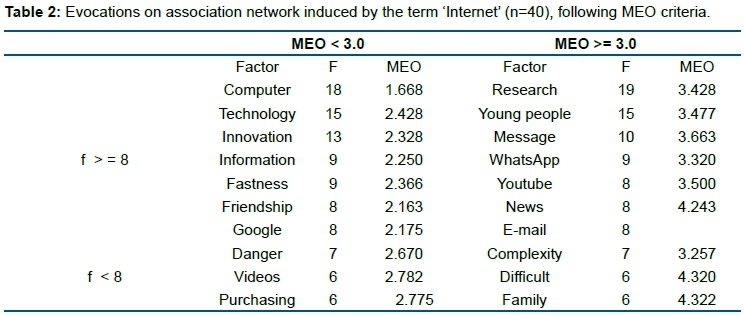
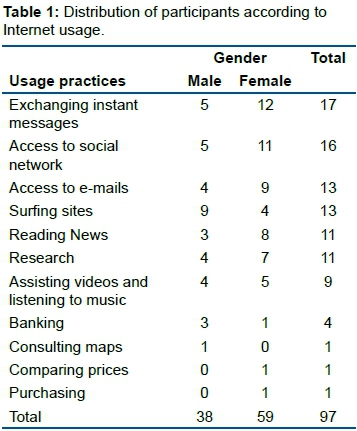
<body><![CDATA[<p><font face="Verdana, Arial, Helvetica, sans-serif" size="2">Six pre-tests were undertaken with participants, or rather, three with low level usage elderly and three with high and medium level elderly people with regard to digital usage. Pre-tests trained researchers and tested the tools for possible flaws<sup>24</sup>.</font></p> 	    <p><font face="Verdana, Arial, Helvetica, sans-serif" size="2">The analysis of data retrieved from the questionnaire was performed by descriptive statistical analysis, or rather, a description of absolute and relative frequencies, dispersion measurements and central trend by Statistical Package for Social Sciences, 17.0. Data on Association Network were analyzed by EVOC 2000 which evaluated frequency and order of importance of words<sup>25</sup>. Polarity of evaluated words was calculated as positive, negative and neutral by the participants. The latter is an important datum on the aspects of attitude dimension of representation<sup>22</sup>. The mentioned words were then grouped in categories according to bonding to identify the main words of each elderly group.</font></p> 	    <p><font face="Verdana, Arial, Helvetica, sans-serif" size="2">Semi-structured interviews were organized within a corpus submitted to simple Decreasing Hierarchical Classification (DHC) and Contrast Analysis by IRaMuTeQ. DHC disposes the corpus into classes of Text Segments (TS) with similar vocabulary and different from those of other classes. Further, Contrast Analysis classifies the words of the corpus according to their association with the descriptive variables selected by the researchers. In current study, the use or non-use of the Internet formed the variables<sup>26</sup>. The same corpus underwent Content Analysis by Atlas.ti 6.2 to characterize and identify anchoring and objectification of representations. Following Bardin&acute;s Content Analysis<sup>27</sup>, the flow reading was undertaken for the organization of hypotheses, aims and indexes that base interpretation for further codifying data as from register units. Finally, categorization was executed according to the factors&acute; differences and convergences.</font></p> 	    <p><font face="Verdana, Arial, Helvetica, sans-serif" size="2">Current study complied with ethical rules in the Resolution of the Health National Council (CNS 510/16) for research in Human and Social Sciences, with a positive mark by the Committee for Ethics in research with Humans (CEPSH) of the Universidade Federal de Santa Catarina (Protocol 1.688.433).</font></p> 	    <p>&nbsp;</p> 	     <p><font face="Verdana, Arial, Helvetica, sans-serif" size="3"><b>RESULTS</b></font></p> 	    <p><font face="Verdana, Arial, Helvetica, sans-serif" size="2">As discussed above, current study comprised 40 participants, average age 64 years (&plusmn; 3.46 years), minimum and maximum age at 60 and 68 years respectively. Fourteen were males and 26 females. Access site for the 20 with high and medium Internet usage level comprises home (n=15), work (n=8) and course (n=3), either by computer (n=14) or mobile phone (n=20). Fifteen high and medium level users reported daily usage, whereas three reported three times a week and two an average of five times a week (&plusmn; 2.14). Twelve participants said that they started usage at work; 8 through relatives and 3 participants reported they started in Computer Science Courses. <a href="#t1">Table 1</a> shows Internet practices.</font></p> 	    <p><a name="t1"></a></p> 	    <p>&nbsp;</p> 	    <p align="center"><img src="/img/revistas/rbcdh/v30n2/09t1.jpg"></p> 	    ]]></body>
<body><![CDATA[<p>&nbsp;</p> 	    <p><font face="Verdana, Arial, Helvetica, sans-serif" size="2">Schooling of participants with high and medium Internet usage mainly means higher education (n=13), whereas others only frequented high school (n=7). Average family earnings of the group reached 7.29 Brazilian minimum wages. In the case of low or no Internet usage, basic (n=12) and high school education (n=8) were dominant. Average family earning for the group reached 2.27 Brazilian minimum wages (&plusmn;1.08). Twenty-five of participants were employed, eleven were retired and four were housewives. Participants&acute; family structure is formed by partner and children (n=24).</font></p> 	    <p><font face="Verdana, Arial, Helvetica, sans-serif" size="2"><b>Association network</b></font></p> 	    <p><font face="Verdana, Arial, Helvetica, sans-serif" size="2">Results for the Association Network on the term "Internet" comprised 200 callings, with 78 different words and five words for each participant at an average. Twenty-five out of the 78 different words were given by the high and medium Internet usage group, 13 by the low Internet usage group and the other 50 words by both groups.</font></p> 	    <p><font face="Verdana, Arial, Helvetica, sans-serif" size="2">Polarity calculation with variation between -1 and +1 provides attitude aspects of representation the Rosa<sup>22,</sup> with slight positivity (M=0.23&plusmn;0.14) for polarity of words evoked by the term 'Internet'. The above indicates the presence of positive attitudes within the composition of social representation of the Internet. Polarity degree between groups was different: the high and medium level had a greater positive polarity (M=0.23&plusmn;0.14) when compared to the group with low or no experience on the Internet (M=0.02&plusmn;0.41). Means demonstrate significant statistical differences [U=22; Z=-3.57; p&lt; 0.001].</font></p> 	    <p><font face="Verdana, Arial, Helvetica, sans-serif" size="2">The prototypic analysis of words associated to the 'Internet' shows that minimum frequency of word occurrences for inclusion was 6 and the mean evocation order (MEO) was 3. In other words, recalled words were, at an average, at the third position. Mean frequency of evocation reached 8.15.</font></p> 	     <p><font face="Verdana, Arial, Helvetica, sans-serif" size="2">Factors with low    MEO rates, or rather, recalled immediately and with greater frequency are shown    on the left upper square of <a href="/img/revistas/rbcdh/v30n2/09t2.jpg">Table 2</a>, characterizing    factors with a greater probability of belonging to the representation's central    nucleus<sup>28</sup>. The right upper square of <a href="/img/revistas/rbcdh/v30n2/09t2.jpg">Table    2</a> shows high frequency factors, although evoked less immediately, and which    compose the first periphery of representation. The left lower square comprises    low frequency factors, albeit evoked faster, whilst the right lower square contains    factors that were evoked less readily and with lower frequency, forming the    second periphery of representation.</font></p> 	    <p><font face="Verdana, Arial, Helvetica, sans-serif" size="2">It may be perceived that the term 'research' obtained the greatest recall frequency, followed by 'computer', 'technology' and 'young people'. The factors of the left upper square organize the social representation of the Internet, with the materialization of the computer with the hardware&acute;s fastness and innovation. Google and its possibility to obtain information are functionalities. The word 'friendship' appears as a consequence of Internet usage and results in bonds maintained or established by the network. Consequently, the Internet may be represented by the image of the computer, anchored on the idea of technology, characterized by fastness and innovation. Functionalities are represented by data retrieval and by maintaining or establishing more friendships, with the Google as a tool.</font></p> 	    <p><font face="Verdana, Arial, Helvetica, sans-serif" size="2">The first periphery, characterized by Youtube, WhatsApp and e-mail, denotes factors on the usability of the Internet, the main tools and functionalities associated to the object. These factors are evoked less immediately by participants. Certain functions comprised access to news, research and message exchange which are an example of representation-associated social practices. The term 'young people' is also underscored as associated to the Internet&acute;s social representation. They are factors that integrate social practices and the relationship Me-Alter-Object of the representation. Alter is represented by the figure of the young person.</font></p> 	    <p><font face="Verdana, Arial, Helvetica, sans-serif" size="2">The factors of the left lower square denote complications in Internet usage, represented by the term 'danger'. In spite of its low frequency, it is immediately recalled by elderly people. In the case of usability, the terms 'video' and 'purchase' are associated. The right lower square has some factors that associate the Internet with something difficult and complicated which, in turn, lessens the perception of usability. The term 'family' refers not only to social support but also to contact established through the network.</font></p> 	     ]]></body>
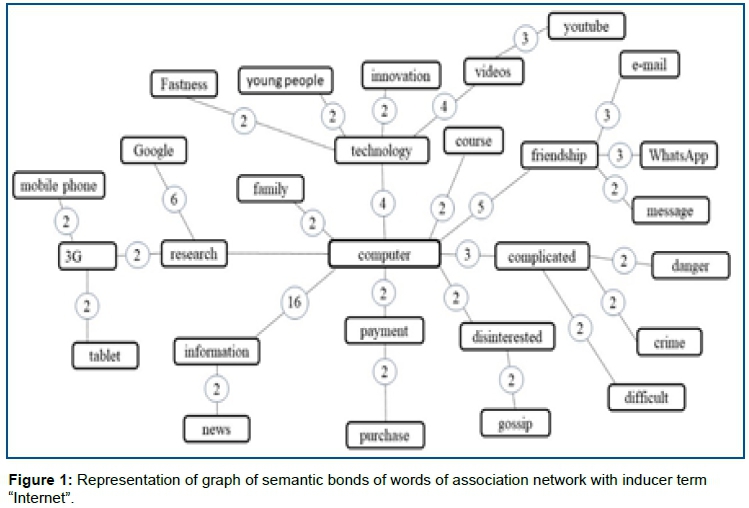
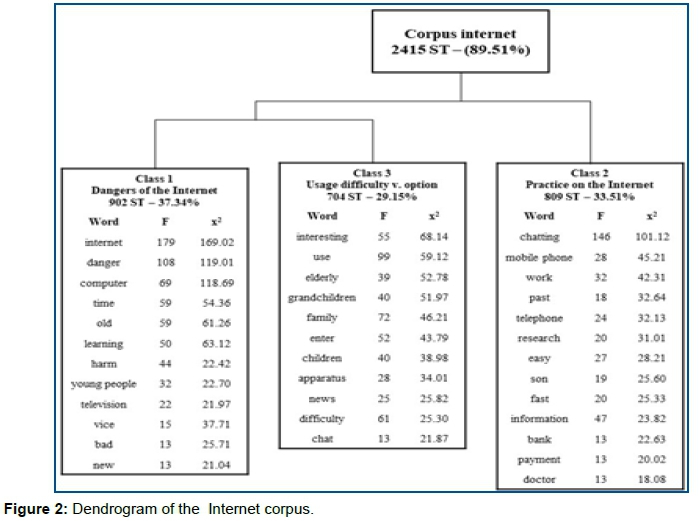
<body><![CDATA[<p><font face="Verdana, Arial, Helvetica, sans-serif" size="2">Recalled words    underwent prototype analysis which takes into account the mean importance order    (MIO) of recalling. MIO reached 3 and average recalling frequency reached 8.15.    The left upper square of <a href="/img/revistas/rbcdh/v30n2/09t3.jpg">Table 3</a> demonstrates    the most important factors with the lowest MIOs and greatest frequency rates.    First periphery lays in the right upper square and is characterized by high    frequency factors, albeit less important. The left lower square contains low    frequency factors, albeit featuring high importance levels. Second periphery    is represented in the right lower square and contains factors with low frequency    and importance levels for the elderly.</font></p> 	    <p><font face="Verdana, Arial, Helvetica, sans-serif" size="2">Some periphery factors may become central, such as research and news, whilst others, such as technology, innovation, fastness and Google become peripheral. Consequently, the Internet&acute;s social representation seems to be centered around positive or neutral factors, characterized by the image of the computer with the function of informing, represented by the words 'information', 'research' and 'news', and social functions associated with the term 'friendship'.</font></p> 	    <p><font face="Verdana, Arial, Helvetica, sans-serif" size="2">When the order of importance of the recalled factors are analyzed, changes in the organization of representation are identified where the idea of Internet is more centralized in the image of the computer, in friendship as a social function and in research and news associated to usage practices, mainly composed of positive factors.</font></p> 	     <p><font face="Verdana, Arial, Helvetica, sans-serif" size="2">In the case of    bonding between words of the association network, factors that have bonds have    been identified. Filter of at least two co-occurrences followed grouping and    counting. <a href="/img/revistas/rbcdh/v30n2/09f01.jpg">Figure 1</a> provides the data.</font></p> 	    <p><font face="Verdana, Arial, Helvetica, sans-serif" size="2">Similar to the recalling analysis, bonding analysis demonstrated the computer as a central factor, with a great number of bonds. It establishes bonds with the words 'payment', 'information', 'research', 'technology', 'course', 'friendship', 'complicated' and 'uninteresting'. In other words, it is related to social and financial possibilities and its use is associated with the family and study courses. It is also described as complicated and uninteresting by some participants. On the other hand, the factor 'complicated' is linked to the terms 'difficult', 'crime' and 'danger', whereas 'uninteresting' is linked to 'gossip'. Therefore, the negative aspects of social representation of the Internet seem to be associated with complexity, possibility to commit crime, cybernetic dangers and gossip generated by sharing social information.</font></p> 	    <p><font face="Verdana, Arial, Helvetica, sans-serif" size="2">Moreover, technology as an Internet factor is associated to the fastness of information flow, constant innovation, usage associated with young people through videos, which, in their turn, are linked to Youtube. In the case of research, it is associated with Google, tablet and 3G, the latter is linked to mobile telephone as a material tool for information accessing. Access to information is associated to updating and news. The term 'payment' is associated with buying and possibility of online transactions. Social support by the Internet is associated to the term 'friendship' guaranteed by message exchange, e-mail and WhatsApp.</font></p> 	    <p><font face="Verdana, Arial, Helvetica, sans-serif" size="2">As a rule, the Internet is represented in the association network by the image of the computer and described through its functionalities, positively through possibilities of leisure, social bonds, financial transactions and obtaining information, albeit in a negative form due to threats to privacy, viability to virtual crimes and complexity.</font></p> 	    <p><font face="Verdana, Arial, Helvetica, sans-serif" size="2"><b>Decreasing Hierarchical Classification</b></font></p> 	     <p><font face="Verdana, Arial, Helvetica, sans-serif" size="2">Analysis of the    Decreasing Hierarchical Classification (DHC) of the semi-structured interview    by IRaMuTeQ generated 2,508 text segments, with 2,245 for analysis (89.51%).    Text Segments (TS) were integrated by 6,300 words that occurred 82,705 times,    an average of 13,612 times per word. TS contextualizes typical vocabulary of    each phrase which was taken into account in the quantitative analysis. <a href="/img/revistas/rbcdh/v30n2/09f02.jpg">Figure    2</a> illustrates the relationship between DHC classes.</font></p> 	     <p><font face="Verdana, Arial, Helvetica, sans-serif" size="2">One should note    that the program divided the corpus into two sub-corpora, giving rise to Classes    1 and 3 and, separated from them, Class 2. The first class was separated and    transformed into Class 3 and then into Class 1. <a href="/img/revistas/rbcdh/v30n2/09f02.jpg">Figure    2</a> has the name of each class, the amount of TS and their respective words    with the greatest association according to the double lexographic criterion:    to have a frequency which is higher than the average and according to association    </font><font size="2">&#967;</font><font face="Verdana, Arial, Helvetica, sans-serif" size="2"><sup>2</sup>    </font><font size="2">&#8805;</font><font face="Verdana, Arial, Helvetica, sans-serif" size="2">    3.84.</font></p> 	    ]]></body>
<body><![CDATA[<p><font face="Verdana, Arial, Helvetica, sans-serif" size="2">Class 1, called 'perils of the Internet', was the first class to be differentiated from the rest of the corpus. It comprises 37.34% of total TS, associated to the idea that the Internet is a dangerous and hostile element. Texts were mainly provided by females and participants with low level Internet usage. It forwards the terms 'Internet', 'danger' and 'computer', with the computer as the materialization and object associated with the Internet and as a tool that makes possible the invasion of data and access to data. This is why the terms 'bad' and 'harm' are underscored. The term 'television' in this class indicates the Internet as a space of illicit acts, associated with games and violence.</font></p> 	    <p><font face="Verdana, Arial, Helvetica, sans-serif" size="2">The terms 'old', 'young' and 'time' pinpoint young people as the main public of the Internet, associated to vice due to their exaggerated usage. The term 'old' shows a self-identification which is a contrast to the Internet, something new and, therefore, difficult to 'learn' how to use it. Lack of family support underlies the term 'time', denoting the short period available for help. However, the term 'time' also refers to the past through the phrase 'in my time' and the time spent using the Internet.</font></p> 	    <p><font face="Verdana, Arial, Helvetica, sans-serif" size="2">Class 3, titled 'Difficulties in Use v. Option', characterized 29.15% of TS and mostly elderly people with low or no Internet usage level. It comprises factors that justify the reasons for not using the Internet due to internal and external causes. The factors 'difficulty', 'family' and 'use' demonstrate the difficulty in learning new technologies, a dichotomy by which one would like to participate in family discussions, but shuns exposing oneself.</font></p> 	    <p><font face="Verdana, Arial, Helvetica, sans-serif" size="2">This is also associated to 'interest' which indicates lack of interest as a motive for not using the web. The terms 'children' and 'grandchildren' are also used to justify lack of usage due to the absence of attention and sensitiveness of relatives using the network. Internet is underscored in this class by the word 'chat' which is an asset but makes difficult direct contact. The term 'elderly' in this class also denotes self-nomination and the moral judgment that makes one believe that one suffers due to relatives and other elderly people. Elderly people believe that other people think they are outdated and incapable due to lack of Internet usage.</font></p> 	    <p><font face="Verdana, Arial, Helvetica, sans-serif" size="2">Class 2, called 'practice on the Internet' corresponds to 33.51% of TS and mainly comprises married elderly people who live with their children and have high and medium usage level. Main factors are 'talk', 'news' and 'work', with contents related to Internet use, association practices and accessibility. Proportional interaction is a positive factor since it maintains or forms new bonds through the terms 'talk' and 'past'. Description of the Internet as 'fast' and 'easy' is associated with availability to information and contents.</font></p> 	    <p><font face="Verdana, Arial, Helvetica, sans-serif" size="2">The use of the Internet evidences 'research', access to 'information', access to 'banking', 'medical test results' and 'payments'. 'Mobile' and 'telephone' are quoted as accessibility tools, with usage in places beyond the 'work' site. The term 'work' also denotes digital inclusion and the term 'children' indicates the social support for the initial use of the medium, but also related to the lack of family support for other elderly people.</font></p> 	    <p><font face="Verdana, Arial, Helvetica, sans-serif" size="2">As a rule, one may perceive that social representations of the Internet for the elderly may be grouped according to the possibilities of use, association to dangers and management difficulties. Social support is thus an asset with regard to use and mediation of usage, whereas crimes and virtual dangers spread by television news, moral crimes and overexposures are unfavorable for use. The Internet materializes through the computer, mobile phones and telephones, and is associated to the maintenance of social bonds.</font></p> 	    <p><font face="Verdana, Arial, Helvetica, sans-serif" size="2"><b>Contrast analysis</b></font></p> 	    <p><font face="Verdana, Arial, Helvetica, sans-serif" size="2">Analysis was undertaken within the corpus containing answers on social judgment with regard to the use of the Internet by the elderly. A question was asked to high and medium level elderly users: "What do you think that people over 60 years old and who do not access the Internet think about you who uses the Internet?" Another type of question was asked to low or no elderly users: "What do you think that people over 60 years old and who use the Internet think about you who doesn't use the Internet?" Corpus reached 1.811 TS and IRaMuTeQ was employed for contrast analysis to compare the data for the two groups. Analysis identified words associated with each group, frequency and </font><font size="2">&#967;</font><font face="Verdana, Arial, Helvetica, sans-serif" size="2"><sup>2</sup>.</font></p> 	    <p><font face="Verdana, Arial, Helvetica, sans-serif" size="2">One may perceive that in the case of elderly people with low or no experience with the Internet, the term 'old' (f=41) is underscored because shunning the Internet amounts to something new. The word 'outside' (f=28) underscores the fact that they are at the periphery of the Internet world and excluded from it. The term 'young' (f=32) indicates the group associated with technology. Further, it underscores a type of thinking young from which they consider themselves far off. 'Updating' (f=37) and 'acquiring' (f=26) are factors associated with the idea of elderly people with more experience in contrast to outdated elderly people, evidently from the point of view of exclusion. There is also the notion of the elderly with less experience in Internet usage as incapable of entering such a world.</font></p> 	    ]]></body>
<body><![CDATA[<p><font face="Verdana, Arial, Helvetica, sans-serif" size="2">In the case of the elderly with high and medium Internet experience the term 'believe' (f=42) indicate, on the one hand, a belief that they are judged, and, on the other hand, the belief that no judgment is emitted on Internet usage. Similarly, the term 'normal' (f=21) corresponds to the idea of lack of judgment, since everybody may learn to use it. This fact denotes an inclusive feature of the Internet as a form of social participation. The terms 'criticize' (f=33) and 'vice' (f=20) correspond to an example of instances in which relatives and friends indicate its use as something excessive and harmful. Moreover, the term 'time' (f=38) denotes the idea of loss of time according to elderly people who do not access the web. The term 'arrogance' (f=21) supposes that elderly people with low experience think that elderly people with greater contact are narcissistic and arrogant.</font></p> 	    <p><font face="Verdana, Arial, Helvetica, sans-serif" size="2">Consequently, in the representation of the elderly with low or no digital experience is that they are at the periphery and excluded from social conviviality and linked to oldness. On the other hand, elderly people with high or medium digital inclusion level feel they are not criticized or, when criticized, they are criticized for their exaggerated, unnecessary and harmful use. For such a group, the Internet is thus linked to social belonging and updating and being far away from the real world. Vice and loss of time is a consequence.</font></p> 	    <p><font face="Verdana, Arial, Helvetica, sans-serif" size="2"><b>The process of objectification and anchoring of social representation (SR) of the Internet</b></font></p> 	    <p><font face="Verdana, Arial, Helvetica, sans-serif" size="2">A thematic-category content analysis from sections of interviews dealing with image, attitude and information was performed by Atlas.ti so that the anchoring process and objectification of Internet social representations could be identified. Five hundred and five occurrences were identified and divided into 3 categories: image, attitude and information, and then divided into thematic factors.</font></p> 	    <p><font face="Verdana, Arial, Helvetica, sans-serif" size="2">The category image is integrated by the thematic factors 'computer' (52), 'mobile phone' (42), 'Google' (31), 'messaging app' (31), 'social network' (27), 'new/young' (15), 'window/door/lock' (15). The category 'attitude' comprises the thematic factors 'socialization space' (34), makes easy access to information (32), approximation of the family (29), accessibility to products and services (25), loss of time (24), dangerous environment (21) and loss of privacy (20). Further, the category 'information' deals with thematic factors sources of information (33), type of technology (32), form of communication (30) and type of leisure (12).</font></p> 	    <p><font face="Verdana, Arial, Helvetica, sans-serif" size="2">Regarding to the image of social representation, objectification seems to be associated to access hardware, with the mobile telephone as the concrete representative of this abstract social object, especially for the elderly with high and medium level usage (f=33). The naturalization of the Internet is perceived through social network and apps, and this is the figurative nucleus of the representation (f=39). In another context of the image, the representative of the social object is the young person as a contrast to the elderly, mentioned mainly by participants with low or no experience with the web (f=9). In their case, materialization occurs through the image of a lock or window that allows insiders to see those who are outside and vice-versa (f=12).</font></p> 	    <p><font face="Verdana, Arial, Helvetica, sans-serif" size="2">Regarding attitudes towards the Internet, high and medium digital elderly people demonstrated positive attitudes towards the web as a form of socialization (f=26), widening or extending bonds (f=23), access to useful information for real action and to satisfy one&acute;s curiosity (f=20), access to products and services (f=19) and approximation towards the family (f=19). However, elderly people with low or no Internet usage demonstrated unfavorable attitudes which were based on fear with regard to invasion of privacy (f=28), loss of time (f=23) and cybernetic crimes (f=20).</font></p> 	    <p><font face="Verdana, Arial, Helvetica, sans-serif" size="2">The Internet was characterized as a way to retrieve cultural information or practical knowledge (f=19) and a sort of communication linked to the notion of telephoning (f=21), and a manner to obtain leisure through videos and audios (f=8) by high and medium Internet users. On the other hand, the low or no Internet users define the Internet as a type of technology (f=20) anchored to technological progress.</font></p> 	    <p><font face="Verdana, Arial, Helvetica, sans-serif" size="2">Consequently, high or medium Internet elderly people defend the Internet&acute;s social representations, coupled to factors linked to sociability, access to information and services through the image of access hardware, such as mobile and computer and online platforms to socialize and access information. Consequently, representation is anchored on the notion of the internet as a means to obtain information, leisure and communication.</font></p> 	    <p><font face="Verdana, Arial, Helvetica, sans-serif" size="2">Low Internet elderly users are imbued with the Internet&acute;s social representation as a loss of time, poor privacy and a site for crime. The objectification of representation occurs through primary access hardware or the computer. The image of the lock/door/window becomes associated to the representation as a metaphor that connotes invasion of privacy and space. The anchoring of representation is derived from technology and changes from the analogical to the digital system, based on previous experiences.</font></p> 	    ]]></body>
<body><![CDATA[<p>&nbsp;</p> 	     <p><font face="Verdana, Arial, Helvetica, sans-serif" size="3"><b>DISCUSSION</b></font></p> 	    <p><font face="Verdana, Arial, Helvetica, sans-serif" size="2">In current research, the Internet was represented by elderly people through the image of the computer, described by its functions. It seems to be centered on positive and neutral factors related to hardware as image, to information and the web&acute;s social functions. Negative factors and tools that permit access to the Internet&acute;s function may be found in the periphery. Consequently, accessibility and perceived utility become central in the elderly&acute;s representation and demonstrates the relevance for the development of digital inclusion strategies that confirm perceived utility. In other words, that would investigate the elderly&acute;s social representations to make feasible workshops that start from social thought to forward network tools.</font></p> 	    <p><font face="Verdana, Arial, Helvetica, sans-serif" size="2">The Internet materializes from such factors as computer, mobile telephone, telephone, and seems to be associated with the maintenance of bonds. Therefore, the bond is relevant for elderly people and should be taken into consideration during the digitalization process. It may be suggested that digitalization workshops should initially help in the management of communication tools online and within the social network. Or rather, the perceived usefulness should be taken into account.</font></p> 	    <p><font face="Verdana, Arial, Helvetica, sans-serif" size="2">One should take into account that current analysis investigates the social representations of the elderly for the progress of knowledge in the area. In spite of the digitalization context and the social relevance in a country with a fast ageing process of its population, social representations are only slightly exploited. This study is a starting point for new issues on social thought and the digital inclusion of the elderly. It actually discusses the intersection between social and digital belonging.</font></p> 	    <p><font face="Verdana, Arial, Helvetica, sans-serif" size="2">Although current study has reached its target, it still has its limitations. Pairing of the variables gender, schooling level and social and economic condition was not performed. They are significant data to understand digital inclusion and favorability with regard to the internet<sup>29-31</sup>. Health status and dependence level were important intervening factors for the understanding of acceptance of technology, which have not been studied in current work<sup>32,33</sup>. It should be underscored that the participants&acute; age bracket is a factor that should have been taken into account in a study on social representations since older people tend to reject technology<sup>34,35</sup>. Variables mentioned above are an asset in the understanding of intra-group differences. Through them, one may verify the groups to which the elderly belong and which may contribute towards aspects of social representations of the Internet for elderly people. It may be thus suggested that further studies that control such variables and new methodological strategies, such as focal groups with the handling of web-accessible hardware, so that social representations are shared in a context of social practices, should be undertaken. The use of several research methods makes more feasible the relationship between the elderly and the Internet.</font></p> 	    <p><font face="Verdana, Arial, Helvetica, sans-serif" size="2"><b>Socio-economic conditions and the use of the Internet by the elderly</b></font></p> 	    <p><font face="Verdana, Arial, Helvetica, sans-serif" size="2">During the characterization of the participants in current analysis, one could pinpoint that several high or medium Internet users started within the work environment. In their analysis, Barnard<i> et al.</i><sup>17</sup> underscored that representations and attitudes on technology are associated to 'good' and 'bad' experiences, especially within the work milieu.</font></p> 	    <p><font face="Verdana, Arial, Helvetica, sans-serif" size="2">Family mediation is an important factor for the preference of using the Internet, especially when associated to positive work experiences, both of which are important conditions for the perception of the elderly on themselves as capable people<sup>16-17</sup>. Contrastingly, if the elderly&acute;s social environment associates them with the stereotype of oldness as incapable of progressing in technology, this attitude affects the rejection of technology by the elderly<sup>9,17</sup>. Consequently, elderly people take the social role offered to them when they reach this stage of life. The role is organized and maintained by social representations that affect the favorability towards the Internet<sup>36</sup>.</font></p> 	    <p><font face="Verdana, Arial, Helvetica, sans-serif" size="2">It may be stated that the social environment is an important influencing factor for or against access. However, schooling and income are also associated conditions, or rather, the higher the family monthly income and schooling, the more probable elderly people maintain or broaden technological usage<sup>7</sup>. In the case of schooling, elderly people with higher education present a greater possibility of usage due to the need of preparing assignments during this period. Further, income makes easy the acquisition of access hardware<sup>29</sup>.</font></p> 	    ]]></body>
<body><![CDATA[<p><font face="Verdana, Arial, Helvetica, sans-serif" size="2">The social practice of access to the Internet affects representation dynamics, or rather, positive usage practices affect positive polarity of social representation of the Internet presented by the elderly<sup>17,37</sup>. Further Contarello e Sarrica<sup>38</sup> identify that positive representations tend to be related to the notion of the Internet as an information, communication and contact medium.</font></p> 	    <p><font face="Verdana, Arial, Helvetica, sans-serif" size="2"><b>Social representations of the Internet</b></font></p> 	    <p><font face="Verdana, Arial, Helvetica, sans-serif" size="2">Computers, research, friendship and news were the central factors of representation, whilst technology, innovation, fastness and Google were peripheral ones. Similar data have been found in the literature: the computer and mobile phone are frequently employed by the elderly to establish family communication and broaden or strengthen friendship<sup>7,12,39,40</sup>, such as retrieving information for learning, updating and accessing social network and health contents<sup>7</sup>.</font></p> 	    <p><font face="Verdana, Arial, Helvetica, sans-serif" size="2">The computer was amply cited due to its popularity and its several usage possibilities. Since it was the first hardware with extensive access, it transformed communication dynamics, demanding changes in social practices. In other words, people had to adapt themselves to the types of communication and develop new capacities<sup>41</sup>.</font></p> 	    <p><font face="Verdana, Arial, Helvetica, sans-serif" size="2">The negative aspects of the Internet&acute;s social representation comprise possible dangers, particularly those associated with cybernetic crimes. Fears of exposing oneself, compromising oneself professionally, people&acute;s reaction and crimes are present even among young people that use the web. They are manifestations of life&acute;s insecurity<sup>42</sup>. Consequently, representations are based on significant social context and acquire new symbolism following the digitalization process<sup>43</sup>.</font></p> 	    <p><font face="Verdana, Arial, Helvetica, sans-serif" size="2">Web complexity is also a representation factor for the elderly and may be associated with their concern for the unknown. They anchor the new learning mode on previous experiences with other apparatuses<sup>9,16,38</sup>. In fact, one of the most important factors in digital exclusion is their digital difficulty since acknowledging the utility of a new technology and previous experience are not a guarantee for usage. In fact, one has to take into consideration the complexity of their usage<sup>17,44-46</sup>.</font></p> 	    <p><font face="Verdana, Arial, Helvetica, sans-serif" size="2">Elderly people with slight usage experience have the notion that the Internet is a thing for young people. This notion makes difficult acknowledging oneself as a web user. Further, the stereotype of the elderly with difficulty in learning new technologies contributes towards acting according to social expectations that reaffirm their devaluation<sup>47-49</sup>. Consequently, the above internal and external factors contribute towards the acknowledgment of oneself, the object, and the representation of oneself, of the social group to which one belongs and also the object&acute;s representation<sup>50</sup>.</font></p> 	    <p><font face="Verdana, Arial, Helvetica, sans-serif" size="2">Participants presented the figurative nucleus of social representation of the Internet through access tools, such as computers/notebook/peripherals, mobile telephone and tablet. The figurative nucleus makes easier for the elderly to speak on the object. It is used to understand the groups associated to the object, the object itself and its relationships with its own group<sup>51</sup>, or rather, the materialization of the Internet through its tools, the elderly associate it with the group of young people. The use of the Internet is a rather complex thing and it needs previous experiences with other technological equipments in the case of the elderly group<sup>16</sup>.</font></p> 	    <p><font face="Verdana, Arial, Helvetica, sans-serif" size="2">The central nucleus of a representation is influenced by the object itself and by the relationship of the person with the object<sup>13</sup>. Current analysis reveals that the computer is a central nucleus factor, associated to its history. In fact, it was invented before the Internet and it is related to information exchange which, in its turn, is a function for current usage for the elderly<sup>52</sup>. The other contents are the peripheral representation factors, which are secondary. Innovation and functionality aspects, such as Google, WhatsApp, e-mail and messages, or rather, factors of social practice and relationship with the object, belong to the first periphery. Such experience occurs as from the interiorization of the other&acute;s perspective on oneself who places oneself as the social object. In this context, the representations of the object, common to me and to the other, are established<sup>53</sup>.</font></p> 	    <p><font face="Verdana, Arial, Helvetica, sans-serif" size="2">Representation&acute;s second peripheral zone brings more specific factors<sup>54</sup> and presents factors related to difficulty and complexity of usage. They are negative factors that affect the elderly&acute;s non-favorability with the Internet, probably related to the fear of making mistakes and to the notion of not belonging to the digital era<sup>9</sup>.</font></p> 	    ]]></body>
<body><![CDATA[<p><font face="Verdana, Arial, Helvetica, sans-serif" size="2">Further, data from DHC confirm aspects found in the association network with regard to usage practices and possible cybernetic crimes. Accessibility to information, medical and health data are also the main motives for the use of the web, all affecting autonomy level, self-medication, as a reliable source of information<sup>55</sup>.</font></p> 	    <p><font face="Verdana, Arial, Helvetica, sans-serif" size="2">The terms 'family' and 'time' have different nuances within the different ways of analysis in current study. There is the lack of support of the family with regard to the use of the Internet because of lack of time to teach the elderly. Pires<sup>12</sup> found that the elderly are worried not only because they do not demand young people to teach them but also because they think that the Internet is a loss of time. The time issue is also relevant to denote something that does not belong to their past.</font></p> 	    <p><font face="Verdana, Arial, Helvetica, sans-serif" size="2">Consequently, the Internet&acute;s social representations are identified due to the symbolic load and the social evidence of the object which is broadly shared between the groups<sup>38</sup>. Contrast and content analyses allowed a widening of representation in spite of the fact that many contents are reaffirmed in the analyses. Several new factors, such as the Internet associated with inclusion or exclusion, also arise. Therefore, the Internet is a new type of community linked to information and communication and to belonging marked by web surfing. In other words, lack of knowledge and lack of spreading information is equivalent to not belonging<sup>56</sup>.</font></p> 	    <p><font face="Verdana, Arial, Helvetica, sans-serif" size="2">The social judgment that low or no Internet elderly endure is associated to persons who do not belong to this context, or rather, they do not maintain communications and information with the same speed as the Internet&acute;s. However, the self-representation attributed to the other may produce aspects of one&acute;s representation<sup>57</sup>, or rather, a metaphor occurs by which something is attributed to the other which gives meaning to the elderly but it is not perceived as coming from oneself<sup>53</sup>.</font></p> 	    <p><font face="Verdana, Arial, Helvetica, sans-serif" size="2">On the other hand, some elderly people with high and medium Internet levels relate social judgment to their own image as fools, pretending to be young and with a lot of free time, whereas others think that no judgment is emitted since the Internet, as free, is accessible to all who want to learn. Therefore, digital inclusion is a choice, justifying the digital exclusion of others<sup>58</sup>. The Internet is perceived as maintaining oneself young and accessible to all, which brings tension among groups. The above are representations that manifest themselves within the relationship between subjects and which organize the relationship of people and their respective social worlds<sup>36</sup>.</font></p> 	    <p><font face="Verdana, Arial, Helvetica, sans-serif" size="2"><b>Anchoring and objectification of representations</b></font></p> 	    <p><font face="Verdana, Arial, Helvetica, sans-serif" size="2">Anchoring and objectification processes comprise the genesis of representation which occurs through the simplification of the object according to its most relevant aspects for the belonging group (objectification). Followed by the assimilation of the objectified content within a network of preexisting meanings for the group (anchoring)<sup>37</sup>.</font></p> 	    <p><font face="Verdana, Arial, Helvetica, sans-serif" size="2">Representation passes to an image which guarantees the applicability of knowledge through the inclusion of practical aspects<sup>53</sup>. In the case of high and medium Internet elderly users of mobile telephones, the social networks and apps are the concrete aspects representative of the Internet, whereas in the case of the elderly with low or no Internet usage, the image is associated to young people as a contrast to the figure of the elderly, coupled to the image of the lock/window. In the case of the first group, these access hardware make elderly people transform ideas into reality which may be experimented and confirmed by the senses<sup>15,59</sup>. The contrast between the new versus the old seems associated with the dichotomy between activity and inactivity<sup>60 </sup>and the image of the lock/window/door is a metaphor on privacy and the need to maintain the relationship with the other, with the necessary distance that provides a limit to the other<sup>61,62</sup>.</font></p> 	    <p><font face="Verdana, Arial, Helvetica, sans-serif" size="2">Metaphors are relevant to understand a representation. As a rule, they are tridimensional: dominion of origin, dominion of target and the relationship between the target and origin dominion, or rather, the concrete content and its relationship through experience, one&acute;s own or a third party&acute;s, shared, with the social object. The metaphor transforms an experience towards an explanation level and forms a concept<sup>63</sup>.</font></p> 	    <p><font face="Verdana, Arial, Helvetica, sans-serif" size="2">One may thus perceive the contrast with regard to the objectification between social groups and not between the group and the individual<sup>64</sup>. Divergences between groups also arise with regard to attitudes which are the predispositions to answer favorably or unfavorably to an object, person, occurrence or institution<sup>65</sup>. Elderly people with high usage levels have positive attitudes towards the Internet, especially because of interaction, information and consumption aspects. Similar data have been reported by Contarello &amp; Sarrica<sup>38</sup> in their study with 100 Italian university students on social representations and attitude vis-&agrave;-vis the Internet, and by Targino<sup>66</sup> on the social representations of the elderly in the virtual environment. The group of elderly people with the lowest level of Internet experience had an unfavorable attitude towards the Internet, especially due to the notion of loss of time and virtual crimes. These factors were corroborated by research work on the use of information and communication technologies by Contarello &amp; Sarrica<sup>38 </sup>and by Santos &amp; Alm&ecirc;da<sup>67</sup> with elderly people in the state of Rio Grande do Norte.</font></p> 	    ]]></body>
<body><![CDATA[<p><font face="Verdana, Arial, Helvetica, sans-serif" size="2">The start of social representations among the elderly with high and medium experience levels with the web shows favorable attitudes due to the acknowledgment of their interaction, information and service aspects, objectified by access hardware, app and search sites, and anchored on the notion of the Internet as a way to retrieve information, to provide leisure and communication. However, social representation among elderly people with low or no Internet experience is supported by unfavorable attitudes due to their perception of the Internet as loss of time, lack of privacy and a site for cybercrimes, objectified by the computer as a primary access hardware anchored within a basic sociological perspective in its relationship with social groups with similar representations.</font></p> 	    <p>&nbsp;</p> 	     <p><font face="Verdana, Arial, Helvetica, sans-serif" size="3"><b>FINAL CONSIDERATION    </b> </font></p> 	    <p><font face="Verdana, Arial, Helvetica, sans-serif" size="2">The manner the elderly analyze the Internet is influenced by, and concomitantly, may influence, their experience in their use of the system<sup>68</sup>. This is highly important for the elaboration of potential new services, not merely to find better ways to introduce technologies for the elderly but also to improve the design of digital products for easy use and learning. This may imply the introduction of ICT for a greater number of users<sup>17</sup>.</font></p> 	    <p><font face="Verdana, Arial, Helvetica, sans-serif" size="2">The Internet was represented through the image of the computer and its functions. It seems to be centered in positive and neutral factors related to the hardware as image (computer); to information functions characterized by the terms 'information', 'research' and 'news'; to the web&acute;s social functions, illustrated by the term 'friendship'. Negative elements may be found at the periphery, such as 'crime', 'danger' and 'complicated', coupled to tools that allow access to the functions of the Internet.</font></p> 	    <p><font face="Verdana, Arial, Helvetica, sans-serif" size="2">The objectification of high experience elderly people occurs through access hardware and tools which lead towards information and communication access. In the case of low experience elderly people, the invasion of privacy sustains the image context. Anchoring of high experience elderly people occurs through knowledge derived from perceived and confirmed usage, whereas low experience elderly people derive their anchoring from experience during the transition from the analogical to the digital period. For a better understanding of the digital inclusion/exclusion process, confirmed usages, perceived threats and initial experiences with Technologies should be taken into account.</font></p> 	    <p><font face="Verdana, Arial, Helvetica, sans-serif" size="2">Access mode and perceived usage emerge as central in the representation of elderly people, denoting the relevance for the development of strategies of digital inclusion that would confirm perceived usage. In other words, the social representations of the elderly should be investigated to make feasible workshops that derive from social thought to present web tools and functions.</font></p> 	    <p>&nbsp;</p> 	    <p><font face="Verdana, Arial, Helvetica, sans-serif" size="3"><b>REFERENCES</b></font></p> 	    <!-- ref --><p><font face="Verdana, Arial, Helvetica, sans-serif" size="2">1.Global AgeWatch Index 2015. Global AgeWatch Index 2014: Insight report, summary and methodology [internet] 2015. [Cited 2016 Apr 05] Available from: <a href="https://www.helpage.org/global-agewatch/reports/global-agewatch-index-2014-insight-report-summary-and-methodology/" target="_blank">https://www.helpage.org/global-agewatch/reports/global-agewatch-index-2014-insight-report-summary-and-methodology/</a></font>&nbsp;&nbsp;&nbsp;&nbsp;&nbsp;&nbsp;&nbsp;&nbsp;[&#160;<a href="javascript:void(0);" onclick="javascript: window.open('/scielo.php?script=sci_nlinks&ref=2554522&pid=S0104-1282202000020000900001&lng=','','width=640,height=500,resizable=yes,scrollbars=1,menubar=yes,');">Links</a>&#160;]<!-- end-ref --><!-- ref --><p><font face="Verdana, Arial, Helvetica, sans-serif" size="2">2.Instituto Brasileiro de Geografia e Estat&iacute;stica (IBGE). S&iacute;ntese de indicadores sociais: Uma an&aacute;lise das condi&ccedil;&otilde;es de vida [internet] 2015. [Cited 2015 Apr 05]. Available from: <a href="https://biblioteca.ibge.gov.br/visualizacao/livros/liv95011.pdf" target="_blank">https://biblioteca.ibge.gov.br/visualizacao/livros/liv95011.pdf</a>.    &nbsp;&nbsp;&nbsp;&nbsp;&nbsp;&nbsp;&nbsp;&nbsp;[&#160;<a href="javascript:void(0);" onclick="javascript: window.open('/scielo.php?script=sci_nlinks&ref=2554523&pid=S0104-1282202000020000900002&lng=','','width=640,height=500,resizable=yes,scrollbars=1,menubar=yes,');">Links</a>&#160;]<!-- end-ref --></font></p> 	    <!-- ref --><p><font face="Verdana, Arial, Helvetica, sans-serif" size="2">3.Anjos TP, Gontijo A. Descomplicando o uso do telefone celular pelo idoso: desenvolvimento de interface de celular com base nos princ&iacute;pios de usabilidade e acessibilidade. Disserta&ccedil;&atilde;o (Mestrado) - Universidade Federal de Santa Catarina. Florian&oacute;polis: 2012.    &nbsp;&nbsp;&nbsp;&nbsp;&nbsp;&nbsp;&nbsp;&nbsp;[&#160;<a href="javascript:void(0);" onclick="javascript: window.open('/scielo.php?script=sci_nlinks&ref=2554525&pid=S0104-1282202000020000900003&lng=','','width=640,height=500,resizable=yes,scrollbars=1,menubar=yes,');">Links</a>&#160;]<!-- end-ref --></font></p> 	    <!-- ref --><p><font face="Verdana, Arial, Helvetica, sans-serif" size="2">4.Fern&aacute;ndez AF. II Asamblea Mundial sobre el Envejecimiento. Rev Esp Geriatr Gerontol. 2002;37(S2):1-2.    &nbsp;&nbsp;&nbsp;&nbsp;&nbsp;&nbsp;&nbsp;&nbsp;[&#160;<a href="javascript:void(0);" onclick="javascript: window.open('/scielo.php?script=sci_nlinks&ref=2554527&pid=S0104-1282202000020000900004&lng=','','width=640,height=500,resizable=yes,scrollbars=1,menubar=yes,');">Links</a>&#160;]<!-- end-ref --></font></p> 	    <!-- ref --><p><font face="Verdana, Arial, Helvetica, sans-serif" size="2">5.Instituto Brasileiro de Geografia e Estat&iacute;stica (IBGE). S&iacute;ntese de indicadores sociais: Uma an&aacute;lise das condi&ccedil;&otilde;es de vida [internet] 2013. [Cited 2015 Jun 12]. Available from: <a href="ftp://ftp.ibge.gov.br/Indicadores_Sociais/Sintese_de_Indicadores_Sociais_2012/SIS_2013.pdf" target="_blank">ftp://ftp.ibge.gov.br/Indicadores_Sociais/Sintese_de_Indicadores_Sociais_2012/SIS_2013.pdf</a></font>&nbsp;&nbsp;&nbsp;&nbsp;&nbsp;&nbsp;&nbsp;&nbsp;[&#160;<a href="javascript:void(0);" onclick="javascript: window.open('/scielo.php?script=sci_nlinks&ref=2554529&pid=S0104-1282202000020000900005&lng=','','width=640,height=500,resizable=yes,scrollbars=1,menubar=yes,');">Links</a>&#160;]<!-- end-ref --><!-- ref --><p><font face="Verdana, Arial, Helvetica, sans-serif" size="2">6.Petrella S, Pinto M, Pereira S. O idoso e a educa&ccedil;&atilde;o para os media: novos desafios entre envelhecimento e exclus&atilde;o social. 8&ordm; SOPCOM Comunica&ccedil;&atilde;o Global, Cultura e Tecnologia 2016 [internet]. 2013. [Cited 2015 Jun 12]. Available from: <a href="https://repositorium.sdum.uminho.pt/bitstream/1822/29756/1/SP_MP_SP_Idoso_Educacao_media.pdf" target="_blank">https://repositorium.sdum.uminho.pt/bitstream/1822/29756/1/SP_MP_SP_Idoso_Educacao_media.pdf</a>.    &nbsp;&nbsp;&nbsp;&nbsp;&nbsp;&nbsp;&nbsp;&nbsp;[&#160;<a href="javascript:void(0);" onclick="javascript: window.open('/scielo.php?script=sci_nlinks&ref=2554530&pid=S0104-1282202000020000900006&lng=','','width=640,height=500,resizable=yes,scrollbars=1,menubar=yes,');">Links</a>&#160;]<!-- end-ref --></font></p> 	    <!-- ref --><p><font face="Verdana, Arial, Helvetica, sans-serif" size="2">7.Krug RR, Xavier AJ, d'Orsi E. Factores associated with maintenance of the use of internet: EpiFloripa Idodo longitudinal study. Rev Sa&uacute;de P&uacute;blica. 2018; 52:37. DOI: <a href="https://doi.org/10.11606/s1518-8787.2018052000216" target="_blank">https://doi.org/10.11606/s1518-8787.2018052000216</a></font>&nbsp;&nbsp;&nbsp;&nbsp;&nbsp;&nbsp;&nbsp;&nbsp;[&#160;<a href="javascript:void(0);" onclick="javascript: window.open('/scielo.php?script=sci_nlinks&ref=2554532&pid=S0104-1282202000020000900007&lng=','','width=640,height=500,resizable=yes,scrollbars=1,menubar=yes,');">Links</a>&#160;]<!-- end-ref --><!-- ref --><p><font face="Verdana, Arial, Helvetica, sans-serif" size="2">8.Ferreira MAS, Alves VP. Representa&ccedil;&atilde;o social do idoso do Distrito Federal e sua inser&ccedil;&atilde;o social no mundo contempor&acirc;neo a partir da Internet. Rev Bras Geriatr Gerontol. 2011;14(4):699-712. DOI: <a href="https://doi.org/10.1590/S1809-98232011000400009" target="_blank">https://doi.org/10.1590/S1809-98232011000400009</a></font>&nbsp;&nbsp;&nbsp;&nbsp;&nbsp;&nbsp;&nbsp;&nbsp;[&#160;<a href="javascript:void(0);" onclick="javascript: window.open('/scielo.php?script=sci_nlinks&ref=2554533&pid=S0104-1282202000020000900008&lng=','','width=640,height=500,resizable=yes,scrollbars=1,menubar=yes,');">Links</a>&#160;]<!-- end-ref --><!-- ref --><p><font face="Verdana, Arial, Helvetica, sans-serif" size="2">9.Foletto R, Fiepke RB, Wilhelm E. Usos da internet como meio de comunica&ccedil;&atilde;o e fonte de informa&ccedil;&atilde;o por idosos. Contempor&acirc;nea Rev Comunic Cult. 2018;16(2):504-18. DOI: DOI: <a href="http://dx.doi.org/10.9771/1809-9386contemporanea.v16i2.21504" target="_blank">http://dx.doi.org/10.9771/1809-9386contemporanea.v16i2.21504</a></font>&nbsp;&nbsp;&nbsp;&nbsp;&nbsp;&nbsp;&nbsp;&nbsp;[&#160;<a href="javascript:void(0);" onclick="javascript: window.open('/scielo.php?script=sci_nlinks&ref=2554534&pid=S0104-1282202000020000900009&lng=','','width=640,height=500,resizable=yes,scrollbars=1,menubar=yes,');">Links</a>&#160;]<!-- end-ref --><!-- ref --><p><font face="Verdana, Arial, Helvetica, sans-serif" size="2">10. Buse CE. E-scaping the ageing body? Computer technologies and embodiment in later life. Age Soc. 2010;30(06):987-1009. DOI: <a href="https://doi.org/10.1017/S0144686X10000164" target="_blank">https://doi.org/10.1017/S0144686X10000164</a></font>&nbsp;&nbsp;&nbsp;&nbsp;&nbsp;&nbsp;&nbsp;&nbsp;[&#160;<a href="javascript:void(0);" onclick="javascript: window.open('/scielo.php?script=sci_nlinks&ref=2554535&pid=S0104-1282202000020000900010&lng=','','width=640,height=500,resizable=yes,scrollbars=1,menubar=yes,');">Links</a>&#160;]<!-- end-ref --><!-- ref --><p><font face="Verdana, Arial, Helvetica, sans-serif" size="2">11.Pereira C, Neves R. Os idosos e as TIC-compet&ecirc;ncias de comunica&ccedil;&atilde;o e qualidade de vida. Rev Kair&oacute;s Gerontol. 2011;14(1):5-26.    &nbsp;&nbsp;&nbsp;&nbsp;&nbsp;&nbsp;&nbsp;&nbsp;[&#160;<a href="javascript:void(0);" onclick="javascript: window.open('/scielo.php?script=sci_nlinks&ref=2554536&pid=S0104-1282202000020000900011&lng=','','width=640,height=500,resizable=yes,scrollbars=1,menubar=yes,');">Links</a>&#160;]<!-- end-ref --></font></p> 	    <!-- ref --><p><font face="Verdana, Arial, Helvetica, sans-serif" size="2">12.Pires LLA. Envelhecimento, tecnologias e juventude: caminhos percorridos por alunos de cursos de inform&aacute;tica e seus av&oacute;s. Estudos Interdiscipl Envelhecimento. 2013;8(2):293-309.    &nbsp;&nbsp;&nbsp;&nbsp;&nbsp;&nbsp;&nbsp;&nbsp;[&#160;<a href="javascript:void(0);" onclick="javascript: window.open('/scielo.php?script=sci_nlinks&ref=2554538&pid=S0104-1282202000020000900012&lng=','','width=640,height=500,resizable=yes,scrollbars=1,menubar=yes,');">Links</a>&#160;]<!-- end-ref --></font></p> 	    <!-- ref --><p><font face="Verdana, Arial, Helvetica, sans-serif" size="2">13.Abric W. O estudo experimental das representa&ccedil;&otilde;es sociais. In: Jodelet D. As representa&ccedil;&otilde;es sociais. Rio de Janeiro: EDUERJ, 2001; p. 123-56.    &nbsp;&nbsp;&nbsp;&nbsp;&nbsp;&nbsp;&nbsp;&nbsp;[&#160;<a href="javascript:void(0);" onclick="javascript: window.open('/scielo.php?script=sci_nlinks&ref=2554540&pid=S0104-1282202000020000900013&lng=','','width=640,height=500,resizable=yes,scrollbars=1,menubar=yes,');">Links</a>&#160;]<!-- end-ref --></font></p> 	    <!-- ref --><p><font face="Verdana, Arial, Helvetica, sans-serif" size="2">14.Jodelet D. Representa&ccedil;&otilde;es sociais: um dom&iacute;nio em expans&atilde;o. In: Jodelet D. As representa&ccedil;&otilde;es sociais. Rio de Janeiro: EDUERJ, 2001; p. 17-41.    &nbsp;&nbsp;&nbsp;&nbsp;&nbsp;&nbsp;&nbsp;&nbsp;[&#160;<a href="javascript:void(0);" onclick="javascript: window.open('/scielo.php?script=sci_nlinks&ref=2554542&pid=S0104-1282202000020000900014&lng=','','width=640,height=500,resizable=yes,scrollbars=1,menubar=yes,');">Links</a>&#160;]<!-- end-ref --></font></p> 	    <!-- ref --><p><font face="Verdana, Arial, Helvetica, sans-serif" size="2">15.Moscovici S. A psican&aacute;lise, sua imagem e seu p&uacute;blico. Petr&oacute;polis: Vozes, 2012.    &nbsp;&nbsp;&nbsp;&nbsp;&nbsp;&nbsp;&nbsp;&nbsp;[&#160;<a href="javascript:void(0);" onclick="javascript: window.open('/scielo.php?script=sci_nlinks&ref=2554544&pid=S0104-1282202000020000900015&lng=','','width=640,height=500,resizable=yes,scrollbars=1,menubar=yes,');">Links</a>&#160;]<!-- end-ref --></font></p> 	    <!-- ref --><p><font face="Verdana, Arial, Helvetica, sans-serif" size="2">16.Frias MAE, Peres HHC, Pereira VAG, Negreiros MC, Paranhos WY, Leite MMJ. Idosos em situa&ccedil;&atilde;o de rua ou vulnerabilidade social: facilidades e dificuldades no uso de ferramentas computacionais. Rev Bras Enferm. 2014;67(5):788-72. DOI: <a href="http://dx.doi.org/10.1590/0034-7167.2014670514" target="_blank">http://dx.doi.org/10.1590/0034-7167.2014670514</a></font>&nbsp;&nbsp;&nbsp;&nbsp;&nbsp;&nbsp;&nbsp;&nbsp;[&#160;<a href="javascript:void(0);" onclick="javascript: window.open('/scielo.php?script=sci_nlinks&ref=2554546&pid=S0104-1282202000020000900016&lng=','','width=640,height=500,resizable=yes,scrollbars=1,menubar=yes,');">Links</a>&#160;]<!-- end-ref --><!-- ref --><p><font face="Verdana, Arial, Helvetica, sans-serif" size="2">17.Barnard Y, Bradley MD, Hodgson F, Lloyd AD. Learning to use new Technologies by older adults: perceived difficulties, experimentation behaviour and usubility. Comp Human Behavior. 2013;29(4):1715-24. DOI: <a href="https://doi.org/10.1016/j.chb.2013.02.006" target="_blank">https://doi.org/10.1016/j.chb.2013.02.006</a></font>&nbsp;&nbsp;&nbsp;&nbsp;&nbsp;&nbsp;&nbsp;&nbsp;[&#160;<a href="javascript:void(0);" onclick="javascript: window.open('/scielo.php?script=sci_nlinks&ref=2554547&pid=S0104-1282202000020000900017&lng=','','width=640,height=500,resizable=yes,scrollbars=1,menubar=yes,');">Links</a>&#160;]<!-- end-ref --><!-- ref --><p><font face="Verdana, Arial, Helvetica, sans-serif" size="2">18.Marconi MA, Lakatos EM. Fundamentos de metodologia cient&iacute;fica. S&atilde;o Paulo: Atlas, 2003.    &nbsp;&nbsp;&nbsp;&nbsp;&nbsp;&nbsp;&nbsp;&nbsp;[&#160;<a href="javascript:void(0);" onclick="javascript: window.open('/scielo.php?script=sci_nlinks&ref=2554548&pid=S0104-1282202000020000900018&lng=','','width=640,height=500,resizable=yes,scrollbars=1,menubar=yes,');">Links</a>&#160;]<!-- end-ref --></font></p> 	    <!-- ref --><p><font face="Verdana, Arial, Helvetica, sans-serif" size="2">19.Ghiglione R, Maralon B. O inqu&eacute;rito: teoria e pr&aacute;tica. Oeiras: Celta, 1997.    &nbsp;&nbsp;&nbsp;&nbsp;&nbsp;&nbsp;&nbsp;&nbsp;[&#160;<a href="javascript:void(0);" onclick="javascript: window.open('/scielo.php?script=sci_nlinks&ref=2554550&pid=S0104-1282202000020000900019&lng=','','width=640,height=500,resizable=yes,scrollbars=1,menubar=yes,');">Links</a>&#160;]<!-- end-ref --></font></p> 	    <!-- ref --><p><font face="Verdana, Arial, Helvetica, sans-serif" size="2">20.Brasil. Minist&eacute;rio da Sa&uacute;de. O Estatuto do idoso. 2nd ed. Bras&iacute;lia: Minist&eacute;rio da Sa&uacute;de [internet] 2006. [Cited 2016 Mar 07]. Available from: <a href="http://portal.saude.gov.br/portal/arquivos/pdf/estatuto_idoso.pdf" target="_blank">http://portal.saude.gov.br/portal/arquivos/pdf/estatuto_idoso.pdf</a>.    &nbsp;&nbsp;&nbsp;&nbsp;&nbsp;&nbsp;&nbsp;&nbsp;[&#160;<a href="javascript:void(0);" onclick="javascript: window.open('/scielo.php?script=sci_nlinks&ref=2554552&pid=S0104-1282202000020000900020&lng=','','width=640,height=500,resizable=yes,scrollbars=1,menubar=yes,');">Links</a>&#160;]<!-- end-ref --></font></p> 	    <!-- ref --><p><font face="Verdana, Arial, Helvetica, sans-serif" size="2">21.Becker HS. M&eacute;todos de pesquisa em ci&ecirc;ncias sociais. S&atilde;o Paulo: Hucitec, 1993.    &nbsp;&nbsp;&nbsp;&nbsp;&nbsp;&nbsp;&nbsp;&nbsp;[&#160;<a href="javascript:void(0);" onclick="javascript: window.open('/scielo.php?script=sci_nlinks&ref=2554554&pid=S0104-1282202000020000900021&lng=','','width=640,height=500,resizable=yes,scrollbars=1,menubar=yes,');">Links</a>&#160;]<!-- end-ref --></font></p> 	    <!-- ref --><p><font face="Verdana, Arial, Helvetica, sans-serif" size="2">22.Rosa A. A rede associativa: uma t&eacute;cnica para captar a estrutura, os conte&uacute;dos e os &iacute;ndices de polaridade, neutralidade e estereotipia dos campos sem&acirc;nticos relacionados com as representa&ccedil;&otilde;es sociais. In: Moreira ASP, Camargo BV, Jesu&iacute;no JC, N&oacute;brega SM. Perspectivas te&oacute;rico-metodol&oacute;gicas em representa&ccedil;&otilde;es sociais. Jo&atilde;o Pessoa: Universit&aacute;ria UFPB, 2005.    &nbsp;&nbsp;&nbsp;&nbsp;&nbsp;&nbsp;&nbsp;&nbsp;[&#160;<a href="javascript:void(0);" onclick="javascript: window.open('/scielo.php?script=sci_nlinks&ref=2554556&pid=S0104-1282202000020000900022&lng=','','width=640,height=500,resizable=yes,scrollbars=1,menubar=yes,');">Links</a>&#160;]<!-- end-ref --></font></p> 	    <!-- ref --><p><font face="Verdana, Arial, Helvetica, sans-serif" size="2">23.Bolza LM, Vieira KM, Coronel DA, L&ouml;bler ML. Valida&ccedil;&atilde;o de um instrumento capaz de identificar o n&iacute;vel de inclus&atilde;o digital individual. Inf Soc Est. 2013;23(2):75-88.    &nbsp;&nbsp;&nbsp;&nbsp;&nbsp;&nbsp;&nbsp;&nbsp;[&#160;<a href="javascript:void(0);" onclick="javascript: window.open('/scielo.php?script=sci_nlinks&ref=2554558&pid=S0104-1282202000020000900023&lng=','','width=640,height=500,resizable=yes,scrollbars=1,menubar=yes,');">Links</a>&#160;]<!-- end-ref --></font></p> 	    <!-- ref --><p><font face="Verdana, Arial, Helvetica, sans-serif" size="2">24.Barbetta PA. Estat&iacute;stica aplicada &agrave;s ci&ecirc;ncias sociais. Florian&oacute;polis: UFSC, 2004.    &nbsp;&nbsp;&nbsp;&nbsp;&nbsp;&nbsp;&nbsp;&nbsp;[&#160;<a href="javascript:void(0);" onclick="javascript: window.open('/scielo.php?script=sci_nlinks&ref=2554560&pid=S0104-1282202000020000900024&lng=','','width=640,height=500,resizable=yes,scrollbars=1,menubar=yes,');">Links</a>&#160;]<!-- end-ref --></font></p> 	    <!-- ref --><p><font face="Verdana, Arial, Helvetica, sans-serif" size="2">25.Scano S, Junique C, Verg&egrave;s P. Ensemble de programmes permettant l'analyse des &eacute;vocations, EVOC2000: Manuel d'utilsateur, 2002.    &nbsp;&nbsp;&nbsp;&nbsp;&nbsp;&nbsp;&nbsp;&nbsp;[&#160;<a href="javascript:void(0);" onclick="javascript: window.open('/scielo.php?script=sci_nlinks&ref=2554562&pid=S0104-1282202000020000900025&lng=','','width=640,height=500,resizable=yes,scrollbars=1,menubar=yes,');">Links</a>&#160;]<!-- end-ref --></font></p> 	    <!-- ref --><p><font face="Verdana, Arial, Helvetica, sans-serif" size="2">26.Camargo BV, Justo AM. IRAMUTEQ: um software gratuito para an&aacute;lise de dados textuais. Temas Psicol. 2013;21(2):513-18. DOI: <a href="http://dx.doi.org/10.9788/TP2013.2-16" target="_blank">http://dx.doi.org/10.9788/TP2013.2-16</a></font>&nbsp;&nbsp;&nbsp;&nbsp;&nbsp;&nbsp;&nbsp;&nbsp;[&#160;<a href="javascript:void(0);" onclick="javascript: window.open('/scielo.php?script=sci_nlinks&ref=2554564&pid=S0104-1282202000020000900026&lng=','','width=640,height=500,resizable=yes,scrollbars=1,menubar=yes,');">Links</a>&#160;]<!-- end-ref --><!-- ref --><p><font face="Verdana, Arial, Helvetica, sans-serif" size="2">27.Bardin L. An&aacute;lise de conte&uacute;do. Lisboa: Edi&ccedil;&otilde;es 70; 2009.    &nbsp;&nbsp;&nbsp;&nbsp;&nbsp;&nbsp;&nbsp;&nbsp;[&#160;<a href="javascript:void(0);" onclick="javascript: window.open('/scielo.php?script=sci_nlinks&ref=2554565&pid=S0104-1282202000020000900027&lng=','','width=640,height=500,resizable=yes,scrollbars=1,menubar=yes,');">Links</a>&#160;]<!-- end-ref --></font></p> 	    <!-- ref --><p><font face="Verdana, Arial, Helvetica, sans-serif" size="2">28. S&aacute; CP. N&uacute;cleo Central das representa&ccedil;&otilde;es sociais. Petr&oacute;polis: Vozes, 1996.    &nbsp;&nbsp;&nbsp;&nbsp;&nbsp;&nbsp;&nbsp;&nbsp;[&#160;<a href="javascript:void(0);" onclick="javascript: window.open('/scielo.php?script=sci_nlinks&ref=2554567&pid=S0104-1282202000020000900028&lng=','','width=640,height=500,resizable=yes,scrollbars=1,menubar=yes,');">Links</a>&#160;]<!-- end-ref --></font></p> 	    <!-- ref --><p><font face="Verdana, Arial, Helvetica, sans-serif" size="2">29.Choi NG, DiNitto DM. The digital divide among low-income homebound older adults: internet use patterns, eHealth literacy, and atitudes toward computer/Internet use. J Med Internet Res. 2013;15(5):e93. DOI: <a href="http://dx.doi.org/10.2196/jmir.2645" target="_blank">http://dx.doi.org/10.2196/jmir.2645</a></font>&nbsp;&nbsp;&nbsp;&nbsp;&nbsp;&nbsp;&nbsp;&nbsp;[&#160;<a href="javascript:void(0);" onclick="javascript: window.open('/scielo.php?script=sci_nlinks&ref=2554569&pid=S0104-1282202000020000900029&lng=','','width=640,height=500,resizable=yes,scrollbars=1,menubar=yes,');">Links</a>&#160;]<!-- end-ref --><!-- ref --><p><font face="Verdana, Arial, Helvetica, sans-serif" size="2">30.Ma Q, Chan AHS, Chen K. Personal and other factors affecting acceptance of smartphone technology by older chinese adults. Ergonomia Appl Ergon. 2016;54:62-71. DOI: <a href="https://doi.org/10.1016/j.apergo.2015.11.015" target="_blank">https://doi.org/10.1016/j.apergo.2015.11.015</a></font>&nbsp;&nbsp;&nbsp;&nbsp;&nbsp;&nbsp;&nbsp;&nbsp;[&#160;<a href="javascript:void(0);" onclick="javascript: window.open('/scielo.php?script=sci_nlinks&ref=2554570&pid=S0104-1282202000020000900030&lng=','','width=640,height=500,resizable=yes,scrollbars=1,menubar=yes,');">Links</a>&#160;]<!-- end-ref --><!-- ref --><p><font face="Verdana, Arial, Helvetica, sans-serif" size="2">31.Vo</font><font size="2">&#353;</font><font face="Verdana, Arial, Helvetica, sans-serif" size="2">ner HB, Bobek S, Kokol P, Kre</font><font size="2">&#269;</font><font face="Verdana, Arial, Helvetica, sans-serif" size="2">i</font><font size="2">&#269;</font><font face="Verdana, Arial, Helvetica, sans-serif" size="2"> MJ. Attitudes of active older Internet users towards online social networking. Comp Hum Behavior. 2016;55:230-241. DOI: <a href="https://doi.org/10.1016/j.chb.2015.09.014" target="_blank">https://doi.org/10.1016/j.chb.2015.09.014</a></font>&nbsp;&nbsp;&nbsp;&nbsp;&nbsp;&nbsp;&nbsp;&nbsp;[&#160;<a href="javascript:void(0);" onclick="javascript: window.open('/scielo.php?script=sci_nlinks&ref=2554571&pid=S0104-1282202000020000900031&lng=','','width=640,height=500,resizable=yes,scrollbars=1,menubar=yes,');">Links</a>&#160;]<!-- end-ref --><!-- ref --><p><font face="Verdana, Arial, Helvetica, sans-serif" size="2">32.Medeiros FL, Xavier AJ, Schneider IJC, Ramos LR, Sigulem D, d'OrsiI E. Inclus&atilde;o digital e capacidade funcional de idosos residentes em Florian&oacute;polis, Santa Catarina, Brasil (EpiFloripa 2009-2010). Rev Bras Epidemiol. 2012;15(1):106-22. DOI: <a href="https://doi.org/10.1590/S1415-790X2012000100010" target="_blank">https://doi.org/10.1590/S1415-790X2012000100010</a></font>&nbsp;&nbsp;&nbsp;&nbsp;&nbsp;&nbsp;&nbsp;&nbsp;[&#160;<a href="javascript:void(0);" onclick="javascript: window.open('/scielo.php?script=sci_nlinks&ref=2554572&pid=S0104-1282202000020000900032&lng=','','width=640,height=500,resizable=yes,scrollbars=1,menubar=yes,');">Links</a>&#160;]<!-- end-ref --><!-- ref --><p><font face="Verdana, Arial, Helvetica, sans-serif" size="2">33.Scoralick-Lempke NN, Barbosa AJG, Mota MMPE. Effects of digital literacy process in elderly cognition. Psicol Reflex Cr&iacute;t. 2012;25(4):774-82. DOI: <a href="https://doi.org/10.1590/S0102-7972201200040001" target="_blank">https://doi.org/10.1590/S0102-7972201200040001</a></font>&nbsp;&nbsp;&nbsp;&nbsp;&nbsp;&nbsp;&nbsp;&nbsp;[&#160;<a href="javascript:void(0);" onclick="javascript: window.open('/scielo.php?script=sci_nlinks&ref=2554573&pid=S0104-1282202000020000900033&lng=','','width=640,height=500,resizable=yes,scrollbars=1,menubar=yes,');">Links</a>&#160;]<!-- end-ref --><!-- ref --><p><font face="Verdana, Arial, Helvetica, sans-serif" size="2">34.van Deursen AJAM, Helsper EJ. A nuanced understanding of Internet use and non-use among the elderly. Eur J Communication. 2015;30(2):171-87. DOI: <a href="https://doi.org/10.1177/0267323115578059" target="_blank">https://doi.org/10.1177/0267323115578059</a></font>&nbsp;&nbsp;&nbsp;&nbsp;&nbsp;&nbsp;&nbsp;&nbsp;[&#160;<a href="javascript:void(0);" onclick="javascript: window.open('/scielo.php?script=sci_nlinks&ref=2554574&pid=S0104-1282202000020000900034&lng=','','width=640,height=500,resizable=yes,scrollbars=1,menubar=yes,');">Links</a>&#160;]<!-- end-ref --><!-- ref --><p><font face="Verdana, Arial, Helvetica, sans-serif" size="2">35.Ald&eacute; A. O internauta casual: notas sobre a circula&ccedil;&atilde;o da opini&atilde;o pol&iacute;tica na internet. Rev USP. 2011;(90):24-41. DOI: <a href="https://doi.org/10.11606/issn.2316-9036.v0i90p24-41" target="_blank">https://doi.org/10.11606/issn.2316-9036.v0i90p24-41</a></font>&nbsp;&nbsp;&nbsp;&nbsp;&nbsp;&nbsp;&nbsp;&nbsp;[&#160;<a href="javascript:void(0);" onclick="javascript: window.open('/scielo.php?script=sci_nlinks&ref=2554575&pid=S0104-1282202000020000900035&lng=','','width=640,height=500,resizable=yes,scrollbars=1,menubar=yes,');">Links</a>&#160;]<!-- end-ref --><!-- ref --><p><font face="Verdana, Arial, Helvetica, sans-serif" size="2">36.Valsiner J. Hierarquia de signos: representa&ccedil;&atilde;o social no seu contexto din&acirc;mico. In: Jesu&iacute;no JC, Mendes FRP, Lopes MJ. As representa&ccedil;&otilde;es sociais nas sociedades em mudan&ccedil;a. Petr&oacute;polis: Vozes, 2015; p. 19-58.    &nbsp;&nbsp;&nbsp;&nbsp;&nbsp;&nbsp;&nbsp;&nbsp;[&#160;<a href="javascript:void(0);" onclick="javascript: window.open('/scielo.php?script=sci_nlinks&ref=2554576&pid=S0104-1282202000020000900036&lng=','','width=640,height=500,resizable=yes,scrollbars=1,menubar=yes,');">Links</a>&#160;]<!-- end-ref --></font></p> 	    <!-- ref --><p><font face="Verdana, Arial, Helvetica, sans-serif" size="2">37.Chamon EMQO. A educa&ccedil;&atilde;o do campo: contribui&ccedil;&otilde;es da teoria das representa&ccedil;&otilde;es sociais. In: Chamon EMQO, Guareschi PA, Campos PHF. Textos e debates em representa&ccedil;&atilde;o social. Porto Alegre: ABRAPSO, 2014; p. 107-33.    &nbsp;&nbsp;&nbsp;&nbsp;&nbsp;&nbsp;&nbsp;&nbsp;[&#160;<a href="javascript:void(0);" onclick="javascript: window.open('/scielo.php?script=sci_nlinks&ref=2554578&pid=S0104-1282202000020000900037&lng=','','width=640,height=500,resizable=yes,scrollbars=1,menubar=yes,');">Links</a>&#160;]<!-- end-ref --></font></p> 	    <!-- ref --><p><font face="Verdana, Arial, Helvetica, sans-serif" size="2">38.Contarello A, Sarrica M. Tecnologias de conhecimento e informa&ccedil;&atilde;o, pensamentos social e bem-estar subjetivo. A internet e a sua representa&ccedil;&atilde;o na vida cotidiana. In: Nascimento-Schulze MC, Jesu&iacute;no JC. Representa&ccedil;&otilde;es sociais ci&ecirc;ncia e tecnologia. Lisboa: Instituto Piaget, 2008; p. 105-23.    &nbsp;&nbsp;&nbsp;&nbsp;&nbsp;&nbsp;&nbsp;&nbsp;[&#160;<a href="javascript:void(0);" onclick="javascript: window.open('/scielo.php?script=sci_nlinks&ref=2554580&pid=S0104-1282202000020000900038&lng=','','width=640,height=500,resizable=yes,scrollbars=1,menubar=yes,');">Links</a>&#160;]<!-- end-ref --></font></p> 	    <!-- ref --><p><font face="Verdana, Arial, Helvetica, sans-serif" size="2">39.Carleto DGS, Santana CS. Rela&ccedil;&otilde;es intergeracionais de idosos mediadas pelas tecnologias de informa&ccedil;&atilde;o e comunica&ccedil;&atilde;o. Disserta&ccedil;&atilde;o (Mestrado) - Universidade de S&atilde;o Paulo. S&atilde;o Carlos; 2013.    &nbsp;&nbsp;&nbsp;&nbsp;&nbsp;&nbsp;&nbsp;&nbsp;[&#160;<a href="javascript:void(0);" onclick="javascript: window.open('/scielo.php?script=sci_nlinks&ref=2554582&pid=S0104-1282202000020000900039&lng=','','width=640,height=500,resizable=yes,scrollbars=1,menubar=yes,');">Links</a>&#160;]<!-- end-ref --></font></p> 	    <!-- ref --><p><font face="Verdana, Arial, Helvetica, sans-serif" size="2">40.N&atilde;si M, R&auml;s&atilde;nen P, Sarpila O. ICT activity in later life: Internet use and leisure activities amongst s&ecirc;nior citizens in Finland. Eur J Ageing. 2012;9(2):169-76. DOI: <a href="https://doi.org/10.1007/s10433-011-0210-8" target="_blank">https://doi.org/10.1007/s10433-011-0210-8</a></font>&nbsp;&nbsp;&nbsp;&nbsp;&nbsp;&nbsp;&nbsp;&nbsp;[&#160;<a href="javascript:void(0);" onclick="javascript: window.open('/scielo.php?script=sci_nlinks&ref=2554584&pid=S0104-1282202000020000900040&lng=','','width=640,height=500,resizable=yes,scrollbars=1,menubar=yes,');">Links</a>&#160;]<!-- end-ref --><!-- ref --><p><font face="Verdana, Arial, Helvetica, sans-serif" size="2">41.Rosa AS. Um, nenhum, cem mil... jogos com nomes de batismo: um estudo sobre nicknames em duas saladas de bate-papos italianas. In: Nascimento-Schulze CM, Jesu&iacute;no JC. Representa&ccedil;&otilde;es Sociais ci&ecirc;ncia e tecnologia. Lisboa: Instituto Piaget, 2008; p. 125-50.    &nbsp;&nbsp;&nbsp;&nbsp;&nbsp;&nbsp;&nbsp;&nbsp;[&#160;<a href="javascript:void(0);" onclick="javascript: window.open('/scielo.php?script=sci_nlinks&ref=2554585&pid=S0104-1282202000020000900041&lng=','','width=640,height=500,resizable=yes,scrollbars=1,menubar=yes,');">Links</a>&#160;]<!-- end-ref --></font></p> 	    <!-- ref --><p><font face="Verdana, Arial, Helvetica, sans-serif" size="2">42.Rosa GAM, Santos BR. Facebook: negocia&ccedil;&atilde;o de identidades e o medo da viol&ecirc;ncia. Arq Bras Psicol. 2014;66(1):18-32.    &nbsp;&nbsp;&nbsp;&nbsp;&nbsp;&nbsp;&nbsp;&nbsp;[&#160;<a href="javascript:void(0);" onclick="javascript: window.open('/scielo.php?script=sci_nlinks&ref=2554587&pid=S0104-1282202000020000900042&lng=','','width=640,height=500,resizable=yes,scrollbars=1,menubar=yes,');">Links</a>&#160;]<!-- end-ref --></font></p> 	    <!-- ref --><p><font face="Verdana, Arial, Helvetica, sans-serif" size="2">43.Jodelet D. Loucuras e representa&ccedil;&otilde;es sociais. Petr&oacute;polis: Vozes, 2005.    &nbsp;&nbsp;&nbsp;&nbsp;&nbsp;&nbsp;&nbsp;&nbsp;[&#160;<a href="javascript:void(0);" onclick="javascript: window.open('/scielo.php?script=sci_nlinks&ref=2554589&pid=S0104-1282202000020000900043&lng=','','width=640,height=500,resizable=yes,scrollbars=1,menubar=yes,');">Links</a>&#160;]<!-- end-ref --></font></p> 	    <!-- ref --><p><font face="Verdana, Arial, Helvetica, sans-serif" size="2">44.Barroso CMRSR, Teixeira MR. Perfil, comportamentos, usos, atitudes e escolhas de consumo e bem-estar na popula&ccedil;&atilde;o s&eacute;nior portuguesa. Disserta&ccedil;&atilde;o (Mestrado) - Instituto Universit&aacute;rio de Lisboa. Lisboa: 2014.    &nbsp;&nbsp;&nbsp;&nbsp;&nbsp;&nbsp;&nbsp;&nbsp;[&#160;<a href="javascript:void(0);" onclick="javascript: window.open('/scielo.php?script=sci_nlinks&ref=2554591&pid=S0104-1282202000020000900044&lng=','','width=640,height=500,resizable=yes,scrollbars=1,menubar=yes,');">Links</a>&#160;]<!-- end-ref --></font></p> 	    ]]></body>
<body><![CDATA[<!-- ref --><p><font face="Verdana, Arial, Helvetica, sans-serif" size="2">45.Silva PM, Dias GA, J&uacute;nior MRS. A import&acirc;ncia da cultura na ado&ccedil;&atilde;o tecnol&oacute;gica: o caso do Technology Acceptance Model (TAM). Rev Eletr&ocirc;n Bibliotecon Ci&ecirc;nc infor. 2008;13(26):94-100. DOI: <a href="https://doi.org/10.5007/1518-2924.2008v13n26p94" target="_blank">https://doi.org/10.5007/1518-2924.2008v13n26p94</a></font>&nbsp;&nbsp;&nbsp;&nbsp;&nbsp;&nbsp;&nbsp;&nbsp;[&#160;<a href="javascript:void(0);" onclick="javascript: window.open('/scielo.php?script=sci_nlinks&ref=2554593&pid=S0104-1282202000020000900045&lng=','','width=640,height=500,resizable=yes,scrollbars=1,menubar=yes,');">Links</a>&#160;]<!-- end-ref --><!-- ref --><p><font face="Verdana, Arial, Helvetica, sans-serif" size="2">46.Chou WH, Lai YT, Liu KH. User requirements of social media for the elderly: a case study in Taiwan. J Behav Informat Technol. 2013;32(9):920-37. DOI: <a href="https://doi.org/10.1080/0144929X.2012.681068" target="_blank">https://doi.org/10.1080/0144929X.2012.681068</a></font>&nbsp;&nbsp;&nbsp;&nbsp;&nbsp;&nbsp;&nbsp;&nbsp;[&#160;<a href="javascript:void(0);" onclick="javascript: window.open('/scielo.php?script=sci_nlinks&ref=2554594&pid=S0104-1282202000020000900046&lng=','','width=640,height=500,resizable=yes,scrollbars=1,menubar=yes,');">Links</a>&#160;]<!-- end-ref --><!-- ref --><p><font face="Verdana, Arial, Helvetica, sans-serif" size="2">47.Cutler SJ. Technological Change and Aging. In: Binstock R, George K. Handbook of aging and the social sciences. Amsterdam: Elsevier Academic Press, 2006; p. 257-76.    &nbsp;&nbsp;&nbsp;&nbsp;&nbsp;&nbsp;&nbsp;&nbsp;[&#160;<a href="javascript:void(0);" onclick="javascript: window.open('/scielo.php?script=sci_nlinks&ref=2554595&pid=S0104-1282202000020000900047&lng=','','width=640,height=500,resizable=yes,scrollbars=1,menubar=yes,');">Links</a>&#160;]<!-- end-ref --></font></p> 	    <!-- ref --><p><font face="Verdana, Arial, Helvetica, sans-serif" size="2">48.Santos LBD, Alegre AM, Freire E. Da inclus&atilde;o digital &agrave; social: um estudo a partir da experi&ecirc;ncia com idosos e adultos na FATEC Jundia&iacute;. Faschi-Tech. 2009;1(1):114-25.    &nbsp;&nbsp;&nbsp;&nbsp;&nbsp;&nbsp;&nbsp;&nbsp;[&#160;<a href="javascript:void(0);" onclick="javascript: window.open('/scielo.php?script=sci_nlinks&ref=2554597&pid=S0104-1282202000020000900048&lng=','','width=640,height=500,resizable=yes,scrollbars=1,menubar=yes,');">Links</a>&#160;]<!-- end-ref --></font></p> 	    <!-- ref --><p><font face="Verdana, Arial, Helvetica, sans-serif" size="2">49.Roberto MS, Fidalgo A, Buckingham D. De que falamos quando falamos de infoexclus&atilde;o e literacia digital? Perspectivas dos nativos digitais. OBS. 2015;9(1):43-54.    &nbsp;&nbsp;&nbsp;&nbsp;&nbsp;&nbsp;&nbsp;&nbsp;[&#160;<a href="javascript:void(0);" onclick="javascript: window.open('/scielo.php?script=sci_nlinks&ref=2554599&pid=S0104-1282202000020000900049&lng=','','width=640,height=500,resizable=yes,scrollbars=1,menubar=yes,');">Links</a>&#160;]<!-- end-ref --></font></p> 	    <!-- ref --><p><font face="Verdana, Arial, Helvetica, sans-serif" size="2">50.Alaya DB. Fundamentos de uma representa&ccedil;&atilde;o social em constru&ccedil;&atilde;o: a revolu&ccedil;&atilde;o tunisiana. In: Jesu&iacute;no FRP, Lopes MJ. As representa&ccedil;&otilde;es sociais na sociedade em mudan&ccedil;a. Petr&oacute;polis: Vozes, 2015; p. 131-152.    &nbsp;&nbsp;&nbsp;&nbsp;&nbsp;&nbsp;&nbsp;&nbsp;[&#160;<a href="javascript:void(0);" onclick="javascript: window.open('/scielo.php?script=sci_nlinks&ref=2554601&pid=S0104-1282202000020000900050&lng=','','width=640,height=500,resizable=yes,scrollbars=1,menubar=yes,');">Links</a>&#160;]<!-- end-ref --></font></p> 	    ]]></body>
<body><![CDATA[<!-- ref --><p><font face="Verdana, Arial, Helvetica, sans-serif" size="2">51.Moscovici S. On social representations. In: Forgas JP. Social Cognition: Perspectives on Everyday understanding. London: Academic Press, 1981.    &nbsp;&nbsp;&nbsp;&nbsp;&nbsp;&nbsp;&nbsp;&nbsp;[&#160;<a href="javascript:void(0);" onclick="javascript: window.open('/scielo.php?script=sci_nlinks&ref=2554603&pid=S0104-1282202000020000900051&lng=','','width=640,height=500,resizable=yes,scrollbars=1,menubar=yes,');">Links</a>&#160;]<!-- end-ref --></font></p> 	    <!-- ref --><p><font face="Verdana, Arial, Helvetica, sans-serif" size="2">52.Russell AL, Schafer V. In the shadow of ARPANET and Internet: Louis Pouzin and the Cyclades Network in the 1970s. Technol Culture. 2014;55(4):880-907.    &nbsp;&nbsp;&nbsp;&nbsp;&nbsp;&nbsp;&nbsp;&nbsp;[&#160;<a href="javascript:void(0);" onclick="javascript: window.open('/scielo.php?script=sci_nlinks&ref=2554605&pid=S0104-1282202000020000900052&lng=','','width=640,height=500,resizable=yes,scrollbars=1,menubar=yes,');">Links</a>&#160;]<!-- end-ref --></font></p> 	    <!-- ref --><p><font face="Verdana, Arial, Helvetica, sans-serif" size="2">53.Jodelet D. Representa&ccedil;&otilde;es sociais e mundos de vida. S&atilde;o Paulo: Funda&ccedil;&atilde;o Carlos Chagas, 2017.    &nbsp;&nbsp;&nbsp;&nbsp;&nbsp;&nbsp;&nbsp;&nbsp;[&#160;<a href="javascript:void(0);" onclick="javascript: window.open('/scielo.php?script=sci_nlinks&ref=2554607&pid=S0104-1282202000020000900053&lng=','','width=640,height=500,resizable=yes,scrollbars=1,menubar=yes,');">Links</a>&#160;]<!-- end-ref --></font></p> 	    <!-- ref --><p><font face="Verdana, Arial, Helvetica, sans-serif" size="2">54.Wachelke J, Wolter R. Crit&eacute;rios de constru&ccedil;&atilde;o e relato da an&aacute;lise protot&iacute;pica para representa&ccedil;&otilde;es sociais. Psicol Teor Pesq. 2011;27(4):521-26. DOI: <a href="https://doi.org/10.1590/S0102-37722011000400017" target="_blank">https://doi.org/10.1590/S0102-37722011000400017</a></font>&nbsp;&nbsp;&nbsp;&nbsp;&nbsp;&nbsp;&nbsp;&nbsp;[&#160;<a href="javascript:void(0);" onclick="javascript: window.open('/scielo.php?script=sci_nlinks&ref=2554609&pid=S0104-1282202000020000900054&lng=','','width=640,height=500,resizable=yes,scrollbars=1,menubar=yes,');">Links</a>&#160;]<!-- end-ref --><!-- ref --><p><font face="Verdana, Arial, Helvetica, sans-serif" size="2">55.Rodrigues ACM, Lima GC, Coelho LO, Silva LO, Oliveira AS, Torres TG, et al. A internet como fonte de informa&ccedil;&atilde;o em sa&uacute;de de pacientes. Revi Educ Sa&uacute;de. 2017;5(suppl1):4.    &nbsp;&nbsp;&nbsp;&nbsp;&nbsp;&nbsp;&nbsp;&nbsp;[&#160;<a href="javascript:void(0);" onclick="javascript: window.open('/scielo.php?script=sci_nlinks&ref=2554610&pid=S0104-1282202000020000900055&lng=','','width=640,height=500,resizable=yes,scrollbars=1,menubar=yes,');">Links</a>&#160;]<!-- end-ref --></font></p> 	    <!-- ref --><p><font face="Verdana, Arial, Helvetica, sans-serif" size="2">56.Sbardelotto M. Intera&ccedil;&otilde;es em rituais online cat&oacute;licos: uma an&aacute;lise da pr&aacute;tica religiosa em tempos de internet. In: Ribeiro JC, Falc&atilde;o T, Silva T. M&iacute;dias Sociais, Saberes e Representa&ccedil;&otilde;es. Salvador: EDUFBA, 2012; p. 131-48.    &nbsp;&nbsp;&nbsp;&nbsp;&nbsp;&nbsp;&nbsp;&nbsp;[&#160;<a href="javascript:void(0);" onclick="javascript: window.open('/scielo.php?script=sci_nlinks&ref=2554612&pid=S0104-1282202000020000900056&lng=','','width=640,height=500,resizable=yes,scrollbars=1,menubar=yes,');">Links</a>&#160;]<!-- end-ref --></font></p> 	    <!-- ref --><p><font face="Verdana, Arial, Helvetica, sans-serif" size="2">57.Gillespie A. Social representarions, alternative representarions and semantic barriers. J Theory Social Behav. 2008;38(4):375-91. DOI: <a href="https://doi.org/10.1111/j.1468-5914.2008.00376.x" target="_blank">https://doi.org/10.1111/j.1468-5914.2008.00376.x</a></font>&nbsp;&nbsp;&nbsp;&nbsp;&nbsp;&nbsp;&nbsp;&nbsp;[&#160;<a href="javascript:void(0);" onclick="javascript: window.open('/scielo.php?script=sci_nlinks&ref=2554614&pid=S0104-1282202000020000900057&lng=','','width=640,height=500,resizable=yes,scrollbars=1,menubar=yes,');">Links</a>&#160;]<!-- end-ref --><!-- ref --><p><font face="Verdana, Arial, Helvetica, sans-serif" size="2">58.Palmonari A, Zani B. As representa&ccedil;&otilde;es sociais no campo dos psic&oacute;logos. In: Jodelet D. Representa&ccedil;&otilde;es sociais. Rio de Janeiro: EDUERJ, 2001.    &nbsp;&nbsp;&nbsp;&nbsp;&nbsp;&nbsp;&nbsp;&nbsp;[&#160;<a href="javascript:void(0);" onclick="javascript: window.open('/scielo.php?script=sci_nlinks&ref=2554615&pid=S0104-1282202000020000900058&lng=','','width=640,height=500,resizable=yes,scrollbars=1,menubar=yes,');">Links</a>&#160;]<!-- end-ref --></font></p> 	    <!-- ref --><p><font face="Verdana, Arial, Helvetica, sans-serif" size="2">59.Doise W. Debating social representarions. In: Breakwell GM, Canter GV. Empirical Approaches to Social Representations. Oxford: Clarendon Press, 1993.    &nbsp;&nbsp;&nbsp;&nbsp;&nbsp;&nbsp;&nbsp;&nbsp;[&#160;<a href="javascript:void(0);" onclick="javascript: window.open('/scielo.php?script=sci_nlinks&ref=2554617&pid=S0104-1282202000020000900059&lng=','','width=640,height=500,resizable=yes,scrollbars=1,menubar=yes,');">Links</a>&#160;]<!-- end-ref --></font></p> 	    <!-- ref --><p><font face="Verdana, Arial, Helvetica, sans-serif" size="2">60.Magnabosco-Martins CR, Vizeu-Camargo B, Biasus F. Representa&ccedil;&otilde;es Sociais do idoso e da velhice de diferentes faixas et&aacute;rias. Univer Psychol. 2009;8(3):831-47.    &nbsp;&nbsp;&nbsp;&nbsp;&nbsp;&nbsp;&nbsp;&nbsp;[&#160;<a href="javascript:void(0);" onclick="javascript: window.open('/scielo.php?script=sci_nlinks&ref=2554619&pid=S0104-1282202000020000900060&lng=','','width=640,height=500,resizable=yes,scrollbars=1,menubar=yes,');">Links</a>&#160;]<!-- end-ref --></font></p> 	    <!-- ref --><p><font face="Verdana, Arial, Helvetica, sans-serif" size="2">61.Altman I. Environmente and social behavior: personal space, privacy, crowding and territory. Monterey: Brooks Cole, 1975.    &nbsp;&nbsp;&nbsp;&nbsp;&nbsp;&nbsp;&nbsp;&nbsp;[&#160;<a href="javascript:void(0);" onclick="javascript: window.open('/scielo.php?script=sci_nlinks&ref=2554621&pid=S0104-1282202000020000900061&lng=','','width=640,height=500,resizable=yes,scrollbars=1,menubar=yes,');">Links</a>&#160;]<!-- end-ref --></font></p> 	    ]]></body>
<body><![CDATA[<!-- ref --><p><font face="Verdana, Arial, Helvetica, sans-serif" size="2">62.Antunes D, Bernardo F, Palma-Oliveira JM. Psicologia do Ambiente. In: Lopes MP, Palma PJ, B&aacute;rtolo-Ribeiro R, Cunha MP. Psicologia Aplicada. Lisboa: Editora RH, 2011; p. 189-210.    &nbsp;&nbsp;&nbsp;&nbsp;&nbsp;&nbsp;&nbsp;&nbsp;[&#160;<a href="javascript:void(0);" onclick="javascript: window.open('/scielo.php?script=sci_nlinks&ref=2554623&pid=S0104-1282202000020000900062&lng=','','width=640,height=500,resizable=yes,scrollbars=1,menubar=yes,');">Links</a>&#160;]<!-- end-ref --></font></p> 	    <!-- ref --><p><font face="Verdana, Arial, Helvetica, sans-serif" size="2">63.Wagner W. Elejabarrieta F, Lahnsteiner I. How the sperm dominates the ovum: objetification by metaphor in the social representation of conception. Eur J Social Psychol. 1995;25(6):671-88. DOI: <a href="https://doi.org/10.1002/ejsp.2420250606" target="_blank">https://doi.org/10.1002/ejsp.2420250606</a></font>&nbsp;&nbsp;&nbsp;&nbsp;&nbsp;&nbsp;&nbsp;&nbsp;[&#160;<a href="javascript:void(0);" onclick="javascript: window.open('/scielo.php?script=sci_nlinks&ref=2554625&pid=S0104-1282202000020000900063&lng=','','width=640,height=500,resizable=yes,scrollbars=1,menubar=yes,');">Links</a>&#160;]<!-- end-ref --><!-- ref --><p><font face="Verdana, Arial, Helvetica, sans-serif" size="2">64.Moscovici S. Noter towards a description of social representations. Eur J Social Psychol. 1988;18(3):211-50. DOI: <a href="https://doi.org/10.1002/ejsp.2420180303" target="_blank">https://doi.org/10.1002/ejsp.2420180303</a></font>&nbsp;&nbsp;&nbsp;&nbsp;&nbsp;&nbsp;&nbsp;&nbsp;[&#160;<a href="javascript:void(0);" onclick="javascript: window.open('/scielo.php?script=sci_nlinks&ref=2554626&pid=S0104-1282202000020000900064&lng=','','width=640,height=500,resizable=yes,scrollbars=1,menubar=yes,');">Links</a>&#160;]<!-- end-ref --><!-- ref --><p><font face="Verdana, Arial, Helvetica, sans-serif" size="2">65.Ajzen I. Attitudes, personality and behavior. Dorsey Press, 1988.    &nbsp;&nbsp;&nbsp;&nbsp;&nbsp;&nbsp;&nbsp;&nbsp;[&#160;<a href="javascript:void(0);" onclick="javascript: window.open('/scielo.php?script=sci_nlinks&ref=2554627&pid=S0104-1282202000020000900065&lng=','','width=640,height=500,resizable=yes,scrollbars=1,menubar=yes,');">Links</a>&#160;]<!-- end-ref --></font></p> 	    <!-- ref --><p><font face="Verdana, Arial, Helvetica, sans-serif" size="2">66.Targino RB, Targino RRB. Representa&ccedil;&otilde;es sociais virtual do idoso: A velhice &eacute; o ocaso da vida &eacute; uma... Rev Acad Feminina Letras Artes Para&iacute;ba . 2012;1:9.    &nbsp;&nbsp;&nbsp;&nbsp;&nbsp;&nbsp;&nbsp;&nbsp;[&#160;<a href="javascript:void(0);" onclick="javascript: window.open('/scielo.php?script=sci_nlinks&ref=2554629&pid=S0104-1282202000020000900066&lng=','','width=640,height=500,resizable=yes,scrollbars=1,menubar=yes,');">Links</a>&#160;]<!-- end-ref --></font></p> 	    <!-- ref --><p><font face="Verdana, Arial, Helvetica, sans-serif" size="2">67.Santos RF, Alm&ecirc;da KA. O envelhecimento humano e a inclus&atilde;o digital: an&aacute;lise do uso de ferramentas tecnol&oacute;gicas pelos idosos. Ci&ecirc;nc Inform Rev. 2017;4(2):59-68.    &nbsp;&nbsp;&nbsp;&nbsp;&nbsp;&nbsp;&nbsp;&nbsp;[&#160;<a href="javascript:void(0);" onclick="javascript: window.open('/scielo.php?script=sci_nlinks&ref=2554631&pid=S0104-1282202000020000900067&lng=','','width=640,height=500,resizable=yes,scrollbars=1,menubar=yes,');">Links</a>&#160;]<!-- end-ref --></font></p> 	    ]]></body>
<body><![CDATA[<!-- ref --><p><font face="Verdana, Arial, Helvetica, sans-serif" size="2">68.Renaud K, van Biljon J. Predicting technology acceptance and adoption by the elderly: a qualitative study. SAICSIT '08: Proceedings of the 2008 annual research conference of the South African Institute of Computer Scientists and Information Technologists on IT research in developing countries: riding the wave of technology. 2008; p. 210-19.    &nbsp;&nbsp;&nbsp;&nbsp;&nbsp;&nbsp;&nbsp;&nbsp;[&#160;<a href="javascript:void(0);" onclick="javascript: window.open('/scielo.php?script=sci_nlinks&ref=2554633&pid=S0104-1282202000020000900068&lng=','','width=640,height=500,resizable=yes,scrollbars=1,menubar=yes,');">Links</a>&#160;]<!-- end-ref --></font></p> 	    <p>&nbsp;</p> 	    <p>&nbsp;</p> 	     <p><font face="Verdana, Arial, Helvetica, sans-serif" size="2"><a href="#top" name="corresp"><img src="/img/revistas/rbcdh/v30n2/seta.jpg" border="0"></a>    <b>Correspondence</b>:    <br>   <a href="mailto:amandacastrops@gmail.com">amandacastrops@gmail.com</a></font></p> 	    <p><font face="Verdana, Arial, Helvetica, sans-serif" size="2">Manuscript received: September 2019    <br> Manuscript accepted: January 2020    <br> Version of record online: May 2020</font></p>           ]]></body>
<back>
<ref-list>
<ref id="B1">
<label>1</label><nlm-citation citation-type="">
<collab>Global AgeWatch Index</collab>
<source><![CDATA[Global AgeWatch Index 2014: Insight report, summary and methodology]]></source>
<year>2015</year>
<month>20</month>
<day>15</day>
</nlm-citation>
</ref>
<ref id="B2">
<label>2</label><nlm-citation citation-type="">
<collab>Instituto Brasileiro de Geografia e Estatística</collab>
<source><![CDATA[Síntese de indicadores sociais: Uma análise das condições de vida]]></source>
<year>2015</year>
</nlm-citation>
</ref>
<ref id="B3">
<label>3</label><nlm-citation citation-type="book">
<person-group person-group-type="author">
<name>
<surname><![CDATA[Anjos]]></surname>
<given-names><![CDATA[TP]]></given-names>
</name>
<name>
<surname><![CDATA[Gontijo]]></surname>
<given-names><![CDATA[A]]></given-names>
</name>
</person-group>
<source><![CDATA[Descomplicando o uso do telefone celular pelo idoso: desenvolvimento de interface de celular com base nos princípios de usabilidade e acessibilidade]]></source>
<year>2012</year>
<publisher-loc><![CDATA[Florianópolis ]]></publisher-loc>
<publisher-name><![CDATA[Universidade Federal de Santa Catarina]]></publisher-name>
</nlm-citation>
</ref>
<ref id="B4">
<label>4</label><nlm-citation citation-type="journal">
<person-group person-group-type="author">
<name>
<surname><![CDATA[Fernández]]></surname>
<given-names><![CDATA[AF]]></given-names>
</name>
</person-group>
<article-title xml:lang="es"><![CDATA[II Asamblea Mundial sobre el Envejecimiento]]></article-title>
<source><![CDATA[Rev Esp Geriatr Gerontol]]></source>
<year>2002</year>
<volume>37</volume>
<numero>^sS2</numero>
<issue>^sS2</issue>
<supplement>S2</supplement>
<page-range>1-2</page-range></nlm-citation>
</ref>
<ref id="B5">
<label>5</label><nlm-citation citation-type="">
<collab>Instituto Brasileiro de Geografia e Estatística</collab>
<source><![CDATA[Síntese de indicadores sociais: Uma análise das condições de vida]]></source>
<year>2013</year>
</nlm-citation>
</ref>
<ref id="B6">
<label>6</label><nlm-citation citation-type="confpro">
<person-group person-group-type="author">
<name>
<surname><![CDATA[Petrella]]></surname>
<given-names><![CDATA[S]]></given-names>
</name>
<name>
<surname><![CDATA[Pinto]]></surname>
<given-names><![CDATA[M]]></given-names>
</name>
<name>
<surname><![CDATA[Pereira]]></surname>
<given-names><![CDATA[S]]></given-names>
</name>
</person-group>
<source><![CDATA[O idoso e a educação para os media: novos desafios entre envelhecimento e exclusão social]]></source>
<year>2013</year>
<conf-name><![CDATA[ 8º SOPCOM Comunicação Global, Cultura e Tecnologia 2016]]></conf-name>
<conf-loc> </conf-loc>
</nlm-citation>
</ref>
<ref id="B7">
<label>7</label><nlm-citation citation-type="journal">
<person-group person-group-type="author">
<name>
<surname><![CDATA[Krug]]></surname>
<given-names><![CDATA[RR]]></given-names>
</name>
<name>
<surname><![CDATA[Xavier]]></surname>
<given-names><![CDATA[AJ]]></given-names>
</name>
<name>
<surname><![CDATA[d'Orsi]]></surname>
<given-names><![CDATA[E]]></given-names>
</name>
</person-group>
<article-title xml:lang="en"><![CDATA[Factores associated with maintenance of the use of internet: EpiFloripa Idodo longitudinal study]]></article-title>
<source><![CDATA[Rev Saúde Pública]]></source>
<year>2018</year>
<volume>52</volume>
<page-range>37</page-range></nlm-citation>
</ref>
<ref id="B8">
<label>8</label><nlm-citation citation-type="journal">
<person-group person-group-type="author">
<name>
<surname><![CDATA[Ferreira]]></surname>
<given-names><![CDATA[MAS]]></given-names>
</name>
<name>
<surname><![CDATA[Alves]]></surname>
<given-names><![CDATA[VP]]></given-names>
</name>
</person-group>
<article-title xml:lang="pt"><![CDATA[Representação social do idoso do Distrito Federal e sua inserção social no mundo contemporâneo a partir da Internet]]></article-title>
<source><![CDATA[Rev Bras Geriatr Gerontol]]></source>
<year>2011</year>
<volume>14</volume>
<numero>4</numero>
<issue>4</issue>
<page-range>699-712</page-range></nlm-citation>
</ref>
<ref id="B9">
<label>9</label><nlm-citation citation-type="journal">
<person-group person-group-type="author">
<name>
<surname><![CDATA[Foletto]]></surname>
<given-names><![CDATA[R]]></given-names>
</name>
<name>
<surname><![CDATA[Fiepke]]></surname>
<given-names><![CDATA[RB]]></given-names>
</name>
<name>
<surname><![CDATA[Wilhelm]]></surname>
<given-names><![CDATA[E]]></given-names>
</name>
</person-group>
<article-title xml:lang="pt"><![CDATA[Usos da internet como meio de comunicação e fonte de informação por idosos]]></article-title>
<source><![CDATA[Contemporânea Rev Comunic Cult]]></source>
<year>2018</year>
<volume>16</volume>
<numero>2</numero>
<issue>2</issue>
<page-range>504-18</page-range></nlm-citation>
</ref>
<ref id="B10">
<label>10</label><nlm-citation citation-type="journal">
<person-group person-group-type="author">
<name>
<surname><![CDATA[Buse]]></surname>
<given-names><![CDATA[CE]]></given-names>
</name>
</person-group>
<article-title xml:lang="en"><![CDATA[E-scaping the ageing body?: Computer technologies and embodiment in later life]]></article-title>
<source><![CDATA[Age Soc]]></source>
<year>2010</year>
<volume>30</volume>
<numero>06</numero>
<issue>06</issue>
<page-range>987-1009</page-range></nlm-citation>
</ref>
<ref id="B11">
<label>11</label><nlm-citation citation-type="journal">
<person-group person-group-type="author">
<name>
<surname><![CDATA[Pereira]]></surname>
<given-names><![CDATA[C]]></given-names>
</name>
<name>
<surname><![CDATA[Neves]]></surname>
<given-names><![CDATA[R]]></given-names>
</name>
</person-group>
<article-title xml:lang="pt"><![CDATA[Os idosos e as TIC-competências de comunicação e qualidade de vida]]></article-title>
<source><![CDATA[Rev Kairós Gerontol]]></source>
<year>2011</year>
<volume>14</volume>
<numero>1</numero>
<issue>1</issue>
<page-range>5-26</page-range></nlm-citation>
</ref>
<ref id="B12">
<label>12</label><nlm-citation citation-type="journal">
<person-group person-group-type="author">
<name>
<surname><![CDATA[Pires]]></surname>
<given-names><![CDATA[LLA]]></given-names>
</name>
</person-group>
<article-title xml:lang="pt"><![CDATA[Envelhecimento, tecnologias e juventude: caminhos percorridos por alunos de cursos de informática e seus avós]]></article-title>
<source><![CDATA[Estudos Interdiscipl Envelhecimento]]></source>
<year>2013</year>
<volume>8</volume>
<numero>2</numero>
<issue>2</issue>
<page-range>293-309</page-range></nlm-citation>
</ref>
<ref id="B13">
<label>13</label><nlm-citation citation-type="book">
<person-group person-group-type="author">
<name>
<surname><![CDATA[Abric]]></surname>
<given-names><![CDATA[W]]></given-names>
</name>
</person-group>
<article-title xml:lang="pt"><![CDATA[O estudo experimental das representações sociais]]></article-title>
<person-group person-group-type="editor">
<name>
<surname><![CDATA[Jodelet]]></surname>
<given-names><![CDATA[D]]></given-names>
</name>
</person-group>
<source><![CDATA[As representações sociais]]></source>
<year>2001</year>
<page-range>123-56</page-range><publisher-loc><![CDATA[Rio de Janeiro ]]></publisher-loc>
<publisher-name><![CDATA[EDUERJ]]></publisher-name>
</nlm-citation>
</ref>
<ref id="B14">
<label>14</label><nlm-citation citation-type="book">
<person-group person-group-type="author">
<name>
<surname><![CDATA[Jodelet]]></surname>
<given-names><![CDATA[D]]></given-names>
</name>
</person-group>
<article-title xml:lang="pt"><![CDATA[Representações sociais: um domínio em expansão]]></article-title>
<person-group person-group-type="editor">
<name>
<surname><![CDATA[Jodelet]]></surname>
<given-names><![CDATA[D]]></given-names>
</name>
</person-group>
<source><![CDATA[As representações sociais]]></source>
<year>2001</year>
<page-range>17-41</page-range><publisher-loc><![CDATA[Rio de Janeiro ]]></publisher-loc>
<publisher-name><![CDATA[EDUERJ]]></publisher-name>
</nlm-citation>
</ref>
<ref id="B15">
<label>15</label><nlm-citation citation-type="book">
<person-group person-group-type="author">
<name>
<surname><![CDATA[Moscovici]]></surname>
<given-names><![CDATA[S]]></given-names>
</name>
</person-group>
<source><![CDATA[A psicanálise, sua imagem e seu público]]></source>
<year>2012</year>
<publisher-loc><![CDATA[Petrópolis ]]></publisher-loc>
<publisher-name><![CDATA[Vozes]]></publisher-name>
</nlm-citation>
</ref>
<ref id="B16">
<label>16</label><nlm-citation citation-type="journal">
<person-group person-group-type="author">
<name>
<surname><![CDATA[Frias]]></surname>
<given-names><![CDATA[MAE]]></given-names>
</name>
<name>
<surname><![CDATA[Peres]]></surname>
<given-names><![CDATA[HHC]]></given-names>
</name>
<name>
<surname><![CDATA[Pereira]]></surname>
<given-names><![CDATA[VAG]]></given-names>
</name>
<name>
<surname><![CDATA[Negreiros]]></surname>
<given-names><![CDATA[MC]]></given-names>
</name>
<name>
<surname><![CDATA[Paranhos]]></surname>
<given-names><![CDATA[WY]]></given-names>
</name>
<name>
<surname><![CDATA[Leite]]></surname>
<given-names><![CDATA[MMJ]]></given-names>
</name>
</person-group>
<article-title xml:lang="pt"><![CDATA[Idosos em situação de rua ou vulnerabilidade social: facilidades e dificuldades no uso de ferramentas computacionais]]></article-title>
<source><![CDATA[Rev Bras Enferm]]></source>
<year>2014</year>
<volume>67</volume>
<numero>5</numero>
<issue>5</issue>
<page-range>788-72</page-range></nlm-citation>
</ref>
<ref id="B17">
<label>17</label><nlm-citation citation-type="journal">
<person-group person-group-type="author">
<name>
<surname><![CDATA[Barnard]]></surname>
<given-names><![CDATA[Y]]></given-names>
</name>
<name>
<surname><![CDATA[Bradley]]></surname>
<given-names><![CDATA[MD]]></given-names>
</name>
<name>
<surname><![CDATA[Hodgson]]></surname>
<given-names><![CDATA[F]]></given-names>
</name>
<name>
<surname><![CDATA[Lloyd]]></surname>
<given-names><![CDATA[AD]]></given-names>
</name>
</person-group>
<article-title xml:lang="en"><![CDATA[Learning to use new Technologies by older adults: perceived difficulties, experimentation behaviour and usubility]]></article-title>
<source><![CDATA[Comp Human Behavior]]></source>
<year>2013</year>
<volume>29</volume>
<numero>4</numero>
<issue>4</issue>
<page-range>1715-24</page-range></nlm-citation>
</ref>
<ref id="B18">
<label>18</label><nlm-citation citation-type="book">
<person-group person-group-type="author">
<name>
<surname><![CDATA[Marconi]]></surname>
<given-names><![CDATA[MA]]></given-names>
</name>
<name>
<surname><![CDATA[Lakatos]]></surname>
<given-names><![CDATA[EM]]></given-names>
</name>
</person-group>
<source><![CDATA[Fundamentos de metodologia científica]]></source>
<year>2003</year>
<publisher-loc><![CDATA[São Paulo ]]></publisher-loc>
<publisher-name><![CDATA[Atlas]]></publisher-name>
</nlm-citation>
</ref>
<ref id="B19">
<label>19</label><nlm-citation citation-type="book">
<person-group person-group-type="author">
<name>
<surname><![CDATA[Ghiglione]]></surname>
<given-names><![CDATA[R]]></given-names>
</name>
<name>
<surname><![CDATA[Maralon]]></surname>
<given-names><![CDATA[B]]></given-names>
</name>
</person-group>
<source><![CDATA[O inquérito: teoria e prática]]></source>
<year>1997</year>
<publisher-loc><![CDATA[Oeiras ]]></publisher-loc>
<publisher-name><![CDATA[Celta]]></publisher-name>
</nlm-citation>
</ref>
<ref id="B20">
<label>20</label><nlm-citation citation-type="book">
<collab>Brasil^dMinistério da Saúde</collab>
<source><![CDATA[O Estatuto do idoso]]></source>
<year>2006</year>
<edition>2</edition>
<publisher-loc><![CDATA[Brasília ]]></publisher-loc>
<publisher-name><![CDATA[Ministério da Saúde]]></publisher-name>
</nlm-citation>
</ref>
<ref id="B21">
<label>21</label><nlm-citation citation-type="book">
<person-group person-group-type="author">
<name>
<surname><![CDATA[Becker]]></surname>
<given-names><![CDATA[HS]]></given-names>
</name>
</person-group>
<source><![CDATA[Métodos de pesquisa em ciências sociais]]></source>
<year>1993</year>
<publisher-loc><![CDATA[São Paulo ]]></publisher-loc>
<publisher-name><![CDATA[Hucitec]]></publisher-name>
</nlm-citation>
</ref>
<ref id="B22">
<label>22</label><nlm-citation citation-type="book">
<person-group person-group-type="author">
<name>
<surname><![CDATA[Rosa]]></surname>
<given-names><![CDATA[A]]></given-names>
</name>
</person-group>
<article-title xml:lang="pt"><![CDATA[A rede associativa: uma técnica para captar a estrutura, os conteúdos e os índices de polaridade, neutralidade e estereotipia dos campos semânticos relacionados com as representações sociais]]></article-title>
<person-group person-group-type="editor">
<name>
<surname><![CDATA[Moreira]]></surname>
<given-names><![CDATA[ASP]]></given-names>
</name>
<name>
<surname><![CDATA[Camargo]]></surname>
<given-names><![CDATA[BV]]></given-names>
</name>
<name>
<surname><![CDATA[Jesuíno]]></surname>
<given-names><![CDATA[JC]]></given-names>
</name>
<name>
<surname><![CDATA[Nóbrega]]></surname>
<given-names><![CDATA[SM]]></given-names>
</name>
</person-group>
<source><![CDATA[Perspectivas teórico-metodológicas em representações sociais]]></source>
<year>2005</year>
<publisher-loc><![CDATA[João Pessoa ]]></publisher-loc>
<publisher-name><![CDATA[Universitária UFPB]]></publisher-name>
</nlm-citation>
</ref>
<ref id="B23">
<label>23</label><nlm-citation citation-type="journal">
<person-group person-group-type="author">
<name>
<surname><![CDATA[Bolza]]></surname>
<given-names><![CDATA[LM]]></given-names>
</name>
<name>
<surname><![CDATA[Vieira]]></surname>
<given-names><![CDATA[KM]]></given-names>
</name>
<name>
<surname><![CDATA[Coronel]]></surname>
<given-names><![CDATA[DA]]></given-names>
</name>
<name>
<surname><![CDATA[Löbler]]></surname>
<given-names><![CDATA[ML]]></given-names>
</name>
</person-group>
<article-title xml:lang="pt"><![CDATA[Validação de um instrumento capaz de identificar o nível de inclusão digital individual]]></article-title>
<source><![CDATA[Inf Soc Est]]></source>
<year>2013</year>
<volume>23</volume>
<numero>2</numero>
<issue>2</issue>
<page-range>75-88</page-range></nlm-citation>
</ref>
<ref id="B24">
<label>24</label><nlm-citation citation-type="book">
<person-group person-group-type="author">
<name>
<surname><![CDATA[Barbetta]]></surname>
<given-names><![CDATA[PA]]></given-names>
</name>
</person-group>
<source><![CDATA[Estatística aplicada às ciências sociais]]></source>
<year>2004</year>
<publisher-loc><![CDATA[Florianópolis ]]></publisher-loc>
<publisher-name><![CDATA[UFSC]]></publisher-name>
</nlm-citation>
</ref>
<ref id="B25">
<label>25</label><nlm-citation citation-type="">
<person-group person-group-type="author">
<name>
<surname><![CDATA[Scano]]></surname>
<given-names><![CDATA[S]]></given-names>
</name>
<name>
<surname><![CDATA[Junique]]></surname>
<given-names><![CDATA[C]]></given-names>
</name>
<name>
<surname><![CDATA[Vergès]]></surname>
<given-names><![CDATA[P]]></given-names>
</name>
</person-group>
<source><![CDATA[Ensemble de programmes permettant l'analyse des évocations, EVOC2000: Manuel d'utilsateur]]></source>
<year>2002</year>
</nlm-citation>
</ref>
<ref id="B26">
<label>26</label><nlm-citation citation-type="journal">
<person-group person-group-type="author">
<name>
<surname><![CDATA[Camargo]]></surname>
<given-names><![CDATA[BV]]></given-names>
</name>
<name>
<surname><![CDATA[Justo]]></surname>
<given-names><![CDATA[AM]]></given-names>
</name>
</person-group>
<article-title xml:lang="pt"><![CDATA[IRAMUTEQ: um software gratuito para análise de dados textuais]]></article-title>
<source><![CDATA[Temas Psicol]]></source>
<year>2013</year>
<volume>21</volume>
<numero>2</numero>
<issue>2</issue>
<page-range>513-18</page-range></nlm-citation>
</ref>
<ref id="B27">
<label>27</label><nlm-citation citation-type="book">
<person-group person-group-type="author">
<name>
<surname><![CDATA[Bardin]]></surname>
<given-names><![CDATA[L]]></given-names>
</name>
</person-group>
<source><![CDATA[Análise de conteúdo]]></source>
<year>2009</year>
<publisher-loc><![CDATA[Lisboa ]]></publisher-loc>
<publisher-name><![CDATA[Edições 70]]></publisher-name>
</nlm-citation>
</ref>
<ref id="B28">
<label>28</label><nlm-citation citation-type="book">
<person-group person-group-type="author">
<name>
<surname><![CDATA[Sá]]></surname>
<given-names><![CDATA[CP]]></given-names>
</name>
</person-group>
<source><![CDATA[Núcleo Central das representações sociais]]></source>
<year>1996</year>
<publisher-loc><![CDATA[Petrópolis ]]></publisher-loc>
<publisher-name><![CDATA[Vozes]]></publisher-name>
</nlm-citation>
</ref>
<ref id="B29">
<label>29</label><nlm-citation citation-type="journal">
<person-group person-group-type="author">
<name>
<surname><![CDATA[Choi]]></surname>
<given-names><![CDATA[NG]]></given-names>
</name>
<name>
<surname><![CDATA[DiNitto]]></surname>
<given-names><![CDATA[DM]]></given-names>
</name>
</person-group>
<article-title xml:lang="en"><![CDATA[The digital divide among low-income homebound older adults: internet use patterns, eHealth literacy, and atitudes toward computer/Internet use]]></article-title>
<source><![CDATA[J Med Internet Res]]></source>
<year>2013</year>
<volume>15</volume>
<numero>5</numero>
<issue>5</issue>
<page-range>e93</page-range></nlm-citation>
</ref>
<ref id="B30">
<label>30</label><nlm-citation citation-type="journal">
<person-group person-group-type="author">
<name>
<surname><![CDATA[Ma]]></surname>
<given-names><![CDATA[Q]]></given-names>
</name>
<name>
<surname><![CDATA[Chan]]></surname>
<given-names><![CDATA[AHS]]></given-names>
</name>
<name>
<surname><![CDATA[Chen]]></surname>
<given-names><![CDATA[K]]></given-names>
</name>
</person-group>
<article-title xml:lang="en"><![CDATA[Personal and other factors affecting acceptance of smartphone technology by older chinese adults]]></article-title>
<source><![CDATA[Ergonomia Appl Ergon]]></source>
<year>2016</year>
<volume>54</volume>
<page-range>62-71</page-range></nlm-citation>
</ref>
<ref id="B31">
<label>31</label><nlm-citation citation-type="journal">
<person-group person-group-type="author">
<name>
<surname><![CDATA[Vo&#353;ner]]></surname>
<given-names><![CDATA[HB]]></given-names>
</name>
<name>
<surname><![CDATA[Bobek]]></surname>
<given-names><![CDATA[S]]></given-names>
</name>
<name>
<surname><![CDATA[Kokol]]></surname>
<given-names><![CDATA[P]]></given-names>
</name>
<name>
<surname><![CDATA[Kre&#269;i&#269;]]></surname>
<given-names><![CDATA[MJ]]></given-names>
</name>
</person-group>
<article-title xml:lang="en"><![CDATA[Attitudes of active older Internet users towards online social networking]]></article-title>
<source><![CDATA[Comp Hum Behavior]]></source>
<year>2016</year>
<volume>55</volume>
<page-range>230-241</page-range></nlm-citation>
</ref>
<ref id="B32">
<label>32</label><nlm-citation citation-type="journal">
<person-group person-group-type="author">
<name>
<surname><![CDATA[Medeiros]]></surname>
<given-names><![CDATA[FL]]></given-names>
</name>
<name>
<surname><![CDATA[Xavier]]></surname>
<given-names><![CDATA[AJ]]></given-names>
</name>
<name>
<surname><![CDATA[Schneider]]></surname>
<given-names><![CDATA[IJC]]></given-names>
</name>
<name>
<surname><![CDATA[Ramos]]></surname>
<given-names><![CDATA[LR]]></given-names>
</name>
<name>
<surname><![CDATA[Sigulem]]></surname>
<given-names><![CDATA[D]]></given-names>
</name>
<name>
<surname><![CDATA[d'OrsiI]]></surname>
<given-names><![CDATA[E]]></given-names>
</name>
</person-group>
<article-title xml:lang="pt"><![CDATA[Inclusão digital e capacidade funcional de idosos residentes em Florianópolis, Santa Catarina, Brasil (EpiFloripa 2009-2010)]]></article-title>
<source><![CDATA[Rev Bras Epidemiol]]></source>
<year>2012</year>
<volume>15</volume>
<numero>1</numero>
<issue>1</issue>
<page-range>106-22</page-range></nlm-citation>
</ref>
<ref id="B33">
<label>33</label><nlm-citation citation-type="journal">
<person-group person-group-type="author">
<name>
<surname><![CDATA[Scoralick-Lempke]]></surname>
<given-names><![CDATA[NN]]></given-names>
</name>
<name>
<surname><![CDATA[Barbosa]]></surname>
<given-names><![CDATA[AJG]]></given-names>
</name>
<name>
<surname><![CDATA[Mota]]></surname>
<given-names><![CDATA[MMPE]]></given-names>
</name>
</person-group>
<article-title xml:lang="en"><![CDATA[Effects of digital literacy process in elderly cognition]]></article-title>
<source><![CDATA[Psicol Reflex Crít]]></source>
<year>2012</year>
<volume>25</volume>
<numero>4</numero>
<issue>4</issue>
<page-range>774-82</page-range></nlm-citation>
</ref>
<ref id="B34">
<label>34</label><nlm-citation citation-type="journal">
<person-group person-group-type="author">
<name>
<surname><![CDATA[van Deursen]]></surname>
<given-names><![CDATA[AJAM]]></given-names>
</name>
<name>
<surname><![CDATA[Helsper]]></surname>
<given-names><![CDATA[EJ]]></given-names>
</name>
</person-group>
<article-title xml:lang="en"><![CDATA[A nuanced understanding of Internet use and non-use among the elderly]]></article-title>
<source><![CDATA[Eur J Communication]]></source>
<year>2015</year>
<volume>30</volume>
<numero>2</numero>
<issue>2</issue>
<page-range>171-87</page-range></nlm-citation>
</ref>
<ref id="B35">
<label>35</label><nlm-citation citation-type="journal">
<person-group person-group-type="author">
<name>
<surname><![CDATA[Aldé]]></surname>
<given-names><![CDATA[A]]></given-names>
</name>
</person-group>
<article-title xml:lang="pt"><![CDATA[O internauta casual: notas sobre a circulação da opinião política na internet]]></article-title>
<source><![CDATA[Rev USP]]></source>
<year>2011</year>
<volume>(90)</volume>
<page-range>24-41</page-range></nlm-citation>
</ref>
<ref id="B36">
<label>36</label><nlm-citation citation-type="book">
<person-group person-group-type="author">
<name>
<surname><![CDATA[Valsiner]]></surname>
<given-names><![CDATA[J]]></given-names>
</name>
</person-group>
<article-title xml:lang="pt"><![CDATA[Hierarquia de signos: representação social no seu contexto dinâmico]]></article-title>
<person-group person-group-type="editor">
<name>
<surname><![CDATA[Jesuíno]]></surname>
<given-names><![CDATA[JC]]></given-names>
</name>
<name>
<surname><![CDATA[Mendes]]></surname>
<given-names><![CDATA[FRP]]></given-names>
</name>
<name>
<surname><![CDATA[Lopes]]></surname>
<given-names><![CDATA[MJ]]></given-names>
</name>
</person-group>
<source><![CDATA[As representações sociais nas sociedades em mudança]]></source>
<year>2015</year>
<page-range>19-58</page-range><publisher-loc><![CDATA[Petrópolis ]]></publisher-loc>
<publisher-name><![CDATA[Vozes]]></publisher-name>
</nlm-citation>
</ref>
<ref id="B37">
<label>37</label><nlm-citation citation-type="book">
<person-group person-group-type="author">
<name>
<surname><![CDATA[Chamon]]></surname>
<given-names><![CDATA[EMQO]]></given-names>
</name>
</person-group>
<article-title xml:lang="pt"><![CDATA[A educação do campo: contribuições da teoria das representações sociais]]></article-title>
<person-group person-group-type="editor">
<name>
<surname><![CDATA[Chamon]]></surname>
<given-names><![CDATA[EMQO]]></given-names>
</name>
<name>
<surname><![CDATA[Guareschi]]></surname>
<given-names><![CDATA[PA]]></given-names>
</name>
<name>
<surname><![CDATA[Campos]]></surname>
<given-names><![CDATA[PHF]]></given-names>
</name>
</person-group>
<source><![CDATA[Textos e debates em representação social]]></source>
<year>2014</year>
<page-range>107-33</page-range><publisher-loc><![CDATA[Porto Alegre ]]></publisher-loc>
<publisher-name><![CDATA[ABRAPSO]]></publisher-name>
</nlm-citation>
</ref>
<ref id="B38">
<label>38</label><nlm-citation citation-type="book">
<person-group person-group-type="author">
<name>
<surname><![CDATA[Contarello]]></surname>
<given-names><![CDATA[A]]></given-names>
</name>
<name>
<surname><![CDATA[Sarrica]]></surname>
<given-names><![CDATA[M]]></given-names>
</name>
</person-group>
<article-title xml:lang="pt"><![CDATA[Tecnologias de conhecimento e informação, pensamentos social e bem-estar subjetivo: A internet e a sua representação na vida cotidiana]]></article-title>
<person-group person-group-type="editor">
<name>
<surname><![CDATA[Nascimento-Schulze]]></surname>
<given-names><![CDATA[MC]]></given-names>
</name>
<name>
<surname><![CDATA[Jesuíno]]></surname>
<given-names><![CDATA[JC]]></given-names>
</name>
</person-group>
<source><![CDATA[Representações sociais ciência e tecnologia]]></source>
<year>2008</year>
<page-range>105-23</page-range><publisher-loc><![CDATA[Lisboa ]]></publisher-loc>
<publisher-name><![CDATA[Instituto Piaget]]></publisher-name>
</nlm-citation>
</ref>
<ref id="B39">
<label>39</label><nlm-citation citation-type="book">
<person-group person-group-type="author">
<name>
<surname><![CDATA[Carleto]]></surname>
<given-names><![CDATA[DGS]]></given-names>
</name>
<name>
<surname><![CDATA[Santana]]></surname>
<given-names><![CDATA[CS]]></given-names>
</name>
</person-group>
<source><![CDATA[Relações intergeracionais de idosos mediadas pelas tecnologias de informação e comunicação]]></source>
<year>2013</year>
<publisher-loc><![CDATA[São Carlos ]]></publisher-loc>
<publisher-name><![CDATA[Universidade de São Paulo]]></publisher-name>
</nlm-citation>
</ref>
<ref id="B40">
<label>40</label><nlm-citation citation-type="journal">
<person-group person-group-type="author">
<name>
<surname><![CDATA[Nãsi]]></surname>
<given-names><![CDATA[M]]></given-names>
</name>
<name>
<surname><![CDATA[Räsãnen]]></surname>
<given-names><![CDATA[P]]></given-names>
</name>
<name>
<surname><![CDATA[Sarpila]]></surname>
<given-names><![CDATA[O]]></given-names>
</name>
</person-group>
<article-title xml:lang="en"><![CDATA[ICT activity in later life: Internet use and leisure activities amongst sênior citizens in Finland]]></article-title>
<source><![CDATA[Eur J Ageing]]></source>
<year>2012</year>
<volume>9</volume>
<numero>2</numero>
<issue>2</issue>
<page-range>169-76</page-range></nlm-citation>
</ref>
<ref id="B41">
<label>41</label><nlm-citation citation-type="book">
<person-group person-group-type="author">
<name>
<surname><![CDATA[Rosa]]></surname>
<given-names><![CDATA[AS]]></given-names>
</name>
</person-group>
<article-title xml:lang="pt"><![CDATA[Um, nenhum, cem mil: .. jogos com nomes de batismo: um estudo sobre nicknames em duas saladas de bate-papos italianas]]></article-title>
<person-group person-group-type="editor">
<name>
<surname><![CDATA[Nascimento-Schulze]]></surname>
<given-names><![CDATA[CM]]></given-names>
</name>
<name>
<surname><![CDATA[Jesuíno]]></surname>
<given-names><![CDATA[JC]]></given-names>
</name>
</person-group>
<source><![CDATA[Representações Sociais ciência e tecnologia]]></source>
<year>2008</year>
<page-range>125-50</page-range><publisher-loc><![CDATA[Lisboa ]]></publisher-loc>
<publisher-name><![CDATA[Instituto Piaget]]></publisher-name>
</nlm-citation>
</ref>
<ref id="B42">
<label>42</label><nlm-citation citation-type="journal">
<person-group person-group-type="author">
<name>
<surname><![CDATA[Rosa]]></surname>
<given-names><![CDATA[GAM]]></given-names>
</name>
<name>
<surname><![CDATA[Santos]]></surname>
<given-names><![CDATA[BR]]></given-names>
</name>
</person-group>
<article-title xml:lang="pt"><![CDATA[Facebook: negociação de identidades e o medo da violência]]></article-title>
<source><![CDATA[Arq Bras Psicol]]></source>
<year>2014</year>
<volume>66</volume>
<numero>1</numero>
<issue>1</issue>
<page-range>18-32</page-range></nlm-citation>
</ref>
<ref id="B43">
<label>43</label><nlm-citation citation-type="book">
<person-group person-group-type="author">
<name>
<surname><![CDATA[Jodelet]]></surname>
<given-names><![CDATA[D]]></given-names>
</name>
</person-group>
<source><![CDATA[Loucuras e representações sociais]]></source>
<year>2005</year>
<publisher-loc><![CDATA[Petrópolis ]]></publisher-loc>
<publisher-name><![CDATA[Vozes]]></publisher-name>
</nlm-citation>
</ref>
<ref id="B44">
<label>44</label><nlm-citation citation-type="book">
<person-group person-group-type="author">
<name>
<surname><![CDATA[Barroso]]></surname>
<given-names><![CDATA[CMRSR]]></given-names>
</name>
<name>
<surname><![CDATA[Teixeira]]></surname>
<given-names><![CDATA[MR]]></given-names>
</name>
</person-group>
<source><![CDATA[Perfil, comportamentos, usos, atitudes e escolhas de consumo e bem-estar na população sénior portuguesa]]></source>
<year>2014</year>
<publisher-loc><![CDATA[Lisboa ]]></publisher-loc>
<publisher-name><![CDATA[Instituto Universitário de Lisboa]]></publisher-name>
</nlm-citation>
</ref>
<ref id="B45">
<label>45</label><nlm-citation citation-type="journal">
<person-group person-group-type="author">
<name>
<surname><![CDATA[Silva]]></surname>
<given-names><![CDATA[PM]]></given-names>
</name>
<name>
<surname><![CDATA[Dias]]></surname>
<given-names><![CDATA[GA]]></given-names>
</name>
<name>
<surname><![CDATA[Júnior]]></surname>
<given-names><![CDATA[MRS]]></given-names>
</name>
</person-group>
<article-title xml:lang="pt"><![CDATA[A importância da cultura na adoção tecnológica: o caso do Technology Acceptance Model (TAM)]]></article-title>
<source><![CDATA[Rev Eletrôn Bibliotecon Ciênc infor]]></source>
<year>2008</year>
<volume>13</volume>
<numero>26</numero>
<issue>26</issue>
<page-range>94-100</page-range></nlm-citation>
</ref>
<ref id="B46">
<label>46</label><nlm-citation citation-type="journal">
<person-group person-group-type="author">
<name>
<surname><![CDATA[Chou]]></surname>
<given-names><![CDATA[WH]]></given-names>
</name>
<name>
<surname><![CDATA[Lai]]></surname>
<given-names><![CDATA[YT]]></given-names>
</name>
<name>
<surname><![CDATA[Liu]]></surname>
<given-names><![CDATA[KH]]></given-names>
</name>
</person-group>
<article-title xml:lang="en"><![CDATA[User requirements of social media for the elderly: a case study in Taiwan]]></article-title>
<source><![CDATA[J Behav Informat Technol]]></source>
<year>2013</year>
<volume>32</volume>
<numero>9</numero>
<issue>9</issue>
<page-range>920-37</page-range></nlm-citation>
</ref>
<ref id="B47">
<label>47</label><nlm-citation citation-type="book">
<person-group person-group-type="author">
<name>
<surname><![CDATA[Cutler]]></surname>
<given-names><![CDATA[SJ]]></given-names>
</name>
</person-group>
<article-title xml:lang="en"><![CDATA[Technological Change and Aging]]></article-title>
<person-group person-group-type="editor">
<name>
<surname><![CDATA[Binstock]]></surname>
<given-names><![CDATA[R]]></given-names>
</name>
<name>
<surname><![CDATA[George]]></surname>
<given-names><![CDATA[K]]></given-names>
</name>
</person-group>
<source><![CDATA[Handbook of aging and the social sciences]]></source>
<year>2006</year>
<page-range>257-76</page-range><publisher-loc><![CDATA[Amsterdam ]]></publisher-loc>
<publisher-name><![CDATA[Elsevier Academic Press]]></publisher-name>
</nlm-citation>
</ref>
<ref id="B48">
<label>48</label><nlm-citation citation-type="journal">
<person-group person-group-type="author">
<name>
<surname><![CDATA[Santos]]></surname>
<given-names><![CDATA[LBD]]></given-names>
</name>
<name>
<surname><![CDATA[Alegre]]></surname>
<given-names><![CDATA[AM]]></given-names>
</name>
<name>
<surname><![CDATA[Freire]]></surname>
<given-names><![CDATA[E]]></given-names>
</name>
</person-group>
<article-title xml:lang="pt"><![CDATA[Da inclusão digital à social: um estudo a partir da experiência com idosos e adultos na FATEC Jundiaí]]></article-title>
<source><![CDATA[Faschi-Tech]]></source>
<year>2009</year>
<volume>1</volume>
<numero>1</numero>
<issue>1</issue>
<page-range>114-25</page-range></nlm-citation>
</ref>
<ref id="B49">
<label>49</label><nlm-citation citation-type="journal">
<person-group person-group-type="author">
<name>
<surname><![CDATA[Roberto]]></surname>
<given-names><![CDATA[MS]]></given-names>
</name>
<name>
<surname><![CDATA[Fidalgo]]></surname>
<given-names><![CDATA[A]]></given-names>
</name>
<name>
<surname><![CDATA[Buckingham]]></surname>
<given-names><![CDATA[D]]></given-names>
</name>
</person-group>
<article-title xml:lang="pt"><![CDATA[De que falamos quando falamos de infoexclusão e literacia digital?]]></article-title>
<source><![CDATA[Perspectivas dos nativos digitais. OBS]]></source>
<year>2015</year>
<volume>9</volume>
<numero>1</numero>
<issue>1</issue>
<page-range>43-54</page-range></nlm-citation>
</ref>
<ref id="B50">
<label>50</label><nlm-citation citation-type="book">
<person-group person-group-type="author">
<name>
<surname><![CDATA[Alaya]]></surname>
<given-names><![CDATA[DB]]></given-names>
</name>
</person-group>
<article-title xml:lang="pt"><![CDATA[Fundamentos de uma representação social em construção: a revolução tunisiana]]></article-title>
<person-group person-group-type="editor">
<name>
<surname><![CDATA[Jesuíno]]></surname>
<given-names><![CDATA[FRP]]></given-names>
</name>
<name>
<surname><![CDATA[Lopes]]></surname>
<given-names><![CDATA[MJ]]></given-names>
</name>
</person-group>
<source><![CDATA[As representações sociais na sociedade em mudança]]></source>
<year>2015</year>
<page-range>131-152</page-range><publisher-loc><![CDATA[Petrópolis ]]></publisher-loc>
<publisher-name><![CDATA[Vozes]]></publisher-name>
</nlm-citation>
</ref>
<ref id="B51">
<label>51</label><nlm-citation citation-type="book">
<person-group person-group-type="author">
<name>
<surname><![CDATA[Moscovici]]></surname>
<given-names><![CDATA[S]]></given-names>
</name>
</person-group>
<article-title xml:lang="en"><![CDATA[On social representations]]></article-title>
<person-group person-group-type="editor">
<name>
<surname><![CDATA[Forgas]]></surname>
<given-names><![CDATA[JP]]></given-names>
</name>
</person-group>
<source><![CDATA[Social Cognition: Perspectives on Everyday understanding]]></source>
<year>1981</year>
<publisher-loc><![CDATA[London ]]></publisher-loc>
<publisher-name><![CDATA[Academic Press]]></publisher-name>
</nlm-citation>
</ref>
<ref id="B52">
<label>52</label><nlm-citation citation-type="journal">
<person-group person-group-type="author">
<name>
<surname><![CDATA[Russell]]></surname>
<given-names><![CDATA[AL]]></given-names>
</name>
<name>
<surname><![CDATA[Schafer]]></surname>
<given-names><![CDATA[V]]></given-names>
</name>
</person-group>
<article-title xml:lang="en"><![CDATA[In the shadow of ARPANET and Internet: Louis Pouzin and the Cyclades Network in the 1970s]]></article-title>
<source><![CDATA[Technol Culture]]></source>
<year>2014</year>
<volume>55</volume>
<numero>4</numero>
<issue>4</issue>
<page-range>880-907</page-range></nlm-citation>
</ref>
<ref id="B53">
<label>53</label><nlm-citation citation-type="book">
<person-group person-group-type="author">
<name>
<surname><![CDATA[Jodelet]]></surname>
<given-names><![CDATA[D]]></given-names>
</name>
</person-group>
<source><![CDATA[Representações sociais e mundos de vida]]></source>
<year>2017</year>
<publisher-loc><![CDATA[São Paulo ]]></publisher-loc>
<publisher-name><![CDATA[Fundação Carlos Chagas]]></publisher-name>
</nlm-citation>
</ref>
<ref id="B54">
<label>54</label><nlm-citation citation-type="journal">
<person-group person-group-type="author">
<name>
<surname><![CDATA[Wachelke]]></surname>
<given-names><![CDATA[J]]></given-names>
</name>
<name>
<surname><![CDATA[Wolter]]></surname>
<given-names><![CDATA[R]]></given-names>
</name>
</person-group>
<article-title xml:lang="pt"><![CDATA[Critérios de construção e relato da análise prototípica para representações sociais]]></article-title>
<source><![CDATA[Psicol Teor Pesq]]></source>
<year>2011</year>
<volume>27</volume>
<numero>4</numero>
<issue>4</issue>
<page-range>521-26</page-range></nlm-citation>
</ref>
<ref id="B55">
<label>55</label><nlm-citation citation-type="journal">
<person-group person-group-type="author">
<name>
<surname><![CDATA[Rodrigues]]></surname>
<given-names><![CDATA[ACM]]></given-names>
</name>
<name>
<surname><![CDATA[Lima]]></surname>
<given-names><![CDATA[GC]]></given-names>
</name>
<name>
<surname><![CDATA[Coelho]]></surname>
<given-names><![CDATA[LO]]></given-names>
</name>
<name>
<surname><![CDATA[Silva]]></surname>
<given-names><![CDATA[LO]]></given-names>
</name>
<name>
<surname><![CDATA[Oliveira]]></surname>
<given-names><![CDATA[AS]]></given-names>
</name>
<name>
<surname><![CDATA[Torres]]></surname>
<given-names><![CDATA[TG]]></given-names>
</name>
</person-group>
<article-title xml:lang="pt"><![CDATA[A internet como fonte de informação em saúde de pacientes]]></article-title>
<source><![CDATA[Revi Educ Saúde]]></source>
<year>2017</year>
<volume>5</volume>
<numero>^s1</numero>
<issue>^s1</issue>
<supplement>1</supplement>
<page-range>4</page-range></nlm-citation>
</ref>
<ref id="B56">
<label>56</label><nlm-citation citation-type="book">
<person-group person-group-type="author">
<name>
<surname><![CDATA[Sbardelotto]]></surname>
<given-names><![CDATA[M]]></given-names>
</name>
</person-group>
<article-title xml:lang="pt"><![CDATA[Interações em rituais online católicos: uma análise da prática religiosa em tempos de internet]]></article-title>
<person-group person-group-type="editor">
<name>
<surname><![CDATA[Ribeiro]]></surname>
<given-names><![CDATA[JC]]></given-names>
</name>
<name>
<surname><![CDATA[Falcão]]></surname>
<given-names><![CDATA[T]]></given-names>
</name>
<name>
<surname><![CDATA[Silva]]></surname>
<given-names><![CDATA[T]]></given-names>
</name>
</person-group>
<source><![CDATA[Mídias Sociais, Saberes e Representações]]></source>
<year>2012</year>
<page-range>131-48</page-range><publisher-loc><![CDATA[Salvador ]]></publisher-loc>
<publisher-name><![CDATA[EDUFBA]]></publisher-name>
</nlm-citation>
</ref>
<ref id="B57">
<label>57</label><nlm-citation citation-type="journal">
<person-group person-group-type="author">
<name>
<surname><![CDATA[Gillespie]]></surname>
<given-names><![CDATA[A]]></given-names>
</name>
</person-group>
<article-title xml:lang="en"><![CDATA[Social representarions, alternative representarions and semantic barriers]]></article-title>
<source><![CDATA[J Theory Social Behav]]></source>
<year>2008</year>
<volume>38</volume>
<numero>4</numero>
<issue>4</issue>
<page-range>375-91</page-range></nlm-citation>
</ref>
<ref id="B58">
<label>58</label><nlm-citation citation-type="book">
<person-group person-group-type="author">
<name>
<surname><![CDATA[Palmonari]]></surname>
<given-names><![CDATA[A]]></given-names>
</name>
<name>
<surname><![CDATA[Zani]]></surname>
<given-names><![CDATA[B]]></given-names>
</name>
</person-group>
<article-title xml:lang="pt"><![CDATA[As representações sociais no campo dos psicólogos]]></article-title>
<person-group person-group-type="editor">
<name>
<surname><![CDATA[Jodelet]]></surname>
<given-names><![CDATA[D]]></given-names>
</name>
</person-group>
<source><![CDATA[Representações sociais]]></source>
<year>2001</year>
<publisher-loc><![CDATA[Rio de Janeiro ]]></publisher-loc>
<publisher-name><![CDATA[EDUERJ]]></publisher-name>
</nlm-citation>
</ref>
<ref id="B59">
<label>59</label><nlm-citation citation-type="book">
<person-group person-group-type="author">
<name>
<surname><![CDATA[Doise]]></surname>
<given-names><![CDATA[W]]></given-names>
</name>
</person-group>
<article-title xml:lang="en"><![CDATA[Debating social representarions]]></article-title>
<person-group person-group-type="editor">
<name>
<surname><![CDATA[Breakwell]]></surname>
<given-names><![CDATA[GM]]></given-names>
</name>
<name>
<surname><![CDATA[Canter]]></surname>
<given-names><![CDATA[GV]]></given-names>
</name>
</person-group>
<source><![CDATA[Empirical Approaches to Social Representations]]></source>
<year>1993</year>
<publisher-loc><![CDATA[Oxford ]]></publisher-loc>
<publisher-name><![CDATA[Clarendon Press]]></publisher-name>
</nlm-citation>
</ref>
<ref id="B60">
<label>60</label><nlm-citation citation-type="journal">
<person-group person-group-type="author">
<name>
<surname><![CDATA[Magnabosco-Martins]]></surname>
<given-names><![CDATA[CR]]></given-names>
</name>
<name>
<surname><![CDATA[Vizeu-Camargo]]></surname>
<given-names><![CDATA[B]]></given-names>
</name>
<name>
<surname><![CDATA[Biasus]]></surname>
<given-names><![CDATA[F]]></given-names>
</name>
</person-group>
<article-title xml:lang="pt"><![CDATA[Representações Sociais do idoso e da velhice de diferentes faixas etárias]]></article-title>
<source><![CDATA[Univer Psychol]]></source>
<year>2009</year>
<volume>8</volume>
<numero>3</numero>
<issue>3</issue>
<page-range>831-47</page-range></nlm-citation>
</ref>
<ref id="B61">
<label>61</label><nlm-citation citation-type="book">
<person-group person-group-type="author">
<name>
<surname><![CDATA[Altman]]></surname>
<given-names><![CDATA[I]]></given-names>
</name>
</person-group>
<source><![CDATA[Environmente and social behavior: personal space, privacy, crowding and territory]]></source>
<year>1975</year>
<publisher-loc><![CDATA[Monterey ]]></publisher-loc>
<publisher-name><![CDATA[Brooks Cole]]></publisher-name>
</nlm-citation>
</ref>
<ref id="B62">
<label>62</label><nlm-citation citation-type="book">
<person-group person-group-type="author">
<name>
<surname><![CDATA[Antunes]]></surname>
<given-names><![CDATA[D]]></given-names>
</name>
<name>
<surname><![CDATA[Bernardo]]></surname>
<given-names><![CDATA[F]]></given-names>
</name>
<name>
<surname><![CDATA[Palma-Oliveira]]></surname>
<given-names><![CDATA[JM]]></given-names>
</name>
</person-group>
<article-title xml:lang="pt"><![CDATA[Psicologia do Ambiente]]></article-title>
<person-group person-group-type="editor">
<name>
<surname><![CDATA[Lopes]]></surname>
<given-names><![CDATA[MP]]></given-names>
</name>
<name>
<surname><![CDATA[Palma]]></surname>
<given-names><![CDATA[PJ]]></given-names>
</name>
<name>
<surname><![CDATA[Bártolo-Ribeiro]]></surname>
<given-names><![CDATA[R]]></given-names>
</name>
<name>
<surname><![CDATA[Cunha]]></surname>
<given-names><![CDATA[MP]]></given-names>
</name>
</person-group>
<source><![CDATA[Psicologia Aplicada]]></source>
<year>2011</year>
<page-range>189-210</page-range><publisher-loc><![CDATA[Lisboa ]]></publisher-loc>
<publisher-name><![CDATA[Editora RH]]></publisher-name>
</nlm-citation>
</ref>
<ref id="B63">
<label>63</label><nlm-citation citation-type="journal">
<person-group person-group-type="author">
<name>
<surname><![CDATA[Wagner]]></surname>
<given-names><![CDATA[W]]></given-names>
</name>
</person-group>
<article-title xml:lang="en"><![CDATA[Elejabarrieta F, Lahnsteiner I: How the sperm dominates the ovum: objetification by metaphor in the social representation of conception]]></article-title>
<source><![CDATA[Eur J Social Psychol]]></source>
<year>1995</year>
<volume>25</volume>
<numero>6</numero>
<issue>6</issue>
<page-range>671-88</page-range></nlm-citation>
</ref>
<ref id="B64">
<label>64</label><nlm-citation citation-type="journal">
<person-group person-group-type="author">
<name>
<surname><![CDATA[Moscovici]]></surname>
<given-names><![CDATA[S]]></given-names>
</name>
</person-group>
<article-title xml:lang="en"><![CDATA[Noter towards a description of social representations]]></article-title>
<source><![CDATA[Eur J Social Psychol]]></source>
<year>1988</year>
<volume>18</volume>
<numero>3</numero>
<issue>3</issue>
<page-range>211-50</page-range></nlm-citation>
</ref>
<ref id="B65">
<label>65</label><nlm-citation citation-type="book">
<person-group person-group-type="author">
<name>
<surname><![CDATA[Ajzen]]></surname>
<given-names><![CDATA[I]]></given-names>
</name>
</person-group>
<source><![CDATA[Attitudes, personality and behavior]]></source>
<year>1988</year>
<publisher-name><![CDATA[Dorsey Press]]></publisher-name>
</nlm-citation>
</ref>
<ref id="B66">
<label>66</label><nlm-citation citation-type="journal">
<person-group person-group-type="author">
<name>
<surname><![CDATA[Targino]]></surname>
<given-names><![CDATA[RB]]></given-names>
</name>
<name>
<surname><![CDATA[Targino]]></surname>
<given-names><![CDATA[RRB]]></given-names>
</name>
</person-group>
<article-title xml:lang="pt"><![CDATA[Representações sociais virtual do idoso: A velhice é o ocaso da vida é uma...]]></article-title>
<source><![CDATA[Rev Acad Feminina Letras Artes Paraíba]]></source>
<year>2012</year>
<volume>1</volume>
<page-range>9</page-range></nlm-citation>
</ref>
<ref id="B67">
<label>67</label><nlm-citation citation-type="journal">
<person-group person-group-type="author">
<name>
<surname><![CDATA[Santos]]></surname>
<given-names><![CDATA[RF]]></given-names>
</name>
<name>
<surname><![CDATA[Almêda]]></surname>
<given-names><![CDATA[KA]]></given-names>
</name>
</person-group>
<article-title xml:lang="pt"><![CDATA[O envelhecimento humano e a inclusão digital: análise do uso de ferramentas tecnológicas pelos idosos]]></article-title>
<source><![CDATA[Ciênc Inform Rev]]></source>
<year>2017</year>
<volume>4</volume>
<numero>2</numero>
<issue>2</issue>
<page-range>59-68</page-range></nlm-citation>
</ref>
<ref id="B68">
<label>68</label><nlm-citation citation-type="">
<person-group person-group-type="author">
<name>
<surname><![CDATA[Renaud]]></surname>
<given-names><![CDATA[K]]></given-names>
</name>
<name>
<surname><![CDATA[van Biljon]]></surname>
<given-names><![CDATA[J]]></given-names>
</name>
</person-group>
<source><![CDATA[Predicting technology acceptance and adoption by the elderly: a qualitative study. SAICSIT '08: Proceedings of the 2008 annual research conference of the South African Institute of Computer Scientists and Information Technologists on IT research in developing countries: riding the wave of technology]]></source>
<year>2008</year>
<page-range>210-19</page-range></nlm-citation>
</ref>
</ref-list>
</back>
</article>