Traditional peoples and communities: a systematic review about knowledge production in Psychology
Pueblos y comunidades tradicionales: revisión sistemática de la producción de conocimiento en psicología
Andressa Veras de Carvalho; João Paulo Macedo
Federal University of Piauí - UFPI, PI, Brazil
]]> Mailling address
ABSTRACT
This work is a systematic review of published articles in Psychology about traditional peoples and communities. We searched the database of the Virtual Health Library - Psychology in national periodical publications, which resulted in 444 articles. After inclusion/exclusion criteria, focusing on studies related to Psychology, ten articles remained. Most of them have empirical nature, using different designs, such as ethnography, action research, and documentary analysis, and interviewing as the main instrument for data collection. There has been a plurality of themes investigated, though in summary we could recognize situations involving territories expropriation due to development projects and environmental legislation, causing many impacts on communities' way of life. The small number of studies reveals the shortcomings in knowledge production in Psychology about traditional communities, representing a great challenge for the area.
Keywords: traditional peoples and communities; preservation and conservation areas; psychology; knowledge production; systematic review.
RESUMEN
Se trata de una revision sistemática de los artículos publicados en el área de Psicologia acerca de los pueblos y comunidades tradicionales. Se realizó una búsqueda en la base de datos de la BVS - Psicologia, en periódicos nacionales, que resultó en 444 artículos. Después de los criterios de inclusión/exclusión, quedaron diez artículos. La mayoría es de naturaleza empírica, utilizó diversos delineamientos, como etnografia, investigación-acción y análisis documental, y la entrevista como principal instrumento de recolección de datos. Hubo una pluralidad de temas investigados, pero, en síntesis, hay el reconocimiento de situaciones de expropiación de los territorios en razón de proyectos desarrollistas y de la legislación ambiental, causando impactos diversos en los modos de vida de las comunidades. El pequeno número de estudios revela las brechas existentes en la producción de conocimiento en Psicología orientada a las comunidades tradicionales, y por lo tanto representa un gran desafío para el área.
Palabras clave: pueblos y comunidades tradicionales; áreas de preservación y conservación; Psicología; producción de conocimiento; revisión sistemática.
]]>
Introduction
Brazil is widely known for its riches and the natural and the ethnic-cultural diversity of its people, which can also be represented by the many diverse traditional communities, with their different ways of life. Among the main ones, we highlight: indigenous people, quilombo descendants, artisanal fishermen, ribeirinhos, coconut breakers, caiçaras, and many others. Although they are an important part of the Brazilian population, they were made invisible to wider society and public power, which is reflected in governmental absences in what refers to implementing public policy in these societies (Silva, 2007).
The trajectory of recognition of those communities was marked by a conceptual imprecision, at times referring to a vague and generic category, such as other terms which refer to ethnic populations, like autochthonous communities and tribal societies (Vianna, 2008), and at times serving as a grand conceptual umbrella to host historically specific social groups which differ among themselves, whose strength lies exactly in the expression's major capacity for generalization (Barretto, 2006). In Brazil, the discussion gained shape via three vectors: 1. the incorporation of environmental debates about the preservation areas (A.P. in Portuguese) and the conflicts with the local population; 2. the formation process of the Brazilian people and 3. the protagonism of social movements in the fields which resisted expropriation and violence against its territories (Barretto, 2006).
The creation of APs, initially, had as goal the preservation of natural areas from the underlying idea that the relation between man and nature was destructive in itself; and as such, these areas should not be inhabited. With the emergence of conflicts generated by the creation of the APs and local populations, environmentalists started to worry about allying biodiversity and sociodiversity, from the premise that both should be preserved. These ideas also suffered the influence of studies which indicated that these populations had contributed with the preservation of the areas in which they inhabited, because they possessed the traditional knowledge, which strengthened the argument for their stay in protected natural areas (Barretto, 2006; Diegues, 2008).
These discussions started to be incorporated to Brazil under the context of the creation of the National System of Conservation Unities (SNUC), by the Brazilian Institute of the Environment and Renewable Natural Resources (Ibama). The law project which regulates SNUCs arrived at Congress in 1992. In its first version, it still had a conservative view of the environmental question, whose concerns were about the value of the species and the loss of biodiversity, not taking into consideration the presence of people in the ecosystems and their concrete needs as well as quality of life (Santilli, 2005). Only in 2000 the law n. 9.985 was sanctioned, which normalized SNUC and recognized the importance of traditional populations for the conservation of biodiversity. Still being voted at Congress, the law predicted a conceptual definition for traditional peoples/populations:
[...] culturally different human groups who live for three generations, at least, in a given environment, historically reproducing their way of life, in narrow dependency of natural means for their subsistence and using natural resources in a sustainable way (Santilli, 2005, p. 83).
However, the proposal of definition was vetoed in the final draft as there was a lack of consensus both among environmentalists, which saw it as too wide, open for dubious uses, and the very same populations, like the rubber tapper communities, which considered the proposal too restrictive because of the three generations criteria (Santilli, 2005).
Another vector which influenced the construction of the category of "Traditional Peoples and Communities" (PCT in Portuguese) was the race mixing narrative, through some of the currents of Brazilian social thought, especially from Darcy Ribeiro, as pointed out by Barretto Filho (2006). Based on the classic work "The Brazilian People", after colonization, a new ethnic core was being formed in Brazil, spreading, initially, in the Atlantic coast, and next, going into the country toward the sertões wilderness or coursing through the rivers, shaping different ways of life and singular cultures in local, ecological, and productive conditions of territories. The result of this movement through territories originated the regional variations, the so-called rustic cultures: the crioula culture, which developed in the fertile lands of the Northeast, with the sugar mill as a main strength; the caipira culture, made by the mamelucos, mixed from indigenous people with the Portuguese, in the coastal stripe of São Paulo; the sertaneja culture, which expanded through cattle creation, from the agreste and the caatinga in the Northeast toward the cerrados of the Center-East; the cabocla culture, including the populations of the Amazon, which survives mainly off extractivism; and the gaucho culture, which extends from the hills in the South and suffered a strong influence of immigrants, mainly German and Italian (Ribeiro, 2015).
]]> This model of rustic culture is being built as a basis of production that includes both colonial undertakings, monoculture and cattle business, and populations. Thus, through Brazilian history, populations found themselves marginal from the dominant economic cores and took refuge in peripheral and isolated spaces, with a larger quantity of natural resources, allowing for their survival and social reproduction, beyond a subsistence economical development, originating in many regional variants (Diegues & Arruda, 2000).Another element relates to the influence of thousand-year-old adaptive techniques of indigenous people, which were embraced both by the Portuguese and the fledgling Brazilian population, from the indigenous nutrition basis, like planting techniques, to the organization of labour and sociability. The accumulation of this empirical knowledge was translated into systems of sustainable handling of natural resources, which respected the natural cycles and the species' recovery capacity (Diegues & Arruda, 2000). It was the incorporation of these indigenous techniques which allowed for different rustic cultures to adjust to all ecological regional variations and survive to all successive productive cycles, preserving their particularities and culture (Ribeiro, 2015), and also contributed for them to be considered holders of positive characteristics for the preservation of nature, ensuring a place in the conceptual umbrella of traditional populations (Barretto, 2006).
However, it is important to highlight that the recognition process of traditional populations did not happen unattached to resistance movements from those people, which started to inhabit this category because of outside forces, and were made political subjects willing to turn them into instruments of struggle and mobilization (Cunha & Almeida, 2001). The indigenous movements and the National Council of Rubber Tappers were the first to organize around common complaints, followed by the coconut breakers, ribeirinhos, communities of fundos de pasto, and faxinais, toward legal recognition of its traditional forms of occupations and natural resources (Almeida, 2008).
In this scenario, the incorporation of the international debate and the ebullition of social movements in the democratization period of the country, after many tense stances next to governmental agencies, there was an initial recognition of traditional populations by public power, particularly by IBAMA, with the creation of the Center of National Development Sustained by Traditional Populations (CNPT) in 1992. The ultimate aim was to implement plans, projects, and actions demanded by traditional populations, through their representative entities, governmental organs or NGOs (Barreto, 2006), which did not translate into effective actions nor did it solve existing conflicts (Almeida, 2008).
Only in 2004, more than a decade after the creation of CNPT, the traditional populations were a governmental concern. The Commission for Sustainable Development of Traditional Communities was created with the purpose of implementing a national policy which was specific to these populations. This commission organized nine encounters through 2004 and 2005, which resulted in the "1st National Encounter of Traditional Peoples: Public Policy Schedules", in August 2005, in Luziânia, in the state of Goiás. The encounter aimed to propose a conceptual definition for the traditional communities, identifying their main needs, electing representatives, and also review the very commission (Calegare, 2010). Such aspects were important so that in 2007, by means of Decree n. 6.040, the National Policy of Sustainable Development of Traditional Peoples and Communities (PNPCT), with the main goal to promote sustainable development of these populations, recognizing and ensuring territorial social, environmental, economic and cultural rights, respecting and valuing their identities, their ways to structure themselves and their institutions. Through the PNPCT, traditional communities and peoples are defined as:
Culturally differentiated groups that recognize themselves as such, that possess its own social organization forms, that occupy and use natural territories and resources as a condition of their cultural, social, religious, ancestral and economic reproductions, using knowledges, innovations, and practices generated and transmitted by tradition (Decree n. 6.040/2007, 2007, p. 1).
In this way, this policy brought as a main novelty the self-definition criteria for the identification of these people and communities, with the right of recognizing themselves as belonging to a determined social group, with its own identity and unique ways of life, extrapolating the environmental question to also involve the many human groups which compose the Brazilian ethnic and cultural plurality (Diegues, 2008; Calegare, 2010). The PNPCT was, therefore, a great advancement for the recognition of traditional peoples and communities in the country, ensuring their rights in several categories, to be used as a tool for political struggle and protagonism in face of public power. However, these populations, according to Costa Filho (s.d.), still remain, in their majority, invisible to the economic and propriety pressures, in discriminatory and excluding processes.
Traditional populations also remain silent when we think about Psychology as an interface in these contexts, considering that, historically, the rural areas remained distant from discussions in Psychology, because of its eminently urban tradition. This distance produced some gaps in reflections about many actors in society that build their ways of life in relation to the land in the scope of Psychology. On the other hand, these new realities are a great challenge for our science and profession (Leite, Macedo, Dimenstein, & Dantas, 2013), specially because of its interiorization movement, with the creation of public policy and subsequent opening of services and the insertion of psychologists in mid-sized cities and small towns with very rural characteristics (Macedo & Dimenstein, 2011).
In an effort to respond to this demand and guide professionals about the possibilities of acting in this field, the Federal Council of Psychology (CFP) released in 2013 the guidebook of Techniques References for Psychology Action in Matters Related to the Land, calling for the exercise of committed ethic that implicates in recovering the historical dimension of our society's formation and our people's constitution (CFP, 2013). It is an advancement, although denser and more critical theoretical reflections are still needed, about Brazilian rural areas, also appropriating the discussions in other fields of knowledge that are already dedicating themselves to the study of this territory for much longer, such as Anthropology, Sociology, Geography, Economy, and others.
]]> That put, this study aims to do a systematic review of the production of knowledge in Psychology about traditional peoples and communities, as to identify what has been researched in this context; understanding the proximity and reflections about such peoples and their ways of life; and reflect about the challenges the theme brings to psychological science.
Method
This is a systematic review study, made from the research of published articles in national papers until October, 2017, focusing on the theme of traditional peoples and communities. For this, we have researched in the electronic database of the Virtual Library of Health - Psychology (BVS-Psi), which contains the Scientific Electronic Library Online (SciELO), the Latin-American and Caribbean Health Science Literature (LILACS) and INDEXPsi papers, involving, thus, a wide collection of scientific papers. The boolean descriptor used in the search was "(peoples OR communities OR populations) AND traditional" as to find articles which contemplated the expressions "traditional peoples", "traditional communities" or "traditional populations", in any part of the articles, be it in the abstracts, the body of text or the keywords.
The data search resulted in 444 publications, which composed the initial sample. In a first moment, this sample was submitted to a refining process, considering as an inclusion criteria articles available in full, which focused on traditional peoples and communities, that had been published in national periodicals related to the area of Psychology or another area of knowledge whose author or authors have been linked to Psychology. In this way, thesis, dissertations, books, reviews, event documents, articles that were not about the main theme were excluded, as well as international paper studies and other areas of knowledge whose authors were not linked to the area of Psychology and studies not available for full reading. This process can be viewed in Figure 1.
From the application of the criteria mentioned, ten articles were left, which constituted most of the final study sample. Such articles were read integrally and systematized according to the following informations: the year and publication papers, the conceptual aspects, the nature of the study (theoretical or empirical), the methodological boundaries, the main areas or identification of themes and the main finds and/or problematizations.
]]>Results
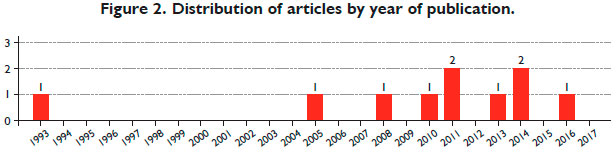
In relation to the articles' publishing year, most have been concentrated in the last decade (n = 7), as exposed in Figure 2. The oldest study identified by us in the area of Psychology about the theme was by Schmidt & Mahfoud (1993), and the most recent one was by Massola, Svartman, Martins, & Galeao-Silva (2016).
About the published papers, most of the articles identified have been from the Psychology (n = 8): Psicologia em Estudo (n = 2), Psicologia & Sociedade (n = 2), Psicologia: Ciência e Profissão (n = 1), Psychology (n = 1), Psicologia Política (n = 1), and Psicologia USP (n = 1). The other two articles were published in interdisciplinary papers, with one of them being published in Ciência e Saúde Coletiva magazine and the author was linked to the area of the Psychology (Anaya, 2014), and the other one in the paper Ambiente e Sociedade, with one of their authors linked to Psychology (Cale-gare, Higuchi, & Bruno, 2014).
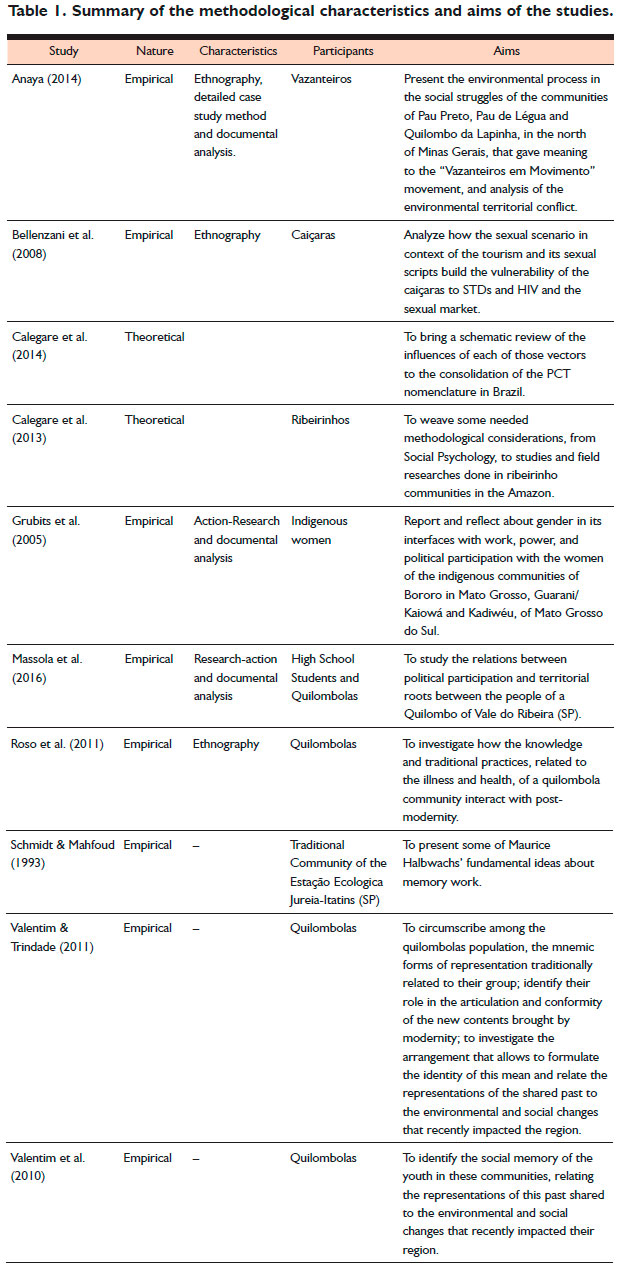
In Table 1 we can see the general characterization of the aims and methodological aspects of each study.
In what refers to conceptual aspects, four articles brought definitions and descriptions about traditional populations which are specific in each of them (Grubits, Darrault-Harris, & Pedroso, 2008; Roso, Gass, Orsato, Alves, & Moraes, 2011; Valentim & Trindade, 2011; Anaya, 2014). Despite that, they don't present any concept of traditional peoples, community or populations, nor do they mention the Decree n. 6.040 which instated the PCT category. Only in three studies is there is the presence of some definition in relation to these populations (Valentim, Trindade, & Menandro, 2010; Anaya, 2014; Calegare et al., 2014).
In regard to the methodological aspects, the studies of an empirical nature were highlighted, totalling eight articles. The two theoretical articles were the studies of Calegare, Higuchi, & Forsberg (2013) and Calegare et al. (2014). Among the empirical articles, the following methodological aspects were found: ethnography (Bellenzani, Blessa, & Paiva, 2008; Roso et al., 2011); ethnography, document analysis and ex-tended-case method or the detailed case study method (Anaya, 2014); research-action and documental analysis (Grubits et al., 2005; Massola et al., 2016) and others.
Specifically about the characterization of the samples, we found: four studies with quilombola communities (Valentim et al., Roso et al., 2011; Valentim & Trindade, 2011; Massola et al., 2016); a study with the caiçaras (Bellenzani et al., 2008); a study with indigenous women (Grubits et al., 2005); and one with vazanteiros (Anaya, 2014). One of the articles (Schmidt & Mahfoud, 1993) mentions that it is a research report with traditional communities of the Estação Ecológica Juréia-Itatins, in São Paulo, but does not characterize its communities. One of the theoretical studies analyzed the ribeirinhas populations (Calegare et al., 2013).
Referring to the instruments of data collection, most of it (n = 5) utilized an interviewing technique, with two studies characterized it as a semi-structured interview (Valentim et al., 2010; Valentim & Trindade, 2011), one study used in depth interviews (Bellenzani et al., 2007), one study used narrative interview (Roso et al., 2011) and two did not characterize the type of interview being used (Anaya, 2014; Massola et al., 2016). Two articles (Roso et al., 2011; Massola et al., 2016) mentioned yet the use of the observation technique. It has also been found one study which used the life story through oral reports procedure (Schmidt & Mahfoud, 1993).). In two studies there was a mention of the field diary as a resource (Roso et al., 2011; Massola et al., 2016).
In relation to data analysis, only three of the eight empirical articles described using analytical techniques, meaning: categorial analysis (Massola et al., 2016), the Bardin content analysis (Valentim & Trindade, 2011) and the analysis of a phenomenological background (Roso et al., 2011).
]]> In what concerns the main theoretical intake which oriented the studies, including analytical terms, the most directly prevalence was the Social Psychology aspect, with the total of seven articles (Grubits et al., 2005; Bellenzani et al., 2008; Valentim & Trindade, 2011; Roso et al., 2011, Valentim et al., 2010; Calegare et al., 2013; Schmidt & Mahfoud, 1993). A study is affiliated to Environmental Psychology (Massola et al., 2016) and was also found in the field of Political Ecology and Critical Sociology (Anaya, 201 4). Only one article does not mention the specific focus point, which is the Calegare et al. (2014) study, and was published in an interdisciplinary approach magazine.In what concerns the focus of the studies, we found a lot of different themes, among them: the relationship attachment to the place, participation and roots (Massola et al., 2016), gender and work interfaces, power and political participation (Grubits et al., 2005), identity and social memory (Valentim & Trindade, 2011), memory (Schmidt & Mahfoud, 1993; Valentim et al., 2010), social representations (Roso et al., 2011), social struggles environmentalization and political participation (Anaya, 2014), sexual scenario and sexual scripts (Bellenzani et al., 2008), methodological orientation in the research with ribeirinha communities (Calegare et al., 2013), and the construction of the PCT category (Calegare et al., 2014).
Discussion
From the data acquirement process about the article production in Psychology scientific papers that talk about traditional peoples and communities, we conclude that there were few published studies about these populations. This fact shows that the knowledge production in Psychology is still very shy in what concerns these specific segments, which constitute a considerable part of the Brazilian population and face many forms of vulnerability.
Most of the studies was published between the years of 2008 and 2016, after, then, the creation of PNPCT, which could indicate that such policy has, maybe, created momentum, even if in a small amount, for research in relation to these populations. The inexpressive number of articles found points to a large gap in the production of knowledge in Psychology toward these realities, reinforcing the hegemonically urban outlook and the low traffic that psychological science has had in the debates of this context, even in the production of Social Psychology.
From the data raised, we saw also that there is not only a tendency in distributing these articles along the years. We highlight the article by Schmidt & Mahfoud (1993), which was the oldest article and concerns a research report done with the traditional communities of the Estação Ecológica Juréia-Itatins. This is a conservation unity, which, according to Diegues (2008), was created in 1986 in the Atlantic Forest and would not allow for human presence, although traditional populations of the caiaçaras already existed in the area for generations. Such conditions resulted in the exodus of a part of this population adding to the pockets of misery which already existed in the peripheral areas of cities.
After this study published in 1993, there was a long period with no publications, even with the category of "traditional populations" getting a presence in international debates about the environment question in the areas protected without human presence. Beyond that, we had the incorporation of this discussion on the scope of the creation of the SNUC, whose first law proposal was elaborated in the early 90s, and we can also highlight the bubbling social movements representing these populations since the democratization process in the country, in the 80s. Despite that, Psychology did not lean into the lives of these peoples, their struggles, and conditions. Such a fact reinforces the historical situation of invisibility in the realities outside of urban contexts which related to our science and profession.
As a positive point, although there was few publications targeting this theme of this systematic review, we highlight that the studies analyzed are found to be well-distributed in Psychology papers, being almost unanimous the number of publications in papers which posess Qualis A (Psicologia & Sociedade, Psicologia Ciência e Profissão, Psicologia em Estudo, Psico, and Psicologia USP). One of the two articles published in interdisciplinary approach paper, is also a publication with a Qualis A in that area (Ambiente e Sociedade). In this way, the studies found, in a general manner, are located in the best available publications.
A limitation in relation to the analyzed studies concerns the fact that a vast majority of it does not bring a single definition about what the called traditional peoples, communities or populations nor do they mention the Decree n. 6.040/2007, which instituted the National Policy dedicated to these segments, an important accomplishment in the struggle for rights and recognitions desired by social movements, especially considering that most of these studies were published after the creation of the policy.
]]> Only the theoretical study of Calegare et al. (2014) mentions the definition expressed by the PNPCT, with one of the authors having as a goal exactly to do a theoretical review as to explore the scenario which involved the traditional populations until the consolidations of the PCT nomenclature in Brazil, and how this label widened the limits of protected areas, to design distinct social groups. Such a study was published in a paper of interdisciplinary focus and counting with authors from Psychology and Anthropology. In a field so full of conflicts and disagreements which has many diverse elements in order, economic, social, cultural, environmental, and political, as we initially saw, interdisciplinary studies acquired a great importance, as it allows for the construction of new perspectives in the intersection of different knowledges and disciplinary fields.Another study which does bring the definition is the one of Valentim et al. (2010): "the name traditional peoples is used for communities organized around primary economic activities - like the care of animals, the cultivation or the farming - strongly marked by its own culture, "local" (Souza-Santos, Meneses, & Nunes, 2005 as quoted by Valentim et al., 2010, p. 280). Beyond it, the authors affirm that this local culture is orally transmitted through generations, and have a marginal character in relation to the "global" level of circulation of values and ideas. However, such a study does not mention the PNPCT nor does it mention the self-definition criteria, the most important point of the policy, restricting itself to an exogenesis definition.
The definition suggested by Valetim et al. (2010) approaches the characterization proposed by Diegues (2008), one of the main creators of the literature about traditional populations, which indicates some aspects related to traditional communities, such as: subsistence activities and the accumulation of capital, the knowledge about nature and the elaboration of use and handling of natural resources strategies, which are generally transferred across generations through the oral traditions, among others. But the authors point out that, although communities possess common characteristics, there is no ideal type, and the elements mentioned could vary with greater or lesser weight in the ways of living of traditional populations, including combining the influence of the capitalist mode of production that transforms in different measures these populations.
Also in the Anaya (2014, p. 4044) study about the vazanteiras communities, we found the following use of the term traditional populations with this definition: "culturally differentiated groups, owners of traditional practices and knowledges passed on along generations", referencing the decree by SNUC. It is important to bring up that in this decree the traditional populations definition was vetoed for being too inclusive, and that many human groups, just for inhabiting continuously one same ecosystem, cannot be defined as a traditional population. This study is also does not mention PNPCT.
In relation to methodological aspects, only the study of Roso et al. (2011) presented complete informations, like the type and drawing of the research, description of the participants, instruments and procedures of data collection and the used analysis technique. In this way, despite the studies being published in qualified papers, there was some methodological gaps that future publications should look more carefully, once these informations are necessary for the readers to understand in a clear way the procedural steps of the research and better understand the achieved results, possibly to better study the challenges imposed to the researchers in the field.
It is interesting to highlight also the unanimity of studies characteristically qualitative, which could be related to the fact that the studies were a part of different social groups in specific regions in the country, besides using small samples, and show the researchers concern in understanding the different aspects of the investigated reality, from local specificals, and not necessarily in making general data summaries. However, it is worth pointing out that data such as social, income, demographic, school levels conditions and health, education, and social services systems are also important to approach complex realities.
A point in common in the studies, despite the different focus, is about the transformations of a developmental background, which sees economical growth as preferential over social relations, and affected the territories, ways of lives and traditional communities, generating impact of many orders. In the study of Massola et al. (2016), for instance, we find that the rigorous environmental of the Conservation Unities imposes to the local communities many restrictions, in what regards the handling of the land, which draws a social exclusion landscape, where, specially for young people, there are few perspectives of work or income, reflected by the low social indicators of the regions of the Vale do Ribeira, in São Paulo, which composes the Atlantic Forest Reservation Biosphere, created by UNESCO in 1991.
In the study about the caiçaras, Bellenzani et al. (2008) point out that the traditional activities of subsistence in those communities, such as agriculture, fishing and extrac-tivism, suffered restrictions because many places have become environmental protection areas, which had as a consequence the strengthening of tourism as a source of income from the local population. Such an activity brought some socioeconomic and cultural impact like the proliferation of diseases from bad environmental sanitation conditions, the increase of STDs due to unprotected sexual relations between tourists and local dwellers, professional prostitution and sexual exploitation of minors, and the increase of alcohol and other drugs among the young people in the local communities. Besides that, the study showed that the caiçaras were seen by the tourists as "exotic", with characteristic virility and sensuality.
In the studies by Valentim et al. (2010) and Valentim & Trindade (2011), conducted in the same region, known as Sapê, in Espírito Santo, the arrival of many investments from the Federal Government with the installation of cellulosic agroexportador pole and the construction of the highway BR 101, which promoted the replacement of the Atlantic Forest for monoculture and agribusiness. This situation brought impact to the material conditions of the traditional communities, beyond the lack of resources, alternatives of subsistence, of isolation, and also affected the symbolic survival of those people, reflected by the incorporation of new forms of occupation and representation of the territory and its relation with the traditional forms of dieting, crafts, living conditions, and others.
In the study by Anaya (2014), the state parks that had as an aim to strengthen agribusiness were put to place as integral conservation unities, in 2005, with a series of restrictions to the practices of traditional communities known as vazanteiras, as well as the expropriation of their territories, which lead to these communities migrating to peripheral areas of cities. However, we also found in the study references to practices of the resistance and mobilization techniques used by the vazanteiros and the articulation of a social movement for the conservation of nature which constituted itself as a fundamental reference for territory, with the dialectical relation of these traditional communities with nature serving as a factor in a distinctive identity among them and other peasant farmer groups.
]]> Grubits et al. (2005), in their study about indigenous women about the tribes Guarani/Kaiowa, reveal the distancing of men from the family unity because of work in farms and alcohol breweries and sugar. For the authors, factors like territory and economy have determined changes in the female role in family structure. On the other hand, the increased participation of indigenous women in the fights for the rights of their peoples has resulted in important changes of positioning in gender relations: while women have presented themselves as important interlocutors between their groups and non-indigenous societies, besides being important fighters in the defense of their culture, indigenous men have acquired a masculine identity of city men.From the data analyzed we also find two studies which bring the concern in relation to research with traditional communities, one with the remaining quilombos de-scendents and another with the ribeirinho population. In the first study (Roso et al., 2011), the authors point to the challenges that the social psychologist faces when doing research with the quilombolas, because of the differences in relation to cities. Besides that, they reveal a low entry point for psychologist in this kind of territory, which in one hand causes a feeling of strangeness from both parts, but on another, may allow the insertion of new looks and perspectives for this new practice.
In the study with ribeirinho population, Calegare et al. (2013) bring some guidelines to the researchers that adventure in these territories. Beyond theoretical approaches and research techniques, they must mainly follow ethical presets about social diversity and the everyday practices of the communities. For that, it is necessary to be up to date with current discussions that permeate the modern contexts, including the use of theoretical support of other areas. The authors also reveal the low knowledge production in Social Psychology which dedicates itself to ribeirinho communities of the
Amazon, though some discussions in Communitary and Political Psychology could be useful to study some psychosocial phenomena in these contexts.
Final considerations
This study had as aim a systematic revision about the production of knowledge in Psychology related to traditional peoples and communities. In a general way, the studies involving such populations are still scarce, which indicates the theme has not figured as an investigation object of Psychology, as it was also not observed to have been any expressive growth trend in the number of articles.
It is necessary to point some limitations of the present study, once it is a selection of researches from the use certain descriptors and the choice for some databases. Such choices could have restricted the total of articles about the theme that was investigated, considering that there can be studies in Psychology that are about traditional peoples and communities that don't mention, however, this identification, but only their self-denomination, like for instance, about quilombolas and indigenous people. Furthermore, the inclusion/exclusion criteria have been limited to the research selection to articles, and as such other types of documents like thesis and dissertations have not been included, for instance. Such limitations still don't annul the relevancy of the study and indicate possible pathways for new systematic reviews.
At last, due to legal-juridical advances that recognized the rights of traditional peoples and communities and the recent attacks from conservative legislators and sectors from agribusiness in relation to areas of protection and preservation, Psychology has a great challenge in promoting quality of life and the fight against inequalities of many orders to which traditional communities are submitted. For that, it is necessary to rethink the professional action and mainly the making of Psychology professionals that are technically and ethically qualified to understand the many ways of life of traditional peoples and their singular traits, and to act in ethical and political exercise of the profession together with them to defend and insure their rights and human emancipation.
]]> References
Almeida, A. W. (2008). Terra de quilombo, terras indígenas, "babaçuais livre", "castanhais do povo", faixinais e fundos de pasto: terras tradicionalmente ocupadas. Manaus: PGSCA-Ufam. Recuperado em 20 outubro, 2018, de http://www.ppgcspa.uema.br/wp-content/uploads/2017/07/Alfredo-Wagner-B-de-Almeida_Terras-Tradicionalmente-Ocupadas.pdf [ Links ]
Anaya, F. C. (2014). "Vazanteiros em movimento": o processo de ambientalização de suas lutas territoriais no contexto das políticas de modernização ecológica. Ciência & Saúde Coletiva, 79(10),4041-4050. doi:10.1590/1413-812320141910.09242014 [ Links ]
Barretto, H. T., Filho (2006). Populações tradicionais: introdução à crítica da ecologia política de uma noção. In C. Adams, R. Murrieta, & W. Neves (Orgs.). Sociedades caboclas amazônicas: modernidade e invisibilidade (pp. 109-143). São Paulo: Annablume. [ Links ]
Bellenzani, R., Blessa, C., & Paiva, V. (2008). Scripts em cena: HIV e mercado sexual no contexto turístico. Psicologia em Estudo, 13(4),653-662. doi:10.1590/S1413-73722008000400003 [ Links ]
Calegare, M. G. (2010). Contribuições da Psicologia Social ao estudo de uma comunidade ribeirinha no Alto Solimões: redes comunitárias e identidades coletivas. Tese de doutorado, Universidade de São Paulo, São Paulo, SP, Brasil. doi:10.11606/T.47.2010.tde-03052010-163111 [ Links ]
Calegare, M. G. A., Higuchi, M. I. G., & Bruno, A. C. S. (2014). Povos e comunidades tradicionais: das áreas protegidas à visibilidade política de grupos sociais portadores de identidade étnica e coletiva. Ambiente & Sociedade, 17(3),115-134. doi:10.1590/S1414-753X2014000300008 [ Links ]
Calegare, M. G. A., Higuchi, M. I. G., & Forsberg, S. S. (2013). Desafios metodológicos ao estudo de comunidades ribeirinhas amazônicas. Psicologia & Sociedade, 25(3),571-580. doi:10.1590/S0102-71822013000300011 [ Links ]
Conselho Federal de Psicologia (2013). Referências técnicas para atuação das(os) psicólogas(os) em questões relativas à terra. Brasília: CFP. [ Links ]
Costa, A. Filho (n. d.). Quilombos e povos tradicionais. Recuperado em 20 outubro, 2018, de http://conflitosambientaismg.lcc.ufmg.br/wp-content/uploads/2014/04/TAMC-COSTA_FILHO_Aderval_Quilombos_e_Povos_Tradicionais.pdf [ Links ]
Cunha, M. C., & Almeida, M. (2001). Populações indígenas, povos tradicionais e preservação na Amazônia. In J. P. Capobianco, A. Veríssimo, A. Moreira, D. Sawyer, I. Santos, & L. P. Pinto (Orgs.). Biodiversidade na Amazônia Brasileira. Avaliação e ações prioritárias para a conservação, uso sustentável e repartição de benefícios (pp. 184-193). São Paulo: Instituto Socioambiental. Recuperado em 20 outubro, 2018, de https://mwba.files.wordpress.com/2010/07/2001-cunha-e-almeida-populacoes-indigenas-e-conservacao-capobianco-ed.pdf [ Links ]
Decreto n. 6.040, de 7 de fevereiro de 2007 (2007). Institui a Política Nacional de Desenvolvimento Sustentável dos Povos e Comunidades Tradicionais. Recuperado em 20 outubro, 2018, de http://www.planalto.gov.br/ccivil_03/_ato2007-2010/2007/decreto/d6040.htm [ Links ]
Diegues, A. C. (2008). O mito moderno da natureza intocada (6a ed.). São Paulo: Hucitec. [ Links ]
Diegues, A. C., & Arruda, R. S. (Orgs.). (2000). Saberes tradicionais e biodiversidade no Brasil. Brasília: Ministério do Meio Ambiente. Recuperado em 20 outubro, 2018, de http://nupaub.fflch.usp.br/sites/nupaub.fflch.usp.br/files/saberes%20trad.pdf [ Links ]
Grubits, S., Darrault-Harris, I., & Pedroso, M. (2005). Mulheres indígenas: poder e tradição. Psicologia em Estudo, 10(3),363-372. doi:10.1590/S1413-737220050003 00004 [ Links ]
Leite, J. F., Macedo, J. P., Dimenstein, M., & Dantas, C. (2013). A formação em Psicologia para a atuação em contextos rurais. In J. F. Leite & M. Dimenstein (Orgs.). Psicologia e contextos rurais (pp. 27-56). Natal: EDUFRN. Recuperado em 20 outubro, 2018, de https://www.researchgate.net/profile/Joao_Macedo8/publication/317646743_A_formacao_em_Psicologia_para_a_atuacao_em_contextos_rurais/links/59467fc145851525f899a224/A-formacao-em-Psicologia-para-a-atuacao-em-contextos-rurais.pdf [ Links ]
Macedo, J. P., & Dimenstein, M. (2011). Expansão e interiorização da Psicologia: reorganização dos saberes e poderes na atualidade. Psicologia: Ciência e Profissão, 31(2),296-313. doi:10.1590/S1414-98932011000200008 [ Links ]
Massola, G. M., Svartman, B. P., Martins, A. B. M., Galeão-Silva, L. G., & Santos, A. O. (2016). Pré-iniciação científica em Psicologia: contribuição para a formação científica no ensino médio. Psicologia: Ciência e Profissão, 36(3),558-570. doi:10.15 90/1982-3703001262014 [ Links ]
Ribeiro, D. (2015). O povo brasileiro: a formação e o sentido do Brasil (3a ed.). São Paulo: Global. [ Links ]
Roso, A., Moraes, M., Gass, R. L., Orsato, D., & Alves, T. (2011) Minorias étnicas e representações sociais: notas sobre a entrada do psicólogo social em uma comunidade quilombola. Psico, 42(3),346-353. Recuperado em 20 outubro, 2018, de http://revistaseletronicas.pucrs.br/ojs/index.php/revistapsico/article/viewFile/9914/6990 [ Links ]
Santilli, J. (2005). Socioambientalismo e novos direitos: proteção jurídica à diversidade biológica e cultural. São Paulo: Peirópolis. Recuperado em 20 outubro, 2018, de http://portal.iphan.gov.br/uploads/ckfinder/arquivos/SANTILLI_Juliana-Socioambientalismo-e-novos-direitos.pdf [ Links ]
Schmidt, M., & Mahfoud, M. (1993). Halbwachs: memória coletiva e experiência. Psicologia USP, 4(1-2),285-298. doi: 10.1590/S1678-51771993000100013 [ Links ]
Silva, M. O. (2007). Saindo da invisibilidade - a política nacional de povos e comunidades tradicionais. Inclusão Social, 2(2),7-9. Recuperado em 20 outubro, 2018, de http://revista.ibict.br/inclusao/article/view/1596/1802 [ Links ]
Valentim, R., & Trindade, Z. A. (2011). Modernidade e comunidades tradicionais: memória, identidade e transmissão em território quilombola. Revista Psicologia Política, 11(22),295-308. Recuperado em 20 outubro, 2018, de http://pepsic.bvsalud.org/scielo.php?script=sci_arttext&pid=S1519-549X2011000200008&lng=pt&tlng=pt [ Links ]
Valentim, R., Trindade, Z. A., & Menandro, M. C. S. (2010). Memórias sociais de juventude entre quilombolas do norte do Espírito Santo. Psicologia & Sociedade, 22(2),279-287. doi:10.1590/S0102-71822010000200008 [ Links ]
Vianna, L. P. (2008). De invisíveis a protagonistas: populações tradicionais e unidades de conservação. São Paulo: Annablume, Fapesp. [ Links ]
 Mailling address:
João Paulo Macedo
Universidade Federal do Piauí, Campus Ministro Reis Velloso, Programa de Pós-Graduação em Psicologia
Av. São Sebastião, 2819. São Benedito
Parnaíba, PI, Brazil. CEP: 64202-020
E-mail: jampamacedo@gmail.com
Submission: 3.1.18 ]]> Acceptance: 27.7.18
]]>