<?xml version="1.0" encoding="ISO-8859-1"?><article xmlns:mml="http://www.w3.org/1998/Math/MathML" xmlns:xlink="http://www.w3.org/1999/xlink" xmlns:xsi="http://www.w3.org/2001/XMLSchema-instance">
<front>
<journal-meta>
<journal-id>1517-2805</journal-id>
<journal-title><![CDATA[Revista de Etologia]]></journal-title>
<abbrev-journal-title><![CDATA[Rev. etol.]]></abbrev-journal-title>
<issn>1517-2805</issn>
<publisher>
<publisher-name><![CDATA[Sociedade Brasileira de Etologia]]></publisher-name>
</publisher>
</journal-meta>
<article-meta>
<article-id>S1517-28052010000100001</article-id>
<title-group>
<article-title xml:lang="en"><![CDATA[An alternative technique for individual marking of orb-web spiders]]></article-title>
</title-group>
<contrib-group>
<contrib contrib-type="author">
<name>
<surname><![CDATA[Zambonato]]></surname>
<given-names><![CDATA[Bianca P.]]></given-names>
</name>
<xref ref-type="aff" rid="A01"/>
</contrib>
<contrib contrib-type="author">
<name>
<surname><![CDATA[Daemon]]></surname>
<given-names><![CDATA[Erik]]></given-names>
</name>
<xref ref-type="aff" rid="A01"/>
</contrib>
<contrib contrib-type="author">
<name>
<surname><![CDATA[Prezoto]]></surname>
<given-names><![CDATA[Fábio]]></given-names>
</name>
<xref ref-type="aff" rid="A01"/>
</contrib>
</contrib-group>
<aff id="A01">
<institution><![CDATA[,Universidade Federal de Juiz de Fora  ]]></institution>
<addr-line><![CDATA[ ]]></addr-line>
</aff>
<pub-date pub-type="pub">
<day>00</day>
<month>01</month>
<year>2010</year>
</pub-date>
<pub-date pub-type="epub">
<day>00</day>
<month>01</month>
<year>2010</year>
</pub-date>
<volume>9</volume>
<numero>1</numero>
<fpage>3</fpage>
<lpage>5</lpage>
<copyright-statement/>
<copyright-year/>
<self-uri xlink:href="http://pepsic.bvsalud.org/scielo.php?script=sci_arttext&amp;pid=S1517-28052010000100001&amp;lng=en&amp;nrm=iso"></self-uri><self-uri xlink:href="http://pepsic.bvsalud.org/scielo.php?script=sci_abstract&amp;pid=S1517-28052010000100001&amp;lng=en&amp;nrm=iso"></self-uri><self-uri xlink:href="http://pepsic.bvsalud.org/scielo.php?script=sci_pdf&amp;pid=S1517-28052010000100001&amp;lng=en&amp;nrm=iso"></self-uri><abstract abstract-type="short" xml:lang="en"><p><![CDATA[A technique is proposed for individually marking orb-web spiders aiming at facilitating the identification of the individuals on their webs. To check the efficiency of the method, 17 females and 30 males of Nephila clavipes (Linnaeus 1767) were marked on the dorsal part of the opisthosoma using enamel applied through a disposable syringe. Success was obtained in marking 47 individuals; no death, dispersal or agonistic behavior was observed after the use of the method. This marking did not dissolve in contact with water, resisted the expansion of the opisthosoma and was lost only in the ecdysis. This method also was efficient for males that, being smaller than the females, demand a more careful methodology.]]></p></abstract>
<abstract abstract-type="short" xml:lang="pt"><p><![CDATA[Uma técnica alternativa para a marcação individual de aranhas orbitelas. Propõe-se uma técnica de marcação individual de aranhas orbitelas visando facilitar a identificação dos indivíduos em suas teias. Para verificar a eficiência do método, 17 fêmeas e 30 machos de Nephila clavipes (Linnaeus, 1767) foram marcados na parte dorsal do abdômen utilizando-se esmalte, aplicado por meio de seringa descartável. Obteve-se sucesso na marcação dos 47 indivíduos, não sendo observada morte, dispersão ou comportamentos agonísticos após o uso do método. Esta marcação não dissolveu em contato com a água, resistiu ao aumento do opistossoma e foi perdida somente na ecdise. Esse método também foi eficiente para os machos que, por serem menores que as fêmeas, exigem uma metodologia mais cuidadosa.]]></p></abstract>
<kwd-group>
<kwd lng="en"><![CDATA[Marking]]></kwd>
<kwd lng="en"><![CDATA[Araneae]]></kwd>
<kwd lng="en"><![CDATA[Nephila clavipes]]></kwd>
<kwd lng="pt"><![CDATA[Marcação]]></kwd>
<kwd lng="pt"><![CDATA[Araneae]]></kwd>
<kwd lng="pt"><![CDATA[Nephila clavipes]]></kwd>
</kwd-group>
</article-meta>
</front><body><![CDATA[ <p align="right"><font face="Verdana, Arial, Helvetica, sans-serif" size="2"><b>Artigos</b></font></p>     <p>&nbsp;</p>     <p><font face="Verdana, Arial, Helvetica, sans-serif" size="4"><b>An alternative technique for individual marking of orb-web spiders</b></font></p>     <p>&nbsp;</p>     <p><font face="Verdana, Arial, Helvetica, sans-serif" size="3"><b>Uma técnica alternativa para a marcação individual de aranhas orbitelas</b></font></p>     <p>&nbsp;</p>     <p>&nbsp;</p>     <p><font face="Verdana, Arial, Helvetica, sans-serif" size="2"><b>Bianca P. Zambonato; Erik Daemon; Fábio Prezoto</b></font></p>     <p><font face="Verdana, Arial, Helvetica, sans-serif" size="2">Universidade Federal de Juiz de Fora, Minas Gerais</font></p>    <br>     ]]></body>
<body><![CDATA[<p><font face="Verdana, Arial, Helvetica, sans-serif" size="2"><a name="enda"></a><a href="#end">Correspondece to</a></font></p>     <p>&nbsp;</p> <hr noshade size="1">     <p><font face="Verdana, Arial, Helvetica, sans-serif" size="2"><b>ABSTRACT</b></font></p>     <p><font face="Verdana, Arial, Helvetica, sans-serif" size="2">A technique is proposed for individually marking orb-web spiders aiming at facilitating the identification of the individuals on their webs. To check the efficiency of the method, 17 females and 30 males of <i>Nephila clavipes</i> (Linnaeus 1767) were marked on the dorsal part of the opisthosoma using enamel applied through a disposable syringe. Success was obtained in marking 47 individuals; no death, dispersal or agonistic behavior was observed after the use of the method. This marking did not dissolve in contact with water, resisted the expansion of the opisthosoma and was lost only in the ecdysis. This method also was efficient for males that, being smaller than the females, demand a more careful methodology</font></p>     <p><font face="Verdana, Arial, Helvetica, sans-serif" size="2"><b>Keywords: </b>Marking. Araneae. <i>Nephila clavipes</i>.</font></p> <hr noshade size="1">     <p><font face="Verdana, Arial, Helvetica, sans-serif" size="2"><b>RESUMO</b></font></p>     <p><font face="Verdana, Arial, Helvetica, sans-serif" size="2">Propõe-se uma técnica de marcação individual de aranhas orbitelas visando facilitar a identificação dos indivíduos em suas teias. Para verificar a eficiência do método, 17 fêmeas e 30 machos de <i>Nephila clavipes</i> (Linnaeus, 1767) foram marcados na parte dorsal do abdômen utilizando-se esmalte, aplicado por meio de seringa descartável. Obteve-se sucesso na marcação dos 47 indivíduos, não sendo observada morte, dispersão ou comportamentos agonísticos após o uso do método. Esta marcação não dissolveu em contato com a água, resistiu ao aumento do opistossoma e foi perdida somente na ecdise. Esse método também foi eficiente para os machos que, por serem menores que as fêmeas, exigem uma metodologia mais cuidadosa.</font></p>     <p><font face="Verdana, Arial, Helvetica, sans-serif" size="2"><b>Palavras-chave: </b>Marcação. Araneae. <i>Nephila clavipes</i>.</font></p> <hr noshade size="1">     <p>&nbsp;</p>     <p>&nbsp;</p>     ]]></body>
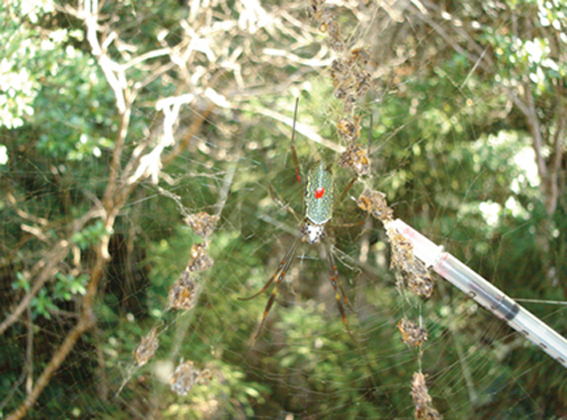
<body><![CDATA[<p><font face="Verdana, Arial, Helvetica, sans-serif" size="2">The use of markings on spiders is essential for keeping track of individuals in field studies of behavior, biology and ecology. The methodology chosen must offer characteristics such as ease of application, durability and resistance to weathering which guarantees the efficiency of the research without loss of data and without behavior alterations in individual survival and behavior.</font></p>     <p><font face="Verdana, Arial, Helvetica, sans-serif" size="2">Methodologies that require the removal of the animals from their natural sites and the use of anesthetics (Edgar 1971; Samu, Sunderland, Topping, & Fenlon, 1996); are considered invasive and disadvantageous for behavioral studies. Other forms of marking commonly used are adaptations of methods described for insects, such as the use of acrylic paint (Rypstra, 1985) and adhesive labels (Framenau & Elgar 2005).</font></p>     <p><font face="Verdana, Arial, Helvetica, sans-serif" size="2">For conducting behavioral studies in orb-web spiders it is necessary to use a methodology which does not compromise the welfare and activity patterns of individuals, and has a low operational cost. We here describe an alternative methodology for marking orb-web spiders intended for behavioral field studies.</font></p>     <p><font face="Verdana, Arial, Helvetica, sans-serif" size="2">Markings were made, from March to August 2008 on 47 individual Nephila clavipes (Linnaeus 1767) (17 females and 30 males), in an area of human habitation at the Universidade Federal de Juiz de Fora, Minas Gerais State, Brazil. Markings were performed in a natural environment in which individuals were exposed to normal weather conditions.</font></p>     <p>&nbsp;</p>     <p align="center"><font face="Verdana, Arial, Helvetica, sans-serif" size="2"><img src="/img/revistas/reto/v9n1/1a01f1.jpg"></font></p>     <p align="center"><font face="Verdana, Arial, Helvetica, sans-serif" size="2"><i>Figura 1.</i> Female of <i>Nephila clavipes</i> with opisthosoma recently marked.</font></p>     <p>&nbsp;</p>     <p><font face="Verdana, Arial, Helvetica, sans-serif" size="2">Specimens were marked individually in the dorsal part of the opisthosoma using enamels of varied coloration (blue, green, orange, pink, purple, red, white and yellow). For the application, a small quantity of enamel was sucked into a disposable syringe of 1 ml with a needle of 13 x 0.38 mm.  A drop was subsequently formed, by pressure of the piston, at the distal extremity of the needle and put into contact with the dorsal part of the opisthosoma. Contact  with the genitalia, respiratory openings or spinnerets was avoided.</font></p>     <p><font face="Verdana, Arial, Helvetica, sans-serif" size="2">47 individuals were successfully marked. In females which were tested the application of enamel did not cause death, and the spiders accomplished other ecdyses after marking. Marked females remained on their webs and no dispersion was caused by the application process. Permanence was confirmed through daily checks of the position of the individuals on the webs. Death of males did not occur after marking and marked individuals remained on the webs, maintaining the male hierarchy of proximity towards the female previously observed. Position alternation eventually occurred in at least four days after marking. These events were similar to those documented for non-marked males, thus they are considered natural events.</font></p>     ]]></body>
<body><![CDATA[<p><font face="Verdana, Arial, Helvetica, sans-serif" size="2">The marking was resistant to rain and to the dilatation of the opisthosoma, remaining up to the occurrence of ecdysis, which took place around one month later. An individual female, as an exceptional case, remained marked for 81 days before she dispersed.</font></p>     <p><font face="Verdana, Arial, Helvetica, sans-serif" size="2">Use of the syringe allowed control of the volume of the drop to be applied, making it possible to mark smaller specimens (6 mm), as in the case of the males. Due to its volume and viscosity, the drop from the enamel quickly fixed itself to the opisthosoma, without dripping on the body of the animal. It was  not necessary to exert pressure on the marking place or even to repeat the procedure (fig. 1). Control of drop size was not possible when the application of enamel was performed with a brush, wooden sticks or dental microbrushes. In these cases the volume of the drop formed was much bigger than that necessary for the marking, making the individuals more conspicuous and in some cases compromising locomotion due to the adherence of enamel between the legs</font>.</p>     <p><font face="Verdana, Arial, Helvetica, sans-serif" size="2">Besides the characteristics already mentioned (quick adherence and drying, absence of toxicity, durability); ease of application should be emphasized, as well as the low cost of the material used, the ease of visualizing the markings at a distance, and the possibility of color combinations. In addition to the matching of colors, natural characteristics as the absence of legs, may be associated to this methodology in order to optimize the marking.</font></p>     <p><font face="Verdana, Arial, Helvetica, sans-serif" size="2">These features are, according to Walker and Wineriter (1981), essential for an efficient methodology of marking. We believe that this methodology, successful as it was in the case of N. clavipes, can be adapted to different species of spider and other arthropods, in both field studies and laboratory.</font></p>     <p>&nbsp;</p>     <p><font face="Verdana, Arial, Helvetica, sans-serif" size="3"><b>Referências</b></font></p>     <!-- ref --><p><font face="Verdana, Arial, Helvetica, sans-serif" size="2">Edgar, W. D. (1971). The life-cycle, abundance and seasonal movement of the wolf spider, Lycosa (Pardosa) lugubris, in central Scotland. <i>Journal of Animal Ecology, 40</i>, 303-322.    &nbsp;&nbsp;&nbsp;&nbsp;&nbsp;&nbsp;&nbsp;&nbsp;[&#160;<a href="javascript:void(0);" onclick="javascript: window.open('/scielo.php?script=sci_nlinks&ref=3189931&pid=S1517-2805201000010000100001&lng=','','width=640,height=500,resizable=yes,scrollbars=1,menubar=yes,');">Links</a>&#160;]<!-- end-ref --></font></p>     <!-- ref --><p><font face="Verdana, Arial, Helvetica, sans-serif" size="2">Framenau, V. W., & Elgar, M. A. (2005). Cohort dependent life-history traits in a wolf spider (Araneae: Lycosidae) with a bimodal life cycle. <i>Journal of Zoology, 265</i>, 179-188.    &nbsp;&nbsp;&nbsp;&nbsp;&nbsp;&nbsp;&nbsp;&nbsp;[&#160;<a href="javascript:void(0);" onclick="javascript: window.open('/scielo.php?script=sci_nlinks&ref=3189933&pid=S1517-2805201000010000100002&lng=','','width=640,height=500,resizable=yes,scrollbars=1,menubar=yes,');">Links</a>&#160;]<!-- end-ref --></font></p>     ]]></body>
<body><![CDATA[<!-- ref --><p><font face="Verdana, Arial, Helvetica, sans-serif" size="2">Samu, F., Sunderland, K. D., Topping, C. J., & Fenlon, J. S. (1996). A spider population in flux: Selection and abandonment of artificial web-sites and the importance of intraspecific interactions in <i>Lepthyphantes tenuis</i> (Araneae: Linyphiidae) in wheat. <i>Oecologia, 106</i>, 228-239.    &nbsp;&nbsp;&nbsp;&nbsp;&nbsp;&nbsp;&nbsp;&nbsp;[&#160;<a href="javascript:void(0);" onclick="javascript: window.open('/scielo.php?script=sci_nlinks&ref=3189935&pid=S1517-2805201000010000100003&lng=','','width=640,height=500,resizable=yes,scrollbars=1,menubar=yes,');">Links</a>&#160;]<!-- end-ref --></font></p>     <!-- ref --><p><font face="Verdana, Arial, Helvetica, sans-serif" size="2">Rypstra, A. L. (1985). Aggregations of <i>Nephila clavipes (L.)</i> (Araneae, Araneidae) in relation to prey availability. <i>Journal of Arachnology, 13</i>, 71-78.    &nbsp;&nbsp;&nbsp;&nbsp;&nbsp;&nbsp;&nbsp;&nbsp;[&#160;<a href="javascript:void(0);" onclick="javascript: window.open('/scielo.php?script=sci_nlinks&ref=3189937&pid=S1517-2805201000010000100004&lng=','','width=640,height=500,resizable=yes,scrollbars=1,menubar=yes,');">Links</a>&#160;]<!-- end-ref --></font></p>     <!-- ref --><p><font face="Verdana, Arial, Helvetica, sans-serif" size="2">Walker, T. J., & Wineriter, S. A. (1981). Marking techniques for recognizing individual insects. <i>Florida Entomologist, 64</i>, 18-29.    &nbsp;&nbsp;&nbsp;&nbsp;&nbsp;&nbsp;&nbsp;&nbsp;[&#160;<a href="javascript:void(0);" onclick="javascript: window.open('/scielo.php?script=sci_nlinks&ref=3189939&pid=S1517-2805201000010000100005&lng=','','width=640,height=500,resizable=yes,scrollbars=1,menubar=yes,');">Links</a>&#160;]<!-- end-ref --></font></p>     <p>&nbsp;</p>     <p>&nbsp;</p>     <p><font face="Verdana, Arial, Helvetica, sans-serif" size="2">Received: 13/02/2009    <br> Accepted: 20/09/2009</font></p>     ]]></body>
<body><![CDATA[<p>&nbsp;</p>     <p>&nbsp;</p>     <p><font face="Verdana, Arial, Helvetica, sans-serif" size="2"><b><img src="/img/seta.gif" width="15" height="17"><a name="end"></a><a href="#enda">Correspondece to</a></b></font></p>     <p><font face="Verdana, Arial, Helvetica, sans-serif" size="2"><sup></sup> Bianca P. Zambonato, Erik Daemon e Fábio Prezoto, Programa de Pós-graduação em Ciências Biológicas Comportamento e Biologia Animal, Universidade Federal de Juiz de Fora. Campus Universitário, Bairro Martelos. Juiz de Fora, MG. CEP: 36036-900.</font></p>    <br>     <p>&nbsp;</p>     <p>&nbsp;</p>      ]]></body>
<back>
<ref-list>
<ref id="B1">
<nlm-citation citation-type="journal">
<person-group person-group-type="author">
<name>
<surname><![CDATA[Edgar]]></surname>
<given-names><![CDATA[W. D.]]></given-names>
</name>
</person-group>
<article-title xml:lang="en"><![CDATA[The life-cycle, abundance and seasonal movement of the wolf spider, Lycosa (Pardosa) lugubris, in central Scotland]]></article-title>
<source><![CDATA[Journal of Animal Ecology]]></source>
<year>1971</year>
<volume>40</volume>
<page-range>303-322</page-range></nlm-citation>
</ref>
<ref id="B2">
<nlm-citation citation-type="journal">
<person-group person-group-type="author">
<name>
<surname><![CDATA[Framenau]]></surname>
<given-names><![CDATA[V. W.]]></given-names>
</name>
<name>
<surname><![CDATA[Elgar]]></surname>
<given-names><![CDATA[M. A.]]></given-names>
</name>
</person-group>
<article-title xml:lang="en"><![CDATA[Cohort dependent life-history traits in a wolf spider (Araneae: Lycosidae) with a bimodal life cycle]]></article-title>
<source><![CDATA[Journal of Zoology]]></source>
<year>2005</year>
<volume>265</volume>
<page-range>179-188</page-range></nlm-citation>
</ref>
<ref id="B3">
<nlm-citation citation-type="journal">
<person-group person-group-type="author">
<name>
<surname><![CDATA[Samu]]></surname>
<given-names><![CDATA[F.]]></given-names>
</name>
<name>
<surname><![CDATA[Sunderland]]></surname>
<given-names><![CDATA[K. D.]]></given-names>
</name>
<name>
<surname><![CDATA[Topping]]></surname>
<given-names><![CDATA[C. J.]]></given-names>
</name>
<name>
<surname><![CDATA[Fenlon]]></surname>
<given-names><![CDATA[J. S.]]></given-names>
</name>
</person-group>
<article-title xml:lang="en"><![CDATA[A spider population in flux: Selection and abandonment of artificial web-sites and the importance of intraspecific interactions in Lepthyphantes tenuis (Araneae: Linyphiidae) in wheat]]></article-title>
<source><![CDATA[Oecologia]]></source>
<year>1996</year>
<volume>106</volume>
<page-range>228-239</page-range></nlm-citation>
</ref>
<ref id="B4">
<nlm-citation citation-type="journal">
<person-group person-group-type="author">
<name>
<surname><![CDATA[Rypstra]]></surname>
<given-names><![CDATA[A. L.]]></given-names>
</name>
</person-group>
<article-title xml:lang="en"><![CDATA[Aggregations of Nephila clavipes (L.) (Araneae, Araneidae) in relation to prey availability]]></article-title>
<source><![CDATA[Journal of Arachnology]]></source>
<year>1985</year>
<volume>13</volume>
<page-range>71-78</page-range></nlm-citation>
</ref>
<ref id="B5">
<nlm-citation citation-type="journal">
<person-group person-group-type="author">
<name>
<surname><![CDATA[Walker]]></surname>
<given-names><![CDATA[T. J.]]></given-names>
</name>
<name>
<surname><![CDATA[Wineriter]]></surname>
<given-names><![CDATA[S. A.]]></given-names>
</name>
</person-group>
<article-title xml:lang="en"><![CDATA[Marking techniques for recognizing individual insects]]></article-title>
<source><![CDATA[Florida Entomologist]]></source>
<year>1981</year>
<volume>64</volume>
<page-range>18-29</page-range></nlm-citation>
</ref>
</ref-list>
</back>
</article>
