<?xml version="1.0" encoding="ISO-8859-1"?><article xmlns:mml="http://www.w3.org/1998/Math/MathML" xmlns:xlink="http://www.w3.org/1999/xlink" xmlns:xsi="http://www.w3.org/2001/XMLSchema-instance">
<front>
<journal-meta>
<journal-id>1413-8557</journal-id>
<journal-title><![CDATA[Psicologia Escolar e Educacional]]></journal-title>
<abbrev-journal-title><![CDATA[Psicol. esc. educ.]]></abbrev-journal-title>
<issn>1413-8557</issn>
<publisher>
<publisher-name><![CDATA[Associação Brasileira de Psicologia Escolar e Educacional (ABRAPEE)]]></publisher-name>
</publisher>
</journal-meta>
<article-meta>
<article-id>S1413-85572003000100003</article-id>
<title-group>
<article-title xml:lang="pt"><![CDATA[Determinantes psicolingüísticos da compreensão de leitura em inglês como língua estrangeira]]></article-title>
<article-title xml:lang="en"><![CDATA[Psycholinguistic determinants of reading comprehension in english as a foreign language]]></article-title>
</title-group>
<contrib-group>
<contrib contrib-type="author">
<name>
<surname><![CDATA[Vivaldo-Lima]]></surname>
<given-names><![CDATA[Javier]]></given-names>
</name>
<xref ref-type="aff" rid="A01"/>
</contrib>
<contrib contrib-type="author">
<name>
<surname><![CDATA[López-Olivas]]></surname>
<given-names><![CDATA[Miguel]]></given-names>
</name>
<xref ref-type="aff" rid="A02"/>
</contrib>
<contrib contrib-type="author">
<name>
<surname><![CDATA[González-Robles]]></surname>
<given-names><![CDATA[Rosa Obdulia]]></given-names>
</name>
<xref ref-type="aff" rid="A01"/>
</contrib>
</contrib-group>
<aff id="A01">
<institution><![CDATA[,Universidad Autónoma Metropolitana  ]]></institution>
<addr-line><![CDATA[ ]]></addr-line>
</aff>
<aff id="A02">
<institution><![CDATA[,Universidad Nacional Autónoma de México  ]]></institution>
<addr-line><![CDATA[ ]]></addr-line>
</aff>
<pub-date pub-type="pub">
<day>00</day>
<month>06</month>
<year>2003</year>
</pub-date>
<pub-date pub-type="epub">
<day>00</day>
<month>06</month>
<year>2003</year>
</pub-date>
<volume>7</volume>
<numero>1</numero>
<fpage>21</fpage>
<lpage>31</lpage>
<copyright-statement/>
<copyright-year/>
<self-uri xlink:href="http://pepsic.bvsalud.org/scielo.php?script=sci_arttext&amp;pid=S1413-85572003000100003&amp;lng=en&amp;nrm=iso"></self-uri><self-uri xlink:href="http://pepsic.bvsalud.org/scielo.php?script=sci_abstract&amp;pid=S1413-85572003000100003&amp;lng=en&amp;nrm=iso"></self-uri><self-uri xlink:href="http://pepsic.bvsalud.org/scielo.php?script=sci_pdf&amp;pid=S1413-85572003000100003&amp;lng=en&amp;nrm=iso"></self-uri><abstract abstract-type="short" xml:lang="pt"><p><![CDATA[O objetivo deste estudo foi analisar a contribuição das variáveis lingüísticas e psicológicas da variância associada à compreensão de leitura em inglês (L2). A amostra esteve integrada por 280 estudantes universitarios, falantes nativos do espanhol. A dimensão lingüística da análise avaliou a influência das habilidades de processamento de texto do leitor em espanhol (L1), da sua competência lingüística em L2 e da sua habilidade para perceber transparência léxica entre as duas línguas, enquanto a dimensão psicológica analisou a influência do estilo cognoscitivo, do locus de controle e do controle de ação sobre a capacidade do leitor para construir significado a partir do texto. Administrou-se aos sujeitos uma bateria de sete instrumentos de avaliação. Uma série de análise de regressão múltipla indicou a existência dum modelo explicativo da leitura em L2 em duas etapas. Na primeira, as variáveis psicológicas explicaram 10.2% da variância associada ao processamento do texto em L1, variável que, na segunda etapa, explicou 35.8% da variância associada à compreensão de leitura em inglês, ajuntada à competência lingüística do leitor em L2 e à sua capacidade para perceber transparência léxica entre L1 e L2.]]></p></abstract>
<abstract abstract-type="short" xml:lang="en"><p><![CDATA[The purpose of this study was to analyze the contribution of linguistic and psychological variables in the explanation of the variance associated with reading comprehension in English (L2). Two hundred and eighty Mexican university students participated in the study. The variables analyzed within the linguistic dimension were: reading strategies in Spanish, linguistic competence in English, and ability to perceive lexical transparency between L1 and L2. The psychological dimension evaluated the influence of the reader&#8217;s cognitive style, locus of control, and action control orientation on reading comprehension in L2. Subjects were administered a battery of seven evaluation instruments. Multiple regression analyses suggested a two-stage explanatory model of reading in L2. Firstly, psychological variables accounted for 10.0% of the variance in reading comprehension in the first language. Secondly, reading comprehension in Spanish, linguistic competence in L2, and perception of lexical transparency, accounted for 35.5% of the variance in reading comprehension in English.]]></p></abstract>
<kwd-group>
<kwd lng="pt"><![CDATA[Compreensão de leitura em inglês]]></kwd>
<kwd lng="pt"><![CDATA[Competência lingüística]]></kwd>
<kwd lng="en"><![CDATA[Reading comprehension]]></kwd>
<kwd lng="en"><![CDATA[Foreign language]]></kwd>
<kwd lng="en"><![CDATA[Psycholinguistic research]]></kwd>
</kwd-group>
</article-meta>
</front><body><![CDATA[ <p align="right"><font face="Verdana, Arial, Helvetica, sans-serif" size="2"><b>ARTIGOS</b></font></p>     <p>&nbsp;</p>     <p><font face="Verdana, Arial, Helvetica, sans-serif" size="4"><b>Determinantes psicoling&uuml;&iacute;sticos da compreens&atilde;o de leitura em ingl&ecirc;s como l&iacute;ngua estrangeira</b></font></p>     <p>&nbsp;</p>     <p><font face="Verdana, Arial, Helvetica, sans-serif" size="3"><b>Psycholinguistic determinants of reading comprehension in english as a foreign language</b></font></p>     <p>&nbsp;</p>     <p><font face="Verdana, Arial, Helvetica, sans-serif" size="2"><b>Javier Vivaldo-Lima<sup><a href="#1a">1</a><a name="1"></a>*</sup>; Miguel L&oacute;pez-Olivas<sup><a href="#2a">2</a><a name="2"></a>**</sup>; Rosa Obdulia Gonz&aacute;lez-Robles<sup><a href="#3a">3</a></sup><a name="3"></a>*  </b> </font></p>     <p><font face="Verdana, Arial, Helvetica, sans-serif" size="2"><sup>*</sup> Universidad Aut&oacute;noma Metropolitana</font></p>     <p><font face="Verdana, Arial, Helvetica, sans-serif" size="2"><sup>**</sup>Universidad Nacional Aut&oacute;noma de M&eacute;xico</font></p>     <p>&nbsp;</p> <hr noshade size="1">     ]]></body>
<body><![CDATA[<p><font face="Verdana, Arial, Helvetica, sans-serif" size="2"><b>RESUMO</b> </font></p>           <p><font face="Verdana, Arial, Helvetica, sans-serif" size="2">O objetivo deste estudo foi analisar a contribui&ccedil;&atilde;o das vari&aacute;veis ling&uuml;&iacute;sticas e psicol&oacute;gicas da vari&acirc;ncia associada &agrave; compreens&atilde;o de leitura em           ingl&ecirc;s (L2). A amostra esteve integrada por 280 estudantes universitarios, falantes nativos do espanhol. A dimens&atilde;o ling&uuml;&iacute;stica da an&aacute;lise avaliou           a influ&ecirc;ncia das habilidades de processamento de texto do leitor em espanhol (L1), da sua compet&ecirc;ncia ling&uuml;&iacute;stica em L2 e da sua habilidade para           perceber transpar&ecirc;ncia l&eacute;xica entre as duas l&iacute;nguas, enquanto a dimens&atilde;o psicol&oacute;gica analisou a influ&ecirc;ncia do estilo cognoscitivo, do locus de           controle e do controle de a&ccedil;&atilde;o sobre a capacidade do leitor para construir significado a partir do texto. Administrou-se aos sujeitos uma bateria de           sete instrumentos de avalia&ccedil;&atilde;o. Uma s&eacute;rie de an&aacute;lise de regress&atilde;o m&uacute;ltipla indicou a exist&ecirc;ncia dum modelo explicativo da leitura em L2 em duas           etapas. Na primeira, as vari&aacute;veis psicol&oacute;gicas explicaram 10.2% da vari&acirc;ncia associada ao processamento do texto em L1, vari&aacute;vel que, na segunda           etapa, explicou 35.8% da vari&acirc;ncia associada &agrave; compreens&atilde;o de leitura em ingl&ecirc;s, ajuntada &agrave; compet&ecirc;ncia ling&uuml;&iacute;stica do leitor em L2 e &agrave; sua           capacidade para perceber transpar&ecirc;ncia l&eacute;xica entre L1 e L2.</font></p>      <p><font face="Verdana, Arial, Helvetica, sans-serif" size="2"><B>Palavras chave:</B> Compreens&atilde;o de leitura em ingl&ecirc;s, Compet&ecirc;ncia ling&uuml;&iacute;stica.                </font></p> <HR noshade size="1">    <p><font face="Verdana, Arial, Helvetica, sans-serif" size="2"><B>ABSTRACT</B></font></p>     <p><font face="Verdana, Arial, Helvetica, sans-serif" size="2"> The purpose of this study was to analyze the contribution of linguistic and psychological variables in the explanation of the variance associated                   with reading comprehension in English (L2). Two hundred and eighty Mexican university students participated in the study. The variables analyzed                   within the linguistic dimension were: reading strategies in Spanish, linguistic competence in English, and ability to perceive lexical transparency                   between L1 and L2. The psychological dimension evaluated the influence of the reader&rsquo;s cognitive style, locus of control, and action control                   orientation on reading comprehension in L2. Subjects were administered a battery of seven evaluation instruments. Multiple regression analyses                   suggested a two-stage explanatory model of reading in L2. Firstly, psychological variables accounted for 10.0% of the variance in reading                   comprehension in the first language. Secondly, reading comprehension in Spanish, linguistic competence in L2, and perception of lexical                   transparency, accounted for 35.5% of the variance in reading comprehension in English.         </font></p>     <p><font face="Verdana, Arial, Helvetica, sans-serif" size="2"><B>Keywords:</B> Reading comprehension, Foreign language, Psycholinguistic research. </font></p> <HR noshade size="1">    <p>&nbsp;</p>     <p>&nbsp;</p>     <p><font face="Verdana, Arial, Helvetica, sans-serif" size="3"><B>INTRODUCTION</B>               </font></p>     <p><font face="Verdana, Arial, Helvetica, sans-serif" size="2">The ability to read proficiently in at least one foreign                           language has become a major requirement of the                           curricula of institutions of higher education throughout                           the world. This increasing demand for proficiency in                           specific skills in foreign languages (reading being the                           most outstanding) has led to the development of courses                           for specific objectives, designed to meet concrete                           academic priorities.                 </font></p>     ]]></body>
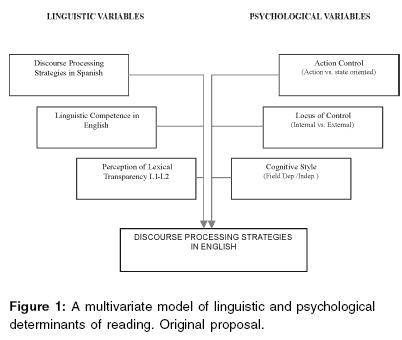
<body><![CDATA[<p><font face="Verdana, Arial, Helvetica, sans-serif" size="2">Given the current need to improve the reading skills                             of our university students, it is considered of utmost                                                        importance to achieve a deep comprehension of the                             mechanisms, processes, and variables that promote the                             acquisition of relevant discourse processing skills in a                             second or a foreign language, with particular emphasis                             on reading. Such understanding would address a major                             research priority (Pugh &amp; Ulijn, 1984) and promote the                             development of research-grounded instructional                   approaches in the field.</font></p>     <p><font face="Verdana, Arial, Helvetica, sans-serif" size="2"> Fearch and Kasper (1986) have stressed the need to                               extrapolate the research done in the field of reading in a first language (L1) to the study of reading processes in                               foreign languages (L2) with specific reference to the                               development of reading comprehension models, the                               formulation of research hypothesis, and the selection of                               relevant instructional methodologies. They contend that                               although the reader&rsquo;s linguistic competence in L2 may                               play an important role in the construction of meaning                               from text in a foreign language, it is not necessarily the                               main determinant, considering the facilitation effect                               associated with the reader&rsquo;s knowledge of the linguistic                               system of the L1 and its strategic application.                     </font></p>     <p><font face="Verdana, Arial, Helvetica, sans-serif" size="2"><B>The problem</B></font></p>     <p><font face="Verdana, Arial, Helvetica, sans-serif" size="2"> A constant found among students registered in                                   reading comprehension courses in English at the                                   Universidad Aut&oacute;noma Metroplitana in Mexico is their                                   wide variation in reading achievement, variation that can                                   not be uniquely associated with deficits in linguistic                                   competence in L2. That is, although most of our students                                   enter with a limited linguistic competence in English,                                   some of them eventually develop powerful reading                                   comprehension strategies, and achieve an efficient                                   comprehension of textual information in L2, thus                                   overcoming their original linguistic limitations. However,                                   cases of students with rigid and inefficient text processing                                   strategies are invariably detected, most of them showing                                   a lack of ability to integrate to their reading repertoires                                   strategies which demand a flexible and interactive                         processing of information.</font></p>     <p><font face="Verdana, Arial, Helvetica, sans-serif" size="2"> Hence, and although the utmost importance of                                     linguistic determinants for L2 reading comprehension is                                     acknowledged, this study is based on the assumption                                     that the construction of meaning from text in a foreign                                     language may also be determined by psychological                                     factors associated with the reader&rsquo;s perceptual, cognitive                                     and volitional orientation. In such regard, the main                                     purpose of this study is to validate a multivariate model                                     of reading comprehension in L2 integrated by two main                                     explanatory dimensions of analysis: the linguistic and the                                     psychological.                           </font></p>     <p><font face="Verdana, Arial, Helvetica, sans-serif" size="2"><B>Conceptualization of the reading process</B>                             </font></p>     <p><font face="Verdana, Arial, Helvetica, sans-serif" size="2">The theoretical approach to reading comprehension                                         that underlies this research is based on the Strategic                                         Model of Discourse Processing developed by Van Dijk                                         and Kintsch (1983). Discourse processing is                                         conceptualized as a strategic and interactive process in                                         which the reader constructs a mental representation of                                         discourse in memory using both external information (the                                         text) and internal information (cognitive presuppositions).                                         Discourse is analyzed from the word as the basic unit at                                         the lower level to whole themes as units at the higher                                         level, with a continuous interaction among different text                                         processing levels. In their words: &ldquo;The model moves                                         from the comprehension of words to the comprehension                                         of clauses in which words have different functions, and                                         from there to complex sentences, sentence sequences                                         and whole textual structures, with a continuous feedback                                         existing among less and more complex units ... instead                                         of operating with a conventional structural processing                               model we operate with a strategic model&rdquo;(p. 10).</font></p>     <p><font face="Verdana, Arial, Helvetica, sans-serif" size="2"><B> The model</B>                                 </font></p>     <p><font face="Verdana, Arial, Helvetica, sans-serif" size="2">The model evaluated in this study (figure 1) is based                                             on the tenet that the variability observed in academic                                             reading comprehension in English in Mexican university                                             students can be accounted for by the interaction of two                                             linguistic and psychological variables. The first dimension                                             of the model (linguistic) is threefold and analyses the                                             impact of (1) the reader&rsquo;s strategies in his/her first                                             language (Spanish), (2) his/her level of linguistic                                             competence in the foreign language (English), and (3)                                             his/her ability to perceive lexical transparency between                                             both languages (cognate perception). On the other hand,                                             the psychological dimension, which is also threefold,                                             evaluates the influence of the reader&rsquo;s cognitive style,                                             locus of control and action control orientation on her/his                                             construction of meaning from text.                                   </font></p>     <p>&nbsp;</p>     ]]></body>
<body><![CDATA[<p align="center"><img src="/img/revistas/pee/v7n1/n1a03f1.jpg"></p>     <p>&nbsp;</p>     <p><font face="Verdana, Arial, Helvetica, sans-serif" size="2"> Following, a summarized revision of the variables       incorporated in the proposed model is presented in order to       provide a theoretical and research background to the reader. </font></p>     <p><font face="Verdana, Arial, Helvetica, sans-serif" size="2"><B>Reading comprehension in Spanish.</B> </font> <font face="Verdana, Arial, Helvetica, sans-serif" size="2">The first           variable proposed in the explanation of the reading           performance of university students in English is their           ability to strategically process textual information in their           first language. Its integration into the model was based           on theoretical considerations about the preeminent role           of the first language in the acquisition of a foreign           language. In such regard, Beaugrande (1984)           underscored the decisive influence of the learner&rsquo;s                                                       knowledge of L1 in learning a foreign language, and                                                       proposed that the mother tongue plays the role of a metamodel                                                       of language (of a set of expectancies regarding                                                       the way in which any particular language is organized),                                                       which according to him, would eventually adjust to                                                       accommodate the divergence among the L1 and the L2.   </font></p>     <p><font face="Verdana, Arial, Helvetica, sans-serif" size="2"><B>Linguistic Competence in English.</B> The importance                                                         of linguistic competence in L2 for reading comprehension                                                         has been vastly acknowledged, although perhaps                                                         underestimated in current L2 teaching methodologies.                                                         Specifically, Beck and Carpenter (1986) propose the                                                         existence of a &ldquo;threshold level&rdquo; of linguistic competence                                                         for reading, which may fluctuate according to specific                                                         task demands but, below which, a reader cannot construct                                                         meaning from text. Williams and Moran (1989), on the                                                         other hand, make reference to a &ldquo;linguistic ceiling&rdquo; for                                                         reading which, if extremely low, &ldquo;would limit the ability of                                               the reader to interact with the text&rdquo; (p. 221).</font></p>     <p><font face="Verdana, Arial, Helvetica, sans-serif" size="2"><B> Perception of Lexical Transparency between L1                                                           and L2.</B> According to a conceptualization of reading as                                                           a strategic process, it was considered that the ability to                                                           perceive and exploit cognate relationships between L1                                                           and L2 would become a most powerful strategy in                                                           reading, helping the reader to overcome limitations in                                                           his/her lexical repertoire. Such contention has also been                                                           endorsed by Beaugrande (1984) in the following terms: &ldquo;If we presuppose the existence of a general memory                                                           store for both languages (the native and the foreign), all                                                           tactics that lead from elements in the mother tongue to                                                           their equivalents in the foreign language help to enhance                                                           both the efficiency and the search in memory improving                                                           familiarity ... the similarity supports learning enabling the                                                           transference of elements, assumptions, and processes                                                           already familiar&rdquo; (p.10).                                                 </font></p>     <p><font face="Verdana, Arial, Helvetica, sans-serif" size="2"><B>Cognitive Style.</B> Cognitive style is defined as the                                                             typical way to solve problems, think and perceive of a                                                             given subject. Research literature in the field makes                                                             reference to several categorizations of the construct                                                             including field dependence-independence, conceptual                                                             tempo, and attentional style, among others. This study                                                             centers in the analysis of the first of these categories                                                             given its relevance to the study of reading as a complex                                                             problem-solving skill as well as the vast amount of experimental                                                             research relating cognitive style and reading                                                             comprehension. According to Witkin (in Pitts &amp;   Thompson, 1984), the field independent (FI) person has   a greater ability to discover outstanding features in a   complex field as well as to react to ambiguous stimuli in   an analytical way, while the field dependent (FD) person   visualizes patterns more globally. Field independence has   also been associated with a greater articulation and   competence in cognitive analysis and restructuring, while   field dependence has been related to a more global   approach and to a greater interpersonal competence.   Research on the relationship between reading   comprehension and cognitive style has shown that FI   readers are more capable of making inferences than   their dependent counterparts when confronted with tasks   that demand an inferential interpretation from prose; that   FD subjects tend to constrain their reasoning to real   events, whereas FI individuals consider multiple   alternatives (Linn, 1978); and that FD readers strongly   rely on information in the text, not exploiting their   previous knowledge as efficiently as FI independent   subjects (Spiro &amp; Tirre, 1980).</font></p>     <p><font face="Verdana, Arial, Helvetica, sans-serif" size="2"><B> Locus of Control. Locus of control</B> is defined as a                                                               set of generalized expectancies that reflect consistent                                                               individual differences among subjects regarding the                                                               extent to which they perceive a contingency between                                                               their behavior and subsequent events. According to                                                               Strickland (1989), subjects with an internal locus of                                                               control perceive a contingency between their own                                                               behavior and subsequent events, whereas individuals with                                                               an external orientation have more probability of perceiving                                                               those events as resulting from fate, chance or                                                               circumstances beyond their personal control. Research                                                               literature in the field includes studies analyzing the                                                               relationship between locus of control and intentional and                                                               incidental memorization (Beaule &amp; Mckelvie, 1986), and                                                               locus of control and academic achievement                                                               (Mwamwenda &amp; Mwamwenda, 1986). Findley and                                                               Cooper (1988) report a literature review of 98 research                                                               studies analyzing the relationship between locus of                                                               control and academic achievement. According with their                                                               results, internal control beliefs showed to be consistently                                                               and significantly correlated with higher academic                                                     achievement. </font></p>     <p><font face="Verdana, Arial, Helvetica, sans-serif" size="2"><B>Action Control.</B> The construct of action control,                                                                 advanced by Kuhl (1987), refers to a meta-cognitive                                                                 process that mediates the execution of an action related                                                                 to an intention of an individual. The process organizes                                                                 and controls cognitive operations, such as selective                                                                 attention and the amount and quality of information                                                                 processed in a way that maximizes the congruence                                                                 between intention and performance. The extent of action                                                                 control evoked in a particular situation varies along the                                                                 two ends of a continuum between action and state                                                                 orientation. State-oriented cognitions do not evoke any                                                                 tendency to action but can actively inhibit the expression                                 of action tendencies as a result of a partial incompatibility                                                               between action and state orientation. That is, according                                                                 to Kuhl (1987), in a complex problem-solving situation,                                                                 as the amount of state-oriented cognitions increases,                                                                 the likelihood that the individual performs an expected                                                                 action tends to decrease. It is assumed that an action                                                                 that demands complex preparatory planning cannot be                                                                 carried out when the organism is state-oriented since                                                                 part of the attentional capacity required is employed in                               state-oriented processes. Research studies focused on                                                                 the analysis of the relationship between action control                                                                 and reading comprehension are not reported in the                                                                 literature. Nevertheless, based on a conceptualization                                                       of the reading process in L2 as a complex problemsolving                                                                 endeavor, and on the results of preliminary                                                                 exploratory studies conducted with Mexican university                                                                 students, it was considered that the reader&rsquo;s action                                                                 control orientation may also contribute to explain the                                                                 variability in L2.                                                       </font></p>     <p><font face="Verdana, Arial, Helvetica, sans-serif" size="2"><B>Research hypothesis</B>                                                                   As can be concluded from the previous revision of                                                                   literature, the individual influence on reading                                                                   comprehension of the linguistic and psychological                                                                   variables incorporated into the model has been                                                                   documented on the research literature. However, no                                                                   previous attempts to integrate the two dimensions into a                                                                   single, comprehensive model of reading have been                                                                   reported. Therefore, the purpose of this study was to                                                                   examine the explanatory power of a multivariate model                                                                   of reading centered around two dimensions of analysis:                                                                   the linguistic and the psychological. The model was                                                                   translated into the following research hypothesis                                                         </font></p>     ]]></body>
<body><![CDATA[<p><font face="Verdana, Arial, Helvetica, sans-serif" size="2">Reading comprehension in English in Mexican                                                                     university students, native speakers of Spanish, is a                                                                     function of their level of reading comprehension in                                      Spanish (reading strategies in L1); of their level of                                                                   linguistic competence in the foreign language; of their                                                                     ability to perceive lexical transparency between both                                                                     the first and the foreign language; of their cognitive style                                                                     (field dependence vs. field independence); of their locus                                                                     of control (internal vs. external); and of the type of action                                                           control orientation.</font></p>     <p>&nbsp;</p>     <p><font face="Verdana, Arial, Helvetica, sans-serif" size="3"><B> METHOD</B></font></p>     <p><font face="Verdana, Arial, Helvetica, sans-serif" size="2"><B> Participants.</B> Two hundred and eighty voluntary                                                                       undergraduate college students from two Mexican public                                                                       universities participated in the study, 118 males and 162                                     females. As to the institution of reference, 105 were                                                                       from the Universidad Nacional Aut&oacute;noma de M&eacute;xico                                                                       (UNAM) and 175 from the Universidad Aut&oacute;noma                                                                       Metropolitana (UAM).                                                             </font></p>     <p><font face="Verdana, Arial, Helvetica, sans-serif" size="2"><B>Instruments.</B> The evaluation of the sample was                                                                         based on the administration of a battery of tests                                                                         integrated by the following instruments: (1) Test of                                                                         Discourse Processing in English as a Foreign Language                                                                         (Vivaldo, 1994); (2) Test of Discourse Processing in                                                                         Spanish as a First Language (Vivaldo, 1994); (3) Nelson                                                                         English Language Test-Level 150 (Fowler &amp; Coe,                                                                         1976); (4) Test of Perception of Lexical Transparency                                                                         between English and Spanish (Vivaldo, 1992); (5) The                                                                         Embedded Figures Test (Witkin, Oltman, Raskin &amp; Karp,                                                                         1971); (6) Internality-Externality Scale (Romero-Garc&iacute;a &amp; P&eacute;rez, 1983); and (7) Action Control Scale (Kuhl,                                                                         1990). Following a brief description of each instrument                                                                         is presented.                                                               </font></p>     <p><font face="Verdana, Arial, Helvetica, sans-serif" size="2"><i>Tests of Discourse Processing Strategies in                                                                           English and Spanish</i>. Two equivalent tests for the                                                                           evaluation of reading comprehension in English and                                                                           Spanish were developed specifically for the study. The                                                                           theoretical and methodological approach to the                                                                           evaluation of reading comprehension was based on an                                                                           extrapolation of the strategic model of discourse                                                                           processing developed by Van Dijk and Kintsch (1983).                                                                           The evaluation involved the analysis of the reader&rsquo;s                                                                           performance at the following major levels of discourse                                                                           processing: schematic, macro propositional, local                                                                 coherence and propositional.</font></p>     <p><font face="Verdana, Arial, Helvetica, sans-serif" size="2"> Given that a major methodological challenge of the                                                                             study was to assure the equivalence between the                                                                             evaluation of reading strategies in English and in Spanish,                                                                             a major consideration in the design of these instruments was to control for textual variables (text length, lexical                                                                   density, conceptual density, structure, typographical clues).</font></p>     <p><font face="Verdana, Arial, Helvetica, sans-serif" size="2"> Multiple-choice items evaluating the reader&rsquo;s                                                                               performance on each of the four main levels of strategic                                                                               discourse processing proposed by Van Dijk and Kintsch                                                                               (1983) were developed for each text. Items were                                                                               presented in Spanish in both tests in order to avoid                                                                               additional task demands associated to the understanding                                                                               of the evaluation items in the foreign language. Final                                                                               versions of the tests were revised and piloted using                                                                               teachers of English as judges. The final version for each                                                                               instruments contained 45 items classified as follows:                                                                     </font></p>     <p><font face="Verdana, Arial, Helvetica, sans-serif" size="2"><i>Sections 1 and 2</i>. <i>Macropropositional Level</i> (Items                                                                                 1-17) Included 10 multiple choice and 7 true-false items                                                                                 evaluating the ability of the reader to discriminate and                                                                                 integrate the main macro ideas in the text both at a global                                                                       and at a local level.</font></p>     <p><font face="Verdana, Arial, Helvetica, sans-serif" size="2"> <i>Section 3</i>. <i>Local Coherence Level </i>(Items 18-25).                                                                                   Included 8 multiple-choice items centered on the                 evaluation of contextual referents within the text, as well                                                                               as on the ability of the reader to follow the argumentative                                                                               network in the text.                                                                         </font></p>     ]]></body>
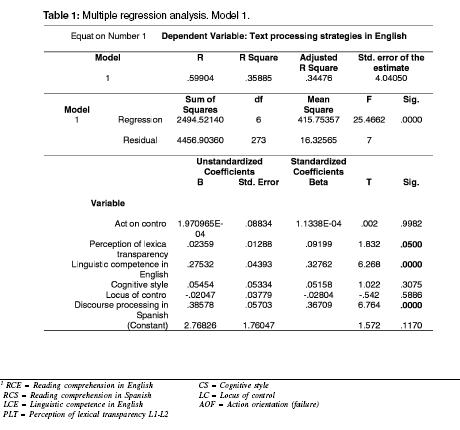
<body><![CDATA[<p><font face="Verdana, Arial, Helvetica, sans-serif" size="2"><i>Section 4</i>. <i>Propositional Level</i> (Items 26-40). This                                                                                     section was based on a &ldquo;cloze&rdquo; format and focused on                                                                                     the evaluation of the reader&rsquo;s ability to integrate syntactic,                                                                                     morphological, discursive, lexical and grammatical                                                                                     information at a propositional level.                                                                           </font></p>     <p><font face="Verdana, Arial, Helvetica, sans-serif" size="2"><i>Test of Perception of Lexical Transparency                                                                                       between L1 and L2</i>. The test measured the ability of                                                                                       the reader to perceive cognates (words sharing both                                                                                       similar form and meaning in two languages) within an                                                                                       academic text. The test was based on a short expository                                                                                       text about chemistry (&ldquo;<i>The Nobel Prizes</i>&rdquo;), published                                                                                       in <i>Scientific American</i>. The text was initially piloted                                                                                       with a group of experts who were asked to underline                                                                                       all English-Spanish cognates included in it, with exact                                                                                       registration made of their response times. From the                                                                                       previous procedure 134 words were categorized as                                                                                       cognates (those words selected as such by all the                                                                                       experts). On the other hand, and according to the mean                                                                                       response time between experts, a response time of 5                                                                                       min. was established for the administration of the test                                                                                       (the idea being to obtain an indicator of the reader&rsquo;s                                                                                       first impression during a first read of the article and                                                                                       not of a word-by word analytical process not natural                                                                                       during normal reading). The grading for the test ranges                                                                                       between 0 (minimum possible value) and 134                                                                                       (maximum possible value).                                                                             </font></p>     <p><font face="Verdana, Arial, Helvetica, sans-serif" size="2"><i>Action Control Scale</i>. The Action Control Scale                                                                                         (Kuhl, 1991) is a 36-item instrument divided into three                                                                                         subscales (action control during performance, failure and                                                                                         decision taking). Each subscale is integrated by 12 items                                                                                         describing particular problem situations. For each                                                                                         situation the subject is given an alternative between two                                                                                         possible response alternatives, either A or B (one oriented                                                                                         towards action and the other towards an emotional state).                                                                                         The grading of the subjects&rsquo; responses for each subscale                                                                                         is based o the count of the total of action-oriented                                                                                         responses (between 0 and 12). In order to provide for                                                                                         effects associated with item presentation, items are                                                                                         distributed at random as well as options A and B. In the                                                                                         case of this study, only the subject&rsquo;s scores for the AOF                                                                               scale were taken into consideration.</font></p>     <p><font face="Verdana, Arial, Helvetica, sans-serif" size="2"> <i>Levenson Internality-Externality Scale</i>. (Romero-                                                                                           Garc&iacute;a &amp; P&eacute;rez, 1985). This instrument is centered on                                                                                           the analysis of the subjects&acute; locus of control within an                                                                                           internal-external dimension. It includes 24 Likert-type                                                                                           items ranging between 0 (totally disagree) and 6 (totally                                                                                           agree). The total internality score for the subject (IT) is                                                                                           obtained adding separately the scores for each one of                                                                                 the three subscales of the instrument.</font></p>     <p><font face="Verdana, Arial, Helvetica, sans-serif" size="2"><B> Procedure.</B> Administration of instruments was                                                                                             carried out on a group basis and involved three twohour                                                                                             sessions per group. A total of 27 group sessions                                                                                             were held (9 groups analyzed). The administration of                                                                                             reading comprehension tests was carried out on the basis                                                                                             of a counterbalance procedure regarding the following                                                                                             criteria: (1) order of language evaluation (L1 or L2);                                                                                             and (2) version of exam administered (Text A or Text B                                                                                             in each language). Statistical analyses included a series                                                                                             of descriptive, correlational, and multiple regression                                                                                             analyses, an were conducted using the Statistical     Package for Social Sciences (SPSS).                                                                                   </font></p>     <p>&nbsp;</p>     <p><font face="Verdana, Arial, Helvetica, sans-serif" size="3"><B>RESULTS</B></font></p>     <p><font face="Verdana, Arial, Helvetica, sans-serif" size="2"> The final sample for the study included 280                                                                                                 undergraduate college students, 118 males (42.1%) and 162                                                                                                   females (57.9%). The mean age for the sample 23.06 years.                                                                                                   105 of the participants were from the UNAM whereas                                                                                                   175 of them were students at UAM. As to their field of                                                                                                   studies, 208 (74.3%) were from the Division of Social                                                                                                   Sciences and Humanities; 38 (13.6%) from the Division of                                                                                                   Basic Sciences and Engineering; and 34 (12.0% from the                                                                                         Division of Biological and Health Sciences. </font></p>     <p><font face="Verdana, Arial, Helvetica, sans-serif" size="2">The descriptive analysis of the main variables under                                                                                                     study yielded the following results: (1) Reading                                                                                                     comprehension in English: mean score of 19.32,                                                                                                     equivalent to 52/100, with an standard deviation of 4.99;                                                                                                     (2) Reading comprehension in Spanish: mean score of                                                                                                     25.62 (equivalent to 69/100) with a standard deviation                                                                                                     of 4.75; (3) Linguistic competence in English: mean                                                                                                   score of 15.85 (equivalent to 31/100) with a standard                                                                                                 deviation of 5.87; (4) Perception of lexical transparency                                                                                                   between English and Spanish: mean score of 93.8                                                                                                   (equivalent to 69% of correctly identified cognates                                                                                                   within the corresponding test) with a standard deviation                                                                                                     of 19.46; (5) Cognitive style: mean score of 9.55 (slightly                                                                                                     above de median of possible scores for such test) with                                                                                                     a standard deviation of 4.72; (6) Locus of control: mean                                                                                                     score of 20.24 (slightly above the median of possible                                                                                                     scores for the corresponding test 20) with a standard                                                                                                     deviation of 6.84, (7) Action Orientation (AOF                                                                                                     subscale): mean score of 6.57 (slightly above the                                                                                                     median of possible scores for the corresponding                                                                                                     subscale of Kuhl&rsquo;s scale=6.0) with a standard deviation                                                                                           of 6.57.</font></p>     <p><font face="Verdana, Arial, Helvetica, sans-serif" size="2"><B> Multiple regression analysis.</B> The regression                                                                                                       model originally proposed to explain the variability of                                                                                                       reading comprehension in English (RCE) -Model 1-                                                                                                       estimated from the scores of the 280 subjects included                                                                                                       in the sample under study, yielded the following results                                                                                                       (Table 1): An F=25.46627 for the associated analysis of                                                                                                       variance, indicating a significant regression of model 1                                                                                                       (p&lt;0.01), a multiple correlation coefficient of 0.59904                                                                                                       (Multiple R), and a determination coefficient of 0.35885                                                                                                       (R. Square), indicating that the independent variables                                                                                                       explained 35.88% of the variability in discourse processing                                                                                             in English under Model 1.</font></p>     ]]></body>
<body><![CDATA[<p><font face="Verdana, Arial, Helvetica, sans-serif" size="2"><B> RCE = b<SUB>0</SUB> + b<SUB>1</SUB>RCS + <SUB>b2</SUB> LCE + b<SUB>3</SUB>PLT + b<SUB>4</SUB>CS +                                                                                               b<SUB>5</SUB>LC + b<SUB>6</SUB>AOF + e...........(Model 1)<SUP>1</SUP></B> </font></p>     <p>&nbsp;</p>     <p align="center"><img src="/img/revistas/pee/v7n1/n1a03t1.jpg"></p>     <p>&nbsp;</p>     <p><font face="Verdana, Arial, Helvetica, sans-serif" size="2">However, under Model 1 only three variables showed                                                                                                           to be significant, namely, reading comprehension in                                                                                                           Spanish, linguistic competence in English and perception                                                                                                           of lexical transparency between L1 and L2 (p &lt; 0.0000;                                                                                                           0.0000; and 0.05, respectively). Therefore, alternative                                                                                                           models were examined, withdrawing each of the nonsignificant                                                                                                           variables. Models with 5, 4 and 3 independent                                                                                                           variables were tested. The model with three independent                                                                                                           variables (RCS, LCE, and PLT) was the only one in                                                                                                           which all explanatory variables were significant (Table                                                                                                           2 - &ldquo;Sig T column&rdquo;).                                                                                                 </font></p>     <p><font face="Verdana, Arial, Helvetica, sans-serif" size="2"><B>RCE = b<SUB>0</SUB> + b<SUB>1</SUB>RCS +<SUB>b2</SUB>  LCE + b<SUB>3</SUB>PLT+                                                                                                             e...............................(Model 2)</B> </font></p>     <p>&nbsp;</p>     <p align="center"><img src="/img/revistas/pee/v7n1/n1a03t2.jpg"></p>     <p>&nbsp;</p>     <p><font face="Verdana, Arial, Helvetica, sans-serif" size="2">The regression analysis for Model 2 (Table 2) yielded   a multiple correlation coefficient of 0.59652, a   determination coefficient of 0.35584 (that is, RCS, LCE,   and PLT explained 35.584% of RCE&rsquo;s variability under   model 2, roughly equivalent to the percentage obtained   under model 1), and an F value of 50.82 indicating the   existence of a significant regression for model 2 (p&lt;.01).   Column &ldquo;B&rdquo; in Table 2 presents the estimators for the   b0, b1, b2 and b3 parameters, from which the following fit   model was derived (Prediction Model):</font></p>     ]]></body>
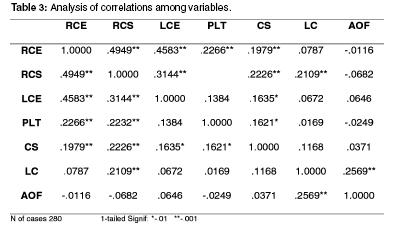
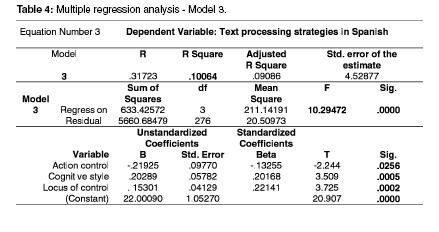
<body><![CDATA[<p><font face="Verdana, Arial, Helvetica, sans-serif" size="2"><B> RCE = 2.5829 + .38847 RCS + .27944 LCI +     .0253 PLT............Prediction Mode</B></font><font face="Verdana, Arial, Helvetica, sans-serif" size="2">l</font></p>     <p><font face="Verdana, Arial, Helvetica, sans-serif" size="2">Nevertheless, and given the fact that the exclusion   of the psychological variables from the original model   contradicted to a certain extent research findings in the field suggesting their theoretical relevance, it was hypothesized that they could have not a direct but an indirect influence on he discourse processing skills in English. That is, it could be the case that the psychological variables did not explain RCE in the presence of RCS, LCI and PLT due to the fact that they could be involved in the explanation of the variability of any of those variables. Hence, and as a first step in such direction, it was decided to analyze the influence of the reader&rsquo;s cognitive style, locus of control and action control on his/her text processing skills in Spanish, based on the following considerations: (1) The knowledge of the first language is considered to be play the role of a metamodel in the acquisition of a foreign language (Beaugrande, 1984); (2) The analysis of correlations among variables showed that the correlations between text processing skills in Spanish and the psychological variables (Table 3) was stronger than that between the latter variables and linguistic competence in English or perception of lexical transparency between L1 and L2. Hence, it was hypothesized that the psychological set of variables could exert a preliminary influence on reading comprehension in the first language which, in turn, could become a major determinant of reading comprehension in the foreign language. Accordingly, the following model was tested:</font></p>     <p><font face="Verdana, Arial, Helvetica, sans-serif" size="2"><b>RCS = b<sub>0</sub> + b<sub>1</sub> CS + b<sub>2</sub>LC + b<sub>3</sub>AOF + e...................................(Model 3)</b></font></p>     <p>&nbsp;</p>     <p align="center"><img src="/img/revistas/pee/v7n1/n1a03t3.jpg"></p>     <p>&nbsp;</p>     <p><font face="Verdana, Arial, Helvetica, sans-serif" size="2">  The results in Table 4 show a significant regression   for Model 3 (F=10.29472, p&lt;0.0001) with all three independent variables (cognitive style, locus of control                                                                                                                               and action control) significant (p&lt;0.0256; p&lt;0.0005 and                                                                                                                               p&lt;0.0002, respectively).                                                                                                                     </font></p>     <p><font face="Verdana, Arial, Helvetica, sans-serif" size="2">Furthermore, the three psychological variables                                                                                                                                 explained 10.1% of the variability of reading                                                                                                                                 comprehension in Spanish as indicated by the associated                                                                                                                                                                                                                                                                  determination coefficient (R Square), with a multiple                                                                                                                                 correlation coefficient of .31723 (Multiple R). The                                                                                                                                 estimators for the model&rsquo;s coefficients generated the                                                                                                                                 following prediction model:                                                                                                                       </font></p>     <p><font face="Verdana, Arial, Helvetica, sans-serif" size="2"><b>RCS = 22.0089 + .20289 EC + .15381 LC -                                                                                                                         .21925 AOF............Prediction Model</b> </font></p>     <p align="center"><img src="/img/revistas/pee/v7n1/n1a03t4.jpg"></p>     ]]></body>
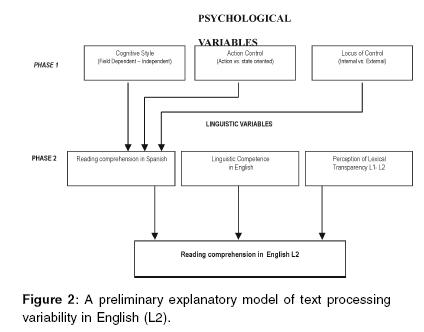
<body><![CDATA[<p>&nbsp;</p>     <p><font face="Verdana, Arial, Helvetica, sans-serif" size="2">Notice that the weights for cognitive style (CS) and                                                                                                                                     locus of control (LC) were positive as well as the                                                                                                                                     correlation coefficients between reading comprehension                                                                                                                                     in Spanish (RCS) and both, cognitive style and locus of                                                                                                                                     control (Table 5). Hence, it is suggested that these two                                                                                                                                     psychological variables are directly proportional to                                                                                                                                     reading comprehension in Spanish. On the other hand,                                                                                                                                     both the coefficient of action control in the predictive                                                                                                                                     model as well as its correlation with reading                                                                                                                                     comprehension in Spanish were negative, indicating that                                                                           such variable is inversely proportional to RCS.                                                                                                                           </font></p>     <p><font face="Verdana, Arial, Helvetica, sans-serif" size="2">In short, in can be concluded that the last three                                                                                                                                       variables in Model 1 (cognitive style, locus of control                                                                                                                                       and action control) are not significant because what we actually have is a rather indirect effect of those variables                                                                                                                                   a two-phase model which is explained as follows:                                                                                                                             </font></p>     <p><font face="Verdana, Arial, Helvetica, sans-serif" size="2"><b>PHASE 1</b>                                                                                                                               </font></p>     <p><font face="Verdana, Arial, Helvetica, sans-serif" size="2">Reading comprehension in Spanish is a function of                                                                                                                                           the reader&rsquo;s cognitive style, locus of control, and action                                                                                                                                 control orientation. Model 3</font></p>     <p><font face="Verdana, Arial, Helvetica, sans-serif" size="2"><b> PHASE 2</b>                                                                                                                                   </font></p>     <p><font face="Verdana, Arial, Helvetica, sans-serif" size="2">R</font><font face="Verdana, Arial, Helvetica, sans-serif" size="2">eading comprehension in English is a function of                                                                                                                                                 the reader&rsquo;s level of reader comprehension in Spanish,                                                                                                                                                 linguistic competence in English, and ability to perceive                                                                                                                                                 lexical transparency between L1 and L2. Model 2 </font></p>     <p>&nbsp;</p>     <p><font face="Verdana, Arial, Helvetica, sans-serif" size="3"><b>DISCUSSION AND CONCLUSIONS</b>                                                                                                                                         </font></p>     <p><font face="Verdana, Arial, Helvetica, sans-serif" size="2">The main research hypothesis of this study was that                                                                                                                                                     that the variation in reading comprehension in English in                                                                                                                                                     Mexican university students was a function of the                                                                                                                                                     interaction of both linguistic variables (text processing                                                                                                                                                     strategies in L1, linguistic competence in L2 and perception                                                                                                                                                     of lexical transparency between L1 and L2) and                                                                                                                                                     psychological variables (cognitive style, locus of control                                                                                                                                                     and action control). However, and even though the                                                                                                                                                     influence of the aforementioned variables was partially validated from the series of regression analyses performed,                                                                                                                                                     it became evident that the explanation of the variability in                                                                                                                                                     reading comprehension in L2 was not straightforward (i.e.,                                                                                                                                                     one that could be accounted for on the basis of the direct                                                                                                                                                   contribution of the complete set of originally proposed                                                                                                                                                   variables). Rather, such variability was partially explained                                                                                                                                                   on the basis of a two-stage process in which the influence                                                                                                                                                     of the three linguistic variables integrated into the model                                                                                                                                                     showed to be direct, whereas the influence of the three                                                                                                                                                     psychological variables was indirect (Figure 2).                                                                                                                                           Figure 2:</font></p>     ]]></body>
<body><![CDATA[<p>&nbsp;</p>     <p align="center"><img src="/img/revistas/pee/v7n1/n1a03f2.jpg"></p>     <p>&nbsp;</p>     <p>&nbsp;</p>     <p><font face="Verdana, Arial, Helvetica, sans-serif" size="2">  Specifically, and as originally hypothesized, the                                                                                                                                                             readers&rsquo; ability to process academic written discourse                                                                                                                                                             in English has shown to be a function of three major                                                                                                                                                             predictor variables, namely, reading comprehension in                                                                                                                                                             Spanish, linguistic competence in the foreign language,                                                                                                                                                             and ability to perceive lexical transparency between the                                                                                                                                                             two languages. In such regard, a model has been                                                                                                                                                             validated that accounts for an initial 35% of the variance                                                                                                                                                             of reading comprehension in English taking as predictor                                                                                                                                                             variables the three linguistic variables incorporated into                                                                                                                                                             the original model. On the other hand, and even though                                                                                                                                                             the set of psychological variables did not show a direct,                                                                                                                                                             significant contribution in the explanation of reading                                                                                                                                                             comprehension in English, an alternative multiple   regression analysis, which considered the readers&rsquo; text                                                                                                                                                             processing strategies in L1 as the dependent variable,                                                                                                                                                             revealed that the reader&rsquo;s cognitive style, locus of control                                                                                                                                                             and action control orientation have a slight, though                                                                                                                                                             significant contribution, in the explanation of the variability                                                                                                                                                             of text processing strategies in L1. Hence, given the                                                                                                                                                             fact that reading comprehension in Spanish constitute in                                                                                                                                                             our model the most important predictor of the variability                                                                                                                                                             associated with discourse processing in English, and that                                                                                                                                                             the former is in itself partially explained by the complete                                                                                                                                                             set of psychological variables, a two-stage explanatory                                                                                                                                                             model of reading in LLL2 is suggested from this study                                                                                                                                                             based on the following considerations.                                                                                                                                                   </font></p>     <p><font face="Verdana, Arial, Helvetica, sans-serif" size="2">First, it has been found that the ability of the reader                                                                                                                                                               to process written academic discourse in L1 is the most powerful predictor of his/her reading comprehension in                                                                                                                                                               the foreign language, maybe in the form of the metamodel                                                                                                                                                               of language proposed by Beaugrande (1984)                                                                                                                                                               paving the way for the extrapolation of reading strategies                                                                                                                                                             from L1 to L2. Second, text processing skills in English                                                                                                                                                           have also been explained by the reader&rsquo;s level of                                                                                                                                                               linguistic competence in the foreign language,                                                                                                                                                               competence that would represent the linguistic                                                                                                                                                               knowledge base of the reader and that would play a                                                                                                                                                               major role in the successful construction of meaning from                                                                                                                                                               text. Third, the ability to perceive and exploit lexical                                                                                                                                                               transparency between L1 and L2 has also been found                                                                                                                                                               to constitute a determinant of text processing ability in                                                                                                                                                               the foreign language.                                                                                                                                                     </font></p>     <p><font face="Verdana, Arial, Helvetica, sans-serif" size="2">Furthermore, it has been found that cognitive style,                                                                                                                                                                 locus of control, and action control orientation function as                                                                                                                                                                 indirect psychological mediators of reading comprehension                                                                                                                                                                 in English, exerting an indirect impact on such variable   via their influence on the reader&rsquo;s discourse processing ability in the first language, the first major predictor of L2                                                                                                                                                                 reading in our study. In such regard, it may be the case                                                                                                                                                                 that the influence of psychological variables can be more                                                                                                                                                                 strongly differentiated in the explanation of reading                                                                                                                                                                 comprehension in L1 due to the fact that the reader would                                                                                                                                                                 have already developed and internalized a sound spectrum                                                                                                                                                                 of lexical, semantic, syntactic and grammatical decoding                                                                                                                                                                 skills, thus making it more feasible to discriminate the                                                                                                                                                                 differential impact of psychological variables, in                                                                                                                                                                 themselves more distal to the central process under study.                                                                                                                                                                 On the other hand, the impact of linguistic variables in the                                                                                                                                                                 explanation of text processing variability in L2 would be                                                                                                                                                                 expected to be more preeminent, since the readers&rsquo; lexical,                                                                                                                                                                 syntactic and grammatical repertories would tend to be                                                                                                                                                                 more limited as a result of the limited level of linguistic                                                                                                                                                                 competence in the foreign language. Hence, upon                                                                                                                                                                 constructing meaning from text the specialized processes                                                                                                                                                                 associated with the linguistic dimension of analysis would                                                                                                                                                                 constitute the strongest determinants in the construction                                                                                                                                                                 of meaning from text.                                                                                                                                                       </font></p>     <p><font face="Verdana, Arial, Helvetica, sans-serif" size="2">To conclude, the model validated from this study                                                                                                                                                                   provides a preliminary, non-exhaustive explanation                                                                                                                                                                   of an otherwise extremely complex phenomenon: the                                                                                                                                                                   development of academic written discourse                                                                                                                                                                   processing skills in a foreign language. In such                                                                                                                                                                   regard, further research is needed in order to                                                                                                                                                           broaden our explanatory framework, integrating the                                                                                                                                                         analysis of the contribution of additional predictive                                                                                                                                                                   variables not considered in this investigation which                                                                                                                                                                   may include vocabulary knowledge in L2 (Nation,                                                                                                                                                               1983), lexical access (Baddeley, Loggie, Nimmo-                                                                                                                                                               Smith &amp; Brereton, 1985), previous knowledge                                                                                                                                                                   (Afferbach, 1990); and socially-related factors                                                                                                                                                         (Parry, 1993; Street, 1993; Au, 1998) </font></p>     <p>&nbsp;</p>     <p><font face="Verdana, Arial, Helvetica, sans-serif" size="3"><b>REFERENCES</b>                                                                                                                                                             </font></p>     ]]></body>
<body><![CDATA[<p><font face="Verdana, Arial, Helvetica, sans-serif" size="2">Afferbach, P. P. (1990). The influence of prior knowledge on                                                                                                                                                                         expert readers&rsquo; main idea construction strategies. <i>Reading                                                                                                                                                                         Research Quarterly</i>, 25 (1), 31-41.                                                                                                                                                               </font></p>     <!-- ref --><p><font face="Verdana, Arial, Helvetica, sans-serif" size="2">Au, K. H. (1998). Social constructivism and the school literacy                                                                                                                                                                           learning of students of diverse backgrounds. <i>Journal of                                                                                                                                                                 Literacy Research</i>, 30 (2), 297-319.</font>&nbsp;&nbsp;&nbsp;&nbsp;&nbsp;&nbsp;&nbsp;&nbsp;[&#160;<a href="javascript:void(0);" onclick="javascript: window.open('/scielo.php?script=sci_nlinks&ref=1869172&pid=S1413-8557200300010000300002&lng=','','width=640,height=500,resizable=yes,scrollbars=1,menubar=yes,');">Links</a>&#160;]<!-- end-ref --><!-- ref --><p><font face="Verdana, Arial, Helvetica, sans-serif" size="2"> Baddeley, A., Logie, R., Nimmo-Smith, I., &amp; Brereton, N. (1985).                                                                                                                                                                             Components of fluent reading. <i>Journal of Memory and                                                                                                                                                                             Language</i>, 24, 119-131.                                                                                                                                                                   </font>&nbsp;&nbsp;&nbsp;&nbsp;&nbsp;&nbsp;&nbsp;&nbsp;[&#160;<a href="javascript:void(0);" onclick="javascript: window.open('/scielo.php?script=sci_nlinks&ref=1869173&pid=S1413-8557200300010000300003&lng=','','width=640,height=500,resizable=yes,scrollbars=1,menubar=yes,');">Links</a>&#160;]<!-- end-ref --><!-- ref --><p><font face="Verdana, Arial, Helvetica, sans-serif" size="2">Beaugrande, R. (1984) Reading skills for foreign languages: A                                                                                                                                                                               processing approach. In A. K. Pugh &amp; J. M. Ulijn, J. M.                                                                                                                                                                               (1984). <i>Reading for professional purposes</i>: Studies and                                                                                                                                                                               practices in native and foreign languages. Heinemann:                                                                                                                                                                               London.                                                                                                                                                                     </font>&nbsp;&nbsp;&nbsp;&nbsp;&nbsp;&nbsp;&nbsp;&nbsp;[&#160;<a href="javascript:void(0);" onclick="javascript: window.open('/scielo.php?script=sci_nlinks&ref=1869174&pid=S1413-8557200300010000300004&lng=','','width=640,height=500,resizable=yes,scrollbars=1,menubar=yes,');">Links</a>&#160;]<!-- end-ref --><!-- ref --><p><font face="Verdana, Arial, Helvetica, sans-serif" size="2">Beaule, B., &amp; Mckelvie, S.J. (1986). Effects of locus of control                                                                                                                                                                                 and relevance on intentional and incidental memory for                                                                                                                                                                                 passages. <i>Perceptual and Motor Skills</i>, 63, 855-862.                                                                                                                                                                       </font>&nbsp;&nbsp;&nbsp;&nbsp;&nbsp;&nbsp;&nbsp;&nbsp;[&#160;<a href="javascript:void(0);" onclick="javascript: window.open('/scielo.php?script=sci_nlinks&ref=1869175&pid=S1413-8557200300010000300005&lng=','','width=640,height=500,resizable=yes,scrollbars=1,menubar=yes,');">Links</a>&#160;]<!-- end-ref --><!-- ref --><p><font face="Verdana, Arial, Helvetica, sans-serif" size="2">Beck, I. L., &amp; Carpenter, P. E. (1986). Cognitive approaches to                                                                                                                                                                                   understanding reading. <i>American Psychologist</i>,                                                                                                                                                                         (October), 1098-1105.</font>&nbsp;&nbsp;&nbsp;&nbsp;&nbsp;&nbsp;&nbsp;&nbsp;[&#160;<a href="javascript:void(0);" onclick="javascript: window.open('/scielo.php?script=sci_nlinks&ref=1869176&pid=S1413-8557200300010000300006&lng=','','width=640,height=500,resizable=yes,scrollbars=1,menubar=yes,');">Links</a>&#160;]<!-- end-ref --><!-- ref --><p><font face="Verdana, Arial, Helvetica, sans-serif" size="2"> Fearch, C., &amp; Kasper, G (1986). The role of comprehension in                                                                                                                                                                                     second language learning. <i>Applied Linguistics</i>, 7 (3), 257-                                                                                                                                                                                     274.                                                                                                                                                                           </font>&nbsp;&nbsp;&nbsp;&nbsp;&nbsp;&nbsp;&nbsp;&nbsp;[&#160;<a href="javascript:void(0);" onclick="javascript: window.open('/scielo.php?script=sci_nlinks&ref=1869177&pid=S1413-8557200300010000300007&lng=','','width=640,height=500,resizable=yes,scrollbars=1,menubar=yes,');">Links</a>&#160;]<!-- end-ref --><!-- ref --><p><font face="Verdana, Arial, Helvetica, sans-serif" size="2">Findley, M. J., &amp; Cooper, H.M. (1983). Locus of control and                                                                                                                                                                                       academic achievement: A literature review. <i>Journal of                                                                                                                                                                             Personality and Social Psychology</i>, 44 (2), 419-427.</font>&nbsp;&nbsp;&nbsp;&nbsp;&nbsp;&nbsp;&nbsp;&nbsp;[&#160;<a href="javascript:void(0);" onclick="javascript: window.open('/scielo.php?script=sci_nlinks&ref=1869178&pid=S1413-8557200300010000300008&lng=','','width=640,height=500,resizable=yes,scrollbars=1,menubar=yes,');">Links</a>&#160;]<!-- end-ref --><!-- ref --><p><font face="Verdana, Arial, Helvetica, sans-serif" size="2"> Fowler, W. S., &amp; Coe, N. (1976). <i>Nelson English Language                                                                                                                                                                               Tests</i>. Hong Kong: Thomas Nelson &amp; Sons.</font>&nbsp;&nbsp;&nbsp;&nbsp;&nbsp;&nbsp;&nbsp;&nbsp;[&#160;<a href="javascript:void(0);" onclick="javascript: window.open('/scielo.php?script=sci_nlinks&ref=1869179&pid=S1413-8557200300010000300009&lng=','','width=640,height=500,resizable=yes,scrollbars=1,menubar=yes,');">Links</a>&#160;]<!-- end-ref --><!-- ref --><p><font face="Verdana, Arial, Helvetica, sans-serif" size="2"> Kuhl, J. (1987). Feeling vs. being helpless: Metacognitive                                                                                                                                                                                           mediation of failure-induced performance deficits. In F.                                                                                                                                                                                           E. Weinhart &amp; R. H. Klowe (Eds.). <i>Metacognition,                                                                                                                                                                                           motivation and understanding</i>. New Jersey: Lawrence                                                                                                                                                                                 Erlbaum Associates, Publishers.</font>&nbsp;&nbsp;&nbsp;&nbsp;&nbsp;&nbsp;&nbsp;&nbsp;[&#160;<a href="javascript:void(0);" onclick="javascript: window.open('/scielo.php?script=sci_nlinks&ref=1869180&pid=S1413-8557200300010000300010&lng=','','width=640,height=500,resizable=yes,scrollbars=1,menubar=yes,');">Links</a>&#160;]<!-- end-ref --><!-- ref --><p><font face="Verdana, Arial, Helvetica, sans-serif" size="2"> Kuhl, J. (1991). Action versus state orientation. Psychometric                                                                                                                                                                                             properties of the Action Control Scale (ACS 90). In J. Kuhl &amp; J. Beckmann. (Eds.) <i>Volition and Personality</i>: Action                                                                                                                                                                                   versus State Orientation (pp.). Toronto: G&ouml;ttingen Hogrefe.</font>&nbsp;&nbsp;&nbsp;&nbsp;&nbsp;&nbsp;&nbsp;&nbsp;[&#160;<a href="javascript:void(0);" onclick="javascript: window.open('/scielo.php?script=sci_nlinks&ref=1869181&pid=S1413-8557200300010000300011&lng=','','width=640,height=500,resizable=yes,scrollbars=1,menubar=yes,');">Links</a>&#160;]<!-- end-ref --><!-- ref --><p><font face="Verdana, Arial, Helvetica, sans-serif" size="2"> Linn, M. C. (1978). Influence of cognitive style and training                                                                                                                                                                                               on tasks requiring the separation of variables schema.                                                                                                                                                                                               <i>Child Development</i>, 49, 874-877.                                                                                                                                                                                     </font>&nbsp;&nbsp;&nbsp;&nbsp;&nbsp;&nbsp;&nbsp;&nbsp;[&#160;<a href="javascript:void(0);" onclick="javascript: window.open('/scielo.php?script=sci_nlinks&ref=1869182&pid=S1413-8557200300010000300012&lng=','','width=640,height=500,resizable=yes,scrollbars=1,menubar=yes,');">Links</a>&#160;]<!-- end-ref --><p><font face="Verdana, Arial, Helvetica, sans-serif" size="2">Mwamwenda, T. S., &amp; Mwamwenda, B. B. (1986). Transkenian                                                                                                                                                                                                   students&rsquo; Locus of Control and academic achievement.                                                                                                                                                                                                   <i>Psychological Reports</i>, 59, 511-516. </font></p>     <!-- ref --><p><font face="Verdana, Arial, Helvetica, sans-serif" size="2">Nation, P. (1983). Testing and teaching Vocabulary. <i>Guidelines</i>, 5(1), 12-25. </font>&nbsp;&nbsp;&nbsp;&nbsp;&nbsp;&nbsp;&nbsp;&nbsp;[&#160;<a href="javascript:void(0);" onclick="javascript: window.open('/scielo.php?script=sci_nlinks&ref=1869184&pid=S1413-8557200300010000300014&lng=','','width=640,height=500,resizable=yes,scrollbars=1,menubar=yes,');">Links</a>&#160;]<!-- end-ref --><!-- ref --><p><font face="Verdana, Arial, Helvetica, sans-serif" size="2">Parry, K. (1993). The social construction of reading strategies:                                                                                                                                                                                                       New directions for research. <i>Journal of Research in                                                                                                                                                                                                       Reading</i>. 16 (2), 148-158.     </font>&nbsp;&nbsp;&nbsp;&nbsp;&nbsp;&nbsp;&nbsp;&nbsp;[&#160;<a href="javascript:void(0);" onclick="javascript: window.open('/scielo.php?script=sci_nlinks&ref=1869185&pid=S1413-8557200300010000300015&lng=','','width=640,height=500,resizable=yes,scrollbars=1,menubar=yes,');">Links</a>&#160;]<!-- end-ref --><!-- ref --><p><font face="Verdana, Arial, Helvetica, sans-serif" size="2">Pitts, M. M., &amp; Thompson, B. (1984). Cognitive styles as                                                                                                                                                                                                         mediating variables in inferential comprehension.                                                                                                                                                                                                         <i>Reading Research Quarterly</i>, 19 (4), 426-435.       </font>&nbsp;&nbsp;&nbsp;&nbsp;&nbsp;&nbsp;&nbsp;&nbsp;[&#160;<a href="javascript:void(0);" onclick="javascript: window.open('/scielo.php?script=sci_nlinks&ref=1869186&pid=S1413-8557200300010000300016&lng=','','width=640,height=500,resizable=yes,scrollbars=1,menubar=yes,');">Links</a>&#160;]<!-- end-ref --><!-- ref --><p><font face="Verdana, Arial, Helvetica, sans-serif" size="2">Pugh, A. K., &amp; Ulijn, J. M. (1984). <i>Reading for Professional                                                                                                                                                                                                           Purposes</i>: Studies and Practices in Native and Foreign                                                                                                                                                                                                           Languages. London: Heinemann.         </font>&nbsp;&nbsp;&nbsp;&nbsp;&nbsp;&nbsp;&nbsp;&nbsp;[&#160;<a href="javascript:void(0);" onclick="javascript: window.open('/scielo.php?script=sci_nlinks&ref=1869187&pid=S1413-8557200300010000300017&lng=','','width=640,height=500,resizable=yes,scrollbars=1,menubar=yes,');">Links</a>&#160;]<!-- end-ref --><!-- ref --><p><font face="Verdana, Arial, Helvetica, sans-serif" size="2">Romero-Garc&iacute;a, O., &amp; P&eacute;rez de Maldonado, I. (1985). Escala                                                                                                                                                                                                             Levenson de locus de control: An&aacute;lisis factorial en                                                                                                                                                                                                             Venezuela. <i>Publicaci&oacute;n 51</i>. M&eacute;rida, Venezuela:           Universidad de los Andes. </font>&nbsp;&nbsp;&nbsp;&nbsp;&nbsp;&nbsp;&nbsp;&nbsp;[&#160;<a href="javascript:void(0);" onclick="javascript: window.open('/scielo.php?script=sci_nlinks&ref=1869188&pid=S1413-8557200300010000300018&lng=','','width=640,height=500,resizable=yes,scrollbars=1,menubar=yes,');">Links</a>&#160;]<!-- end-ref --><!-- ref --><p><font face="Verdana, Arial, Helvetica, sans-serif" size="2">Spiro, R. J., &amp; Tirre, W.C. (1980). Individual differences in                                                                                                                                                                                                               schema utilization during discourse processing. <i>Journal                                                                                                                                                                                                               of Educational Psychology</i>, 72, 204-208.             </font>&nbsp;&nbsp;&nbsp;&nbsp;&nbsp;&nbsp;&nbsp;&nbsp;[&#160;<a href="javascript:void(0);" onclick="javascript: window.open('/scielo.php?script=sci_nlinks&ref=1869189&pid=S1413-8557200300010000300019&lng=','','width=640,height=500,resizable=yes,scrollbars=1,menubar=yes,');">Links</a>&#160;]<!-- end-ref --><!-- ref --><p><font face="Verdana, Arial, Helvetica, sans-serif" size="2">Street, B. V. (1993). The new literacy studies, guest editorial.                                                                                                                                                                                                                 <i>Journal of Research in Reading</i>, 16 (2).               </font>&nbsp;&nbsp;&nbsp;&nbsp;&nbsp;&nbsp;&nbsp;&nbsp;[&#160;<a href="javascript:void(0);" onclick="javascript: window.open('/scielo.php?script=sci_nlinks&ref=1869190&pid=S1413-8557200300010000300020&lng=','','width=640,height=500,resizable=yes,scrollbars=1,menubar=yes,');">Links</a>&#160;]<!-- end-ref --><!-- ref --><p><font face="Verdana, Arial, Helvetica, sans-serif" size="2">Strickland, B. R. (1989). Internal-external control expectancies.                                                                                                                                                                                                                   <i>American Psychologist</i>, 44 (1), 1-12.                 </font>&nbsp;&nbsp;&nbsp;&nbsp;&nbsp;&nbsp;&nbsp;&nbsp;[&#160;<a href="javascript:void(0);" onclick="javascript: window.open('/scielo.php?script=sci_nlinks&ref=1869191&pid=S1413-8557200300010000300021&lng=','','width=640,height=500,resizable=yes,scrollbars=1,menubar=yes,');">Links</a>&#160;]<!-- end-ref --><!-- ref --><p><font face="Verdana, Arial, Helvetica, sans-serif" size="2">Van Dijk, T. A., &amp; Kintsch, W. (1983). Strategies of discourse                                                                                                                                                                                                                     comprehension. New York: Academic Press.                   </font>&nbsp;&nbsp;&nbsp;&nbsp;&nbsp;&nbsp;&nbsp;&nbsp;[&#160;<a href="javascript:void(0);" onclick="javascript: window.open('/scielo.php?script=sci_nlinks&ref=1869192&pid=S1413-8557200300010000300022&lng=','','width=640,height=500,resizable=yes,scrollbars=1,menubar=yes,');">Links</a>&#160;]<!-- end-ref --><!-- ref --><p><font face="Verdana, Arial, Helvetica, sans-serif" size="2">Vivaldo, L. J. (1992).<i> Determinantes ling&uuml;&iacute;sticos y psicol&oacute;gicos                                                                                                                                                                                                                       de la variabilidad del procesamiento del discurso                                                                                                                                                                                                                       acad&eacute;mico escrito en lengua extranjera (ingl&eacute;s) en                                                                                                                                                                                                                       estudiantes universitarios</i>. Master in Education                                                                                                                                                                                                                       Dissertation. Universidad Nacional Aut&oacute;noma de M&eacute;xico,                     M&eacute;xico.</font>&nbsp;&nbsp;&nbsp;&nbsp;&nbsp;&nbsp;&nbsp;&nbsp;[&#160;<a href="javascript:void(0);" onclick="javascript: window.open('/scielo.php?script=sci_nlinks&ref=1869193&pid=S1413-8557200300010000300023&lng=','','width=640,height=500,resizable=yes,scrollbars=1,menubar=yes,');">Links</a>&#160;]<!-- end-ref --><!-- ref --><p><font face="Verdana, Arial, Helvetica, sans-serif" size="2"> Vivaldo, L. J. (1994). Lectura y evaluaci&oacute;n: Un enfoque estrat&eacute;gico.                                                                                                                                                                                                                         <i>Im&aacute;genes Educativas</i>,1 (4), 3-13.                       </font>&nbsp;&nbsp;&nbsp;&nbsp;&nbsp;&nbsp;&nbsp;&nbsp;[&#160;<a href="javascript:void(0);" onclick="javascript: window.open('/scielo.php?script=sci_nlinks&ref=1869194&pid=S1413-8557200300010000300024&lng=','','width=640,height=500,resizable=yes,scrollbars=1,menubar=yes,');">Links</a>&#160;]<!-- end-ref --><!-- ref --><p><font face="Verdana, Arial, Helvetica, sans-serif" size="2">Williams, E., &amp; Moran, C. (1989). Reading in a foreign language                                                                                                                                                                                                                           at intermediate and advanced levels with particular                                                                                                                                                                                                                           reference to English. Language Teaching (<i>The                                                                                                                                                                                                                           International Abstracting Journal of Language Teachers                         and Applied Linguists</i>), Cambridge University Press.</font>&nbsp;&nbsp;&nbsp;&nbsp;&nbsp;&nbsp;&nbsp;&nbsp;[&#160;<a href="javascript:void(0);" onclick="javascript: window.open('/scielo.php?script=sci_nlinks&ref=1869195&pid=S1413-8557200300010000300025&lng=','','width=640,height=500,resizable=yes,scrollbars=1,menubar=yes,');">Links</a>&#160;]<!-- end-ref --><!-- ref --><p><font face="Verdana, Arial, Helvetica, sans-serif" size="2"> Witkin, H., Oltman, P., Raskin, E., &amp; Karp, S. (1971). <i>A manual                                                                                                                                                                                                                             for the Group Embedded Figures Test</i>. Palo Alto, CA:                                                                                                                                                                                                                             Consulting Psychologist. </font>&nbsp;&nbsp;&nbsp;&nbsp;&nbsp;&nbsp;&nbsp;&nbsp;[&#160;<a href="javascript:void(0);" onclick="javascript: window.open('/scielo.php?script=sci_nlinks&ref=1869196&pid=S1413-8557200300010000300026&lng=','','width=640,height=500,resizable=yes,scrollbars=1,menubar=yes,');">Links</a>&#160;]<!-- end-ref --><p>&nbsp;</p>     <p><font face="Verdana, Arial, Helvetica, sans-serif" size="2"> Recebido em: 19/12/02    <br>   Revisado em: 01/04/03    <br> Aprovado em: 03/06/03    ]]></body>
<body><![CDATA[<br> </font></p>     <p>&nbsp;</p>     <p><font face="Verdana, Arial, Helvetica, sans-serif" size="2"><sup><a name="1a"></a><a href="#1">1</a></sup>  Universidad Aut&oacute;noma Metropolitana, Unidad Iztapalapa - &Aacute;rea de Investigaci&oacute;n en Lenguas y Culturas Extranjeras.    <br>  <sup><a name="2a"></a><a href="#2">2</a></sup> Universidad Nacional Aut&oacute;noma de M&eacute;xico - Facultad de Psicolog&iacute;a.    <br>  <sup><a name="3a" id="3a"></a><a href="#3">3</a></sup> Universidad Aut&oacute;noma Metropolitana - Unidad Iztapalapa - Departamento de Matem&aacute;ticas.</font></p>      ]]></body>
<back>
<ref-list>
<ref id="B1">
<nlm-citation citation-type="journal">
<person-group person-group-type="author">
<name>
<surname><![CDATA[Afferbach]]></surname>
<given-names><![CDATA[P. P.]]></given-names>
</name>
</person-group>
<article-title xml:lang="en"><![CDATA[The influence of prior knowledge on expert readers&#8217; main idea construction strategies]]></article-title>
<source><![CDATA[Reading Research Quarterly]]></source>
<year>1990</year>
<volume>25</volume>
<numero>1</numero>
<issue>1</issue>
<page-range>31-41</page-range></nlm-citation>
</ref>
<ref id="B2">
<nlm-citation citation-type="journal">
<person-group person-group-type="author">
<name>
<surname><![CDATA[Au]]></surname>
<given-names><![CDATA[K. H.]]></given-names>
</name>
</person-group>
<article-title xml:lang="en"><![CDATA[Social constructivism and the school literacy learning of students of diverse backgrounds]]></article-title>
<source><![CDATA[Journal of Literacy Research]]></source>
<year>1998</year>
<volume>30</volume>
<numero>2</numero>
<issue>2</issue>
<page-range>297-319</page-range></nlm-citation>
</ref>
<ref id="B3">
<nlm-citation citation-type="journal">
<person-group person-group-type="author">
<name>
<surname><![CDATA[Baddeley]]></surname>
<given-names><![CDATA[A.]]></given-names>
</name>
<name>
<surname><![CDATA[Logie]]></surname>
<given-names><![CDATA[R.]]></given-names>
</name>
<name>
<surname><![CDATA[Nimmo-Smith]]></surname>
<given-names><![CDATA[I.]]></given-names>
</name>
<name>
<surname><![CDATA[Brereton]]></surname>
<given-names><![CDATA[N.]]></given-names>
</name>
</person-group>
<article-title xml:lang="en"><![CDATA[Components of fluent reading]]></article-title>
<source><![CDATA[Journal of Memory and Language]]></source>
<year>1985</year>
<volume>24</volume>
<page-range>119-131</page-range></nlm-citation>
</ref>
<ref id="B4">
<nlm-citation citation-type="book">
<person-group person-group-type="author">
<name>
<surname><![CDATA[Beaugrande]]></surname>
<given-names><![CDATA[R.]]></given-names>
</name>
</person-group>
<article-title xml:lang="en"><![CDATA[Reading skills for foreign languages: A processing approach]]></article-title>
<person-group person-group-type="editor">
<name>
<surname><![CDATA[Pugh]]></surname>
<given-names><![CDATA[A. K.]]></given-names>
</name>
<name>
<surname><![CDATA[Ulijn]]></surname>
<given-names><![CDATA[J. M.]]></given-names>
</name>
</person-group>
<source><![CDATA[Reading for professional purposes: Studies and practices in native and foreign languages]]></source>
<year>1984</year>
<month>19</month>
<day>84</day>
<publisher-loc><![CDATA[London ]]></publisher-loc>
<publisher-name><![CDATA[Heinemann]]></publisher-name>
</nlm-citation>
</ref>
<ref id="B5">
<nlm-citation citation-type="journal">
<person-group person-group-type="author">
<name>
<surname><![CDATA[Beaule]]></surname>
<given-names><![CDATA[B.]]></given-names>
</name>
<name>
<surname><![CDATA[Mckelvie]]></surname>
<given-names><![CDATA[S.J.]]></given-names>
</name>
</person-group>
<article-title xml:lang="en"><![CDATA[Effects of locus of control and relevance on intentional and incidental memory for passages]]></article-title>
<source><![CDATA[Perceptual and Motor Skills]]></source>
<year>1986</year>
<volume>63</volume>
<page-range>855-862</page-range></nlm-citation>
</ref>
<ref id="B6">
<nlm-citation citation-type="journal">
<person-group person-group-type="author">
<name>
<surname><![CDATA[Beck]]></surname>
<given-names><![CDATA[I. L]]></given-names>
</name>
<name>
<surname><![CDATA[Carpenter]]></surname>
<given-names><![CDATA[P. E.]]></given-names>
</name>
</person-group>
<article-title xml:lang="en"><![CDATA[Cognitive approaches to understanding reading]]></article-title>
<source><![CDATA[American Psychologist]]></source>
<year>1986</year>
<page-range>1098-1105</page-range></nlm-citation>
</ref>
<ref id="B7">
<nlm-citation citation-type="journal">
<person-group person-group-type="author">
<name>
<surname><![CDATA[Fearch]]></surname>
<given-names><![CDATA[C.]]></given-names>
</name>
<name>
<surname><![CDATA[Kasper]]></surname>
<given-names><![CDATA[G]]></given-names>
</name>
</person-group>
<article-title xml:lang="en"><![CDATA[The role of comprehension in second language learning]]></article-title>
<source><![CDATA[Applied Linguistics]]></source>
<year>1986</year>
<volume>7</volume>
<numero>3</numero>
<issue>3</issue>
<page-range>257- 274</page-range></nlm-citation>
</ref>
<ref id="B8">
<nlm-citation citation-type="journal">
<person-group person-group-type="author">
<name>
<surname><![CDATA[Findley]]></surname>
<given-names><![CDATA[M. J.]]></given-names>
</name>
<name>
<surname><![CDATA[Cooper]]></surname>
<given-names><![CDATA[H.M.]]></given-names>
</name>
</person-group>
<article-title xml:lang="en"><![CDATA[Locus of control and academic achievement: A literature review]]></article-title>
<source><![CDATA[Journal of Personality and Social Psychology]]></source>
<year>1983</year>
<volume>44</volume>
<numero>2</numero>
<issue>2</issue>
<page-range>419-427</page-range></nlm-citation>
</ref>
<ref id="B9">
<nlm-citation citation-type="book">
<person-group person-group-type="author">
<name>
<surname><![CDATA[Fowler]]></surname>
<given-names><![CDATA[W. S.]]></given-names>
</name>
<name>
<surname><![CDATA[Coe]]></surname>
<given-names><![CDATA[N.]]></given-names>
</name>
</person-group>
<source><![CDATA[Nelson English Language Tests]]></source>
<year>1976</year>
<publisher-loc><![CDATA[Hong Kong ]]></publisher-loc>
<publisher-name><![CDATA[Thomas Nelson & Sons]]></publisher-name>
</nlm-citation>
</ref>
<ref id="B10">
<nlm-citation citation-type="book">
<person-group person-group-type="author">
<name>
<surname><![CDATA[Kuhl]]></surname>
<given-names><![CDATA[J.]]></given-names>
</name>
</person-group>
<article-title xml:lang="en"><![CDATA[Feeling vs. being helpless: Metacognitive mediation of failure-induced performance deficits]]></article-title>
<person-group person-group-type="editor">
<name>
<surname><![CDATA[Weinhart]]></surname>
<given-names><![CDATA[F. E.]]></given-names>
</name>
<name>
<surname><![CDATA[Klowe]]></surname>
<given-names><![CDATA[R. H.]]></given-names>
</name>
</person-group>
<source><![CDATA[Metacognition, motivation and understanding]]></source>
<year>1987</year>
<publisher-loc><![CDATA[New Jersey ]]></publisher-loc>
<publisher-name><![CDATA[Lawrence Erlbaum Associates, Publishers]]></publisher-name>
</nlm-citation>
</ref>
<ref id="B11">
<nlm-citation citation-type="book">
<person-group person-group-type="author">
<name>
<surname><![CDATA[Kuhl]]></surname>
<given-names><![CDATA[J.]]></given-names>
</name>
</person-group>
<article-title xml:lang="en"><![CDATA[Action versus state orientation. Psychometric properties of the Action Control Scale (ACS 90)]]></article-title>
<person-group person-group-type="editor">
<name>
<surname><![CDATA[Kuhl]]></surname>
<given-names><![CDATA[J.]]></given-names>
</name>
<name>
<surname><![CDATA[Beckmann]]></surname>
<given-names><![CDATA[J.]]></given-names>
</name>
</person-group>
<source><![CDATA[Volition and Personality: Action versus State Orientation]]></source>
<year>1991</year>
<publisher-loc><![CDATA[Toronto ]]></publisher-loc>
<publisher-name><![CDATA[Göttingen Hogrefe]]></publisher-name>
</nlm-citation>
</ref>
<ref id="B12">
<nlm-citation citation-type="journal">
<person-group person-group-type="author">
<name>
<surname><![CDATA[Linn]]></surname>
<given-names><![CDATA[M. C.]]></given-names>
</name>
</person-group>
<article-title xml:lang="en"><![CDATA[Influence of cognitive style and training on tasks requiring the separation of variables schema]]></article-title>
<source><![CDATA[Child Development]]></source>
<year>1978</year>
<volume>49</volume>
<page-range>874-877</page-range></nlm-citation>
</ref>
<ref id="B13">
<nlm-citation citation-type="journal">
<person-group person-group-type="author">
<name>
<surname><![CDATA[Mwamwenda]]></surname>
<given-names><![CDATA[T. S.]]></given-names>
</name>
<name>
<surname><![CDATA[Mwamwenda]]></surname>
<given-names><![CDATA[B. B.]]></given-names>
</name>
</person-group>
<article-title xml:lang="en"><![CDATA[Transkenian students&#8217; Locus of Control and academic achievement]]></article-title>
<source><![CDATA[Psychological Reports]]></source>
<year>1986</year>
<volume>59</volume>
<page-range>511-516</page-range></nlm-citation>
</ref>
<ref id="B14">
<nlm-citation citation-type="journal">
<person-group person-group-type="author">
<name>
<surname><![CDATA[Nation]]></surname>
<given-names><![CDATA[P.]]></given-names>
</name>
</person-group>
<article-title xml:lang="en"><![CDATA[Testing and teaching Vocabulary]]></article-title>
<source><![CDATA[Guidelines]]></source>
<year>1983</year>
<volume>5</volume>
<numero>1</numero>
<issue>1</issue>
<page-range>12-25.</page-range></nlm-citation>
</ref>
<ref id="B15">
<nlm-citation citation-type="journal">
<person-group person-group-type="author">
<name>
<surname><![CDATA[Parry]]></surname>
<given-names><![CDATA[K.]]></given-names>
</name>
</person-group>
<article-title xml:lang="en"><![CDATA[The social construction of reading strategies: New directions for research]]></article-title>
<source><![CDATA[Journal of Research in Reading]]></source>
<year>1993</year>
<volume>16</volume>
<numero>2</numero>
<issue>2</issue>
<page-range>148-158</page-range></nlm-citation>
</ref>
<ref id="B16">
<nlm-citation citation-type="journal">
<person-group person-group-type="author">
<name>
<surname><![CDATA[Pitts]]></surname>
<given-names><![CDATA[M. M.]]></given-names>
</name>
<name>
<surname><![CDATA[Thompson]]></surname>
<given-names><![CDATA[B.]]></given-names>
</name>
</person-group>
<article-title xml:lang="en"><![CDATA[Cognitive styles as mediating variables in inferential comprehension]]></article-title>
<source><![CDATA[Reading Research Quarterly]]></source>
<year>1984</year>
<volume>19</volume>
<numero>4</numero>
<issue>4</issue>
<page-range>426-435</page-range></nlm-citation>
</ref>
<ref id="B17">
<nlm-citation citation-type="book">
<person-group person-group-type="author">
<name>
<surname><![CDATA[Pugh]]></surname>
<given-names><![CDATA[A. K.]]></given-names>
</name>
<name>
<surname><![CDATA[Ulijn]]></surname>
<given-names><![CDATA[J. M.]]></given-names>
</name>
</person-group>
<article-title xml:lang="en"><![CDATA[Reading for Professional Purposes: Studies and Practices]]></article-title>
<source><![CDATA[Native and Foreign Languages]]></source>
<year>1984</year>
<publisher-loc><![CDATA[London ]]></publisher-loc>
<publisher-name><![CDATA[Heinemann]]></publisher-name>
</nlm-citation>
</ref>
<ref id="B18">
<nlm-citation citation-type="book">
<person-group person-group-type="author">
<name>
<surname><![CDATA[Romero-García]]></surname>
<given-names><![CDATA[O.]]></given-names>
</name>
<name>
<surname><![CDATA[Pérez de Maldonado]]></surname>
<given-names><![CDATA[I.]]></given-names>
</name>
</person-group>
<article-title xml:lang="es"><![CDATA[Escala Levenson de locus de control: Análisis factorial en Venezuela]]></article-title>
<source><![CDATA[Publicación 51]]></source>
<year>1985</year>
<publisher-loc><![CDATA[Mérida ]]></publisher-loc>
<publisher-name><![CDATA[Universidad de los Andes]]></publisher-name>
</nlm-citation>
</ref>
<ref id="B19">
<nlm-citation citation-type="journal">
<person-group person-group-type="author">
<name>
<surname><![CDATA[Spiro]]></surname>
<given-names><![CDATA[R. J.]]></given-names>
</name>
<name>
<surname><![CDATA[Tirre]]></surname>
<given-names><![CDATA[W.C.]]></given-names>
</name>
</person-group>
<article-title xml:lang="en"><![CDATA[Individual differences in schema utilization during discourse processing]]></article-title>
<source><![CDATA[Journal of Educational Psychology]]></source>
<year>1980</year>
<volume>72</volume>
<page-range>204-208</page-range></nlm-citation>
</ref>
<ref id="B20">
<nlm-citation citation-type="journal">
<person-group person-group-type="author">
<name>
<surname><![CDATA[Street]]></surname>
<given-names><![CDATA[B. V.]]></given-names>
</name>
</person-group>
<article-title xml:lang="en"><![CDATA[The new literacy studies, guest editorial]]></article-title>
<source><![CDATA[Journal of Research in Reading]]></source>
<year>1993</year>
<volume>16</volume>
<numero>2</numero>
<issue>2</issue>
</nlm-citation>
</ref>
<ref id="B21">
<nlm-citation citation-type="journal">
<person-group person-group-type="author">
<name>
<surname><![CDATA[Strickland]]></surname>
<given-names><![CDATA[B. R.]]></given-names>
</name>
</person-group>
<article-title xml:lang="en"><![CDATA[Internal-external control expectancies]]></article-title>
<source><![CDATA[American Psychologist]]></source>
<year>1989</year>
<volume>44</volume>
<numero>1</numero>
<issue>1</issue>
<page-range>1-12</page-range></nlm-citation>
</ref>
<ref id="B22">
<nlm-citation citation-type="book">
<person-group person-group-type="author">
<name>
<surname><![CDATA[Van Dijk]]></surname>
<given-names><![CDATA[T. A.]]></given-names>
</name>
<name>
<surname><![CDATA[Kintsch]]></surname>
<given-names><![CDATA[W.]]></given-names>
</name>
</person-group>
<source><![CDATA[Strategies of discourse comprehension]]></source>
<year>1983</year>
<publisher-loc><![CDATA[New York ]]></publisher-loc>
<publisher-name><![CDATA[Academic Press]]></publisher-name>
</nlm-citation>
</ref>
<ref id="B23">
<nlm-citation citation-type="">
<person-group person-group-type="author">
<name>
<surname><![CDATA[Vivaldo]]></surname>
<given-names><![CDATA[L. J.]]></given-names>
</name>
</person-group>
<source><![CDATA[Determinantes lingüísticos y psicológicos de la variabilidad del procesamiento del discurso académico escrito en lengua extranjera (inglés) en estudiantes universitarios]]></source>
<year>1992</year>
</nlm-citation>
</ref>
<ref id="B24">
<nlm-citation citation-type="journal">
<person-group person-group-type="author">
<name>
<surname><![CDATA[Vivaldo]]></surname>
<given-names><![CDATA[L. J.]]></given-names>
</name>
</person-group>
<article-title xml:lang="es"><![CDATA[Lectura y evaluación: Un enfoque estratégico]]></article-title>
<source><![CDATA[Imágenes Educativas]]></source>
<year>1994</year>
<volume>1</volume>
<numero>4</numero>
<issue>4</issue>
<page-range>3-13</page-range></nlm-citation>
</ref>
<ref id="B25">
<nlm-citation citation-type="book">
<person-group person-group-type="author">
<name>
<surname><![CDATA[Williams]]></surname>
<given-names><![CDATA[E.]]></given-names>
</name>
<name>
<surname><![CDATA[Moran]]></surname>
<given-names><![CDATA[C.]]></given-names>
</name>
</person-group>
<source><![CDATA[Reading in a foreign language at intermediate and advanced levels with particular reference to English. Language Teaching (The International Abstracting Journal of Language Teachers and Applied Linguists)]]></source>
<year>1989</year>
<publisher-name><![CDATA[Cambridge University Press]]></publisher-name>
</nlm-citation>
</ref>
<ref id="B26">
<nlm-citation citation-type="book">
<person-group person-group-type="author">
<name>
<surname><![CDATA[Witkin]]></surname>
<given-names><![CDATA[H.]]></given-names>
</name>
<name>
<surname><![CDATA[Oltman]]></surname>
<given-names><![CDATA[P.]]></given-names>
</name>
<name>
<surname><![CDATA[Raskin]]></surname>
<given-names><![CDATA[E.]]></given-names>
</name>
<name>
<surname><![CDATA[Karp]]></surname>
<given-names><![CDATA[S.]]></given-names>
</name>
</person-group>
<source><![CDATA[A manual for the Group Embedded Figures Test]]></source>
<year>1971</year>
<publisher-loc><![CDATA[Palo Alto^eCA CA]]></publisher-loc>
<publisher-name><![CDATA[Consulting Psychologist]]></publisher-name>
</nlm-citation>
</ref>
</ref-list>
</back>
</article>