




 Inglês (pdf)
 Artigo em XML
 Referências do artigo
 Tradução automática
 Permalink

Career adaptability is a psychosocial construct that refers to a person's readiness and resources to deal with career development tasks, as well as with occupational transitions and personal and vocational traumas (Savickas, 2013). Adaptability strategies are continuous and dynamic processes concerning the actions that individuals take to solve labor situations (Savickas, 1997). Career adaptability has four dimensions (Concern, Control, Curiosity, and Confidence) referring to the behavioral competencies necessary for adaptation to take place during the process of career construction. Concern indicates the sense of orientation regarding the vocational future, generating planning, anticipation, and preparation. Control is the ability to take responsibility for building one's career through an active and assertive stance. Curiosity refers to the initiative in exploring activities of interest. Finally, Confidence is defined as a belief in one's own competence in defending and attaining goals, even with obstacles (Savickas, 2005; Savickas, 2013; Savickas et al., 2009).
The development of the resources of career adaptability comes from the interaction between the internal and external realities of an individual, relating to specific roles to be performed and contextual contingencies. In cultural terms, there is a variation in the degree of stimulus for adaptability, since each country provides different opportunities and needs in the development and expression of psychosocial resources and transitional skills (Savickas & Porfeli, 2012). Despite the cultural differences, adaptive resources are fundamental in the context of the 21st Century world of work, marked by unpredictability and non-linearity in the careers, which turns people increasingly anxious and insecure (Savickas, 2011) and demanding a higher level of self-regulation to stay healthy.
Savickas (2005) stated that careers are not restricted to the performance of a formal occupation or successions and transitions during a given period. An occupation is a mechanism of social integration and understood as a strategy to sustain itself in society (Savickas & Porfeli, 2012). In this sense, it is important to consider the career in its complexity, heterogeneity, as well as in its moments of stability, instability, and transitions (Ribeiro, 2013). In this way, the focus of the career counseling field turns to the understanding of careers rather than a rigid, classic career model. Thus, it is possible to understand socially delegitimized careers, such as those in informal situations or without social and labor rights, described as marginalized workers (Savickas et al., 2009). Marginalized workers are those with seasonal, temporary, and intermittent jobs (Maynard & Ferdman, 2009), accompanied by low self-efficacy and difficulty in labor identification (Savickas et al., 2009). Due to the characteristics of the occupation of post-graduate students in Brazil, they can be included in this group of workers, since, although they are already graduates, they carry out professional activities while still in the process of training, without any guarantee of labor law or legal protection.
In Brazil, there are specificities concerning post-graduate courses differently from other countries. After completing higher education, a post-graduate student has two directions. The training of specialists (Lato Sensu post-graduate program) focuses on graduates who work directly in the job market of their respective professions. The other one is a specific and technical training of researchers and professors (Stricto Sensu graduate program) that gather the graduates with higher interests to act as researchers within their areas of formation (there is no scientist career regulated in Brazil).
Stricto Sensu Postgraduate is considered the highest degree in the educational system worldwide (Steiner, 2005). In Brazil, this modality appeared in 1930 and the most recent data provided by the Coordination for the Improvement of Higher Education Personnel (Coordenação de Aperfeiçoamento de Pessoal de Nível Superior [CAPES], 2019), an organism of Brazilian Education Ministry, indicated the existence of 4465 Postgraduate Programs, with a total of 292.418 students enrolled in masters and doctorates. This growth in Post-Graduate has aroused the interest of career counseling researchers in an attempt to understand the choice of this academic area, as well as the professional expectations and difficulties faced in this period (Faro, 2013; Hortale, Moreira, Bochner, & Leal, 2014, Paré, 2017, Silva & Bardagi, 2015). One should note that during the post-graduate period in Brazil, students who receive government funding do not have any guaranteed labor rights and can not perform formal work.
Regarding the difficulties of adaptation in the period of post-graduate training, there are indications that these can lead to physical and mental illness, as observed in a review of Brazilian studies about this population (Silva & Bardagi, 2015). The theme of post-graduate students' mental health is also a concern about international research, especially with a focus on depressive symptomatology and depression. An institutional survey of the University of Berkeley, USA (2014) found that 46% of graduate students were depressed. In Belgium (Levecque, Anseel, De Beuckelaer, Van der Heyden, & Gisle, 2017) it was found that 32% of doctoral students presented at least four of 12 depressive symptoms and that these results were typical to all areas of knowledge (Social Sciences, Humanities, Applied Sciences or Biomedical Sciences) without significant differentiation. Another study with graduate students from 26 countries concluded that post-graduate students are six times more likely to develop depression and anxiety when compared to the general population (Evans, Bira, Gastelum, Weiss, & Vanderford, 2018).
Among the potential reasons for the development of depression in graduate programs, Levecque et al. (2017) identified that students whose advisors abstained from advising presented 8% more chances of psychic suffering. Family-conflict students were 52% more likely to develop psychiatric problems, as was work overload, which increases the chance of developing mental illness by 65%. Regarding gender, women presented a trend of 27% higher than men did in the development of psychiatric conditions. Evans et al. (2018) found similar results in which the female population has overcome the male tendency to develop depression. The problem is sensitive for transgender post-graduate students, who presented rates of 57%, while for cisgender people, the probability was 43% in women and 35% in men.
Mental illness in the graduate environment can also be associated with a high workload and lack of regular vacations, as well as being intensified by the stigma attributed to the person who becomes ill (Berry et al., 2021). Factors such as poor sleep quality, financial instability, pressure from advisors and fear of failure can also trigger mental suffering in the academic environment (Costa & Nebel, 2018). As indicated by master's and doctoral students, anxiety, stress, depression and lack of motivation are also difficulties faced during training, and these can be expressed in thoughts of doubt about their own capacity for performance and productivity, loneliness, procrastination and perfectionism (Marcílio, Blando, Burin, & La Porta, 2020).
Thus, it is important to investigate the level of illness in Post-Graduation, as well as seek alternatives to prevent these indices. Among the possibilities, investing in the development of positive aspects, such as satisfaction and hope, can help the individual to cope with situations, and these aspects may act as protective factors for mental health (Seligman, 2009). When considering that depression is the result of numerous factors and symptoms that permeate the individual's life, among them, the presence of hopelessness characterized by self-defeating feeling and cynical and pessimistic view of the future (American Psychiatric Association [APA], 2015), it would be essential to foster the development of hope as a protective agent.
Hope is understood as the ability to wait for the best in the future and work to achieve it, believing that a good future is possible (Peterson & Seligman, 2002). The construct is derived from goal-directed cognition, composed of motivations to achieve established goals (agency) and through achieving such objectives (routes) (Snyder et al., 1991). Staats (1989) proposed two dimensions; the first relating to the desires for something to happen (altruistic hope) and the second to the expectation that something desired may happen (self-centered hope). For the author, hope can contribute to the bond and success of the therapeutic process, in health rehabilitation processes and as a predictor of academic success.
In addition to acting as a protective factor for depressive symptomatology, higher levels of hope relate to higher levels of career adaptability although the work context exposes the individual to difficult situations (Santilli, Marcionetti, Rochat, Rossier, & Nota, 2017; Santilli, Nota, Ginevra, & Soresi, 2014). Career adaptability is also influenced by the level of satisfaction in being a graduate student, as verified by Barros, Moreira, Martins, and Ambiel (2018). The authors found that students with greater satisfaction with the post-graduate role presented higher averages in all adaptability factors, indicating that satisfaction may facilitate or impair the individual's adaptation in the context of the Post-Graduate Program.
Thus, considering the importance of career adaptability and its relationships with positive aspects and potential prevention of development of mental illness, the objective of this paper is to verify possible differences in depressive symptomatology, career adaptability and hope as a function of the variables: being fellow or not, being in the masters or doctorate, have another occupation beyond the post-graduation and level of satisfaction in being a post-graduate student. In addition, the mediating effect of career adaptability to depressive symptomatology and hope in post-graduate students will be analyzed, with the control of the level of satisfaction in being post-graduate using an explanatory model (Figure 1).
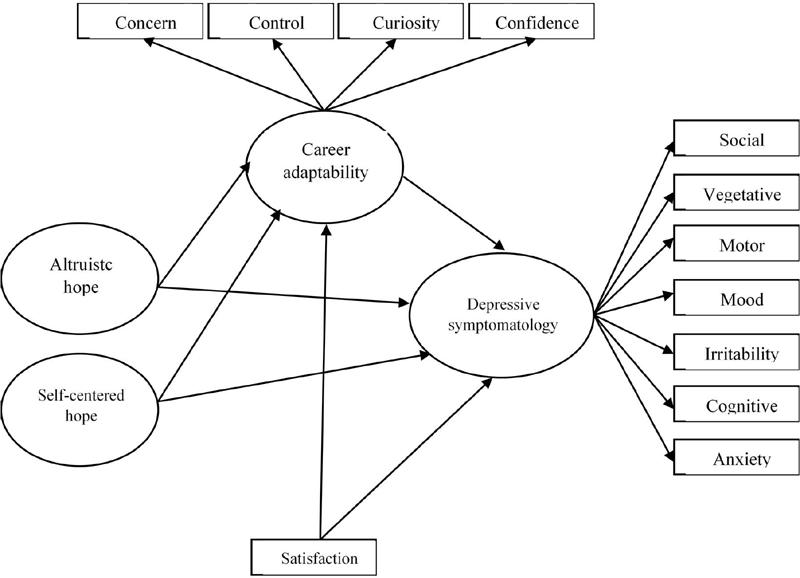
Hypothesis 1: the level of satisfaction in being a graduate student will positively predict career adaptability (Barros et al., 2018) and decrease the development of depressive symptoms (Levecque et al., 2017).
Hypothesis 2: career adaptability will mediate the relationships between self-centered hope to depressive symptomatology, but will not mediate the relationships between altruist hope to depressive symptomatology (Snyder et al., 1991; Staats, 1989).
Hypothesis 3: career adaptability will positively predict hope levels (Santilli et al., 2017) and negatively depressive symptomatology (Peterson & Seligman, 2002).
Method
Participants
A total of 2115 Brazilian Stricto Sensu postgraduate students, aged between 21 and 62 years (M = 28.91; SD = 5.17) participated in this study, of which 74.4% (n = 1573) were females. Participants were enrolled in an academic master's degree (n = 1096, 51.8%) and a doctorate (n = 1019, 48.2%), dividing those who were in the initial phase of the research - studying subjects and elaborating the research project n = 638, 30.2%), intermediate - qualified and in data collection (n = 720, 34%) and final - in data analysis and thesis defense (n = 757, 35.8%). In relation to the area of knowledge, students of Human Sciences (n = 466, 22%) and Biological Sciences (n = 356, 16.8%) predominated.
Most of the sample came from federal public universities (n = 1225, 57.9%), followed by state public institutions (n = 644, 30.4%) and private universities (n = 246, 11.6%). Of the total number of respondents, 73.9% (n = 1564) claimed to be fellows and the majority received assistance from federal agencies (n = 1357, 64.2%). The minority of the students (n = 756; 35.7%) stated that they had to do other work besides the Graduate Program, of which 415 (51.48%) said that this work was not related to the research topic. In relation to the geopolitical region, the participants were: North (n = 101, 4.8%); Northeast (n = 233; 11%); Central West (n = 139, 6.6%); Southeast (n = 1099; 52%) and South (n = 543, 25.7%).
Instruments
Sociodemographic questionnaire: with open and closed questions for the characterization of the sample related to gender, age, level of education, fellow, the geopolitical region of residence, type of institution, work, and level of satisfaction in post-graduate studies. For this last question, the respondents should score on a scale of 10 points, being 0 very unsatisfied and 10 very satisfied.
Career Adapt-Abilities Scale (CAAS) (Savickas & Porfeli, 2012 adapted version Audibert & Teixeira, 2015). The instrument is composed of 24 items and aims to evaluate competencies related to career development. The scale is answered on a Likert response scale ranging from very little (1) to fully (5) and is divided into four factors (Concern, Control, Curiosity, and Confidence). Regarding the level of reliability, the scale presented Cronbach's alpha ranging from .83 to .89 between the factors and .94 on the full scale in the adaptation study for Brazil.
The Hope Index (Staats, 1989 adapted version by Pacico, Zanon, Bastianello, Reppold, & Hutz, 2013). The purpose of the instrument is to evaluate the interaction between desires and expectations about the future and divides into two dimensions, self-centered hope, and selfless hope. Containing 21 items and answered on two Likert scales ranging from little (0) to much (5), the first evaluating how much the person wants what is proposed in the item and the second when he believes it will happen. The scale obtained Cronbach's alpha coefficient of 0.86 (self-centered hope) and 0.80 (altruistic hope) in the Brazilian study of adaptation.
Baptista Depression Scale - Adult Version (EBADEP-A - Baptista, 2012). It is an instrument for the assessment of clinical and non-clinical depressive symptomatology, composed of 45 items with two opposite sentences (one negative in one side and one positive, on the other side), with a total of 90 sentences. Negative sentences are related to depression symptoms. The instrument is answered on a scale of four points ranging from zero to three, where values closest to zero indicate more resemblance to negative sentences and values closest to three indicate more resemblance to the positive sentence. For interpretation, the score ranges from zero to 135, and the low score indicates low symptomatology. In the standardization study, the instrument presented a reliability index of 0.95 (Cronbach's alpha). EBADEP-A is one-dimensional and consists of items based on social, mood, cognitive, motor, vegetative/symptomatic, irritability, and anxiety symptomatology.
Ethical Procedures
The research protocol was elaborated in the Google Forms platform containing the Informed Consent Term (ICT), Sociodemographic Questionnaire, Career Adaptability Scale, The Hope Index, and Baptista Depression Scale. The data collection occurred online between October and November 2017. The link to the protocol was disclosed in groups and pages of post-graduate students in the online social network Facebook and forwarded to Stricto Sensu programs post-graduate coordinators. Participants should be over 18 years old to access the instruments, be regularly enrolled in a master's or doctoral degree, and agree to the ICT. The mean response time was 15 minutes.
Data Analysis
We performed statistical analyses using the Statistical Package for the Social Sciences (SPSS) software version 21 and Mplus. We used inferential statistics using Student's t-test and analysis of variance to verify possible differences in the averages of the factors of the instruments by the sociodemographic variables, to take a master's or doctorate, to be a fellow and to carry out another work besides the post-graduate level and satisfaction level in being a graduate student. We elaborated on an explanatory model to map the relationships between career adaptability, hope, depressive symptomatology, and satisfaction in being a graduate student. The structural equation model was analyzed using the Path Analysis technique and the Maximum Likelihood (MLR) method in the Mplus software. The fit of the model was verified with the chi-square test (which should not be significant), the adjustment indexes of the Confirmatory Fit Index (CFI) with values equal to or higher than .95; Tucker-Lewis Index (TLI) with values equal to or greater than .95 and Root Mean Square Error of Approximation (RMSEA) values of .08 or less.
Results
Initially, we analyzed the mean differences related to the sociodemographic variables. Regarding the level of the course (masters and doctorates), only for altruistic hope were observed statistically significant differences, and students of masters presented higher means when compared with doctoral students. Table 1 shows the results that obtained statistical significance in the other variables, a fact that occurred only for the depressive symptoms of cognitive origin and mood and for the hope factors. None of the variables tested had any influence on the dimensions of career adaptability.
Table 1 Comparison of Means as a Function of The Variables to be a Fellow and to Carry Out another Work besides the Post-Graduate
| Question | Factor | Variable | M | D.P | t | p |
|---|---|---|---|---|---|---|
| Are you fellow?? | Mood (EBADEP-A) | Yes | 17.28 | 9.26 | 2.025 | 0.04 |
| No | 16.35 | 9.19 | ||||
| Cognitive (EBADEP-A) | Yes | 14.96 | 8.17 | 2.892 | 0.00 | |
| No | 13.78 | 8.25 | ||||
| Altruistic hope (EEC) | Yes | 61.10 | 29.98 | -2.315 | 0.02 | |
| No | 64.58 | 31.05 | ||||
| Do you have any other job besides post-graduate? | Mood (EBADEP-A) | Yes | 16.23 | 9.01 | -3.017 | 0.00 |
| No | 17.49 | 9.35 | ||||
| Cognitive (EBAPED-A) | Yes | 13.90 | 8.14 | -3.123 | 0.00 | |
| No | 15.07 | 8.21 | ||||
| Self-centered hope (EEC) | Yes | 236.5 | 65.17 | 2.493 | 0.01 | |
| No | 228.8 | 68.59 | ||||
| Altruistic hope (EEC) | Yes | 63.71 | 30.53 | 1.931 | 0.05 | |
| No | 61.06 | 30.01 |
Participants who declared to be fellow and who did not carry out any other professional activity besides the post-graduate program had the highest means of depressive symptomatology of cognitive origin or mood. Regarding altruistic hope, the highest means were for post-graduate students who were not fellow and for those who had other work than Postgraduate. About self-centered hope, this was more endorsed by post-graduates who reported to have another occupation than a student. Afterward, comparisons of means were made by Analysis of Variance and Tukey Post-hoc Test as a function of the variable time of the research (initial, intermediate, and final), and the statistically significant results are presented in Table 2.
Table 2 Analysis of Variance and Tukey between research time and instrument factors
| Factor | gl | F | p | Research time | Sub-sets | |
|---|---|---|---|---|---|---|
| 1 | 2 | |||||
| Humor (EBADEP-A) | 2 | 3.620 | 0.02 | Initial | 16.26 | |
| Intermediate | 17.16 | 17.16 | ||||
| Final | 17.58 | |||||
| Cognitive (EBADEP-A) | 2 | 4.044 | 0.01 | Initial | 13.89 | |
| Intermediate | 14.89 | 14.89 | ||||
| Final | 15.06 | |||||
| Motor (EBADEP-A) | 2 | 4.371 | 0.01 | Initial | 3.34 | |
| Intermediate | 3.59 | |||||
| Final | 3.62 | |||||
| Anxiety (EBADEP-A) | 2 | 3.513 | 0.03 | Initial | 0.49 | |
| Final | 0.56 | 0.56 | ||||
| Intermediate | 0.62 | |||||
| General Factor (EBADEP-A) | 2 | 3.184 | 0.04 | Initial | 57.63 | |
| Intermediate | 30.66 | 60.66 | ||||
| Final | 61.26 | |||||
| Altruistic hope (EEC) | 2 | 3.064 | 0.04 | Intermediate | 60.52 | |
| Final | 61.39 | 61.39 | ||||
| Initial | 64.43 | |||||
Concerning depressive symptoms, these were higher for students in the final phase of research in the cognitive, mood, motor components, and general score of EBADEP-A, differentiating them from the students in the initial phase of the research. Only for the anxiety symptoms, the students in the intermediate stage obtained the highest means when compared with the others. When considering the altruistic hope dimension, the inverse occurred in the distribution of the groups, and students in the initial phase obtained the highest mean differing from students in the intermediate stage. Subsequently, we sought to verify differences in scores based on the level of satisfaction in being a graduate student, as presented in Table 3. For this procedure, the participants were divided into three groups according to the following percentiles: low satisfaction (up to 25th percentile - up to 5 points); average satisfaction (Percentile 50 - scores between 6 and 7); and high satisfaction (Percentile 75 and above - scores from 8) (Table 3).
Table 3 Analysis of Variance and Tukey between Level of Satisfaction in being a Post-Graduate Student and Factors of the Instruments
| Factor | gl | F | p | Satisfaction level | Sub-sets | ||
|---|---|---|---|---|---|---|---|
| 1 | 2 | 3 | |||||
| Concern (CAAS) | 2 | 45.952 | 0.00 | Low | 23.60 | ||
| Medium | 24.05 | ||||||
| High | 25.32 | ||||||
| Control (CAAS) | 2 | 130.174 | 0.00 | Low | 20.79 | ||
| Medium | 22.06 | ||||||
| High | 24.18 | ||||||
| Curiosity (CAAS) | 2 | 68.490 | 0.00 | Low | 20.63 | ||
| Medium | 21.76 | ||||||
| High | 23.34 | ||||||
| Confidence (CAAS) | 2 | 71.313 | 0.00 | Low | 22.44 | ||
| Medium | 23.29 | ||||||
| High | 25.04 | ||||||
| Social (EBADEP-A) | 2 | 189.80 | 0.00 | High | 14.77 | ||
| Medium | 19.58 | ||||||
| Low | 23.97 | ||||||
| Mood (EBADEP-A) | 2 | 266.884 | 0.00 | High | 12.73 | ||
| Medium | 17.53 | ||||||
| Low | 22.76 | ||||||
| Cognitive (EBADEP-A) | 2 | 209.980 | 0.00 | High | 11.12 | ||
| Medium | 15.22 | ||||||
| Low | 19.17 | ||||||
| Vegetative (EBADEP-A) | 2 | 119.153 | 0.00 | High | 9.76 | ||
| Medium | 11.56 | ||||||
| Low | 13.98 | ||||||
| Motor (EBADEP-A) | 2 | 116.059 | 0.00 | High | 2.88 | ||
| Medium | 3.66 | ||||||
| Low | 4.32 | ||||||
| Irritability (EBADEP-A) | 2 | 91.696 | 0.00 | High | 2.97 | ||
| Medium | 3.60 | ||||||
| Low | 4.22 | ||||||
| Anxiety (EBADEP-A) | 2 | 15.778 | 0.00 | High | 0.43 | ||
| Medium | 0.60 | ||||||
| Low | 0.70 | ||||||
| General Factor (EBADEP-A) | 2 | 232.564 | 0.00 | High | 47.40 | ||
| Medium | 61.65 | ||||||
| Low | 76.36 | ||||||
| Self-centered hope (EEC) | 2 | 119.580 | 0.00 | Low | 200.57 | ||
| Medium | 232.13 | ||||||
| High | 252.80 | ||||||
| Altruistic hope (EEC) | 2 | 48.794 | 0.00 | Low | 53.17 | ||
| Medium | 61.43 | ||||||
| High | 68.55 | ||||||
The satisfaction in being a graduate student was related to significant differences in the scores of all the factors of the instruments. Regarding the levels of career adaptability, more satisfied students presented higher means in the four factors of the CAAS, differing from those with low levels of satisfaction. About the depressive symptomatology, it was verified that the graduate students with lower levels of satisfaction presented higher scores in all the symptomatologic components of the EBADEP-A, differentiating themselves from the participants with a higher level of satisfaction. Finally, the most satisfied students also presented the highest means in the levels of self-centered and altruistic hope, differing from those with less satisfaction. Thus, we tested the model of structural equations having the variable level of satisfaction as control and career adaptability as mediators of the relationship between hope and depressive symptomatology, and the results are presented in Figure 2.
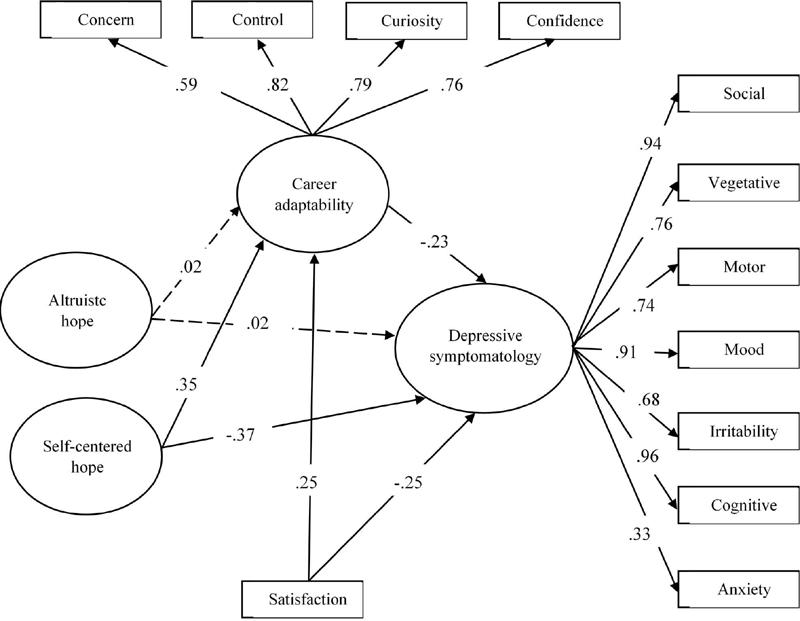
Figure 2 Structural Equations Model for Relationship between Hope. Career Adaptability and Depressive Symptomatology Controlling the Level of Satisfaction in Being a Post-Graduate Student.
The tested model showed impoverished fit indexes, χ2 (69) = 1328.16 (p <.01), RMSEA = .09 (p <.01), CFI = .93, TLI = .91. Modification indexes suggest that the low model fit may be due to residual correlations between the indicators. The model is shown in Figure 1, and the results indicate that the career adaptability and the satisfaction of being a graduate influence the level of depressive symptomatology. Concerning hope, only self-centered hope obtained significant coefficients. The indirect effect between the mediation of career adaptability between self-centered hope and depressive symptomatology is .008. The direct effect obtained a value of .37. In total terms, the explained percentage of mediation in this model is 19%.
Discussion
Considering the impact of post-graduate studies on the mental health of graduate students (Evans et al., 2018; Levecque et al., 2017; Silva & Bardagi, 2015), this study aimed to verify the mediating effect of career adaptability in the development of healthy aspects (hope) and as a protective agent for the development of depressive symptomatology, controlling the level of satisfaction in being a graduate student. Also, we tried to verify possible differences in the means of the instruments depending on the variables being a fellow, Master's degree or doctorate, having a different occupation from the post-graduate level, and the level of satisfaction in being a graduate student.
The level of training (Master's or doctoral degree) had an impact only on the altruistic level of hope, in which the Master's students presented the highest means when compared to the doctoral candidates. This dimension is related to the beliefs in better conditions for the society (Staats, 1989), it can be inferred that the Master’s students have more unrealistic research motivations related to social transformation than the doctoral students. Probably, it happened because when master’s students are in the initial step of researcher training. In this sense, it is important that in the process of training the future researcher there is freedom of creation and incentives to carry out works that effectively contribute to social development, since the level of satisfaction with the post-graduate, specifically in the case of doctoral students, relates with the perception of performing work that has a relevant social impact (Hortale et al., 2014).
When analyzing the level of depressive symptomatology, the students who declared to be fellow and who were exclusively dedicated to the research presented the highest means in the humoral and cognitive symptoms. On the other hand, non-Fellows, who had other work activities besides post-graduation, had the highest averages of hope. These results suggest that exclusive dedication to research may be a reason for the potential development of depressive symptoms. These results may be related to the fact that fellow is subjected to more substantial pressures and collections in terms of productivity and emotional exhaustion (Radons, Cunha, & Veiga, 2017), involving many other activities in addition to the necessary completion activities of credits and research development (Paré, 2017). The problem may be bigger because of the difficulty in reconciling studies with personal life (Faro, 2013), which requires interventions that help students to organize themselves in academic tasks and, at the same time, develop healthy aspects of their personal lives.
The level of depressive symptomatology was also higher for students in the final phase of the Master's or doctorate, and only in the symptoms of anxiety, the highest means were for students in the intermediate stage. Levels of altruistic hope were also higher for participants at the beginning of the course to the detriment of those at the intermediate stage. It is possible to think that the uncertainty regarding the professional future, through the uncertainties and difficulties of insertion in the market after the conclusion of the post-graduation (Faro, 2013), are the reasons why the highest levels of depressive symptomatology emerge in the students in the final phase. Thus, it would be essential to offer career guidance services to build life projects and planning for the future beyond post-graduate, minimizing the negative impacts of the career transition.
The comparison by the level of satisfaction in being a graduate student allowed us to observe differentiation for the participants in all dimensions and factors of the measured constructs. Regarding the level of career adaptability and hope, the highest averages were for students who stated that they were highly satisfied with their role. On the other hand, the levels of depressive symptomatology were higher for the participants who declared lower satisfaction with the graduate program. These results indicate that satisfaction can be understood as a factor that develops career adaptability increases the perception of positive aspects, and acts as a protective agent about the development of depression. Considering that satisfaction with Post-Graduation involves internal and external aspects (Barros et al., 2018), specialized psychological and career counseling services for this population would be necessary to intervene at the individual levels. In addition, concerning external aspects, the need for structural changes in post-graduate programs about training (Silva & Bardagi, 2015) and at the political level for the development of public policies for their insertion and persistence as undergraduate students.
Finally, the analysis of the explanatory model between the constructs gives important indications for the articulation of the phenomena, although with the impoverished parameters. The career adaptability exerted a mediating effect between hope and depressive symptomatology with moderate and negative magnitude coefficients. Thus, as other authors found (Santilli et al., 2017; Santilli et al., 2014), when testing the influence of career adaptability on the levels of hope, develop curiosity, concern, control and confidence in the construction of the professional trajectory also implies fostering the emergence of more positive beliefs about life and career. In the present study, the results suggest that in addition to positive beliefs, career adaptability also acts as a protective factor for the onset of post-graduate depression.
The satisfaction in being a graduate student also has a mediating and controlling effect on the model. This variable tends to increase levels of career adaptability and decrease the degree of depressive symptoms. This fact reinforces the importance of joint actions so that the master’s and doctoral students have adequate conditions to carry out their research and to develop themselves professionally as researchers (Paré, 2017). In addition, self-centered hope, characterized by positive beliefs about the future (Staats, 1989), has a direct impact on career adaptability and, independently of this, can predict the occurrence of depressive symptomatology, thus acting as a protective factor.
The model tested allows us to verify in which aspect intervention is worth to minimize the negative impacts on the mental health of the graduate students in their process of career building. In this sense, interventions can focus directly on the dimensions of career adaptability, since more consciously engaging with work tasks can result in more positive perceptions in life (Santilli et al., 2017) preventing mental illness. In addition, the results indicate that intervening alone in levels of hope may also result in higher levels of career adaptability and protection for the development of depression. The findings are following the notes of Santilli et al. (2014), in which hope was identified as a variable that assists individuals in transitions and vocational traumas, resulting in higher levels of career adaptability, even if work situations cross the work trajectory.
In practical terms, the results of the present study contribute to the understanding of the variables linked to the career development process of Brazilian post-graduate students, a subject that is not discuted on the national scenario (Silva & Bardagi, 2014). Also, it was intended to contribute to the understanding and direction of interventions aimed at minimizing the negative impact of post-graduate studies on the mental health of masters and doctoral students, given the high number of students who are ill at an international level (Evans et al., 2018; Levecque et al., 2017) and national (Faro, 2013). In a broad aspect, the findings suggest that career adaptability plays a preventive role in the development of depressive symptomatology and that a higher level of this ability in the students could facilitate the adjustment and, consequently, greater use of the period in the Graduate Program.
It is necessary to think about the importance of specific actions for students of exclusive dedication (fellow) and in the phase of the conclusion of the masters or doctorate, that in this study presented higher symptoms of the type humor, cognitive, that is, loss of interest and pleasure and presence of hopelessness (Baptista, 2012). At the same time, these groups had lower means of hope and, considering that hopelessness is one of the main factors for the onset of depression (APA, 2015), it is advisable to have listening space for potential reasons for diminishing positive beliefs in life and for career development.
This study does not intend to exhaust the discussions on the subject, since much research has to be done to subsidize interventions with this population. In this way, we suggest that future studies solve gaps of this research, such as lack of balance in areas of knowledge that allow us to verify in which areas there is a greater need for the development of the investigated aspects. It would also be important to carry out qualitative studies to understand the reasons that interfere in the satisfaction of being a graduate student since this variable had a significant influence on the constructs and the model tested. It is also necessary to test alternative models involving career adaptability because this construct is identified as a necessary skill in the current configuration of the world of work (Savickas, 2011).
Even though graduate programs have grown exponentially (CAPES, 2019), allowing for a diverse audience and the development of knowledge that contributes to the technical and scientific progress of the country, it has become an increasingly precarious space with the constant budgetary cuts in recent years. This precariousness, allied to other aspects, can be one of the factors of lower perception of students' satisfaction, resulting in lower positive beliefs regarding the professional future, low levels of career adaptability, and an increase of depressive symptoms. Public investment becomes important in the social recognition of the career of the post-graduates, as well as investments that allow adequate working conditions and intervention actions to cope with the psychological illness in this context.

