




 Inglês (pdf)
 Artigo em XML
 Referências do artigo
 Tradução automática
 Permalink

Introduction
In the modern work context, characterized by improving diversity, technological advances, and organizational structure changes, competencies and career resources are essential for individual development and success (Hirschi & Koen, 2021; Monteiro & Almeida, 2021). The current environment for the professional development of university students and workers exhibits non-linear and unpredictable patterns (Savickas et al., 2009), demanding increased flexibility (Hirschi, 2012; Sullivan et al., 1998), self-management (De Andrade et al., 2022), and adaptability (Savickas, 2012) from individuals.
In the field of career theories, different theories that attempt to explore, evaluate, and understand different aspects of personal career management are treated as self-directed career management (SDCM). According to Hirschi (2012) and Hirschi et al. (2018), an overlap exists among constructs, ideas, psychological scales, and dimensions that appear to generate redundancy between constructs/measures related to the same aspects of management and personal responsibility in individuals' current career development. Other authors in the professional development field have also identified problems and limitations associated with these overlapping theories and constructs (Ng & Feldman, 2014).
Moving toward integrative proposals for selfdirected career management models, the concept of career resources was developed (Hirschi, 2012) and assessed using the Career Resource Questionnaire (CRQ) (Hirschi et al., 2018; Rocha et al., 2021), which evaluates key factors of career success. The CRQ model integrates four superior career resources: Human Capital, Environment, Motivation, and Management Behavior. These superior resources encompass 13 specific dimensions: Occupational expertise, Job market knowledge, Soft skills, Career opportunities, Organizational career, Job challenge, Social career support, Career involvement, Career confidence, Career clarity, Networking, Career exploration, and Continuous learning.
Table 1 displays a brief definition of each resource along with some behavioral examples, following the framework proposed by Hirschi et al. (2018) and Rocha et al. (2021).
Table 1 Career Resources Dimensions
| Dimension | Definition | Examples |
|---|---|---|
| CRHC | Corresponds to occupational expertise and knowledge about the job market | I have profound knowledge about the occupation I aspire to have |
| CRENV | Organizational and social support for career, work, or study challenges | My university/college supports the career I aspire to have |
| CRMOT | Engagement and identification with the career, career confidence, and objectives | My studies are a central part of my identity |
| CRMB | Corresponds to networking, career exploration, and learning aspects | I regularly search for information about career opportunities |
Caption: CRHC (Career Resource of Human Capital), CRENV (Career Resource of Environmental), CRMOT (Career Resource of Motivational), and CRMB (Career Resource of Management Behavior).
Studies utilizing the integrative CRQ model's resource perspectives are still recent. Previous findings demonstrate that resources were important in preparing Swiss teenagers for the job market (Marciniak et al., 2021), involving correlations with occupational self-efficacy (r = 0.59) and engagement with their careers (r = 0.37). For Portuguese university students, career resources were shown to be more characteristic with the advancement of university education and work experiences (Monteiro & Almeida, 2021). In Brazil, hierarchical resource aspects (Career Resource of Human Capital [CRHC], Environmental [CRENV], Motivational [CRMOT], and Management Behavior [CRMB]) reported initial findings with adult university students, pointing to their relationship with career adaptability and psychological capital (Rocha et al., 2021).
Study hypotheses
According to Hirschi (2012), career adaptability (CA), individual career capital, and employability are central constructs in the aspects of career self-management, forming a synthesis of self-directed career management (SDCM) as the integrated career resources model. CA corresponds to hierarchically structured individual career resources, encompassing dimensions of curiosity, control, confidence, and concern to face transitions in the working world (Ambiel, 2014). As for employability, it can be conceptualized as aspects of self-efficacy and the perception of competencies that contribute to one's permanence and growth in the job market (Vanhercke et al., 2014). Psychological capital is described as the psychological capacities to evaluate work-related behaviors with a positive perspective (optimism), believe in oneself (selfefficacy), anticipate positive results (hope), and undergo personal development when facing challenges (resilience) (Matos & De Andrade, 2021).
Considering this, this article aims to examine predictors and mediators of Psychological Capital among university students based on their relationships with Career Resources, Employability, and Career Adaptability. Specifically, the objectives are: a) To identify how Career Resources, and their specific dimensions (CRHC, CRENV, CRMOT, CRMB), explain the relationship between Psychological Capital at Work (PCW) and Employability (EMP); and, b) To identify how Career Adaptability (CA) explains the relationship between Psychological Capital at Work (PCW) and Career Resources, including their specific dimensions (CRHC, CRENV, CRMOT, CRMB).
The sample includes university students enrolled in various educational institutions in Brazil. Research indicates that a common characteristic of Brazilian university students is their youthfulness (Bardagi & Boff, 2010; Instituto Nacional de Estudos e Pesquisas Educacionais Anísio Teixeira [INEP, Anísio Teixeira National Institute for Educational Studies and Research], 2017), and this demographic is particularly susceptible to instability and crises in their context (Santos & Gimenez, 2015). Economic stagnation contributes to the high rate of unemployment among young people. This age group experiences one of the highest unemployment rates and is the most affected by the negative consequences of crises (Santos & Gimenez, 2015). Data from the Instituto Brasileiro de Geografia e Estatística [IBGE, Brazilian Institute of Geography and Statistics] for the third quarter of 2022 (IBGE, 2022) indicated an unemployment rate of 8.7% in Brazil. When considering young people aged from 18 to 24 years, the same rate reached 30.3%, rising to 34.9% for those between 25 to 39 years. Therefore, these rates among the younger population significantly exceed those estimated for the other age groups.
In the literature on careers, various researchers are beginning to focus on the younger population and university students to investigate different phenomena. Examples of recent studies include the investigation of self-efficacy and professional choice intentions (Deemer et al., 2017); career and decision-level exploration (Lent et al., 2016); the association of gender with social support and self-efficacy in navigating obstacles (Fort & Murariu, 2018); perceived support and obstacles in the professional context (Flores et al., 2020); career obstacles, including ethnic and sexual discrimination (Melo et al., 2020); and career adaptability and obstacles associated with university seniors' employability and satisfaction (Melo et al., 2021). Considering the current characteristics affecting careers, such as informal and temporary jobs, high unpredictability, unemployment, underutilization of work, and large-scale layoffs (Perera & Athanasou, 2019), it is relevant to reflect on various aspects of career development and self-management in the context of the university public. Thus, in line with the objectives of this research, four hypotheses are outlined and displayed in Figure 1.
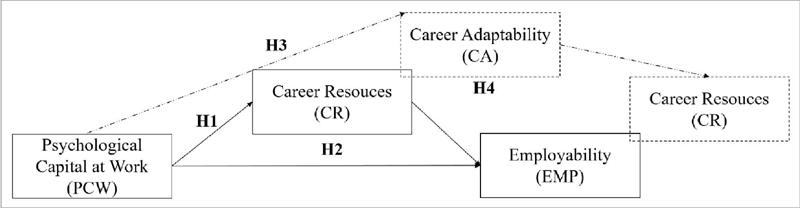
Positive Organizational Behavior (POB) is a concept derived from positive psychology that involves the investigation of measurable attitudes and human strengths in work environments. By considering these positive aspects in the workplace, the promotion of well-being can be possible, thereby improving work performance (Luthans et al., 2006). Psychological capital, known as PsyCap, comprises four dimensions derived from the POB construct: self-efficacy, hope, optimism, and resilience (Martins & Souza, 2014). Previous research associated PsyCap positively with job crafting, job satisfaction, well-being, job performance, and career development (Cenciotti et al., 2017). Therefore, understanding that career resources represent a synthesis of abilities and personal competencies in the professional development process (Hirschi et al., 2018; Hirschi et al., 2019; Rocha et al., 2021), it is expected that Psychological Capital predicts Career Resources (H1).
The acknowledgment of the responsibility for engagement and self-management as a means to integrate and maintain individuals in the workforce has been increasing (Direnzo et al., 2015). Employability represents the objective and subjective characteristics that enhance career engagement and reduce concerns about unemployment (Praskova et al., 2015; Silva & De Andrade, 2019). As for Career Resources, they represent the domains of self-management and adequate strategies to navigate current career scenarios (Hirschi et al., 2019; Rocha et al., 2021). This is applicable to both adults and young people facing transitions in the job market (Monteiro & Almeida, 2021). Consequently, it is posited that career resources mediate the relationship between psychological capital and perceived employability (H2).
Career adaptability is one of the central concepts in contemporary career studies (Hirschi et al., 2015; Melo et al., 2021). The construct refers to an individual's readiness and resources to deal with career development tasks (Brown & Lent, 2016). Adaptability is essential for confronting changes in the working world, being theoretically and operationally composed of the following aspects: a) concern (with the future and the challenges of the career); b) control (self-responsible for building one's career); c) curiosity (making discoveries in search of learning and opportunities); and d) career confidence (belief in one's abilities to learn and overcome professional obstacles). Considering that psychological capital also represents high levels of individual resources to face life (Luthans et al., 2006; Luthans & Youssef-Morgan, 2017), including work transitions (Silva & De Andrade, 2019), it is expected that psychological capital will predict career adaptability (H3).
Lastly, considering adaptability as an individual self-regulation resource for facing the demands of career development (Savickas & Porfeli, 2012) associated with the consequences of career success (Haenggli & Hirschi, 2020; Zacher, 2014), as well as positive life outcomes (Silva & De Andrade, 2019), it is expected that adaptability will mediate the relationship between psychological capital and career resources (H4).
Method
Participants and Data Collection
The participants in this study's sample were recruited and selected using a non-random convenience sampling method based on the following inclusion criteria: a) being 18 years old or older, and b) being enrolled as a student in any university undergraduate course. The total number of participants that validly completed the questionnaires was 433 Brazilian university students, divided in two waves of data collection.
In the first wave, a total of 289 participants were included. The average age was 23.04 years (SD = 5.80). Among these, 56% were men, 58% lived with their parents, and 66% were studying in a public higher education institution. In this group, the most prevalent majors were in the fields of applied humanities/management (administration and business), representing 41.5% of university students.
In the second wave of data collection, 144 participants were included. The average age was 24.50 years (SD = 7.0). Among them, there was a prevalence of women (68%). Most declared that they lived with their parents (N = 95; 66%) and studied in a private education institution (74.3%), with a predominant focus on lawrelated fields (38.2%) and health-related fields (20.8%).
Regarding data collection, this study obtained ethical clearance from the Universidade Federal do Espírito Santo (UFES) - Campus Goiabeiras (Ref: CAAE 15422119.2.0000.5542). The process of recruiting participants began by contacting supervisors of undergraduate courses through email and telephone. Upon receiving authorization from the institution, the researcher visited classrooms to explain the study's objectives to students and invite them to participate. Each participant provided their agreement and signed an informed consent form distributed by the researcher prior to completing the questionnaire. The collected data were manually tabulated using a spreadsheet software.
Instruments
The data were collected using the instruments below.
a) Sociodemographic Questionnaire: Questions about social and demographic profiles, such as age, gender, and the social nature of the higher education institution (public or private) to which they were affiliated at the time of the survey.
b) Student Career Resources Scale (Rocha et al., 2021): An adapted version of CRQ-S for the Brazilian context, divided into four central career resources (Human Capital Resources, ω = 0.82; Contextual Career Resources, ω = 0.79; Motivational Resources, ω = 0.88; and, Career Management Behaviours, ω = 0.89), graded on a 5-point Likert scale (strongly disagree to strongly agree).
c) Psychological Capital Scale (WPCI-12): A 12-item version developed by Martins and Souza (2014) that evaluates personal beliefs in Self-efficacy (e.g., "I am capable of mastering my job's technology"), Optimism (e.g., "I believe that better days will come for my job"), Hope (e.g., "I hope to have enough knowledge to grow at work"), and Resilience (e.g., "I feel stronger after facing losses at work"). Responses were graded on a 5-point Likert scale (Strongly disagree to Strongly agree).
d) Career Adaptabilities Scale (Audibert & Teixeira, 2015): A tool that evaluates four dimensions: Concern (e.g., "I realize that my future depends on the choices I make today"); Control ("Making decisions by myself"); Curiosity (e.g., "Observing different ways of doing things"), and Confidence (e.g., "Performing tasks efficiently"). The items were graded on a 5-point Likert scale (Little or not developed to Extremely well development).
e) Perceived Employability Scale (Silva & De Andrade, 2019): composed of eight items, graded on a 5-point Likert scale (Strongly disagree to Strongly agree), evaluating work abilities that correspond to their area of education and the capacity for insertion in the job market (e.g, "You believe that you detain work abilities that are valued by the job market").
It is worth noting that the data were collected in two waves. In the first wave, the following scales were administered: Student Career Resources Scale, Psychological Capital Scale, and Perceived Employability Scale. In the second wave of data collection, the scales applied were Student Career Resources Scale, Psychological Capital Scale, and Career Adaptabilities Scale. The sociodemographic questionnaire was administered in both waves, with the same set of questions.
Data Analysis
Firstly, data analysis involved checking the fit indices of all scales applied in this research. The JASP software was used for the analyses. Therefore, Confirmatory Factor Analysis (CFA) of the scales was conducted following Brown's (2006) criteria for the following fit indices: normed χ² (χ² / df) ≤ 5.00; Comparative Fit Index (CFI) ≥ 0.95; Tucker-Lewis Index (TLI) ≥ 0.95; Standardized Root-Mean-Square Residual (SRMR) ≤ 0.08; and Root Mean Square Error of Approximation (RMSEA) ≤ 0.06. All CFAs utilized the Weighted Least Squares Mean and Variance Adjusted Diagonally estimator.
For the analysis and verification of the proposed hypotheses, construct scores were computed using the SPSS software. The computed final scores were the mean scores for each analyzed construct, considering overall scores (Psychological Capital at Work, General Career Resource, Employability, Career Adaptability), and scores for each dimension of the Career Resources construct, namely: Career Resource of Human Capital, Career Resource of Environment, Career Resource of Motivation, and Career Resource of Management.
Finally, to test the hypotheses, mediation analyses were conducted through different models - including prediction analyses - following Hayes's (2018) guidelines for testing mediation models. The mediation analysis involved interactional processes of the conceptual models of hypothetical mediation. The Macro PROCESS (version 4.2), an extension of SPSS, was used to analyze the mediation models with different mediators. Following Hayes (2018), Model 4 (simple mediation and parallel mediation) was used as a template for simple mediation, in which the mediating variables were considered as explanatory mechanisms in the relationship between the independent and dependent variable. The number of bootstrap samples for percentile bootstrap confidence intervals was 10,000. Confidence limits were evaluated using Lower Limit (BootLLCI) and Upper Limit (BootULCI; CI 95%). Bootstrap confidence intervals respect non-normality (Hayes, 2018).
Results
Confirmatory and Descriptive Factor Analysis and correlations between variables
Before conducting tests for conditional mediation models, confirmatory factor analysis (CFA) procedures were performed using the WLS method. Additionally, reliability analysis (McDonald's omega) and descriptive analyses (mean and standard deviation) were performed, as well as the establishment of correlations (Pearson's r). The results of these analyses are presented in Table 1.
The results for all models were satisfactory, displaying good adjustment indices considering the internal structures that were tested. The CFA of Career Resources shows that the one-dimension model is appropriate and well adjusted for twelve items; it seems to be a good fit with all indices [χ² (597) = 1019.724, p < 0.001; χ²/df = 1.7; CFI = 0.95; TLI = 0.94; SRMR = 0.046; RMSEA = 0.04]. As for the CFA of the instrument model corresponding to four dimensions, it also demonstrated satisfying results [χ² (659) = 1787.483, p < 0.001; χ²/df = 2.7; CFI = 0.93; TLI = 0.92; SRMR = 0.08; RMSEA = 0.07].
The results from the CFA for the four-factor model, which measures self-efficacy, openness, optimism, happiness, and resilience, exhibited good values for all fit indices [RMSEA = 0.22; SRMR = 0.49; χ²/df 1.18; CFI = 0.93; TLI 0.95]. The CFA results indicated that the one-dimension model demonstrated satisfactory adjustment indices [χ²/df = 2.33; CFI = 0.97; TLI = 0.96; SRMR = 0.87; RMSEA (CI 90%) = 0.69], except for the SRMR < 0.80. Finally, the adaptability model with a general factor showed good adjustment indices [CFI = 0.91; TLI = 0,90; χ²/df = 1.89; SRMR= 0.53]. However, the RMSEA value is higher than desired, which could be attributed to the small sample size, as it can lead to inflationary effects (Kline, 2015). Regarding reliability, the values are considered excellent because they are all above 0.80; the Omega coefficients (ω) range from 0.81 (CR/ Environmental) to 0.92 (CR).
Considering Psychological Capital at Work (PCW), Career Resources (GCR and dimensions), and Employability, all the correlations were significant at the 0.01 level. The correlations of GCR with Employability (r = 0.55, p < 0.01), PCW with GCR (r = 0.54, p < 0.01), and PCW with Employability (r = 0.48, p < 0.01) were relatively strong.
Career Resources as a mediator of the relationship between Psychological Capital at Work (PCW) and Employability (EMP)
Hypotheses H1 and H2 were tested through Models 1 and 2 of mediation, following Hayes's (2018) guidelines. The results indicated that Psychological Capital at Work (PCW) was a predictor of General Career Resources (GCR) and Career Resources by dimensions (Human Capital, Environment, Motivation, and Management Behavior). These results support H1. Additionally, GCR and Career Resources by dimensions were predictors of Employability (EMP).
Table 2 Model Adjustment, Descriptive Statistics, and Measurement Correlations
| Mean | SD | Ω | 1 | 2 | 3 | 4 | 5 | 6 | 7 | 8 | |
|---|---|---|---|---|---|---|---|---|---|---|---|
| 1. PCW | 3.99 | 0.59 | 0.85 | - | |||||||
| 2. CA | 3.85 | 0.80 | 0.96 | 0.49** | - | ||||||
| 3. GCR | 3.45 | 0.55 | 0.92 | 0.54** | 0.54** | - | |||||
| 4. CRHC | 3.22 | 0.69 | 0.82 | 0.36** | 0.31** | 0.67** | - | ||||
| 5. CRENV | 3.36 | 0.71 | 0.81 | 0.26** | 0.26** | 0.63** | 0.16** | - | |||
| 6. CRMOT | 3.67 | 0.74 | 0.88 | 0.50** | 0.57** | 0.83** | 0.43** | 0.39** | - | ||
| 7. CRMB | 3.53 | 0.84 | 0.88 | 0.47** | 0.47** | 0.81** | 0.46** | 0.31** | 0.58** | - | |
| 8. Employability | 3.95 | 0.67 | 0.85 | 0.48** | (n/a) | 0.55** | 0.42** | 0.23** | 0.46** | 0.50** | - |
Source: Research data.
Caption: PCW (Psychological Capital at Work); CA (Career Adaptability); GCR (General Career Resource); Career Resource Dimensions (CRDim); CRHC (Career Resource of Human Capital), CRENV (Career Resource of Environment), CRMOT (Career Resource of Motivation), and CRMB (Career Resource of Management Behavior).
**p < .01.
Note: The correlation between Career Adaptability and Employability are not applicable (n/a) in this study as they were not in the same data collection wave.
In Model 1, the indirect effect of PCW on EMP via GCR was significant and positive (β = 0.26, SE = 0.06, 95% CI [0.14; 0.39]). The direct effect of PCW on EMP was also significant (β = 0.29, SE = 0.07, 95% CI[0.16; 0.42]). This direct effect of PCW on EMP decreased after the insertion of the GCR variable, changing from β = 0.55 to β = 0.29, a variation of Δβ = 0.26. The R² value in EMP increased after the insertion of GCR in the indirect relationship, changing from R² = 22.60% to R² = 34.52%, a variation of ΔR² = 11.92%. These results support H2, where GCR mediates the relationship between PCW and EMP. When evaluating the mediated effect ([1 - Direct Effect/Total Effect]%), it was verified that GCR mediated approximately 47.27% of the relationship between PCW and EMP.
Next, for a higher level of analysis, Model 2 considered parallel mediation for each dimension of General Career Resource (GCR) in its relationship between Psychological Capital at Work (PCW) and Employability (EMP). The indirect effects of PCW on EMP via Career Resource of Human Capital (CRHC) (β = 0.07, SE = 0.03, 95% CI [0.02; 0.13]), Career Resource of Motivation (CRMOT) (β = 0.07, SE = 0.04, 95% CI [0.00; 0.16]), and Career Resource of Management Behavior (CRMB) (β = 0.13, SE = 0.04, 95% CI[0.06; 0.22]) were significant and positive. Similar to Model 1, the direct effect of PCW on EMP remained significant even after the insertion of intervening variables. However, when evaluating the indirect effect through the Career Resource of Environment (CRENV) dimension, it was not significant (β = 0.00, SE = 0.02, 95% CI [-0.03; 0.04]). In summary, these results suggest that the dimensions playing a mediating role in the relationship between PCW and EMP were CRHC, CRMOT, and CRMB. Conversely, CRENV did not have a mediating role in the relationship between PCW and EMP.
The results of Models 1 and 2, related to hypotheses H1 and H2, are shown in Figure 2.

Career Adaptability as a mediator of the relationship between Psychological Capital at Work (PCW) and Career Resources
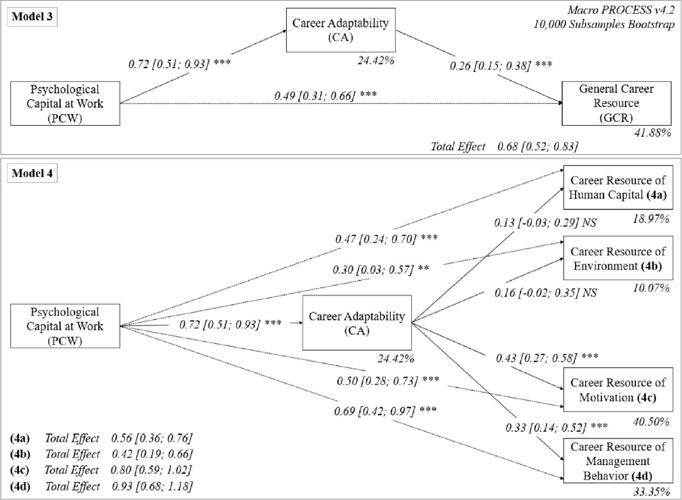
Hypotheses H3 and H4 were tested through Models 3 and 4 of mediation, also following Hayes's guidelines (2018). According to H3, Psychological Capital at Work (PCW) was a predictor of Career Adaptability (CA). In both models, the results indicated that PCW was a predictor of CA, corroborating H3. Additionally, CA predicted General Career Resource (GCR). However, when examining the dimensions in detail, CA only predicted the Motivation and Management Behavior dimensions of Career Resources.
Sequentially, the indirect effects of the models were tested to assess mediations. The indirect effects obtained by the models were tested with 10,000 bootstrap-simulated samples. In Model 3, simple mediation with the response variable GCR was tested. The indirect effect of PCW on GCR via CA was significant and positive (β = 0.19, SE = 0.06, 95% CI [0.09; 0.33]). The direct effect of PCW on GCR was also significant (β = 0.49, SE = 0.09, 95% CI [0.31; 0.66]). This direct effect of PCW on GCR decreased after the insertion of the CA variable, changing from β = 0.68 to β = 0.49, a variation of Δβ = 0.19. The R² value in GCR increased after the insertion of CA in the indirect relationship, changing from R² = 33.59% to R² = 41.88%, a variation of ΔR² = 8.29%. These results support H4, where CA mediates the relationship between PCW and GCR. When evaluating the mediated effect, it was found that CA mediated approximately 27.94% of the relationship between PCW and GCR.
To investigate at a higher level of analysis, Model 4 was tested for each of the Career Resources dimensions. Specific analysis of the simple mediation models was adopted for each dimension, treating them as response variables in these models: Career Resource of Human Capital (CRHC) (4a), Career Resource of Environment (CRENV) (4b), Career Resource of Motivation (CRMOT) (4c), and Career Resource of Management Behavior (CRMB) (4d). The indirect effects of PCW via CA were significant and positive in CRMOT (4c) (β = 0.31, SE = 0.07, IC 95% [0.17; 0.46]) and in CRMB (4d) (β = 0.24, SE = 0.09, 95 % CI [0.09; 0.43]). Considering such models with significant indirect effects, 4c, with the explanatory variable CRMOT, demonstrated the highest effect, approximately 37.50%. For the explanatory variables CRHC (4a) and CRENV (4b), the indirect effects were not significant, and therefore, there was no mediation effect. The results are displayed in Figure 3.
Discussion
This study aimed to examine predictors and mediators of Psychological Capital among university students based on their relationships with Career Resources, Employability, and Career Adaptability. To achieve this, theoretical frameworks from positive organizational psychology (Luthans, 2002) were used, drawing upon the psychological capital construct (Avey et al., 2009; Matos & De Andrade, 2021). In addition to the perspective of career construction (Savickas et al., 2009), the study also adopted the perspective of career adaptability (Savickas & Porfeli, 2012). The general results of the study revealed that psychological capital positively influences career resources and explains employability prospects for university students. Furthermore, the results indicated that psychological capital fosters the development of adaptability resources, while adaptability and psychological capital contribute to the formation of career resources.
The results of the confirmatory factor analysis point to good fit indices for the general structure of the Psychological Capital scale, as well as for career adaptability, career resources (dimensions and general), and employability. These results reinforce the general theoretical nature of the models (Hirschi et al., 2018; Luthans et al., 2006; Rocha et al., 2021; Silva & De Andrade, 2016) for the reality of Brazilian university students, providing empirical support for the study's theoretical hypotheses.
The models that were initially tested demonstrated that the general factor of psychological capital predicted dimensions of career resources, including Human Capital, Environment, Motivation, Management Behavior, General Career Resource, and Employability; supporting H1. Viewed as an individual resource associated with resilience, self-efficacy, optimism, and hope (Matos & De Andrade, 2021), psychological capital plays a facilitative role in the development of individual career behaviors (Hirschi et al., 2018). These traits, in turn, have significant correlations with achieving successful career outcomes. Similarly, in a study involving young Swiss individuals, the psychological capital subcomponent of self-efficacy exhibited a positive relationship with career consequences (Marciniak et al., 2021).
In another study, Deemer et al. (2017) examined the connections between self-efficacy beliefs and the professional choice intentions of university students. The authors determined that the collective perceptions of selfefficacy among students predicted their career intentions. Self-efficacy also significantly influences career decisionmaking (Lent et al., 2016) and how individuals navigate obstacles in the educational sphere (Fort & Murariu, 2018). It is worth highlighting that, being an individual resource, psychological capital can be developed, which is proven to be highly important for students' career construction. This is related to a study done by Flores et al. (2020), where they observed changes in self-efficacy beliefs over time as individuals confront obstacles. In studies on other constructs, Psycap was also positively associated with various constructs of the professional sphere (job crafting, job satisfaction, well-being, job performance, and career development) (Cenciotti et al., 2017), being an important personal resource for work-related performance.
The analysis of the mediation Model demonstrated that Career Resources (CR) have a direct and indirect impact on the employability of university students. Moreover, in the analysis of CR dimensions as mediators in the relationship, the indirect effects were positive and significant for Human Capital (i.e., abilities and competencies), Motivational (i.e., career confidence), and Career Management (i.e., networking) behaviors. Among the significant indirect effects, the greatest was observed in the dimension of management behavior, encompassing behaviors that promote career management, such as exploration, curiosity, and learning (Rocha et al., 2021). The indirect effect was only not significant in the dimension of contextual resources, partially corroborating with H2. In summary, both individual psychological resources (PCW) and career resources contribute to individuals' engagement in actions that enhance employability.
As emphasized by Lo Presti and Pluviano (2016), employability has become a pressing concept that is highly relevant for employees, employers, scholars, policy-makers and, more broadly, for every individual in the working world. Ladeira et al. (2019) argue that work stability has been replaced by the perception of employability. Additionally, previous studies also emphasize the importance of cultivating employability, such as Melo et al. (2021), in which the authors highlight the positive impact of perception of employability on individuals' career satisfaction.
Research involving Brazilian university psychology students reveals that engagement in market exploration resources, such as job searching and gathering professional information, is associated with career self-management (De Andrade et al., 2016). Similarly, a study involving young Portuguese individuals indicates that individual traces of resilience, self-efficacy, hope, and optimism are important for facing occupational transitions (Monteiro & Almeida, 2021). Furthermore, career adaptability, emcompassing concern, control, curiosity, and confidence abilities (Savickas, 2012), has been identified as a predictor of employability in a recent study involving Brazilian university students (Melo et al., 2021).
In addition, our findings suggest that psychological capital can operate as a predictor of career adaptability, corroborating with H3. Given that adaptability is an important resource in navigating career transitions (De Andrade et al., 2022; Melo et al., 2021), its characteristics are enhanced by aspects of psychological capital. Moreover, a study involving university students in the applied humanities field (Melo et al., 2021) indicates that career adaptability significantly predicts employability and career satisfaction. In other words, this suggests that the development of concern, control, curiosity, and confidence abilities assists individuals in achieving positive work outcomes, consequently enhancing their satisfaction with career development.
In the case of Brazilian university students, research has demonstrated that psychological capital, in its hierarchical structure, stimulates aspects of career success and adaptability (Silva & De Andrade, 2019). The importance of psychological capital for personal and professional development has grown, gaining prominence in the scientific field (Avey et al., 2009). This personal resource, when combined with career resources associated with concern, control, confidence, and curiosity, helps individuals to navigate contemporary occupational processes.
Lastly, our study also establishes that PCW positively impacts career resources, whether directly or indirectly, through CA as a mediator. Upon scrutinizing the CR dimensions, it was observed that the indirect effect through CA is only significant for the Motivational and Management Behaviors dimensions, partially corroborating H4. Among these, the most pronounced indirect effect is observed in the motivation dimension, encompassing crucial factors for career development such as engagement, confidence building, and clarity in one's career trajectory (Rocha et al., 2021).
In other words, contextual resources (i.e., organizational support, work challenges, and social support) were not significant. Students with higher psychological capital and a richer set of career transition resources experience career resources related to motivation and career management, involving behaviors like clarity, confidence, and exploration of the job market (Hirschi et al., 2018; Rocha et al., 2021). While this does not actively support the two models, these elements can potentially foster employability as well as other subsequent aspects in the professional (e.g., rotation, work well-being, performance, etc.) and health (e.g., stress, burnout, etc.) spheres.
Final considerations
It is widely recognized that education and employability warrant attention, given the substantial individual and public investments demanded by higher education (Mason et al., 2013). The expectation is that universities can equip their students with the necessary skills. Aligned with this objective, this study explored how individual aspects acquired through the socialization processes, as well as career adaptability resources, might favor shifts in employability perspectives. Moreover, specific career resources were also investigated, for example: the search for job opportunities, the development of networking skills to improve adaptation in contemporary career scenarios, and occupational uncertainties that future university students will encounter.
The objective of this research was to examine predictors and mediators of Psychological Capital among university students based on their relationships with Career Resources, Employability, and Career Adaptability. The results demonstrated that career resources mediate the relationship between psychological capital at work and employability. While evaluating career resources based on their dimensions (Rocha et al., 2021), it was found that the dimensions of human capital, motivation, and management behavior acted as mediators in this relationship. Furthermore, it was observed that career adaptability plays a mediating role in the relationship between psychological capital at work and career resources. Again, assessing career resources by their dimensions (Rocha et al., 2021), the mediation of career adaptability only functions when the dimensions of motivation and management behavior are the dependent variables, with psychological capital at work as the independent variable.
The overlap of constructs and psychological scales in the career guidance field has been previously investigated (Hirschi, 2012; Hirschi et al., 2018; Ng & Feldman, 2014). The results of the correlation matrix between different constructs - employability (Silva & De Andrade, 2019), career resources (Rocha et al., 2021), career adaptability (De Andrade et al., 2022), and psychological capital (Martins & Souza, 2014) reveal moderating correlations between the central constructs of this study. While these results are inconclusive, they demonstrate that these variables are not necessarily overlapping, but have elements perceived as similar in cause or substance by those that filled in the scale items. This represents a possible limitation of this study, yet it is also an observation worth highlighting. Additionally, the sampling method should be acknowledged as a limitation of this research since it relied on a convenience sample with limited representation of a more diverse university audience. In this way, to gain a deeper understanding of the constructs' specificities, future research should consider performing an analysis of the constructs and their operational definitions (items). Moreover, there should be an emphasis on promoting studies and research with conditional design models, as discussed by Hayes (2018).

